
The design and implementation of a congestion control plane
Texte intégral
Figure
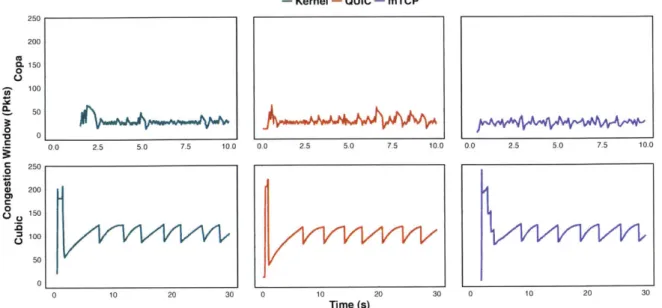
![Figure 1-1: As link characteristics diversify, developers have developed a battery of conges- conges-tion control algorithms, from the "long-fat pipe" schemes of the mid-2000s [10,22, 31, 34]](https://thumb-eu.123doks.com/thumbv2/123doknet/14679733.558960/14.917.147.794.118.299/figure-characteristics-diversify-developers-developed-battery-control-algorithms.webp)



Documents relatifs
Depending on the current network state coupled with thresholds on data transaction losses, RTT-CoAP updates the sending rate of each CoAP source to stabilise network delays and
At time 18 the lost packet is acked, the source exits the fast recovery mode and enters congestion avoidance.. The congestion window is set to the
In a more complex network setting, does AIMD distribute rates according to max‐min. fairness or
Reducing the number of messages sent to φ would increase revenues to φπ (φ) − φγ for the twin reasons that total sent is lower and π (.) is decreasing (so the demand price at
A basic consequence is that feedback control laws which involve congestion avoidance are given by a continuous selection procedure of the regulation map.. It is of interest to
و ﻰﻟإ ﺮﻜﺸﻟا ﻞﻳﺰﺠﺑ مﺪﻘﺗأ نأ ﻲﻨﺗﻮﻔﻳ ﻻ ﺎﻤﻛ ﻞﻛ ﻷا ﻢﻫ ﻦﻳﺬﻟاو ﻢﻬﺘﻓﺮﻌﻤﺑ ﺎﻧوﺮﺛأ ﻦﻳﺬﻟا ماﺮﻜﻟا ةﺬﺗﺎﺳ ﻲﻧﻮﻤﻠﻋ ﻦﻳﺬﻟاو ﻢﻬﻌﺿاﻮﺘﺑ رﺎﺒﻛو ﻢﻬﺘﻋﺎﻨﻘﺑ
The bad worst-case conges- tion of bit-fixing can not be overcome without the use of randomization or adaptive routing; Kaklamanis, Krizanc, and Tsantilas [8] have
QUIC’s pluggable congestion control interface provides Hybrid Slow Start as a module to incorporate into TCP based algorithms; the evaluation of Hybrid Slow Start in CCP QUIC
