Publisher’s version / Version de l'éditeur:
Vous avez des questions? Nous pouvons vous aider. Pour communiquer directement avec un auteur, consultez la première page de la revue dans laquelle son article a été publié afin de trouver ses coordonnées. Si vous n’arrivez pas à les repérer, communiquez avec nous à [email protected].
Questions? Contact the NRC Publications Archive team at
[email protected]. If you wish to email the authors directly, please see the first page of the publication for their contact information.
https://publications-cnrc.canada.ca/fra/droits
L’accès à ce site Web et l’utilisation de son contenu sont assujettis aux conditions présentées dans le site LISEZ CES CONDITIONS ATTENTIVEMENT AVANT D’UTILISER CE SITE WEB.
Building Research Note, 1980-06
READ THESE TERMS AND CONDITIONS CAREFULLY BEFORE USING THIS WEBSITE. https://nrc-publications.canada.ca/eng/copyright
NRC Publications Archive Record / Notice des Archives des publications du CNRC :
https://nrc-publications.canada.ca/eng/view/object/?id=1856e4bb-5a91-4a0b-8589-0115fe305032 https://publications-cnrc.canada.ca/fra/voir/objet/?id=1856e4bb-5a91-4a0b-8589-0115fe305032
NRC Publications Archive
Archives des publications du CNRC
This publication could be one of several versions: author’s original, accepted manuscript or the publisher’s version. / La version de cette publication peut être l’une des suivantes : la version prépublication de l’auteur, la version acceptée du manuscrit ou la version de l’éditeur.
For the publisher’s version, please access the DOI link below./ Pour consulter la version de l’éditeur, utilisez le lien DOI ci-dessous.
https://doi.org/10.4224/40000552
Access and use of this website and the material on it are subject to the Terms and Conditions set forth at
Reverberant noise control in rooms using sound absorbing materials
Warnock, A. C. C.
ISSN 0701-5232
REVERBERANT
NOISE
CONTROL I N ROOMS USING SOUND ARSORBPNG MATERIALSby
A,C.C. lzIamock
For a given noise source t h e behaviour of t h e sound i t e m i t s and t h e
n o i s e levels it produces w i t h i n a room are largely determined by t h e sound absorbing properties of t h e materials in t h e room. The problem of noise
t r a n s m i t t e d to adjacent rooms is determined by the sound insulating
p r o p e r t i e s o f the w a l l s and is not dealt with in t h i s Note. F o r many Tooms
where t h e exact behaviour of the sound need n o t be examined as critically as, for example, in
a
l e c t ~ i r e theatre o r a concert h a l l , sound absorbingmaterials a r e used mainly t o reduce reverberant noise l e v e l s . This Note provides some information t o aid in t h e d e s i g n of such rooms.
DESCRIPTION OF TERMS
Same of t h e more common terms used i n this area of acoustics follow.
The
sound absorption c o e f f i c i e n t for a material i s the fraction or percentage a f i n c i d e n t sound energy that is absorbed by t h e m a t e r i a l . The absorption coefficient depends on t h e sound frequency and values are u s u a l l y p r o v i d e d in t h e literature at t h e standard frequencies of 1 2 5 , 250, 500, 1000, 2000 and 4000 Hertz. The n o i s e r e d u c t i o n c o e f f i c i e n t(NRC]
is t h eaverage of t h e values from 258 t o 2000 Hz, inclusive, rounded to the nearest
0.05. Absorptian coefficients are sometimes expressed a s percentages.
The sound absorption f o r a sample of material o r an object i s measured
in sabins or metr2c s a b i n s . One ~ a b i n may be t h o u g h t o f as t h e absorption of
unit area (1 rn2 or I ft2) o f a s u r f a c e that h a s an absorption coefficient of
1.0 (1 00 per cent)
.
I%en areas are measured in square metres, the termmetric s a b i n i s used. The absorption for a s u r f a c e can be found by multiply- i n g i t s area by i t s absorption coefficient. Thus f o r a material with an
absorption c o e f f i c i e n t of 0.5, 10 s q ft has a sound absorption of 5 sabins and 100
m2
is 50 metric s a b i n s .The t o t a l absorption i n a room can be estimated by multiplying t h e area
of each surface by an estimated absorption coefficient f o r t h a t surface and then adding together the contributions from each surface.
l a e n a source of sound in a 'live' room is turned o f f , a noticeable t i m e
elapses before the noise becomes inaudible. The l e s s sound absorbing material
there is in a room t h e longer t h e sound takes to d i e away. The reverberation
time i s d e f i n e d as t h e time in seconds r e q u i r e d for d e c a y i n g sound to decrease in l e v e l by 60 decibels (dB]. Since the sound absorption in t h e room depends
on t h e frequency of the sounds being considered, so a l s o does t h e reverberation t i m e
.
REVERBERATION
IN ROOMSHard surfaces such a s g l a s s , concrete, brick, wood and plaster r e f l e c t
almost aXL of t h e sound incident on them. In c o n t r a s t with t h i s , soft porous materials such as glass or mineral wool, s o f t fabrics, clothing, people, and
even the a i r , will absorb sound.
In an extremely "Tivet or reverberant room where t h e surfaces are a l l good sound reflectors, noise can build up to produce unpleasantly high sound levels and the sound field is constant i n l e v e l far all distances greater than
a few metres from the source. The reverberation times in such rooms can be
from 5 to 10 seconds long
o r
more making speech a t distancesof
more thana
f e w metres difficult to understand.
In a reverberant room the two quantities, absorption and reverberation time, T, in seconds, can be related by the equations
V is t h e volume of t h e
room
in cubic metres and A is the total absorption in it in metric sabins (square metres) in t h e frequency band being considered.In an extremely absorptive environment the sound l e v e l decreases by 6 dB each time the distance from a small source is doubled. There are no
reflections, no reverberation and a l l sound comes d i r e c t l y from t h e source.
This
i s
knownas f r e e f i e l d
behaviour.Tn typical rooms the behaviour o f the sound f i e l d can be described
approximately wixh reference to a critical distance D. Within t h e c r i t i c a l
d i s t a n c e the sound f i e l d behaves as in t h e f r e e field case just described, as i f t h e r e were no reflecting surfaces. This region is called t h e
n e a r
field.Beyond t h e critical distance, in t h e region called t h e reverberant f i e l d ,
the sound pressure l e v e l remains constant. The critical d i s t a n c e is g i v e n
approximately by
D = metres 1( 2
3
where A is the total absorption in the room in metric sabins.
REDUCTION OF REVERBERANT SOUNP LEVEL
Wen absorptfve material is added to a noisy room, the reduction of sound pressure l e v e l in the reverberant f i e l d can be predicted from t h e equation
Absorption a f t e r addition
Noise r e d u c t i o n (dB) = 1 0 l a g
Absorption b e f o r e addition
For example, doubling t h e amount sf absorption in a room will seduce the
revcrbcrant sound level by 3 dB. To o b t a i n a f u r t h e r 3 dB improvcmcnt the amount o f absorption must be doubled once again, i - e . , four rimes more than
originally existed in the room.
I t is important to remember that E q . (3) o n l y applies in t h e r e v e r b e r a n t field. Increasing the a b s o r p t i o n in a room will reduce noise levels from a
machine o n l y f o r those employees beyond t h e critical distance. The operator
o r t h o s e c l o s e to t h e machine will be exposed to sound coming d i r e c t l y from
it and additional absorptive material will not change t h e sound l e v e l s . "
Equation (23 s h o u l d be used to estimate where t h e r e v e r b e r a n t f i e l d b e g i n s .
TYPES OF ABSORBING FlATERIAZS
The absorption coefficients o f t h e many types o f sound a b s o r b i n g
materials available a r e i n f l u e n c e d by a number o f f a c t o r s . Tn general t h e
g r e a t e r The porosity of a given volume of material, t h e greater i t s sound
absorbing capability. Thus g l a s s wool is more a b s o r b e n t than wood c h i p s and nonporous polystyrene foam is a very poor sound absorber. For s h e e t
materials t h e absorption coefficients v a r y with mounting technique, e.g., ( i )
increasing t h e thickness increases t h e absorption a t a l l f r e q u e n c i e s unless
t h e absorption c o c f f i c i c n t i s already close to 1.0; ( i i ) i n c r e a s i n g t h c a i r
gap between the s h e e t and a s o l i d backing surface Increases t h e absorption at t h e low frequencies; ( i i i ) covering the sound absorbin? material with a v e r y lightweight sheet of plastic or a p r o t e c t i v e l a y e r more t h a n
In
p e r c e n t openreduces the a b s o r p t i o n coefficients slightly at the higher frequencies o n l y .
A b s o r p t i v e materials are a f t e n a p p l i e d in patches o r s t r i p s o f material
o r suspended as r e c t a n g u l a r panels o r o t h e r forms. These suspended shapes a r e known as u n i t absorbers. 1 t . k q u i t e common f o r materials t e s t e d i n a
laboratory r e v e r b e r a t i o n chamber a s a small sample o r callcction of small
samples to e x h i b i t absorption coefficients g r e a t e r than 1 . 0 . This i s a reaI
e f f e c t caused b y diffraction. Tn such cases t h e measured absorption c o c f f i c i c n t s a r e very strongly influenced by t h e s i z e of the patches or
snrnplcs nnd thc s p a c i n g between them. T e s t r e p o r t s , u s u a l l y available from
n ~ a n t l f a c t u r c r s , s l ~ o t ~ l d "n econsulted so determine t h e appropriate c o e f f i c i e n t s For nny prnposed i n s t n 1 1 a t i on.
* A n c x c c ~ r t i n n t n this o c c u r s when t h e noisy machine and its o p e r a t o r a r c situntrcG c l o s e to walls or other r e f l e c t i n g s u r f a c e s . Here t h e u s e of s o ~ ~ n d n l ) s o r h i n c m:~tcrial c o r r e c t l y p l a c e d on t h e s e s u r f a c e s can p r o v i d e some noise r e d r l c t i o n .
Many common materials, drapes, carpets and f u r n i t u r e a l s o allsorb sound
to varying degrees. Table 1 illustrates same o f t h e foregoing p o i n t s with representative values of a b s o r p t i o n coefficients for a variety of materials.
UfQUNT OF ABSORPTIlrE MATERIAL REOUIRED
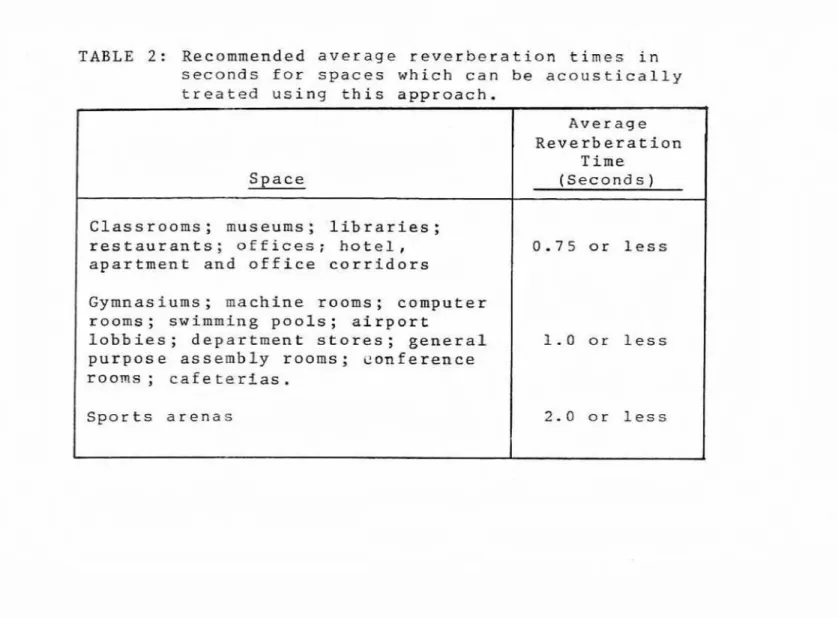
The t y p e s o f rooms t h a t can be treated using these equations as a basis f o r calculation a r e l i s t e d i n T a b l e 2 t o g e t h e r with recommended a v e r a g e
reverberation times. These t i m e s a r e meant as a guide and need not be a c h i e v e d e x a c t l y .
Thc acoustical treatment of t h e types o f rooms l i s t e d is q u i t e straightforward. From t h e recommended reverberation time and t h e room
volume, the r e q u i r e d absorption in sabins is c a l c u l a t e d using E q . [ l b ) . The
a p p r o p r i a t e c h a i c e o f t y p e and location o f material is t h e n m a d e considering thermal, mechanical and o t h e r physical requirements such a s condensation control. The area o f each material is m u l t i p l i e d by its noise reduction coefficient value to o b t a i n i t s contribution to t h e t o t a l absorption; t h e
total i s compared with the d e s i g n requirement and any necessary adjustments made. The reverberation time s h o u l d t h e n be calculated f o r each frequency band using t h e appropriate absorption coefficients to e n s u r e reasonable agreement with t h e recommended average v a l u e . Tt is q u i t e u s u a l f o r t h e reverberation time a t the lower f r e q u e n c i e s t o be as much a s twice as long
as those at t h e m i d d l e frequencies. I F t h e variations w i t h frequency a r e
excessive, change of materials or methods of mounting may be necessary.
I n many o f t h e rooms l i s t e d i n T a b l e 2 it will be q u i t e adequatc to
install a good q u a l i t y acoustical ceiling, a c a r p e t o r t h e equivalent. This is the case, for example, in h o t e l or apartment corridors. l n small offices
and dvelIing rooms, t h e normal furnishings and occupants themselves usually
provide enough a b s o r p t i o n . Tn general, however, f o r b e s t performance
acoustical materials should be distributed over as many a € the room surfaces as possible. An example of poor application would be an acoustical ceiling
i n a v e r y h i g h room w i t h v e r y little o t h e r absorptive material present. Sound would t h e n be q u i t e free to circulate in t h e h o r i z o n t a l p l a n e and t h e
room ~ o u l d be mare l i v e than calculation would suggest.
Tn a few of thc cases listed in Table 2 , particularly where speech
intelligibility i s important, it is necessary t o cxcscise some c a r e i n the pas it ion in^ o f the sound n b s o r b i n ~ m a t e r i a l . For examplc, in conference
rooms t h e cciling immediately above the t a b l e should h e hard and sound
reflecting. Tfic sound absorbing materials should be restricted to t h e f l o o r ,
walls and ceiling perimeter. Similarly, in a classroom where t h e t e a c h e r
a d d r e s s e s t h c students from one end of t h e room, it i s good practice to make t h e ccntra portion o f t h e ceiling sound r e f l e c t i n g to provide useful voice rcflcctions. Tn sticlr cases it is probably advisable to o b t a i n professional h c l p or e l s e c o n s t ~ l t a good t e x t b o o k .
1r
i s i m p o r t a n t during t h e d e s i g n phase to i n c l u d e t h e absorrtive properties of t h e normal c o n t e n t s of the space, i . e . , people, merchandise,essential furnishings and sometimes a i r . This would be i m p o r t a n t i n n s p o r t s arena, for example. I n a department store t h e absorption p r o v i d e d by t h e
merchandise will v a r y widely from place to p l a c e , but ns a rough g u i d e t h c absorption v a l u e s for a typical carpet may be assumed.
Example: Determine t h e necessary a c o u s t i c a l t r e a t m e n t for a $>mnasiurn with
a volume of 2720 rn3 and a ceiling area of 340 m2.
From T a b l c 2 t h e recommended reverberation time i s 1 second and from
E q . ( l b ) t h e r e q u i r e d absorption is 433 metric s a b i n s . The sound absorbing
material c a n be applied on b o t h ceiling and w a l l s and should be a b l e t o
withstand a c e r t a i n amount of impact. S l o t t e d sound
absorb in^
c o n c r c t c blocks arc extremely useful in gymnasiums, swimming p o o l s , machine shops andsimilar places s i n c e they can fulfill structural requirements as well a s providing sound a b s o r p t i o n . The NRC for t h e s e blocks is given in TabIe 2 a s
0 . 6 .
Suppose, i n this case, a spray-on cellulose f i b r e is t o be a p p l i e d
directly t o a r i g i d ceiling [ T a b l e 2 , NRC = 0 . 5 5 ) . The resulting ceiling will contribute 183 m sabins. This l e a v e s 251 m s a b i n s to b e p r o v i d e d by the slotted sound absorbing b l o c k s , i .e., an area o f 4 1 8 m2. The c a l c u l a t e d r e v e r b e r a t i o n time at 1 2 5 Hz is 1 . 4 seconds and at 40130 H z it wotlld fall to 0.93 s e c . This is q u i t e a c c e p t a b l e . [The contribution of t h e sir i s n o t important i n t h i s c a s e . )
CONCLUSION
T h i s mcthod of n p ~ r o a c h h a s d e f i n i t e limitations, but it may be applied
without s e r i o u s e r r o r to the types of rooms l i s t e d h e r e . The d e s i g n o f
special purpose rooms such as auditoriums, t h e a t r e s , recording studios and so on i s b e s t l e f t i n qualified hands.
T A B L E 1: R e p r e s e n t a t i v e v a l u e s of a b s o r p t i o n c o e f f i c i e n t s f o r s o m e c o m m o n a c o u s t i c a l m a t e r i a l s G l a s s f i b r e on hard s u r f a c e (i) 2 5 m m (1") t h i c k (ii) 5 0 m m ( 2 " ) r h i c k ( F i t ) 7 5 m m ( 3 " ) t h i c k I (iv) 100 mrn ( 4 " ) t h i c k G l a s s E i b r e , 5 0 m m ( 2 " ) t h i c k , 2 5 m m (1'9 a i r s p a c e b e h i n d 2 5 m m (1") t h i c k o n 400 rnm I 2 5 m m
(I")
g l a s s E i b r e c o v e r e d b y 5 Z o p e n p e r f o r a t e d l a y e r ' 2 5 mm (1") g l a s s E i b r e c o v e r e d1
b y 10% o p e n p e r f o r a t e d l a y e r Wood w o o l b o a r d s 2 5 m m (1")I
t h i c k/
(i) n o a i r s p a c e/
(ii) 2 5 m m (I") a i r s p a c e (iii) 400 m m (16") air s p a c e M i n e r a l f i b r e c e i l i n g t i l e s (i) n o a i r s p a c e Eii) 400 m m (16") a i r s p a c ej
F r e e h a n g i n g g l a s s f f b r e a b s o r b i n g u n i t s II
S p r a y e d - o n f i b r e 1 5 m m ( 5 / 8 " ) t h i c k a n s o l i d s u r f a c e G l a s s f i b r e f i l l e d s l o t t e d s o u n d a b s o r b i n g c o n c r e t e b l o c k s T y p i c a l c a r p e t Lightweight d r a p e s Heavy w e i g h t d r a p e s A u d l e n c e in u p h o l s t e r e d s e a t s p e r u n i t f l o o r a r e a A i r a b s o r p t i o nTABLE 2 : R e c o m m e n d e d a v e r a g e r e v e r b e r a t i o n t i m e s i n s e c o n d s f o r s p a c e s w h i c h c a n be a c o u s t i c a l l y t r e a t e d u s i n g t h i s a p p r o a c h . S p a c e A v e r a g e R e v e r b e r a t i o n T i m e ( S e c o n d s ) t C l a s s r o o m s ; m u s e u m s ; l i b r a r i e s ; r e s t a u r a n t s ; o f f i c e s ; h o t e l , a p a r t m e n t and o f f i c e c o r r i d o r s G y m n a s i u m s ; m a c h i n e r o o m s ; c o m p u t e r r o o m s ; s w i m m i n g p o o l s ; a i r p o r t l o b b i e s ; d e p a r t m e n t s t o r e s ; g e n e r a l p u r p o s e a s s e m b l y r o o m s ; c o n f e r e n c e r o o m s ; c a f e t e r i a s . S p o r t s a r e n a s 11.75 or l e s s 1 - 0 or l e s s 2 . 0 or l e s s C