arXiv:0808.0703v3 [hep-ex] 23 Oct 2008
Observation of ZZ production in p¯
p collisions at
√
s =1.96 TeV
V.M. Abazov36, B. Abbott75, M. Abolins65, B.S. Acharya29, M. Adams51, T. Adams49, E. Aguilo6, M. Ahsan59,
G.D. Alexeev36
, G. Alkhazov40
, A. Alton64,a, G. Alverson63
, G.A. Alves2
, M. Anastasoaie35
, L.S. Ancu35
, T. Andeen53, B. Andrieu17, M.S. Anzelc53, M. Aoki50, Y. Arnoud14, M. Arov60, M. Arthaud18, A. Askew49,
B. ˚Asman41
, A.C.S. Assis Jesus3
, O. Atramentov49 , C. Avila8 , F. Badaud13 , L. Bagby50 , B. Baldin50 , D.V. Bandurin59, P. Banerjee29, S. Banerjee29, E. Barberis63, A.-F. Barfuss15, P. Bargassa80, P. Baringer58,
J. Barreto2, J.F. Bartlett50, U. Bassler18, D. Bauer43, S. Beale6, A. Bean58, M. Begalli3, M. Begel73,
C. Belanger-Champagne41, L. Bellantoni50, A. Bellavance50, J.A. Benitez65, S.B. Beri27, G. Bernardi17,
R. Bernhard23, I. Bertram42, M. Besan¸con18, R. Beuselinck43, V.A. Bezzubov39, P.C. Bhat50, V. Bhatnagar27,
C. Biscarat20, G. Blazey52, F. Blekman43, S. Blessing49, K. Bloom67, A. Boehnlein50, D. Boline62, T.A. Bolton59,
E.E. Boos38, G. Borissov42, T. Bose77, A. Brandt78, R. Brock65, G. Brooijmans70, A. Bross50, D. Brown81,
X.B. Bu7 , N.J. Buchanan49 , D. Buchholz53 , M. Buehler81 , V. Buescher22 , V. Bunichev38 , S. Burdin42,b,
T.H. Burnett82, C.P. Buszello43, J.M. Butler62, P. Calfayan25, S. Calvet16, J. Cammin71, E. Carrera49,
W. Carvalho3 , B.C.K. Casey50 , H. Castilla-Valdez33 , G. Cerminara63,c, S. Chakrabarti18 , D. Chakraborty52 , K.M. Chan55, A. Chandra48, E. Cheu45, F. Chevallier14, D.K. Cho62, S. Choi32, B. Choudhary28, L. Christofek77,
T. Christoudias43, S. Cihangir50, D. Claes67, J. Clutter58, M. Cooke50, W.E. Cooper50, M. Corcoran80,
F. Couderc18 , M.-C. Cousinou15 , S. Cr´ep´e-Renaudin14 , V. Cuplov59 , D. Cutts77 , M. ´Cwiok30 , H. da Motta2 , A. Das45, G. Davies43, K. De78, S.J. de Jong35, E. De La Cruz-Burelo33, C. De Oliveira Martins3, K. DeVaughan67,
J.D. Degenhardt64 , F. D´eliot18 , M. Demarteau50 , R. Demina71 , D. Denisov50 , S.P. Denisov39 , S. Desai50 , H.T. Diehl50, M. Diesburg50, A. Dominguez67, H. Dong72, T. Dorland82, A. Dubey28, L.V. Dudko38, L. Duflot16,
S.R. Dugad29, D. Duggan49, A. Duperrin15, J. Dyer65, A. Dyshkant52, M. Eads67, D. Edmunds65, J. Ellison48,
V.D. Elvira50, Y. Enari77, S. Eno61, P. Ermolov38,‡, H. Evans54, A. Evdokimov73, V.N. Evdokimov39, G. Facini63,
A.V. Ferapontov59, T. Ferbel71, F. Fiedler24, F. Filthaut35, W. Fisher50, H.E. Fisk50, M. Fortner52, H. Fox42,
S. Fu50, S. Fuess50, T. Gadfort70, C.F. Galea35, C. Garcia71, A. Garcia-Bellido71, V. Gavrilov37, P. Gay13,
W. Geist19, W. Geng15,65, C.E. Gerber51, Y. Gershtein49, D. Gillberg6, G. Ginther71, N. Gollub41, B. G´omez8,
A. Goussiou82 , P.D. Grannis72 , H. Greenlee50 , Z.D. Greenwood60 , E.M. Gregores4 , G. Grenier20 , Ph. Gris13 , J.-F. Grivaz16, A. Grohsjean25, S. Gr¨unendahl50, M.W. Gr¨unewald30, F. Guo72, J. Guo72, G. Gutierrez50,
P. Gutierrez75 , A. Haas70 , N.J. Hadley61 , P. Haefner25 , S. Hagopian49 , J. Haley68 , I. Hall65 , R.E. Hall47 , L. Han7, K. Harder44, A. Harel71, J.M. Hauptman57, J. Hays43, T. Hebbeker21, D. Hedin52, J.G. Hegeman34,
A.P. Heinson48, U. Heintz62, C. Hensel22,d, K. Herner72, G. Hesketh63, M.D. Hildreth55, R. Hirosky81, J.D. Hobbs72,
B. Hoeneisen12 , H. Hoeth26 , M. Hohlfeld22 , S. Hossain75 , P. Houben34 , Y. Hu72 , Z. Hubacek10 , V. Hynek9 , I. Iashvili69, R. Illingworth50, A.S. Ito50, S. Jabeen62, M. Jaffr´e16, S. Jain75, K. Jakobs23, C. Jarvis61, R. Jesik43,
K. Johns45 , C. Johnson70 , M. Johnson50 , D. Johnston67 , A. Jonckheere50 , P. Jonsson43 , A. Juste50 , E. Kajfasz15 , J.M. Kalk60, D. Karmanov38, P.A. Kasper50, I. Katsanos70, D. Kau49, V. Kaushik78, R. Kehoe79, S. Kermiche15,
N. Khalatyan50, A. Khanov76, A. Kharchilava69, Y.M. Kharzheev36, D. Khatidze70, T.J. Kim31, M.H. Kirby53,
M. Kirsch21, B. Klima50, J.M. Kohli27, J.-P. Konrath23, A.V. Kozelov39, J. Kraus65, T. Kuhl24, A. Kumar69,
A. Kupco11, T. Kurˇca20, V.A. Kuzmin38, J. Kvita9, F. Lacroix13, D. Lam55, S. Lammers70, G. Landsberg77,
P. Lebrun20 , W.M. Lee50 , A. Leflat38 , J. Lellouch17 , J. Li78,‡, L. Li48 , Q.Z. Li50 , S.M. Lietti5 , J.K. Lim31 , J.G.R. Lima52, D. Lincoln50, J. Linnemann65, V.V. Lipaev39, R. Lipton50, Y. Liu7, Z. Liu6, A. Lobodenko40,
M. Lokajicek11 , P. Love42 , H.J. Lubatti82 , R. Luna3 , A.L. Lyon50 , A.K.A. Maciel2 , D. Mackin80 , R.J. Madaras46 , P. M¨attig26, C. Magass21, A. Magerkurth64, P.K. Mal82, H.B. Malbouisson3, S. Malik67, V.L. Malyshev36,
Y. Maravin59 , B. Martin14 , R. McCarthy72 , A. Melnitchouk66 , L. Mendoza8 , P.G. Mercadante5 , M. Merkin38 , K.W. Merritt50, A. Meyer21, J. Meyer22,d, J. Mitrevski70, R.K. Mommsen44, N.K. Mondal29, R.W. Moore6,
T. Moulik58, G.S. Muanza20, M. Mulhearn70, O. Mundal22, L. Mundim3, E. Nagy15, M. Naimuddin50, M. Narain77,
N.A. Naumann35 , H.A. Neal64 , J.P. Negret8 , P. Neustroev40 , H. Nilsen23 , H. Nogima3 , S.F. Novaes5 , T. Nunnemann25, V. O’Dell50, D.C. O’Neil6, G. Obrant40, C. Ochando16, D. Onoprienko59, N. Oshima50,
N. Osman43 , J. Osta55 , R. Otec10 , G.J. Otero y Garz´on50 , M. Owen44 , P. Padley80 , M. Pangilinan77 , N. Parashar56, S.-J. Park22,d, S.K. Park31, J. Parsons70, R. Partridge77, N. Parua54, A. Patwa73, G. Pawloski80,
M.-A. Pleier22, P.L.M. Podesta-Lerma33,d, V.M. Podstavkov50, Y. Pogorelov55, M.-E. Pol2, P. Polozov37,
B.G. Pope65, A.V. Popov39, C. Potter6, W.L. Prado da Silva3, H.B. Prosper49, S. Protopopescu73, J. Qian64,
A. Quadt22,e, B. Quinn66
, A. Rakitine42 , M.S. Rangel2 , K. Ranjan28 , P.N. Ratoff42 , I. Razumov39 , P. Renkel79 , P. Rich44, J. Rieger54, M. Rijssenbeek72, I. Ripp-Baudot19, F. Rizatdinova76, S. Robinson43, R.F. Rodrigues3,
M. Rominsky75 , C. Royon18 , P. Rubinov50 , R. Ruchti55 , G. Safronov37 , G. Sajot14 , A. S´anchez-Hern´andez33 , M.P. Sanders17, B. Sanghi50, G. Savage50, L. Sawyer60, T. Scanlon43, D. Schaile25, R.D. Schamberger72,
Y. Scheglov40, H. Schellman53, T. Schliephake26, S. Schlobohm82, C. Schwanenberger44, A. Schwartzman68,
R. Schwienhorst65 , J. Sekaric49 , H. Severini75 , E. Shabalina51 , M. Shamim59 , V. Shary18 , A.A. Shchukin39 , R.K. Shivpuri28, V. Siccardi19, V. Simak10, V. Sirotenko50, P. Skubic75, P. Slattery71, D. Smirnov55, G.R. Snow67,
J. Snow74 , S. Snyder73 , S. S¨oldner-Rembold44 , L. Sonnenschein17 , A. Sopczak42 , M. Sosebee78 , K. Soustruznik9 , B. Spurlock78, J. Stark14, J. Steele60, V. Stolin37, D.A. Stoyanova39, J. Strandberg64, S. Strandberg41,
M.A. Strang69 , E. Strauss72 , M. Strauss75 , R. Str¨ohmer25 , D. Strom53 , L. Stutte50 , S. Sumowidagdo49 , P. Svoisky55 , A. Sznajder3, P. Tamburello45, A. Tanasijczuk1, W. Taylor6, B. Tiller25, F. Tissandier13, M. Titov18,
V.V. Tokmenin36, I. Torchiani23, D. Tsybychev72, B. Tuchming18, C. Tully68, P.M. Tuts70, R. Unalan65,
L. Uvarov40, S. Uvarov40, S. Uzunyan52, B. Vachon6, P.J. van den Berg34, R. Van Kooten54, W.M. van Leeuwen34,
N. Varelas51, E.W. Varnes45, I.A. Vasilyev39, P. Verdier20, L.S. Vertogradov36, M. Verzocchi50, D. Vilanova18,
F. Villeneuve-Seguier43 , P. Vint43 , P. Vokac10 , M. Voutilainen67,f, R. Wagner68 , H.D. Wahl49 , M.H.L.S. Wang50 , J. Warchol55, G. Watts82, M. Wayne55, G. Weber24, M. Weber50,g, L. Welty-Rieger54, A. Wenger23,h, N. Wermes22,
M. Wetstein61 , A. White78 , D. Wicke26 , M. Williams42 , G.W. Wilson58 , S.J. Wimpenny48 , M. Wobisch60 , D.R. Wood63, T.R. Wyatt44, Y. Xie77, S. Yacoob53, R. Yamada50, W.-C. Yang44, T. Yasuda50, Y.A. Yatsunenko36,
H. Yin7, K. Yip73, H.D. Yoo77, S.W. Youn53, J. Yu78, C. Zeitnitz26, S. Zelitch81, T. Zhao82, B. Zhou64,
J. Zhu72
, M. Zielinski71
, D. Zieminska54
, A. Zieminski54,‡, L. Zivkovic70
, V. Zutshi52
, and E.G. Zverev38
(The DØ Collaboration)
1
Universidad de Buenos Aires, Buenos Aires, Argentina
2
LAFEX, Centro Brasileiro de Pesquisas F´ısicas, Rio de Janeiro, Brazil
3Universidade do Estado do Rio de Janeiro, Rio de Janeiro, Brazil 4
Universidade Federal do ABC, Santo Andr´e, Brazil
5
Instituto de F´ısica Te´orica, Universidade Estadual Paulista, S˜ao Paulo, Brazil
6University of Alberta, Edmonton, Alberta, Canada,
Simon Fraser University, Burnaby, British Columbia, Canada, York University, Toronto, Ontario, Canada, and McGill University, Montreal, Quebec, Canada
7University of Science and Technology of China, Hefei, People’s Republic of China 8
Universidad de los Andes, Bogot´a, Colombia
9
Center for Particle Physics, Charles University, Prague, Czech Republic
10
Czech Technical University, Prague, Czech Republic
11
Center for Particle Physics, Institute of Physics,
Academy of Sciences of the Czech Republic, Prague, Czech Republic
12Universidad San Francisco de Quito, Quito, Ecuador 13
LPC, Universit´e Blaise Pascal, CNRS/IN2P3, Clermont, France
14
LPSC, Universit´e Joseph Fourier Grenoble 1, CNRS/IN2P3, Institut National Polytechnique de Grenoble, Grenoble, France
15
CPPM, Aix-Marseille Universit´e, CNRS/IN2P3, Marseille, France
16
LAL, Universit´e Paris-Sud, IN2P3/CNRS, Orsay, France
17LPNHE, IN2P3/CNRS, Universit´es Paris VI and VII, Paris, France 18
CEA, Irfu, SPP, Saclay, France
19
IPHC, Universit´e Louis Pasteur, CNRS/IN2P3, Strasbourg, France
20
IPNL, Universit´e Lyon 1, CNRS/IN2P3, Villeurbanne, France and Universit´e de Lyon, Lyon, France
21
III. Physikalisches Institut A, RWTH Aachen University, Aachen, Germany
22
Physikalisches Institut, Universit¨at Bonn, Bonn, Germany
23
Physikalisches Institut, Universit¨at Freiburg, Freiburg, Germany
24Institut f¨ur Physik, Universit¨at Mainz, Mainz, Germany 25
Ludwig-Maximilians-Universit¨at M¨unchen, M¨unchen, Germany
26
Fachbereich Physik, University of Wuppertal, Wuppertal, Germany
27Panjab University, Chandigarh, India 28
Delhi University, Delhi, India
29
30
University College Dublin, Dublin, Ireland
31
Korea Detector Laboratory, Korea University, Seoul, Korea
32SungKyunKwan University, Suwon, Korea 33
CINVESTAV, Mexico City, Mexico
34
FOM-Institute NIKHEF and University of Amsterdam/NIKHEF, Amsterdam, The Netherlands
35Radboud University Nijmegen/NIKHEF, Nijmegen, The Netherlands 36
Joint Institute for Nuclear Research, Dubna, Russia
37
Institute for Theoretical and Experimental Physics, Moscow, Russia
38Moscow State University, Moscow, Russia 39Institute for High Energy Physics, Protvino, Russia 40
Petersburg Nuclear Physics Institute, St. Petersburg, Russia
41
Lund University, Lund, Sweden, Royal Institute of Technology and Stockholm University, Stockholm, Sweden, and Uppsala University, Uppsala, Sweden
42
Lancaster University, Lancaster, United Kingdom
43
Imperial College, London, United Kingdom
44University of Manchester, Manchester, United Kingdom 45
University of Arizona, Tucson, Arizona 85721, USA
46
Lawrence Berkeley National Laboratory and University of California, Berkeley, California 94720, USA
47California State University, Fresno, California 93740, USA 48
University of California, Riverside, California 92521, USA
49
Florida State University, Tallahassee, Florida 32306, USA
50
Fermi National Accelerator Laboratory, Batavia, Illinois 60510, USA
51
University of Illinois at Chicago, Chicago, Illinois 60607, USA
52
Northern Illinois University, DeKalb, Illinois 60115, USA
53
Northwestern University, Evanston, Illinois 60208, USA
54Indiana University, Bloomington, Indiana 47405, USA 55
University of Notre Dame, Notre Dame, Indiana 46556, USA
56
Purdue University Calumet, Hammond, Indiana 46323, USA
57Iowa State University, Ames, Iowa 50011, USA 58
University of Kansas, Lawrence, Kansas 66045, USA
59
Kansas State University, Manhattan, Kansas 66506, USA
60Louisiana Tech University, Ruston, Louisiana 71272, USA 61
University of Maryland, College Park, Maryland 20742, USA
62
Boston University, Boston, Massachusetts 02215, USA
63Northeastern University, Boston, Massachusetts 02115, USA 64
University of Michigan, Ann Arbor, Michigan 48109, USA
65
Michigan State University, East Lansing, Michigan 48824, USA
66University of Mississippi, University, Mississippi 38677, USA 67University of Nebraska, Lincoln, Nebraska 68588, USA 68
Princeton University, Princeton, New Jersey 08544, USA
69
State University of New York, Buffalo, New York 14260, USA
70Columbia University, New York, New York 10027, USA 71
University of Rochester, Rochester, New York 14627, USA
72
State University of New York, Stony Brook, New York 11794, USA
73Brookhaven National Laboratory, Upton, New York 11973, USA 74
Langston University, Langston, Oklahoma 73050, USA
75
University of Oklahoma, Norman, Oklahoma 73019, USA
76Oklahoma State University, Stillwater, Oklahoma 74078, USA 77Brown University, Providence, Rhode Island 02912, USA
78
University of Texas, Arlington, Texas 76019, USA
79
Southern Methodist University, Dallas, Texas 75275, USA
80Rice University, Houston, Texas 77005, USA 81
University of Virginia, Charlottesville, Virginia 22901, USA and
82
University of Washington, Seattle, Washington 98195, USA (Dated: August 6, 2008)
We present an observation for ZZ → ℓ+ℓ−ℓ′+ℓ′−
(ℓ, ℓ′ = e or µ) production in p¯p collisions at a center-of-mass energy of√s = 1.96 TeV. Using 1.7 fb−1 of data collected by the D0 experiment at
the Fermilab Tevatron Collider, we observe three candidate events with an expected background of 0.14+0.03
−0.02 events. The significance of this observation is 5.3 standard deviations. The combination
of D0 results in this channel, as well as in ZZ → ℓ+
ℓ−ν ¯ν, yields a significance of 5.7 standard
deviations and a combined cross section of σ(ZZ) = 1.60 ± 0.63 (stat.)+0.16−0.17(syst.) pb.
Studies of the pair production of electroweak gauge bosons provide an interesting test of the electroweak theory predictions [1]. In contrast with other diboson processes, Z boson pair production (ZZ) does not in-volve trilinear gauge boson interactions within the stan-dard model (SM). The observation of an unexpectedly high cross section could indicate the presence of anoma-lous ZZZ or ZZγ couplings [2]. The SM prediction for the total ZZ production cross section in p¯p collisions at the Fermilab Tevatron Collider at √s = 1.96 TeV is σ(ZZ) = 1.4 ± 0.1 pb [3]. The requirement of leptonic Z boson decays reduces the observable cross section, mak-ing its measurement rather challengmak-ing. The accumu-lation of integrated luminosities in excess of 3 fb−1 at
the Fermilab Tevatron Collider and the development of highly optimized event selection criteria has now made possible the direct observation of ZZ production.
Previous investigations of ZZ production have been performed both at the Fermilab Tevatron p¯p and the CERN e+e− (LEP) [4] Colliders. The D0 collaboration
reported a search for ZZ → ℓ+ℓ−ℓ′+
ℓ′− (ℓ, ℓ′
= e or µ) with 1 fb−1 of data that provided a 95% C.L. limit of
σ(ZZ) < 4.4 pb [5]. The CDF collaboration reported a signal for ZZ production with a significance of 4.4 standard deviations from combined ZZ → ℓ+ℓ−ℓ′+
ℓ′−
and ZZ → ℓ+ℓ−ν ¯ν searches, and measured a production
cross section of σ(ZZ) = 1.4+0.7−0.6pb [6].
In this Letter, we present a search for Z boson pairs where the Z bosons have decayed to either electron or muon pairs, resulting in final states consisting of four electrons (4e), four muons (4µ) or two muons and two electrons (2µ2e). Data used in this analysis were col-lected with the D0 detector at the Fermilab Tevatron p¯p Collider at√s = 1.96 TeV between June 2006 and May 2008. The integrated luminosities [7] for the three an-alyzed channels are about 1.7 fb−1. This result is later
combined with that from an earlier similar analysis [5] us-ing data collected from October 2002 to February 2006 and corresponding to an integrated luminosity of 1 fb−1.
The D0 detector [8] consists of a central tracking sys-tem, comprised of a silicon microstrip tracker (SMT), and a central fiber tracker (CFT), providing coverage to pseudorapidity |η| < 3 [9], both located within a 2 T superconducting solenoidal magnet. Three liquid argon and uranium calorimeters provide coverage to |η| < 4. Electromagnetic objects are well reconstructed in the re-gions of the central calorimeter (CC) with coverage to |η| < 1.1 and the end calorimeters (EC) with coverage of 1.5 < |η| < 3.2. A muon system surrounds the calorime-try, consisting of three layers of scintillators and drift tubes and 1.8 T iron toroids, with a coverage of |η| < 2. This analysis employs a combination of single and di-electron triggers for the 4e channel. Similarly, single and dimuon triggers are used for the 4µ channel. The 2µ2e channel uses a combination of all these triggers, and ad-ditional specific electron-muon triggers. The triggering
efficiency for events with four leptons having high trans-verse momentum (pT) that satisfy all offline selection
re-quirements exceeds 99%.
For the 4e channel, we require four electrons with or-dered transverse energies ET > 30, 25, 15, and 15 GeV,
respectively. Electrons must be reconstructed either in the CC region or in the EC region, and be isolated from other energy clusters in the calorimeter. Electrons in the CC are required to satisfy identification criteria based on a multivariate discriminant derived from calorimeter shower shape and a matched track reconstructed in the SMT and CFT. Electrons in the EC are not required to have a matched track, but must satisfy more stringent shower shape requirements. At least two electrons must be in the CC region. With no requirement applied on the charge of the electrons at this stage to increase se-lection efficiency, three possible ZZ combinations can be formed for each 4e event. Events are required to have a solution for which one ee combination has an invari-ant mass > 70 GeV and the other > 50 GeV. Finally, events are split into three categories, depending on the number of electrons in the CC region. Subsamples with two electrons, with three electrons and with four or more electrons in the CC are denoted as 4e2C, 4e3C, and 4e4C,
respectively. The three exclusive subsamples contain sig-nificantly different levels of background contamination and thus the separation of the subsamples provides more sensitivity to the search.
For the 4µ channel, each muon must satisfy quality cri-teria based on scintillator and wire chamber information from the muon system, and have a matched track in the central tracker. We require that the four most energetic muons have ordered transverse momenta pT > 30, 25,
15, and 15 GeV, respectively. At least three muons in the event must be isolated, each passing a requirement of less than 2.5 GeV of transverse energy deposited in the calorimeter in the annulus 0.1 < ∆R < 0.4 centered around the muon track [10]. Finally, the muon is re-quired to be well reconstructed and to originate from the primary event vertex. Of the three possible ZZ combina-tions per event that can be formed without considering muon charge at this stage, a solution is required where one µµ combination has an invariant mass > 70 GeV and the other > 50 GeV.
For the 2µ2e channel, the two most energetic electrons and muons in an event must have ET(pT) > 25, 15 GeV.
All muons and electrons must satisfy the single lepton selection criteria defined for the 4e and 4µ final states. In addition, electrons and muons are required to be spa-tially separated by ∆R > 0.2 to remove Z → µµ back-ground with muons radiating photons giving events with two muon and two trackless electron candidates. At least one muon must satisfy the same calorimeter isolation re-quirement imposed in the 4µ final state. A solution is required where one pair of same flavor leptons has an invariant mass > 70 GeV, and the other > 50 GeV.
Fi-nally, events are split into three categories depending on the number of electrons in the CC region. Subsamples with no electron, with one electron and with two or more electrons in the CC are denoted as 2µ2e0C, 2µ2e1C and
2µ2e2C, respectively. As in the 4e channel, these
sub-samples have significantly different levels of background contamination.
A Monte Carlo (MC) simulation is used to determine the expected number of signal events in each subchan-nel. The small contribution from ZZ events with at least one Z boson decaying into tau pairs is also in-cluded in the signal. Simulated events are generated us-ing pythia [11] and passed through a detailed geant-based simulation [12] of the detector response. Differ-ences between MC simulation and data in the recon-struction and identification efficiencies for electrons and muons are corrected using efficiencies derived from large data samples of inclusive Z → ℓℓ (ℓ = e, or µ) events. The systematic uncertainty in the signal is dominated by the uncertainty in the theoretical cross section (6.25%), the uncertainty on the lepton identification and recon-struction efficiencies (≈ 4% for the 4e and 4µ subchannels and ≈ 2.5% for the 2µ2e subchannels) and a 6.1% un-certainty on the luminosity measurement [7]. Additional smaller sources of systematic uncertainty arise from en-ergy and momentum resolutions and MC modeling of the signal process.
Backgrounds to the ZZ signal originate from top quark pair (t¯t) production and from events with W and/or Z bosons that decay to leptons and additional jets or pho-tons. The jets can then be misidentified as leptons or contain true electrons or muons from in-flight decays of pions, kaons, or heavy-flavored hadrons.
The background from t¯t production is estimated from MC, assuming the cross section of σ(t¯t) = 7.9 pb [13] for a top quark mass of 170 GeV. The systematic un-certainty includes a 10% unun-certainty on σ(t¯t), as well as contributions from the variation in cross section and ac-ceptance originating from uncertainties on the mass of the top quark.
To estimate the misidentified lepton background, we first measure the probability for a jet to produce an elec-tron or muon that satisfy the identification criteria from data using a “tag and probe” method [5]. The probabil-ity for a jet to mimic an electron, parameterized in terms of jet ET and η, is equal to 4 × 10⁻⁴ for the case of CC
electrons with a matched track and 5 × 10⁻³ in the case
of EC electrons for which no track matching is applied. The probability for a 15 GeV (100 GeV) jet to produce a muon of pT > 15 GeV is 10−4(10−2) without requiring
muon isolation, and it is 10−5(10−4) when the muon is
required to be isolated. A systematic uncertainty of 30% on the jet-to-lepton misidentification probabilities is es-timated by varying the selection criteria of the control samples used.
The probabilities for jets to be misidentified as
elec-Four lepton invariant mass (GeV)
0 100 200 300 400 500 Events/50 GeV 0.5 1 1.5 2 2.5
Four lepton invariant mass (GeV)
0 100 200 300 400 500 Events/50 GeV 0.5 1 1.5 2 2.5 4e data4µ data signal background -1 DØ Run II, 1.7 fb
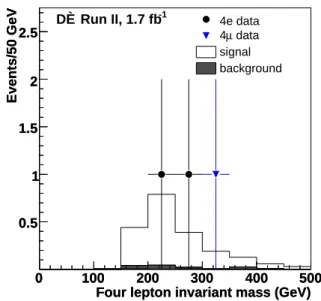
FIG. 1: Distribution of four lepton invariant mass in data, expected signal, and expected background.
trons are then applied to jets in eee+jets and µµe+jets data to determine the background to the 4e and 2µ2e channels, respectively. This method takes into ac-count contributions from Z+jets, Z+γ+jets, W Z+jets, W W +jets, W +jets, and events with ≥ 4 jets. However, this method double counts the contribution from Z+jets. A correction is measured, amounting to ≈ 20%, to cor-rect for the double counting. The probabilities for jets to contain a muon are applied to jets in µµ+jets data to determine a background estimate for the 4µ channel. Systematic uncertainties on this background arise from the 30% uncertainty in measured misidentification rates, and from the limited statistics of the data remaining in the samples after selection.
Table I summarizes the expected signal and back-ground contributions to each subchannel, as well as the number of candidate events in data. The total signal and background expectations are 1.89 ± 0.08 events and 0.14+0.03
−0.02events, respectively. We observe a total of three
candidate events in the data, two in the 4e4Csubchannel
and one in the 4µ subchannel. Table II summarizes some of their kinematic characteristics. The quoted dilepton masses in the table correspond to the one out of the three possible combinations having opposite charge within the pairs and having a dilepton mass closest to that of the Z boson. Figure 1 shows the distribution of the four lepton invariant mass for data and for the expected signal and background.
We extract the significance of the observed event dis-tributions using a negative log-likelihood ratio (LLR) test-statistic [14]. As input, we use the expected yields (number of events) from signal and background, sepa-rated into the seven subchannels compared to the
ob-TABLE I: The integrated luminosity, expected number of signal (Z/γ∗Z/γ∗) and background events (t¯t and Z(γ)+jets which
includes all W /Z/γ+jets contributions), and the number of observed candidates in the seven ZZ → ℓ+
ℓ−ℓ′+
ℓ′−subchannels.
Uncertainties reflect statistical and systematic contributions added in quadrature.
Subchannel 4e2C 4e3C 4e4C 4µ 2µ2e0C 2µ2e1C 2µ2e2C
Luminosity (fb−1) 1.75 ± 0.11 1.75 ± 0.11 1.75 ± 0.11 1.68 ± 0.10 1.68 ± 0.10 1.68 ± 0.10 1.68 ± 0.10 Signal 0.084 ± 0.008 0.173 ± 0.015 0.140 ± 0.012 0.534 ± 0.043 0.058+0.007 −0.006 0.352 ± 0.040 0.553 +0.045 −0.044 Z(γ)+jets 0.030+0.009 −0.008 0.018 +0.008 −0.007 0.002 +0.002 −0.001 0.0003 ± 0.0001 0.03 +0.02 −0.01 0.05 ± 0.01 0.008 +0.004 −0.003 t¯t – – – – 0.0012+0.0016 −0.0009 0.005 ± 0.002 0.0007 +0.0009 −0.0005 Observed events 0 0 2 1 0 0 0
TABLE II: Characteristics of the observed candidate events. η and φ values are measured relative to the location of the p¯p collision. Mllis the mass of the lepton pair.
e+ 1 e + 2 e − 3 e − 4 pT (GeV) 107 59 52 16 4e η 0.66 0.25 -0.64 -0.85 candidate 1 φ 4.10 1.08 0.46 2.62 e+ 1e−4 e + 2e−3 Mℓℓ (GeV) 89 ± 3 61 ± 2 e+ 1 e + 2 e−3 e−4 pT (GeV) 83 75 35 26 4e η 0.64 0.40 0.85 1.17 candidate 2 φ 6.16 3.80 3.83 1.40 e+ 1e − 3 e + 2e − 4 Mℓℓ (GeV) 99 ± 3 90 ± 4 µ+ 1 µ − 2 µ − 3 µ + 4 pT (GeV) 115 77 42 24 4µ η 0.04 -1.01 0.77 -1.93 candidate φ 1.69 4.26 5.29 0.36 µ+ 1µ−3 µ−2µ + 4 Mℓℓ (GeV) 148+32−18 90+12−8
served yields. The modified frequentist method returns the probability (p-value) of the background-only fluctu-ating to give the observed yields or higher. In 5×10⁹
background pseudo-experiments, we find 213 trials with an LLR value smaller or equal to that observed in data. This gives a p-value of 4.3×10⁻⁸which corresponds to a
5.3 standard deviation (σ) observed significance (3.7σ ex-pected). The probability for the signal plus background hypothesis to give less signal-like observations than the observed one is 0.87. A correction factor of 0.93, de-rived using pythia, is used to convert the measured cross section for (Z/γ∗)(Z/γ∗) into that for ZZ production.
Minimizing the LLR function we obtain a cross section of σ(ZZ) = 1.75+1.27−0.86 (stat.) ± 0.13 (syst.) pb for this
analysis.
This result is combined with the results from an in-dependent ZZ → ℓ+ℓ−ν ¯ν search [15], and the
previ-ous (Z/γ∗)(Z/γ∗) → ℓ+ℓ−ℓ′+
ℓ′− analysis [5] which used
a separate data sample with a looser mass requirement
M (ℓℓ) > 30 GeV. The earlier search contributes no signal events and we have scaled its background estimate to the tighter kinematic range used in the recent analysis. The combination of the three analyses is performed taking into account the correlations of systematic uncertainties between subchannels and among analyses. The resulting p-value is 6.2×10⁻⁹, and the significance for observation
of ZZ production increases to 5.7σ (4.8σ expected). The probability for the signal plus background hypothesis to give less signal-like observations than the observed one is 0.71. We therefore report the observation of a ZZ sig-nal at a hadron collider with a combined cross section of σ(ZZ) = 1.60 ± 0.63 (stat.)+0.16−0.17(syst.) pb, consistent
with the standard model expectation.
We thank the staffs at Fermilab and collaborating institutions, and acknowledge support from the DOE and NSF (USA); CEA and CNRS/IN2P3 (France); FASI, Rosatom and RFBR (Russia); CNPq, FAPERJ, FAPESP and FUNDUNESP (Brazil); DAE and DST (India); Colciencias (Colombia); CONACyT (Mexico); KRF and KOSEF (Korea); CONICET and UBACyT (Argentina); FOM (The Netherlands); STFC (United Kingdom); MSMT and GACR (Czech Republic); CRC Program, CFI, NSERC and WestGrid Project (Canada); BMBF and DFG (Germany); SFI (Ireland); The Swedish Research Council (Sweden); CAS and CNSF (China); Alexander von Humboldt Foundation (Germany); and the Istituto Nazionale di Fisica Nucleare (Italy).
[a] Visitor from Augustana College, Sioux Falls, SD, USA. [b] Visitor from The University of Liverpool, Liverpool, UK. [c] Visitor from INFN Torino, Torino, Italy.
[d] Visitor from ECFM, Universidad Autonoma de Sinaloa, Culiac´an, Mexico.
[e] Visitor from II. Physikalisches Institut, Georg-August-University, G¨ottingen, Germany.
[f] Visitor from Helsinki Institute of Physics, Helsinki, Fin-land.
[g] Visitor from Universit¨at Bern, Bern, Switzerland. [h] Visitor from Universit¨at Z¨urich, Z¨urich, Switzerland. [‡] Deceased.
[1] R.W. Brown and K.O. Mikaelian, Phys. Rev. D 19, 922 (1979).
[2] U. Baur and D. Rainwater, Phys. Rev. D 62, 113011 (2000).
[3] J. M. Campbell and R. K. Ellis, Phys. Rev. D 60, 113006 (1999).
[4] R. Barate et al. [ALEPH Collaboration], Phys. Lett. B 469, 287 (1999); J. Abdallah et al. [DELPHI Collabo-ration], Eur. Phys. J. C 30, 447 (2003); M. Acciarri et al. [L3 Collaboration], Phys. Lett. B 465, 363 (1999); G. Abbiendi et al. [OPAL Collaboration], Eur. Phys. J. C 32, 303 (2003).
[5] V. M. Abazov et al. [D0 Collaboration], Phys. Rev. Lett. 100, 131801 (2008).
[6] T. Aaltonen et al. [CDF Collaboration], Phys. Rev. Lett. 100, 201801 (2008).
[7] T. Andeen et al. , FERMILAB-TM-2365 (2007). [8] V. M. Abazov et al. [D0 Collaboration], Nucl. Instrum.
Meth. Phys. Res. A 565, 463 (2006).
[9] The D0 coordinate system is cylindrical with the z-axis along the proton beamline and the polar and azimuthal angles denoted as θ and φ respectively. The pseudorapid-ity is defined as η = − ln[tan(θ/2)].
[10] The variable ∆R between two objects i and j is defined as ∆R =p(ηi− ηj)2+ (φi− φj)2.
[11] T. Sj¨ostrand et al., Comput. Phys. Commun. 135, 238 (2001).
[12] R. Brun and F. Carminati, CERN Program Library Long Writeup W5013, 1993 (unpublished).
[13] N. Kidonakis and R. Vogt, Phys. Rev. D 68, 114014 (2003).
[14] W. Fisher, FERMILAB-TM-2386-E (2007).
[15] V. M. Abazov et al. (D0 Collaboration), Phys. Rev. D 78, 072002 (2008).