HAL Id: hal-03090348
https://hal.inria.fr/hal-03090348
Submitted on 29 Dec 2020
HAL is a multi-disciplinary open access
archive for the deposit and dissemination of
sci-entific research documents, whether they are
pub-lished or not. The documents may come from
teaching and research institutions in France or
abroad, or from public or private research centers.
L’archive ouverte pluridisciplinaire HAL, est
destinée au dépôt et à la diffusion de documents
scientifiques de niveau recherche, publiés ou non,
émanant des établissements d’enseignement et de
recherche français ou étrangers, des laboratoires
publics ou privés.
JavaScript
Yoonseok Ko, Tamara Rezk, Manuel Serrano
To cite this version:
Yoonseok Ko, Tamara Rezk, Manuel Serrano. SecureJS Compiler: Portable Memory Isolation in
JavaScript. SAC 2021 - The 36th ACM/SIGAPP Symposium On Applied Computing, Mar 2021,
Gwangju / Virtual, South Korea. �hal-03090348�
SecureJS Compiler: Portable Memory Isolation in JavaScript
∗
Yoonseok Ko
Inria Sophia-Antipolis, France yoon- [email protected]Tamara Rezk
Inria Sophia-Antipolis, France [email protected]Manuel Serrano
Inria Sophia-Antipolis, France [email protected]ABSTRACT
The memory isolation mechanism plays an essential role to provide security enforcement in JavaScript programs. Existing secure inter-action libraries such as Google Caja, SES, and VM2 rely on built-in memory isolation mechanisms provided by Node.js and browsers, yet most of the other engines such as JerryScript and Duktape, which are implementations for IoT devices, do not support such isolation mechanisms.
In this paper, we report about the design and implementation of SecureJS, a portable JavaScript-to-JavaScript compiler that enforces memory isolation. As it only uses standard features, the compiled code it generates can be used by any JavaScript engine. We vali-dated empirically the semantics preservation and memory isolation of SecureJS compiled programs by using 10,490 test programs of ECMAScript Test262 test suite. We also developed a novel experi-ment to evaluate memory isolation property of compiled code by instrumented JavaScript engines.
CCS CONCEPTS
•Security and privacy → Software security engineering; Web application security; • Software and its engineering → Syn-tax; Semantics;
KEYWORDS
Compiler, Memory Isolation, JavaScript
ACM Reference Format:
Yoonseok Ko, Tamara Rezk, and Manuel Serrano. 2021. SecureJS
Com-piler: Portable Memory Isolation in JavaScript. InThe 36th ACM/SIGAPP Symposium on Applied Computing (SAC ’21), March 22–26, 2021, Virtual Event, Republic of Korea. ACM, New York, NY, USA, Article 4, 10 pages. https://doi.org/10.1145/3412841.3442001
1
INTRODUCTION
JavaScript has been growing at a rapid pace over the years due to its easy manipulation and deployment in development. The dynamic
∗
This research has been partially supported by the ANR17-CE25-0014-01 CISC project, the Inria Project Lab SPAI, and the European Union’s Horizon 2020 research and innovation programme under grant agreement No 830892.
Permission to make digital or hard copies of all or part of this work for personal or classroom use is granted without fee provided that copies are not made or distributed for profit or commercial advantage and that copies bear this notice and the full citation on the first page. Copyrights for components of this work owned by others than the author(s) must be honored. Abstracting with credit is permitted. To copy otherwise, or republish, to post on servers or to redistribute to lists, requires prior specific permission and /or a fee. Request permissions from [email protected].
SAC’21, March 22-March 26, 2021, Gwangju, South Korea
© 2021 Copyright held by the owner/author(s). Publication rights licensed to ACM. ACM ISBN 978-1-4503-8104-8/21/03. . . $15.00
https://doi.org/10.1145/3412841.3442001
nature of the language provides a smooth environment for the inte-gration of code, and it contributes to the easy and fast development of complex applications [10].
Whereas the dynamic features of JavaScript play an essential role in the language popularity by simplifying application devel-opments, they also enable malicious JavaScript libraries to exploit these dynamic features to break the integrity and confidentiality of the applications [3]. Within a single JavaScript program execution all components share a global object and intrinsic objects such as
ObjectandObject.prototype. Due to the idiosyncratic JavaScript semantics whose primitive operations implicitly access these global and intrinsic objects, all the components that form an application are tightly bond together. This gives opportunities to a malicious third-party code to pervert or extract undue pieces of information from others execution.
Various researches have been carried out so as to provide security enforcement achieved by memory isolation [2, 8, 9, 11, 13–16]. Total isolation is the simplest way to run programs without unintended interplay. However, more complex programs that need interac-tions between programs cannot enjoy the benefit of isolation. The practical secure JavaScript programming solutions such as Google Caja [9], SES [1], and VM2 [13] rely on such an isolation mechanism provided by Node.js or browsers and provide secure interactions between isolated programs by controlling the interactions. Still, such built-in isolation mechanisms are not supported other popu-lar JavaScript implementations such as JerryScript1and Duktape2, which are JavaScript implementations for micro-controllers, and thus, it limits the use of these secure interaction solutions in a practical use. It motivates the need for portable isolated JavaScript environments independent from JavaScript implementations.
A basic building block for JavaScript memory isolation is arealm (as it is defined in the latest ECMAScript specification3), which consists of a global object and intrinsic objects. Programs running in the same realm share the global and intrinsic objects, and isolated realms initially do not share any references between the realms. Running programs in different isolated realms guarantees that their memory accesses do not interfere with each other. However, pro-grams in a realm are able to interact with propro-grams in another realm by intentionally exporting a value, and it breaks the isolation. Thus, isolated realms are a basic and essential unit for secure pro-gram executions, and they can achieve security enforcement on fur-ther interactions by combining with the existing secure JavaScript programming solutions. Unfortunately, JavaScript realms are only supported by some JavaScript implementations, such as Node.js and browsers, and it limits the use of the existing secure programming solutions in other JavaScript implementations.
1https://jerryscript.net 2
https://duktape.org
3
Our Approach. In this paper, we propose a novel technique, based on a JavaScript-to-JavaScript compilation, to run JavaScript programs in an isolated realm. Our method focuses on rewriting the semantics of implicit field accesses of the given program and achieves memory isolation by using revised field access operations. For that, we define a subset of JavaScript language, JSexplicit, in which primitive operations do not involve implicit field accesses. The translation from JavaScript to JSexplicit replaces all the im-plicit field accesses of the source program with exim-plicit operations. JSexplicitprograms are meant to run in a dedicated secure runtime environment that creates an isolated virtual realm and provides se-cure primitive operations that implicitly access the isolated virtual realm.
We have implemented a secure JavaScript-to-JavaScript compiler, SecureJS. It transforms programs into equivalent ones, but which would execute as if they were running inside an isolated memory. The compilation relies on the translation to JSexplicitand replaces primitive operations to secure versions and thus execute in an iso-lated memory, which simulates a JavaScript realm. The program running in the isolated memory can interact with others by inten-tionally exporting a value of the isolated memory to outside. This compiler is portable and only uses standard features so it can be used by any JavaScript engine that complies with ECMAScript 5.1 specification. Thus, the compiler provides an isolation mechanism independently of JavaScript implementation, and it enables us to use existing secure interaction libraries in any JavaScript engine.
Contributions.
• We propose a subset of the JavaScript language JSexplicit, in which primitive operations do not involve implicit field accesses, and we present a translation from JavaScript to JSexplicit(Section 3).
• We provide a secure JavaScript-to-JavaScript compiler, Se-cureJS, as a tool. This compiler transforms programs into equivalent ones but which would execute as if they are run-ning inside an isolated realm without relying on any built-in mechanisms. This implementation is portable to any EC-MAScript 5.1 compliant implementations and the isolated realm supports all features of ECMAScript 5.14(Section 4). • We provide instrumented JavaScript engines that detect
im-plicit field accesses and field accesses to intrinsic objects. We have used it to test empirically the semantic preservation and memory isolation of the SecureJS compiled programs. The instrumented engines can be used independently of Se-cureJS to test memory isolation. Our tool and the patch for the instrumented engine are publicly available5(Section 5).
2
OVERVIEW
We give an overview of our approach with an overly simple example that only use a field access operation that involves a dynamic type conversion and prototype chain field lookup.
We demonstrate the evaluation of a JavaScript program construct. An evaluation of a single JavaScript program construct consists of
4
We intentionally do not provideeval and with constructs.
5
https://gitlab.inria.fr/securejs/sjs-compiler
a series of JavaScriptinternal primitive operations. We consider the following code fragment:
1Boolean . prototype .x = 10;
2var o = { toString : f u n c t i o n() { r e t u r n "x"; }}; 3
4true[o] === 10;
The evaluation of the field lookup operationtrue[o]used in the test at line 4 consists of a series of JavaScript primitive operations as follows:
(1) It appliesToObject totrueto dynamically converts the value to an object. The semantics ofToObject creates an instance ofBooleanintrinsic object by callingnew Boolean(true), and an internal field[[Prototype]]6of the created object is set to the reference ofBoolean.prototype.
(2) It applies the internal operationToString to the field name designatoroto dynamically convert the value to a string. The semantics ofToString implicitly accesses the fieldtoStringof the objectoand calls it. As we defined at line 2, the function returns a string"x".
(3) The field lookup operation searches a field named"x"from the instance ofBooleanintrinsic object. Since the instance does not have a field named"x", itimplicitly accesses the field
"x"of the objectBoolean.prototype, which is the prototype chain object of the instance. Since the field value of the object
Boolean.prototypeis10as we defined at line 1, the result of the field lookup operation is evaluated to10and the equality test succeeds.
The evaluation of a field lookup operation in JavaScript involves two implicit field accesses, and by one of these field accesses reads a field value of the intrinsic objectBoolean.prototype.
Our goal is to run programsas if they were running in isolated realms. For that we will actually run them in isolated virtual realms that rely on two ingredients:i) newly created controlled global and intrinsic objects, and,ii) a rerouting of the implicit field accesses from the original intrinsic objects to the controlled intrinsic objects. In order to reroute field accesses, we use the two steps code trans-formation. First, we transform programs into equivalent ones but were implicit operations have be replaced with equivalent explicit ones. For instance, in the above example, the implicit field accesses are involved in the dynamic type conversion. For example, the code
true[o] === 10is converted as follows:
1// ToObject (true)
2var r = new Boolean (true); 3// ToString (o)
4var s = o. toString (); 5// actual field lookup 6f u n c t i o n Load(o,s) {
7 if (o. hasOwnProperty (s)) r et u r n o[s]; 8 o = Object . getPrototypeOf (o); 9 r et u r n Load(o,s);
10}
11Load(r,s) === 10;
Second, we rewrite the codeLoadto reroute the field accesses as follows:
6
In ECMAScript specification, internal field and method names are presented with a double square brackets[[Name]]. These methods and field names are not allowed to be called or accessed directly from JavaScript programs but callable or accessible from other internal methods or operations.
SecureJS Compiler: Portable Memory Isolation in JavaScript SAC’21, March 22-March 26, 2021, Gwangju, South Korea
1f u n c t i o n SJSLoad (o,s) {
2 if (o. hasOwnProperty (s)) r e t u r n o[s]; 3 o = Object . getPrototypeOf (o); 4 if (o === Boolean . prototype ) 5 o = isolated . Boolean . prototype ; 6 r e t u r n SJSLoad (o,s);
7}
8SJSLoad (r,s) === 10;
This code uses theSJSLoadinstead of Loadfor the field lookup operation. The crucial point is line 4. When a field access reaches an intrinsic objectBoolean.prototype, it reroutes the field access to the controlled intrinsic objectisolated.Boolean.prototype(line 5). Thus, the rewritten code runs as if the code is running with the controlled intrinsic object.
In the rest of the paper, we propose a core JavaScript language, JSexplicit, that does not involve implicit field accesses, and we present a translation from JavaScript to JSexplicit(Section 3). Then, we im-plement a secure runtime environment that consists of an isolated virtual realm and secure primitive operations which reroute field accesses to the virtual realm (Section 4).
3
JS
explicit, A CORE JAVASCRIPT LANGUAGE
In this section, we define JSexplicit, a core language for JavaScript, whose semantics is simpler than that of JavaScript in that its primi-tive operations do not involve implicit field access.
3.1
Syntax
We use the following formal syntax for JSexplicit:
e ::= x | xд|v ∈ Vprim|this | e ⊕ e | ⊖ e
| ⋄hasOwnProperty e1e2| ⋄getPrototypeOf e | ⋄toString e | ⋄ toNumber e | ⋄ toBoolean e i ::= var x | x = e | xд = e | x1 = ⋄alloc(x2)
|e1[e2] = e3|x = e1[e2] |x = λ( ®xn).i | return e |x = ⋄apply(x1,x2,[ ®yn]) |while x do i | if (x) i1 else i2 |try i1 catch(x) i2 finally i3 |throw e | {i } | i1;i2|ϵ | ⋄defineOwnProperty(x,e1,e2)
|x = ⋄getOwnPropertyDescriptor(e1,e2)
where⊕ and ⊖ are the binary and unary operators of the JavaScript language, respectively.
Expressions. An expressione is either a local variable access x, a global variable accessxд, a constant valuev ∈ Vprim, this value
this, binary operators, or unary operators.
Non-standard Expressions. The operators whose name starts with the⋄ symbol are non-standard operators. Their semantics follow those of the corresponding JavaScript built-in functions, but they do not involve implicit type conversion. The field test operator ⋄hasOwnPropertye1e2returnstrueif an object designated bye1
has a field namede2, and otherwise, returnsfalse. This operator
requires an object value fore1and a string value fore2. The
op-erator⋄getPrototypeOfe returns a prototype chain object of the given objecte. The operator requires an object value for e. The primitive type conversion operators⋄toStringe, ⋄toNumbere, and ⋄toBooleane take a primitive value e as its argument and return a string, a number, and a boolean value, respectively.
Instructions. JSexplicituses non-standard semantics for the field lookup and update operations. The field update operatione1[e2] = e3updates a field designated by the value ofe2of an objecte1to
the value ofe3. Note that the update operation does not access a
prototype chain of the given object and does not involve a dynamic type conversion. Thus,e1must be evaluated to an object, ande2
must be evaluated to a string value. The field lookup operationx
= e1[e2]reads a field designated bye2of an objecte1and assigns
the result to the local variablex. Like the field update operation, the field lookup operation does not access a prototype chain object and does not involve a dynamic type conversion. Thus,e1must be
evaluated to an object, ande2must be evaluated to a string value.
The semantics of the rest of the instructions follow the standard semantics but these instructions do not involve dynamic type con-versions. The variable declarationvar x declares a variable in a local scope. The assignment instructionsx = eandxд = eassign the value of expressione to the local variable x and the global variablexд, respectively. When the instruction assigns a value to a global variable, it updates to the new value if its writable property istrue; otherwise, it ignores the update operation. The object allo-cationx1 = ⋄alloc(x2)allocates an object whose a prototype chain
designatesx2, and it assigns the newly allocated location tox1. The
function declarationx = λ( ®xn).iallocates a new function object with its argument namesx®nand the function body instructioni. We assume that all the program flows in the function bodyi end with a return instructionreturn e. The return instructionreturn ereturns the value of the expressione to its caller site. The function callx =
⋄apply(x1,x2,[ ®yn])calls a functionx1with athisvaluex2and its
argumentsy®n, and it assigns the return value of the function to the variablex. The loopwhile x do iiterates its bodyi while the value of its conditionx is true. The branch instructionif (x) i1 else i2
executes the instructioni1ori2depending on the value of variable
x. The instructiontry i1 catch(x) i2 finally i3executes the
in-structioni1, and if there is an exception from the instructioni1, it
catches the exception value, bind it to a local variablex, and run the instructioni2. Then, it executes the instructioni3. The throw
instructionthrow ethrows an exception with an exception valuee. Once an exception is thrown, it ignores instructions until it reaches to the catch clause. The sequencei1;i2executes the instructionsi1
andi2in order. The no-op instructionϵ does nothing.
Non-standard Instructions. JSexplicituses non-standard instruc-tions:⋄defineOwnPropertyand⋄getOwnPropertyDescriptor. In Java-Script, they are supported by built-in functionsObject.defineProperty andObject.getOwnPropertyDescriptor. The immediate field update operation with attributes⋄defineOwnProperty(x,e1,e2)assigns the
value of the expressione2to an objectx of a field e1. The value of
expressione2is either a data descriptor object that has fieldsvalue,
enumerable, configurable, and writable attributes or a accessor de-scriptor object that has fieldsget, set, enumerable, and configurable. The immediate field lookupx = ⋄getOwnPropertyDescriptor(e1,e2)
reads a fielde2of an objecte1and assigns the field value record as an object to the variablex.
For the sake of simplicity, we use the following notations in the rest of the section:x = f (y1,...,yn)denotesx = ⋄apply(f , null,
®
yn), and we use a functionisObjectdefined as follows:
2 r et u r n (t y p e o f x === " object " && x !== null) || 3 t y p e o f x === " function ";
4}
We omit else branches ofifstatements when empty.
3.2
Semantics
We define the semantics of a program by the means of a big-step semantics. The semantics of the JSexplicitfollows the semantics of JavaScript language, but they do not involve dynamic type conver-sion and implicit field access. The configurations have the form µ, ls, i, t ⇓ µ′, t′, whereµ, µ′ ∈ M are memories, ls ∈ Vlocis a current scope object location,i is an instruction, and t is either anormal state or an exception state with a value exc(v) where v ∈ V. The state tag normal denote that the program state is in a normal state, and the state tagexc(v) denote that the program state is in an exception state with an exception valuev. A memory M = Vloc → O is a map from locations to objects and an object
o ∈ O = Vfld→ R is a map from field names to field values where
Vfld= Vstr∪ Viand Vstrare strings and Viare special values used to name internal JavaScript fields such as@env and @proto, and R = Vstr→ V is a map from record names to values and we write
{name1:v1, name2:v2} to denote a record that has two elements
of namesname1andname2respectively with its valuesv1andv2.
The evaluation of an expressione has the form µ, ls, e ⇓E v, whereµ ∈ M is a program memory, v is a value of the expression in the memory.
The auxiliary functionPut(ls,x,v) either updates the current scope object withx = v or walks the scope chain designated by the outer scope@env to update the value of a local variablex as defined by: µ′= µ[l s7→µ(ls)[x 7→ v]] µ, Put(ls, x, v) ⇓Aµ′ x ∈ dom(µ(ls)) µ, Put(µ(ls)(@env).1,x, v) ⇓Aµ′ µ, Put(ls, x, v) ⇓Aµ′ x < dom(µ(ls ))
Figure 1 presents an excerpt of the formal semantics containing only the essential rules. It shows the semantics of object allocation, field lookup, and update operations. Unlike the standard JavaScript semantics, the field lookup and update operations only accept that a receiver is an object and a field name designator evaluates to a string value, and the operations do not search a field in a prototype-chain of the given receiver object.
•Alloc rule. The instructionx1 = ⋄alloc(x2)evaluates the
argumentx2to a valuev, allocates a new object in a new locationlnwith a prototype chain valuev, and assigns the allocated object reference to the local variablex1. The
instruc-tion requires the prototype valuex2to either be a location
value or anullvalue.
•Lookup rule. The instructionx1 = x2[e]first evaluates the
receiver objectx2and field name designatore respectively to
a locationl and a string value k. The semantics do not search a prototype chain, but merely read a field of the receiver objectµ(l)(k). In this rule, the field must be a record, which has four fieldsvalue, enumerable, configurable, and writable, and it assigns the value of the fieldvalue to the left-hand side variablex1by calling the auxiliary functionPut.
• Update rule. The instructionx[e1] = e2 also evaluates
the receiver objectx to a location l, the field name e1to
a string valuek. It evaluates the expression e2to a value
v, and it assigns the value v as a record with enumerable, configurable, and writable fields to the fieldk of the receiver object designated by the locationl. This rule is applied when there was no field namedk in the receiver object, and it creates a new field.
The semantics of non-standard instructions and operators fol-lows the semantics of the corresponding JavaScript built-in func-tions, but they do not apply dynamic type conversion.
Figure 2 shows three additional semantics rules:
• hasOwnProp1 and hasOwnProp2 rules. The binary op-eration⋄hasOwnPropertytests whether the objecte1has a
field designated by the string namee2or not.
• getPrototypeOf rule. The unary operation ⋄getPrototypeOfe returns the internal prototype chain value of the given object. The unary operations⋄toString,⋄toNumber, and⋄toBooleantake a primitive value as an argument and returns their corresponding typed value. The conversion algorithm is defined in the ECMAScript specification7[4], and these conversion algorithm do not involve implicit field access.
3.3
JavaScript Primitive Operations in JS
explicitIn this section, we present JavaScript primitive operations written in JSexplicit. Each primitive operation is devised by a corresponding internal method or operation defined in ECMAScript specification. We write[[A]] and B to denote an internal field or method named A and an operation named B, respectively.
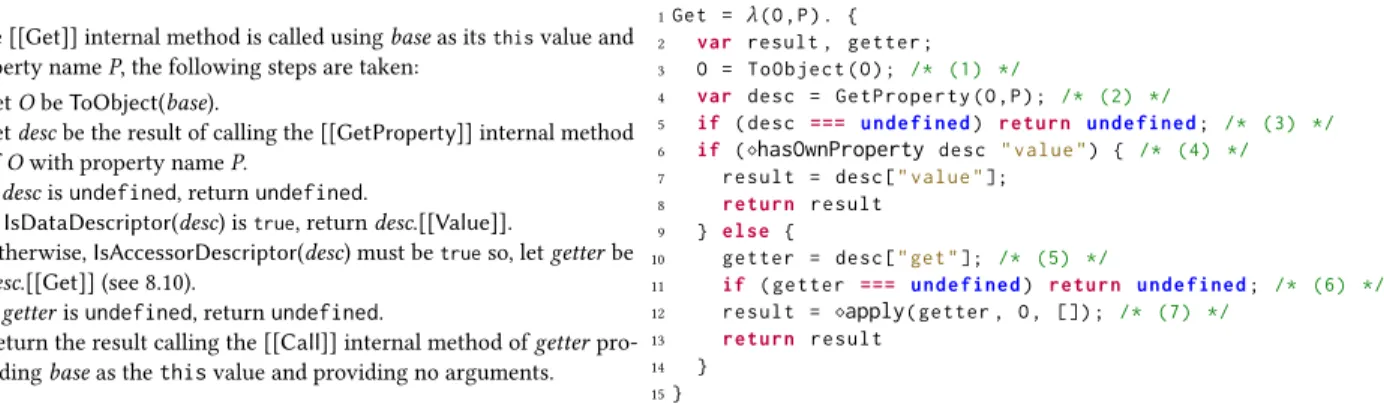
Figure 3a shows the[[Get]] internal method of ECMAScript specification that defines the essential semantics of a field lookup operation in JavaScript. For a given code iso[s],ois passed as base andsis passed asP in the specification. Figure 3b shows the code ofGetfunction which mimics the semantics of[[Get]] internal method in JSexplicit. Each step of the auxiliary functionGet is designed with the specification and written in JSexplicit.
First, the[[Get]] internal method of the specification converts the receiver valuebase to an object by calling theToObject operation (step 1). In theGetfunction, it calls the functionToObjectwhich mimics the semantics of the operationToObject in the specification. This operation returns the input value if a type of the input value is already an object. Otherwise, it allocates a typed object if a type of the input value is one of string, number, and boolean types. This semantics is defined by the auxiliary functionToStringwritten in JSexplicit. Then, it calls[[GetProperty]] internal method to search the field namedP from the object base and its prototype chain (step 2). The result is eitherundefinedvalue when it fails to find a field or a descriptor object. If the result isundefined, it returnsundefined value (step 3). The descriptor object hasvaluefield if the field is an ordinary value field. Otherwise, the descriptor object has to have thegetfield and it is the getter value. Thus, it first checks whether the descriptor object has a field"value", and it returns the value of the field"value"when the descriptor object has the field (step 4).
7
ToBoolean: https://www.ecma-international.org/ecma-262/5.1/#sec-9.2, ToNumber: https://www.ecma-international.org/ecma-262/5.1/#sec-9.3, ToString: https://www.ecma-international.org/ecma-262/5.1/#sec-9.8
SecureJS Compiler: Portable Memory Isolation in JavaScript SAC’21, March 22-March 26, 2021, Gwangju, South Korea
Alloc
µ, ls, x2⇓Ev lnfresh in Vloc µ′= µ[ln7→ {@proto 7→ {value :v }}] µ′, Put(ls, x1, ln) ⇓Aµ′′
µ, ls,x1 = ⋄alloc(x2), normal ⇓ µ ′′, normal Lookup µ, ls, x2⇓El µ, ls, e ⇓Ek v = µ(l)(k).value µ, Put(ls, x1, v) ⇓Aµ′ µ, ls,x1 = x2[e], normal ⇓ µ ′, normal Update
µ, ls, x ⇓El µ, ls, e1⇓Ek µ, ls, e2⇓Ev µ′= µ[l 7→ µ(l)[k 7→ {value : v, enumerable :true, configurable :true, writable :true}]]
µ, ls,x[e1] = e2, normal ⇓ µ
′, normal wherek <dom(µ(l))
Figure 1: An excerpt from semantics rules for instructions
hasOwnProp1 µ, ls, e1⇓El µ, ls, e2⇓Ek k ∈dom(µ(l)) µ, ls, ⋄hasOwnPropertye1e2⇓Etrue hasOwnProp2 µ, ls, e1⇓El µ, ls, e2⇓Ek k <dom(µ(l)) µ, ls, ⋄hasOwnPropertye1e2⇓Efalse getPrototypeOf µ, ls, e ⇓El v = µ(l)(@proto).value µ, ls, ⋄getPrototypeOfe ⇓Ev
Figure 2: An excerpt from semantics rules for expressions
When the[[Get]] internal method is called using base as itsthisvalue and with property nameP, the following steps are taken:
(1)LetO beToObject(base).
(2)Letdesc be the result of calling the[[GetProperty]] internal method ofO with property name P.
(3)Ifdesc isundefined, return undefined.
(4)IfIsDataDescriptor(desc) istrue, returndesc.[[Value]].
(5)Otherwise,IsAccessorDescriptor(desc) must betrueso, letgetter be desc.[[Get]] (see 8.10).
(6)Ifgetter isundefined, return undefined.
(7)Return the result calling the[[Call]] internal method of getter pro-vidingbase as thethis value and providing no arguments.
(a)[[Get]] internal method
1Get = λ(O,P). { 2 var result , getter ;
3 O = ToObject (O); /* (1) */
4 var desc = GetProperty (O,P); /* (2) */
5 if ( desc === u n d e f i n e d) r e t u r n u n d e f i n e d; /* (3) */ 6 if (⋄hasOwnProperty desc " value ") { /* (4) */ 7 result = desc[" value "];
8 r e t u r n result 9 } else {
10 getter = desc["get"]; /* (5) */
11 if ( getter === u n d e f i n e d) r et u r n u n d e f i n e d; /* (6) */
12 result = ⋄apply(getter , O, []); /* (7) */
13 r et u r n result 14 }
15}
(b) The function Get written in JSexplicit
Figure 3: The specification of[[Get]] internal method and its meaning written in JSexplicit Otherwise, it loads the field"get"(step 5). If the getter function is
undefined, it just returnsundefinedvalue (step 6). Otherwise, the getter function is a function value, and it calls the getter function withbase as itsthisvalue and returns the result (step 7).
Figures 4a and 4b show the[[GetProperty]] internal method specification and its meaning written in JSexplicit. The [[GetProp-erty]] method defines the field search in a prototype chain. It first tries to access the fieldP from the given object O (step 1). If the objectO has a field named P, it just returns the field record (step 2). Otherwise, it loads the value of a prototype chain object of the objectO (step 3). If the given object does not have a prototype chain object, it fails to find a field and returnsundefinedvalue (step 4). Otherwise, it recursively searches the field namedP from the pro-totype chain object of the objectO (step 5). The auxiliary function
GetPropertyimplements the semantics in JSexplicit.
Figures 5a and 5b show the[[DefaultValue]] internal method specification with hint String and its meaning written in JSexplicit. The[[DefaultValue]] method defines the dynamic type conversion when a given value is an object. In a field lookup operationo[s], when the given field name designatorsis an object, it converts the field name valuesto a string typed value by calling the [[De-faultValue]] method. In the [[De[[De-faultValue]] method, it first calls
[[Get]] internal method with the argumenttoStringand we de-fine its corresponding auxiliary function in Figure 3a (step 1). If the result is a callable, that is, if the value is a function (step 2), it calls the result function withOas the this value (step 2a). If the result oftoStringis a primitive value, it returns the result (step 2b). Otherwise, it calls[[Get]] internal method with an argument
valueOf(step 3). If the result is a callable (step 4), it calls the result function withOas the this value (step 4a). If the result ofvalueOf is a primitive value, it returns the result (step 4b). If both result values oftoStringandvalueOfare not a primitive value, it throws aTypeErrorexception (step 5). In the auxiliary function written JSexplicit, it creates an instance of TypeError, which designates a built-in function ofTypeErrorobject.
Figure 6 presents the semantics ofToString and ToNumber op-erations defined in ECMAScript specification. If the value is not an object, it converts the primitive value respectively to a string value and a number value by⋄toStringand⋄toNumberoperations. Other-wise, it callsDefaultValuewith a hint "String" or "Number", which mimics the semantics of[[DefaultValue]]. Then, it again calls the function itselfToStringorToNumberwith the result ofDefaultValue. Since the auxiliary functionDefaultValuealways returns a primi-tive value, this recursion does not create a loop, and the auxiliary
When the[[GetProperty]] internal method of O is called with property name P, the following steps are taken:
(1)Letprop be the result of calling the[[GetOwnProperty]] internal method ofO with property name P.
(2)Ifprop is notundefined, return prop.
(3)Letproto be the value of the[[Prototype]] internal property of O. (4)Ifproto isnull, return undefined.
(5)Return the result of calling the[[GetProperty]] internal method of proto with argument P.
(a)[[GetProperty]] internal method
1GetProperty = λ(O,P). { 2 var prop , proto , result ;
3 prop = ⋄getOwnPropertyDescriptor(O,P); /* (1) */ 4 if ( prop !== u n d e f i n e d) { r et u r n prop } /* (2) */ 5 else {
6 proto = ⋄getPrototypeOf(O); /* (3) */
7 if ( proto === null) { r e t u r n u n d e f i n e d } /* (4) */ 8 else {
9 result = GetProperty (proto , P); /* (5) */
10 r et u r n result 11 }
12 } 13}
(b) The function GetProperty written in JSexplicit
Figure 4: The specification of[[GetProperty]] internal method and its meaning written in JSexplicit
When the[[DefaultValue]] internal method of O is called with hint String, the following steps are taken:
(1)LettoString be the result of calling the[[Get]] internal method of objectO with argument "toString".
(2)IfIsCallable(toString) is true then,
(a) Letstr be the result of calling the[[Call]] internal method of toString, with O as the this value and an empty argument list. (b) Ifstr is a primitive value, return str.
(3)LetvalueOf be the result of calling the[[Get]] internal method of objectO with argument "valueOf".
(4)IfIsCallable(valueOf ) is true then,
(a) Letval be the result of calling the[[Call]] internal method of valueOf, withO as the this value and an empty argument list. (b) Ifval is a primitive value, return val.
(5)Throw a TypeError exception.
(a)[[DefaultValue]] internal method
1DefaultValue = λ(O,hint). {
2 var str , val , toString , valueOf ; 3 if ( hint === " String ") {
4 toString = Get(O, " toString "); /* (1) */ 5 if (t y p e o f toString === " function ") { /* (2) */
6 str = ⋄apply(toString , O, []); /* (2a) */
7 if (! isObject (str)) r et u r n str else { } /* (2b) */
8 } else { }
9 valueOf = Get(O, " valueOf "); /* (3) */ 10 if (t y p e o f valueOf === " function ") { /* (4) */
11 val = ⋄apply(valueOf , O, []); /* (4a) */
12 if (! isObject (val)) r et u r n val else { } /* (4b) */
13 } else { }
14 throw TypeError (); /* (5) */ 15 } else { /* hint === " Number " */
16 /* it calls " valueOf " and " toString " in order . */ 17 }
18}
(b) The function DefaultValue written in JSexplicit
Figure 5: The specification of[[DefaultValue]] internal method and its meaning written in JSexplicit
1ToString = λ(x). { 2 if (! isObject (x)) { r et u r n ⋄toString(x) } 3 else { 4 x = DefaultValue (x, " String "); 5 x = ToString (x); 6 r e tu r n x 7 } 8}
(a) The auxiliary function ToString
1ToNumber = λ(x). { 2 if (! isObject (x)) { r et u r n ⋄toNumber(x) } 3 else { 4 x = DefaultValue (x, " Number "); 5 x = ToNumber (x); 6 r e tu r n x 7 } 8}
(b) The auxiliary function ToNumber
Figure 6: TheToString and ToNumber in JSexplicit
functionsToStringandToNumberreturn a string and number value, respectively.
Support for ECMAScript in functions. The ECMAScript built-in functions also rely on the primitive operations defbuilt-ined above, and the semantics involves implicit field access. For instance, let us consider theslicemethod of the String API. According to the
specification [4], when this method is invoked, thethisargument must be converted into a string and the arguments into integers. These conversions have to be protected too. For that, the original
slicefunction (String_prototype_slice) is protected by a JSexplicit wrapper defined as:
1wrap = λ( old_slice ). {
2 var new_slice = λ[start ,end ].{
3 var s;
4 CheckObjectCoercible (this);
5 s = ToString (this);
6 start = ToInteger ( start );
7 if (end !== u n d e f i n e d)
8 end = ToInteger (end);
9 r et u r n ⋄apply( old_slice , s, [start ,end ]); 10 }
11};
12/* wrapped String . prototype . slice */ 13slice = wrap( String_prototype_slice );
All JavaScript functions involving conversion and field accesses are wrapped similarly.
3.4
Translation to JS
explicitWe present translation functioncompile⟦P⟧ that takes JavaScript codeP and translates it into JSexplicit.
First, we consider explicit references to global variables, e.g.,
SecureJS Compiler: Portable Memory Isolation in JavaScript SAC’21, March 22-March 26, 2021, Gwangju, South Korea
with accesses to the global object, and later on, we will present a revised operation to reroute these accesses to a virtual global object. When an identifier expression does not have a correspond-ing variable declaration bindcorrespond-ing, the expression is considered as a global variable access.compile⟦x_g⟧ transforms a global variable accessx_ginto an auxiliary function callLoadvar("x_g")defined as follows:
1Loadvar = λ(id).{
2 Get(global , id);
3}
The variableglobaldesignates the global object. Note that the semantics of a global variable read searches the global object and its prototype chain.
We consider a translation of a field lookup operationcompile⟦x
= e1[e2]⟧ wherexis a local variable. The translated code to JSexplicit is as follows: 1fn = λ(o,s).{ 2 if (o === null || o === u n d e f i n e d) 3 throw TypeError (); 4 s = ToString (s); 5 x = Get(o, s); 6}; 7fn(compile⟦e1⟧, compile⟦e2⟧)
A field lookup operation first ensures that the given receiverois a coercible value. If the receiver object isnullorundefined, it throws aTypeErrorexception. Otherwise, the value is either an object value or able to be converted to an object value in the auxiliary function
Get. Then, it converts the field name designatorsto a string value by calling an operationToString, and we use corresponding auxil-iary functionToStringpresented in 6a. At last, it uses an auxiliary function for a field lookup operationGetand assigns the result to the local variablex.
Rewriting explicit field accesses is not enough to prevent im-plicit field accesses as JavaScript accesses fieldsimplicitly in many situations. For instance, let us consider the binary operatione1-e2. According to the JavaScript semantics,e1ande2have to be con-verted to a number before applying the subtraction. How to make the conversion depends on the type ofe1ande2. If it is an object, itsvalueOffield is used, That is, if one ofe1ande2is an object, the subtraction operation involves implicit access to thevalueOf field. This access has to be intercepted and replaced as explicit field accesses. For that, a translation ofcompile⟦e1-e2⟧ to JSexplicitis defined as follows: 1fn = λ(lhs ,rhs).{ 2 lhs = ToNumber (lhs); 3 rhs = ToNumber (rhs); 4 r et u r n lhs - rhs; 5}; 6fn(compile⟦e1⟧, compile⟦e2⟧)
The auxiliary functionToNumberpresented in Figure 6b guarantees that the result is a number value. Thus, the actual subtract operation
lhs - rhsat line 4 of the translated code does not involve implicit field access.
In JavaScript, a function invocation is considered as a method invocation if and only if the syntactic form of the function is an object field access. That is, “obj.met(arg)” is a method invocation and the pseudo argumentthiswill be bound toobjin the body of
obj.met. On the other hand, in “var f=obj.met; f(arg)” is not a
method invocation but as a regular function call andthiswill not be bound toobj. This difference between function invocation and method invocation demands the JSexplicitcompilation to specially treat method invocation. We consider a translation of a method call expressioncompile⟦x = e1[e2](e3)⟧ wherexis a local variable as follows: 1fn = λ(o,s).{ 2 var f; 3 f = compile⟦o[s]⟧; 4 r e t u r n ⋄apply(f, o, compile⟦e3⟧); 5}; 6x = fn(compile⟦e1⟧, compile⟦e2⟧);
First, the syntactic parte1[e2]is transformed as regular field lookup operation. Second, when the function is found in the object, the function is invoked in such a way thate1(the first argumento) is bound tothisande3as the argument.
4
IMPLEMENTATION: SecureJS
In this section, we present the SecureJS implementation. SecureJS compiled programs execute as if they were in isolated realms, which do not share any references with other realms. Thus, if a compiled program does not export value to others, executions of the compiled program preserve total memory isolation, and it guarantees that running a compiled program with other uncompiled programs does not interfere with each other.
This isolation relies on a secure runtime environment, which consists of an isolated virtual global object and intrinsic objects, and secure primitive operations, which reroute field accesses for the global and intrinsic objects to corresponding virtual ones. This section details the implementation the secure primitive operations and the runtime environment.
4.1
Secure Primitive Operations
The SecureJS compiler rewrites JavaScript programs in such a way that no expression can ever access, explicitly or implicitly, objects created by uncompiled code. For that, the compiled code replaces normal object field access and normal prototype chain lookups with custom operations that enforce memory isolation. Let us detail these operations.
First of all, explicit references to global variables must be replaced with accesses to secure objects that proxy these global plain objects. For that, the compiler transforms a global variable accessxinto a library function callSJS.Loadvar("x")defined as:
1SJS. Loadvar = f u n c t i o n SJSloadvar (id) { 2 r et u r n Get(SJS.global , id);
3}
The objectSJS.globalis a secure version of the global object. It ensures that all the interactions with the global object will not be exposed to the uncompiled code.
Second, object field accesses have to be intercepted in order to prevent the normal prototype chain inspection to access objects of the uncompiled environment. For that, we provide a secure version ofGetPropertyauxiliary function defined as:
1SJS. GetProperty = f u n c t i o n SJSGetProperty (O, P) {
2 var prop;
3 prop = SJS. getOwnPropertyDescriptor (O,P); /* (1) */
5 else { 6 O = SJS. getPrototypeOf (O); /* (3) */ 7 if (O === null) r et u r n u n d e f i n e d; /* (4) */ 8 if (SJS. securePrototypeOf (O) !== u n d e f i n e d) 9 O = SJS. securePrototypeOf (O) 10 r e t u r n SJSGetProperty (O,P); /* (5) */ 11 } 12}
The crucial point is line 8. It ensures that the field lookup will never escape the memory controlled by the compiled environment. If the search for the field hits the global object that belongs to the uncompiled code, it reroutes the search to another object (line 9) under the control of SecureJS.
For compatibility with current IoT platforms such as JerryScript [5], SecureJS compiles and targets ECMAScript 5 but it also supports a restricted version of the ECMAScript 6 module export form. The
exportinstruction to establish communication channels between compiled and uncompiled code. The compiler transforms a declara-tion “export id” into:
id = SJS. Loadvar ("id")
where the left-hand sideiddesignates the global variableidoutside the realm.
The last role of the compiler is to create a secure execution context for the compiled code. For that, the compiled code will be embedded into an anonymous function that will start creating the secure environment and that will then execute client code. That is, all compiled programs have the following shape:
(f u n c t i o n() {
var SJS = SJSbootstrap ();
... client compiled code ...
}) ();
SecureJS compiled code guarantees that any uncompiled expres-sion cannot ever access objects created by compiled code. The variableSJSis hidden in the local scope of the compiled code, and the functionSJSbootstrapis immutable and returns a new isolated realm whenever it is called.
4.2
Secure Runtime Environment
SecureJS compiled code initializes a secure environment by invok-ing theSJSbootstrap(see Figure 7, line 42) function at the very beginning of the execution. This function is defined in a library
sjs.jsthat captures native built-in objects and provides secure interfaces for compiled programs. In this section, we present the implementation of that library.
Thesjs.jslibrary executes before any other computation. It captures the standard JavaScript functions (line 2-5) and stores them in a function local variables so that they cannot be tampered from outside the library. It creates an immutable field@calltoSJScall with the built-in value ofFunction.prototype.call(line 6) so that the semantics of the call expressionSJScall[’@call’]also cannot be tampered, and theSJScall[’@call’](f,obj,args)implements
⋄apply(f,obj,args)in JSexplicit. The library defines the function
SJSbootstrap(line 9) that is bound to the global JavaScript variable
SJSbootstrap(line 42). The function definition requires two steps, as this is the only way ECMAScript 5 proposes to define read-only variables.
1(f u n c t i o n() {
2 var SJScreate = Object . create ; 3 var SJScall = Function . prototype .call; 4 var SJSObjProto = Object . prototype ;
5 var SJSFunProto = Function . prototype ; ...
6 Object . defineProperty (SJScall , '@call ',
7 { value : SJScall , configurable : false,
8 writable : false, enumerable : false });
9 f u n c t i o n SJSbootstrap () { 10 f u n c t i o n securePrototypeOf (obj) { 11 if(obj === SJSObjProto ) 12 r e t u r n SecureObjP ; 13 if(obj === SJSFunProto ) 14 r e t u r n SecureFunP ; 15 ... 16 r e t u r n false; 17 }
18 var global = SJScreate (null);
19 var SJS = SJScreate (null);
20 SJS. global = global ; 21 f u n c t i o n CheckObjectCoercible (o) {...}; 22 f u n c t i o n Get(x) {...}; 23 f u n c t i o n DefaultValue_S (x) {...}; 24 f u n c t i o n ToString (o) {...}; 25 f u n c t i o n ToNumber (o) {...}; 26 f u n c t i o n ToInteger (o) {...}; 27 SJS. Loadvar = f u n c t i o n (id) {...}; 28 SJS. GetProperty = f u n c t i o n (O, P) {...}; 29 global . Object = f u n c t i o n (v) {...}; 30 ...
31 global . String . prototype . slice = 32 f u n c t i o n(v) {...};
33 var SecureObjP =
34 global . Object . prototype =
35 SJScreate (null);
36 var SecureFunP =
37 global . Function . prototype =
38 SJScreate ( SecureObjP );
39 ...
40 r et u r n SJS; 41 };
42 Object . defineProperty (this, 43 " SJSbootstrap ", {
44 value : SJSbootstrap , configurable :false,
45 writable :false, enumerable :false });
46}) ();
Figure 7: An excerpt ofsjs.js.
The functionSJSbootstrapcreates a regular JavaScript object (line 18) that will act as a replacement of the standard JavaScript global object inside the secure code.
5
EVALUATION
This section seeks for an experimental validation that the SecureJS compiler preserves the semantics of the original program and the compiled code complies with memory isolation. First, we test that SecureJS compilation preserves the semantics of the original pro-gram in practical JavaScript engines V8 [6], Hop [12], and Jer-ryScript [5] using the Test262 test suite. Second, we test that a SecureJS compiled program complies with memory isolation by testing that execution of the compiled program does not cause im-plicit field accesses. For this, we used the Test262 test suite in Hop and JerryScript JavaScript engines.
SecureJS Compiler: Portable Memory Isolation in JavaScript SAC’21, March 22-March 26, 2021, Gwangju, South Korea
5.1
Experimentation Settings
We implemented SecureJS on top of the front-end of the open-source JavaScript engine Hop compiler [12]. SecureJS takes a JavaScript program and generates an ECMAScript 5th specification compati-ble JavaScript program. Executions are done with state-of-the-art JavaScript engines V8, Hop, and JerryScript.
We use the Test262 test suite and use thees5-testsbranch from the github repository. Since the test programs of the Test262 test suites check the program states and flows by means of theassert function, the comparison of the resulting state confirms the equiva-lent execution of the programs. The Test262 programs also test the semantics of all the ECMAScript built-in functions and the seman-tics of thestrict modefunctions. We consider 10490 numbers of the test programs as our target test programs of the Test262 test suite and exclude 1082 numbers of the test programs from the target programs. In particular, we excluded tests using theevalfunction, thewithstatement. SecureJS does not supportevalandwith. Ad-ditionally, we excluded tests checking syntactic errors. The latest version of ECMAScript specifies less strict syntactic rules than the syntactic rules specified in ECMAScript 5th. Since the front-end parser of SecureJS supports the latest ECMAScript specification for compatibility, it parses the program that follows the latest EC-MAScript specification and translates it into an ECEC-MAScript 5th compatible program when possible.
5.2
Testing Semantic preservation
The goal of this experiment is to show that SecureJS compiler pre-serves the semantics of an original program. For that, we compiled target test programs of the Test262 suites and ran them on V8, Hop, and JerryScript JavaScript engines, and we checked whether the re-sulting states of both the program and the corresponding compiled program are equivalent.
Among 10490 numbers of the test programs, V8 passed 10386 successfully. 104 failed because of the semantics differences between the source language test 262 assumed and the latest JavaScript evolutions V8 supports. SecureJS preserves this result. That is, the 10386 successful tests remain successful after SecureJS compilation, and the 104 failed tests remain failed. Hop passed 10414 numbers of the test programs and failed in 76 tests, and JerryScript passed 10474 numbers of the test programs and failed in 16 tests. SecureJS also preserves these results.
5.3
Testing Memory Isolation
The SecureJS compiled programs run as if they were running in an isolated realm. If the compiled programs do not intentionally export values for interaction with others, the compiled and other uncompiled programs cannot reference each other. In this section, we test that such SecureJS compiled programs that do not useexport comply with this isolation property. For that, we empirically verify that compiled programs ever access objects outside the controlled realm.
For the experiment, we modified the Hop and JerryScript im-plementations to log all accesses to the[[Prototype]] field that is needed to walk prototype chains. We have used two radically different JavaScript implementations in order to reduce the proba-bility of unnoticed[[Prototype]] accesses that would be removed
by the JavaScript engine’s optimizer, independently of SecureJS. In addition, we modified the JerryScript engine also to log all accesses to global and intrinsic objects, which are outside of the controlled realm.
We executed all the 10490 programs from the Test262 suite with the instrumented JavaScript engines. We confirmed that there is no field access attempt to global and intrinsic objects. We observed a single situation where[[Prototype]] is implicitly accessed by the programs compiled by SecureJS. During the initialization of a program, an empty object is created with an empty prototype chain by the expressionObject.create(null). Later on, this object is used to optimized SecureJS field accesses. Since this object has no prototype chain, the accesses are harmless but are logged by the instrumented engines.
6
RELATED WORK
A number of studies have been carried out so as to provide memory isolation in JavaScript.
Bhargavanet al. [2] proposes defensive JavaScript (DJS), which is a small subset of the JavaScript language satisfying static typing constraints. DJS achieves memory isolation by the use of a small subset of the JavaScript language that does not involve dynamic features. The main limitation of DJS is that legacy code needs to be manually rewritten in the DJS subset and be typable in order to achieve memory isolation. A program written in DJS does not rely on a realm and cannot use built-in functions defined in ECMAScript specification.
Swamyet al. [14] proposes JS⋆, which is a programming lan-guage supporting various dynamic features of JavaScript, while ensuring type safety in the presence of an untrusted JavaScript program. As it requires type-annotations for the trusted programs, legacy code needs to be manually rewritten in the JS⋆, and it sup-ports only a small subset of JavaScript language in terms of the support of built-in functions. It implements a limited form of in-terfaces for inter-communication since the interface requires type-annotations and must implement the interface functions with the compiled interpreter programs.
Terraceet al. [15] implements a JavaScript interpreter written in JavaScript. It supports interactions that use primitive values, typed objects, and functions that has typed argument and return values, and it does not work on the JerryScript engine. For these reasons, it cannot be applied to IoT environments in particular.
Vasilakiset al. [16] proposes BreakApp, which provides isolation and interaction policies between programs. It relies on various levels of built-in isolation primitives, yet the isolation mechanisms strongly depends on Node.js. One of the isolation mechanisms BreakApp relies on is the isolated realm supported by Node.js.
Guhaet al. [7] proposes a formal semantics of a core calculus,λJ S, and provides a reduction step of JavaScript toλJ S. This reduction step is similar to our translation to JSexplicit, but our translation to JSexplicitfocuses on rewriting primitive operations to their secure versions in order to simulate a JavaScript realm.
7
CONCLUSION
We presented SecureJS, a secure JavaScript-to-JavaScript compiler. It transforms programs into equivalent ones but that would execute
as if they were running inside an isolated realm. This compiler is portable and only uses standard features so it can be used by any JavaScript engine. In order to rewrite the semantics of dynamic features of JavaScript language, we presented JSexplicit, which does not involve implicit field accesses, and presented translation from JavaScript to JSexplicit. In the evaluation, we showed that the com-pilation preserves the semantics of the original programs that use full-features of ECMAScript 5.1 and achieves memory isolation if a given program does not export a value. In order to show that executions of the compiled programs preserve memory isolation, we use instrumented JavaScript engines, and to the best of our knowledge, no one has attempted to test such properties before by JavaScript engine instrumentation. SecureJS compiler provides an essential building block to use JavaScript security enforcement libraries that rely on isolated realms, in particular, it enables us to use such libraries in JerryScript JavaScript implementation, which does not support a built-in isolation mechanism.
REFERENCES
[1] Agoric. 2020. SES: Proposal for Secure EcmaScript. https://github.com/tc39/ proposal- ses.
[2] Karthikeyan Bhargavan, Antoine Delignat-Lavaud, and Sergio Maffeis. 2013. Language-based Defenses Against Untrusted Browser Origins. InPresented as part of the 22nd USENIX Security Symposium (USENIX Security 13). USENIX, Washington, D.C., 653–670.
[3] Martin Bodin, Arthur Chargueraud, Daniele Filaretti, Philippa Gardner, Sergio Maffeis, Daiva Naudziuniene, Alan Schmitt, and Gareth Smith. 2014. A Trusted Mechanised JavaScript Specification. InProceedings of the 41st ACM SIGPLAN-SIGACT Symposium on Principles of Programming Languages (POPL ’14). ACM, New York, NY, USA, 87–100. https://doi.org/10.1145/2535838.2535876 [4] European Association for Standardizing Information and Communication
Sys-tems (ECMA). 2011. ECMA-262: ECMAScript Language Specification. Edition 5.1.
[5] Evgeny Gavrin, Sung-Jae Lee, Ruben Ayrapetyan, and Andrey Shitov. 2015. Ultra Lightweight JavaScript Engine for Internet of Things. InCompanion Proceedings of the 2015 ACM SIGPLAN International Conference on Systems, Programming, Languages and Applications: Software for Humanity (SPLASH Companion 2015). ACM, New York, NY, USA, 19–20. https://doi.org/10.1145/2814189.2816270 [6] Google. 2018. V8 JavaScript Engine. http://developers.google.com/v8. [7] Arjun Guha, Claudiu Saftoiu, and Shriram Krishnamurthi. 2010. The Essence of
JavaScript. InECOOP 2010 – Object-Oriented Programming, Theo D’Hondt (Ed.). Springer Berlin Heidelberg, Berlin, Heidelberg, 126–150.
[8] Zhengqin Luo and Tamara Rezk. 2012. Mashic Compiler: Mashup Sandbox-ing Based on Inter-frame Communication. InProceedings of the 2012 IEEE 25th Computer Security Foundations Symposium (CSF ’12). IEEE Computer Society, Washington, DC, USA, 157–170. https://doi.org/10.1109/CSF.2012.22 [9] Mark S. Miller, Mike Samuel, Ben Laurie, Ihab Awad, and Mike Stay. October
2007. Caja - safe active content in sanitized JavaScript. http://math.ucr.edu/ ~mike/caja- spec- 2008- 06- 06.pdf .
[10] Nick Nikiforakis, Luca Invernizzi, Alexandros Kapravelos, Steven Van Acker, Wouter Joosen, Christopher Kruegel, Frank Piessens, and Giovanni Vigna. 2012. You are what you include: large-scale evaluation of remote javascript inclusions. Inthe ACM Conference on Computer and Communications Security, CCS’12, Raleigh, NC, USA, October 16-18, 2012. 736–747.
[11] Joe Gibbs Politz, Spiridon Aristides Eliopoulos, Arjun Guha, and Shriram Krishna-murthi. 2011. ADsafety: Type-based Verification of JavaScript Sandboxing. In Pro-ceedings of the 20th USENIX Conference on Security (SEC’11). USENIX Association, Berkeley, CA, USA, 12–12. http://dl.acm.org/citation.cfm?id=2028067.2028079 [12] Manuel Serrano and Vincent Prunet. 2016. A Glimpse of Hopjs. InProceedings
of the 21st ACM SIGPLAN International Conference on Functional Programming (ICFP 2016). ACM, New York, NY, USA, 180–192. https://doi.org/10.1145/2951913. 2951916
[13] Patrik Simek. 2020. VM2 npm package. https://www.npmjs.com/package/vm2. [14] Nikhil Swamy, Cedric Fournet, Aseem Rastogi, Karthikeyan Bhargavan, Juan Chen, Pierre-Yves Strub, and Gavin Bierman. 2014. Gradual Typing Embedded Securely in JavaScript. InProceedings of the 41st ACM SIGPLAN-SIGACT Sympo-sium on Principles of Programming Languages (POPL ’14). ACM, New York, NY, USA, 425–437. https://doi.org/10.1145/2535838.2535889
[15] Jeff Terrace, Stephen R. Beard, and Naga Praveen Kumar Katta. 2012. JavaScript in JavaScript ( js.js): Sandboxing Third-Party Scripts. InPresented as part of the
3rd USENIX Conference on Web Application Development (WebApps 12). USENIX, Boston, MA, 95–100.
[16] Nikos Vasilakis, Ben Karel, Nick Roessler, Nathan Dautenhahn, André DeHon, and Jonathan M. Smith. 2018. BreakApp: Automated, Flexible Application Com-partmentalization. In25th Annual Network and Distributed System Security Sym-posium, NDSS 2018, San Diego, California, USA, February 18-21, 2018. The Internet Society.