1
Ak
i 4:
A S S Y S T E M S
Submitted in partial fulfillment of the requirements
for the degree of Master in Architecture
at the
Massachusetts Institute of Technology
. G Whitcomb Bachelor of Architecture University of Illinois, 1961 Bachelor of Science Architectural Engineering University of Miami, 1960 Associate Degree Architectural Constructi n Wentworth Institue, 1951
Professor Lawrence B. Anderson, Head
Department of Architecture
Massachusetts Institute of Technology
June, 1964
U
L
2
M. I. T. Graduate House Cambridge, Massachusetts
July, 1964
Pietro Belluschi, Dean
School of Architecture and Planning Massachusetts Institute of Technology Dear Dean Belluschi:
In partial fulfillment of the requirements for the degree of Master in Architecture, I hereby submit this thesis entitled "Buildings as Systems".
Respectfully,
F. G. Whitcomb
3
A B S T R A C T
The entire scale of Architecture is changing.
Buildings to house our vastly changing technologically orientated society must be able to grow and change with this society. Buildings built today must be able to adapt to future change in use - they must have a system of growth of internal flexibility.
New rules must be found to be used as a basis for planning and design. Architecture should be based more on the scientific method of inquiry and rationality rather than the arbitrary and ambiguous irrationality so prevelant about us today.
In this thesis we shall design a building to house academic research activities in the fields of science and technology. We will approach the building as a total system - a synthesis of all the systems and sub-systems which form the component parts.
The first part of the thesis treats the study of systems in general. We shall then take a look at
attempts both historical and contemporary, to use systems as a basis for design and building.
The thesis is concluded with the design of the Academic-Research building.
4 A C K N O W L E D G M E N T S THESIS SUPERVISOR Eduardo F. Catalano STRUCTURES Mrs. Deborah Forsman MECHANICAL SYSTEMS Sital Daryanani
5
C 0 N T E N T S
I. I N T R 0 D U C T IO N 7
II. S Y S T E M S
A. Systems in General 9
B. Geometric Systems of Shape 10
and Growth in Nature
III. A T T E M P T S T 0 D E S I G N A N D
B U I L D T H R 0 U G H S Y S T E M S
A. Geometrical and Analytical 16
Systems of Proportion as a basis of design
B. A System of Planning based 26
on the Human Scale - The
Modulor
C. A System of Construction - 26
The Crystal Palace
D. Attempts to Build many varied 27
Spatial Configurations through a Uniform System of Structure
E. An Integrated System of Planning 28
and Construction - The General
Panel System IV. A I M 0 F T H E T H E S I S 35 V. T H E P R 0 G R A M 36 VI. T H E S 0 L U T IO N A. The Systems 38 B. The Building 46
6
VII. CONCLUS ION 48
B I B L IO G R A P H Y 50
7
T. I N T R 0 D U C T I 0 N
To design buildings for today and the future we must understand the forces that are shaping them. We must be a product of this scientific-technologically orientated society which permeates our thinking. We must understand the industrial process that is shaping our products.
Buildings can no longer be orientated to the hand-craft tradition. Architecture can no longer be the result of arbitrary and often ambiguous decisions.
Building for today and tomorrow must evolve from a conscious effort to arrive at a synthesis of all that
is present and in the future of our
technological-industrial age. We can no longer conceive of buildings as an entity in themselves but as a part of an ever
changing whole - an evolution of growth.
The entire scale of Architecture is changing. Buildings to house our vastly changing sophisticated
society are growing to large di'mensions. A building is
becoming an entire city. With this change a new basis
of judgement is needed.
8
formalism but rather on sound reasoning - a rationality
of purpose. The cosmetics which appear from a lack of direction and decision must disappear. Architecture must be basdd on integrity of purpose.
How can we understand this purpose?
Understanding building and construction as being governed by laws, laws of growth and change, laws of force and solution, cause and effect; such as nature is regulated to its' own laws of control may help to form a sound basis for Architecture.
An understanding of the system of nature - the systems which balance cause and effect, is of value to the creative process. By understanding the basic causes of design and applying to them the ordercd interaction of systems we can evolve to a synthesis of integrity
9
II. S Y S T E M S
SYSTEMS IN GENERAL
A system is an assemblage of objects united by some
form of regular interaction or interdependence ; an organic or organized whole. In Biology, a system is defined as those organs collectively which contribute toward one of the more important and complex vital
functions such as the nervous system.
The value of a system is that the collective parts, each with its own function, work together to contribute
toward a more important complex vital function. Systems are the ordering pattern for nature. They unite
individual efforts into a synthesis of purpose.
Man has adopted the system concept to order his own effort. Organizations such as industry, the govern-ment, the military, the law and its administration are all working systems. Each department has its function, its hierarchy to achieve the total end result.
The great scientific and technological advances of these two centuries are the result of the system concept.
All discoveries of the past working together to make the
10
itself a systematic approach to knowledge - a system.
Every human institution and development is a system
-a system of government, -a system of l-aw, -a system of education, a system of economic structure, a social system. We and all our extensions are truly the result
of the human system.
GEOMETRIC SYSTEMS OF SHAPE AND GROWTH IN NATURE
A system of growth based on geometry plays a capitol
role in the proportions of the human body and in the
curves and diagrams connected with the growth and shapes of plants and flowers, also of many marine organisms
where the pentagonal symnetry appears very often. Plates I and 2 show examples of pentagonal synmetry in flowers and marine animals.
Marine shells show a mathematical growth. The mathematical curve most intimately related to living
growth is the equiangular or logarithmic spiral in which the angles between radii grow in arithmetical progression but the radii themselves in an exponential progression. This curve has the property of gnomonic growth, that is:
two of its arcs are always "similar" to each other, varying in dimension but not in shape, and the same
11
applies to the volumes controlled by logarithmic spirals as in marine shells. Plate 3.
Crystals and other homogenous equipartitions of
space show different variations on the hexagon or triangle Plate 4 shows an example of snow flake hexagonal symmetry.
12
Plate VIll Pentagonal Symmetry in Flowers
Systems in Nature
(I'hoo: Wasnnah Ber/in
13
Plate IX Pentagonal Syliictry in Mari-ne Animals
( Phoo : Bib/iographisches Institu(. Leipz i )
Systems in Nature PLATE 2
14
Plate X Logarithmic Spiral and Shell-Growth.
Systems in Nature
15
IllIte XI leixagoumil SyImenhctry in Snof\\ flkc.
Systems in Nature PLATE 4
16
III. ATTEMPT S T O D E S I G N A N D
B U I L D T H R 0 U G H S Y S T E M S
GEOMETRICAL AND ANALYTICAL SYSTEMS OF PROPORTION AS A BASIS OF DESIGN
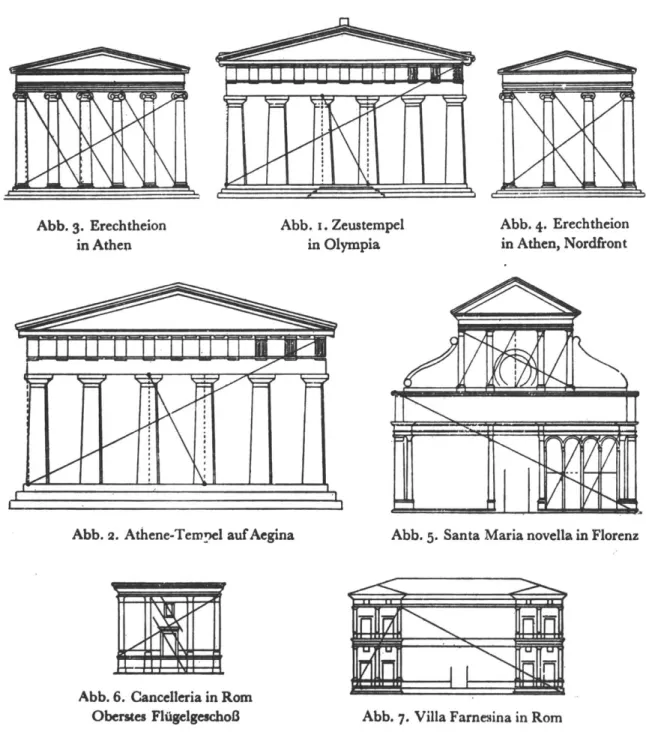
All through the nineteenth and early 20th century
architects and archeologists have tried to find
explanations and keys for the beautiful proportions of many historical monuments. They were searching for traces of early systems of building.
Many systems were offered as an explanation by such men as Viollet-le-Duc, the American J. Hambidge, the Norwegian F. 14. Lund, Sir Thomas Cook and Matila Ghyha,
Some of the systems offered were various geometrical compositions composed of circles, rectangles, squares and diagonal lines as conforming to established criteria to result in harmony and beauty of proportion. Other
systems offered were based upon mathematical manipulation
for example the planning of a facade - the fenistratton
had to conform to a repetition based upon a mathematical progression.
Analysis of many historical buildings and paintings resulted in the belief that the buildings were designed
17
D,
B
C
PLAE LVII
The Parthenon, Harmonic Analysis (Hambidge)
Geometric Systems as a Basis of Design PLATE 5
18
I ~ I ~ 1
-I,
/
PLATE XLV
Gothic Masons' Marks
Geometric Systems as a Basis of Design PLATE 6
eeN
"IKI
z
/000 z
\1 1
D
19
PLAra LX
Egyptian Temple Plan-Rock Tomb at Mira (Moessel)
Geometric Systems as a Basis of Design
20
PLAT LXII
Pantheon of Rome, Harmonic Analysis (Wiener) Geometric Systems as a Basis of Design
__ ~
RP PB
IPF
-Jpu
DTTPW3,PDPE
AsurAu5cMA-PLATE LXXIX
Fagade in F Proportion by a Pupil of C. IlHuptli
M 1 2o.-0 (D 0 *CD (D -(1) Cl (D co) ~z1
22 *I* *~\ I' ~ I 1%
N..
4
TI 00 1' , d F' /; ~'*;r~K
d
4~
t
Ne 'r~educed/I c, urteo II/% r 'e'. \-/i inal ( a/ler .I.andon.
'ltc XII RaLphael Crui/ixiton. Dccaguon mnd Pciiuon.
Geometric Systems as a Basis of Design PLATE 10
23
\
I I/
-/l
I
/
ISi rul uraI .l diauram of RIpha8el' ( Cn.ci/ixiall
24
=
Abb- 3. Erechtheion
in Athen
Abb. I. Zeustempel Abb. 4. Erechtheion
in Olympia in Athen, Nordfront
Abb. 2. Athene-Tempel auf Aegina Abb. 5. Santa Maria novella in Florenz
Abb. 6. Cancelleria in Rom
Oberstes FingelgeschoB Abb. 7. Villa Farnesina in Rom
13. ANALYSES OF CLASSICAL BUILDINGS BY W6LPFLIN
(From Heinrich Wblfflin's Kleine Schrfften, 1946.)
Geometric Systems as a Basis of Design
PLATE 12
3
K
I25
II. THE VILLA SAREGO AT MIEGA
(From Palladio's I quattro 1ibri dell'architettura, translated by Isaac Ware, 1738; Pl. 1.)
Analytical Systems as a Basis of Design
26
construction to achieve visual harmony and beauty. Plates
5 thru 13.
THE MODULOR
The Modulor is an attempt to design through the use of a system. A system of planning based upon the human scale and constructed from a combination of geometrical and mathematical progressions.
The Modulor as a system of architectural proportion is to produce harmony and unity in buildings, through the use of repitition of like shapes and measures - each related to the human scale. The Modulor is also to provide measures which can be used for mass production of articles used by man and still relate to each other with a human value.
Le Corbusier, developed the Modulor system in Post War France and has used the system in his Unite D' Habitation at Marseilles. Plate 14.
THE CRYSTAL PALACE
An example of a building designed as a total system of elements of growth is the Crystal Palace. Joseph
Paxton was not concerned with the over all size of the building but with the individual parts, the units from
27
which it was made.
The size of the building was no longer important,
it was required merely to serve the purpose to a perfection and from this its proportion would flow. The size was
determined by the number of unit components used and the building could be arbitrarily larger or smaller.
The component parts, columns, trusses, beams and connections, each designed so as to best maximize the industrial process were the important elements. The spatial organization of the final product was only one of many configurations that could have been built from the machine perfect elements.
The whole structure is made up entirely of small prefabricated parts, there is no suggestion of a powerful overwhelming mass. The final building character is a synthesis of the industrial process which fabricated its components. There is nothing which is not
immediately intelligible down to the finest detail. Plate 15.
A BUCKMINISTER FULLER LIGHT-WEIGHT DOME
A combination of tubes, acting as compression members, light tension rods and folded rhombs of sheet
28
metal gives a space system for very light, wide-span dome structures with a cross section based on the great
circle. Plate 16.
YOUTZ LIFT SLAB SYSTEM
The completion of a building erected by means of the "Youtz Lift Slab" system begins with the installation of pipe runs and wiring. Vertical exterior and interior prefabricated building elements are mounted between the
concrete slabs. Plate 17.
UNISTRUT SYSTEM
The U-shaped standard sections of the unistrut
system are assembled into space-frame systems with bent-plate connections. The geometric moduler system of
Unistrut construction utilizes standardized floor, ceiling, roof and wall panels. Plate 18.
THE GENERAL PANEL SYSTEM
The "General Panel System" developed by Walter
Gropins and Konrad Wachsmann is a system of construction
utilizing industrial techniques. The aim was to design the most versittle possible prefabricated building
29
element suitable for easy assembly of small structures. It was part of the general concept that windows, doors, glazing, fittings and mechanical installations should all be incorporated in the building elements in advance. The final result was a prefabricated structure that
could be moved from the factory by unskilled workers in a day.
The component parts consisted of standard wood panels, with metal connectors, identical in aspect on all sides, which contains the electrical installations. Other building elements included sills, roof trusses, gable and roof panels and all the corresponding feller strips.
All the elements were coordinated for construction
and planning flexibility, to a three-dimensional modular arrangement. Plate 19.
30
FIlj
Analytical
1Q2
Systems as a Basis of Design
31
1 Koistruktionssysten eines Binderleldes des Kristallpalastes in
London, 1851. Achsenabstand der Stutzen 24 FuO
2 Details von unten nach oberv Ouerschnitt der Guleisensaule mit
Aulageplatte. Anschlu6 der StUtze an den Socket und die
scnniede-eisernen Diagonalverstreuungen. Oberer AnschluB der Diagonal-verstrebungen mit der Auflage fUr die guiteisernen Binder. An-sichlen und Schnitte des Kreuzungspunktes der schmiedeeisernen Diagonalverstrebungen * I ~ 4 Ku
1!.
1-~ ~*~] I~
A System of Building PLATE 1532
A System of Building
& A System of Building PLATE 18 33 yr
IT
144 Die an den Enden gerade abgesdihIttenen U-fbrmigen Stan-dardprodf le des Unistrut-Systems bilden mil Hille gefaltoter Knolen bleche raumliche Fschwerksysteme
18$ Die Aullagepunkle der verteillen Lasten aul einzelne
Knoten-punkte ruhen auf kleir.en Fundamentsteinen, die mit Stellschrauben adjustiert werden Ydnnen.
186 Die Verlegung der landadrdscrten Fullbodenpilten ist
iden-tisch nm1 del Verlegung oer Decken- Dich- und Wanqplatlen
-198 (|i b F ~'.' A System of Building PLATE 19 34
.1
V35
IV. A I M 0F THE T H
E S I S
The aim of the thesis is to apply the systematic approach as a basis for the design of buildings
compatable with and part of our vastly expanding
scientific society. We must conceive of our buildings as a total system - a system of growth, a system of adaptability, a system of structure - a synthesis of many sub-systems all united and working together.
We must impart to these many vystems a hierarchy of use - of purpose. The systems must evolve from
there singular purpose and yet interact with each other to receive maximum utilization from each and from the whole. The hierarchy of space and use must indicate how some systems are subordinate to others and yet how
each has an impact on the other.
The scale of this building is of the new scale with many varied functions accommodated at the same time.
The building is a city in itself and must, like the city, offer to the person a sense of spatial quality - an
36
V. THE P R 0 G R A M
The vehicle for a study on the systematic approach to design and building is the design of a concrete
building of approximately 1,500,000 square feet to house academic research activities in the fields of science and technology.
One of the basic premises is that the function of the building will change in use through time. The buildings we are building today have a structural life that will last many years, yet our technology is advancing and changing rapidly. Many of the changes are unpredic-table. So that the building may continue to be of
service in the future - so as not to grow obsolete, the
building must be able to change - to accommodate to
changing functions.
The building must have a system of growth - both
internally and externally. We must provide flexibility
to the user - present and future.
There are many activities which must be accommodated in this one building: classrooms, offices, seminars, laboratories, workshops, drafting rooms, libraries,
37
rooms. Each of these functions have specific require-ments. We must find what requirements that they all
have in common. What are the common denominators for
all these activities?
Flexibility of internal space dictates that we design
neutral areas containing the common denominators so as to allow an area to be accommodated to a specific function with a minimum of modification.
38
VI.
THE S
0 L U T
I O
N
The systems of the building must be established in a hierarchy of purpose. Some systems are of a more permanent nature than others.
The most permanent system is the structural system. The mechanical system, etc. can be taken completely out
of the building but the very shell must remain. Any change in the building must be accomplished without interrupting or altering the structure.
THE SYSTEMS
The sub-systems which contribute to the total system: 1. Space-flexibility system. 2. Utility-service system. 3. Structural system. 4. Circulation system. 5. Electrical system. 6. Communications system. 7. Air-Conditioning system.
39
The subosystems are divided into two categories:
1. Permanent systems.
2. Temporary systems.
The permanent systems are those which are required in any contemporary inhabited building regardless of the specific function.
The temporary systems are those which are required
by one of the specific functions of the building
-research laboratories. These services are of a temporary
nature because to satisfy the original premise of complete program flexibility we must assume that the location of the laboratory is temporary,
FLEXIBILITY FOR TEMPORARY AND PERMANENT SYSTEMS
By definition the permanent systems are those
required throughout the building regardless of functional change. Therefore the permanent systems can originally be built into all parts of the building systems in the original design and do not require any large degree of
flexibility.
The temporary systems, however, require complete
40
Permanent systems:
1. Space flexibility system.
2. Structural systems. 3. Circulation system. 4. Electrical system.
5. Communication system. 6. AireConditioning system.
7. Artificial Illumination system.
The temporary systems:
1. Utilityoservice system.
THE UTILITY-SERVICE SYSTEM
The Utility-Service System supplies utilities and services that may be required for any type of research
activity:
1. Direct air and fume exhaust.
2. Special temperature control requirements.
3. Utilities of a fluid or gaseous
state transferred in pipes or flexible conduit.
4. Additional electric power supply.
41
6. Any new utility or system required by a changing technology.
The Utility*Service System must be easily accessible to any area of the building without altering the structure. Other considerations must be added to this. Part of the service that this system supports is to provide space for air and fume ducts to be vented directly to the roof. It is a requirement for many types of fume hoods to be vented with a minimum of horizontal duct. Another service of this system is to receive waste drains from sinks, c.
Short runs of straight pipe are preferred for drains
because of the slope required.
To satisfy these objectives all vertical lines for the system are in the columns. The column utility-service
lines are terminated in a sub-basement system of service tunnels and extend to the roof offering direct vertical exhaust.
Horizontal lines, so as not to interfere with the partitions, will be housed within the structural depth. Utilities-service must be allowed complete flexibility
which necessitates that they be accessable to every module. This will require a hole in the structural grid in every
42
grid the maximum horizontal run for any utility need not be longer than 20'.
THE SPACE*FLEXIBILITY SYSTEM
The Space-Flexibility system provides for maximum internal flexibility, either by decreasing or increasing floor area, by moving and/or building partitions. To prevent confusion and chaos the moving or rebuilding of new partitions must be regulated by some order or control,
This order or control can be accomplished by
establishing a grid upon which to build partitions. All space will then grow in increments of the basic unit of the grid: the module.
The physical dimensions of the grid can be permanently established in the building by an exposed floor structure corresponding to the direction and size of the grid.
The under side of the exposed structural webs forms a
logical and sound construction termination for partitions.
A module of 5' square was selected on the following
premises:
1. Smallest desirable width for
43
2. Smallest desirable inhabitable space 10' x 10'.
3. Maximum number of different room
sizes is obtained by using a small module.
THE STRUCTURA SYSTEM
In addition to the basic requirements of structure, to support, to span and to enclose space, the structure must also satisfy requirements dictated by other sub-systems.
The Space-flexibility system demands an exposed floor structure of constant floor to ceiling height.
The system further dictates ribs in two directions i five foot square grid. These conditions are satisfied with a two way rib slab built on a five foot square grid.
The Utilities-Service system demands access
openings within the structural depth in both directions. This condition is satisfied by holes left in the ribs of the slab, which necessitates increasing the structural depth.
The system also has many vertical services of sufficient dimensions to accommodate a large utility
44
supply. These services are enclosed within the column space. This condition is satisfied by split columns with a nominal dimension of one module five feet square.
A bay dimension was chosen on the premise that the
smaller the structural bay then the more varied are the
spatial configurations which can be adapted. Forty
foot clear span was chosen as small enough to satisfy
this requirement and at the same time provide enough
dimension for an adequately large room.
THE AIR- CONDITIONING SYSTEM
The Air-Conditioning system is a permanent system and is supplied to all areas of the building. The function of this system is to ventilate and maintain a desired temperature level.
This system is an all-air system with an interior zone and a perimeter zone. The cooling towers are
located on the top of each core, thus freeing the roof area for exterior research and activities. The boilers,
fan rooms and refrigeration equipment are located in a sub-basement mechanical room.
The primary horizontal air supply and return is located in the structural cavity above the primary
45
circulation on each floor.
Air is supplied to and returned from the interior and exterior zone by an air floor system which is attached to the primary horizontal air.
An air floor system was used in place of the more conventional duct distribution system. Ducts would be an intrusion into the structural depth which has been reserved for the utilities-service system. The air-conditioning system is a permanent system and can be built in.
Assigning the two systems to a horizontal strati-fication within the floor depth allows each system to function without compromising each other.
Each module has a diffuser hole cast into the top of the structure. Every other module houses a supply diffuser and each adjacent module a return diffuser.
The diffusers are sized to handle just the required amount of air for one module area, twenty five square feet.
Thus, the smallest room of 10' x 10' is four modules in area and has two supply and two return
diffusers, handling an amount of air sufficient for the
46
air system any arrangement of partitions can be accomplished without rearranging the air-conditioning system.
The perimeter zone air is re-heated or re-cooled with fan coil units.
THE BUILDING
The total building system thea is composed of eight systems all subordinate to the structural system. A building has a hierarchy of space. Though not needed
today for direct ventilation or light the exterior
perimeter is still the primary space. Man has a
psycho-logical infinity for exterior view. Activities
accom-modating the most people should be grouped on the exterior
so as to allow the largest number of people visual
contact with the exterior. It would be a mistake to obstruct the exterior with storage rooms, cores etc.
The exterior, free of obstructions, forms a continuous flexible floor area which can accommodate to any function.
All other services and functions necessary to this
large building are restricted to the interior space. These interior functions are those which are necessary
for the operation of the building and used by all the
47
The center of the building is the most logical area to place these common functions because they are more strategically located and assesable and do not obstruct the expansion of the permanent perimeter area. These interior functions include toilets, elevators,
stairs, duct space, mechanical equipment rooms, main-tenance rooms, etc.
The cores are designed to be multiples of our
established structural bay. The cores then become part of the system and do not interrupt the integrity of the
structural system.
The positioning of the cores establishes the major horizontal circulation pattern. This resolves a hierarchy
of circulation and offers orientation.
EXTERIOR EXPRESSION
The outside envelope of a building this size must offer variation such as is found in the city scope. Variety must be accomplished by maintaining structural
integrity. There should not be any confusion as to which is structure and that which is not. The exterior
48
VII. C 0 N C L U S I 0 N
The systematic approach to design the use of systems as a basis for design and building is a valid attempt to place architectural design and planning in harmony with
the contemporary age of science and technology.
The premise of considering the component parts of buildings and there services as systems and logically
assigning to them a hierarchy of purpose insures the maximum efficiency from each and the whole. Flexibility
of the total system, both internal and external can only be successfully accomplished when considered in the
original design concept as a system in itself - a system of growth.
Buildings of this size require special emphasis on scale and the creation of internal life. As part of the city scope these large buildings must offer variety and interest. However, variety and interest should be
accomplished without interrupting the integrity of the structural system.
With the system concept buildings need not grow obsolete - they can grow internally and externally to
accommodate future changes in function.
K)
49
Buildings for the industrialized age of today and the future should not be an entity but part of an evolution of growth, change, life.
This evolution can be accomplished by using a systematic rational system of purpose as a basis of design - buildings then can be a synthesis of integrity
50
B I B L 1 0 G R A P h Y
1. Ghyka, Matila. The Geometr of Art and Life,
New York, 1946.
2. Ghyka, Matila. Handbook of Geometrical Composition
And De~sgn London, 1952.
3. Larson, C. T. and Paraskevopoulos, S. C. "Unistrut
System of Construction" Design Brochure No. 1, University of Michigan, 1956.
4. Le Corbusier. Le Modulor, Boulogne 1950; translated
by Peter de Francia and Anna Bostock as The Modulor,
London, 1954,
5. McHale, John. R. Buckmini ster Fuller, New York,
1962.
6. Scholfield, P. H. The Theory of Proportion in
Architecture, London, 1958.
7. Wachsmann, Konrad. The Turning Point of Building,