HAL Id: hal-03122829
https://hal.archives-ouvertes.fr/hal-03122829
Submitted on 9 Feb 2021
HAL is a multi-disciplinary open access
archive for the deposit and dissemination of
sci-entific research documents, whether they are
pub-lished or not. The documents may come from
teaching and research institutions in France or
abroad, or from public or private research centers.
L’archive ouverte pluridisciplinaire HAL, est
destinée au dépôt et à la diffusion de documents
scientifiques de niveau recherche, publiés ou non,
émanant des établissements d’enseignement et de
recherche français ou étrangers, des laboratoires
publics ou privés.
laboratory methodologies, and identification techniques
applied to port environment
Laura Cutroneo, Anna Reboa, Giovanni Besio, Franco Borgogno, Laura
Canesi, Susanna Canuto, Manuela Dara, Francesco Enrile, Iskender Forioso,
Giuseppe Greco, et al.
To cite this version:
Laura Cutroneo, Anna Reboa, Giovanni Besio, Franco Borgogno, Laura Canesi, et al.. Microplastics
in seawater: sampling strategies, laboratory methodologies, and identification techniques applied to
port environment. Environmental Science and Pollution Research, Springer Verlag, 2020, 27 (9),
pp.8938-8952. �10.1007/s11356-020-07783-8(2020)27:8938-8952�. �hal-03122829�
REVIEW ARTICLE
Microplastics in seawater: sampling strategies, laboratory
methodologies, and identification techniques applied
to port environment
Laura Cutroneo1 &Anna Reboa1&Giovanni Besio2&Franco Borgogno3&Laura Canesi1&Susanna Canuto3&
Manuela Dara1&Francesco Enrile2&Iskender Forioso3&Giuseppe Greco1&Véronique Lenoble4&Arianna Malatesta1&
Stéphane Mounier4&Mario Petrillo1&Ruben Rovetta2&Alessandro Stocchino2&Javier Tesan4&Greta Vagge1&
Marco Capello1
Received: 30 July 2019 / Accepted: 21 January 2020 #
Abstract
The European Interreg Italy–France 2014–2020 Maritime Project SPlasH! (Stop to Plastics in H2O!) focused on the study of
microplastics (MPs) in the marine port environment to evaluate their presence, abundance, and mechanisms of diffusion to the open sea. In the framework of this project, a worldwide review of 74 studies was carried out, providing an overview of MP investigation techniques, focusing on sampling strategies, laboratory methodologies, and identification of MPs collected in seawater, and specifically evaluating their applicability to the marine port environment. Nets were the most commonly used device for MP surface sampling, but their use can be difficult in narrow spaces within the port basins, and they must be coupled to discrete sampling devices to cover all port basins. In the laboratory, density separation (NaCl, ZnCl2, NaI, sodium lauryl sulfate (SLS)), filtration (polycarbonate, polyamide,
glass, cellulose, ANOPORE inorganic membrane filters), sieving, visual sorting, and digestion methods (acidic, enzymatic, alkaline, oxidative) were used to separate MPs from seawater. Digestion becomes essential with water samples with great inorganic and organic loads as deriving from a port. Although many studies are based only on visual MP identification under a microscope, analytical identification techniques unequivocally determine the particle nature and the identity of the plastic polymers and are necessary to validate the visual sorting of MPs. Fourier-transform infrared spectroscopy (FTIR) is the most used analytical identification technique. Keywords Microplastics . Seawater monitoring . Sampling devices . Visual sorting . Analytical identification . Port environment
Introduction
Plastic is a synthetic organic compound, derived from polymer-ization processes of organic and inorganic raw materials, such as carbon, silicon, hydrogen, oxygen, and chloride, which can be extracted from oil, coal, or natural gas (Ivar do Sul and Costa
2014). Plastic represents one of the main wastes in seas and oceans (de Lucia et al. 2014). This is due to the widespread use of plastic, which started around six decades ago (Thompson et al.2004; Barnes et al.2009), and it has grown continuously, with a global production of more than 348 million tons in 2017. Asia (50.1%) and China in particular (29.4%) are the largest producers of plastics, followed by Europe (18.5%) and coun-tries that are part of the North American Free Trade Agreement (NAFTA, 17.7%) (PlasticsEurope2018).
Plastic released into the marine environment can have land-based origins (e.g., household or personal care products that reach the sea mainly through waste treatment) or marine-based origins
Responsible Editor: Christian Gagnon
Electronic supplementary material The online version of this article (https://doi.org/10.1007/s11356-020-07783-8) contains supplementary material, which is available to authorized users.
* Laura Cutroneo
1 DISTAV, University of Genoa, 26 Corso Europa,
I-16132 Genoa, Italy
2 DICCA, University of Genoa, 1 Via Montallegro,
I-16145 Genoa, Italy
3
ERI– European Research Institute Onlus, 24/d Via Pinelli, Turin, Italy
4 Laboratoire MIO, University of Toulon, CS 60584, 83041 Toulon
CEDEX 9, France
/ Published online:6 February2020
The Author(s) 2020, corrected publication 2020
(e.g., nylon nets used for fishing) (de Lucia et al.2014; Duis and Coors2016). Due to different physical mechanisms of transport, in particular, currents and tides, plastics are widespread in all marine environments, from the poles to the equator (Derraik
2002; Ivar do Sul and Costa 2014; Lusher et al. 2015; Cincinelli et al.2017).
The wide plastic diffusion in the marine environment be-comes even more important considering plastics with small dimensions (from 1μm to 5 mm are called microplastics (MPs); Gago et al.2018). MPs tend to accumulate on the sur-face of the water column, but they are also transported vertically to the bottom through different mechanisms (Wang et al.2016). Indeed, during their permanence in seawater, the density of the plastic particles can increase, for example, due to biofouling (Cózar et al.2014; Wang et al.2016). Moreover, turbulence generated by strong wind events can determine the mixing of the sea surface layer and, consequently, the redistribution of plastics within this layer (Collignon et al.2012). In addition, MPs can concentrate different contaminants on their surface, such as persistent organic pollutants (POPs), and tend to be easily ingested by aquatic organisms, thus entering the food chain carrying contaminants with them. For this reason, they endanger marine organisms and possibly affect human health since MPs have been found in different foodstuffs, including seafood (Karbalaei et al.2018; Rist et al.2018).
Many efforts are spent in MP study and MPs are part of the national and international laws. For example, the Honolulu Strategy was developed by the United Nations Environment Programme (UNEP) and the National Oceanic and Atmospheric Administration (NOAA), and it provides ap-proaches to minimize plastic waste and to reduce marine debris (Xanthos and Walker2017). Several initiatives across the world have banned plastic bags and microbeads such as the Canadian Environmental Protection Act (Schnurr et al.2018). At the European level, the Marine Strategy Framework Directive (MSFD/2008/56/EC) of the European Commission (EC) estab-lishes a framework for community action in the field of marine environmental policy. It sets the achievement of the Good Environmental Status (GES) by 2020 as the main target, which shall be assessed based on 11 descriptors (European Commission2008; Gago et al.2016). MPs fall within descrip-tor number 10, concerning Marine Litter and are a parameter that needs to be monitored following two criteria: criterion “D10C2 - Primary: The composition, amount and spatial dis-tribution of micro-litter on the coastline, in the surface layer of the water column, and in seabed sediment, are at levels that do not cause harm to the coastal and marine environment”; crite-rion“D10C3 - Secondary: The amount of litter and micro-litter ingested by marine animals is at a level that does not adversely affect the health of the species concerned” (European Commission2017). In 2018, the first European strategy on plastics was adopted, establishing a ban of non-reusable and non-recyclable plastic packaging by 2030 (Schnurr et al.2018).
Despite the great attention placed on the study of MPs, a standard methodology for the MP study in terms of abundance, distribution, and effects on organisms is lacking. Thus, it is difficult to make comparisons between different areas and stud-ies. In this context, the European Commission set up a Technical Group on Marine Litter (TGML) under the MSFD Common Implementation Strategy. One of the documents developed by this organization is the Guidance on Monitoring of Marine Litter in European Seas, which provides the member states of the European Union with recommendations to follow the same strategies on MP investigation in a marine environment (Galgani et al.2013). Other two research groups that dealt with finding common indications for the study and monitoring of MPs in the marine environment are the Joint Group of Experts on the Scientific Aspects of Marine Environmental Protection (GESAMP) and JPI-Oceans that published recently two guides for MP study in the ocean (Gago et al.2018; GESAMP2019). The European Interreg Italy–France 2014–2020 Maritime Project SPlasH! (Stop to Plastics in H2O!; http://interreg-maritime.eu/web/splash) has entered the European panorama of MP study and focused on the MPs investigation inside the marine port environment. This study aimed to analyze common MP sampling strategies, laboratory methodologies, and identification techniques to identify different methods that have been specifically used for seawater analyses all over the world and find the appropriate devises and methodologies for applications inside ports.
The following literature review was carried out from July 2018 to January 2019 using databases, such as Science Direct and Google Scholar and selecting only research studies on MPs in seawater. The term“microplastics” was used for the first time in 2004 (Thompson et al.2004; Hidalgo-Ruz et al.
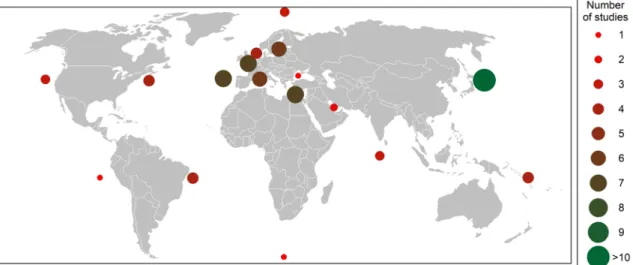
2012), which why the research articles found do not date back prior to this year. A total of 74 research articles were found (complete reference list in Online Resource1): most publica-tions are from 2018, with 81% of all literature published in the last 5 years (Fig.1), and most studies were in the Northern Hemisphere instead of the Southern Hemisphere, as already noted by Gago et al. (2018) (Fig.2).
Microplastic sampling
MP sampling strategies can be distinguished in bulk and volume-reduced samplings (Hidalgo-Ruz et al. 2012). Bulk sampling consists of collecting the entire volume of seawater without reducing it during this process, while the extraction of MPs occurs in a laboratory. Volume-reduced sampling means that each sample is taken, reducing its volume during the sampling process and preserving only the portions of the sam-ples that are useful for further processing in a laboratory. This strategy provides for the extraction of MPs from seawater samples filtered with nets during the sampling process.
MPs in seawater are sampled using different kinds of de-vices. Based on the device used, it is possible to collect dif-ferent layers of the water column, from the surface layer (from 0 to 1 m depth; Song et al.2015) to the bottom layer (Lima et al.2014). Sampling devices can be divided into three cate-gories: non-discrete sampling devices (nets and pumping sys-tems), discrete sampling devices (Niskin bottles, rosette, inte-grating water sampler [IWS], bucket, bottle, and steel sam-pler), and sampling devices of the surface microlayer (sieves and rotating drum sampler).
Non-discrete sampling devices
Nets
Nets have been designed for collecting plankton, but they recently started being used for MP sampling. In general, nets
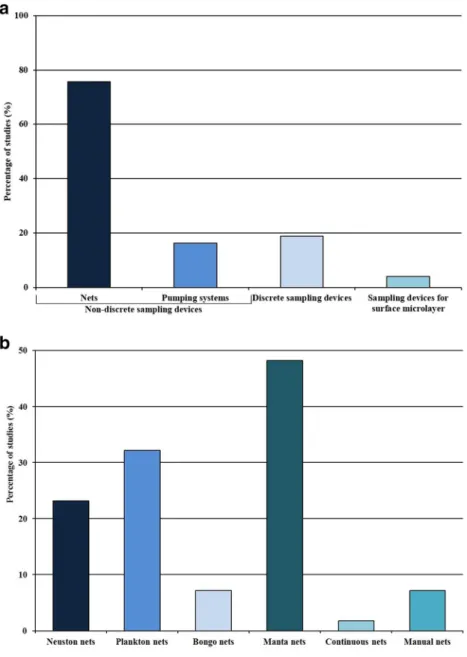
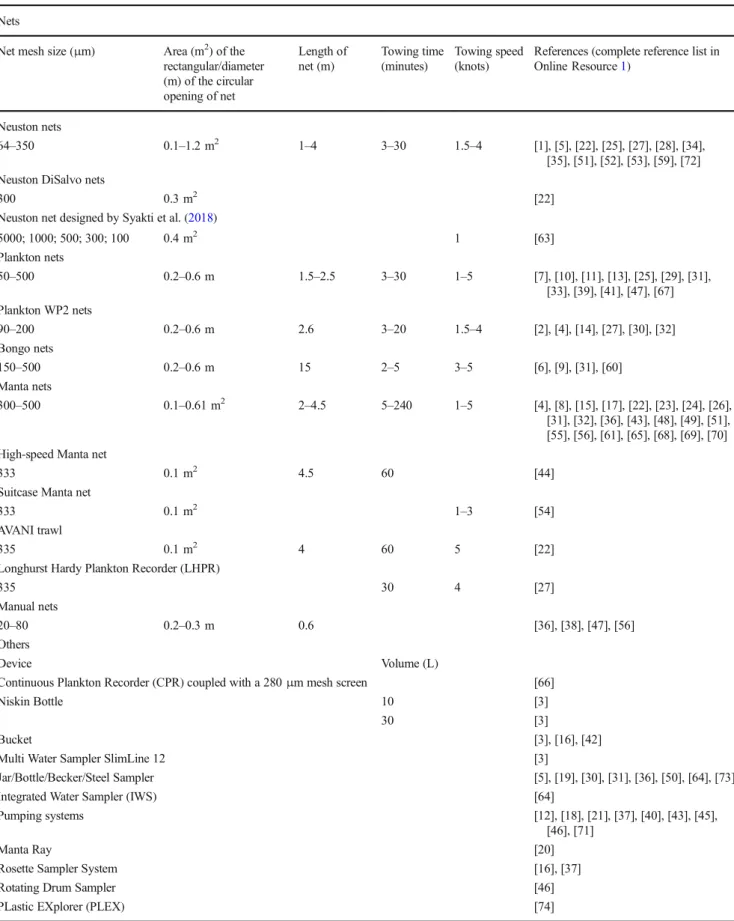
allow for sampling large volumes of water, from the surface to the bottom layer (Lima et al.2014; Kang et al.2015). Nets are the most used devices for MP sampling and their application occurs in 56 out of 74 analyzed studies (76%) (Fig.3a). In these 56 studies, different kinds of nets were used, including a neuston net, plankton net, manta net, continuous net, and man-ual net (Fig.3b). General information about the characteristics of the nets used in the analyzed studies is shown in Table1.
Nets are deployed from the ship using structures (spinnaker, A-frame, etc.) that allow for displaying nets away from the ship to avoid bow wave and turbulence generated from the ship wake (Palatinus et al. 2015; Green et al. 2018). Nets are usually equipped with a flow meter for measuring the amount of water that has been filtered during the trawl (Norén2007). If a flow meter is not present, the amount of filtered water can be calcu-lated with the net opening size and the length of the transect, which in turn can be calculated as the distance between the
Fig. 2 Distribution of areas where the studies analyzed in the present review are conducted and numbers of studies (from 1 to > 10) for each area showed by the colored circles
Fig. 1 Evolution in the published studies on microplastics in seawater from 2004 to 2018
starting and ending points (Eriksen et al.2018). Nets may have a rectangular or circular opening (Gajšt et al.2016; Figueiredo and Vianna2018; Tunçer et al. 2018) with different dimensions (Table1). The net aperture is composed of a rigid frame that maintains a continuous rectangular or circular net opening at the surface, while at the end there is a collecting jar where the sample is concentrated. Two wings, made of a mixture of resins, may be welded at the side of the aperture to keep the net floating on the surface or at a specific depth. Nets are usually built with plastic material (e.g., polyvinyl chloride (PVC)).
Nets are 1.5–4.5 m long (Gajšt et al.2016; Maes et al.2017) and they have variable mesh sizes (20–5000 μm; Khalik et al.
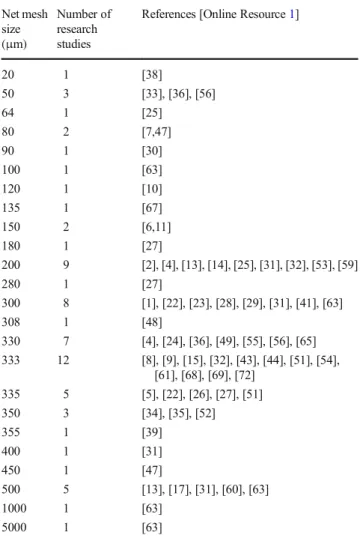
2018; Syakti et al.2018) (Table1). A 333-μm net mesh is most
commonly used in the considered literature (Table2). The use of these mesh sizes causes underestimation of the real number of MPs because the loss of the smaller sizes occurs. However, nets with smaller mesh sizes (e.g., 80μm) are difficult to use because
they can get clogged up, compromising the sampling process (Löder and Gerdts 2015), in particular in a port environment where suspended particles can be very concentrated. For this reason, it is also recommended to avoid collecting samples dur-ing phytoplankton blooms (Löder and Gerdts2015). To over-come the underestimation of MP abundance, with a net, it is possible to combine a device (e.g., discrete sampling device) that allows for the specific evaluation of the small fraction of MPs (Sedlak et al.2017). Otherwise, it is necessary to consider the underestimation due to the lack of information for smaller parti-cles. Nets can be towed horizontally (Collignon et al. 2014), within the superficial layer or at greater depths, vertically from the bottom to the surface to sample the entire water column (Gorokhova2015; Baini et al.2018), or obliquely. In the case of horizontal sampling seawater, nets were towed along the hor-izontal transect within the surface layer for specific periods (3– 240 min; Frias et al.2014; Pan et al.2019) at a known speed (1– Fig. 3 (a) Number of reviewed
studies expressed in percentage (%) in which different sampling devices are used. (b) Number of the reviewed studies expressed in percentage (%) in which different types of net are used; maximum percentage shown in they-axis is equal to 50 instead of 100 to be able to appreciate the difference between each histogram
Table 1 Characteristics of devices used for MP sampling in the studies analyzed in the present study Nets
Net mesh size (μm) Area (m2) of the
rectangular/diameter (m) of the circular opening of net Length of net (m) Towing time (minutes) Towing speed (knots)
References (complete reference list in Online Resource1)
Neuston nets
64–350 0.1–1.2 m2 1–4 3–30 1.5–4 [1], [5], [22], [25], [27], [28], [34], [35], [51], [52], [53], [59], [72] Neuston DiSalvo nets
300 0.3 m2 [22]
Neuston net designed by Syakti et al. (2018)
5000; 1000; 500; 300; 100 0.4 m2 1 [63] Plankton nets 50–500 0.2–0.6 m 1.5–2.5 3–30 1–5 [7], [10], [11], [13], [25], [29], [31], [33], [39], [41], [47], [67] Plankton WP2 nets 90–200 0.2–0.6 m 2.6 3–20 1.5–4 [2], [4], [14], [27], [30], [32] Bongo nets 150–500 0.2–0.6 m 15 2–5 3–5 [6], [9], [31], [60] Manta nets 300–500 0.1–0.61 m2 2–4.5 5–240 1–5 [4], [8], [15], [17], [22], [23], [24], [26], [31], [32], [36], [43], [48], [49], [51], [55], [56], [61], [65], [68], [69], [70] High-speed Manta net
333 0.1 m2 4.5 60 [44]
Suitcase Manta net
333 0.1 m2 1–3 [54]
AVANI trawl
335 0.1 m2 4 60 5 [22]
Longhurst Hardy Plankton Recorder (LHPR)
335 30 4 [27]
Manual nets
20–80 0.2–0.3 m 0.6 [36], [38], [47], [56]
Others
Device Volume (L)
Continuous Plankton Recorder (CPR) coupled with a 280μm mesh screen [66]
Niskin Bottle 10 [3]
30 [3]
Bucket [3], [16], [42]
Multi Water Sampler SlimLine 12 [3]
Jar/Bottle/Becker/Steel Sampler [5], [19], [30], [31], [36], [50], [64], [73]
Integrated Water Sampler (IWS) [64]
Pumping systems [12], [18], [21], [37], [40], [43], [45], [46], [71]
Manta Ray [20]
Rosette Sampler System [16], [37]
Rotating Drum Sampler [46]
5 knots; Eriksen et al.2018; Green et al.2018; Syakti et al.
2018). The speed of the vessels must be calibrated to avoid turbulence, which may influence the flow rate through the net opening and, consequently, the quality of the collected samples. After sampling, nets need to be rinsed from the outside, preferably with decontaminated water (e.g., Milli-Q water), to avoid sampling contamination. Hence, all sampled MP par-ticles are gathered in the collecting jar. Then, the collecting jar is rinsed repeatedly using decontaminated water (e.g., Milli-Q water) and emptied into another jar. Each sample collected with a net is preserved in a jar until laboratory analysis. The net, once cleaned, can be used for the next sampling. Pumping systems
Pumping systems are sampling devices that are less common-ly used than nets. They occurred in 16% of the anacommon-lyzed stud-ies (Fig.3a, Table1). These systems can consist of different
kinds of pumps (Lusher et al.2014; Setälä et al.2016; Zobkov et al.2019) and allow for sampling a large volume of seawater. Seawater intake systems of the vessel can be used for this purpose (Morgana et al.2018). Pumps can be lowered from the vessel using a winch sideways or towards the stern of the ship (Ng and Obbard2006; Setälä et al.2016). There is no standardization for sampling time with pumping systems and they can work for several hours straight along the same tran-sect (Lenz et al.2015) or for a few minutes or hours in differ-ent sampling stations (Desforges et al. 2014; Zobkov et al.
2019). Pumping systems allow for sampling the sub-superficial layer of the water column from surface to 6-m depth or down to a depth of 100 m (Zhao et al. 2015; Morgana et al.2018; Zobkov et al.2019). When sampling is performed continuously, the vessel speed must be kept at 1–12 knots (Enders et al.2015; Setälä et al.2016). The dimension of the sampled MP depends on the filters/sieves of the pumping systems, which allow for selecting plastic of the size of interest. First, there is a filter with a 5-mm mesh size used to remove bigger plastic particles, then a second filter or a series of sieves with a different mesh size that divides MPs into size classes (Desforges et al.2014; Cai et al.2018).
At the end of the sampling, MPs can be directly analyzed on filters, whereas sieves need to be rinsed with decontaminated water (e.g., Milli-Q water) and MPs collected in a glass jar and preserved until labora-tory analysis. Pumping systems can be equipped with a flow meter to determine the rate of filtered water, which can be used to calculate MP abundance and/or mass for volume unit (Cincinelli et al. 2017).
Discrete sampling devices
Discrete sampling devices are used to sample water at specific depths. They were employed in only 19% of the analyzed studies (Fig.3a, Table1). Discrete sampling devices such as Niskin bottle (Bagaev et al.2018), rosette (Dai et al.2018; Kanhai et al.2018), IWS (Tamminga et al.2018) are common in water sampling for different purposes, such as analysis of total suspended solids. For this reason, they are widely known in the literature. Moreover, buckets, bottles, and steel samplers are also used (Dubaish and Liebezeit2013; Khalik et al.2018; Zhu et al. 2019). These devices are lowered manually or through a winch from the vessel down to the sampling depth (Bagaev et al.2018).
At the end of sampling with discrete devices, the sample is transferred to a jar and the inside of the device is rinsed with decontaminated water (e.g., microfiltered water) to collect MP particles that remain attached. The sample is preserved until laboratory analysis. In another way, discrete samples can be filtered (Dai et al.2018) or sieved (Kanhai et al.2018) directly on board.
Table 2 Net mesh sizes used for sampling microplastics in the studies analyzed in the present review. Different net mesh sizes can be used during the same research. To simplify the table, references are here indicated with a number and the corresponding complete list is presented in the Online Resource1
Net mesh size (μm) Number of research studies
References [Online Resource1]
20 1 [38] 50 3 [33], [36], [56] 64 1 [25] 80 2 [7,47] 90 1 [30] 100 1 [63] 120 1 [10] 135 1 [67] 150 2 [6,11] 180 1 [27] 200 9 [2], [4], [13], [14], [25], [31], [32], [53], [59] 280 1 [27] 300 8 [1], [22], [23], [28], [29], [31], [41], [63] 308 1 [48] 330 7 [4], [24], [36], [49], [55], [56], [65] 333 12 [8], [9], [15], [32], [43], [44], [51], [54], [61], [68], [69], [72] 335 5 [5], [22], [26], [27], [51] 350 3 [34], [35], [52] 355 1 [39] 400 1 [31] 450 1 [47] 500 5 [13], [17], [31], [60], [63] 1000 1 [63] 5000 1 [63]
Sampling devices for the surface microlayer
Sampling devices for the sea surface microlayer can collect seawater within the first micrometers of the water column, and only 4% of the analyzed studies used them (Fig.3a, Table1). They are stainless-steel sieves with 2-mm mesh size and a rotating drum sampler that are placed on the surface of the water (Ng and Obbard2006; Song et al.2015).
During sampling, the sieve is placed in contact with the seawater surface, which is retained within the mesh of the sieve due to surface tension and is collected in a stainless-steel plate. This procedure is repeated for a specific amount of time, e.g., 100 times (Song et al.2015). Water collected in the plate is then transferred to a jar and preserved until labo-ratory analysis. A rotating drum sampler is placed on the sea-water surface at the beginning of sampling. It consists of a glass cylinder that rotates while partially submerged, and it has a hydrophilic clean surface, which, using capillary force, can collect samples from the surface microlayer (from 1 to 1000μm depths; Ng and Obbard2006; Hidalgo-Ruz et al.
2012).
MP sample preservation methods
Once the sampling process ends, different sample preservation methods can be used. To preserve the biological component of samples for laboratory analysis, preservation methods mainly involve the use of 4% formalin, which is added to the sample before it is sealed for transfer to the laboratory (van der Hal et al.2017; Figueiredo and Vianna2018). If MPs are the only parameters of interest in a study, ethanol or sample refrigera-tion can be used as a preservative (Castillo et al.2016; Viršek
et al.2016).
Laboratory methodologies for MP analysis
MP samples must undergo one or more separation processes to isolate the MP from seawater. The MP can be directly identified and classified, without separation processes, only when it remains already collected on a filter after sampling. Separation methods can be classified into the following: den-sity separation, filtration, and sieving (Fig.4; Hidalgo-Ruz et al.2012). Visual sorting of samples can be performed prior to filtration or sieving to remove MPs with sizes larger than 5 mm, which are visible with the naked eye (Maes et al.2017), or it can also be performed after sieving by removing the MPs retained on the sieve (Fig.4) (Viršek et al.2016) (Figure4). Moreover, different kinds of sample digestion (acidic, enzy-matic, alkaline, and oxidative) can be performed to separate MPs from biological matter (Miller et al.2017).
Density separation
Density separation removes MPs from the rest of the sample, exploiting the floating properties of MPs in different solutions which need to be denser than MPs. Supernatant-containing MPs are collected and filtered (Barrows et al.2017) (Fig.4). MPs on filters are finally identified and classified. Sodium chlo-ride (NaCl) solutions are the most used (Galgani et al.2013). Other density separation methods can be applied to obtain a denser solution and to float even the densest MPs, and they involve the use of zinc chloride (ZnCl2) (Syakti et al.2018),
sodium iodide (NaI) solution (Saliu et al.2018), or surfactants such as sodium lauryl sulfate (SLS) (Lenz et al.2015).
Filtration
Gravity filtration or vacuum filtration can be performed. Different kinds of filters can be used to separate MPs from seawater, including polycarbonate (Norén2007), polyamide (Enders et al.2015), nylon (Tang et al.2018), glass fiber (Pan et al.2019), cellulose acetate (Castro et al.2016), mixed cel-lulose ester (Desforges et al.2014), cellulose nitrate (Dubaish and Liebezeit 2013), and Anopore inorganic membrane (Anodisc) filters (Saliu et al. 2018). Filter diameters of 45 mm (Norén2007) and 47 mm (Zhu et al.2019) are the most frequently used. The pore sizes of the filters used for MP samples range from 0.2μm (Syakti et al. 2018) to 300μm (Setälä et al.2016). Gridded filters with clearly defined grid lines are used to facilitate MP quantification (MERI2017).
Samples can be directly filtered (no pre-treatment is neces-sary with bulk seawater samples) or they can undergo previous treatments step like sieving, which help retain MP particles (Fig.4). Then, decontaminated water (e.g., micro-filtered wa-ter) is used to remove MPs from the sieve (Lusher et al.2014). In some cases, MP particles retained by the sieve are directly subjected to visual analysis, while MPs contained in the flow passing through the sieve are filtered (Erni-Cassola et al.2017) (Fig.4). Otherwise, the original MP sample can be left to settle to obtain the deposition of the inorganic and biological material on the bottom. Then, the supernatant is filtered, whereas the precipitate is sieved (Castro et al.2016) (Fig.4).
In the final phase of the filtration procedure, filters can be rinsed with pure water, such as ultrapure water, to avoid the formation of salt crystals on the dry filters (Palatinus et al.
2015). Filters are preserved in previously cleaned glass Petri dishes, and remaining solutions can be removed by an oven or a drier (40–70 °C; Hall et al.2015) or at room temperature (Barrows et al.2017). The temperature must be carefully cho-sen since some plastics melt at temperatures lower than 70 °C; however, most of the plastics melt at temperatures higher than 100 °C (Sigma Aldrich 2019). Dried filters are weighed to determine the MP mass (Song et al.2015) or they can undergo a digestion procedure (Abayomi et al.2017).
Sieving
Sieving allows for the separation of MPs from seawater using one or more metal sieves. It can be performed with only one sieve or with a series of sieves. The number of sieves used, and their mesh sizes depend on the sieving goal, such as selection of a specific MP size range, removal of a specific fraction of MPs (e.g., plastic particles with sizes greater than 5 mm), or partition of the MPs into size classes (Masura et al.2015).
Sieving can be carried out directly on the vessel (Desforges et al.2014) or in the laboratory, and it can be performed on the MP sample once it has been separated from seawater through different methods, such as visual sorting, density separation, or digestion methods (Lima et al.2014; Masura et al.2015; Suaria et al.2016; Kroon et al.2018) (Fig.4).
To start a sieving procedure, MP samples are poured onto a sieve or a series of sieves and then rinsed with decontaminated water (e.g., Milli-Q water). When the sieving process is con-cluded, the sieve is rinsed accurately with pre-filtered water to collect all MP particles (Maes et al.2017). MPs on each sieve can be placed or rinsed into Petri dishes or glass jars (Dubaish and Liebezeit2013; Desforges et al.2014) or they can be fil-tered using rinse water (Lusher et al.2014) (Fig. 4). MPs retained by the sieve undergo visual sorting, whereas those that flow through the sieve can undergo filtration (Kang et al.2015; Erni-Cassola et al.2017) (Fig.4). MPs placed on filters or into Petri dishes and glass jars can be dried in an oven or a drier (50– 65 °C or at room temperature; Collignon et al.2012; Palatinus et al.2015) and then weighted.
Digestion methods
Digestion methods are separation techniques that isolate the MP from the organic matter (Miller et al.2017). In fact, digestion
methods are used to degrade the organic part of the sample, whereas MPs are not removed. There are different types of di-gestion, including acidic (Zobkov et al.2019), enzymatic (Saliu et al.2018), alkaline (Zhu et al.2019), and oxidative (Pan et al.
2019), and they can also be used in combination (Tamminga et al.2018). The use of different digestion methods allows for the degradation of a wider range of compounds. Digestion pro-cesses take place after MP separation from seawater, and they are usually coupled with density separation (Masura et al.2015).
Substances that are commonly used during the digestion procedure are hydrogen peroxide (H2O2), with different
vol-umes (30% volvol-umes most used; Dai et al.2018), H2O2
com-bined with a catalyst such as ferrous sulfate (FeSO4) (Masura
et al. 2015), hydrochloric acid (HCl) (Zobkov et al. 2019), hydrofluoric acid (HF) (Dubaish and Liebezeit2013), sodium hydroxide (NaOH) (Cole et al.2014) and/or potassium hydrox-ide (KOH) (Beer et al.2018), sodium hypochlorite (NaClO) (Beer et al. 2018), and different enzymes, of which the most common is proteinase K (Saliu et al.2018). Substances used for digestion of organic matter can be used in combination, such as 30% H2O2, followed by treatment of the sample with 40% HF
(Dubaish and Liebezeit2013). To remove organic matter, wet peroxide oxidation (WPO) can also be used (Sutton et al.2016). After sample digestion, MP samples can undergo other separa-tion processes (e.g., filtrasepara-tion) or they can be identified and classified. Acid digestion using a strong acid, such as HCl or HF, can compromise the structural integrity of the MP (Miller et al.2017), therefore their use is not recommended.
MP identification techniques
MP identification techniques can be divided into visual and analytical techniques. Visual identification provides for MP
Fig. 4 Scheme of different steps of laboratory methodologies applied to separate microplastics from seawater in the studies analyzed in the present review
classification and identification with the naked eye or using a microscope. Analytical techniques (spectroscopy, gas-chro-matography, etc.) require the use of different laboratory equip-ment generally used in analytical chemistry. These techniques allow for the identification of MP polymer.
Visual identification techniques
When studies on MPs started, visual identification techniques are primarily used to identify and classify MPs. They consist of the observation of MPs preserved on a filter (Song et al.
2015) or in Petri dishes (Palatinus et al.2015) or jars (Reisser et al.2013) using the naked eye or a microscope. For this purpose, different microscopes can be used, including fluores-cence (Cai et al.2018), dissection (Sagawa et al.2018), optical (Bagaev et al. 2018), electron (Leslie et al. 2011), stereo (Zobkov et al.2019), binocular (de Lucia et al.2014), inverted (Gorokhova2015), and vertical (Setälä et al. 2016) micro-scopes. Microscope magnification used for MP identification varies from × 4.5 (MERI2017) to × 400 (Norén2007).
A scanning electron microscope (SEM) can also be used. Due to its high resolution, it allows for the most precise MP identification, even if it is not possible to distinguish color (Sagawa et al.2018). Microscopes may be equipped with a camera, and therefore, MPs can also be photographed and sub-sequently analyzed (Sun et al.2018). To facilitate visual analy-sis, especially under the microscope, samples that undergo fil-tration are generally placed on gridded filters (MERI2017).
Three criteria have been established for MP recognition, which allows for discerning MPs from other materials, in par-ticular, biological matter, as follows: MP particles must not have visible cellular or organic structures; fibers should be equally thick throughout their entire length; and particles should exhibit clear and homogeneous color throughout (Norén2007; Hidalgo-Ruz et al.2012; MERI2017). If these criteria are followed, particles can be defined as plastic (Hidalgo-Ruz et al.2012).
Furthermore, a melting test and hot needle test can be per-formed to assess if the observed particles are effectively made of plastic (Enders et al.2015; Tunçer et al.2018). These tests consist of burning particles and the burned particle is defined as plastic if it melts or wrinkles (MERI2017). Specifically, the hot needle test requires the use of a needle previously heated to high temperatures (Gorokhova2015). These tests compromise or cause the loss of the analyzed particle, and for this reason, they are performed only on particles of uncertain nature.
Analytical identification techniques
The application of analytical techniques comes after visual sorting, and it requires different instruments to determine if particles are made of plastic and for MP polymer identifica-tion. The most common instrument used is Fourier-transform
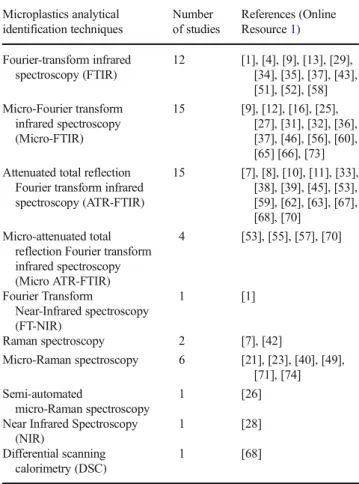
infrared (FTIR) spectroscopy (Table3); MPs can be analyzed individually or on a filter depending on their dimensions (Ng and Obbard2006; Gallagher et al. 2016). For spectroscopy techniques, instruments can be coupled with a microscope for identification of MPs of very small dimensions (< 1 mm). These include micro-FTIR (Frias et al.2014; Sun et al. 2018), micro-attenuated total reflection FTIR (ATR-FTIR) (Palatinus et al. 2015), focal plane array (FPA) detector-based micro-Fourier-transform infrared (FPA-micro-FTIR), and micro-Raman (Enders et al. 2015; Erni-Cassola et al.2017) (Table3). If analytical identification techniques that exploit the thermal stability properties of MPs are applied, destruction of the sample occurs, as when using differential scanning calorimetry (DSC) (Tunçer et al.2018).
All analytical techniques result in a spectrum related to each analyzed particle. To identify which polymer the parti-cles are made of, each spectrum is compared with a reference. Therefore, these techniques allow for unequivocally determin-ing if particles are made of plastic. To facilitate MP identifi-cation, it is possible to use artificial colors, and Nile Red is the fluorescent color most commonly used (Desforges et al.2014; Tamminga et al.2018).
Table 3 Analytical identification techniques of microplastics used in the studies analyzed in the present review. To simplify the table, references are here indicated with a number and the corresponding complete list is presented in the Online Resource1
Microplastics analytical identification techniques Number of studies References (Online Resource1) Fourier-transform infrared spectroscopy (FTIR) 12 [1], [4], [9], [13], [29], [34], [35], [37], [43], [51], [52], [58] Micro-Fourier transform infrared spectroscopy (Micro-FTIR) 15 [9], [12], [16], [25], [27], [31], [32], [36], [37], [46], [56], [60], [65] [66], [73] Attenuated total reflection
Fourier transform infrared spectroscopy (ATR-FTIR) 15 [7], [8], [10], [11], [33], [38], [39], [45], [53], [59], [62], [63], [67], [68], [70] Micro-attenuated total reflection Fourier transform infrared spectroscopy (Micro ATR-FTIR) 4 [53], [55], [57], [70] Fourier Transform Near-Infrared spectroscopy (FT-NIR) 1 [1] Raman spectroscopy 2 [7], [42] Micro-Raman spectroscopy 6 [21], [23], [40], [49], [71], [74] Semi-automated micro-Raman spectroscopy 1 [26] Near Infrared Spectroscopy
(NIR)
1 [28] Differential scanning
calorimetry (DSC)
Analytical techniques are time-consuming because MPs are analyzed one by one, and they are expensive (Frère et al.
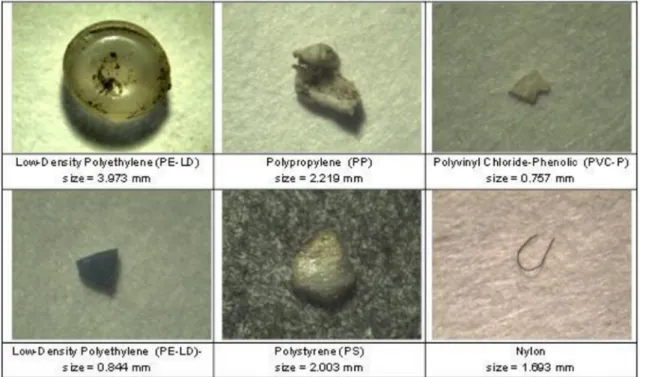
2016). For these reasons, for 17 studies analyzed, only part of the MP was analyzed with analytical techniques; this subset must be representative of all MPs collected during sampling, extending the result of the analytical identification to the bulk sample. Some examples of MP particles analyzed to deter-mine their polymeric composition are shown in Fig.5.
How to report MP results
MP classification
MP classification is based on different morphological character-istics, such as the type (plastic fragments, pellets, filaments, plas-tic films, foamed plasplas-tics, granules, and styrofoam), shape (cy-lindrical, disks, flat, ovoid, spheruloids, rounded, subrounded, subangular, angular, irregular, elongated, degraded, rough, and broken edges), color (transparent, crystalline, white, clear-white-cream, red, orange, blue, opaque, black, gray, brown, green, pink, tan, yellow), size, and type of polymer (Galgani et al.2013).
Different studies used MP classification methods that are slightly different from each other and for this reason, the re-sults of these studies are not comparable.
Abundance and concentration of MPs
Results from MP studies can be reported as abundance or concentration of MP in seawater (Table4). MP abundance is
expressed as surface units (number of MP km−2, number of MP m−2) when MPs are collected from the surface layer of the water column. Moreover, MP abundance can be reported as units of volume. The number of MP m−3is the most used, but the number of MP L−1is also used (Table4). MP concentra-tion can also be estimated from its dry weight and then report-ed as unit area or units of volume (g or mg of MP km−2, g or mg of MP m−3) (Suaria et al.2016; Baini et al.2018; Erni-Cassola et al.2017; Syakti et al.2018).
How to avoid sample contamination
Studies on MP content in seawater are particularly affected by air contamination of the sample. Potential sources of contam-ination during sampling include clothes, all equipment that come into contact which sampling devices such as the paint of the vessel, all kinds of plastic material on the vessel, and devices used to move samples from collecting jars to storage jars (Bagaev et al.2018; Baini et al.2018). To avoid contam-ination as much as possible, it is strongly recommended to wear non-plastic clothes, such as a cotton lab coat and nitrile or latex gloves (Kanhai et al. 2018; Morgana et al.2018). Alternatively, it is possible to wear clothes and gloves of a color that can easily be recognized or to record materials and colors of the equipment in a way to remove them during visual sorting of the sampled MP (Bagaev et al.2018).
In the same way, it is preferred that sampling and lab instru-ments be made of non-plastic materials, such as glass (Bimali Koongolla et al.2018). If plastic items are used, they should be
disposable (Erni-Cassola et al.2017). Otherwise, it is necessary to check possible contamination from the item, analyzing the amount of pre-filtered and preferably distilled water that was used to pre-wash it (Kanhai et al.2018). Pre-washing of sam-pling devices and lab equipment is mandatory, using distilled/ pre-filtered water (Zhu et al.2019), acetone (Beer et al.2018), 70% ethanol (Kroon et al.2018), or an acid (Cole et al.2014). Prior to sampling, checking for possible contamination from the sieves and filters of the sampling device and water used to pre-rinsed them can be useful (Sutton et al.2016). To avoid con-tamination from liquids used during the laboratory procedures, pre-filtration is necessary (Qu et al.2018).
Minimizing air exposure, both during sampling and in the laboratory, is a minimum preventive measure (Zhu et al.
2019); analysis of the MP content of the seawater sample should always occur under a laminar flow hood (Tamminga et al.2018). In addition, it is possible to investigate possible contamination in the laboratory by analyzing a sample of air sucked through a filter (Zhao et al.2015). A good habit that is
extremely useful for assessing sample contamination is plac-ing a blank filter in a Petri dish close to the area where sam-pling and laboratory protocols occur, which must be left open during the entire process. Subsequently, the blank filter must go through the same analysis steps of the sample to compare them and eventually remove MPs found in the blank from the sample results (Lusher et al. 2014; Barrows et al. 2017). Another type of blank is the analysis of negative control (e.g., distilled water): the eventual MP content must be com-pared with the results from the analysis of the samples (Song et al.2015; Cai et al.2018).
Discussion and conclusions
Sampling strategies, laboratory analyses, and identification techniques of MPs are numerous, and there is a lack of proce-dure standardization although a great effort has been underway in this direction in recent years (Gago et al.2018; GESAMP
2019). The use of different methods makes it difficult to com-pare different study results. Moreover, sampling and laboratory analyses of MPs are performed with devices and equipment that are already used to investigate other parameters, and there-fore in some cases, they are not appropriate for the study of microplastics. For example, because some sampling devices are made of plastic material, water samples can be contaminat-ed by them, and a control sample is always necessary. After reviewing 74 papers, the authors present the following sugges-tions regarding different aspects of researching MPs in seawa-ter samples from a port environment.
Sampling devices
A sampling device determines the lower limit in size of the MP collected. A mesh size that is too small (e.g., 10μm) is hard to apply and can easily get clogged, mostly in a marine environment where suspended particles can be very concen-trated such as ports, or during phytoplankton blooms. Nets Nets are strongly recommended for MP sampling, espe-cially from surface seawater in large basin or channels. Mesh sizes of 200, 330, and 333μm are the most commonly used, but, if employed alone, the study lacks the evaluation of MPs smaller than the net mesh size. Despite this, nets are very useful devices because of the following characteristics: fast collection of MPs from a large amount of water in a wide area; not very expensive; no electricity needed; no highly special-ized expertise required. However, because of net length and the fact that net must be kept away from the boat, the horizon-tal use of a net for MP sampling within a port basin can be difficult due to limited spaces, presence of piers, naval traffic, and presence of obstacles (ships, anchors, moorings, and ropes) that typically characterize port basins. Net towing can
Table 4 Microplastics (MP) reporting units in the reviewed studies. The number of studies is equal to 78 instead of the 74 reviewed because some studies did not specify the microplastics reporting unit and others used more than one type of unit. To simplify the table, references are here indicated with a number and the corresponding complete list is presented in Online Resource1 Microplastics reporting unit Number of studies (n = 78)
References (Online Resource
1)
Number of microplastics per square kilometer (MP km−2)
16 [1], [4], [5], [22], [24], [28], [32], [42], [44], [49], [51], [61], [64], [68], [69], [70] Number of microplastics
per square meter (MP m−2)
4 [14], [15], [52], [59]
Number of microplastics per cubic meter (MP m−3) 40 [2], [4], [6], [7], [9], [10], [11], [12], [13], [17], [18], [21], [25], [27], [28], [30], [34], [25], [36], [37], [41], [42], [43], [45], [47], [53], [54], [59], [60], [62], [63], [64], [65], [66], [67], [68], [69], [71], [72], [74] Number of microplastics per liter (MP L−1) 12 [3], [5], [16], [19], [31], [33], [38], [50], [56], [57], [64], [73]
Grams of microplastics per square kilometers (g MP km−2)
2 [4], [59]
Grams of microplastics per cubic meter (g MP m−3)
1 [7] Milligrams of microplastics
per cubic meter (mg MP m−3)
2 [59], [62]
Milligrams of microplastics per square kilometers (mg MP km−2)
therefore be suitable only in long channels present in ports. In the same way, the vertical use of net can be hindered by the low depths that often characterize water column inside port and the presence of obstacles (debris, moorings, etc.) in the water column near piers.
Pumping systems Pumping systems can be coupled with a sieve which directly separate MPs from a larger amount of water. They can be easily used in a port environment because they do not have a large clutter and, therefore, allow sampling in restricted areas, such as between piers and vessels. However, they are more expensive, electricity-consuming, and difficult to clean in between sampling.
Discrete sampling devices Discrete sampling devices allow sampling even in restricted areas and are therefore suitable for sampling in ports; moreover, they are easier to apply than pumping systems because they are not expensive, not electric-ity-consuming, and easy to check for contamination. However, these are only able to collect MPs without any pre-selection in terms of size, thus the results depend only on the laboratory methodologies used (e.g., mesh size of sieves or pore size of filters).
Surface microlayer sampling devices Both the sieve and rotat-ing drum sampler must be used with calm sea to obtain samples of good quality. Since MPs can be found at different depths, from the surface down to the bottom (Dai et al.2018), the sole sampling of the surface microlayer provides an underestimation of the MPs in a study area. In addition, given the small area that can be sampled using these devices, the operations must be repeated numerous times to obtain a sufficiently representative area coverage of the study area. However, these devices allow sampling in even restricted areas and can therefore be useful in port areas with numerous obstructions.
All these considerations are in accordance with the “Guidelines for the monitoring and assessment of plastic litter in the ocean”, which do not recommend any device, relating the choice to the characteristics of the sampling area, the instrumen-tation availability, and the aim of the study (GESAMP2019). However, if the purpose of the research is the characterization of the MP occurrence in a specific area such as port, we would recommend using more than just one sampling device. For ex-ample, MPs from surface seawater may be collected using a net along channel (if present inside the port), while surface water between piers may be collected with a pumping system or a Niskin bottle; those last devices can also be used in parallel with nets to avoid the loss of MPs smaller than the mesh size.
Laboratory procedures and contamination control
The use of hyper-saturated NaCl saline solution is the most convenient density separation method, due to its low cost and
easy availability compared with the other solutions. Solutions of NaI or ZnCl2are not recommended since they are
danger-ous to handle and very expensive.
Filtration is the most reasonable procedure to separate MPs from seawater, and almost every study applies it. In fact, com-paring filtering with sieving, the first can be applied with a small-er pore than a sieve, collecting a widsmall-er size range of MPs. In addition, filtering is less subject to contamination because filters are disposable, while sieves need to be carefully rinsed in be-tween different samples. However, the presence of a blank filter, which must be left open close to the working area and whose use is very common in between the reviewed studies (e.g., Baini et al.
2018; Kanhai et al.2018), is strictly recommended and should be assessed as mandatory during the sample filtering procedure. This type of blank seems to be more useful than using a proce-dural control of filtered distilled water, as air contamination is likely to happen. It is necessary to choose the materials for the filter prior to beginning the study, which depends on the type of analysis performed. In fact, if an analytical identification tech-nique is used, it is mandatory to avoid the use of a filter made of plastic material, which may interfere with the analysis. Digestion of organic matter is a crucial step in the analysis of MPs in water samples taken in the port environment, as very often they are very charged with organic matter that would make it difficult to recognize MPs and disturb polymer analysis.
MP identification
About analytical identification, the visual sorting technique cannot be performed alone, since it is subject to the interpreta-tion of the operator who conducts the analysis and may lead to the underestimation of MPs due to difficulty in observing the smallest ones (< 1 mm) with the naked eye and MPs with micrometric dimensions with the microscope (Hidalgo-Ruz et al.2012). To reduce the risk of underestimation, the visual sorting of a sample must be performed by more than one trained operator (Gajšt et al.2016). Analytical techniques are the only techniques that can assess whether particles are made of plastics and demonstrate how a large part of particles visually defined as plastic is actually made of other materials (e.g., organic matter, cotton fibers, and glass) (Frère et al.2016). However, analytical techniques are expensive and time-consuming; therefore, in most cases, they are not performed for all sampled MP particles. It is mandatory to carry out analytical analysis on at least a subset of samples to validate results obtained by visual analysis, and since MPs are very tiny, it is recommended that a micro-scope be coupled with instruments such as Raman and FTIR to perform a high-quality analysis.
Result reporting
Finally, it is not to be underestimated how MP concentrations are reported. In fact, data presenting different units of
measurement cannot be compared. Already in 2013, the first “Guidance on monitoring of marine litter in European Seas” (Galgani et al.2013) pointed out MP m−3as a useful unit of measurement, and we completely agree with this solution, which should be part of a standard protocol. In addition, we believe that data on seawater surface samples should be pre-sented using MP m−2since the MP m−3unit allows for com-paring results with other studies or matrices, but the MP m−2 unit is more useful to realistically characterize a wide but thin area, such as the seawater surface.
Since a standard protocol for MP investigation in seawater does not exist yet, this study can be a useful tool for taking advantage of both successes and failures of the previous stud-ies; in addition, the authors suggest the use of this review for choosing the best techniques to sample and analyze MPs in such a particular environment as ports.
Fundign information The present study was funded by the European Interreg Italy-France Maritime 2014-2020 Project “SPlasH! - Stop alle Plastiche in H2O” (CUP
D31I18000620007).
References
Abayomi OA, Range P, Al-Ghouti MA, Obbard JP, Almeer SH, Ben-Hamadou R (2017) Microplastics in coastal environments of the Arabian Gulf. Mar Pollut Bull 124:181–188.https://doi.org/10. 1016/j.marpolbul.2017.07.011
Bagaev A, Khatmullina L, Chubarenko I (2018) Anthropogenic microlitter in the Baltic Sea water column. Mar Pollut Bull 129: 918–923.https://doi.org/10.1016/j.marpolbul.2017.10.049
Baini M, Fossi MC, Galli M, Caliani I, Campani T, Finoia G, Panti C (2018) Abundance and characterization of microplastics in the coastal waters of Tuscany (Italy): the application of the MSFD mon-itoring protocol in the Mediterraneand Sea. Mar Pollut Bull 133: 543–552.https://doi.org/10.1016/j.marpolbul.2018.06.016
Barnes DKA, Galgani F, Thompson RC, Barlaz M (2009) Accumulation and fragmentation of plastic debris in global environments. Philos T R Soc 364:1985–1998.https://doi.org/10.1098/rstb.2008.0205
Barrows APW, Neumann CA, Berger ML, Shaw SD (2017) Grabvs. neuston tow net: a microplastic sampling performance comparison and possible advances in the field. Anal Methods-UK 9:1446.
https://doi.org/10.1039/c6ay02387h
Beer S, Garm A, Huwer B, Dierking J, Nielsen TG (2018) No increase in marine microplastic concentration over the last three decades– a
case study from the Baltic Sea. Sci Total Environ 621:1272–1279.
https://doi.org/10.1016/j.scitotenv.2017.10.101
Bimali Koongolla J, Andrady AL, Terney Pradeep Kumara PB, Gangabadage CS (2018) Evidence of microplastics pollution in coastal beaches and waters in southern Sri Lanka. Mar Pollut Bull 137:277–284.https://doi.org/10.1016/j.marpolbul.2018.10.031
Cai M, He H, Liu M, Li S, Tang G, Wang W, Huang P, Wei G, Lin Y, Chen B, Hu J, Cen Z (2018) Lost but can’t be neglected: huge quantities of small microplastics hide in the South China Sea. Sci Total Environ 633:1206–1216.https://doi.org/10.1016/j.scitotenv. 2018.03.197
Castillo AB, Al-Maslamani I, Obbard JP (2016) Prevalence of microplastics in the marine waters of Qatar. Mar Pollut Bull 111: 260–267.https://doi.org/10.1016/j.marpolbul.2016.06.108
Castro RO, Silva ML, Marques MRC, de Araújo FV (2016) Evaluation of microplastics in Jurujuba Cove, Niterói, RJ, Brazil, an area of mus-sels farming. Mar Pollut Bull 110:555–558.https://doi.org/10.1016/ j.marpolbul.2016.05.037
Cincinelli A, Scopetani C, Chelazzi D, Lombardini E, Martellini T, Katsoyiannis A, Fossi MC, Corsolini S (2017) Microplastic in the surface waters of Ross Sea (Antarctica): occurrence, distribution and characterization by FTIR. Chemosphere 175:391–400.https://doi. org/10.1016/j.chemosphere.2017.02.024
Cole M, Webb H, Lindeque PK, Fileman ES, Halsband C, Galloway TS (2014) Isolation of microplastics in biota-rich seawater samples and marine organisms. Sci Rep-UK 4:4528.https://doi.org/10.1038/ srep04528
Collignon A, Hecq JH, Galgani F, Voisin P, Collard F, Goffart A (2012) Neustonic microplastic and zooplankton in the North Western Mediterranean Sea. Mar Pollut Bull 64(4):861–864.https://doi.org/ 10.1016/j.marpolbul.2012.01.011
Collignon A, Hecq J, Galgani F, Collard F, Goffart A (2014) Annual variation in neustonic micro- and meso-plastic particles and zoo-plankton in the Bay of Calvi (Mediterranean-Corsica). Mar Pollut Bull 79:293–298.https://doi.org/10.1016/j.marpolbul.2013.11.023
Cózar A, Echevarría F, Gonzalez-Gordillo JI, Irigoien X, Úbeda B, Hernández-Leon S, Palma AT, Navarro S, García-de-Lomas J, Ruiz A, Fernández-de-Puelles ML, Duarte CM (2014) Plastic debris in the open ocean. P Natl A Sci India 111(28):10239–10244.https:// doi.org/10.1073/pnas.1314705111
Dai Z, Zhang H, Zhou Q, Tian Y, Chen T, Tu C, Fu C, Luo Y (2018) Occurrence of microplastics in the water column and sediment in an inland sea affected by intensive anthropogenic activities. Environ Pollut 242:1557–1565.https://doi.org/10.1016/j.envpol.2018.07. 131
de Lucia GA, Caliani I, Marra S, Camedda A, Coppa S, Alcaro L, Campani T, Giannetti M, Coppola D, Cicero AM, Panti C, Baini M, Guerranti C, Marsili L, Massaro G, Fossi MC, Matiddi M (2014) Amount and distribution of neustonic micro-plastic off the western Sardinian coast (Central-Western Mediterranean Sea). Mar Environ Res 100:10–16.https://doi.org/10.1016/j.marenvres.2014.03.017
Derraik JGB (2002) The pollution of the marine environment by plastic debris: a review. Mar Pollut Bull 44:842–852
Desforges JPW, Galbraith M, Dangerfield N, Ross PS (2014) Widespread distribution of microplastics in subsurface seawater in the NE Pacific Ocean. Mar Pollut Bull 79:94–99.https://doi.org/10.1016/j. marpolbul.2013.12.035
Dubaish F, Liebezeit G (2013) Suspended microplastics and black carbon particles in the jade system, southern North Sea. Water Air Soil Pollut 224(2):1–8.https://doi.org/10.1007/s11270-012-1352-9
Duis K, Coors A (2016) Microplastics in the aquatic and terrestrial envi-ronment: sources (whit a specific focus on personal care products), fate and effects. Environ Sci Eur 28:2.https://doi.org/10.1186/ s12302-015-0069-y
Enders K, Lenz R, Stedmon CA, Nielsen TG (2015) Abundance, size and polymer composition of marine microplastics≥ 10 μm in the Open Access This article is licensed under a Creative Commons
Attribution 4.0 International License, which permits use, sharing, adaptation, distribution and reproduction in any medium or format, as long as you give appropriate credit to the original author(s) and the source, provide a link to the Creative Commons licence, and indicate if changes were made. The images or other third party material in this article are included in the article's Creative Commons licence, unless indicated otherwise in a credit line to the material. If material is not included in the article's Creative Commons licence and your intended use is not permitted by statutory regulation or exceeds the permitted use, you will need to obtain permission directly from the copyright holder. To view a copy of this licence, visithttp://creativecommons.org/licenses/by/4.0/.
samples. Environ Sci Technol 51:13641–13648.https://doi.org/10. 1021/acs.est.7b04512
European Commision (2017) Commission decision (EU) 2017/848 of 17 May 2017 laying down criteria and methodological standards on good environmental status of marine waters and specifications and standardised methods for monitoring and assessment, and repealing decision 2010/477/EU. Off J Eur Union L 125:43–74
European Commission (2008) Directive 2008/56/EC of the European Parliament and of the council establishing a framework for commu-nity action in the field of marine environmental policy (marine strat-egy framework directive). Brussels: Off J Eur Union L164:19–40 Figueiredo GM, Vianna TMP (2018) Suspended microplastics in a highly
p o l l u t e d b a y : a b u n d a n c e , s i z e , a n d a v a i l a b i l i t y f o r mesozooplankton. Mar Pollut Bull 135:256–265.https://doi.org/ 10.1016/j.marpolbul.2018.07.020
Frère L, Paul-Pont I, Moreau J, Soudant P, Lambert C, Huvet A, Rinnert E (2016) A semi-automated Raman micro-spectroscopy method for morphological and chemical characterizations of microplastic litter. Mar Pollut Bull 113:461–468.https://doi.org/10.1016/j.marpolbul. 2016.10.051
Frias JPGL, Otero V, Sobral P (2014) Evidence of microplastics in sam-ples of zooplankton from Portuguese coastal waters. Mar Environ Res 95:89–95.https://doi.org/10.1016/j.marenvres.2014.01.001
Gago J, Galgani F, Maes T, Thompson RC (2016) Microplastics in sea-water: recommendations from the marine strategy framework direc-tive implementation process. Front Mar Sci 3:219.https://doi.org/ 10.3389/fmars.2016.00219
Gago J, Carretero O, Filgueiras AV, Viñas L (2018) Synthetic microfibers in the marine environment: a review on their occurence in seawater and sediments. Mar Pollut Bull 127:365–376.https://doi.org/10. 1016/j.marpolbul.2017.11.070
Gajšt T, Bizjak T, Palatinus A, Liubartseva S, Kržan A (2016) Sea surface microplastics in Slovenian part of the northern Adriatic. Mar Pollut Bull 113:392–399.https://doi.org/10.1016/j.marpolbul.2016.10.031
Galgani F, Hanke G, Werner S, Oosterbaan L, Nilsson P, Fleet D, Kinsey S, Thompson R, Palatinus A, Van Franeker JA, Vlachogianni T, Scoullos M, Veiga JM, Matiddi M, Alcaro L, Maes T, Korpinen S, Budziak A, Leslie H, Gago J, Liebezeit G (2013) Guidance on monitoring of marine litter in European Seas. Report EUR 26113 EN– Joint Research Centre – Institute for Environment and Sustainability, pp. 128
Gallagher A, Rees A, Rowe R, Stevens J, Wright P (2016) Microplastics in the Solent estuarine complex, UK: an initial assessment. Mar Pollut Bull 102:243–249.https://doi.org/10.1016/j.marpolbul. 2015.04.002
GESAMP (2019) Guidelines or the monitoring and assessment of plastic litter and microplastics in the ocean. In: Kershaw PJ, Turra A, Galgani F (eds). (IMO/FAO/UNESCO-IOC/UNIDO/WMO/IAEA/ UN/UNEP/UNDP/ISA Joint Group of Experts on the Scientific Aspects of Marine Environmental Protection). Rep. Stud. GESAMP no. 99, pp. 130
Gorokhova E (2015) Screening for microplastic particles in plankton samples: how to integrate marine litter assessment into existing
monitoring programs? Mar Pollut Bull 99:271–275.https://doi.org/ 10.1016/j.marpolbul.2015.07.056
Green DS, Kregting L, Boots B, Blockley DJ, Brickle P, da Costa M, Crowley Q (2018) A comparison of sampling methods for seawater microplastics and a first report of the microplastic litter in coastal waters of Ascension and Falkland Islands. Mar Pollut Bull 137:695– 701.https://doi.org/10.1016/j.marpolbul.2018.11.004
Hall NM, Berry KLE, Rintoul L, Hoogenboom MO (2015) Microplastic ingestion by scleractinian corals. Mar Biol 162(3):725–732.https:// doi.org/10.1007/s00227-015-2619-7
Hidalgo-Ruz V, Gutow L, Thompson RC, Thiel M (2012) Microplastics in the marine environment: a review of the methods used for identification and quantification. Environ Sci Technol 46:3060– 3075.https://doi.org/10.1021/es2031505
Ivar do Sul JA, Costa MF (2014) The present and future of microplastic pollution in the marine environment. Environ Pollut 185:352–364.
https://doi.org/10.1016/j.envpol.2013.10.036
Kang JH, Kwon OY, Lee KW, Song YK, Shim WJ (2015) Marine neustonic microplastics around the southeastern coast of Korea. Mar Pollut Bull 96:304–312.https://doi.org/10.1016/j.marpolbul. 2015.04.054
Kanhai LDK, Gårdfeldt K, Lyashevska O, Hassellöv M, Thompson RC, O’Connor I (2018) Microplastics in sub-surface waters of the Arctic Central Basin. Mar Pollut Bull 130:8–18.https://doi.org/10.1016/j. marpolbul.2018.03.011
Karbalaei S, Hanachi P, Walker TR, Cole M (2018) Occurrence, sources, human health impacts and mitigation of microplastic pollution. Environ Sci Pollut Res 25:36046–36063.https://doi.org/10.1007/ s11356-018-3508-7
Khalik WMAWM, Ibrahim YS, Anuar ST, Govindasamy S, Baharuddin NF (2018) Microplastics analysis in Malaysian marine waters: a field study of Kuala Nerus and Kuantan. Mar Pollut Bull 135: 451–457.https://doi.org/10.1016/j.marpolbul.2018.07.052
Kroon F, Motti C, Talbot S, Sobral P, Puotinen M (2018) A workflow for improving estimates of microplastic contamination in marine wa-ters: a case study from North-Western Australia. Environ Pollut 238:26–38.https://doi.org/10.1016/j.envpol.2018.03.010
Lenz R, Enders K, Stedmon CA, Mackenzie DMA, Nielsen TG (2015) A critical assessment of visual identification of marine microplastic using Raman spectroscopy for analysis improvement. Mar Pollut Bull 100:82–91.https://doi.org/10.1016/j.marpolbul.2015.09.026
Leslie HA, van der Meulen MD, Kleissen FM, Vethaak AD (2011) Microplastic litter in the Dutch marine environment: providing facts and analysis for Dutch policymakers concerned with marine microplastic litter. (Rapport 1203772-000). Delft / Amsterdam: Deltares / IVM-VU
Lima ARA, Costa MF, Barletta M (2014) Distribution patterns of microplastics within the plankton of a tropical estuary. Environ Res 132:146–155.https://doi.org/10.1016/j.envres.2014.03.031
Löder MG, Gerdts G (2015) Methodology used for the detection and identification of microplastics—a critical appraisal. Marine anthro-pogenic litter. Springer, pp. 201–227. https://doi.org/10.1007/978-3-319-16510-3_8
Lusher AL, Burke A, O'Connor I, Officer R (2014) Microplastic pollution in the Northeast Atlantic Ocean: validated and opportunistic sam-pling. Mar Pollut Bull 88(1):325–333.https://doi.org/10.1016/j. marpolbul.2014.08.023
Lusher AL, Tirelli V, O’Connor I, Officer R (2015) Microplastics in Arctic polar waters: the first reported values of particles in surface and sub-surface samples. Sci Rep-UK 5:14947.https://doi.org/10. 1038/srep14947
Maes T, Van der Meulen MD, Devriese LI, Leslie HA, Huvet A, Frère L, Robbens J, Vethaak AD (2017) Microplastic baseline surveys at the water surface and sediments of the North-East Atlantic. Front Mar Sci 4:135.https://doi.org/10.3389/fmars.2017.00135
Atlantic Ocean and their modelled vertical distribution. Mar Pollut Bull 100:70–81.https://doi.org/10.1016/j.marpolbul.2015.09.027
Eriksen M, Liboiron M, Kiessling T, Charron L, Alling A, Lebreton L, Richards H, Roth B, Ory NC, Hidalgo-Ruz V, Meerhoff E, Box C, Cummins A, Thiel M (2018) Microplastic sampling with the AVANI trawl compared to two neuston trawls in the Bay of Bengal and South Pacific. Mar Pollut Bull 232:430–439.https://doi.org/10. 1016/j.envpol.2017.09.058
Erni-Cassola G, Gibson MI, Thompson RC, Christie-Oleza JA (2017) Lost, but found with Nile red: a novel method for detecting and quantifying small microplastics (1 mm to 20μm) in environmental
and fish samples off Northeast Greenland. Environ Pollut 242: 1078–1086.https://doi.org/10.1016/j.envpol.2018.08.001
Ng KL, Obbard JP (2006) Prevalence of microplastics in Singapore’s coastal marine environment. Mar Pollut Bull 52:761–767.https:// doi.org/10.1016/j.marpolbul.2005.11.017
Norén F (2007) Small plastic particles in coastal Swedish waters. KIMO Report, pp. 11
Palatinus A, Viršek MK, Kaberi E (2015) DeFishGear protocols for sea surface and beach sediment sampling and sample analysis. pp. 27.
http://mio-ecsde.org/wp-content/uploads/2014/12/Protocols-sea-surfacebeach-sediments-Feb15.pdf. Accessed January 2019 Pan Z, Guo H, Chen H, Wang S, Sun X, Zou Q, Zhang Y, Lin H, Cai S,
Huang J (2019) Microplastics in the northwestern Pacific: abun-dance, distribution, and characteristics. Sci Total Environ 650: 1913–1922.https://doi.org/10.1016/j.scitotenv.2018.09.244
PlasticsEurope (2018) Annual report 2018“Plastics – the Facts 2018. An analysis of European latest plastics production, demand and waste data”.https://www.plasticseurope.org/it/resources/market-data. Accessed March 2019
Qu X, Su L, Li H, Liang M, Shi H (2018) Assessing the relationship between the abundance and properties of microplastics in water and in mussels. Sci Total Environ 621:679–686.https://doi.org/10.1016/ j.scitotenv.2017.11.284
Reisser J, Shaw J, Wilcox C, Hardesty BD, Proietti M, Thums M, Pattiaratchi C (2013) Marine plastic pollution in waters around Australia: characteristics, concentrations, and pathways. PloS One 8(11):e80466
Rist S, Carney Almroth B, Hartmann NB, Karlsson TM (2018) A critical perspective on early communications concerning human health as-pects of microplastics. Sci Total Environ 626:720–726.https://doi. org/10.1016/j.scitotenv.2018.01.092
Sagawa N, Kawaai K, Hinata H (2018) Abundance and size of microplastics in a coastal sea: comparison among bottom sediment, beach sediment, and surface water. Mar Pollut Bull 133:532–542.
https://doi.org/10.1016/j.marpolbul.2018.05.036
Saliu F, Montano S, Garavaglia MG, Lasagni M, Seveso D, Galli P (2018) Microplastic and charred microplastic in the Faafu Atoll, Maldives. Mar Pollut Bull 136:464–471.https://doi.org/10.1016/j. marpolbul.2018.09.023
Schnurr REJ, Alboiu V, Chaudhary M, Corbett RA, Quanz ME, Sankar K, Srain HS, Thavarajah V, Xanthos D, Walker TR (2018) Reducing marine pollution from single-use plastics (SUPs): a review. Mar Pollut Bull 137:157–171.https://doi.org/10.1016/j.marpolbul. 2018.10.001
Sedlak M, Sutton R, Box C, Sun J, Lin D (2017) Final sampling and analysis plan for microplastic monitoring in San Francisco Bay and adjacent nation marine sanctuaries. SFEI contribution 819. Richmond CA, pp. 136
Setälä O, Magnusson K, Lehtiniemi M, Norén F (2016) Distribution and abundance of surface water microlitter in the Baltic Sea: a compar-ison of two sampling methods. Mar Pollut Bull 110(1):177–183.
https://doi.org/10.1016/j.marpolbul.2016.06.065
Sigma Aldrich (2019) Thermal transitions of homopolymers: glass tran-sition & melting point https://www.sigmaaldrich.com/technical- documents/articles/materials-science/polymer-science/thermal-transitions-of-homopolymers.html(accessed June 2019)
Song YK, Hong SH, Jang M, Han GM, Rani M, Lee J, Shim WJ (2015) A comparison of microscopic and spectroscopic identification methods for analysis of microplastics in environmental samples. Mar Pollut Bull 93:202–209.https://doi.org/10.1016/j.marpolbul. 2015.01.015
Suaria G, Avio CG, Mineo A, Lattin GL, Magaldi MG, Belmonte G (2016) The Mediterranean plastic soup: synthetic polymers in Mediterranean surface waters. Sci Rep-UK 6:37551.https://doi. org/10.1038/srep37551
Sun X, Liang J, Zhu M, Zhao Y, Zhang B (2018) Microplastics in sea-water and zooplankton from the Yellow Sea. Environ Pollut 242: 585–595.https://doi.org/10.1016/j.envpol.2018.07.014
Sutton R, Mason SA, Stanek SK, Willis-Norton E, Wren IF, Box C (2016) Microplastic contamination in the San Francisco Bay, California, USA. Mar Pollut Bull 109:230–235.https://doi.org/10. 1016/j.marpolbul.2016.05.077
Syakti AD, Hidayati NV, Jaya YV, Siregar SH, Yude R, Suhendy Asia L, Wong-Wah-Chung P, Doumenq P (2018) Simultaneous grading of microplastic size sampling in the Small Island of Bintan water, Indonesia. Mar Pollut Bull 137:593–600.https://doi.org/10.1016/j. marpolbul.2018.11.005
Tamminga M, Hengstmann E, Fischer EK (2018) Microplastic analysis in the south Funen archipelago, Baltic Sea, implementing manta trawling and bulk sampling. Mar Pollut Bull 128:601–608.https:// doi.org/10.1016/j.marpolbul.2018.01.066
Tang G, Liu M, Zhou Q, He H, Chen K, Zhang H, Hu J, Huang Q, Luo Y, Ke H, Chen B, Xu X, Cai M (2018) Microplastics and polycyclic aromatic hydrocarbons (PAHs) in Xiamen coastal areas: implica-tions for anthropogenic impacts. Sci Total Environ 634:811–820.
https://doi.org/10.1016/j.scitotenv.2018.03.336
Thompson RC, Olsen Y, Mitchell RP, Davis A, Rowland SJ, John AWG, McGonigle D, Russell AE (2004) Lost at sea: where is all the plas-tic? Science 304:838.https://doi.org/10.1126/science.1094559
Tunçer S, Artüz OB, Demirkol M, Artüz ML (2018) First report of oc-currence, distribution, and composition of microplastics in surface waters of the Sea of Marmara, Turkey. Mar Pollut Bull 135:283– 289.https://doi.org/10.1016/j.marpolbul.2018.06.054
van der Hal N, Ariel A, Angel DL (2017) Exceptionally high abundances of microplastics in the oligotrophic Israeli Mediterranean coastal waters. Mar Pollut Bull 116:151–155.https://doi.org/10.1016/j. marpolbul.2016.12.052
Viršek MK, Palatinus A, Koren S, Peterlin M, Horvat P, Kržan A (2016) Protocol for microplastics sampling on the sea surface and sample analysis. JOVEJ Vis Exp 118:55161.https://doi.org/10.3791/55161
Wang J, Tan Z, Peng J, Qiu Q, Li M (2016) The behaviors of microplastic in the marine environment. Mar Environ Res 113:7–17.https://doi. org/10.1016/j.marenvres.2015.10.014
Xanthos D, Walker TR (2017) International policies to reduce plastic marine pollution from single-use plastics (plastic bags and microbeads): a review. Mar Pollut Bull 118:17–26.https://doi.org/ 10.1016/j.marpolbul.2017.02.048
Zhao S, Zhu L, Li D (2015) Microplastic in three urban estuaries, China. Environ Pollut 206:597–604.https://doi.org/10.1016/j.envpol.2015. 08.027
Zhu J, Zhang Q, Li Y, Tan S, Kang Z, Yu X, Lan W, Cai L, Wang J, Shi H (2019) Microplastic pollution in the Maowei Sea, a typical maricul-ture bay of China. Sci Total Environ 658:62–68.https://doi.org/10. 1016/j.scitotenv.2018.12.192
Zobkov MB, Esiukova EE, Zyubin AY, Samusev IG (2019) Microplastic content variation in water column: the observations employing a novel sampling tool in stratified Baltic Sea. Mar Pollut Bull 138: 193–205
Publisher’s note Springer Nature remains neutral with regard to jurisdic-tional claims in published maps and institujurisdic-tional affiliations.
Masura J, Baker J, Foster G, Arthur C (2015) Laboratory methods for the analysis of microplastics in the marine environment: recommenda-tions for quantifying synthetic particles in waters and sediments. NOAA Technical Memorandum NOS-OR&R-48, pp. 39
MERI (Marine & Environmental Research Institute) (2017) Guide to microplastic identification. Marine & Environmental Research
Institute, p 14
Miller ME, Kroon FJ, Motti CA (2017) Recovering microplastics from marine samples: a review of current practices. Mar Pollut Bull 123: 6–18.https://doi.org/10.1016/j.marpolbul.2017.08.058
Morgana S, Ghigliotti L, Estévez-Calvar N, Stifanese R, Wieckzorek A, Doyle T, Christiansen JS, Faimali M, Garaventa F (2018) Microplastics in the Arctic: a case study with sub-surface water