HAL Id: tel-03188299
https://tel.archives-ouvertes.fr/tel-03188299
Submitted on 1 Apr 2021HAL is a multi-disciplinary open access archive for the deposit and dissemination of sci-entific research documents, whether they are pub-lished or not. The documents may come from teaching and research institutions in France or abroad, or from public or private research centers.
L’archive ouverte pluridisciplinaire HAL, est destinée au dépôt et à la diffusion de documents scientifiques de niveau recherche, publiés ou non, émanant des établissements d’enseignement et de recherche français ou étrangers, des laboratoires publics ou privés.
Models and Verification for Composition and
Reconfiguration of Web of Things Applications
Ajay Krishna Muroor Nadumane
To cite this version:
Ajay Krishna Muroor Nadumane. Models and Verification for Composition and Reconfiguration of Web of Things Applications. Other [cs.OH]. Université Grenoble Alpes [2020-..], 2020. English. �NNT : 2020GRALM067�. �tel-03188299�
THÈSE
Pour obtenir le grade de
DOCTEUR DE L’UNIVERSITE GRENOBLE ALPES
Spécialité : InformatiqueArrêté ministériel : 25 mai 2016
Présentée par
Ajay Krishna MUROOR NADUMANE
Thèse dirigée par Gwen SALAÜN, Professeur, Université Grenoble Alpes, et
Co-encadrée par Radu MATEESCU, Directeur de recherche, Inria Grenoble - Rhône-Alpes, et Michel LE PALLEC,
Ingénieur de
recherche
, Nokia Bell Labs Francepréparée au sein du CONVECS Inria Grenoble - Rhône-Alpes dans l'École Doctorale Mathématiques, Sciences et
technologies de l'information, Informatique
Models and Verification for Composition and
Reconfiguration of Web of Things Applications
Modèles et vérification pour la composition et la
reconfiguration d'applications basées sur le web
des objets
Thèse soutenue publiquement le 10 déc. 2020, devant le jury composé de :
Monsieur Olivier BARAIS
Professeur, Université de Rennes 1, Examinateur
Monsieur Didier DONSEZ
Professeur, Université Grenoble Alpes, Président
Madame Pascale LE GALL
Professeur, CentraleSupélec, Rapporteur
Monsieur Michel LE PALLEC
Ingénieur de recherche, Nokia Bell Labs, Co-encadrant de thèse
Monsieur Radu MATEESCU
Directeur de recherche, Inria Grenoble, Co-encadrant de thèse
Monsieur Juan Manuel MURILLO RODRIGUEZ
Professeur, Universidad de Extremadura, RapporteurMonsieur Gwen SALAÜN
Professeur, Université Grenoble Alpes, Directeur de thèse
Monsieur Farouk TOUMANI
Abstract
The Internet of Things (IoT) applications are built by interconnecting everyday objects over a network. These objects or devices sense the environment around them, and their network capabilities allow them to communicate with other objects to perform utilitarian tasks. One of the popular ways to build IoT applications in the consumer domain is by combining different objects using Event-Condition-Action (ECA) rules. These rules are typically in the form of IF something-happens THEN do-something. The Web of Things (WoT) are a set of standards and principles that integrate architectural styles and capabilities of web to the IoT. Even though WoT architecture coupled with ECA rules simplifies the building of IoT applications to a large extent, there are still challenges in making end-users develop advanced appli-cations in a simple yet correct fashion due to dynamic, reactive and heterogeneous nature of IoT systems. The broad objective of this work is to leverage formal methods to provide end-users of IoT applications certain level of guarantee at design time that the designed application will behave as intended upon deployment. In this context, we propose a formal development framework based on the WoT. The objects are de-scribed using a behavioural model derived from the Thing Description specification of WoT. Then, the applications are designed not only by specifying individual ECA rules, but also by composing these rules using a composition language. The language enables users to build more expressive automation scenarios. The description of the objects and their composition are encoded in a formal specification from which the complete behaviour of the application is identified. In order to guarantee correct design of the application, this work proposes a set of generic and application-specific properties that can be validated on the complete behaviour before deployment. Further, the deployed applications may be reconfigured during their application lifecycle. The work supports reconfiguration by specifying reconfiguration properties that allow one to qualitatively compare the behaviour of the new configuration with the original configuration. The implementation of all the proposals is achieved by extending the Mozilla WebThings platform. A new set of user interfaces have been built to support the composition of rules and reconfiguration. A model transforma-tion component which transforms WoT models to formal models and an integratransforma-tion with formal verification toolbox are implemented to enable automation. Finally, a deployment engine is built by extending WebThings APIs. It directs the deployment of applications and reconfigurations respecting their composition semantics.
Résumé
Les applications de l’Internet des objets (IoT) sont construites en interconnectant les objets du quotidien en réseau. Les objets connectés collaborent ensemble, afin d’observer l’environnement les entourant, et agir sur celui-ci. Pour le grand pub-lic, l’un des moyens de créer des applications IoT consiste à combiner différents objets à l’aide de règles d’action conditionnelle (ECA). Ces règles se présentent généralement sous la forme « SI quelque chose se produit, ALORS faire quelque chose ». Le web des objets (Web of Things ou WoT) est un ensemble de normes et de principes qui intègrent les capacités du web et les styles architecturaux à l’IoT. Bien que l’architecture WoT associée aux règles de la ECA simplifie dans une large mesure la construction d’applications IoT, il reste des défis à relever afin que les utilisateurs finaux puissent développer aisément des applications avancées et correctes, en raison de la nature dynamique, réactive et hétérogène des systèmes IoT. L’objectif général de ce travail est de tirer parti des méthodes formelles pour fournir un certain niveau de garantie aux utilisateurs finaux des applications IoT. Cela permet, au moment de la conception, d’assurer que l’application conçue se comportera comme prévu lorsque celle-ci sera déployée. Dans ce contexte, nous proposons un cadre de développement formel basé sur le WoT. Les objets sont décrits à l’aide d’un modèle dérivé de la spécification Thing Description du WoT. Ensuite, les applications sont conçues non seulement en spécifiant les règles individuelles ECA, mais aussi en associant ces règles à l’aide d’un langage de composition. Ce langage permet aux utilisateurs de construire des scénarios d’automatisation plus expressifs. La description des objets et leur composition sont traduites dans une spécification formelle à partir de laquelle le comportement complet de l’application est identifié. Afin de garantir une conception correcte de l’application avant le déploiement, cette thèse propose de valider un ensemble de propriétés génériques et spécifiques sur le comportement complet de l’application. En outre, les applications déployées peuvent être reconfigurées au cours de leur cycle de vie. Le travail supporte la reconfigu-ration en spécifiant des propriétés de reconfigureconfigu-ration qui permettent de comparer qualitativement le comportement de la nouvelle configuration avec la configuration d’origine. La mise en œuvre de toutes les propositions est réalisée en étendant la plate-forme Mozilla WebThings. Un nouvel ensemble d’interfaces utilisateur est construit pour prendre en charge la composition des règles et la reconfiguration de l’application. Un composant permettant de transformer automatiquement les modèles WoT en modèles formels, pleinement intégré au sein d’une boite à outils de vérification formelle a été développé. Enfin, un moteur de déploiement est construit en étendant les API de WebThings. Il dirige le déploiement des applications et des reconfigurations en respectant la sémantique de leur composition.
Acknowledgement
I would like to express my sincerest gratitude to all the people who have contributed to wonderful learning experience during the last three years.
First and foremost, I must thank my thesis director Prof. Gwen Salaün, without his guidance and supervision, the work would not have materialised. Prof. Salaün’s experience, knowledge and passion for work has positively influenced my work. He was always willing to listen, understand the problem and guide me in the right direction. My heartfelt thanks to Prof. Radu Mateescu for his gentle and timely guidance which helped me resolve some of the most challenging problems of my work. I have immensely benefited from his wealth of experience which I will carry into rest of my work and life. My thanks to Dr. Michel Le Pallec for bringing an industrial perspective to my work. He was a perfect host whenever I visited Bell Labs, Paris.
I am also grateful to be working with highly talented people, who are among the best in what they do, as part of Convecs team at Inria. Prof. Hubert Garavel, was always there to help whenever I needed his advice. My thanks to Prof. Frederic Lang for his help on technical matters and also enriching discussions over lunch. I would like to thank Prof. Wendelin Serwe for his help especially related to LNT and modelling. I am thankful to Ms. Myriam Etienne for helping me in managing the administrative aspects of the PhD. My special thanks to all the non-permanent members of the team (PhD students, researchers, interns). I am grateful for their help not just in technical matters, but also in day-to-day life. They made my stay pleasant and fun. I consider myself lucky to be a part of this team where everyone was willing to take time out to help me whenever I popped up with questions. Thanks to members of IoT Control Group at Bell Labs, Paris for their collaboration. I must thank the reviewers of my thesis and the examiners for reviewing my work and participating in my thesis defense in a period like no other.
A big thanks to my friends and family, who have been a pillar of support and helped me to pursue my goals.
Contents
1 Introduction 1
1.1 Context and Motivation . . . 3
1.2 Approach . . . 8
1.3 Contributions . . . 10
1.4 Chronology of Work . . . 12
1.5 Thesis Structure . . . 13
2 Related Work 15 2.1 IoT Application Models . . . 15
2.2 Expressiveness of ECA Languages . . . 19
2.3 Verification of IoT Applications . . . 20
2.4 Reconfiguration of IoT Applications . . . 23
2.5 End-User Tools in Smart Homes . . . 25
2.6 Concluding Remarks . . . 30 3 Background 31 3.1 Behavioural Models . . . 31 3.2 LNT Language . . . 33 3.3 Model Checking . . . 39 3.4 Rewriting Logic . . . 42
4 A Formal Model for the Web of Things 45 4.1 Web of Things Specification . . . 46
4.2 Model for IoT Objects . . . 50
4.3 ECA Rules and a Language for Composition . . . 53
4.4 Specification in LNT . . . 63
4.5 Specification in Maude . . . 71
4.6 Concluding Remarks . . . 74
5 Property Specification for the Web of Things 75 5.1 Design-time Verification with MCL . . . 75
5.1.1 Generic Properties . . . 76
5.1.2 Application Properties . . . 81 5.2 Reconfiguration Properties . . . 84 5.2.1 Seamless Reconfiguration . . . 84 5.2.2 Conservative Reconfiguration . . . 87 5.2.3 Impactful Reconfiguration . . . 89 5.2.4 Reconfiguration Example . . . 91 5.3 Concluding Remarks . . . 92 6 Mozart Tool 93 6.1 Project WebThings . . . 93 6.1.1 WebThings Gateway . . . 93
6.2 WebThings Extensions for Design-time Verification and Reconfiguration 96 6.2.1 Design-time Verification Components . . . 97
6.2.2 Reconfiguration Components . . . 99
6.3 Technology and Implementation . . . 101
6.3.1 CADP Toolbox . . . 101 6.3.2 Maude System . . . 103 6.3.3 Implementation . . . 103 6.4 Evaluation . . . 104 6.4.1 Expressiveness of Compositions . . . 104 6.4.2 User Feedback . . . 106 6.4.3 Verification Performance . . . 108 6.4.4 Deployment Setup . . . 110 6.5 Discussion . . . 112 7 Conclusion 113 7.1 Models for the IoT . . . 113
7.2 Verification for the IoT . . . 114
7.3 Tool Implementation . . . 115
7.4 Future Work . . . 116
Bibliography 119
Introduction
1
„
As machines become more and more efficient and perfect, so it will become clear that imperfection is the greatness of man.—Ernst Fischer Austrian journalist, writer and politician
Over the years, communication technologies and electronics have evolved rapidly, and this has brought the world closer than ever. Among them, the internet has helped uncover new frontiers beyond traditional communication. The internet, in tandem with modern electronic devices, has shattered geographical and cultural barriers, created communities of unimaginable scale and reach, enabled a new breed of enterprises. The Internet of Things (IoT) is one such possibility unleashed by the advent of network communication and modern electronics. In a broad sense, IoT encompasses everything in the physical world that is connected to the internet and we refer this ‘everything’ as objects or devices. An object could be as simple as a light bulb that we use every day, or it could be a complex industrial controller connected to the internet. These objects can communicate with each other and perform utilitarian tasks. The International Telecommunication Union (ITU) defines IoT as: “A global
infrastructure for the information society, enabling advanced services by interconnecting (physical and virtual) things based on existing and evolving interoperable information and communication technologies” [ITU16]. In this work, we call IoT applications a set
of interconnected things designed to serve a specific purpose.
Kevin Ashton, a technologist, first introduced the term IoT in the year 1999 during a presentation at Procter & Gamble (P&G) to describe internet connected systems that interact with physical world through ubiquitous sensors [LLC13]. This definition stemmed out of his research on internet connected Radio-frequency Identification (RFID). However, the idea of connected objects that capture their surroundings is not new and it goes back even further than the advent of the internet. The Plain Old Telephony System (POTS) developed in the late 18th century can be considered as the first connected object system. It captured the sound as an analog signal and transmitted it using conductive wires. Later with the invention of radio, wireless
communication systems came into the market and they enabled a new generation of connected systems. A significant breakthrough in 1959 led to the birth of modern electronics: researchers at Bell Labs invented Metal–Oxide–Semiconductor Field-Effect Transistor (MOSFET), a semiconductor device widely used in digital and analog integrated circuits [Mus20].
If we want to look at an early instance of a more pertinent IoT application, it is the connected soda vending machine at Carnegie Mellon University (CMU). Researchers in the 1980s implemented an application to check if the soda vending machine was empty or recently restocked (the drinks would be warm if they were recently placed inside the machine) from the comfort of their offices [Uni70]. It was achieved using a circuit board connected to the ARPANET, the predecessor of the internet. It is worth noting that the concept of connected objects is not limited to the consumer domain. In 1995, Siemens introduced the M1 GSM module, which pioneered cellular machine-to-machine (M2M) communication [Bha18]. It further ushered a new era of industrial manufacturing with remote monitoring, control, and telemetry involving embedded control systems. As time passed, machines have evolved not only to understand the world around themselves but also to coordinate with other machines and take meaningful decisions.
The IoT ecosystem is rapidly growing towards playing a central role in many ap-plication areas like healthcare, transportation, agriculture, manufacturing, smart homes, and smart cities. It is expected that nearly 125 billion connected IoT devices are to be deployed by 2030 [MTK18]. This explosive growth can be explained by understanding how IoT delivers value to our daily lives.
Simple sensors like a Bluetooth transceiver or a temperature sensor may seem only of specific use when viewed in isolation. The transceiver can exchange data with nearby objects and the temperature sensor can measure the body temperature. But when we connect these seemingly simple objects to the internet and enable them to communicate with each other, the possibilities are beyond the obvious. For instance, Bluetooth combined with GPS helped in contact tracing during the recent Coronavirus outbreak [Gre20]. Smart1thermometers played a key role in tracking
and reducing the spread of Coronavirus by aggregating the temperature data of consumers and accurately predicting the spread of virus even before symptoms appeared in patients [YS20].
1prefixing smart to everyday objects is a way to convey the readers that the object has network and
programming capabilities
1.1
Context and Motivation
As with every system that marches towards maturity, there are some growing pains that need to be overcome before the successful adoption of IoT ecosystem. We aim to solve the challenges in the IoT ecosystem through the usage of formal methods. Before we present the challenges in detail, let us take a quick look at the techniques associated with formal methods. It is important to introduce these techniques as to understand how they can fit in to tackle the challenges in the IoT domain.
Formal Specification and Verification Techniques
Formal methods are techniques grounded on mathematics and formal logic. Using these techniques, complex software, hardware, and cyberphysical systems can be modelled as mathematical entities. The process of describing a non-mathematical representation of a system in a precise formal language is known as formal speci-fication. The rigorous syntax and semantics of the formal language enable formal deduction about the specification. Since the specification captures the behaviour of the system with precision and unambiguity, it can be used to mathematically verify the implementation.
Model checking [BPS01] is a formal verification technique where a system is mod-elled in terms of a finite state machine. This model is fed to a model checker which determines if the given model satisfies properties expressed as logical formulas. Equivalence checking [CS01] is another verification technique which determines whether two models are functionally or semantically equivalent.
Term rewriting [BN99] is a computational technique that deals with equations called rewrite rules. It is a reduction process where rewrite rules are applied to terms. A term could be a variable, constant or a result of an operation on variables and constants. Rewriting logic theory models the static and dynamic aspects of a concurrent system. It consists of an equational theory and a set of conditional rewrite rules representing the static and dynamic aspects [Mes12], respectively. Equational theory combined with the rewrite rules can specify how a concurrent system evolves with respect to its states.
The verification techniques mentioned above can be applied to IoT applications to validate that they behave as intended. Validation of IoT applications is important as there are certain characteristics intrinsic to the applications which make it difficult
to guarantee their correct behaviour. In the subsequent text, we describe these characteristics and how formal methods can be placed in this context.
IoT Application Characteristics and Formal Methods
Among the various characteristics of concurrent systems, the ones that make the development of IoT applications a challenge can be broadly described under three categories.
Heterogeneity: As the IoT ecosystem evolved, it leveraged various underlying technologies, standards, and protocols. There are various standards at different levels of IoT stack [Fuq+15].
Fig. 1.1: IoT standards and protocols
Figure 1.1 provides a snapshot of existing standards in IoT across different layers of the network stack. The list of standards mentioned in Figure 1.1 is not exhaustive, but it tries to give an idea of the diversity present across different layers of the system. The reasons for this diversity are many: evolution of standards over time, proprietary standards, large number of small manufacturers who have constraints to implement standards etc. As Petrarch would say, variety is the cure; these standards provide
ample choice for developing IoT systems but, they bring in a baggage of interoper-ability issues. To build a truly global infrastructure for the information society as envisaged by ITU-T, having a single standard would be ideal. So efforts are focussed on building multi-layer frameworks sometimes reusing these protocols, to overcome fragmentation and allow systems with different underlying standards to be inter-operable. There are various organizations and alliances working on this initiative. Internet Engineering Task Force (IETF) has proposed CoRE (Constrained RESTful Environments), OneM2M [Par20] is a Machine2Machine (M2M) standard for IoT, and Weave is an application level protocol backed by Google. Last but not least, the World Wide Web Consortium (W3C) has published Web of Things [W3C20c], a specification based on the principles of web [GT09].
Although these frameworks solve the problem of interoperability to a large extent, the underlying heterogeneity still remains and thus the difficulties in understanding the complete behaviour of the system. Formal specification of the behaviour can be of help in this area as one can define the behaviour of the different heterogeneous systems in a uniform and unambiguous manner. This specification can provide a platform agnostic definition of the system.
Complexity and dynamicity: The heterogeneity of IoT systems makes it complex to deploy and manage them. Along with this, another salient feature of an IoT system which adds to the complexity is its distributed architecture. IoT systems are built to be distributed, spread across network and geographical boundaries. IoT systems range from small home applications to large deployments like smart cities, manufacturing, etc., and a distributed architecture is readily scalable. However, as distributed systems exhibit a high level of concurrency, it can be a challenge to asses the consistency and correctness of these systems, especially when their behaviours are not clearly defined [Alu+16].
IoT objects being reactive systems, constantly interact with their environment and thus change their states. This behaviour of objects makes the IoT application highly dynamic and thus, susceptible to unexpected behaviour. Identifying unexpected behaviour and at the same time ensuring that required behaviour is in place can be a challenge, even more so in a dynamic system.
By specifying the unexpected and intended behaviours in a system as properties, one can check using model checking techniques whether these properties hold on the formal specification of the system. The property specification and verification can help detect errors in a dynamic and distributed system, which in effect allows one to obtain correctness guarantees with respect to the behaviour of the system.
Maintenance and evolution of applications: IoT applications, especially in the consumer domain are not built once for all. They are being constantly modified or upgraded just like any other consumer electronic device these days. Compared to traditionally stable applications like manufacturing lines, enterprise software, etc., the IoT applications evolve at a faster rate. For example, the change in an application (reconfiguration) could be due to a replacement when a device goes out of service or it could be an upgrade of the device software (functionality). In some cases an application could be entirely replaced to provide altogether a new service.
Evolution of an application involves replacement of an existing behaviour by a new behaviour. Under typical circumstances, the application behaviour is not completely replaced but rather users would like to partially preserve or extend the existing behaviour. One of the challenges in reconfiguration is to qualitatively measure the impact of the change with respect to the existing configuration. Additionally, the reconfiguration takes place during the execution lifecycle of the application and therefore, the impact to running applications should be kept minimal in order to preserve the functionality and quality of service as much as possible.
Term rewriting can efficiently track the evolution of the states in a system as rewriting is primarily a replacement of an expression representing the state of the object by an equivalent expression. Rewriting analysis can identify whether the states in a system are equivalent and also determine whether the two different systems lead to the same state (converge). These techniques can be used in the context of IoT applications in two areas: first, to track the evolution of the system with respect to the original system; and second, to identify the ways to evolve from the original system to the desired system maintaining the consistency of states.
Automation in Smart Homes
The problems mentioned in the earlier section require a range of solutions, some of which are beyond the scope of this work. Furthermore, even though these problems appear across various IoT domains, the solutions would be more meaningful if they are domain specific. So, we focussed our work on consumer IoT, specifically applying our approach on smart homes. Smart home automation is one of the fastest growing areas in IoT. Users can automate tasks in their homes using the smart objects available in the market and unlike industrial automation tasks, this is not limited to skilled or expert users. Usability is a key factor in any system to gain wide adoption, especially where end-users are consumers. In a survey of 250 participants at the 2017 Consumer Electronics Show (CES), almost all (>99%) participants
agreed that usability is an important area for IoT product vendors [Row17]. One of the reasons for smart home automation being accessible is the availability of easy to use UI-based tools like IFTTT [IFT20], OpenHab [Com20] etc. These tools allow one to design automation using rules. Typically, rules are in the form of IF
something-happens THEN do-something. Here, something-happens is a trigger or an
event that needs to happen and as a consequence do-something is the action that is being executed. Since these rules follow the specific pattern, they are known as Event-Condition-Action (ECA) rules and the way of programming automation using these rules is referred as Trigger Action Programming (TAP).
Now let us consider some scenarios in an Ambient Assisted Living (AAL) environment where an elderly person lives, and her/his life is made easier by the setting up automation using connected devices. Being a technology novice, s/he configures simple automation in the form of ECA rules to perform routine tasks. Suppose s/he has a set of objects and s/he has configured the following rules:
R1 : I F bpm( abnormal , t r u e ) THEN hub ( n o t i f y , bpm) AND
c o u n t e r (bpm , i n c r )
R2 : I F c o u n t e r (bpm > 3) THEN hub ( c a l l , 112)
R3 : I F camera ( i n t r u s i o n , t r u e ) THEN alarm ( on , t r u e )
R4 : I F thermometer ( temp > 25) THEN window ( open , t r u e )
R5 : I F motion ( p r e s e n c e , f a l s e ) THEN door ( open , f a l s e ) AND
window ( open , f a l s e )
The R1 rule uses a smart watch (e.g., Apple Watch) which actively monitors the health parameters such as blood pressure, heartrate, oxygen levels, etc. So, if an abnormality is detected, then a notification is sent to a centralized hub device at home (e.g., Google Nest Home) and it features a counter which is updated whenever the alert is received. Suppose if the abnormality is detected more than three times (user did not reset the counter), then it is possible that the user is unwell and emergency services are alerted of the incident as defined in rule R2. The rule R3 is configured to detect intrusions at home. It uses a smart surveillance camera (e.g., Nest IQ), which detects strangers and raises an alarm if an intruder is detected. Internally, it uses an analytics service on the cloud to recognize familiar faces. Further, the rule R4 uses a smart thermometer and when it gets warm in the house, windows are opened. Finally, R5 ensures that the doors and windows remain closed when nobody is in the house.
This home setup illustrates various aspects of smart home automation. It can be observed that IoT objects are more than simple sensors and actuators, they can perform more complex operations (e.g., analytics) and thus have an advanced
behaviour (e.g., the hub and surveillance camera). It is important to consider the behaviour of the objects while designing the rules. For instance, in case of R3, the intrusion detection feature is dependent on the cloud service and this information is not captured in the automation rules. Further in R1, if the user replaces his watch by another watch of a different make, which does not have an arrythmia detection feature, then this abnormality will not be captured by the rule. It can have serious consequences on the health of the user. This problem arises because there are no mechanisms to check if the automations are functionally equivalent. In most of the automation setups, the rules are run in parallel (whenever the events occur). Now considering the rules R4 and R5, there is no guarantee that the windows are always closed when nobody is in the house (temperature can be > 25). This is can be a security issue as the windows might open when the user is away from the home. There are no checks at design time that help users detect unsafe automation.
Considering these aspects, our goal is to enable users design applications in a simple manner, yet provide them with means to ensure that the applications behave as intended upon deployment. This correctness guarantee is accomplished by considering not only the rules but also the behaviour of the individual objects.
1.2
Approach
As mentioned earlier, our work leverages formal methods to address the challenges presented in Section 1.1. Formal modelling allows to specify the behaviour of IoT applications in an abstract manner, independent of the underlying heterogeneous components. This specification can be analysed using formal verification techniques to ensure that the system behaves as intended, i.e., it satisfies certain properties of interest. The specification of an application encompasses objects, rules, and their interactions with the physical environment.
We specify the application on the basis of a multi-layer framework, as these frame-works provide horizontal integration which bridges different protocols. Thus, it allows us to focus on specifying the application behaviour without worrying about underlying protocols. It also makes our approach applicable to all the real-world objects and applications which are supported by the framework. The Web of Things (WoT) is a framework that helps to mitigate the interoperability issues by abstracting the underlying details, yet providing necessary interfaces for the users to develop IoT applications. It uses architectural styles and principles of the web, where each object is identified by its URI. The object’s capabilities and the ways to interact
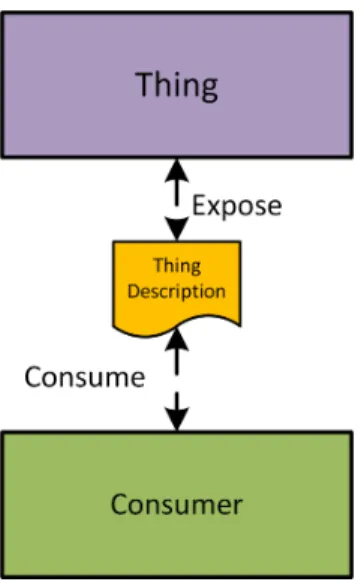
with it, are specified by a machine-readable description called Thing Description (TD) [W3C20b].
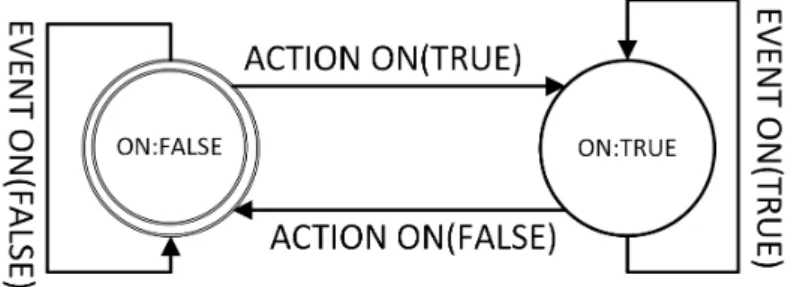
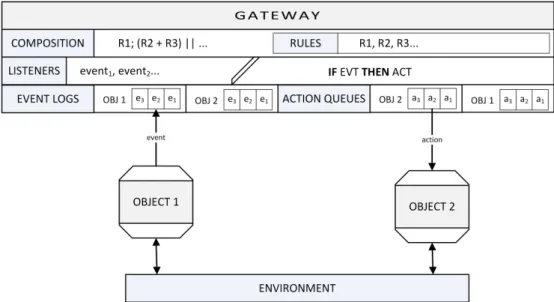
As a first step, we specify the behaviour of an object on the basis of its TD. The behaviour is described in terms of a Labelled Transition System (LTS), a state-transition graph where the system moves from one state to another state depending on the action performed either by the system itself or an external environment. These objects can be used in defining the automation rules. Rules are in the form of IF something-happens THEN do-something. Further, we use a language for composing these rules, which allows one to define more advanced applications in comparison to running the rules independently. Finally, the execution of the application is captured by specifying an environment which interacts with the objects and thus affects the rules and their composition.
Once the model of the application is available, we identified a set of properties that can be checked on the model. These properties are specified as temporal logic formulas. If a model fails to satisfy any of these properties, it indicates that the application behaviour may not be as expected and therefore the design of the application needs to be revised. Once the design is satisfactory, one can proceed to deploy the application.
Regarding the implementation, the application is formally specified in LNT [Cha+18; GLS17], a language with process algebra semantics and programming language syntax. LNT models can be compiled and analysed in CADP [Gar+13], a formal verification toolbox. The correctness properties are specified using Model Checking Language (MCL) [MT08], a data-handling temporal logic suitable for expressing properties of value-passing concurrent systems. The compilers of CADP translate LNT specifications to LTSs on which the MCL formulas are checked and corresponding diagnostics are produced on the fly.
Further, to support possible evolutions of the application over time, we identify reconfiguration properties allowing the designer to compare the current applica-tion with a new one. The properties check whether it is possible to deploy the application maintaining the consistency of states of objects, if the behaviour of the current application is preserved in the new application, and the impact of the new application. This check is achieved by specifying the composition and properties in Maude rewriting logic [Cla+07] as it allows us to track the evolution of the states of objects in the application through rewrite equations.
Users of IoT objects need to be aware of their capabilities and they should be easily able to exploit these capabilities to build useful applications. In the consumer domain,
there are broadly two ways in which users can build applications. First, users with programming knowledge can take advantage of the device and platform APIs like Android Things to build applications. Users who lack programming experience or those who prefer not to use it, can build IoT applications using UI-based tools such as IFTTT [IFT20] and Node-RED [Fou20]. These tools abstract the programming APIs and present users with simple drag-and-drop interfaces to build applications. On the surface it seems that this approach is working well as there is significant adoption of these tools from the general public, but if we dig deeper we find two issues: i) users face difficulties in translating the applications they have in mind into the UI tools [Bri+17]. This is partly due to the fact that these tools are not sufficiently expressive to capture the user requirements [Ur+14; HC15]; and ii) even if the users could design intended applications, they face difficulties in understanding the complete behaviour of the designed application [Bri+17] and if the behaviour is not fully understood, there is no guarantee that the system works as intended.
Keeping these usability issues in mind, we built a tool named MOZART (Mozilla
Advanced Rule Triggers) [Kri+20] by extending the Mozilla WebThings platform [Moz20b], which provides a concrete implementation based on the abstract data models and architecture specified in the Web of Things. MOZARTprovides a user-friendly interface to design compositions, verify them, and deploy them. The expressiveness of the designs is improved by using a composition language based on regular expressions. Verification provides design-time guarantees on the application behaviour.
Once an application is deployed, the users can perform reconfiguration analysis using the MOZARTtool in case they need to update the design. Reconfiguration is supported through an interface that allows users to redesign the application. The interface connects to verification components to perform reconfiguration analysis and provide the result of the analysis to the end user. Finally, reconfigured applications can be deployed in a consistent state using the support provided by the tool. It is worth mentioning that the tool hides the intricacies of formal verification from the end-users by automating the verification process behind a simple user interface.
1.3
Contributions
Our work provides an end-to-end solution i.e., from design-to-deployment for IoT applications. Specifically, by integrating formal methods, it allows one to ensure that
the designed system behaves as expected. In this context, our major contributions are:
• Models for objects and their composition
A behaviour model of IoT objects and their composition is proposed, which helps to understand the behaviour of the application in a uniform and unambiguous way, considering the heterogeneous nature of IoT systems.
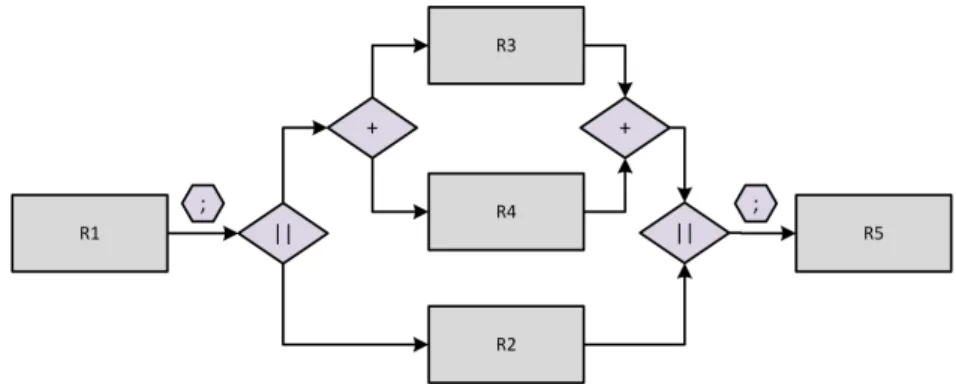
The composition of objects is specified by composing Event-Condition-Action (ECA) rules using a composition language. The syntax and operational semantics of composition is defined in this work.
• Property specification for design and reconfiguration analysis
Support for verification of the composition is achieved by encoding the model and its behaviour in a process algebraic language (LNT) and in rewriting logic (Maude).
Correctness properties during the design of WoT applications are identified and specified in temporal logic. Verifying these properties helps to detect possible issues in the designed systems before deployment.
Support for reconfiguration of IoT applications is provided by specifying properties that qualitatively compare an existing application with the newly designed application.
• Tool support
Transparent integration of formal methods and verification techniques with the Web of Things platform is achieved by developing an easy-to-use UI tool for end-users. This is achieved by extending the Mozilla WebThings platform.
Support for deployment of designed applications is provided through a deployment engine which executes newly designed IoT object compositions and also deploys reconfigured applications seamlessly.
1.4
Chronology of Work
This thesis began in October 2017 at Inria Grenoble in collaboration with Nokia Bell Labs, Paris. The broad objective of this thesis was to integrate formal verification for correct composition and reconfiguration of IoT applications, with focus on consumer IoT.
In the first year of the thesis, we began experimenting on the Majord’Home [Bou+14], an SDN-based platform developed by Bell Labs for deployment of IoT applications. On top of this platform, we proposed a generic interface-based IoT model for com-position and verification [Kri+19b]. It relied on a state based LTS model which captured the behaviour of IoT objects in the state transition system. This model of objects is quite similar to the one presented in this thesis as it specifies the objects’ internal behaviour. Unlike our recent work WoT, the composition of objects was defined using bindings. A binding is the connection between an output of an object to the input of another object. The objects and their bindings defined the overall be-haviour of the composition, which was checked for compatibility. All these proposals were implemented in a tool name IoT Composer [Kri+19a] which was connected to the Majord’Home platform to deploy the composition respecting the bindings. This approach was targeted to IoT applications with a static communication pattern using a simple interface (port) based wiring for generating the composition. In our subsequent work, we use an ECA-based language for defining more expressive compositions and relied on a standard framework, namely WoT.
This thesis covers only the subsequent work on WoT which we did mostly in the second year as it is more relevant in the context of consumer IoT.
In the final year of my thesis, we mostly worked on the quantitative analysis of IoT applications. We built specifications that allow us to perform reliability analysis such as Mean Time to Failure (MTTF) computation and network latency analysis. Since this work is still ongoing at the time of writing, and to keep the manuscript coherent, we have chosen not to present this work and its results in this thesis. Instead, it is mentioned among the future works in the concluding chapter.
Publications
• Ajay Krishna, Michel Le Pallec, Alejandro Martinez, Radu Mateescu, and Gwen Salaün. “MOZART: Design and Deployment of Advanced IoT Applications”. In:
Companion of The Web Conference 2020 (WWW), Taipei, Taiwan, April 20-24, 2020. ACM, 2020, pp. 163–166
• Francisco Durán, Gwen Salaün, and Ajay Krishna. “Automated Composition, Analysis and Deployment of IoT Applications”. In: Software Technology:
Meth-ods and Tools - 51st International Conference, TOOLS 2019, Innopolis, Russia, October 15-17, 2019, Proceedings. Vol. 11771. Lecture Notes in Computer
Science. Springer, 2019, pp. 252–268
• Ajay Krishna, Michel Le Pallec, Radu Mateescu, Ludovic Noirie, and Gwen Salaün. “Rigorous design and deployment of IoT applications”. In: Proceedings
of the 7th International Workshop on Formal Methods in Software Engineering, FormaliSE@ICSE 2019, Montreal, QC, Canada, May 27, 2019. IEEE, 2019,
pp. 21–30
• Ajay Krishna, Michel Le Pallec, Radu Mateescu, Ludovic Noirie, and Gwen Salaün. “IoT Composer: Composition and deployment of IoT applications”. In: 2019 IEEE/ACM 41st International Conference on Software Engineering:
Companion Proceedings (ICSE-Companion). IEEE. 2019, pp. 19–22
1.5
Thesis Structure
Chapter 2 covers the related work. It sheds light on the existing tools in smart
home automation, discusses usability of these tools with regards to expressive-ness, and reviews the works related to verification and reconfiguration of IoT compositions. Our contribution is placed in the context of the state of the art.
Chapter 3 describes the preliminary definitions and background required for the
reading of the subsequent chapters. It introduces terminology related to Web of Things and formal verification. Specifically, LNT and MCL languages are introduced for formal verification. A brief introduction to rewriting logic in Maude is also provided.
Chapter 4 defines the formal models proposed for objects and their composition. It
also defines a language for composition which helps design more expressive scenarios. Further, we define the formal semantics of the rule-based com-position. Finally, the encodings of the composition in LNT and Maude are presented.
Chapter 5 focuses on verification. It defines a set of generic and application-specific properties and their formal specification in MCL. These properties are used to check the correctness of the designed IoT applications. Further, it also defines the set of properties specified in Maude for analysing the reconfiguration of an application.
Chapter 6 covers the implementation of the proposals as an end-user tool. It
describes the various extensions made to the Mozilla WebThings project, as well as experiments related to the evaluation of the proposals.
Chapter 7 concludes the manuscript, summarizing the contributions and suggesting
possible directions for future work.
Related Work
2
„
Study the past if you would define the future.—Confucius Chinese philosopher and politician
This chapter considers the related work to place our contribution in the context of the state of the art. The works are categorized under five sections. First section details the research focusing on models for IoT applications. Then we briefly touch upon the expressiveness of the ECA languages. In the subsequent section a survey on the verification techniques specific to IoT is presented. The penultimate section deals with works pertaining to reconfiguration of applications. Finally, existing tools for designing and deploying IoT applications are surveyed.
2.1
IoT Application Models
This section takes a look at the works in the literature that deal with modelling of IoT applications. These models may not necessarily be used for verification, but they provide a context to compare the proposed model in this work. Note that in the literature we often see IoT application models are also referred to as IoT composition models. Although readers may find that we use the term interchangeably, in our work a composition refers to the design comprising objects and rules and when it is deployed, we refer it to as an application.
In [Fel+17] the authors present a model for IoT configuration based on Answer Set Programming. A configuration consists of a set of constraints and requirements leading to a set of possible solutions. These solutions map to a set of component instances. For modelling smart homes, they identify different types of components: Smart home, smart room and smart appliances. Then concrete instances of these components are specified (e.g., living room, smart thermometer etc.) and a hierar-chical relationship is established between the components (e.g., appliances inside a room). Further, components have attributes and constraints encoded (e.g., home should have at least two rooms). This constraint based declarative model is solved
using a SAT solver to generate a concrete solution(s). This approach is scalable, supports runtime configuration and reconfiguration of applications. However, it is better suited for the initial setup of smart homes rather than designing specific applications at end-user level.
Automated service composition is a technique where objects are modelled with an aim to automatically build a composition satisfying the application requirements. This approach keeps the user intervention to minimum. In [Buc+17], the authors propose an AI planning based approach to solve the composition requirements and guide automated deployment of the composition. The composition is modelled as processes using Adaptable Pervasive Flows Language (APFL), a workflow language. The behaviour of the activities in the process (called fragments) are modelled using a Labelled Transition System (LTS). Similarly, the context of execution is specified using the state-transition system. Fragments are made context aware using context annotations. Finally, requirements are modelled as goals. Fragments, context and requirements are fed to an execution planner to derive consistent solution. This work offers high degree of automation and it can be applied to various domains. It also captures the behavioural information (state information) in the LTS model. A limitation of this approach is that it does not use a rule-based language, which is intuitive and prevalent in the design of IoT applications and it does not follow user-driven design of the applications. Moreover, the model will have to be adapted to the IoT domain as it does not specifically take into account the IoT system architecture.
There are a couple of works that model IoT composition through Business Process Model Notion (BPMN), which is an ISO standard [Sta+13] workflow notation maintained by the Object Management Group. It is quite natural to view IoT applications as workflows as they exhibit a mix of event-driven and flow-based architectures. In [DM17; MD17], the authors use a subset of BPMN elements to model IoT application behaviour – events (timer, start, end), activities (tasks, send, receive), gateways (exclusive split and merge), flows, and data objects. Objects are modelled in separated pools in the process and the interaction is specified through collaboration diagrams. In [MRM13], the authors integrate IoT resources with business process. They identify four components related to IoT resources viz., Physical Entity, IoT Service, IoT Device, and Native Service. Similar to [DM17; MD17], they integrate the IoT resources with traditional process by adding an extra lane for IoT devices, where a device acts like a process participant. Lane is sub-partition in BPMN, which classifies different activities that can interact using sequence flows, whereas in pools only message flows can be used for interaction between the activities.
Overall, the idea of integrating business processes and IoT works because BPMN is expressive and usually only a subset of BPMN elements is required to model applications. However, BPMN semantics is loosely defined and it requires domain knowledge to understand the process execution. Moreover, scalability could be an issue especially when someone has to manage a large number of devices and application, which translates to even bigger number of activities and processes.The applications defined using our composition language can be translated to BPMN processes. We provide this option for users to view the application as a process instead of using BPMN itself as a modelling language.
In [Bro+18], the authors detail IoT-aware business processes. The general idea is similar to [MRM13], introducing the ability to connect the physical world with the digital processes. There are two specialized activities (tasks), sensing and actuating. The sensing task extracts data from the physical device and has a direction connection to the device. The actuating task changes the state of the physical entity. These tasks interact with the entity Thing, which is the representation of the physical device. [CW15] extend this notion further by adding specialized events such as location-based events, error events and intermediate events.
There are other works in the literature which build Petri-Net models from IoT-aware processes. Petri-Nets which are commonly used to model distributed and parallel systems, is a discrete event dynamic model. [Che+18] extend Petri-Nets with sensing event factor to model IoT specific events. It differs from traditional Petri-Net as sensing events have separate places and they define an additional timer variable to model the event waiting time for resources (actions). In [TKJ17], Petri-Nets with priority which is useful in resolving conflicts between actions are used to transform process-aware applications.
In the works related to IoT-aware process models, the focus is on integrating business processes with IoT devices. Interactions between business process elements and IoT devices are modelled here whereas our work is a greenfield model1where the IoT devices are used from the ground-up design.
There are related works based on Model Driven Engineering (MDE) where IoT concepts are abstracted in a model away from underlying implementation details. These models can generate deployable code. ThingML [Har+16] is a modelling language that provides IoT specific constructs for the design and implementation of reactive applications. It relies on two structures – Things and Configuration. A Thing consists of properties, messages, ports and a set of state machines. Ports are the communication interfaces which can send and receive messages. The internal
1
https://en.wikipedia.org/wiki/Greenfield_project
behaviour is specified using state machine or ECA rules to express reaction to events in a stateless fashion. The Configuration or the application specifies the coupling of Things. In [Ber+19], the authors propose a Networking Language Domain Specific Language (DSL) to specify the network of IoT devices. They model the device behaviour using ThingML. Then the designed network is controlled using the proposed policy language. Policies can be defined in terms of rules involving trigger conditions and actions. In [Gom+17], the authors use Elaboration Language, a DSL to describe the architectural model of IoT network. The language elements include an Interface, a Component which consists of properties and services (instances of Interfaces). Interface exposes the services a component can provide, and it enables to bind compatible components. Properties are the state variables. This work targets the networking aspect of IoT systems rather than at the end-user application level. However, these concepts can be translated to application layer as well. MDE techniques are useful as they abstract the heterogeneity of devices and platforms and can generate deployable code. As with any domain specific solution, it requires one to understand the elements of the language and the expressiveness of the generated solutions is limited to the available constructs in the language. Our work instead provides a solution based on a programming paradigm that is very popular in IoT and its underlying models are based on a W3C standard. This makes our solution relevant to end-users especially the non-technical ones as the standard gets widely adopted.
[Gan+15] is a work in the area of Ambient Assisted Living (AAL) that uses timed automata to model home care plans. The care plans describe the medical activities planned in the home of a patient. Each activity is specified as a temporal specification, which indicates when an activity needs to performed in a day. This specification is transformed to a pattern automaton and these patterns are combined together to build an activity automaton which represents the schedule. Finally, activities are composed to build the overall care plan. The composition is done using a specific composition operator which ensures at any instance of time, only a single activity is being executed. Compared to our work, this modelling deals specifically with routine automation which is expressed in terms of temporal expressions. Moreover, the specification is targeted at expert users as there is no high-level specification language.
Finally, in [CBP12], the authors describe behaviour aware composition for web of things. They model the behaviour of things by extending the OASIS standard Devices Profile for Web Services (DPWS). Using the DPWS profile, they specify the behaviour in terms of sequence order (order in which they can send or receive messages). Specifically, at the interface level, they add partial order constraints that define the
device behaviour (afterAll, afterSome, onlyOneOf) and full sequences that need to be respected in terms of state changes. The overall behaviour is represented as a finite state machine. The approach is quite similar to our approach as they account for the internal behaviour of the devices. However, the models are based on the DPWS standard, which although it can be applied to IoT, is more pertinent to web services. Moreover, the composition is defined at interface level and there is no language to specify the interactions between devices.
2.2
Expressiveness of ECA Languages
There are several works on enriching the expressiveness of ECA rules. Since our work uses a composition language, it is worth looking at the works in this area to better understand our choice of the language.
Snoop [CM94] was one of the early works that proposed an ECA language. The au-thors proposed an event specification language which supported simple, composite, and temporal event expressions. Composite events are a combination of one or more events and temporal events which specified the timing of events. They provided operators such as or, any, sequence, aperiodic/periodic (repeat) to build composite events. The authors also proposed algorithms for detecting these composite events. This work is aimed at active databases [PD99] which support event-driven architec-ture. Our work uses a subset of the operators proposed in this work for the design of IoT applications. These operators are sufficiently expressive to build advanced automation scenarios.
The expressiveness and limitations of ECA programming style adopted by IFTTT is discussed in [Ur+16]. They describe their findings by analysing 200,000 IFTTT recipes. Further, in [HC15], the authors provide solutions to clear the ambiguities and improve the expressiveness in ECA rules. The authors classify event triggers and actions in ECA rules in terms of their behaviour. They classify events as state-based or instantaneous, state-based on the time the trigger remains in a particular state. Similarly, the actions are classified as instantaneous, sustained, and extended. Using this classification, they propose a high-level ECA language that uses additional constructs, such as WHEN-event-trigger-DO-action, AS-LONG-AS-state-trigger-DO-sustained-action, etc. These constructs are useful, but introducing them in our work would have required additional training to users who are familiar with IFTTT style rules. Moreover, the implementation of this expressive language along with its operational semantics are not provided in the aforementioned work.
In [Ghi+17], the authors present a tool for non-programmers to customize the behaviour of their web applications using ECA rules. They offer a domain-specific context dependent interface for building rules which allows users create and reuse these rules in different applications. The rules follow the structure IF/WHEN trigger
- expression DO action - expression. In the trigger-expression, one can combine events
using AND, OR operators and also use the NOT operator for negation. The actions can be specified to be executed sequentially. The ECA language presented here is quite similar to the language we use, but we do not allow OR in actions nor NOT operator as they induce ambiguity in the execution. Another important distinction is that we allow composition of rules based on regular expression operators.
In [MSC+19] the authors present a user-interface to debug ECA rules. It partly implements the constructs presented in [HC15]. The authors describe the UI prompts that can aid or prevent users from creating erroneous rules. Similarly, in [DC15], the authors propose intuitive UIs for creating rules with multiple triggers. Here the focus is on better interface design, not on the behavioural correctness of the application. Our interfaces are inspired by the design language of Mozilla and users found it to be quite intuitive (see the user assessment in Chapter 6).
Our work uses a simple yet expressive composition language based on the IF
something-happens THEN do-something style rules. We kept the constructs of the
language simple to avoid introducing additional learning for end-users. Moreover, studies have shown that IFTTT style programming covers nearly 78% of the typical user scenarios [Ur+16].
2.3
Verification of IoT Applications
In this section, we review the works that focus on verifying IoT applications, with special emphasis on verification involving ECA rules.
[Lia+15] is a work that takes advantage of the satisfiability theories. The authors present a safety focussed programming framework for IoT applications. Users write ECA rules and aggregate these rules to build an IoT application, although there are no specific operators for combining the rules. Policies are specified as conditions that should never occur in the application. The set of rules and policies are fed to a safety engine which determines any safety violations in the specification. The engine checks two types of violations – conflicts among the rules and violations of policies. It uses a combination of SMT solving and runtime code exploration. Further in [Lia+16], the authors extend the work to support debugging of detected
policy violations by non-expert users. They propose a framework that localises the fault and uses an SMT solver, to iteratively fix the rule parameters so that the safety properties are satisfied. Although, the authors propose to check these safety violations at design time, checking them at runtime as a monitoring feature would be much more useful.
In [Nac+18], the authors present a building management system that allows users to build automation in large buildings using trigger-action programming. The automa-tion is built using rules of the form IF something-happens THEN do something. Rules are mapped to predefined categories (classes of objects). They are considered to be in conflict when more than one rule is simultaneously active and specific actions cannot be satisfied at the same time. They identify the conflicts by encoding the rules as a propositional formula, which is fed to the Z3 SMT solver [DB08] to check for satisfiability. Rules are checked for conflicts at two levels: design time conflicts are identified statically, and runtime conflicts (which depend on the interaction with the environment) by simulation. Further, users can assign priorities to rules for conflict resolution. The runtime check is similar to the policy violation check proposed in [Lia+15]. Compared to the works [Nac+18; Lia+15], our verification is not specific to rules and it considers the entire application behaviour for checking correctness.
In [JLC13], the authors translate the ECA rules into Petri nets (PN). They use this PN model to analyse two correctness properties: termination and confluence. Termination indicates that the set of rules in the system always yields a result and confluence ensures that possible interleaving in the rules will always lead to the same result. Rules with priorities are taken into account by extending PNs with priorities. The two properties described in this work are generic properties that deals only with the rules, whereas our work supports user-specified properties and the model upon which these properties are verified accounts for the behaviour of the objects.
The tool vIRONy [Van+17], based on the domain specific language IRON, provides a simulation environment to analyse ECA systems’ behaviour. It has a formal verification component which uses SMT solvers and program analysis to check the safety and correctness of a set of ECA rules. The tool checks properties such as termination of rules, non-determinism, unused, incorrect and redundant rules. The tool also features a semantic analyser to perform quantitative and qualitative analysis. This wide range of support for verification is made possible by specifying the ECA rules into IRON programs, which are subsequently transformed by vIRONy to Alloy specifications to perform verification. Compared to our work, the authors
do not consider the internal behaviour of the objects. Objects are modelled as simple sensors and actuators with properties that can be set to a specific value. We model the internal behaviour respecting the order of execution, which is useful in modelling complex objects containing embedded software. Also from a usability point of view, usage of IRON as a composition language makes the approach less relevant to end-users.
[Ouc18] uses formal verification for checking functional correctness in IoT systems. The authors define an IoT architecture with actors, sensors, web services, and physical infrastructure. The architecture is formalized using a process algebra encoding which specifies atomic actions in the components and the interactions between components using a composition operator. The encoding is specified in PRISM language and the functional requirements are expressed as probabilistic computation tree logic (PCTL) formulas. In this model, execution of an action has a cost and probability associated to it. Compared to other works, here the focus is on quantitative requirements rather than general correctness of the system. Thus, the cost/probability model allows one to capture requirements in terms of likelihood or possibility than as discrete actions. It is to be noted that the architecture is not derived from any existing IoT standards, and therefore the semantics of IoT applications captured in this work may not be fully relevant to real-world IoT systems.
In [HCH19] the verification deals with identifying attack chains in trigger-action programming. As the number of rules and devices increase, users may inadvertently provide access to unauthorized devices. This happens when action of an ECA rule is chained as an event in another rules. The authors identify privacy leakage and privilege escalation as the two attack categories. The interaction between devices is modelled as a finite state machine. Devices contain attributes that represent the state and the devices are classified into read only (sensor) and read-write (actuator). Rules are modelled to run concurrently, each rule encoded as a Boolean function, and being triggered when the function returns true. The authors use NuSMV model checker to identify property violations in the automata. This work deals with a specific aspect of chaining of events in rules. Our work does not focus on this aspect, but since our model compiles to an automata, we could verify these chaining of events as safety properties using model checking.
In [Eri09], the authors propose a UI-based tool REX (Rule and Event eXplorer) which allows one to specify event, rules, and application requirements. The event language proposed allows to specify complex events by composing basic ones. The rules are transformed into a timed automata specification in UPPAAL and the requirements
are expressed in CTL. In order to make the tool accessible to non-expert users, the authors use the property patterns such as absence, existence, precedence, etc., as identified in [DAC98]. The tool also supports termination analysis for a given set of rules. This work does not specifically target IoT applications, but since it uses a rule-based language, it can be applied to IoT applications too. Compared to our work, the authors model time in their specification. Events are associated with an expiration time. We found this useful under specific contexts (e.g., manufacturing automation) but for smart home scenarios, it would be simpler to abstract the expiration time to ∞ (endless wait). For instance, if more than one event needs to be triggered, the system waits until all the required events occur as events or actions in home devices like lights, alarms, weather monitors etc., are not time-bound. Regarding the verification, the work focuses on the behaviour of the rules rather than the complete behaviour of the system. This prevents discovering the instances where the rules with different objects are perfectly valid, but they could not be executed as one or more objects may have dependencies that need to be executed before the execution of the rules.
A common theme in these IoT verification works is that correctness is checked at rule level. The composition of objects is validated by verifying the interaction between the objects for correctness. Our work is different in the context of ECA rules as our verification accounts for both interaction between the objects (rules) and also the behaviour of the individual objects involved in these rules.
2.4
Reconfiguration of IoT Applications
As our work proposes reconfiguration properties that allows users to qualitatively compare a redesigned application with the original application, we review some of the works pertaining to reconfiguration of IoT applications.
The authors in [See+19] present an architecture to support automated dynamic reconfiguration of IoT applications in building automation systems. They model the application using a semantic description called Recipes. Recipes have the objects as ingredients along with interactions between ingredients. Recipes are executed as an autonomous choreography. Automated dynamic reconfiguration is enabled by adding constraints to the Recipes. When failures are detected in the distributed environment, the system automatically recovers the configuration respecting the constraints to maintain optimal service. Contrary to this work, our proposals focus on user-driven reconfiguration rather than environment or system driven reconfiguration. It allows
users to make a choice decide whether to proceed with the changes or preserve the existing configuration after performing a comparative analysis. A reconfiguration can never be fully automated as not all reconfiguration scenarios have feasible solutions and in such cases user intervention will be required. Moreover, since our target is personal spaces like homes, it is wise to take user choice into account.
The work by Felfernig et. al [Fel+17] described in Section 2.1, model smart home configuration using Answer Set Programming. They also propose to apply the con-figuration techniques for reconcon-figuration. The hierarchical relationship established between the components can be used to identify compatible components during reconfiguration. Unlike our work, the impact of reconfiguration is not measured here. This work can be complementary to our checks. Initial reconfiguration setup can be checked for the component compatibility and then proceed with the behavioural checks.
In [LBP09], the authors propose recovery mechanisms when dealing with service failures in the context of an Ambient Assisted Living(AAL) system. They propose two kinds of reconfiguration strategies. First, a static reconfiguration is proposed, where at design time components are specified with alternative fallback options (e.g., if there are two lights in the living room, the second light is an alternative if the first light fails). The second option is more dynamic in nature, called effect-based reconfiguration. It compensates for the failed operation by identifying one or more operations from the available devices that produce an effect identical or close to the failed operation. Compared to our work, the focus here is on service failures, whereas we consider both replacements and upgrades to the system. Our approach allows users to compare designs and importantly, enables objects to be deployed seamlessly under certain conditions.
On modelling adaptive systems which enable dynamic reconfiguration, [HLR17] pro-poses a framework which models IoT object functionality using SysML4IoT [FMS14]. The interactions between objects are captured in a publish-subscribe system. The system configuration is adapted as a response to the change in environment. The adaptation is guided by a deployment plan, which is a runtime instance of the IoT system containing values of different attributes of the objects. These plans are modelled as a state-transition system where states refer to the system configurations and transitions are adaptation events. In comparison, we deal with design time reconfiguration of the application, whereas [HLR17] focusses on runtime adaptation and it does not take user feedback into account while performing the adaptation.
There are recent works that tackle dynamic reconfiguration using machine learning techniques. In [Roj+20], the authors use neural networks for automating the
actions among IoT devices. Initially, the home is set up with a bunch of automation rules (configuration). As the time goes by, these rules in the automation may not be appropriate and thus, users may have to manually interact with the devices. The authors use the contextual information available in the objects (how they interacted, environment status, etc.) to predict the future actions (new configuration) as the context evolves. Similarly, in [PA19], the authors use the historical data related to user and rules to offer users a personalized automation rules for changing con-texts. These works are complementary to our work. The interactions and the rules proposed through machine learning can be checked for reconfiguration properties before deployment.
2.5
End-User Tools in Smart Homes
There are several tools available for end-users to design and deploy IoT applications. During the course of this thesis, the tools have evolved in many different ways. Popular tools have added more features, and a few tools have been integrated into larger ecosystems (e.g., Workflow [Inc20a] is now integrated into Apple iOS). The list of tools in this section is not exhaustive, it covers only a few of the popular tools that are relevant to our work. Importantly, the work describes the available features of the tools at the time of writing.
IFTTT
IF-This-THEN-That (IFTTT) [IFT20] is one of the most popular automation platforms. It initially started as a web-based automation service, which has evolved to support physical IoT objects through the cloud-based web service. The app is available on the web and as a native app on phones.
As the name suggests, IFTTT uses trigger-action-programming as the basis for au-tomation. There are four concepts in IFFTT that enable users to build auau-tomation. An applet or recipe is similar to an application, is made up of triggers and actions (events and actions) in the form IF-THIS-THEN-THAT. Triggers are the event
condi-tions that are encoded in the “THIS” part of the applet. Accondi-tions are the resulting reaction or output encoded in the “THAT” part of the applet. Services or channels are similar to objects in an application, they provide data and interfaces that can be integrated in an applet. A service exposes a set of triggers and actions.