HAL Id: halshs-00587703
https://halshs.archives-ouvertes.fr/halshs-00587703
Preprint submitted on 21 Apr 2011HAL is a multi-disciplinary open access archive for the deposit and dissemination of sci-entific research documents, whether they are pub-lished or not. The documents may come from teaching and research institutions in France or abroad, or from public or private research centers.
L’archive ouverte pluridisciplinaire HAL, est destinée au dépôt et à la diffusion de documents scientifiques de niveau recherche, publiés ou non, émanant des établissements d’enseignement et de recherche français ou étrangers, des laboratoires publics ou privés.
Robert Boyer
To cite this version:
Robert Boyer. Growth strategies and poverty reduction: the institutional complementarity hypothesis. 2007. �halshs-00587703�
WORKING PAPER N° 2007 - 43
Growth strategies and poverty reduction:
the institutional complementarity hypothesis
Robert Boyer
JEL Codes: B52, O11, O17, O57, P52
Keywords: development theory, antipoverty policy, Washington consensus, new institutional economics, institutional complementarity hypothesis, qualitative comparative analysis, growth diagnosis
P
ARIS-
JOURDANS
CIENCESE
CONOMIQUESL
ABORATOIRE D’E
CONOMIEA
PPLIQUÉE-
INRA48,BD JOURDAN –E.N.S.–75014PARIS TÉL. :33(0)143136300 – FAX :33(0)143136310
www.pse.ens.fr
CENTRE NATIONAL DE LA RECHERCHE SCIENTIFIQUE –ÉCOLE DES HAUTES ÉTUDES EN SCIENCES SOCIALES
S
S
TTRRAATTÉÉGGIIEESSDDEECCRROOIISSSSAANNCCEEEETTPPOOLLIITTIIQQUUEESSDDEELLUUTTTTEECCOONNTTRREELLAA P PAAUUVVRREETTÉÉ:
:
l
l
’
’
h
h
y
y
p
p
o
o
t
t
h
h
è
è
s
s
e
e
d
d
e
e
c
c
o
o
m
m
p
p
l
l
é
é
m
m
e
e
n
n
t
t
a
a
r
r
i
i
t
t
é
é
i
i
n
n
s
s
t
t
i
i
t
t
u
u
t
t
i
i
o
o
n
n
n
n
e
e
l
l
l
l
e
e
Robert Boyer
RésuméAu cours des deux dernières décennies, les politiques qui supposaient une séparabilité des stratégies de lutte contre la pauvreté et de la logique du régime de croissance ont montré leurs limites. De plus, elles étaient basées essentiellement sur l’activation de mécanismes de marché. Par contraste les recherches en économie institutionnelle soulignent que la résilience et la performance des économies dérivent de la cohérence d’un ensemble de mécanismes de coordination, qui sont plus complémentaires que substituts au marché. L’hypothèse de complémentarité institutionnelle s’avère précieuse pour analyser simultanément les politiques anti-pauvreté et la dynamisation des régimes de croissance. Les différentes formes de capitalisme sont l’expression de complémentarités différentes entre le type de compétition, les institutions du marché du travail, la couverture sociale et le système d’innovation. Très généralement, les économies en voie de développement ne peuvent imiter ces configurations mais les études de cas nationales menées par l’UNRISD font ressortir des traits communs à la plupart des expériences réussies. Elles ont créé l’équivalent de cercles vertueux au sein desquels stimulation de la croissance et programme anti-pauvreté se confortent l’une l’autre. L’article propose deux méthodes pour détecter ces complémentarités : l’analyse qualitative comparative d’une part, les diagnostics des facteurs limitant la croissance de l’autre. Il importe aussi de prendre en compte la séquence des différentes mesures et le temps long du changement institutionnel.
G
G
RROOWWTTHHS
S
TTRRAATTEEGGIIEESSAANNDDP
P
OOVVEERRTTYYR
R
EEDDUUCCTTIIOONN:
:
t
t
h
h
e
e
I
I
n
n
s
s
t
t
i
i
t
t
u
u
t
t
i
i
o
o
n
n
a
a
l
l
C
C
o
o
m
m
p
p
l
l
e
e
m
m
e
e
n
n
t
t
a
a
r
r
i
i
t
t
y
y
H
H
y
y
p
p
o
o
t
t
h
h
e
e
s
s
i
i
s
s
ABSTRACT
This article starts from the limits of the policies that assume a significant de-connection between antipoverty strategies and the logic of the growth regime and that mainly rely upon market mechanisms. By contrast, a branch of the new institutional economics argues that a complete set of coordinating mechanisms is constitutive of really existing economies and that they are more complementary than substitute. The Institutional Complementarity Hypothesis (ICH) may be useful for analyzing simultaneously the antipoverty policies and the viability of growth regimes. The different brands of capitalism are the outcome of complementary institutions concerning competition, labor market institutions, welfare and innovation systems. Generally, such configurations cannot be emulated by poor developing countries, but reviewing the preliminary findings of the UNRISD country case studies suggests some common features to all successful experiments. Basically, antipoverty policies are efficient when they create the equivalent of virtuous circles within which growth entitles antipoverty programs and conversely these programs sustain the speed and stability of growth. Two methods are proposed in order to detect possible complementarities and design accordingly economic policies: the Qualitative Comparative Analysis (QCA) on one side, national growth diagnosis on the other side. A special attention is devoted to the timing of policies and the role of policy regimes. A brief conclusion wraps up the major findings and proposes a research agenda.
JEL Classification : B52 – O11 – O17 – O57 – P52
Mots Clés : Théorie du développement – Politique de lutte contre la pauvreté – Consensus de Washington – Nouvelle économie institutionnelle – Complémentarité institutionnelle – Analyse qualitative comparative – Diagnostic de croissance
Keywords : Development theory – Antipoverty policy – Washington consensus – New institutional economics – Institutional Complementarity Hypothesis – Qualitative Comparative Analysis – Growth Diagnosis
G
G
RROOWWTTHHS
S
TTRRAATTEEGGIIEESSAANNDDP
P
OOVVEERRTTYYR
R
EEDDUUCCTTIIOONN:
:
TTHHEEI
I
NNSSTTIITTUUTTIIOONNAALLC
C
OOMMPPLLEEMMEENNTTAARRIITTYYH
H
YYPPOOTTHHEESSIISS CONTENTS I. INTRODUCTION...1II. UNDER DEVELOPMENT AND POVERTY: THE FAILURE OF MONO-CAUSAL EXPLANATIONS ...2
II.1. The conventional orthodoxy and its limits ...4
II.2. The institutional analyses and their responses...5
III. THE INSTITUTIONAL COMPLEMENTARITY HYPOTHESIS IN A NUTSHELL...10
III.1. No single coordinating mechanism can warrant the viability and efficiency of a national economy ...10
III.2. The various coordinating mechanisms are more complementary than substitute 12 III.3. A definition of complementarity and related concepts... 13
III.3.1 Supermodularity...13
III.3.2 Complementarity ...13
III.3.3 Compatibility...14
IV. DEVELOPED ECONOMIES: A SUGGESTIVE INTERPRETATION OF MAIN STYLIZED FACTS...14
IV.1. The origin of a paradox...15
IV.2. Four examples ...16
IV.3. From dyadic to triadic complementarity: towards an understanding of complex institutional architectures ...17
IV.4. The institutional complementarity at the level of growth regimes ...18
IV.5. Some welfare systems may generate virtuous circles…but do not last for ever....19
IV.6. The diversity of welfare configurations ...21
IV.7. “Commodification” is not the only future of welfare systems...23
V. DEVELOPMENT AND POVERTY REDUCTION STRATEGIES: SOME PRELIMINARY RESULTS...27
V.1. Do not extrapolate successful policies designed for already developed countries 27 ……But take into account the specific context of developing countries...28
V.2. The art of creating virtuous circles by coordinated policies…...29
……But they do not last for ever!...30
V.3. The crucial role of political alliances…...31
……That differ from one country to another...32
VI. SOME METHODS IN ORDER TO APPLY THE INSTITUTIONAL
COMPLEMENTARITY HYPOTHESIS ...35 VI.1. A first method for detecting successful configurations...35 VI.2. A second method: combining two diagnoses about the origin of poverty and the
inhibiting factors of growth...36 VI.3. How to go from here to there? ...40 VII. CONCLUSION: ORGANIZING THE SPILL-OVERS BETWEEN CASE STUDIES
AND INSTITUTIONAL COMPLEMENTARITY THEORIZING ...41 VIII. REFERENCES ...42
I. I
NTRODUCTIONFor many governments and most international organizations, the reduction of poverty is now a crucial objective for the current decade and even the millennium. But the major issue is then to design and implement the related policies. A brief retrospective analysis suggests that the previous policies have had mitigated outcomes and therefore they cannot be generalized to lagging countries.
More precisely, the impact of internal and external liberalization has been reassessed. In some cases, the strengthening of market forces and price mechanisms has been quite helpful in reducing poverty, if not inequalities: it seems to be the case for China and other Asian countries. In other instances, the full liberalization of product, labor and financial markets has been quite detrimental to macroeconomic stability since the bursting out of major financial crises has exacerbated poverty creation in the very same countries that represented themselves as dominated by a large middle class: one recognizes the dramatic transformation of the Argentinean economy.
Similarly, during the 90s, many economists and international institutions stated that a good
macroeconomic policy and environment was a necessary and sufficient condition for a stable and fast
growth and consequently for a large poverty reduction. This hypothesis has been falsified by the trajectory of most Latin American countries, where the implementation of the so-called Washington consensus has significantly pauperized a fraction of middle classes. Even for some Asian countries, the implementation of stabilization programs after the 1997 financial crises has aggravated poverty, far from reducing it. The Indonesian trajectory is quite illustrative of this unexpected outcome.
Therefore since the early 2000s, experts and governments are searching for new strategies in order to promote what is called in most Latin American countries “growth with equity”. This aggiornamento has been associated with a clear perception that the motto “the same size for all” has failed therefore the challenge is to take more explicitly into account the specificities of each national economy. In order to address these two core issues, the present chapter is built upon a threefold hypothesis:
• For any country with massive poverty, policies that target poverty as if it were marginal feature within prosperous economies are totally inadequate. It is much more relevant to explicit the interrelations between the contemporary structural transformations, emerging growth regimes, and their impact upon poverty and inequality.
• A recent development in institutional analysis provides a tool in order to cope with this challenge. The Institutional Complementarity Hypothesis (ICH) explains why not any single policy tool is able to reduce poverty: basically, several instruments have to be combined in order to generate a viable economic regime that reduces poverty.
• Whereas the implicit reference to a pure market economy implies frequently the reference to a one best way and canonical institutional configuration, ICH points out that several configurations may trigger the emergence of a virtuous circle, within which growth and poverty reduction are closely associated.
Building upon this analytical framework, This article is organized as follows. It is first important to survey briefly the nature of conventional antipoverty strategies and explicit the
reasons for rather unsatisfactory outcomes. A core argument of the present chapter is precisely that there is no single panacea for promoting a high growth with equity, since market mechanisms are far from being the only existing and efficient coordinating mechanisms (II). A second step of the analysis is devoted to the general presentation of the ICH that precisely builds upon the complementarity of various coordinating mechanisms as key factors in the viability and stability of a growth regime and simultaneously poverty reduction. The purpose of any institutional design should be to organize such a complementarity in order to propitiate the emergence of a virtuous circle: antipoverty policies enhance growth and conversely the dividends derived from growth allow their financing (III). Since the concept of ICH might be unfamiliar to the reader, it might be enlightening to show how this framework helps in understanding some major stylized facts for developed economies. Basically, combining two or more institutional forms, somehow imperfect with respect to a pure market arrangement, may nevertheless deliver quite satisfactory outcomes in terms of economic efficiency and social justice. Various examples of such configurations are provided concerning the social democratic institutional configuration or the variety of the institutional arrangements fitted for a knowledge-based economy (IV). Nevertheless, it is important to show that ICH can be applied to developing countries, delivering original results concerning the variety of configurations able to promote growth with equity. The purpose is not to mimic or extrapolate the developed world arrangements but to use the related methodology in order to diagnose what are the relevant complementarities in each national case study. Some examples extracted from the national studies of the UNRISD program are given as a first step in the full implementation of this methodology (V). Finally, any progress in the direction of a better understanding of contemporary issues calls for the implementation of some original methods that stick to the specificities of each case study, in space and historical time (VI). A conclusion sketches a research agenda, featuring close interactions between the basic concepts of ICH and the investigation of national case studies (VII).
II. U
NDER DEVELOPMENT AND POVERTY:
T
HE FAILURE OFMONO
-
CAUSAL EXPLANATIONSThe emergence of the sub-discipline of development economics took place when economists had to recognize that the theories they have been elaborating for mature industrialized countries do not fit with the main features of the rest of the world. Thus, the analyses of development have explored the impact upon growth of alternative hypotheses by contrast with those adopted by conventional growth theory. Basically, economic instability, poor growth performance and the persistence of poverty were interpreted as an evidence for the absence of a key single factor that has evolved continuously through time. Firstly, the scarcity of capital has been blamed and then the lack of entrepreneurship, thirdly the absence of competition, and finally a poor human capital formation have been attributed a key role in the absence of development. More recently the lack of transparency, economic freedom, and ultimately good macroeconomic governance, have been perceived as key factors inhibiting growth and poverty reduction (table 1). Since the 90s, the so-called Washington consensus has diffused all over the world a basic vision: full liberalization, both internal and external, was the key strategy for promoting growth and eradicating poverty. In retrospect, the relevance of this strategy has to be reassessed.
Table 1 – Under-Development theories: a succession of mono causal interpretations? Contents/ Explanatory goals factors Self-perpetuating growth Higher standards of living Technological and institutional modernization Human development (health education,…) Less
poverty werment
Empo-Development as a form of freedom Ecological sustainability Development of capital
Neo-classical theory of growth SOLOW (1956; 1957)
Entrepreneurship Schumpeterian theoryHAGEN (1962) An appropriate pricing system Theory of equilibrium SCHULTZ (1964) The opening up of an economy
Open economy model KRUEGER (1979)
Human capital Theory of endogenous growth
LUCAS (1988; 1993) The basic institutions
of capitalism
The new institutionalism NORTH (1981; 1990)
Good governance World Bank
(1993-2001)
Absence of corruption State and corruption
MAURO (1995)
Democracy Democracy and Growth
BARRO (1996) Promotion of rights
and freedom
Development as a form of freedom SEN (2000)
Environment
Ecological model
MEADOWS (1972);
II.1. The conventional orthodoxy and its limits
Basically, the so-called Washington consensus was built upon five main pillars. This framework was perceived as rather coherent and relevant, but the last decade has largely mitigated this statement.
• The first pillar assumed that pure market mechanisms imply the convergence towards full employment, and that it is the best strategy in order to alleviate the sources of poverty linked to underemployment and unemployment. De facto, no careful analytical studies substantiates this belief about the positive role of liberalization on poverty reduction (Reddy 2007). One can find striking counter examples. On one side, back to the 90s, the Argentinean government was among the very best followers of the strategy of full liberalization both internal and external: this has not prevented the pauperization of a large fraction of the population and finally the financial collapse of the country. On the other side, continental China has liberalized most product markets, but not removed strong public interventions in the economy: the poverty rate has drastically declined but the inequalities have been widening.
• Another basic assumption was that any welfare policy or institutionalization of workers/citizens rights was bounded to push the economy out of its “natural equilibrium”. Consequently, any measure explicitly devoted to the reduction of poverty, may end up into the opposite, i.e. and extension of poverty. Such an unintended outcome has actually been observed, but this does not mean that whatever adequate pro-poor policy is bound to fail. Remember that the celebrated social democratic model of Sweden came out of a very turbulent period characterized by rural poverty and large emigration out of the country. Various cases studies of UNRISD program suggest that some social transfers can simultaneously benefit to poor people and stimulate growth as experienced in South Africa (Seekings 2007) and in Botswana (Selolwane et al. 2007).
• Conventional approaches rely heavily upon a rather specific method, benchmarking. It assumes that it is easy to attribute the success of a strategy to a single device. Consequently governments should try to implement it into their economy in order to improve past poor performance. This approach suffers from a basic weakness: the quite impressionistic diagnosis of the unique factor at the origin of a successful strategy. Most of these diagnoses have proven to be false concerning the secrets of the German social market economy in the 70s, the Japanese model in the 80s, and then the Silicon Valley dynamism in the 90s. Basically, a series of economic institutions contribute to the viability and success of a growth regime, and it is not so easy to try to directly import such a complex nexus of social compromises and coordinating mechanisms. It is crucial to understand a specific configuration and its internal dynamics, as a precondition for designing a pro-growth and pro-poor policy.
• A derived conclusion was precisely that lagging countries should try to import the complete institutional setting of the most successful country during the present period. Actually this assumes that there is a single one best configuration, with possibly strong complementarities, for example between market-competition and democratic principles. The recent literature on the diversity of capitalisms (Hall and Soskice 2001) and the previous comparative analysis inspired by régulation theory (Boyer 1996; Amable 2003) challenge this uniqueness and explain that various complementarities and political alliances justify a significant variety of
institutional configurations. This opens some opportunities for developing countries that are not bound to emulate the best strategy observed in the developed world.
• Another pillar of the Washington consensus stated that a sound macroeconomic policy is the necessary and sufficient ingredient in order to promote full employment and rapid growth. Of course, unwise public policies extending debt and generating high and unstable inflation have proven to be quite detrimental to growth and poverty reduction: most Latin-American countries during the 70s and 80s followed such a trajectory. Nevertheless, the return to a more orthodox macroeconomic policy in the 90s has not been sufficient for a complete reversal of previous negative trends: slow and unstable growth, rising inequalities, large unemployment and surge of informal labor have persisted (IADB 1995; 1996). Therefore, experts and governments have to design other policies directed towards innovation, institutional reform and growth and this might be especially important for poverty reduction.
II.2. The institutional analyses and their responses
At the opposite of the ideal of a pure market economy, recent advances in institutional economics enlarge the scope of analysis and provide a more balanced view about the coherence and viability of market economies. For development theories, this means the adoption of a
systemic and institutionalist approach that could be summarized by the following motto: getting the
institutions right according to the legacy of past economic specialization, social traditions and present political choices (Boyer 2006d). This helps in correcting the limits of previous conceptions of development.
• Any really existing economy display a significant variety of coordinating mechanisms, much more diverse than the conventional opposition between Market and State. If the first mechanism relies upon interest and horizontal interactions among actors, at the opposite, the second is built upon obligation and an asymmetric exercise of power. Therefore, if one takes into account both the motive of action (either interest or obligation) and the distribution of power among actors (either symmetric or typically hierarchical) four other coordinating mechanisms emerge: the private hierarchy of organizations and firms, the community, the association, and finally network. Hence societies and economies exhibit a multiplicity of institutional arrangements, more or less imperfect, that have to be compared one with another and not with a mythical pure market economy (figure 1).
Figure 1 – A synopsis of different modes of coordination and institutional arrangements
MODE OF COORDINATION AND DISTRIBUTION OF POWER HORIZONTAL VERTICAL 1 MARKET 2 HIERARCHY Interest ALLIANCE6 5 NETWORK 3 COMMUNITY 4 STATE Motive fo r A cti on Obligation
• Recent research on development has stressed the possible role of social capital in the functioning of contemporary developed economies (Putnam 2000), but also in the process of economic development (Narayan 1999). Actually this term tries to capture the role of personal and collective networks concerning the flow of information, economic exchanges and the provision of a modicum of security to individuals. But there is another meaning that originates from the research on welfare States: by providing some basic collective goods related to health, education and security, the corresponding expenditures should be classified as investment, since they contribute to social capital formation. Its volume and composition are therefore factors of production and contributors to growth. This new framework was first proposed by Dutch scholars (Visser and Hemerijck 1997) and more recently by social scientists from Scandinavian countries (Esping-Andersen 1990; 2003). In a sense, the theory of capability by Amartya Sen (2000) is recognizing that some welfare enhancing supply of public goods may benefit simultaneously to poverty reduction and stimulation of growth. Within these new analytical frameworks, some welfare policies aiming at the development of workers and citizens securities may have favorable productive impact and positively affect the dynamic efficiency of the economic regime. For instance, income security may imply high wages but simultaneously higher productivity and easier acceptance of innovation and structural change: short run extra costs can be associated to a larger dynamic efficiency. Similarly, work life security may imply some constraints detrimental to short run performance of firms but it is an incentive to more innovations and higher growth. It is specially so for health, education and training expenditures. The same reasoning can be applied to skill security or voice and representation security. Therefore the search for social justice is not necessarily detrimental to growth performances, i.e. a strategy that makes compatible poverty reduction and growth (figure 2).
Figure 2 – How some social policies may enhance dynamic efficiency Short-run negative impact on employment Productivity hike Ambiguous short-run impact upon
employment CONCERN FOR SOCIAL JUSTICE + INCOME SECURITY Incentive to labor- saving innovation Medium-term higher-productivity increases Innovation and technical change + V
Higher wage More demand +
OICE -REPRESENTATION
SECURITY
Voice allows better organization Better economic reactivity of firms Higher potential growth + HIGHER DYNAMIC EFFICIENCY DECENT WORK
WORK AND LIFE SECURITY
Healthier population and workers
Higher participation
rate, less absenteeism + +
+ Labor supply SKILL
SECURITY
More competent workforce
Ability to cope with innovation + s p LABOR-MARKET SECURITY More risk acceptance -
• Isolated best practices cannot be simply imported at the level of national institutional building, since they have to be combined existing institutions and organize complementarities among new and old institutions. In some cases, a quite efficient institution in one country may prove to be detrimental to economic performance when transplanted to another country, with distinctive productive organization, social values and political intermediation. For instance, during the 90s, many analysts of the new economy thought that the scarcity of venture capitalist was the main constraint limiting European growth. In retrospect, it is quite clear that once that limitation has been removed, most European economies still have been lagging, by lack of the complementary institutions observed in the Silicon Valley, i.e. a new pattern for intellectual property rights, close relations between university and business, as well as a very active local labor market for highly qualified individuals (Boyer 2004b). Conversely, the absence of typical venture capital, American style, does not seem to have prevented some Scandinavian countries to be quite successful in implementing a knowledge based economy, i.e. the underlying paradigm to the late new economy.
• This last remark points out a quite general teaching of contemporary institutional research: given the same productive paradigm and configuration for the world economy, there exist
several successful configurations that display different complementarities among basic economic
institutional forms. This result has been observed during the Golden Age when at least four brands of capitalisms coexisted and developed complementary specializations (Boyer 2004b, Amable et al. 1997). This plurality of institutional architectures persist in the present era of technological paradigm shift and globalization: the knowledge economy and the related growth regime are compatible with quite contrasted complementarities.
In the social democratic case, a comparative institutional analysis shows that a good and quite diffuse general education, life long learning and a large investment by firms in knowledge are the precondition for the ability to master information and communication technologies and nurture innovations that provide the competitiveness of the national economy (figure 3).
Figure 3 – The social democratic configuration
Life long learning THE SOCIAL DEMOCRATIC INSTITUTIONS Good and homogeneous general education Ability to master ICT and innovation Investment in knowledge
But this is not at all the unique configuration: a knowledge based economy can be the outcome of a large deregulation of quite all markets and the diffusion of science pushed innovations. In this context, the defense of intellectual property rights and incidentally sophisticated financial innovations and markets are crucial components of this configuration, typical of the American way to a knowledge based economy (figure 4).
Figure 4 – The deregulated, Science pushed configuration Pressure to innovation THE MARKET LED ECONOMIES Competition on product markets Market for competences
Leading role and science based
innovation
The empirical analysis (Boyer 2004c) reveals a third configuration, probably the most interesting for contemporary developing economies. Actually, until the 70s, some lagging
countries such as Ireland were constrained in their development by the existing international
relations and their inability to forge the social and economic organizations relevant for their insertion into the Fordist productive paradigm. With the changing pattern in their relations with the world economy and the emergence of a productive paradigm based upon information and communication technologies, some of these countries have been successful in designing and implementing the institutional forms required by this new context. Consequently, the club of industrialized countries that was supposed to be definitely closed for outsiders, is now open for many South Asian countries, India, China, and not only Ireland (figure 5).
Figure 5 – Leap frogging for lagging countries
Opening to the world economy MISMATCH BETWEEN INSTITUTIONS AND TECHNOLOGICAL PARADIGM Rupture of the Fordist paradigm Catching up New opportunity with ICT
• A last rebuttal of the conventional vision about growth and poverty is derived from the advances in macroeconomic theory. Basically the core assumption that long term growth is the mere outcome of a series of shift in the short run macroeconomic equilibrium of an economy has been falsified by the analysis of the two last decades. Clearly, growth is a matter of surplus creation and its productive reallocation, in conformity with the old classical vision. When the degree of sophistication of the economy increases, it is not sufficient to invest a large volume of saving, since it becomes necessary to innovate in order to permanently renew the competitive advantage. Beneath this general approach, the factors constraining this process appear to be quite specific to each group of countries. Therefore, traditional comparative analysis and cross section econometric studies have to be replaced by a precise investigation
of the characteristics of a national trajectory in order to detect the hierarchy of the factors that are limiting growth and possibly poverty reduction (Hausmann et al. 2005).
III. T
HE INSTITUTIONAL COMPLEMENTARITY HYPOTHESIS IN A NUTSHELLThis approach belongs to the theoretical aggiornamento just described by the previous section. One of its merits is to overcome the conventional opposition between Markets and States as exclusive and antagonistic coordination mechanisms and it gives the basis for a better understanding of the complexity of the link between national institutional architectures and performances in terms of economic efficiency and social justice.
Within the quite dynamic field of the economics of the institutions, the Institutional Complementarity Hypothesis (ICH) has proposed a new research agenda in order to understand simultaneously the issue of the diversity of capitalism and how to design viable strategies for reforming the institutions inherited from the Second World War (Hall and Soskice 2003; Aoki 2001; Amable 2003). This framework has successfully been tested for developed and industrialized countries but one finds few references in the domain of development theory. The purpose of this short paper is to initiate such a research program.
III.1. No single coordinating mechanism can warrant the viability and
efficiency of a national economy
This is at the core of institutional analysis.
On one side, any single institutional arrangement (IR) – a market is one of them – requires a precise organization, rules and norms, means of individual and collective compliance and these requirements have to be manufactured by the mobilization of resources outside this institutional arrangement. Under this respect the pure market competition is among the most demanding institutional arrangements and not at all a state of nature that would result from a spontaneous evolution. This is the converging conclusion of the microeconomic theory of asymmetric information, the findings of economic history about the emergence of markets and the evaluation of the fate of deregulation in OECD countries. The quite difficult and painful transformation of former socialist economies is quite illustrative of the fact that a market economy is a complex social and political construction (table 2).
Table 2 – Coordinating mechanisms: their governance and prerequisite
GOVERNANCE MECHANISMS
ORGANIZATIONAL STRUCTURE
RULES OF EXCHANGE INDIVIDUAL MEANS OF COMPLIANCE
COLLECTIVE MEANS OF COMPLIANCE
Free entry and exit Voluntary spot
exchange Legal enforcement of control Norm of private property MARKETS
Bilateral exchange or market place (Wall Street) Regulations to maintain a public market Legitimacy of free market Informal membership evolves over long period of time
Voluntary exchange based on social solidarity and high degree of trust
Social norms and moral principles impose obligations
Highly
institutionalized norms and rules require members to accept "corporate" obligations COMMUNITIES
Knowledge of others
and reciprocity over time
Semiformal
membership Voluntary exchange over a time period Contractual bonds Personal relations NETWORKS
Bilateral or
multilateral exchange Resource dependence Trust built outside the economic arena Formal membership Restricted to members Self-interest Some degree of
compulsion ASSOCIATIONS
Multilateral exchange Opposition insider/
outsider Reputation effect Partially private administration Complex organizations which tend to become bureaucratic Restricted to members, exchange based on asymmetric power, bureaucratic rules
Rewards to individuals Highly
institutionalized rules PRIVATE
HIERARCHIES
Asymmetric power,
threat of sanctions Members socialized into corporate culture, use of sanctions Public hierarchy Unilateral action Exit (tax evasion,
migration) Coercion
STATE
De jure and imposed
membership Indirect and global political and economic exchange
Voice (vote, lobbying) Social rules or norms
On the other side, each institutional arrangement has a limited domain of applicability and cannot be extended to the entire economy. Some IR are adapted to allocate efficiently typical goods, some others are building the trust necessary to the coordination of complex productive chains, still others are devoted to the supply of public goods. Furthermore, equity concerns are not taken into account by the same IR that aim at the efficiency of allocation of resources. For instance, the market cannot deal with the determination of the supply of public goods, with externalities and with social justice concern. States have no clear superiority to allocate conventional goods but they are quite adapted to the coordination of strategic externalities and the delivery of public goods (table 3).
Table 3 – Each coordinating mechanisms has is own specific strengths and failures COORDINATING MECHANIMS
TYPE OF
FAILURE MARKET COMMUNITIES NETWORKS ASSOCIATIONS PRIVATE
HIERARCHIES STATE
Needs an internal enforcement authority
Needs trust and loyalty, often coming from outside (family, religion, ethnicity) Need an external
enforcement authority Usually relies on the state as an enforcer Might enhance opportunistic behavior Needs controls external to state bureaucracy (judges, parliament, market) to correct state abuses ENFORCEMENT Facilitates collusion and imperfect competition Compatible with various types of competition May facilitate cartelization and monopoly Resembles enforcement mechanism of carrels The ideal of internal markets might hurt incumbent workers Lobbies can capture public interest goals Cannot provide collective goods or deal with externalities Can internalize some collective goods (quality, training) but not others (welfare, general public goods)
Useful for enhancing quality and training but not very good in providing for societal general welfare Useful for establishing standards and quality, for setting rules of competition in the industry Governance costs might exceed the benefits of internal division of labor
Can provide public goods but has difficulties in providing them in precise amounts PUBLIC GOOD AND EXTERNALITY Inadequate monitoring of technical change and innovation Members tightly integrated into community, have limited capacity for innovations
Weak in the provision
of collective goods Useful for providing many goods collectively that individual members cannot provide for themselves Slow to react to changes in the environment Might fail in inducing technical change
EFFICIENCY Some basic social relations cannot be provided by pure market mechanisms Some goods cannot be delivered at sufficiently low costs Slow to enhance efficiency and speed of adaptation, except in industries where technology is complex and rapidly changing
Facilitates cooperation and X-efficiency but not allocation efficiency Deficient in cooperation and X-efficiency Can be highly bureaucratic and cannot easily deliver goods at low cost EQUITY Facilitates inequality in income and wealth Might lead to retarded development When widely developed into industrial districts, networks may facilitate greater equality and income distribution. When weakly developed, networks tend to increase societal inequality Narrow encompassing associational structures lead to income inequality Excessive multiplication of controllers (frustration and inequality) Might enhance inequality (power and privilege)
III.2. The various coordinating mechanisms are more complementary than
substitute
The previous results have an important implication: the imperfections of one mechanism are to be corrected by another one, that itself calls for a third and different coordinating mechanism. The example of financial markets is enlightening: what is generally conceived as a pure market do suppose an organization of the transactions under the aegis of an association or a firm, themselves under the supervision of a public agency in charge of preserving the transparency and fairness of transactions. This agency can be captured by lobbies and this may call for direct State intervention. This complex mix displays different configuration across countries and is under permanent threat to be eroded by the generalization of opportunistic behavior. Consequently, the hegemony of a single IR is quite unlikely and generally successful configurations organize a de facto complementary between a whole spectrum of IR (figure 6).
Figure 6 – Combining various and complementary institutional arrangements in order to get a viable configuration Citizens Governed by an association State
intervention Civil Society Example: the Stock market
Market Lobbies
III.3. A definition of complementarity and related concepts
Actually, there is a risk of confusion of complementarity with seemingly similar but distinct concepts. The emergence of this term has been associated with some implicit hypotheses that have to be spelled out.
III.3.1
Supermodularity
Two elements E and E’ are said to be supermodular if the performance R of the conjunction of E and E’ is superior to any other mix of elements i.e.
R(E,E’) > R(E,A) ∀ A ≠ E’ and R(E,E’) > R(B,E’) ∀ B ≠ E
This precise definition put strong limits to the use of the notion of supermodularity. First the analyst has to explicit a criteria of performance that is not so evident (profit maximization for the firm, but what for capitalist economies as a whole: average profit rate , rate of growth, total factor productivity, level of employment and activity, equalitarian distribution of incomes, wealth,…). Second, the concept is clearly associated with the idea of optimum and maximization, a core trend of economic analysis but it is not necessarily so for sociology, law, history and so on. Basically, only sophisticated models (see for instance Amable et al. 2001) are able to prove such a supermodularity. But how can we diagnose supermodularity? It cannot be done by direct observation, since it requires the construction of a formal model engendering a series of fictitious worlds.
A good example of possible supermodularity relates to productive models. It has been argued that just in time, total quality control and high skill workers define a genuine productive model at odds with the previous Fordist model whereby mass-production of standardized good required less competence from the workers and less demanding consumers in terms of quality. The very concept of supermodularity has precisely been used in order to show that a continuous and piece mal adjustment of managerial tools was not able to promote the transition from the old to the new productive model (Milgrom and Roberts 1990).
III.3.2
Complementarity
Two elements E and E’ are said to be complementary if the performance R of the conjunction of E and E’ is superior to the performance of each element considered separately, i.e.
R(E,E’) > R(E) and R(E,E’) > R(E’)
The concept of complementarity is less demanding that supermodularity, since it only requires that the conjunction of two elements is Pareto improving with respect to the existence of only one of the two entities. Nevertheless, both complementarity and supermodularity require the choice of a performance criteria R and the ability to compare various systems in order to check the basic property. Either by using formal models or by observing a hierarchy in the ranking of systems composed respectively of only E, only E’ or both E and E’.
Some examples of possible complementarity might be useful to grasp the nature of this concept. According to many authors, a financial regime governed by direct finance is complementary with weak unions and the domination of short-term strategies and conversely, a patient financial regime built upon banks credit is complementary to a strong union, both involved into long-term strategies. Another example associates as complementary an accommodating monetary policy and flexible labor markets, a typical American configuration, whereas the monetary regime associated to a conservative central banker is seen as complementary to rigid labor markets that are supposed to explain European unemployment.
III.3.3
Compatibility
This third notion is frequently confused with the second one…but it should not! Actually E and E’ are compatible if they can be jointly observed in existing economies and societies, i.e.
There exists an economy such that: E ∩ E’ ≠ ∅
An interesting example is provided by Martin Höpner (2003) when he investigates the links between the dual management board system and employees’ codetermination. The tenants of a strong variant of VOC would call these institutions as complementary – having observed the good “performance” of the German economy until the early 90s – whereas the observation only says that they are compatible. The proof of complementarity would call for a theoretical model adding up and/or subtracting a complete series of institutions and assessing the related impact upon an agreed measure of performance.
IV. D
EVELOPED ECONOMIES:
A
SUGGESTIVE INTERPRETATION OF MAIN STYLIZED FACTSFrequently, institutions are conceived as pure constraints that are detrimental to economic efficiency because they block the free adjustments of preferences and production constraints via price formation. For Douglass North (1990) they are also enablers for the strategy of individuals, in dealing with uncertainty, coordination and interpretation of information. Thus, contrary to Chicago school’s conceptions, some mix of institutions may deliver better economic and/or social outcomes that a pure market economy. This conception considers that some constraints restricting economic opportunism, short-termism or allow the supply of some public goods, are quite essential to the competitiveness of firms and thus they may have beneficial impact on economic and social outcomes (Streeck 1997).
IV.1. The origin of a paradox
In the Walrasian tradition, the equilibrium prices make compatible preferences and technological constraints. This feature can be captured by the following equation that expresses that excess demand for each product and factor market is equal to zero.
Z = f (p, P, T ) 0 [ pw Cw, Nw ] Equilibrium price Consump tion Employment Net excess demand
Price Preferences Technology Walrasian equilibrium
Unfortunately, the Walrasian auctioneer i.e. the global market maker, does not exist and has to be replaced by a series of institutions: a monetary regime (I1), a competition law, labor market
institutions (I2). Therefore, individuals now not only react to the price signals but also according
to the existing institutions that shape the formation of prices. A priori this institution rich economy displays a different equilibrium
Z = g (p, I1 , I2 ) = 0 [ pi Ci, Ni ]
Net excess
demand price Institutions Equilibrium price
Consum
ption Employment Institutional equilibrium
For most economists, the name of the game is to compare the outcome of a totally abstract economy, the Walrasian one, for which any market equilibrium is Pareto optimum, with a more realistic economy with various institutions but still an auctioneer. It is easy to understand then that any institution can only deteriorate the fit between preferences and technological possibilities. But if really existing decentralized imperfect markets are introduced, the various institutions might help in reaching a satisfactory equilibrium. Ideally, the various institutional settings should be compared according to their economic and social outcomes. But this requires the equivalent of a social welfare function in order to derive a single index out of the distribution of economic outcomes among individuals. Concerning the issue of complementarity, this very simple formalization might help in understanding the difference between compatibility and complementarity.
Compatibility among institutions is observed when there exists a set of equilibrium prices,
consumption and employment. Such a property is not necessarily fulfilled and thus this is a discriminating criteria in the assessment of the viability of alternative institutional architectures.
I1 and I2 are compatible if there exists an equilibrium E(I1 , I2) ≠ ∅
Complementarity is a much more demanding criteria. First, the analyst has to compute an
equilibrium with only the first institution I1 i.e. E(I1) and repeat the same operation for institution
I2. Second, one adds the second institutionand has to compute the new equilibrium E (I1, I2).
Third and it is still more difficult, the economist has to adopt a welfare function in order to compare the two equilibria. Finally, the institutions I1 and I2 will be said complementary if their
joint presence delivers a better outcome than each of the separate institutions. It can be captured by the two following conditions:
IV.2. Four examples
If one stick to general equilibrium theory, one could introduce two discrepancies with respect to the conditions that deliver an equilibrium. First increasing returns to scale (H1), second imperfect
competition or more precisely oligopolistic pricing (H2) have positive influence upon the existence of an equilibrium. Whereas a pure competitive (H0) equilibrium does not exist with
(H1), the existence of imperfect competition entitles the existence of an equilibrium i.e.
E(H1 , H2) f E(H1, H0)
Recent research about institutional complementarity (Amable et al. 2002) shows by formal modeling that strong unions (SU) and patient capital (PC) provided by bank credit may deliver better macroeconomic outcomes than competitive labor (CL) markets and short-termism (ST) capital markets, i.e.
E(SU, PC) f E(CL, PC) and E(SU, PC) f E(SU, ST)
Similarly, theoretical and empirical investigations exhibit a rather surprising complementarity (Amable 2003; 2004). Traditionally, economists consider that product market deregulation (PMD) and labor market flexibility (LMF) strategies are to be undertaken simultaneously, because they complement one with another. But empirical analysis shows that a second configuration is built upon the complementarity between product market regulation (PMR) and a significant institutionalization of labor mobility (ILM). By contrast, the intermediate configurations (deregulation of one market, but strong regulation of the other one) display less satisfactory outcomes in terms of growth and employment.
E(PMD, LMF) ≈ E(PMR, ILM) and E(PMD, ILM) p E(PMD, LMF) ; E(PMR, LMF) p E(PMR, ILM)
The viability of a banking system is threatened by periodic bank runs especially when free banking (FB) and fierce competition (FC) prevail. This has triggered the efforts of economists in order to find out regulations that could prevent such dramatic episodes. After nearly two centuries of recurring banking crises, practitioners and analysts finally find out the complementarity of two corrective devices. On one side a deposit insurance (DI) reduces the probability of bank runs but it simultaneously might induce banks to take more risk for their credit activities. Thus, on the other side, prudential ratios (PR) have been imposed in proportion to the risk taken for each category of credit (Borio 2003). We find again that this institutional equilibrium is better that the constraint- free equilibrium:
E(DI, PR) f E(DI, FB) and E(DI, PR) f E(FC, PR)
This leads to two general proposals expressing the same idea. First, two imperfections might be
better than a single one, since they correct each other potential unbalances. Second, two constraints might be beneficial to the quality of economic equilibrium and social outcomes, provided they
IV.3. From dyadic to triadic complementarity: towards an understanding of
complex institutional architectures
The analysis can be pushed one step forward since the ICH extended to more than two institutions. Actually, when social scientists diagnose the existence of socio-economic models, they mobilize a complex web of institutions, organizations and markets.
• The now well known flexicurity model is based upon the synergy of three components (Boyer 2006a). Quite permissive labor laws concerning the hiring and firing of workers generate intense flows on the labor market. Such a permanent flux is accepted by workers under the condition of quite generous unemployment benefits. In order to counteract the possible adverse effects of this generosity upon the duration of unemployment, the system had to be completed by an active employment policy, based on a sophisticated mix of control of the unemployed and upgrading of their competencies (figure 7).
Figure 7 – The flexicurity configuration Labor laws
Employment
policy Denmark
Welfare
• The Danish flexicurity is itself embedded into a social democratic model, typical of Scandinavian economies. They tend to show that a large openness to world competition can be associated to an extended universal welfare provided that the Social System of Innovation (SSI) is sufficiently dynamic and the State is responsive to the demands of citizens. It is the conjunction of at least four institutions (the welfare system, the form of competition, the style of innovation and finally the conception of the state) that is successful in terms of economic performance and limitation of inequalities. In isolation none of any single component could produce such a result, but each plays a determinant role in conjunction with others (figure 8).
Figure 8 – The small open social democratic economy Universal welfare Modern State / Social System of Innovation Sweden Large openness to the world economy
• The contemporary German configuration is a good example of a triadic complementarity. A careful study of the transformation of the structure of governance of German firms (Hopner
2001) has exhibited a surprising compatibility between the adoption of shareholder value and the persistence of a significant power of wage earners via codetermination laws. How is such apparent oxymorum possible? One answer is precisely that a third institution, the welfare state allows the restructuring and employment reduction required by shareholder value by its financing of early retirement and unemployment (Boyer 2006b). The initial mismatch between two managerial styles has been overcome by a socialization by public budget of the externalities thus generated (figure 9).
Figure 9 – an atypical complementarity Codetermination
Early
retirement Germany Share holder
value
These examples point out a specificity of the present analytical framework. Instead of analyzing separately the efficiency (and legitimacy) of any single institution, ICH deals with the coherence and viability of a whole institutional architecture. Therefore, the association of so-called “imperfect institutions” may sustain a rather efficient configuration. Given the diversity of formal and informal organizations in developing countries, this methodology is quite useful in order to detect and explicit actual institutional configurations, faraway from typical text book representation of a pure market economy.
IV.4. The institutional complementarity at the level of growth regimes
One may analyze the institutional configurations from the point of view of the viability of a growth regime and take the rate of growth as one of the criteria for deciding about the complementarity of a given set of institutions. This has proven to be useful in order to understand the difference among growth regimes within OECD economies.
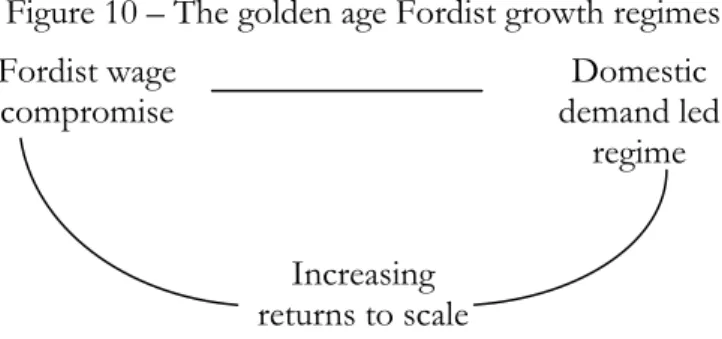
• For medium or large size economies during the Golden Age, the so called Fordist growth was based upon three core institutional arrangements: collective agreements that codified the synchronization of productivity and wage increases, a mass production system of standardized goods capturing increasing returns to scale and finally a large degree of autonomy with respect to foreign competition (figure 10).
Figure 10 – The golden age Fordist growth regimes Fordist wage compromise Domestic demand led regime Increasing returns to scale
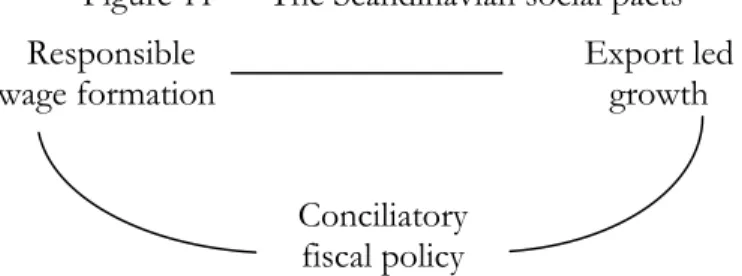
• For small open economies, the precise mix of institutions that shape the growth regime is quite different from the previous one. The wages are set in the exporting sector in accordance
with the preservation of the competitiveness of domestic firms in order to be compatible with the requirement of an export led growth. The productive organization is based upon the differentiation of products by quality and innovation. These complementarities do shape a growth regime that is a priori quite adapted to the new trends of the international economy (figure 11).
Figure 11 –– The Scandinavian social pacts Responsible
wage formation Export growth led Conciliatory
fiscal policy
Therefore, the concept of institutional complementarity is quite useful in order to understand simultaneously the coherence and the diversity of growth regimes. It is of special interest when this methodology is extended to developing countries: given quite different mixes of formal and informal institutional arrangements, the related growth regimes may differ from those already detected for mature economies.
IV.5. Some welfare systems may generate virtuous circles…but do not last for
ever
It is now possible to deal the issue of welfare: can redistributive measures sustain a dynamic growth regime? Retrospective and comparative analyses suggest the possible compatibility or even more complementarity between a large welfare State and a dynamic growth regime. • Within the Fordist growth regime, the intensity and predictability of productivity increases was
sustaining a very specific capital labor accord that was codifying an institutionalized increase of real wage in line with productivity. This was the key component of an original growth regime that was satisfying the objective of each collective actor: high and stable profit for entrepreneurs, near full-employment and better standards of living for wage-earners, buoyant tax base for State and social welfare financing. Thus, contrary to the teaching of a pure short run macroeconomic analysis, an extended system of income redistribution and supply of public goods (education, health, security in response to unemployment,…) was exerting a positive role upon the stability and the legitimacy of this new institutional architecture (figure 12).
Figure 12 – An extended welfare: a key component of the Fordist growth regime IMPLEMENTATION OF MASS PRODUCTION Large productivity increases FAST AND STABLE GROWTH Large real wage increases THE WAGE LABOR NEXUS IS INSTITUTIONALIZED Stability or reduction of income inequalities THE INCOMES OF THE POOR GROW FASTER
DIFFUSION OF THE WELFARE STATE
MIMETIC EVOLUTION OF
LIFE STYLES
EASIER ACCESS TO MASS CONSUMPTION AND
WELFARE
• The demise of this quite interesting regime brings at the forefront a key finding by régulation theory: the very success of this institutional configuration has brought adverse trends that have been cumulating and have transformed a virtuous circle into a vicious one. Firstly, the productive potential of Fordist methods has been exhausting through time. Secondly, the search for increasing returns to scale has triggered an unprecedented internationalization first of exchanges and then of production. Thirdly, financial liberalization, both internal and external, has eroded the previous institutionalized compromises, especially in terms of tax competition among national State. Hence a central conclusion: no institutional configuration, however efficient and satisfactory for social actors in the early beginning, can last forever. This is an important difference with respect to a branch of the economics of institutions based upon an intensive use of the hypothesis of rational expectation and the search for steady state growth regime.
• Should one conclude from the previous statement that the epoch of the complementarity between an extended welfare and an efficient growth regime is over? Clearly, many OECD countries experience recurring financial deficits affecting the various components of their Welfare systems, especially concerning healthcare and pensions. But again, the small open
Scandinavian economies exhibit an interesting counterexample. Of course, the various
subsystems (unemployment benefit, pensions, health,…) have been rationalized, but the creation of new collective rights in response to emerging social needs has generated a new
virtuous circle between a rejuvenated welfare State and an innovation led growth regime.
Basically, the effective implementation of full gender equality has triggered an extension of labor supply for women, whereas this move has generated new jobs in the service sector in the direction of child care, elderly care and health. Coupled with a knowledge based economy, this domestic internal economics circuit has proven to be quite satisfactory in terms of response to social demand from citizens (figure 13).
Figure 13 – Gender equality and responses to ageing as the source of a new service led growth Supply of skilled labor More supply of new and mature goods Reforms of labor legislation, welfare and tax system
Extension of women activity (two incomes family) More service related jobs
New care and
other services Extended demand Health and social services Ageing of population Redesign of institutional rules Easier financing of
public budget and welfare
This is an invitation to investigate how the various institutional arrangements put forward by figure 1 can be combined in order to take into account the large diversity of contemporary Welfare States.
IV.6. The diversity of welfare configurations
The central idea is to map the previous “molecules” into the structure of the costs and benefits associated with each of the three spheres. Each national system is defined by the share of welfare fulfilled within families (domestic order), within large firms (corporatist or paternalistic strategy) or across the whole society via State interventions (citizenship as a basis for collective solidarity). One gets the following description of social security systems (figure 14).
• Some countries exhibit a clear domination of a leading sphere. Former Soviet Union was a good example of a firm based welfare, since a majority of the benefits used to be provided by the firm, be they under a monetary payment or by direct provision of health, education leisure. By contrast, Sweden and Denmark are emblematic for society wide organized welfare, with universalistic values and a financing by general taxation. Southern Europe is a good example of the lasting role of family centered solidarity. The idea put forward by New Labor in UK would suggest that this is not necessarily an archaism (Giddens 1998) when the solidarity is extended from the family to the community and civil society supposed to manufacture trust and security (Fukuyama 1996).
• But generally speaking, most systems combine the three sources of solidarity. In Japan for instance, a firm based social welfare goes along with an important role of the family, as well as a residual role of a minimalist society wide welfare. In France, the ideal of social security, i.e. society wide welfare is mitigated by the fact that the financing and in some case the supply of many components are provided by the firms. In the US, the provision of welfare is largely attached to the labor contract negotiated between the workers and the firms, with some limited examples of society wide welfare for specific categories of population. Under this respect,
Figure 14 – At the origin of Welfare State diversity: three logics and organizing principles
F SOCIETY WIDE ORGANIZED
* Sweden * Denmark Netherlands * * France *
Italy United Kingdom *
* Portugal * Japan * St United ates * Spain
Former Soviet Union*
IV.7. “Commodification” is not the only future of welfare systems.
The contemporary issue, widely discussed, about the role that should be attributed to privatization and market competition (Le Grand and Bartlett 1993; Esping-Andersen 1996; Myles and Pierson 2000) is thus largely redefined (figure 15). Basically, each society manifests a strong path dependency that is not due to pure historical accidents or circumstances but the very nature of social protection (Bonoli and Palier 1999; Palier and Bonoli 2000). The major issue, and the French case is quite enlightening under this respect, is the evolution within the triangle (State, family, firm). For instance, catching-up countries might need to replace domestic solidarity by society wide organization and this is the case for Spain and Portugal. Other societies, such as the German and the French ones, might call for a progressive shift from a typical Bismarckian system, i.e. largely firm based, toward more Beveridgian, Scandinavian type configuration.
Only few national social security systems display a clear move towards privatization and quasi market competition in the supply of welfare. A key reference under with respect is the Chilean strong move toward a leading role of private insurance, with a mixed evidence about the gain in terms of efficiency and the clear non egalitarian consequences for instance for health care provision (WHO, 2000:109). The second example is of course the American privatization of pensions, in a sense largely idiosyncratic to the North American Society (Montagne 2000; O’Sullivan 2000). But the most intriguing trajectory relates to the Dutch case: the extension of universal social rights concerning for example a fully equal treatment of part time and full time jobs has been associated with a significant reliance to market mechanisms for the provision of welfare (De Beer and Luttikhuizen 1998; Barbier and Theret 2000; Esping-Andersen 2000).
Therefore the choice is not between a purely public welfare and a totally privatized one, but governments and social partners are facing the tricky problem of reforming rather idiosyncratic configurations, that manifest strong path dependence and combine various logic and regimes for welfare provision (figure 16). At least four forces shape the contemporary transformations.
• The privatization strategy is strengthened by the emergence of a finance led regime (Boyer 2000b) that develop so quickly stock markets that the old pay-as-you-go systems are presented as inefficient and even unfair, since workers do not get their share of the increased financial wealth (Orléan 2000). But many obstacles prevent the implementation of market mechanisms in the other welfare regimes, such as family, unemployment or sickness. Even the constitution of quasi markets between independent, generally non profit, institutions competing from the supply of welfare benefit is not so easy given the inertia and localization of the supply, the difficult of entry, the poor assessment of quality, the large transaction costs associated to the management of this competition by regional public bodies. Furthermore, if strict rules are not set by public authorities such as block contracts, private firms could cream skim the market and let the most severe risks to the public welfare (Le Grand and Bartlett 1993). Not to forget that the Chilean and American cases show a clear increase in inequality in the access to welfare, as a consequence of privatization.
Figure 15 – Introducing market mechanisms in Welfare States: A fourth dimension. PRIVATELY OPERATED AND MARKET LED
Netherlands
SOCIETY WIDE ORGANIZED, COLLECTIVELY ORGANIZED AND SUPPLIED
Sweden Denmark United States Italy * * United Kingdom Portugal * France * Spain * Japan * * * * * *
Former Soviet Union