HAL Id: hal-01686559
https://hal.archives-ouvertes.fr/hal-01686559
Submitted on 27 Jun 2018HAL is a multi-disciplinary open access
archive for the deposit and dissemination of sci-entific research documents, whether they are pub-lished or not. The documents may come from teaching and research institutions in France or abroad, or from public or private research centers.
L’archive ouverte pluridisciplinaire HAL, est destinée au dépôt et à la diffusion de documents scientifiques de niveau recherche, publiés ou non, émanant des établissements d’enseignement et de recherche français ou étrangers, des laboratoires publics ou privés.
Distributed under a Creative Commons Attribution| 4.0 International License
Microfluidic angle of repose test for Pickering emulsions
Laura Chacon, Jean-Christophe Baret
To cite this version:
Laura Chacon, Jean-Christophe Baret. Microfluidic angle of repose test for Pickering emulsions. Journal of Physics D: Applied Physics, IOP Publishing, 2017, 50 (39), �10.1088/1361-6463/aa8048�. �hal-01686559�
Journal of Physics D: Applied Physics
LETTER • OPEN ACCESS
Microfluidic angle of repose test for Pickering
emulsions
To cite this article: L A Chacon and J C Baret 2017 J. Phys. D: Appl. Phys. 50 39LT04
View the article online for updates and enhancements.
Related content
From tubes to drops: droplet-based microfluidics for ultrahigh-throughput biology
T M Tran, F Lan, C S Thompson et al.
-A review of the theory, methods and recent applications of high-throughput single-cell droplet microfluidics
Todd P Lagus and Jon F Edd
-Topical Review
G F Christopher and S L Anna
1 © 2017 IOP Publishing Ltd Printed in the UK Journal of Physics D: Applied Physics
L A Chacon and J C Baret
Microfluidic Angle of Repose test for Pickering emulsions
Printed in the UK
39LT04
JPAPBE
© 2017 IOP Publishing Ltd 50
J. Phys. D: Appl. Phys.
JPD
10.1088/1361-6463/aa8048
39
Journal of Physics D: Applied Physics
1. Introduction
Pickering emulsions are liquid dispersions stabilized by solid particles [1, 2]. They differ from surfactant-stabilized emul-sions [3, 4], with, for example, an enhanced stability against coalescence related to the dynamics of the particles at the interface. They are of interest in a wide range of emerging applications [2] from the controlled release of substances for drug delivery [5, 6] to the templating of new materials [7]. Recently, fluorinated Pickering emulsions have been com-bined to droplet-based microfluidics [8–10]. Droplet-based microfluidics is a powerful technology for the miniaturiza-tion and automaminiaturiza-tion of biochemical assays at high-throughput
[8, 9, 11, 12]. It is based on the controlled manipulation in the microchannels of droplets of emulsions as assemblies of inde-pendent microreactors. The control of emulsion formulations to be used in these devices is crucial, due to the confinement imposed by the microchannels and the specific requirements of biochemical assays. As a result, the family of molecules usable for droplet-based microfluidics is still limited and the most promising molecules are based on fluorinated com-pounds and formulations [10, 13, 14].
Three main properties of Pickering emulsions are of inter-est for droplet-based microfluidics. First, the adsorption of the particle to the interface is an irreversible process. The free-energy of desorption is several thousands of kBT, which
prevents desorption of the particles [2]. After stabilisation of the emulsion, it is therefore possible to deplete the continu-ous phase from the stabilizing agent without destabilizing the emulsion. It is not possible to do so with surfactants: chemical
Microfluidic angle of repose test
for Pickering emulsions
L A Chacon and J C Baret
CNRS, University of Bordeaux, CRPP, UPR 8641, 33600 Pessac, France E-mail: [email protected]
Received 20 March 2017, revised 31 May 2017 Accepted for publication 18 July 2017 Published 6 September 2017
Abstract
Pickering emulsions are appealing systems for droplet-based microfluidic technology. However, to date, their implementation in experiments is limited by their intrinsic
characteristics: they present a strong gel-like behaviour and their flowability is lower than their surfactant-stabilized counterpart. Measuring the rheological properties of Pickering emulsions is therefore of interest but very few methods provide measurements using low volumes (<1 ml). Here, we propose a microfluidic version of the angle of repose method to study the
flow behaviour of fluorinated Pickering emulsions adapted to small volumes of the sample. We observed a strong link between the nanoparticle level of fluorination and the flow behaviour of the water-in-oil (w/o) emulsions, obtaining a dramatic change from an
empirically very poor flow behaviour to a good one by increasing the particles wettability by the fluorinated phase. Our method combines the advantages of microfluidic rheometers, such as low sample consumption and visual monitoring of the complex fluid elements, and allows the study of emulsions with a strong level of aggregation between the droplets.
Keywords: emulsions, droplet-based microfluidics, nanoparticles (Some figures may appear in colour only in the online journal)
Letter
IOP
Original content from this work may be used under the terms of the Creative Commons Attribution 3.0 licence. Any further distribution of this work must maintain attribution to the author(s) and the title of the work, journal citation and DOI.
2017
1361-6463
1361-6463/17/39LT04+7$33.00
https://doi.org/10.1088/1361-6463/aa8048 J. Phys. D: Appl. Phys. 50 (2017) 39LT04 (7pp)
2
equilibrium determines the concentration of molecules at the interface as a function of molecules in the bulk [15]. As a con-sequence, removing surfactant molecules from the continuous phase affects the emulsion stability. On the other hand, reduc-ing the concentration of the surfactant in the continuous phase would certainly be of interest to improve the performance of the encapsulation process [16], since surfactants were shown to promote the transport of small organic molecules between droplets [16–18]. Pickering emulsions have the properties to reduce these transport processes [19] and, therefore, con-stitute a very promising alternative to surfactant-stabilized emulsions. Second, Pickering emulsions provide a rigid layer, allowing cells to bind at the the droplet interface [20]. As a result, it becomes possible to extend the range of assays per-formed at high-throughput in the droplet format [21–23] to adherent cells. Third, the possibility to graft functional groups at the nanoparticle interface provide additional features, such as molecular recognition [20, 24] increasing interface functionalities.
However, fluorinated Pickering emulsions introduce new challenges not previously encountered with surfactant- stabilized systems. For example, the non-specific adsorp-tion of enzymes on the nanoparticle surface leads to a loss of enzymatic activity. PEG-functionalized nanoparticles have been recently proposed as a solution to this issue [25]. Another potential limiting factor of Pickering emulsions is their flow properties. Pickering emulsions often exhibit the classical behaviour of adhesive suspensions. This behaviour directly results from strong attractive interactions between the droplets. Such a drop adhesion can result from particles that tend to aggregate, even in the dispersed state or from bridging between the droplets [26, 27].
Furthermore, both surfactant stabilized emulsions and solid-stabilized emulsions exhibit elastic behaviours over a critical droplet volume fraction, φc, from which its osmotic
pressure, Π, and shear modulus, G, increase as φ− φc
[28, 29]. However, Arditty et al showed that G and Π val-ues are higher for solid-stabilized emulsions, due to different droplet deformation processes between these two emulsion types. While surfactant stabilized emulsions are controlled by the capillary pressure of the non-deformed droplets, solid-stabilized emulsions are controlled by the 2D yield stress of the droplet surface [30].
Emulsions reinjection and droplets sorting [31], two basic functions of droplet-based microfluidics, have so far not been demonstrated reliably. Measuring the flow properties of these emulsions and choosing their optimal formulations is essential to demonstrate a full compatibility of these systems with the wide range of modules of droplet-based microfluid-ics. The most widely used method to characterize the flow behaviour of complex fluids, such as Pickering emulsions, is the rheometric measurement of steady shear viscosity [32]. Lately, a broad range of microfluidic viscometers with various working principles have been developed to over-come typical limitations of macroscale rheometers which are limited by sample volumes, access to high shear rates, hydrodynamic instabilities and interfacial artifacts [33–35]. Since the microstructure of a fluid strongly influences the
flow behaviour, the capability of microfluidic viscometers to simultaneously characterize rheology and microstructure through microscopic visualization distinguishes them from macroscale rheometric methods [32].
The rheological behaviour of complex fluids can range from viscoelastics fluids to soft solids, and is strongly depend-ent on shear rates. Similarly, the flowing properties of granular materials exhibit non-trivial transitions between static, quasi-static and dynamical states, behaving like a solid or a fluid according to the applied stress [36]. We believe well-known techniques used to characterize the flowing properties of gran-ular materials could potentially bring an additional insight to complex fluids’ flow behaviour. The angle of repose test is a well-known method utilized to characterize granular materials flow behaviour; as described by Lumay et al [36], it consists of placing the studied granular material on top of a circular support until a conical heap naturally develops. The angle of repose αr is the angle of the isosceles triangle which has the
same surface area as the heap formed. Typically, αr<36◦
indicates good to excellent flow properties, whereas αr>57◦
indicates very poor flowability.
In this paper, we propose a microfluidic adaptation of the angle of repose test to characterize the flow behaviour of fluorinated Pickering emulsions. The angle of repose test is very sensitive to the method used to create the heap, needing a defined initialization protocol. Droplet-based microfluidics provide such a versatile system, since the droplets—our equiv-alent to the particles of a granular material—are produced and deposited in a controlled manner by using a simple droplet maker device. Our method provides a quantitative reference on the flow properties of fluorinated Pickering emulsions, and aides in selecting optimal formulations for droplet-based microfluidics applications.
2. Materials and methods 2.1. Fluorination of silica nanoparticles
Pristine silica nanoparticles (Si-NPs) (D = 94 nm) were syn-thesized in house, following the protocol described previously by Hartlen et al [37].
Surface functionalization of these nanoparticles was per-formed following a similar protocol as the one reported by Pan et al [19]: first, Si-NPs were dispersed in absolute etha-nol (99%) at 10 mg ml−1. Ammonium hydroxide solution
(30%) was added to reach 2% v/v. Finally, 1H,1H,2H,2H-perfluorooctyltriethoxysilane (PFOTES) was added in the required amounts to reach the degree of surface function-alization desired (φwt), which, in this paper, we defined as
the weight relation of PFOTES versus Si-NPs in the final dispersion.
The reaction was left mixing at 250 rpm for a reaction time of two days to guarantee a time independent func-tionalization. Afterwards, the dispersion was centrifuged at 15000 rpm for 30 min during three washing cycles. After removing the supernatant, the particles were desiccated over-night and redispersed in the fluorinated solvent HFE-7500 (3 M) using 15 min of sonication followed by vortex mixing.
3
All of the experiments were done with a fixed concentration of Si-NPs of 6 mg ml−1 and φ
wt values ranging from 3.6 to
10.5 (PFOTES (mol)/ Si-NPs (m2) ranging from 1.13 × 10⁻⁵
to 3.29 × 10⁻⁵ values).
2.2. Angle of repose microfluidic device design and fabrication
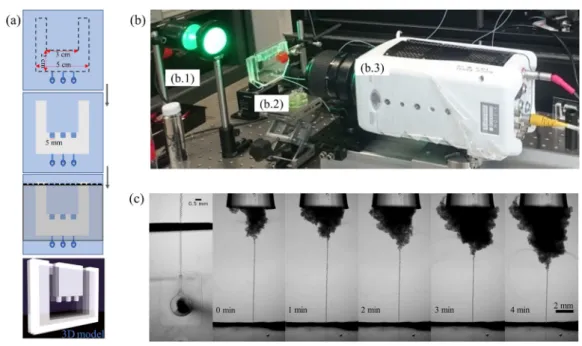
A standard microfluidic droplet maker device with a flow-focusing junction was designed and moulded in polydimeth-ylsiloxane (PDMS) using the soft-lithography techniques of replica moulding of a SU-8 master [14, 38]. A 0.5 cm PDMS stamp was obtained and its inlet ports were punched with a 0.75 mm-diameter biopsy. Then, it was bounded to a 0.5 cm patternless PDMS substrate through oxygen plasma activa-tion. Afterwards, an area of the bounded PDMS was cut and removed, as shown in the figure 1(a), where the edge of the removed area coincides with the ending of the micropattern outlets that are between the two PDMS substrates. A 5 mm-diameter biopsy needle was used to obtain PDMS circular bases, which were fixed 1.5 cm away from the microfluidic device outlets, and, finally, a glass slide was bounded on each side of the PDMS device through oxygen plasma activation; the remaining PDMS was cut and removed. The microfluidic channels were hydrophobized using a commercial coating agent (Aquapel, PPG industries).
It is important to remark that, due to the density differ-ences between the aqueous phase (droplets) and the heavier fluorinated solvent (ρ =1.614 g cm−3) used as continuous
phase, the droplets deposition in our device occurred upwards and the cylindrical PDMS support worked as an upper limit for the droplets.
2.3. Angle of repose measurement set-up
In figure 1(b), the set-up used for all the angle of repose mea-surements is shown. A phantom 4.2 high speed digital camera was mounted on a horizontal rail and connected to a Canon macro photo lens (MP-E 65 mm), as shown in figure 1(b.3).
The angle of the repose device was fixed on a support and filled with clean fluorinated solvent (figure 1(b.2)). Before each trial, the correct alignment of the device was verified using air bubbles injected from the microfluidic device. For illumination, a flash light and filter were placed behind the device, as shown in figure 1(b.1).
The microfluidic inlets were connected to syringes through Peek tubing of 0.75 mm inner diameter and the flu-ids flow rates were controlled using syringe pumps (Nemesys, Cetoni). For all of the trials, unless stated otherwise, the flow rates were fixed as 10 μl min−1 for the fluorinated phase, and
5 μl min−1 for the aqueous phase. Obtaining monodispersed
droplets of ∼80 μm diameter. Droplet production is shown in figure 1(c), as well as the particle-stabilized droplets depo-sition on the cylindrical base, which was monitored and recorded at a frame rate of 24 images per second. Droplet size variations were not observed with the controlled parameters studied (pH of aqueous phase and particle wettability).
2.4. Image processing and data analysis
The image processing was performed with ImageJ software [39]. All of the images were flipped 180° before process-ing. The contour of the pile formed on the PDMS base was extracted as coordinates (x-y) per each frame. This data was processed with a homemade script using Matlab, obtaining an angle of repose value as a function of deposition time.
Figure 1. Angle of repose measurement device fabrication and set-up. (a) Sketch side view of device fabrication steps: First, the indicated area of PDMS-PDMS microfluidic device is cut and retrieved; then, 5 mm cylindrical PDMS supports are fixed and aligned with microfluidic outlet; furthermore, glass slides are plasma bounded on both sides of the microfluidic device and extra PDMS is cut. Finally, a 3D projection of the finished device. (b) Microfluidic angle of repose measurement set-up: (b.1) back-light; (b.2) angle of repose microfluidic device held in place by a clamp on a support; (b.3) high speed camera with photo lens. (c) Pickering emulsion production and heap formation recorded at 24 fps.
4
Time zero was set as the moment the entire surface of the base was completely covered by droplets. The total moni-tored time was between 3 and 20 min, depending on the time required for the specific system to reach a steady state.
3. Results and discussion
3.1. Angle of repose test versus microfluidic adaptation for complex fluids
Our microfluidic adaptation of the angle of repose test brings along inherent differences with the method described by Lumay et al [36]. Rather than a fixed amount of material left on the support to reach a static equilibrium, in our system, the continuous deposition of droplets on the cylindrical support builds up a heap that eventually reaches a dynamic equilib-rium, where the amount of droplets that falls off the base is equivalent to the amount that comes on it. The droplets are regarded as individual grains—since their interface is stabi-lized against coalescence through the use of surfactants or NPs—and monodisperse droplets are obtained by keeping the same flow rate conditions in the droplet maker microfluidic device.
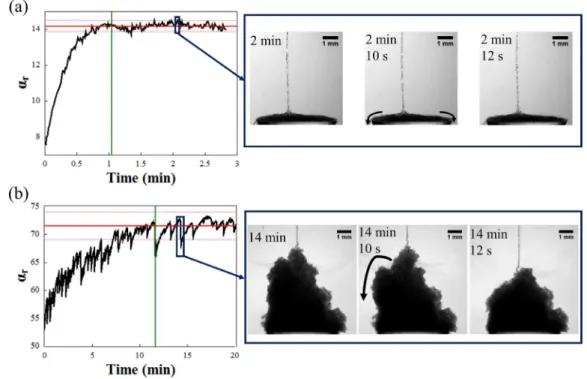
In figure 2, the evolution over time of the angle of repose is shown for droplets stabilized by a fluorinated surfactant (figure 2(a)) and droplets stabilized by fluorinated Si-NPs (figure 2(b)). There are clear differences between both sys-tems: the stabilization time (tss green vertical line in figure 2)
required to reach a steady state is ten times smaller for a flow-able emulsion stabilized by surfactant, since the final steady state angle reached (αss red horizontal line in figure 2) is
sig-nificantly smaller. Additionally, instead of droplets sliding off
the edge of the support with the continuous feeding stream in the middle, in the poorly flowable Pickering emulsion, droplets aggregate with each other until the weight difference is enough to promote an avalanche event, which consists of chunks of aggregated droplets falling from the top of the pile, as shown in figure 2(b).
We consider that the system reaches a steady state after the consecutive cycles of aggregating droplets, followed by an avalanche event with a mean angle variation smaller than 1% between cycles. Then, an additional parameter can be extracted by taking four times the standard deviation (σss pointed red
horizontal lines in figure 2) of the mean angle of repose after reaching a steady state (αss). σss will be directly related to the
aggregation level of droplets, since the stronger the aggrega-tion, the less disrupted the pile by gravitational stress [30]. Consequently, the stronger the aggregation, the bigger the max-imum angle reached before each fall and the bigger the aggre-gated chunks falling per cycle. Lumay et al quantified a similar parameter by relating cohesiveness between grains—originated from interactions, such as liquid bridges, electric charges and van der Waals forces—with the deviation of the irregular con-tour of the pile in repose formed from the ideal isosceles trian-gle shape expected for non-cohesive materials [36].
3.2. Formulation parameters
The wettability of the particles is a key element in the form-ulation of Pickering emulsions, similar to how the hydro-philic-lipophilic balance (HLB) is for emulsions stabilized by surfactants. In both cases, these parameters directly influence the emulsion type and stability [40]. In our system, we moni-tor this variable by changing the Si-NPs surface coverage, φwt,
Figure 2. Angle of repose evolution over time, with indicated stabilization time tss , steady state angle αss and cohesiveness σss
. (a) Emulsion stabilized by Krytox (2% wt) where droplets slide off the edge of the support. (b) Fluorinated Pickering emulsion with consecutive avalanches events (all pile images are tilted 180°).
5
which is the weight ratio of the reacted fluorinated compound on the Si-NPs surface (PFOTES) and the Si-NPs weight. When we increase φwt, the wettability of the particles for the
continuous fluorinated phase increases.
In figure 3(a), we show how by increasing φwt, we can
effectively improve the flowability of the Pickering emulsion obtained. In particular, going from φwt=7.3 to φwt =8.0
dra-matically decreases αss from 70° to 30°, going from an
empir-ically very poor flow behaviour to a good one. This effect is also apparent in figure 3(b), where the interface line of the col-lected Pickering emulsions with the organic phase becomes more irregular the smaller the φwt value is.
The ability to improve the flow behaviour by increasing the degree of Si-NPs coverage, φwt, provides a very useful
param-eter to control when selecting the optimal formulation of Pickering emulsions for droplet-based microfluidics applica-tions. However, increasing φwt to extreme values, renders the
particles too hydrophobic and limits their ability to stabilize collected emulsions, as shown in figure 3(c), where micro-fluidic made emulsions with the same droplet size (80 μm
diameter) were observed after one week of collection, show-ing significant coalescence for small and high values of φwt.
pH is another commonly studied variable affecting Pickering emulsions behaviour, particulary when the particles involved are pH responsive, meaning that its surface chem-istry undergoes some type of modification in response to changes in proton concentration [41]. We used hydrochloric acid or sodium hydroxide to vary the pH of the aqueous phase. In figure 3(a), we show how this parameter affects the flow
behaviour of our system more significantly for intermediate values of φwt. When φwt=8.0, we can effectively vary αss to
empirically flowable or non-flowable emulsions by decreasing or increasing the pH of the aqueous phase, respectively. For
φwt=7.3, αss is not affected by the change of pH; however,
a significant effect can be observed on the aggregation level of droplets reflected on the magnitude of the avalanche events (σss).
The aggregating nature of fluorinated Pickering emul-sions—evidenced in the irregular interface line (figure 3(b)) and the heap formation during the angle of repose test —sug-gest the presence of adhesive interactions between the drop-lets. These interactions, as shown previously by Arditty et al, dominate the bulk elasticity of these emulsions for droplet volume fractions below the random close packing and give remarkably high shear modulus for strongly flocculated emul-sions [30].
Observing the droplets in our system (figure 3(c)), we can discard the droplets-bridging effect as a possible origin of the adhesive interactions between droplets. As described by Lee
et al, when droplet bridging is present, a deviation from the clear circular geometry of the droplets is observed [26]. A more likely origin of the observed droplet adhesion could be from the natural tendency of the more hydrophilic Si-NPs to aggregate. When dispersed in the fluorinated phase, this aggre-gation is not evident, probably because the density of particles is sufficiently low and because Brownian motions helps to prevent the Si-NPs from forming aggregates. The aggregation might, however, be favored at the interface through an increase
Figure 3. (a) Degree of surface functionalization φwt effect on the steady state angle (αss), aggregation level (σss) and stabilization time
(tss): pH = 3 , pH = 6.8 and pH = 9.5 . Emulsion stabilized by surfactant is also indicated , as well as
empirical upper αr limit for a good flowability , and lower limit αr for very poor flow behaviour . (b) Pickering emulsions collected
in vials for different φwt. (c) Observed collected Pickering emulsions on a glass slide after one week of production (original droplet size 80
μm).
6
of local density of the particles. When the Si-NPs hydropho-bicity is raised by increasing φwt, the aggregation should be
decreased leading to a decrease in droplet adhesion. It is sur-prising nonetheless to observe a dependence of the droplet adhesive properties on the pH of the dispersed aqueous phase. When the pH is increased, the dissociation of silanol groups on the surface on to negatively charged silanolate ions renders the surface charge in contact with the aqueous phase more negative, resulting in more hydrophilic NPs and smaller conc-tact angles. This effect is usually employed to destabilize the Pickering emulsion [41] and it has also been used to prevent droplet agglomeration in o/w emulsions [42]. However, it is not obvious why it would cause an effect on particle medi-ated interactions between droplets for w/o emulsions. One interpretation for such a pH dependence could originate from electrostatic interactions between particles at the oil-water interface [43].
Another effect of special significance above the random close packing volume fraction is droplet deformability. Arditty
et al showed a solid-stabilized emulsion is dependent on the tension generated by 2D plasticity in the particle layer. They identified three different contributions to the lateral inter-particle attractions: van der Waals forces, capillary forces and the attractive interactions arising from the interpenetration of the hydrophobic chains grafted on the solid particles [30]. In our case, we cannot provide a definitive answer to the origin of the modulation of the mechanical properties of the inter-face. However, the deformation of the interface involves the deformation of the capillary menisci between nanoparticles. The force required to deform these menisci is presumably a function of the particle wettability and considering the length scale of the menisci—typically the size of the particles—it seems reasonable to consider that the first-order effect in the modulation of the interfacial properties of the droplet comes from capillary effects.
4. Conclusion
In summary, our angle of repose microfluidic adaptation pro-vides a quantitative reference on the flow behaviour of emul-sions, combining the advantages that microfluidic rheometers have over macroscopic ones, such as low amounts of samples required (between 45 and 300 μl of emulsion) and the visual
monitoring of the fluid behaviour. Additionally, it is possible to study samples that present a very strong gel-like behaviour; a task that could be challenging for microfluidic rheometers previously proposed. With our method, we were able to deter-mine the optimal formulation of fluorinated Pickering emul-sions as a function of the degree of surface functionalization (φwt), as well as flow behaviour changes, due to pH variations
in the aqueous phase. Further analysis will be of interest to determine a quantitative link between this method and clas-sical rheological characterization parameters, as well as the effect of additional formulation variables, such as Si-NPs size, droplet size and salt content, to further improve fluorinated Pickering emulsions and implement them into the droplet-based microfluidics toolbox.
Acknowledgments
We thank Celine Hubert and Pierre-Etienne Rouet for provid-ing the pristine nanoparticles used in this study. This proj-ect has received funding from European Research Council (ERC) Seventh Framework Programme (2007–2013) ERC Grant Agreement 306385-SOFt Interfaces and from the European Research Council (ERC) under the European Union’s Horizon 2020 research and innovation programme (grant agreement No 727480), from the ‘Région Aquitaine’ and from the French Government ‘Investments for the Future’ Programme, University of Bordeaux Initiative of Excellence (IDEX Bordeaux) (Reference Agence Nationale de la Recherche (ANR)-10-IDEX-03-02). The technical support of the chemistry facility at the Centre de Recherche Paul Pascal (Pessac, France) is warmly acknowledged. Fruitful discus-sions with Prof. Annie Colin (ESPCI, Paris), Dr Véronique Schmitt (CRPP, Pessac), Prof Valerie Taly (CPSC, Paris), Dr Ouriel Caen (CPSC, Paris) are also acknowledged. Dr Birte Riechers is also acknowledged for her support and fruitful discussions about fluorinated compounds. Finally, the initial input of Jeremy Vrignon on the angle of repose for granular materials is highly appreciated.
ORCID iDs
J C Baret https://orcid.org/0000-0003-2048-8317
References
[1] Pickering S U 1907 CXCVI. Emulsions J. Chem. Soc., Trans.
91 2001–21
[2] Wu J and Ma G-H 2016 Recent studies of pickering emulsions: particles make the difference Small 12 4633
[3] Bibette J, Morse D C, Witten T A and Weitz D A 1992 Stability criteria for emulsions Phys. Rev. Lett. 69 2439–42
[4] Bibette J, Leal-Calderon F and Poulin P 1999 Emulsions: basic principles Rep. Prog. Phys. 62 696–1033
[5] Wahlgren M, Engblom J, Sjoo M and Rayner M 2014 The use of micro- and nanoparticles in the stabilisation of pickering-type emulsions for topical delivery Curr. Pharm.
Biotechnol.14 1222–34
[6] Baillot M, Bentaleb A, Laurichesse E, Schmitt V and Backov R 2016 Triggering the mechanical release of mineralized pickering emulsion-based capsules Langmuir
32 3880–9
[7] Arditty S, Schmitt V, Giermanska-Kahn J and Leal-Calderon F 2004 Materials based on solid-stabilized emulsions J.
Colloid Interface Sci.275 659–64
[8] Guo M T, Rotem A, Heyman J A and Weitz D A 2012 Droplet microfluidics for high-throughput biological assays Lab
Chip12 2146–55
[9] Theberge A B, Courtois F, Schaerli Y, Fischlechner M, Abell C, Hollfelder F and Huck W T S 2010 Microdroplets in microfluidics: an evolving platform for discoveries in chemistry and biology Angew. Chem., Int. Ed. 49 5846–68
[10] Gruner P, Riechers B, Orellana L A C, Brosseau Q, Maes F, Beneyton T, Pekin D and Baret J-C 2015 Stabilisers for water-in-fluorinated-oil dispersions: key properties for microfluidic applications Curr. Opin. Colloid Interface Sci.
20 183–91 J. Phys. D: Appl. Phys. 50 (2017) 39LT04
7
[11] Agresti J J, Antipov E, Abate A R, Ahn K, Rowat A C, Baret J-C, Marquez M, Klibanov A M, Griffiths A D and Weitz D A 2010 Ultrahigh-throughput screening in drop-based microfluidics for directed evolution Proc. Natl Acad.
Sci.107 4004–9
[12] Miller O J et al 2012 High-resolution dose-response screening using droplet-based microfluidics Proc. Natl Acad. Sci.
109 378–83
[13] Courtois F, Olguin L F, Whyte G, Theberge A B, Huck W T S, Hollfelder F and Abell C 2009 Controlling the retention of small molecules in emulsion microdroplets for use in cell-based assays Anal. Chem. 81 3008–16
[14] Baret J-C 2012 Surfactants in droplet-based microfluidics
Lab Chip12 422–33
[15] Riechers B, Maes F, Akoury E, Semin B, Gruner P and Baret J-C 2016 Surfactant adsorption kinetics in microfluidics Proc. Natl Acad. Sci. 113 11465–70
[16] Skhiri Y et al 2012 Dynamics of molecular transport by surfactants in emulsions Soft Matter 8 10618–27
[17] Janiesch J-W, Weiss M, Kannenberg G, Hannabuss J, Surrey T, Platzman I and Spatz J P 2015 Key factors for stable retention of fluorophores and labeled biomolecules in droplet-based microfluidics Anal. Chem. 87 2063–7
[18] Gruner P, Riechers B, Semin B, Lim J, Johnston A, Short K and Baret J-C 2016 Controlling molecular transport in minimal emulsions Nat. Commun. 7 10392
[19] Pan M, Rosenfeld L, Kim M, Xu M, Lin E, Derda R and Tang S K Y 2014 Fluorinated pickering emulsions impede interfacial transport and form rigid interface for the growth of anchorage-dependent cells ACS Appl. Mater. Interfaces
6 21446–53
[20] Platzman I, Janiesch J W and Spatz J P 2013 Synthesis of nanostructured and biofunctionalized water-in-oil droplets as tools for homing T cells J. Am. Chem. Soc. 135 3339–42
[21] Brouzes E, Medkova M, Savenelli N, Marran D,
Twardowski M, Hutchison J B, Rothberg J M, Link D R, Perrimon N and Samuels M L 2009 Droplet microfluidic technology for single-cell high-throughput screening Proc.
Natl Acad. Sci.106 14195–200
[22] Joensson H N, Samuels M L, Brouzes E R, Medkova M, Uhln M, Link D R and Andersson-Svahn H 2009 Detection and analysis of low-abundance cell-surface biomarkers using enzymatic amplification in microfluidic droplets
Angew. Chem., Int. Ed.48 2518–21
[23] Baret J-C, Beck Y, Billas-Massobrio I, Moras D and Griffiths A D 2010 Quantitative cell-based reporter gene assays using droplet-based microfluidics Chem. Biol. 17 528–36
[24] Pan M, Kim M, Blauch L and Tang S K Y 2016 Surface-functionalizable amphiphilic nanoparticles for pickering emulsions with designer fluidfluid interfaces RSC Adv.
6 39926–32
[25] Pan M, Lyu F and Tang S K Y 2015 Fluorinated pickering emulsions with nonadsorbing interfaces for droplet-based enzymatic assays Anal. Chem. 87 7938–43
[26] Lee M N, Chan H K and Mohraz A 2012 Characteristics of pickering emulsion gels formed by droplet bridging
Langmuir28 3085–91
[27] Schmitt V, Destribats M and Backov R 2014 Colloidal particles as liquid dispersion stabilizer: Pickering emulsions and materials thereof C. R. Phys. 15 761–74
[28] Mason T G, Lacasse M-D, Grest G S, Levine D, Bibette J and Weitz D A 1997 Osmotic pressure and viscoelastic shear moduli of concentrated emulsions Phys. Rev. E 56 3150–66
[29] Guerra R E 2014 Elasticity of compressed emulsions PhD
Thesis Harvard University
[30] Arditty S, Schmitt V, Lequeux F and Leal-Calderon F 2005 Interfacial properties in solid-stabilized emulsions Eur.
Phys. J. B 44 381–93
[31] Baret J-C et al 2009 Fluorescence-activated droplet sorting (FADS): efficient microfluidic cell sorting based on enzymatic activity Lab Chip 9 1850–8
[32] Gupta S, Wang W S and Vanapalli S A 2016 Microfluidic viscometers for shear rheology of complex fluids and biofluids Biomicrofluidics 10043402
[33] Hudson S D, Sarangapani P, Pathak J A and Migler K B 2015 A microliter capillary rheometer for characterization of protein solutions J. Pharm. Sci. 104 678–85
[34] Ober T J, Haward S J, Pipe C J, Soulages J and McKinley G H 2013 Microfluidic extensional rheometry using a hyperbolic contraction geometry Rheol. Acta 52 529–46
[35] Pan L and Arratia P E 2012 A high-shear, low Reynolds number microfluidic rheometer Microfluid. Nanofluid.
14 885–94
[36] Lumay G, Boschini F, Traina K, Bontempi S, Remy J-C, Cloots R and Vandewalle N 2012 Measuring the flowing properties of powders and grains Powder Technol.
224 19–27
[37] Hartlen K D, Athanasopoulos A P T and Kitaev V 2008 Facile preparation of highly monodisperse small silica spheres (15–200 nm) suitable for colloidal templating and formation of ordered arrays Langmuir 24 1714–20
[38] Xia Y N and Whitesides G M 1998 Soft lithography Angew.
Chem. Int. Ed.37 550–75
[39] Schindelin J et al 2012 Fiji : an open-source platform for biological-image analysis Nat. Methods 9 676–82
[40] Chevalier Y and Bolzinger M-A 2013 Emulsions stabilized with solid nanoparticles: pickering emulsions Colloids Surf. A 439 23–34
[41] Tang J, Quinlan P J and Tam K C 2015 Stimuli-responsive Pickering emulsions: recent advances and potential applications Soft Matter 11 3512–29
[42] French D J, Taylor P, Fowler J and Clegg P S 2015 Making and breaking bridges in a Pickering emulsion J. Colloid
Interface Sci.441 30–8
[43] Leunissen M E, Blaaderen A V, Hollingsworth A D, Sullivan M T and Chaikin P M 2007 Electrostatics at the oilwater interface, stability, and order in emulsions and colloids Proc. Natl Acad. Sci. 104 2585–90