Elementary Mechanics
by
Robert G. Brown
Duke University Physics Department Durham, NC 27708-0305
This physics textbook is designed to support my personal teaching activities at Duke University, in particular teaching its Physics 141/142, 151/152, or 161/162 series (Introduc-tory Physics for life science majors, engineers, or potential physics majors, respectively). It is freely available in its entirety in a downloadable PDF form or to be read online at:
http://www.phy.duke.edu/∼rgb/Class/intro physics 1.php
It is also available in an inexpensive (really!) print version via Lulu press here: http://www.lulu.com/shop/product-21186588.html
where readers/users can voluntarily help support or reward the author by purchasing either this paper copy or one of the even more inexpensive electronic copies.
By making the book available in these various media at a cost ranging from free to cheap, I enable the text can be used by students all over the world where each student can pay (or not) according to their means.
Nevertheless, I am hoping that students who truly find this work useful will purchase
a copy through Lulu or a bookseller (when the latter option becomes available), if only
to help subsidize me while I continue to write inexpensive textbooks in physics or other subjects.
This textbook is organized for ease of presentation and ease of learning. In partic-ular, they are hierarchically organized in a way that directly supports efficient learning. They are also remarkably complete in their presentation and contain moderately detailed derivations of many of the important equations and relations from first principles while not skimping on simpler heuristic or conceptual explanations as well.
As a “live” document (one I actively use and frequently change, adding or deleting material or altering the presentation in some way), this textbook may have errors great and small, “stub” sections where I intend to add content at some later time but haven’t yet finished it, and they cover and omit topics according to my own view of what is or isn’t important to cover in a one-semester course. Expect them to change with little warning or announcement as I add content or correct errors.
Purchasers of the paper version should be aware of its probable imperfection and be prepared to either live with it or mark up their copy with corrections or additions as need be. The latest (and hopefully most complete and correct) version is always available for free online anyway, and people who have paid for a paper copy are especially welcome to access and retrieve it.
I cherish good-hearted communication from students or other instructors pointing out errors or suggesting new content (and have in the past done my best to implement many such corrections or suggestions).
Physics Textbooks
• Introductory Physics I and IIA lecture note style textbook series intended to support the teaching of introductory physics, with calculus, at a level suitable for Duke undergraduates.
• Classical Electrodynamics
A lecture note style textbook intended to support the second semester (primarily the dynamical portion, little statics covered) of a two semester course of graduate Classical Electrodynamics.
Computing Books
• How to Engineer a Beowulf ClusterAn online classic for years, this is the print version of the famous free online book on cluster engineering. It too is being actively rewritten and developed, no guarantees, but it is probably still useful in its current incarnation.
Fiction
• The Book of LilithISBN: 978-1-4303-2245-0
Web: http://www.phy.duke.edu/∼rgb/Lilith/Lilith.php
Lilith is the first person to be given a soul by God, and is given the job of giving all the things in the world souls by loving them, beginning with Adam. Adam is given the job of making up rules and the definitions of sin so that humans may one day live in an ethical society. Unfortunately Adam is weak, jealous, and greedy, and insists on being on top during sex to “be closer to God”.
Lilith, however, refuses to be second to Adam or anyone else. The Book of Lilith is a funny, sad, satirical, uplifting tale of her spiritual journey through the ancient world soulgiving and judging to find at the end of that journey – herself.
Poetry
• Who Shall Sing, When Man is GoneOriginal poetry, including the epic-length poem about an imagined end of the world brought about by a nuclear war that gives the collection its name. Includes many long and short works on love and life, pain and death.
Ocean roaring, whipped by storm in damned defiance, hating hell with every wave and every swell, every shark and every shell and shoreline.
More original poetry with a distinctly Zen cast to it. Works range from funny and satirical to inspiring and uplifting, with a few erotic poems thrown in.
Chop water, carry wood. Ice all around, fire is dying. Winter Zen?
All of these books can be found on the online Lulu store here: http://stores.lulu.com/store.php?fAcctID=877977
The Book of Lilith is available on Amazon, Barnes and Noble and other online
Contents
Preface xiii
Textbook Layout and Design . . . xiv
I: Getting Ready to Learn Physics 3 Preliminaries 3 See, Do, Teach . . . . 3
Other Conditions for Learning . . . 9
Your Brain and Learning . . . 15
How to Do Your Homework Effectively . . . 22
The Method of Three Passes . . . 26
Mathematics . . . 28
Summary . . . 33
Homework for Week 0 . . . 34
II: Elementary Mechanics 37 Week 1: Newton’s Laws 39 Summary . . . 39
1.1: Introduction: A Bit of History and Philosophy . . . 47
1.2: Dynamics . . . 49
1.3: Coordinates . . . 50
1.4: Newton’s Laws . . . 57
1.5: Forces . . . 58
1.5.1: The Forces of Nature . . . 59
1.5.2: Force Rules . . . 61 i
1.6: Force Balance – Static Equilibrium . . . 63
Example 1.6.1: Spring and Mass in Static Force Equilibrium . . . 64
1.7: Simple Motion in One Dimension . . . 65
Example 1.7.1: A Mass Falling from Height H . . . 66
Example 1.7.2: A Constant Force in One Dimension . . . 72
1.7.1: Solving Problems with More Than One Object . . . 74
Example 1.7.3: Atwood’s Machine . . . 75
Example 1.7.4: Braking for Bikes, or Just Breaking Bikes? . . . 77
1.8: Motion in Two Dimensions . . . 79
1.8.1: Free Flight Trajectories – Projectile Motion . . . 81
Example 1.8.1: Trajectory of a Cannonball . . . 81
1.8.2: The Inclined Plane . . . 84
Example 1.8.2: The Inclined Plane . . . 84
1.9: Circular Motion . . . 87
1.9.1: Tangential Velocity . . . 88
1.9.2: A Note on Notation . . . 89
1.9.3: Centripetal Acceleration . . . 90
Example 1.9.1: Ball on a String . . . 92
Example 1.9.2: Tether Ball/Conic Pendulum . . . 93
1.9.4: Tangential Acceleration . . . 94
1.10: Conclusion: Rubric for Newton’s Second Law Problems . . . 94
Homework for Week 1 . . . 96
Week 2: Newton’s Laws: Continued 117 Summary . . . 117
2.1: Friction . . . 120
Example 2.1.1: Inclined Plane of Length L with Friction . . . 121
Example 2.1.2: Block Hanging off of a Table . . . 123
Example 2.1.3: Find The Minimum No-Skid Braking Distance for a Car . . . 125
Example 2.1.4: Car Rounding a Banked Curve with Friction . . . 128
2.2: Drag Forces . . . 129
2.2.1: Stokes, or Laminar Drag . . . 133
2.2.2: Rayleigh, or Turbulent Drag . . . 133
Example 2.2.1: Falling From a Plane and Surviving . . . 136
Example 2.2.2: Solution to Equations of Motion for Stokes’ Drag . . . 138
2.2.4: Advanced: Solution to Equations of Motion for Turbulent Drag . . . . 139
Example 2.2.3: Dropping the Ram . . . 140
2.3: Inertial Reference Frames – the Galilean Transformation . . . 142
2.3.1: Time . . . 142
2.3.2: Space . . . 143
2.4: Non-Inertial Reference Frames – Pseudoforces . . . 146
2.4.1: Identifying Inertial Frames . . . 148
Example 2.4.1: Weight in an Elevator . . . 150
Example 2.4.2: Pendulum in a Boxcar . . . 152
2.4.2: Advanced: General Relativity and Accelerating Frames . . . 154
2.5: Just For Fun: Hurricanes . . . 156
Homework for Week 2 . . . 160
Week 3: Work and Energy 169 Summary . . . 169
3.1: Work and Kinetic Energy . . . 171
3.1.1: Units of Work and Energy . . . 173
3.1.2: Kinetic Energy . . . 174
3.2: The Work-Kinetic Energy Theorem . . . 175
3.2.1: Derivation I: Rectangle Approximation Summation . . . 175
3.2.2: Derivation II: Calculus-y (Chain Rule) Derivation . . . 177
Example 3.2.1: Pulling a Block . . . 179
Example 3.2.2: Range of a Spring Gun . . . 180
3.3: Conservative Forces: Potential Energy . . . 181
3.3.1: Force from Potential Energy . . . 183
3.3.2: Potential Energy Function for Near-Earth Gravity . . . 185
3.3.3: Springs . . . 186
3.4: Conservation of Mechanical Energy . . . 187
3.4.1: Force, Potential Energy, and Total Mechanical Energy . . . 188
Example 3.4.1: Falling Ball Reprise . . . 189
Example 3.4.2: Block Sliding Down Frictionless Incline Reprise . . . 189
Example 3.4.4: Looping the Loop . . . 190
3.5: Generalized Work-Mechanical Energy Theorem . . . 192
Example 3.5.1: Block Sliding Down a Rough Incline . . . 193
Example 3.5.2: A Spring and Rough Incline . . . 193
3.5.1: Heat and Conservation of Energy . . . 194
3.6: Power . . . 196
Example 3.6.1: Rocket Power . . . 197
3.7: Equilibrium . . . 198
3.7.1: Energy Diagrams: Turning Points and Forbidden Regions . . . 201
Homework for Week 3 . . . 204
Week 4: Systems of Particles, Momentum and Collisions 215 Summary . . . 215
4.1: Systems of Particles . . . 221
4.1.1: Newton’s Laws for a System of Particles – Center of Mass . . . 222
Example 4.1.1: Center of Mass of a Few Discrete Particles . . . 224
4.1.2: Coarse Graining: Continuous Mass Distributions . . . 225
Example 4.1.2: Center of Mass of a Continuous Rod . . . 227
Example 4.1.3: Center of mass of a circular wedge . . . 228
Example 4.1.4: Breakup of Projectile in Midflight . . . 229
4.2: Momentum . . . 230
4.2.1: The Law of Conservation of Momentum . . . 231
4.3: Impulse . . . 233
Example 4.3.1: Average Force Driving a Golf Ball . . . 235
Example 4.3.2: Force, Impulse and Momentum for Windshield and Bug . . 235
4.3.1: The Impulse Approximation . . . 236
4.3.2: Impulse, Fluids, and Pressure . . . 237
4.4: Center of Mass Reference Frame . . . 240
4.5: Collisions . . . 242
4.5.1: Momentum Conservation in the Impulse Approximation . . . 242
4.5.2: Elastic Collisions . . . 243
4.5.3: Fully Inelastic Collisions . . . 243
4.5.4: Partially Inelastic Collisions . . . 244
4.6: 1-D Elastic Collisions . . . 246
4.6.1: The Relative Velocity Approach . . . 247
4.6.2: 1D Elastic Collision in the Center of Mass Frame . . . 249
4.6.3: The “BB/bb” or “Pool Ball” Limits . . . 251
4.7: Elastic Collisions in 2-3 Dimensions . . . 253
4.8: Inelastic Collisions . . . 255
Example 4.8.1: One-dimensional Fully Inelastic Collision (only) . . . 256
Example 4.8.2: Ballistic Pendulum . . . 257
Example 4.8.3: Partially Inelastic Collision . . . 259
4.9: Kinetic Energy in the CM Frame . . . 260
Homework for Week 4 . . . 262
Week 5: Torque and Rotation in One Dimension 275 Summary . . . 275
5.1: Rotational Coordinates in One Dimension . . . 277
5.2: Newton’s Second Law for 1D Rotations . . . 279
5.2.1: The r-dependence of Torque . . . 281
5.2.2: Summing the Moment of Inertia . . . 283
5.3: The Moment of Inertia . . . 284
Example 5.3.1: The Moment of Inertia of a Rod Pivoted at One End . . . . 284
5.3.1: Moment of Inertia of a General Rigid Body . . . 285
Example 5.3.2: Moment of Inertia of a Ring . . . 286
Example 5.3.3: Moment of Inertia of a Disk . . . 286
5.3.2: Table of Useful Moments of Inertia . . . 287
5.4: Torque as a Cross Product . . . 287
Example 5.4.1: Rolling the Spool . . . 289
5.5: Torque and the Center of Gravity . . . 290
Example 5.5.1: The Angular Acceleration of a Hanging Rod . . . 291
5.6: Solving Newton’s Second Law Problems Involving Rolling . . . 292
Example 5.6.1: A Disk Rolling Down an Incline . . . 292
Example 5.6.2: Atwood’s Machine with a Massive Pulley . . . 294
5.7: Rotational Work and Energy . . . 295
5.7.1: Work Done on a Rigid Object . . . 296
Example 5.7.1: Work and Energy in Atwood’s Machine . . . 299
Example 5.7.2: Unrolling Spool . . . 300
Example 5.7.3: A Rolling Ball Loops-the-Loop . . . 301
5.8: The Parallel Axis Theorem . . . 303
Example 5.8.1: Moon Around Earth, Earth Around Sun . . . 305
Example 5.8.2: Moment of Inertia of a Hoop Pivoted on One Side . . . 305
5.9: Perpendicular Axis Theorem . . . 306
Example 5.9.1: Moment of Inertia of Hoop for Planar Axis . . . 308
Homework for Week 5 . . . 309
Week 6: Vector Torque and Angular Momentum 325 Summary . . . 325
6.1: Vector Torque . . . 327
6.2: Total Torque . . . 328
6.2.1: The Law of Conservation of Angular Momentum . . . 329
6.3: The Angular Momentum of a Symmetric Rotating Rigid Object . . . 330
Example 6.3.1: Angular Momentum of a Point Mass Moving in a Circle . . . 332
Example 6.3.2: Angular Momentum of a Rod Swinging in a Circle . . . 333
Example 6.3.3: Angular Momentum of a Rotating Disk . . . 333
Example 6.3.4: Angular Momentum of Rod Sweeping out Cone . . . 334
6.4: Angular Momentum Conservation . . . 334
Example 6.4.1: The Spinning Professor . . . 334
6.4.1: Radial Forces and Angular Momentum Conservation . . . 336
Example 6.4.2: Mass Orbits On a String . . . 337
6.5: Collisions . . . 339
Example 6.5.1: Fully Inelastic Collision of Ball of Putty with a Free Rod . . . 341
Example 6.5.2: Fully Inelastic Collision of Ball of Putty with Pivoted Rod . . 345
6.5.1: More General Collisions . . . 347
6.6: Angular Momentum of an Asymmetric Rotating Rigid Object . . . 347
Example 6.6.1: Rotating Your Tires . . . 350
6.7: Precession of a Top . . . 352
Example 6.7.1: Finding ωp From ∆L/∆t (Average) . . . 354
Example 6.7.2: Finding ωp from ∆L and ∆t Separately . . . 354
Homework for Week 6 . . . 358
Week 7: Statics 365 Statics Summary . . . 365
7.1: Conditions for Static Equilibrium . . . 366
7.2: Static Equilibrium Problems . . . 367
Example 7.2.1: Balancing a See-Saw . . . 369
Example 7.2.2: Two Saw Horses . . . 370
Example 7.2.3: Hanging a Tavern Sign . . . 371
7.2.1: Equilibrium with a Vector Torque . . . 372
Example 7.2.4: Building a Deck . . . 373
7.3: Tipping . . . 374
Example 7.3.1: Tipping Versus Slipping . . . 375
Example 7.3.2: Tipping While Pushing . . . 376
7.4: Force Couples . . . 378
Example 7.4.1: Rolling the Cylinder Over a Step . . . 379
Homework for Week 7 . . . 381
III: Applications of Mechanics 393 Week 8: Fluids 393 Fluids Summary . . . 393
8.1: General Fluid Properties . . . 395
8.1.1: Pressure . . . 396
8.1.2: Density . . . 397
8.1.3: Compressibility . . . 399
8.1.4: Viscosity and fluid flow . . . 400
8.1.5: Properties Summary . . . 400
Static Fluids . . . 401
8.1.6: Pressure and Confinement of Static Fluids . . . 401
8.1.7: Pressure and Confinement of Static Fluids in Gravity . . . 404
8.1.8: Variation of Pressure in Incompressible Fluids . . . 406
Example 8.1.1: Barometers . . . 406
8.1.9: Variation of Pressure in Compressible Fluids . . . 410
Example 8.1.3: Variation of Atmospheric Pressure with Height . . . 411
8.2: Pascal’s Principle and Hydraulics . . . 412
Example 8.2.1: A Hydraulic Lift . . . 414
8.3: Fluid Displacement and Buoyancy . . . 415
8.3.1: Archimedes’ Principle . . . 416
Example 8.3.1: Testing the Crown I . . . 419
Example 8.3.2: Testing the Crown II . . . 420
8.4: Fluid Flow . . . 422
8.4.1: Conservation of Flow . . . 423
8.4.2: Work-Mechanical Energy in Fluids: Bernoulli’s Equation . . . 426
Example 8.4.1: Emptying the Iced Tea . . . 428
Example 8.4.2: Flow Between Two Tanks . . . 429
8.4.3: Fluid Viscosity and Resistance . . . 431
8.4.4: Resistance of a Circular Pipe: Poiseuille’s Equation . . . 434
8.4.5: Turbulence . . . 438
8.5: The Human Circulatory System . . . 440
Example 8.5.1: Atherosclerotic Plaque Partially Occludes a Blood Vessel . 445 Example 8.5.2: Aneurisms . . . 447
Example 8.5.3: The Giraffe . . . 447
Homework for Week 8 . . . 449
Week 9: Oscillations 459 Oscillation Summary . . . 459
9.1: The Simple Harmonic Oscillator . . . 461
9.1.1: The Archetypical Simple Harmonic Oscillator: A Mass on a Spring . 461 9.1.2: The Simple Harmonic Oscillator Solution . . . 467
9.1.3: Plotting the Solution: Relations Involving ω . . . 468
9.1.4: The Energy of a Mass on a Spring . . . 469
9.2: The Pendulum . . . 470
9.2.1: The Physical Pendulum . . . 471
9.3: Damped Oscillation . . . 474
9.3.1: Properties of the Damped Oscillator . . . 477
9.3.2: Energy Damping: Q-value . . . 480
9.4: Damped, Driven Oscillation: Resonance . . . 481
9.4.1: Harmonic Driving Forces . . . 483
9.4.2: Solution to Damped, Driven, Simple Harmonic Oscillator . . . 486
9.5: Adding Springs in Series and in Parallel . . . 490
9.5.1: Adding Springs in Series . . . 491
Example 9.5.1: Three Springs in Series . . . 493
9.5.2: Adding Springs in Parallel . . . 493
Example 9.5.2: Adding Springs in Parallel . . . 494
9.5.3: Rules of Thumb . . . 494
9.6: Elastic Properties of Materials . . . 495
9.6.1: Simple Models for Molecular Bonds . . . 495
9.6.2: The “Spring Constant” of a Molecular Bond . . . 498
9.6.3: A Microscopic Picture of a Solid . . . 499
9.6.4: Shear Forces and the Shear Modulus . . . 503
9.6.5: Deformation and Fracture . . . 505
9.7: Human Bone . . . 508
Example 9.7.1: Scaling of Bones with Animal Size . . . 510
Homework for Week 9 . . . 512
Week 10: The Wave Equation 523 Wave Summary . . . 523
10.1: Waves . . . 524
10.2: Waves on a String . . . 525
10.3: Solutions to the Wave Equation . . . 527
10.3.1: An Important Property of Waves: Superposition . . . 527
10.3.2: Arbitrary Waveforms Propagating to the Left or Right . . . 527
10.3.3: Harmonic Waveforms Propagating to the Left or Right . . . 528
10.3.4: Stationary Waves . . . 529
10.4: Reflection of Waves . . . 531
10.5: Energy . . . 532
10.5.1: Energy in Travelling Waves . . . 532
10.5.2: Power Transmission by a Travelling Wave . . . 535
Homework for Week 10 . . . 539
Week 11: Sound 551 Sound Summary . . . 551
11.1: Sound Waves in a Fluid . . . 554
11.2: The Wave Equation for Sound . . . 555
11.3: Sound Wave Solutions . . . 563
11.4: Sound Wave Intensity . . . 565
11.4.1: Sound Displacement and Intensity In Terms of Pressure . . . 567
11.4.2: Sound Pressure and Decibels . . . 568
11.5: Doppler Shift . . . 570
11.5.1: Moving Source . . . 571
11.5.2: Moving Receiver . . . 571
11.5.3: Moving Source and Moving Receiver . . . 572
11.6: Standing Waves in Pipes . . . 573
11.6.1: Pipe Closed at Both Ends . . . 573
11.6.2: Pipe Closed at One End . . . 574
11.6.3: Pipe Open at Both Ends . . . 575
11.7: Beats . . . 576
11.8: Interference and Sound Waves . . . 577
11.9: The Ear . . . 578
Homework for Week 11 . . . 582
Week 12: Gravity 591 Gravity Summary . . . 591
12.1: Cosmological Models . . . 596
12.2: Kepler’s Laws . . . 601
12.2.1: Ellipses and Conic Sections . . . 602
12.3: Newton’s Law of Gravitation . . . 604
12.4: The Gravitational Field . . . 611
12.4.1: Spheres, Shells, General Mass Distributions . . . 613
12.5: Gravitational Potential Energy . . . 614
12.6: Energy Diagrams and Orbits . . . 615
12.7: Escape Velocity, Escape Energy . . . 617
12.8: Bridging the Gap: Coulomb’s Law and Electrostatics . . . 619 Homework for Week 12 . . . 619
Preface
This introductory mechanics text is intended to be used in the first semester of a two-semester series of courses teaching introductory physics at the college level, followed by a second semester course in introductory electricity and magnetism, and optics. The text is intended to support teaching the material at a rapid, but advanced level – it was developed to support teaching introductory calculus-based physics to potential physics majors, engineers, and other natural science majors at Duke University over a period of more than thirty years.
Students who hope to succeed in learning physics from this text will need, as a min-imum prerequisite, a solid grasp of basic mathematics. It is strongly recommended that all students have mastered mathematics at least through single-variable differential calculus (typified by the AB advanced placement test or a first-semester college calculus course). Students should also be taking (or have completed) single variable integral cal-culus (typified by the BC advanced placement test or a second-semester college calcal-culus course). In the text it is presumed that students are competent in geometry, trigonometry, algebra, and single variable calculus; more advanced multivariate calculus is used in a number of places but it is taught in context as it is needed and is always “separable” into two or three independent one-dimensional integrals.
Many students are, unfortunately weak in their mastery of mathematics at the time they take physics. This enormously complicates the process of learning for them, especially if they are years removed from when they took their algebra, trig, and calculus classes (as is frequently the case for pre-medical students taking the course in their junior year of college). For that reason, a separate supplementary text intended specifically to help
students of introductory physics quickly and efficiently review the required math is
being prepared as a companion volume to all semesters of introductory physics. Indeed, it should really be quite useful for any course being taught with any textbook series and not just this one.
This book is located here:
http://www.phy.duke.edu/∼rgb/Class/math for intro physics.php
and I strongly suggest that all students who are reading these words preparing to begin studying physics pause for a moment, visit this site, and either download the pdf or book-mark the site.
Note that Week 0: How to Learn Physics is not part of the course per se, but I usually do a quick review of this material (as well as the course structure, grading scheme, and
so on) in my first lecture of any given semester, the one where students are still finding the room, dropping and adding courses, and one cannot present real content in good conscience unless you plan to do it again in the second lecture as well. Students greatly
benefit from guidance on how to study, as most enter physics thinking that they can master
it with nothing but the memorization and rote learning skills that have served them so well for their many other fact-based classes. Of course this is completely false – physics is
reason based and conceptual and it requires a very different pattern of study than simply
staring at and trying to memorize lists of formulae or examples.
Students, however, should not count on their instructor doing this – they need to be self-actualized in their study from the beginning. It is therefore strongly suggested that all students read this preliminary chapter right away as their first “assignment” whether or not it is covered in the first lecture or assigned. In fact, (if you’re just such a student reading these words) you can always decide to read it right now (as soon as you finish this Preface). It won’t take you an hour, and might make as much as a full letter difference (to the good) in your final grade. What do you have to lose?
Even if you think that you are an excellent student and learn things totally effortlessly, I strongly suggest reading it. It describes a new perspective on the teaching and learning process supported by very recent research in neuroscience and psychology, and makes very specific suggestions as to the best way to proceed to learn physics.
Finally, the Introduction is a rapid summary of the entire course! If you read it and look at the pictures before beginning the course proper you can get a good conceptual overview of everything you’re going to learn. If you begin by learning in a quick pass the broad strokes for the whole course, when you go through each chapter in all of its detail, all those facts and ideas have a place to live in your mind.
That’s the primary idea behind this textbook – in order to be easy to remember, ideas need a house, a place to live. Most courses try to build you that house by giving you one nail and piece of wood at a time, and force you to build it in complete detail from the ground up.
Real houses aren’t built that way at all! First a foundation is established, then the frame of the whole house is erected, and then, slowly but surely, the frame is wired and plumbed
and drywalled and finished with all of those picky little details. It works better that way. So it is with learning.
Textbook Layout and Design
This textbook has a design that is just about perfectly backwards compared to most text-books that currently cover the subject. Here are its primary design features:
• All mathematics required by the student is reviewed in a standalone, cross-referenced (free) work at the beginning of the book rather than in an appendix that many students never find.
in a single college semester with at most a chapter a week.
• It begins each chapter with an “abstract” and chapter summary. Detail, especially lecture-note style mathematical detail, follows the summary rather than the other way around.
• This text does not spend page after page trying to explain in English how physics works (prose which to my experience nobody reads anyway). Instead, a terse “lecture note” style presentation outlines the main points and presents considerable mathe-matical detail to support solving problems.
• Verbal and conceptual understanding is, of course, very important. It is expected to come from verbal instruction and discussion in the classroom and recitation and lab. This textbook relies on having a committed and competent instructor and a sensible learning process.
• Each chapter ends with a short (by modern standards) selection of challenging home-work problems. A good student might well get through all of the problems in the book, rather than at most 10% of them as is the general rule for other texts.
• The problems are weakly sorted out by level, as this text is intended to support non-physics science and pre-health profession students, engineers, and non-physics majors all three. The material covered is of course the same for all three, but the level of detail and difficulty of the math used and required is a bit different.
• The textbook is entirely algebraic in its presentation and problem solving require-ments – with very few exceptions no calculators should be required to solve prob-lems. The author assumes that any student taking physics is capable of punching numbers into a calculator, but it is algebra that ultimately determines the formula that they should be computing. Numbers are used in problems only to illustrate what “reasonable” numbers might be for a given real-world physical situation or where the problems cannot reasonably be solved algebraically (e.g. resistance networks). This layout provides considerable benefits to both instructor and student. This text-book supports a top-down style of learning, where one learns each distinct chapter topic by quickly getting the main points onboard via the summary, then derives them or ex-plores them in detail, then applies them to example problems. Finally one uses what one has started to learn working in groups and with direct mentoring and support from the in-structors, to solve highly challenging problems that cannot be solved without acquiring the deeper level of understanding that is, or should be, the goal one is striving for.
It’s without doubt a lot of work. Nobody said learning physics would be easy, and this book certainly doesn’t claim to make it so. However, this approach will (for most students)
work.
The reward, in the end, is the ability to see the entire world around you through new eyes, understanding much of the “magic” of the causal chain of physical forces that makes all things unfold in time. Natural Law is a strange, beautiful sort of magic; one that is utterly impersonal and mechanical and yet filled with structure and mathematics and light. It makes sense, both in and of itself and of the physical world you observe.
I: Getting Ready to Learn Physics
Preliminaries
See, Do, Teach
If you are reading this, I assume that you are either taking a course in physics or wish to learn physics on your own. If this is the case, I want to begin by teaching you the importance of your personal engagement in the learning process. If it comes right down to it, how well you learn physics, how good a grade you get, and how much fun you have all depend on how enthusiastically you tackle the learning process. If you remain disengaged, detatched from the learning process, you almost certainly will do poorly and be miserable while doing it. If you can find any degree of engagement – or open enthusiasm – with the learning process you will very likely do well, or at least as well as possible.
Note that I use the term learning, not teaching – this is to emphasize from the beginning that learning is a choice and that you are in control. Learning is active; being taught is pas-sive. It is up to you to seize control of your own educational process and fully participate, not sit back and wait for knowledge to be forcibly injected into your brain.
You may find yourself stuck in a course that is taught in a traditional way, by an instructor that lectures, assigns some readings, and maybe on a good day puts on a little dog-and-pony show in the classroom with some audiovisual aids or some demonstrations. The standard expectation in this class is to sit in your chair and watch, passive, taking notes. No real engagement is “required” by the instructor, and lacking activities or a structure that encourages it, you lapse into becoming a lecture transcription machine, recording all kinds of things that make no immediate sense to you and telling yourself that you’ll sort it all out later.
You may find yourself floundering in such a class – for good reason. The instructor presents an ocean of material in each lecture, and you’re going to actually retain at most a few cupfuls of it functioning as a scribe and passively copying his pictures and symbols without first extracting their sense. And the lecture makes little sense, at least at first, and reading (if you do any reading at all) does little to help. Demonstrations can sometimes make one or two ideas come clear, but only at the expense of twenty other things that the instructor now has no time to cover and expects you to get from the readings alone. You continually postpone going over the lectures and readings to understand the material any more than is strictly required to do the homework, until one day a big test draws nigh and you realize that you really don’t understand anything and have forgotten most of what you did, briefly, understand. Doom and destruction loom.
Sound familiar?
On the other hand, you may be in a course where the instructor has structured the course with a balanced mix of open lecture (held as a freeform discussion where questions aren’t just encouraged but required) and group interactive learning situations such as a carefully structured recitation and lab where discussion and doing blend together, where students teach each other and use what they have learned in many ways and contexts. If so, you’re lucky, but luck only goes so far.
Even in a course like this you may still be floundering because you may not understand
why it is important for you to participate with your whole spirit in the quest to learn anything
you ever choose to study. In a word, you simply may not give a rodent’s furry behind about learning the material so that studying is always a fight with yourself to “make” yourself do it – so that no matter what happens, you lose. This too may sound very familiar to some.
The importance of engagement and participation in “active learning” (as opposed to passively being taught) is not really a new idea. Medical schools were four year programs in the year 1900. They are four year programs today, where the amount of information that a physician must now master in those four years is probably ten times greater today than it was back then. Medical students are necessarily among the most efficient learners on earth, or they simply cannot survive.
In medical schools, the optimal learning strategy is compressed to a three-step adage: See one, do one, teach one.
See a procedure (done by a trained expert).
Do the procedure yourself, with the direct supervision and guidance of a trained expert. Teach a student to do the procedure.
See, do, teach. Now you are a trained expert (of sorts), or at least so we devoutly hope, because that’s all the training you are likely to get until you start doing the procedure over and over again with real humans and with limited oversight from an attending physician with too many other things to do. So you practice and study on your own until you achieve real mastery, because a mistake can kill somebody.
This recipe is quite general, and can be used to increase your own learning in almost
any class. In fact, lifelong success in learning with or without the guidance of a good
teacher is a matter of discovering the importance of active engagement and participation that this recipe (non-uniquely) encodes. Let us rank learning methodologies in terms of “probable degree of active engagement of the student”. By probable I mean the degree of active engagement that I as an instructor have observed in students over many years and which is significantly reinforced by research in teaching methodology, especially in physics and mathematics.
Listening to a lecture as a transcription machine with your brain in “copy machine” mode is almost entirely passive and is for most students probably a nearly complete waste of time. That’s not to say that “lecture” in the form of an organized presentation and review of the material to be learned isn’t important or is completely useless! It serves one very
important purpose in the grand scheme of learning, but by being passive during lecture you cause it to fail in its purpose. Its purpose is not to give you a complete, line by line
brief shining moment, the sense of the concepts so that you understand them.
It is difficult to sufficiently emphasize this point. If lecture doesn’t make sense to you when the instructor presents it, you will have to work much harder to achieve the sense of the material “later”, if later ever comes at all. If you fail to identify the important concepts during the presentation and see the lecture as a string of disconnected facts, you will have to remember each fact as if it were an abstract string of symbols, placing impossible demands on your memory even if you are extraordinarily bright. If you fail to achieve some degree of understanding (or synthesis of the material, if you prefer) in lecture by asking questions and getting expert explanations on the spot, you will have to build it later out of your notes on a set of abstract symbols that made no sense to you at the time. You might as well be trying to translate Egyptian Hieroglyphs without a Rosetta Stone, and the best of luck to you with that.
Reading is a bit more active – at the very least your brain is more likely to be somewhat engaged if you aren’t “just” transcribing the book onto a piece of paper or letting the words and symbols happen in your mind – but is still pretty passive. Even watching nifty movies or cool-ee-oh demonstrations is basically sedentary – you’re still just sitting there while somebody or something else makes it all happen in your brain while you aren’t doing much of anything. At best it grabs your attention a bit better (on average) than lecture, but you are mentally passive.
In all of these forms of learning, the single active thing you are likely to be doing is taking notes or moving an eye muscle from time to time. For better or worse, the human brain isn’t designed to learn well in passive mode. Parts of your brain are likely to take charge and pull your eyes irresistably to the window to look outside where active things are going on, things that might not be so damn boring!
With your active engagement, with your taking charge of and participating in the learn-ing process, thlearn-ings change dramatically. Instead of passively listenlearn-ing in lecture, you can at least try to ask questions and initiate discussions whenever an idea is presented that makes no intial sense to you. Discussion is an active process even if you aren’t the one talking at the time. You participate! Even a tiny bit of participation in a classroom setting where students are constantly asking questions, where the instructor is constantly answer-ing them and askanswer-ing the students questions in turn makes a huge difference. Humans being social creatures, it also makes the class a lot more fun!
In summary, sitting on your ass1and writing meaningless (to you, so far) things down as somebody says them in the hopes of being able to “study” them and discover their meaning on your own later is boring and for most students, later never comes because you are busy with many classes, because you haven’t discovered anything beautiful or exciting (which is the reward for figuring it all out – if you ever get there) and then there is partying and hanging out with friends and having fun. Even if you do find the time and really want to succeed, in a complicated subject like physics you are less likely to be able to discover the meaning on your own (unless you are so bright that learning methodology is irrelevant and you learn in a single pass no matter what). Most introductory students are swamped by the details, and have small chance of discovering the patterns within those details that constitute “making sense” and make the detailed information much, much easier to learn
by enabling a compression of the detail into a much smaller set of connected ideas. Articulation of ideas, whether it is to yourself or to others in a discussion setting,
re-quires you to create tentative patterns that might describe and organize all the details you
are being presented with. Using those patterns and applying them to the details as they are presented, you naturally encounter places where your tentative patterns are wrong, or don’t quite work, where something “doesn’t make sense”. In an “active” lecture students participate in the process, and can ask questions and kick ideas around until they do make sense. Participation is also fun and helps you pay far more attention to what’s going on than when you are in passive mode. It may be that this increased attention, this consideration of many alternatives and rejecting some while retaining others with social reinforcement, is what makes all the difference. To learn optimally, even “seeing” must be an active process, one where you are not a vessel waiting to be filled through your eyes but rather part of a team studying a puzzle and looking for the patterns together that will help you eventually solve it.
Learning is increased still further by doing, the very essence of activity and engage-ment. “Doing” varies from course to course, depending on just what there is for you to do, but it always is the application of what you are learning to some sort of activity, exercise, problem. It is not just a recapitulation of symbols: “looking over your notes” or “(re)reading the text”. The symbols for any given course of study (in a physics class, they very likely will
be algebraic symbols for real although I’m speaking more generally here) do not, initially,
mean a lot to you. If I write ~F = q(~v × ~B) on the board, it means a great deal to me, but if you are taking this course for the first time it probably means zilch to you, and yet I pop it up there, draw some pictures, make some noises that hopefully make sense to you at the time, and blow on by. Later you read it in your notes to try to recreate that sense, but you’ve forgotten most of it. Am I describing the income I expect to make selling ~B tons of barley with a market value of ~v and a profit margin of q?
To learn this expression (for yes, this is a force law of nature and one that we very much must learn this semester) we have to learn what the symbols stand for – q is the charge of a point-like object in motion at velocity ~v in a magnetic field ~B, and ~F is the resulting force acting on the particle. We have to learn that the × symbol is the cross
product of evil (to most students at any rate, at least at first). In order to get a gut feeling
for what this equation represents, for the directions associated with the cross product, for the trajectories it implies for charged particles moving in a magnetic field in a variety of contexts one has to use this expression to solve problems, see this expression in action in laboratory experiments that let you prove to yourself that it isn’t bullshit and that the world really does have cross product force laws in it. You have to do your homework that involves this law, and be fully engaged.
The learning process isn’t exactly linear, so if you participate fully in the discussion and the doing while going to even the most traditional of lectures, you have an excellent chance of getting to the point where you can score anywhere from a 75% to an 85% in the course. In most schools, say a C+ to B+ performance. Not bad, but not really excellent. A few students will still get A’s – they either work extra hard, or really like the subject, or they have some sort of secret, some way of getting over that barrier at the 90’s that is only crossed by those that really do understand the material quite well.
Here is the secret for getting yourself over that 90% hump, even in a physics class (arguably one of the most difficult courses you can take in college), even if you’re not a super-genius (or have never managed in the past to learn like one, a glance and you’re done): Work in groups!
That’s it. Nothing really complex or horrible, just get together with your friends who are also taking the course and do your homework together. In a well designed physics course (and many courses in mathematics, economics, and other subjects these days) you’ll have some aspects of the class, such as a recitation or lab, where you are required to work in groups, and the groups and group activities may be highly structured or freeform. “Studio” or “Team Based Learning” methods for teaching physics have even wrapped the lecture itself into a group-structured setting, so everything is done in groups/teams, and (probably by making it nearly impossible to be disengaged and sit passively in class waiting for learning to “happen”) this approach yields measureable improvements (all things being equal) on at least some objective instruments for measurement of learning.
If you take charge of your own learning, though, you will quickly see that in any course, however taught, you can study in a group! This is true even in a course where “the home-work]” is to be done alone by fiat of the (unfortunately ignorant and misguided) instructor. Just study “around” the actual assignment – assign yourselves problems “like” the actual assignment – most textbooks have plenty of extra problems and then there is the Inter-net and other textbooks – and do them in a group, then (afterwards!) break up and do your actual assignment alone. Note that if you use a completely different textbook to pick your group problems from and do them together before looking at your assignment in your textbook, you can’t even be blamed if some of the ones you pick turn out to be ones your instructor happened to assign.
Oh, and not-so-subtly – give the instructor a PDF copy of this book (it’s free for in-structors, after all, and a click away on the Internet) and point to this page and paragraph containing the following little message from me to them:
Yo! Teacher! Let’s wake up and smell the coffee! Don’t prevent your students from doing homework in groups – require it! Make the homework correspond-ingly more difficult! Give them quite a lot of course credit for doing it well! Construct a recitation or review session where students – in groups – who still cannot get the most difficult problems can get socratic tutorial help after work-ing hard on the problems on their own! Integrate discussion and deliberately teach to increase active engagement (instead of passive wandering attention) in lecture2. Then watch as student performance and engagement spirals into
2Perhaps by using Team Based Learning methods to structure and balance student groups and “flipping”
classrooms to foist the lecture off onto videos of somebody else lecturing to increase the time spent in the class working in groups, but I’ve found that in mid-sized classes and smaller (less than around fifty students) one can get very good results from traditional lecture without a specially designed classroom by the Chocolate Method – I lecture without notes and offer a piece of chocolate or cheap toy or nifty pencil to any student who catches me making a mistake on the board before I catch it myself, who asks a particularly good ques-tion, who looks like they are nodding off to sleep (seriously, chocolate works wonders here, especially when ceremoniously offered). Anything that keeps students focussed during lecture by making it into a game, by allowing/encouraging them to speak out without raising their hands, by praising them and rewarding them for engagement makes a huge difference.
the stratosphere compared to what it was before...
Then pray. Some instructors have their egos tied up in things to the point where they cannot learn, and then what can you do? If an instructor lets ego or politics obstruct their search for functional methodology, you’re screwed anyway, and you might as well just tackle the material on your own. Or heck, maybe their expertise and teaching experience vastly exceeds my own so that their naked words are sufficiently golden that any student should be able to learn by just hearing them and doing homework all alone in isolation from any peer-interaction process that might be of use to help them make sense of it all – all data to the contrary.
My own words and lecture – in spite of my 31 years of experience in the classroom, in spite of the fact that it has been well over twenty years since I actually used lecture notes to teach the course, in spite of the fact I never, ever prepare for recitation because solving the homework problems with the students “cold” as a peer member of their groups is useful where copying my privately worked out solutions onto a blackboard for them to passively copy on their papers in turn is useless, in spite of the fact that I wrote this book similarly without the use of any outside resource – my words and lecture are not. On the other hand, students who work effectively in groups and learn to use this book (and other resources) and do all of the homework “to perfection” might well learn physics quite well without my involvement at all!
Let’s understand why working in groups has such a dramatic effect on learning. What happens in a group? Well, a lot of discussion happens, because humans working on a common problem like to talk. There is plenty of doing going on, presuming that the group has a common task list to work through, like a small mountain of really difficult problems that nobody can possibly solve working on their own and are barely within their abilities working as a group backed up by the course instructor! Finally, in a group everybody has the opportunity to teach!
The importance of teaching – not only seeing the lecture presentation with your whole brain actively engaged and participating in an ongoing discussion so that it makes sense at the time, not only doing lots of homework problems and exercises that apply the material in some way, but articulating what you have discovered in this process and answering
questions that force you to consider and reject alternative solutions or pathways (or not)
cannot be overemphasized. Teaching each other in a peer setting (ideally with mentorship and oversight to keep you from teaching each other mistakes) is essential!
This problem you “get”, and teach others (and actually learn it better from teaching it than they do from your presentation – never begrudge the effort required to teach your group peers even if some of them are very slow to understand). The next problem you don’t get but some other group member does – they get to teach you. In the end you all learn far
more about every problem as a consequence of the struggle, the exploration of false paths,
the discovery and articulation of the correct path, the process of discussion, resolution and agreement in teaching whereby everybody in the group reaches full understanding.
I would assert that it is all but impossible for someone to become a (halfway decent) teacher of anything without learning along the way that the absolute best way to learn any set of material deeply is to teach it – it is the very foundation of Academe and has been for
two or three thousand years. It is, as we have noted, built right into the intensive learning process of medical school and graduate school in general. For some reason, however, we don’t incorporate a teaching component in most undergraduate classes, which is a shame, and it is basically nonexistent in nearly all K-12 schools, which is an open tragedy.
As an engaged student you don’t have to live with that! Put it there yourself, by incorpo-rating group study and mutual teaching into your learning process with or without the help
or permission of your teachers! A really smart and effective group soon learns to iterate
the teaching – I teach you, and to make sure you got it you immediately use the material I taught you and try to articulate it back to me. Eventually everybody in the group under-stands, everybody in the group benefits, everybody in the group gets the best possible
grade on the material. This process will actually make you (quite literally) more intelligent.
You may or may not become smart enough to lock down an A, but you will get the best grade you are capable of getting, for your given investment of effort.
This is close to the ultimate in engagement – highly active learning, with all cylinders of your brain firing away on the process. You can see why learning is enhanced. It is simply a bonus, a sign of a just and caring God, that it is also a lot more fun to work in a group, especially in a relaxed context with food and drink present. Yes, I’m encouraging you to have “physics study parties” (or history study parties, or psychology study parties). Hold contests. Give silly prizes. See. Do. Teach.
Other Conditions for Learning
Learning isn’t only dependent on the engagement pattern implicit in the See, Do, Teach rule. Let’s absorb a few more True Facts about learning, in particular let’s come up with a handful of things that can act as “switches” and turn your ability to learn on and off quite independent of how your instructor structures your courses. Most of these things aren’t
binary switches – they are more like dimmer switches that can be slid up between dim (but
not off) and bright (but not fully on). Some of these switches, or environmental parameters, act together more powerfully than they act alone. We’ll start with the most important pair, a pair that research has shown work together to potentiate or block learning.
Instead of just telling you what they are, arguing that they are important for a paragraph or six, and moving on, I’m going to give you an early opportunity to practice active learning in the context of reading a chapter on active learning. That is, I want you to participate in a tiny mini-experiment. It works a little bit better if it is done verbally in a one-on-one meeting, but it should still work well enough even if it is done in this text that you are reading.
I’m going to give you a string of ten or so digits and ask you to glance at it one time for a count of three and then look away. No fair peeking once your three seconds are up! Then I want you to do something else for at least a minute – anything else that uses your whole attention and interrupts your ability to rehearse the numbers in your mind in the way that you’ve doubtless learned permits you to learn other strings of digits, such as holding your mind blank, thinking of the phone numbers of friends or your social security number. Even rereading this paragraph will do.
remember. Then turn back to right here and compare what you wrote down with the actual number.
Ready? (No peeking yet...) Set? Go!
Ok, here it is, in a footnote at the bottom of the page to keep your eye from naturally reading ahead to catch a glimpse of it while reading the instructions above3.
How did you do?
If you are like most people, this string of numbers is a bit too long to get into your immediate memory or visual memory in only three seconds. There was very little time for rehearsal, and then you went and did something else for a bit right away that was supposed to keep you from rehearsing whatever of the string you did manage to verbalize in three seconds. Most people will get anywhere from the first three to as many as seven or eight of the digits right, but probably not in the correct order, unless...
...they are particularly smart or lucky and in that brief three second glance have time to notice that the number consists of all the digits used exactly once! Folks that happened to “see” this at a glance probably did better than average, getting all of the correct digits but maybe in not quite the correct order.
People who are downright brilliant (and equally lucky) realized in only three seconds (without cheating an extra second or three, you know who you are) that it consisted of the string of odd digits in ascending order followed by the even digits in descending or-der. Those people probably got it all perfectly right even without time to rehearse and “memorize” the string! Look again at the string, see the pattern now?
The moral of this little mini-demonstration is that it is easy to overwhelm the mind’s capacity for processing and remembering “meaningless” or “random” information. A string of ten measely (apparently) random digits is too much to remember for one lousy minute, especially if you aren’t given time to do rehearsal and all of the other things we have to make ourselves do to “memorize” meaningless information.
Of course things changed radically the instant I pointed out the pattern! At this point you could very likely go away and come back to this point in the text tomorrow or even a
year from now and have an excellent chance of remembering this particular digit string,
because it makes sense of a sort, and there are plenty of cues in the text to trigger recall of the particular pattern that “compresses and encodes” the actual string. You don’t have to remember ten random things at all – only two and a half – odd ascending digits followed by the opposite (of both). Patterns rock!
This example has obvious connections to lecture and class time, and is one reason retention from lecture is so lousy. For most students, lecture in any nontrivial college-level course is a long-running litany of stuff they don’t know yet. Since it is all new to them, it might as well be random digits as far as their cognitive abilities are concerned, at least at first. Sure, there is pattern there, but you have to discover the pattern, which requires time and a certain amount of meditation on all of the information. Basically, you have to have a chance for the pattern to jump out of the stream of information and punch the switch of the damn light bulb we all carry around inside our heads, the one that is endlessly portrayed in
cartoons. That light bulb is real – it actually exists, in more than just a metaphorical sense – and if you study long enough and hard enough to obtain a sudden, epiphinaic realization in any topic you are studying, however trivial or complex (like the pattern exposed above) it is quite likely to be accompanied by a purely mental flash of “light”. You’ll know it when it happens to you, in other words, and it feels great.
Unfortunately, the instructor doesn’t usually give students a chance to experience this in lecture. No sooner is one seemingly random factoid laid out on the table than along comes a new, apparently disconnected one that pushes it out of place long before we can either memorize it the hard way or make sense out of it so we can remember it with a lot less work. This isn’t really anybody’s fault, of course; the light bulb is quite unlikely to go off in lecture just from lecture no matter what you or the lecturer do – it is something that happens to the prepared mind at the end of a process, not something that just fires away every time you hear a new idea.
The humble and unsurprising conclusion I want you to draw from this silly little mini-experiment is that things are easier to learn when they make sense! A lot easier. In fact, things that don’t make sense to you are never “learned” – they are at best memorized. Information can almost always be compressed when you discover the patterns that run through it, especially when the patterns all fit together into the marvelously complex and beautiful and mysterious process we call “deep understanding” of some subject.
There is one more example I like to use to illustrate how important this information compression is to memory and intelligence. I play chess, badly. That is, I know the legal moves of the game, and have no idea at all how to use them effectively to improve my position and eventually win. Ten moves into a typical chess game I can’t recall how I got myself into the mess I’m typically in, and at the end of the game I probably can’t remember
any of what went on except that I got trounced, again.
A chess master, on the other hand, can play umpty games at once, blindfolded, against pitiful fools like myself and when they’ve finished winning them all they can go back and recontruct each one move by move, criticizing each move as they go. Often they can remember the games in their entirety days or even years later.
This isn’t just because they are smarter – they might be completely unable to derive the Lorentz group from first principles, and I can, and this doesn’t automatically make me smarter than them either. It is because chess makes sense to them – they’ve achieved a deep understanding of the game, as it were – and they’ve built a complex meta-structure memory in their brains into which they can poke chess moves so that they can be retrieved extremely efficiently. This gives them the attendant capability of searching vast portions of the game tree at a glance, where I have to tediously work through each branch, one step at a time, usually omitting some really important possibility because I don’t realize that that knight on the far side of the board can affect things on this side where we are both moving pieces.
This sort of “deep” (synthetic) understanding of physics is very much the goal of this course (the one in the textbook you are reading, since I use this intro in many textbooks), and to achieve it you must not memorize things as if they are random factoids, you must work to abstract the beautiful intertwining of patterns that compress all of those apparently
random factoids into things that you can easily remember offhand, that you can easily reconstruct from the pattern even if you forget the details, and that you can search through at a glance. But the process I describe can be applied to learning pretty much anything, as patterns and structure exist in abundance in all subjects of interest. There are even sensible rules that govern or describe the anti-pattern of pure randomness!
There’s one more important thing you can learn from thinking over the digit experiment.
Some of you reading this very likely didn’t do what I asked, you didn’t play along with the
game. Perhaps it was too much of a bother – you didn’t want to waste a whole minute learning something by actually doing it, just wanted to read the damn chapter and get it over with so you could do, well, whatever the hell else it is you were planning to do today that’s more important to you than physics or learning in other courses.
If you’re one of these people, you probably don’t remember any of the digit string at this point from actually seeing it – you never even tried to memorize it. A very few of you may actually be so terribly jaded that you don’t even remember the little mnemonic formula I gave above for the digit string (although frankly, people that are that disengaged are probably not about to do things like actually read a textbook in the first place, so possibly not). After all, either way the string is pretty damn meaningless, pattern or not.
Pattern and meaning aren’t exactly the same thing. There are all sorts of patterns one can find in random number strings, they just aren’t “real” (where we could wax poetic at this point about information entropy and randomness and monkeys typing Shakespeare if this were a different course). So why bother wasting brain energy on even the easy way to remember this string when doing so is utterly unimportant to you in the grand scheme of all things?
From this we can learn the second humble and unsurprising conclusion I want you to draw from this one elementary thought experiment. Things are easier to learn when you
care about learning them! In fact, they are damn near impossible to learn if you really don’t
care about learning them.
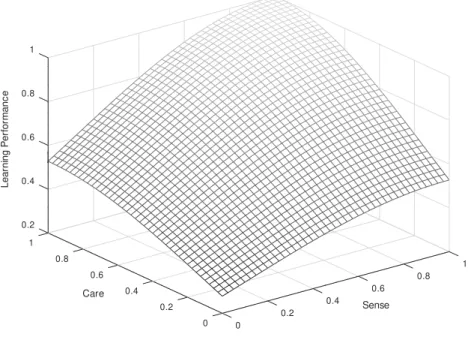
Let’s put the two observations together and plot them as a graph, just for fun (and because graphs help one learn for reasons we will explore just a bit in a minute). If you care about learning what you are studying, and the information you are trying to learn makes sense (if only for a moment, perhaps during lecture), the chances of your learning it are quite good. This alone isn’t enough to guarantee that you’ll learn it, but it they are basically both necessary conditions, and one of them is directly connected to degree of engagement.
On the other hand, if you care but the information you want to learn makes no sense, or if it makes sense but you hate the subject, the instructor, your school, your life and just don’t care, your chances of learning it aren’t so good, probably a bit better in the first case than in the second as if you care you have a chance of finding someone or some way that will help you make sense of whatever it is you wish to learn, where the person who doesn’t cares, well, they don’t care. Why should they remember it?
If you don’t give a rat’s ass about the material and it makes no sense to you, go home. Leave school. Do something else. You basically have almost no chance of learning the material unless you are gifted with a transcendent intelligence (wasted on a dilettante who
0.2 1 0.4 0.8 0.6 L e a rn in g P e rf o rm a n c e 0.8 0.6 0.8 1 Care 0.4 0.6 1 Sense 0.4 0.2 0.2 0 0
Figure 1: Conceptual relation between sense, care and learning, on simple relative scales. lives in a state of perpetual ennui) and are miraculously gifted with the ability learn things effortlessly even when they make no sense to you and you don’t really care about them. All the learning tricks and study patterns in the world won’t help a student who doesn’t try, doesn’t care, and for whom the material never makes sense.
If we worked at it, we could probably find other “logistic” controlling parameters to as-sociate with learning – things that increase your probability of learning monotonically as they vary. Some of them are already apparent from the discussion above. Let’s list a few more of them with explanations just so that you can see how easy it is to sit down to study and try to learn and have “something wrong” that decreases your ability to learn in that particular place and time.
Learning is actual work and involves a fair bit of biological stress, just like working out. Your brain needs food – it burns a whopping 20-30% of your daily calorie intake all by itself just living day to day, even more when you are really using it or are somewhat sedentary in your physical habits. Note that your brain runs on pure, energy-rich glucose, so when your blood sugar drops your brain activity drops right along with it. This can happen (para-doxically) because you just ate a carbohydrate rich meal. A balanced diet containing foods with a lower glycemic index4 tends to be harder to digest and provides a longer period of
sustained energy for your brain. A daily multivitamin (and various antioxidant supplements such as alpha lipoic acid) can also help maintain your body’s energy release mechanisms at the cellular level.
Blood sugar is typically lowest first thing in the morning, so this is a lousy time to actively study. On the other hand, a good hearty breakfast, eaten at least an hour before plunging in to your studies, is a great idea and is a far better habit to develop for a lifetime than
eating no breakfast and instead eating a huge meal right before bed.
Learning requires adequate sleep. Sure this is tough to manage at college – there are no parents to tell you to go to bed, lots of things to do, and of course you’re in class during the day and then you study, so late night is when you have fun. Unfortunately, learning is clearly correlated with engagement, activity, and mental alertness, and all of these tend to shut down when you’re tired. Furthermore, the formation of long term memory of any kind from a day’s experiences has been shown in both animal and human studies to depend on the brain undergoing at least a few natural sleep cycles of deep sleep alternating with REM (Rapid Eye Movement) sleep, dreaming sleep. Rats taught a maze and then deprived of REM sleep cannot run the maze well the next day; rats that are taught the same maze but that get a good night’s worth of rat sleep with plenty of rat dreaming can run the maze well the next day. People conked on the head who remain unconscious for hours and are thereby deprived of normal sleep often have permanent amnesia of the previous day – it never gets turned into long term memory.
This is hardly surprising. Pure common sense and experience tell you that your brain won’t work too well if it is hungry and tired. Common sense (and yes, experience) will rapidly convince you that learning generally works better if you’re not stoned or drunk when you study. Learning works much better when you have time to learn and haven’t put everything off to the last minute. In fact, all of Maslow’s hierarchy of needs5 are important
parameters that contribute to the probability of success in learning.
There is one more set of very important variables that strongly affect our ability to learn, and they are in some ways the least well understood. These are variables that describe you as an individual, that describe your particular brain and how it works. Pretty much everybody will learn better if they are self-actualized and fully and actively engaged, if the material they are trying to learn is available in a form that makes sense and clearly com-municates the implicit patterns that enable efficient information compression and storage, and above all if they care about what they are studying and learning, if it has value to them. But everybody is not the same, and the optimal learning strategy for one person is not going to be what works well, or even at all, for another. This is one of the things that confounds “simple” empirical research that attempts to find benefit in one teaching/learning methodology over another. Some students do improve, even dramatically improve – when this or that teaching/learning methodology is introduced. In others there is no change. Still others actually do worse. In the end, the beneficial effect to a selected subgroup of the students may be lost in the statistical noise of the study and the fact that no attempt is made to identify commonalities among students that succeed or fail.
The point is that finding an optimal teaching and learning strategy is technically an
op-timization problem on a high dimensional space. We’ve discussed some of the important
dimensions above, isolating a few that appear to have a monotonic effect on the desired outcome in at least some range (relying on common sense to cut off that range or suggest 5Wikipedia: http://www.wikipedia.org/wiki/Maslow’s hierarchy of needs. In a nutshell, in order to become
self-actualized and realize your full potential in activities such as learning you need to have your physiological
needs met, you need to be safe, you need to be loved and secure in the world, you need to have good self-esteem and the self-esteem of others. Only then is it particularly likely that you can become self-actualized and become a great learner and problem solver.