HAL Id: hal-00090184
https://hal-insu.archives-ouvertes.fr/hal-00090184
Submitted on 13 Sep 2006HAL is a multi-disciplinary open access archive for the deposit and dissemination of sci-entific research documents, whether they are pub-lished or not. The documents may come from teaching and research institutions in France or abroad, or from public or private research centers.
L’archive ouverte pluridisciplinaire HAL, est destinée au dépôt et à la diffusion de documents scientifiques de niveau recherche, publiés ou non, émanant des établissements d’enseignement et de recherche français ou étrangers, des laboratoires publics ou privés.
Response to the comment by R. H. Byrne on ”Solubility
of platinum in aqueous solutions at 25°c and pHs 4 to 10
under oxidizing conditions” (2001) Geochim.
Cosmochim. Acta 65, 4453-4466
Mohamed Azaroual, Bruno Romand, Philippe Freyssinet, Jean-Robert Disnar
To cite this version:
Mohamed Azaroual, Bruno Romand, Philippe Freyssinet, Jean-Robert Disnar. Response to the com-ment by R. H. Byrne on ”Solubility of platinum in aqueous solutions at 25°c and pHs 4 to 10 under oxidizing conditions” (2001) Geochim. Cosmochim. Acta 65, 4453-4466. Geochimica et Cosmochimica Acta, Elsevier, 2003, 67, pp.13, 2511-2513(3). �10.1016/S0016-7037(02)01415-1�. �hal-00090184�
Response to the comment by R. H. Byrne on “Solubility of
platinum in aqueous solutions at 25°c and pHs 4 to 10
under oxidizing conditions” (2001) Geochim. Cosmochim.
Acta 65, 4453–4466
Mohamed Azaroual, 1, Bruno Romand1, 2, Philippe Freyssinet1 and Jean-Robert Disnar2
1 BRGM, 3, av. C. Guillemin, BP 6009, 45060, Orléans cedex 02, France 2 UMR 6531, Université d’Orléans, BP 6759, 45067, Orléans cedex 02, France – remplacé par
l’UMR6113 – ISTO
In Byrne’s comment (this issue) on the solubility of platinum in aqueous solutions (Azaroual et al., 2001), he claims that our recommended values for the formation constant of PtOH+ (OHβ1) are unreasonably high. We would like to thank him for his interest in our work and for
the opportunity to clarify certain points that were not fully explicit in our initial paper.
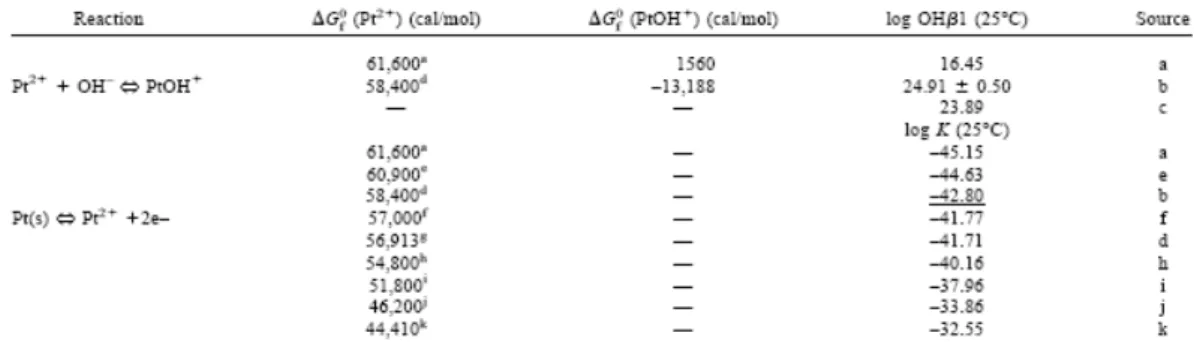
We would like to point out that our paper comprised two parts. First, we presented the experimental measurements of platinum metal solubility (Pt[s]) in solutions of weak ionic strength at 25°C under oxidizing conditions at pHs 4 to 10. These measurements are very precise and enabled, for the first time, an evaluation of the Gibbs free energy of PtOH+ aqueous species (ΔG°f[PtOH+] = −13,188 ± 682 cal/mol) at 25°C. Note that this value is very
close to that proposed by Sassani and Shock (1998) for PdOH+ (−13,130 cal/mol) but very
different from that proposed by the same authors for PtOH+ (1560 cal/mol; see Table 1).
Table 1. Thermodynamic constants of platinum hydroxide complexes and platinum solubility reactions at 25°C.
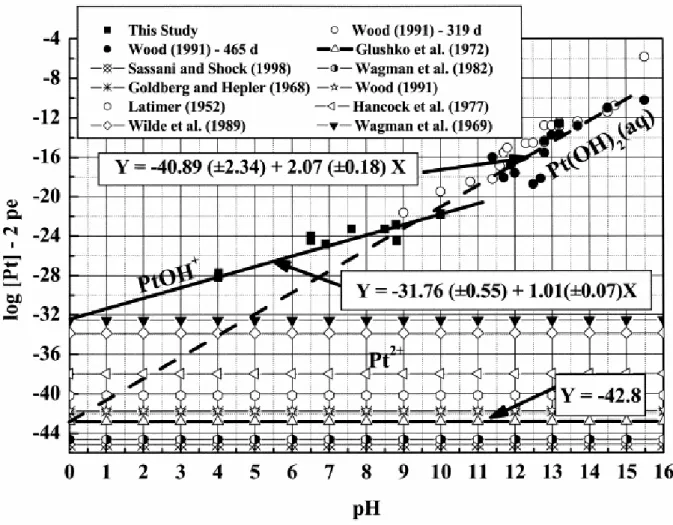
Second, we discussed the selection of the Gibbs free-energy value for Pt2+ aqueous species. The retained value was selected so that platinum speciation in the experimental aqueous solution is consistent with the solubility measurements. The fact that we did not explain this step in greater detail may well have led to some confusion. The value suggested by Glushko et al. (1972) (see Table 1) was retained because this not only gives the “best speciation” of the experimental aqueous solutions but also respects the slope of 1 of the equation (y= −31.76
[±0.55] + 1.01 [±0.07]x ) obtained by adjusting our measurements to the line representing the PtOH+ species (Fig. 1). In other words, by using the data of Glushko et al. (1972), the slope of the line established from the solubility measurements remains unchanged. Obviously, any ΔG°f(Pt2+) value greater than that of Glushko et al. (1972) fulfills this constraint. Conversely,
lower values can influence this line and lead to an overestimation of the concentrations of dissolved Pt in the experimental solutions ( Fig. 1). We thus recommended using the value given in Glushko et al. (1972) for ΔG°f(Pt2+), i.e., 58,400 cal/mol. In addition, Wood (1991)
adopted a value similar to that of Glushko et al. (1972), namely, 56,913 cal/mol, to evaluate the stability constant of the Pt(OH)2(aq) species from his platinum solubility measurements
under a pH range of 9 to 15.5. We then reevaluated the stability constants of the chloride and sulfate complexes of PtII (Table 5 in Azaroual et al., 2001), assuming that the Pt2+ free species is unstable (not observable) under our experimental conditions and in particular under those for which the free-energy formation of these complexes was determined. In other words, the free-energy formation of these complexes (Sassani and Shock, 1998) was determined independently of ΔG°f(Pt2+). Sassani and Shock (1998) provided an excellent literature review
of the Gibbs free-energy values of Pt2+. Moreover, they adopted an even higher value (61,600 cal/mol) than that of Glushko et al. (1972). Our choice may well be debatable, but our measurements of platinum solubility in buffered pH solutions do not indicate lower ΔG°f(Pt2+) values. Because this is precisely on what Byrne’s comment focuses, we here reply
in the following four steps:
1. Byrne argues, “Previous work on the hydrolysis of PdII, whose equilibrium behavior is generally quite similar to that of PtII… .” This is true, but the difference of “approximately 13
orders of magnitude” will vary according to the source used (see Table 1). Moreover, recent measurements show that the first evaluations of stability constants of several aqueous hydroxides, even for the best characterized elements (i.e., Pb, Zn, etc.), were highly approximate. Moreover, all data in the compilation of Baes and Mesmer (1976) may not necessarily be correct.
2. In another statement, Byrne contends that “there are compelling reasons to conclude that the PtOH+ stability results shown in Eqn. 1 and 2 are greatly in error.” He seems surprised that our data assume that the free Pt2+ species is unstable in aqueous solutions under surface conditions. However, Table 1 shows that out of the nine Gibbs free-energy values for Pt2+ published in the literature, only the lowest values (44,410 cal/mol, Wagman et al., 1969; 46,200 cal/mol, Wilde et al., 1989) give [Pt2+]/[PtOH+] molar ratios with respective values of 0.2 and 0.01 in a HClO4 solution with an ionic strength of 1. Wagman et al. (1982) later
abandoned their initial value and proposed a new value of 60,900 cal/mol for the Gibbs free energy of the Pt2+ aqueous species. Note that this last value gives a [Pt2+]/[PtOH+] molar ratio of 10−12.7, which is even lower than that obtained (i.e., 10−10.9) with the data of Glushko et al. (1972) recommended in our paper (Azaroual et al., 2001). Consequently, we still maintain that the free Pt2+ aqueous species is not observable in aqueous solutions under surface conditions. Table 1 and Figure 1 clearly support this statement.
3. Byrne claims that our stability constant brings into question all previously published data. Following our selection, we merely reused the value given by Glushko et al. (1972) to evaluate the thermodynamic constants of the Pt2+ chloride and sulfate complexes, which Byrne himself admits are not very different from the known values. The hypothesis, which we did not enumerate in our paper (Azaroual et al., 2001) when we reassessed the stability constants of the platinum aqueous complexes (see Table 5 in Azaroual et al., 2001), is the fact that the Pt2+ species is unstable in aqueous solutions at ambient conditions. Moreover, we believe that the instability of this species partly explains the multitude of Gibbs free-energy values found in the literature.
4. Byrne adds, “The extraordinarily large OHβ1(Pt) and β1*(Pt) results (Eqn. 1 and 2) of
Azaroual et al. (2001) require that formation of PtOH+ is taken into account in the assessments of Clβ1(Pt). In the absence of such considerations it is apparent that the OHβ1(Pt)
and Clβ1(Pt) results of Azaroual et al. (2001) are not internally consistent.” We did reassess the
chloride stability constants to ensure consistency with our choice of a ΔG°f(Pt2+) value. Here,
we must point out that the reassessment of the stability constants has to be made according to the chosen ΔG°f(Pt2+) value because, as we firmly believe, the free Pt2+ species is unstable
under any experimental conditions (including our own). Calculations of the speciation of platinum in seawater (Fig. 5 in Azaroual et al., 2001) showed that the data of Sassani and Shock (1998) did not at all suppose an observability of the Pt2+ species in sea water.
We admit that Byrne’s comment on the inconsistency of our PtII database in the absence of consideration of PtOH+ in the assessment of
Clβ1(Pt) is probably true. Faced with this
situation, it would be necessary to reexamine all the data previously published, particularly those of Sassani and Shock (1998). This global review would be highly complicated, and it did not enter into the scope of our initial paper. Finally, the serious uncertainty on the stability of Pt2+ (its free energy of formation) necessitates further experimental studies to be resolved.
Fig. 1. Aqueous speciation of platinum in the Pt(II)-O-H system in equilibrium with platinum metal at 25°C. Literature data (Glushko et al 1972 and Wood 1991) are included to examine the relative importance of platinum hydroxide complexes (as given in Azaroual et al., 2001). For comparison, we have integrated the effect of various literature data on the Gibbs free energy of the Pt2+ aqueous species (Latimer 1952; Goldberg and Hepler 1968; Wagman et al 1969; Wagman et al 1982; Hancock et al 1977; Wilde et al 1989 and Sassani and Shock 1998) on the equilibrium constant (log K) of the reaction Pt(s) Pt2+ + 2 e−.
Acknowledgements
This work forms part of BRGM project PRR401 (contribution 02348). The authors would like to thank D. J. Wesolowski and S. A. Wood for their helpful reviews to improve the manuscript.
References
Azaroual, M., Romand, B., Freyssinet, P. and Disnar, J.-R., 2001. Solubility of platinum in aqueous solutions at 25°C and pHs 4 to 10 under oxidizing conditions. Geochim. Cosmochim.
Acta 65, pp. 4453–4466.
Baes, C.F. and Mesmer, R.E., 1976. The Hydrolysis of Cations, John Wiley, New York. Glushko, V.P., Medvedev, V.A., Bergman, G.A., Gurvish, L.V., Yungman, V.S., Vorob’ev, A.F., Kolesov, V.P., Reznitskii, L.A., Mikailov, V.V., Gal’chenko, G.L. and Kharapet’yants, M.K.h., 1972. Thermodynamic Constants of Matter, Academy of Sciences of the USSR, Moscow.
Goldberg, R.N. and Hepler, L.G., 1968. Thermochemistry and oxidation potentials of the platinum group metals and their compounds. Chem. Rev. 68, pp. 229–257.
Hancock, R.D., Finkelstein, N.P. and Evers, A., 1977. A linear free-energy relation involving the formation constants of palladium(II) and platinum(II). J. Inorg. Nucl. Chem. 39, pp. 1031– 1034.
Latimer, W.M., 1952. Oxidation Potentials, 2nd ed, Prentice Hall, Englewood Cliffs, NJ. Sassani, D.C. and Shock, E.L., 1998. Solubility and transport of platinum-group elements in supercritical fluids: Summary and estimates of thermodynamic properties of ruthenium, rhodium, palladium, and platinum solids, aqueous ions, and complexes to 1000°C and 5 kbar.
Geochim. Cosmochim. Acta 62, pp. 2643–2671.
Wagman D. D., Evans W. H., Parker V. B., Halow I., Bailey S. M., Schumm R. H. (1969)
Selected Values of Chemical Thermodynamic Properties. Technical note 270-4. U. S.
National Bureau of Standards
Wagman D. D., Evans W. H., Parker V. B., Schumm R. H., Halow I., Bailey S. M., Churney K. L., Nutall R. L. (1982) The NBS tables of chemical thermodynamic properties. Selected values for inorganic and C1 and C2 organic substances in S1 units. J. Phys. Chem. Ref. Data 11. (Suppl. 2)
Wilde A. R., Bloom M. S., Wall V. J. (1989) Transport and deposition of gold, uranium, and platinum-group elements in unconformity-related uranium deposits. In The Geology of Gold
Deposits: The Perspective in 1988 (eds. R. R. Keays et al.), Econ. Geol. Monogr. 6, 637–650
Wood, S.A., 1991. Experimental determination of the hydrolysis constants of Pt2+ and Pd2+ at 25°C from the solubility of Pt and Pd in aqueous hydroxide solutions. Geochim. Cosmochim.