Publisher’s version / Version de l'éditeur:
3rd IEEE International Conference on Digital Ecosystems and Technologies
(DEST 2009), pp. 384-389, 2009-10-02
READ THESE TERMS AND CONDITIONS CAREFULLY BEFORE USING THIS WEBSITE. https://nrc-publications.canada.ca/eng/copyright
Vous avez des questions? Nous pouvons vous aider. Pour communiquer directement avec un auteur, consultez la
première page de la revue dans laquelle son article a été publié afin de trouver ses coordonnées. Si vous n’arrivez pas à les repérer, communiquez avec nous à [email protected].
Questions? Contact the NRC Publications Archive team at
[email protected]. If you wish to email the authors directly, please see the first page of the publication for their contact information.
NRC Publications Archive
Archives des publications du CNRC
This publication could be one of several versions: author’s original, accepted manuscript or the publisher’s version. / La version de cette publication peut être l’une des suivantes : la version prépublication de l’auteur, la version acceptée du manuscrit ou la version de l’éditeur.
For the publisher’s version, please access the DOI link below./ Pour consulter la version de l’éditeur, utilisez le lien DOI ci-dessous.
https://doi.org/10.1109/DEST.2009.5276745
Access and use of this website and the material on it are subject to the Terms and Conditions set forth at
Collaboration over a service-oriented fiber optic networking platform
Harzallah, Yosri; Horton, Joseph; Spencer, Bruce
https://publications-cnrc.canada.ca/fra/droits
L’accès à ce site Web et l’utilisation de son contenu sont assujettis aux conditions présentées dans le site LISEZ CES CONDITIONS ATTENTIVEMENT AVANT D’UTILISER CE SITE WEB.
NRC Publications Record / Notice d'Archives des publications de CNRC:
https://nrc-publications.canada.ca/eng/view/object/?id=f4c79338-1702-4cb7-aca3-ea9f81ee46c6 https://publications-cnrc.canada.ca/fra/voir/objet/?id=f4c79338-1702-4cb7-aca3-ea9f81ee46c6Collaboration over a Service-Oriented Fiber Optic Networking Platform
Yosri Harzallah
1, Joseph Horton
2and Bruce Spencer
1 1Institute for Information Technology, National Research Council Canada,Fredericton, New Brunswick, Canada e-mail:{FirstName.LastName}@nrc.gc.ca
2Faculty of Comptuer Science, University of New Brunswick, Fredericton, New Brunswick, Canada
e-mail: [email protected]
Abstract—Collaborative tools are among the most resource intensive applications today. Broadband technologies such as fiber-optic communication provide a way to bring these tools, regardless of geography, in a collaborative platform. In this paper, we focus on the feasibility of the network architecture that supports the the collaboration. We solve the RWA problem in this specific context while taking into account the availability of the shared non-network resources. Unlike the previous studies, a traffic demand is defined as a set of one-to-one simultaneous connections to model the traffic of collaboration over a non-multicast capable optical network.
The offline version of the problem is discussed, with and without the time as a parameter for scheduling purposes. The case where the network is meant to carry time-multiplexed traffic over the wavelengths is also discussed.
Several solutions based on Integer Linear Programs (ILP) and heuristics are proposed, implemented and their perfor-mance compared. Two types of ILPs are proposed: link and path formulations. While the link formulations give optimal solutions, they take a long time to solve and thus they can only be used for small problems. Path formulations and heuristics scale better but at the expense of optimality.
Index Terms—Collaboration, routing and wavelength assign-ment, linear programming, heuristic, advance reservation.
I. INTRODUCTION
The convergence of software and network technologies has paved the way to virtual organizations and distributed collaboration where scientists and engineers share access to world-class resources without regard to geography. Vir-tual Organizations (VO) like EarthScope, IPBIR (Integrated Primate Biomaterials and Information Resource), NESS (Network for Earthequake Engineering Simulation) [1] are a few exemples that confirm this collaborative trend. The sophistication of the middleware tools, the emergence of the service oriented architecture paradigm and the huge bandwidth provided by optical networks are all key enablers to a state-of-the-art collaborative cyberinfrastructure. With the wide adoption of fiber-optic networking, supported by the Fibe-to-the-Home (FTTH) initiative [2], [3], social networks could also share network-intensive applications such as high definition videoconferencing and simultaneous access to large data feeds, such as graphics rendered in real time.
We are using these tools, in the smaller scale of a VO called HSVO (Health Services Virtual Organization). A VO can be thought of as a social network where we assume participants work intensely together with some previous knowledge of each other and some common infrastructure. However, allowing people to share resources and work si-multaneously together over computer networks raises man-agement difficulties, mainly because of the distance between
users and resources, as well as the concurrent use. This outlines the need for a management middleware capable of coordinating the collaboration and ensuring the availability of the resources including the bandwidth. In this paper we assume participants are interconnected by a tree or mesh network, with lightpath connectivity available via Argia [4]. The National Research Council developed SAVOIR (Ser-vice Oriented Architecture for a Virtual Organization’s Infractructure and Resources) for the purpose of managing collaboration. It is a platform that provides a single point of entry to the Web-service enabled shared resources. Even the underlying optical network infrastructure is a resource that can be configured. Optical networks, while they are the answer to bandwidth greedy applications, are an expensive technology. With a solution like Argia, provided by the CRC and Inocybe Inc, a wavelength routed network can be virtualized and leased to clients that can remotely configure its switches to create end-to-end connections (lightpaths). The physical topology is then transparent to the user, and with remote calls to Web-services one can set up or teardown a private network.
SAVOIR currently does not have a scheduler to reserve resources and bandwidth. In a wavelength routed optical network, reserving bandwidth means reserving a route and a wavelength. While this problem, commonly known as the Routing and Wavelength Assignment problem, has been the focus of many studies, less work has been done in the context of collaboration.
In this paper, the problem we address is the feasibility of the network architecture for moderate to large VO. We introduce the colaborative RWA (CRWA) problem, in the case of a non-multicast enabled network. A specific defini-tion of the traffic demand is introduced and the availability of the non-network resources is taken into account so that bandwidth is not reserved and waisted between unavailable resources. The Offline version of the problem is considered in this paper. The presented solutions are based on Integer Linear Programming (ILP) and heuristics.
The paper is organized as follows. In section II, we define the problem and we compare it to the related previous work in section III. Section IV describes the proposed solutions and section V evaluates their performance. Conclusions are drawn in section VI along with some suggestions of future work.
II. COLLABORATIVERWA PROBLEM
Scheduling bandwidth in a wavelength routed optical network means assigning a route and a wavelength for every lightpath. However it does not make sense to reserve
bandwidth to connect resources that are not available for use, especially in the context of collaboration and virtual organizations where resources are usually under different ownership domains and thus, their availability is uncertain. Taking into account the availability of the non-network resources is then important to avoid wasting bandwidth and eventually blocking other collaborations from being satisfied.
Also, a distributed collaboration implies a hyperconnec-tivity between the set of users and the set of resources involved. However, when multicast is not available, this means that, at the network level, a collaboration request is actually a request to set up a set of end-to-end simultaneous connections. We define this set as a subsession, that has a start and end time, and define the collaboration session as a set of these subsessions. Indeed we can imagine a scenario of a collaboration session where resources are brought only when needed throughout the session.
The colaborative RWA problem (CRWA) can then be de-fined as the problem of assigning a route and a wavelength for every connection of every subsession of session, while taking into account the availability of the resources and users involved in this connection. Solving this problem is crucial to an efficient use of the network.
The problem can have two versions: an offline version (or static) and an online (or dynamic) one. The offline case is when traffic demands are queued and then processed all together while in the online case the problem is solved for one request at a time as soon as it is issued.
In this paper we study the problem with permanent and temporary traffic. Adding the time dimension allows non-overlapping sessions to use the same resources. The Time Division Multiplexing (TDM) capability, where a lightpath uses a certain number of TDM channels on the wavelength, is also studied.
III. CRWAAND THECLASSICRWA PROBLEM
Several schemes have been proposed to solve the classic RWA problem differing according to the assumptions that can be made on the problem. The RWA problem is known to be hard to solve. The problem is shown in [5] to be NP-hard in the offline case without wavelength converters. Several approaches to solve it are reviewed in [6]. Some of them attempt to tackle the problem as a whole while some break it into two sub-problems (a routing problem and a wavelength assignment problem). Integer Linear Programming (ILP), meta-heuristics and heuristic algorithms have been used to solve the problem.
ILP formulations of the RWA problem are, however, NP-complete, and thus cannot be used in practical cases with big networks or a big number of traffic demands. The alternatives are, then, heuristics and meta-heuristics such as simulated annealing [7], genetic algorithms [8] or tabu-search [9]. These algorithms do not guarantee optimal solutions, but their performance can be evaluated with the ILP solution as a bound.
Other studies propose algorithms that handle traffic re-quests sequentially and assign a path and a wavelength at a time. These algorithms differ according to the scheme used to sort the requests and to define the assignment. Some of these possible schemes are reviewed in [6].
While the RWA problem has been a focus of many researchers, there are few papers studying it in a collabora-tion context. The few papers that does assume a multicast enabled network. The communication is then 1-N: one source broadcasts to N destinations using multicast-capable switches that split a signal to N identical signals; or N-N where several sources deliver streams to all the sites. Dynamic multicast is still at its early stage since it is facing several design problems due to fabrication complexity and optical power loss when splitting the signal [10].
Finally, RWA can be seen as a special case of the intro-duced CRWA where the traffic demand has one subsession with one connection.
IV. PROPOSEDSOLUTIONS
The optical network of interest is a WDM network with no wavelength conversion capabilities: the wavelength continuity constraint applies, a lightpath uses then the same wavelength on every link. The network is represented by an undirected graph where nodes are linked by single bidirectional fibers.
A. Notations
V Set of network nodes: V1, V2, ..., V|V|;
E Set of links E1, E2, . . . , E|E|;
Ce Bandwidth capacity of link Ee measured
in number of OC-1 channels; G= (V, E) Undirected graph;
W Set of wavelengths λ1, λ2, . . . , λ|W;
Psdj jthpath between V
sand Vd;
Psd Ordered set of paths between Vsand Vd;
Lepsd Equals1 if link Ee∈ Psdp;
R Set of resources R0, R1, . . . , R|R|;
σq The maximum number of simultaneous
connections a resource Rq can be part of;
U Set of users U0, U1, . . . , U|U |; D Set of sessions D1, D2, . . . , D|D|; wi Priority of sessions Di; Dij jthsubsession of session Di ; θs ij, θ e
ij Start and end time of subsession Dij;
Θ Set, of size τ , of relevant time points: {θs
ij, θije|i = 1..|D|, j = 1..|Di|};
Θr
Set, of size τr, of relevant time points for
the online problem;
Dijk kthsource-destination (s-d) connection of
subsession Dij;
Σijk hnode,resource,useri source triple for
con-nection Dijk: hsijk, q, ui;
∆ijk Destination triple for connection Dijk:
hdijk, p, vi;
R(Σijk) Resource of Σijk;
U(Σijk) User of Σijk;
Bijk Bandwidth requirement for connection
B. Problem Variables
In order to define the problem we introduce the following variables:
δi =1 if session Di is accepted, 0 otherwise;
δij =1 if subsession Dij is accepted,0 otherwise;
δijk =1 if connection Dijk is accepted,0 otherwise;
αλ
ijk =1 if wavelength λ is assigned to the s-d
connec-tion Dijk,0 otherwise;
γeλ
ijk =1 if s-d connection Dijk goes through the link
Eeusing λ, 0 otherwise;
ηn
ijk =1 if s-d connection Dijk goes through node Vn,
0 otherwise;
βijkpλ =1 if s-d connection Dijkuses path Pspijkdijk and
wavelength λ,0 otherwise.
C. Problem Formulation
Two ILP formulations are proposed for the offline prob-lem: a link and a path formulation.
1) Link formulation: In the link formualtion the ILP defines the route by selcting each edge.
The objective is to maximize the number of sessions accepted while keeping the assigning routes short and use a minimum total number of wavelengths.
max 10000X i wiδi− 100 X i,j,k,n ηnijk− X i,j,k,λ λαijkλ (1) In Eq. (1), the coefficients of the three terms are chosen to prioritize the different objectives.
The variables are subject to a set of constraints related to the netwrok traffic and the availability of the resources:
- The wavelength continuity constraint implies that a lightpath enters an intermediate node using wavelength λ and leaves it using the same wavelength λ:
X λ∈W X e∈V (n) γijkeλ = 2η n
ijk where n∈ V \ {sijk, dijk} (2)
X λ∈W X e∈V (n) γijkeλ = η n
ijk where n∈ {sijk, dijk} (3)
- An accepted connection is assigned a unique wave-length that is used on every assigned link:
X
λ∈W
αλijk= δijk (4)
- On each link a wavelength cannot be shared by two different connections:
X
ijk
γijkeλ ≤ 1 (5)
- γeλ
ijk has to be equal to zero except for the connections
that use λ:
γeλ
ijk≤ αλijk (6)
- A subsession is accepted only if all its connections are accepted and a session is accepted only if all its subsessions are accepted. Later we explain why we do not use a unique variable instead of three.
δijk= δij = δi (7)
- Dijk, if accepted, has to follow a path that goes from
sijk to dijk: 2δij = η sijk ijk + η dijk ijk (8) 2γeλ
ijk≤ ηijkn + ηijkm where Ee= (n, m) (9)
- A resource has a limited number of simultaneous connections:
X
i,j,k
δij ≤ σq whereR(Σijk) = q or R(Λijk) = q
(10) - Integrity constraints: δi, δij, δijk, αλijk, γ eλ ijk, η n ijk ∈ {0, 1} (11)
The time awareness can be added to this formulation by changing only constraints (5) and (10) as follows:
∀t ∈ [1..τ − 1] : X i,j,k|Dij is active in[Θt..Θt+1] γijkeλ ≤ 1 (12) ∀t ∈ [1..τ − 1] : X i,j,k|Dij is active in[Θt..Θt+1] δij ≤ σq
whereR(Σijk) = q or R(Λijk) = q (13)
The TDM support can also be added easily by altering constraint (5) as follows:
X
ijk
Bijkγijkeλ ≤ Ce (14) 2) Path formulation: In the path formulation, the ILP chooses the path from an ordered set of possible paths. The paths are generated using a k-shortest dissimilar paths algorithm based on the Dijkstra’s shortest path algorithm combined with an iterative penalty scheme inspired from [11]. The objective of accepting the maximum number of sessions and the minimum number of wavelengths still stands. In addition, the ILP favours paths with a lower index in the set of paths.
max 10000X i wiδi− 100 X p,λ X i,j,k pβijkpλ −X λ X i,j,k λβijkpλ (15) - An accepted connection is assigned one wavelength
and one route: X
p
X
λ
βijkpλ = δij (16)
- On each link a wavelength cannot be shared by two different connections: X i,j,k X p Leps ijkdijkβ pλ ijk ≤ 1 (17) -δijk = δij = δi (18) -X i,j,k
δij ≤ σq whereR(Σijk) = q or R(Λijk) = q
(19)
Again the time dimension can be added by modifying Eq. (17) as follows while Eq. (19) is replaced as in the link formulation: ∀t ∈ [1..τ − 1] : X i,j,k|Dij is active in[Θt..Θt+1] X p
Lepsijkdijkβpλijk≤ 1 (21) The TDM support is defined by changing Eq. (17) with the following constraint:
X
ijk
X
p
BijkLepsijkdijkβ
pλ
ijk ≤ Ce (22)
Time awareness and TDM support can be combined by merging the corresponding constraints.
Table I sums up the different obtained ILPs.
V. EXPERIMENTALRESULTS
In this section, we present experimental results of our proposed solutions. Simulation experiments were conducted with three networks: a tree network (HSVONET) with 9 nodes and two mesh networks, NSFNET (14 nodes, 19 edges) and EONNET (20 nodes, 38 edges). Links have 4 and 8 wavelengths. ILPs were solved with the solving framework SCIP and algorithms were implemented in Java. The tests were done on a 3.4 Ghz Intel Xeon Dual-Core hyperthreaded quad processor with 32 GB RAM.
The sessions and their requirements were generated ran-domly. The number of subsessions and the number of connections per subsession are drawn randomly in [1..3]. Instances of the Offline problem have a random number of sessions in [1..20] and their solving time limit is set to 4 hours.
Fig. 1 plots, in a logarithmic scale, the average solving times for ILP1 to ILP4 according to the total number of
connections in the problem. The number of connections represents the size of a problem better, since sessions can have a random number of connections.
When the size of the problem is small, the time values for the different ILPs are close to each other in the milliseconds range. However, when the problem’s size increases, the solving time increases exponentially for the link formu-lations of the problem, ILP1 and ILP3. For the same
problem, ILP3 takes less time than ILP1 to solve. ILP1
starts reaching the limit of 4 hours for some problems with a number of connections between 18 and 24. For problems with more than 24 connections, ILP1 always failed, while
TABLE I: Offline ILPs
ILP Link Path Time TDM
ILP1 √ ILP2 √ ILP3 √ √ ILP4 √ √ ILP5 √ √ ILP6 √ √ ILP7 √ √ √ ILP8 √ √ √ 10 100 1000 10000 100000 e so lv in g ti m e in s
ILP1 ILP2 ILP3 ILP4
0.001 0.01 0.1 1 1 23 4 56 7 8910 11 12 13 14 15 16 17 18 19 20 21 22 23 24 25 26 28 29 31 33 35 37 39 40 46 51 A v er a g e so lv Number of Connections
Fig. 1: Comparison of the average solving times of ILP1,
ILP2, ILP3 and ILP4. (NSF, λ= 4)
ILP3succeeded in solving every single problem of the set
in less than 4 hours.
Fig. 2 compares the average percentage of blocked connections for ILP1and ILP2, using the NFSNET and 4
wavelengths. When ILP1does not fail to solve the problem
in less than 4 hours, its blocking percentage is never worse than ILP2. The maximum difference is around 28%.
Fig. 3 plots the number of accepted connections by ILP2
according to the number of accepted connections by ILP1.
Only the solved problems are plotted. A linear regression is also plotted. The trend line shows how far ILP2 solutions
are from the optimal solutions. All the problems under the line have a gap of more than 18.77% with the optimal solution.
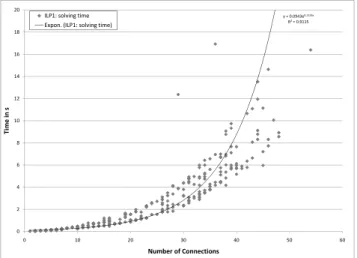
The huge difference of scale in the solving times between the link and path ILPs is obvious in Fig. 1. The exponential behaviour of the solving time is more evident in the next figure. Fig. 4 is a scatter diagram of the solving time according to the number of connections in the case of HSVONET with 4 wavelengths. An exponential trend line is drawn to confirm that. We notice also that the dispersion of the values obtained for the same number of connections increases with that number.
10 100 1000 10000 100000 50% 60% 70% 80% 90% 100% so lv in g ti m e in s b lo ck ed c o n n ec ti o n s
ILP1: blocked connections ILP2: blocked connections ILP1: time ILP2: time
0.001 0.01 0.1 1 10 0% 10% 20% 30% 40% 50% 123456789 10 11 12 13 14 15 16 17 19 20 21 22 23 24 25 26 27 28 29 31 32 33 34 35 36 37 38 39 40 41 46 51 A v er a g e so lv i A v er a g e % o f b lo c Number of Connections
y = 0.8123x 15 20 25 ep ted C o n n ec ti o n s ILP2 Linear (ILP2) 0 5 10 0 5 10 15 20 25 30 IL P 2 : A cc ep ted
ILP1: Accepted Connections
Fig. 3: Comparison of ILP1 and ILP2. (NSF, λ= 4)
The next scatter diagram shows the solving time for all the path formulations, ILP2, ILP4, ILP6, and ILP8.
Adding the TDM support (ILP8) to the time-aware ILP
(ILP4) does not change the solving time significantly, while
adding it to the non-time aware ILP (ILP2) unexpectedly
increases the average solving time.
VI. CONCLUSION ANDFUTUREWORK
We studied the routing and wavelength assignment prob-lem in the context of collaboration. A new definition of a traffic demand is introduced and the availability of the non-network resources used in the collaboration is taken into account to allow efficient advance reservation of all the involved resources. Solving this problem is crucial for an efficient collaborative use of the network and the resources. The solution gives the network enough bandwidth for different kind of social interaction. While this work is currently limited to interactions open to participants with fiber connections, it can be relevant in the future to social networks, with the spread of the Fiber-to-the-Home.
In this paper the solution to the offline version was presented. It is based on Integer Linear Programming. Two types of formulations were developed: a link-based formula-tion and a path-based formulaformula-tion. While path formulaformula-tions
y = 0.0943e0.1133x R² = 0.9115 10 12 14 16 18 20 T im e in s
ILP1: solving time Expon. (ILP1: solving time)
0 2 4 6 8 0 10 20 30 40 50 60 T im Number of Connections
Fig. 4: Exponential solving time. ILP1. (HSVO, λ= 8)
1 10 0 10 20 30 40 50 60 70 80 g ti m e in sec o n d s
ILP2 ILP4 ILP6 ILP8
0.001 0.01 0.1 A v er a g e so lv in g ti m Number of connections
Fig. 5: Comparison of ILP2, ILP4, ILP6, and ILP8.
Average solving time. (EON, λ= 4)
lead to small size problems and thus take millisecond to second times to solve, they give mediocre blocking percentages comparing to the optimal link formulations. However, the link formulations have an exponential scaling behavior making them inefficient in practice even for tree networks.
It was expected that, for the same number of connections, time-aware link formulations would take more time to solve, but the opposite was obtained. For the same number of connections, the solver seemed to take more time to give a solution when more sessions are to be blocked.
The use of Integer Linear Programming limits the con-straints on the resources to linear ones. While in this work we model the constraint on the number of simultaneous connections a resource can be part of, more and different constraints should be considered.
The path formulation could probably be improved by looking into other methods to generate the set of possible paths. It would also be interesting to compare suboptimal solutions of the link formulations with the solutions of the path formulations.
VII. REFERENCES
[1] “The National Science Foundation Cyberinfrastructure Council. Cy-berinfrastructure vision for 21st century discovery,” March 2007, http://www.nsf.gov/pubs/2007/nsf0728/nsf0728.pdf.
[2] M. Reardon, “Verizon bets big on network infrastructure,” http: //news.cnet.com/8301-1035 3-10058498-94.html, October 2008. [3] “Fiber-to-the-Home Council,” http://www.ftthcouncil.org. [4] “Inocybe Inc.” http://www.inocybe.ca.
[5] I. Chlamtac, A. Ganz, and G. Karmi, “Lightpath communications: an approach to high bandwidth optical WAN’s,” Communications, IEEE
Transactions on, vol. 40, no. 7, pp. 1171–1182, Jul 1992.
[6] H. Zang, J. Jue, and B. Mukherjee, “A review of routing and wavelength assignment approaches for wavelength-routed optical WDM networks,” January 2000. [Online]. Available: citeseer.ist.psu.edu/zang00review.html
[7] B. Mukherjee, D. Banerjee, S. Ramamurthy, and A. Mukherjee, “Some principles for designing a wide-area WDM optical network,”
IEEE/ACM Trans. Netw., vol. 4, no. 5, pp. 684–696, 1996.
[8] N. Banerjee, V. Mehta, and S. Pandey, “A Genetic Algorithm Approach for Solving the Routing and Wavelength Assignment Problem in WDM Networks,” in 3rd IEE International Conference
[9] J. Kuri, N. Puech, M. Gagnaire, E. Dotaro, and R. Douville, “Rout-ing and wavelength assignment of scheduled lightpath demands,”
Selected Areas in Communications, IEEE Journal on, vol. 21, no. 8,
pp. 1231–1240, Oct. 2003.
[10] Y. Zhou and G.-S. Poo, “Optical multicast over wavelength-routed WDM networks: A survey,” Optical Switching and Networking, vol. 2, no. 3, pp. 176 – 197, 2005.
[11] Y. Lim and H. Kim, “A shortest path algorithm for real road network based on path overlap,” J. Eastern Asia Soc. Trans. Stud., vol. 6, pp. 1426–1438, 2005.