Atomic physics: An almost lightless laser
The MIT Faculty has made this article openly available.
Please share
how this access benefits you. Your story matters.
Citation
Vuletic, Vladan. “Atomic physics: An almost lightless laser.” Nature
484, no. 7392 (April 4, 2012): 43-44.
As Published
http://dx.doi.org/10.1038/484043a
Publisher
Nature Publishing Group
Version
Author's final manuscript
Citable link
http://hdl.handle.net/1721.1/80855
Terms of Use
Creative Commons Attribution-Noncommercial-Share Alike 3.0
Atomic Physics: An almost lightless laser Vladan Vuletic, MIT Lasers are often described in terms of a light field circulating in an optical resonator system. Now a laser has been demonstrated in which the field resides primarily in the atomic medium that is used to generate the light. Atomic clocks that operate on optical transitions in trapped ions or atoms are the most accurate instruments ever made by mankind [1‐4]. In an atomic clock, the quantum mechanical phase between two atomic levels oscillates at a frequency given by the energy difference between those levels. The atom’s oscillation is detected by a laser, and today’s best clocks are limited by the frequency stability of that readout laser. Recently Murray Holland and colleagues have proposed an ultrastable laser based on an atomic gain medium with a very narrow frequency response [5]. The paper by Bohnet et al. on p. xxx of this issue [6] now reports the first prototype and characterizes key features of such a system.
Atomic transitions used for optical clocks have linewidths at the Millihertz level and standard free‐ running lasers are not sufficiently stable in frequency to directly interrogate the ultranarrow atomic transition. Rather, the world’s best clock lasers are stabilized to a meticulously crafted and controlled reference optical resonator. Currently such reference resonators achieve relative frequency stability below 10‐15, corresponding to a change in the resonator length by less than the radius of a proton. At this level, the stability of the reference resonator is limited by a fundamental process –thermal noise in the mirrors that leads to fluctuations in the length of the resonator, and thus in the frequency of the laser locked to it. Further progress, though difficult, may be possible by cryogenic operation and use of mirror materials with improved mechanical properties.
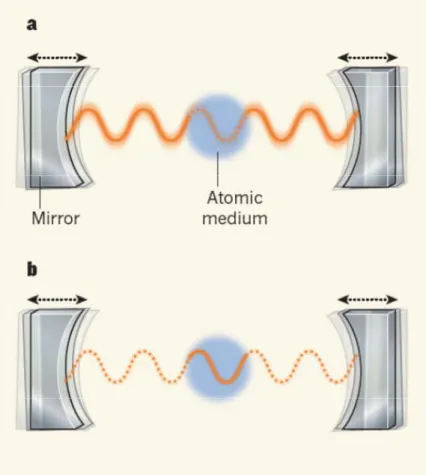
As an alternative, theorists at Boulder have proposed a laser operating in an unusual parameter regime where the linewidth of the atomic gain medium is much smaller than the linewidth of the laser resonator. In such a system, that may be termed superradiant laser following Dicke’s early proposal for a mirrorless laser [7], the laser oscillation is stored predominantly inside the atoms themselves, rather than in the light field circulating inside the resonator. This makes the laser frequency largely immune to cavity length changes (see Fig. 1), with an isolation that is given by the ratio of atomic to resonator linewidths. For their system Bohnet et al. measure an immunity factor exceeding 104.
To realize narrow‐frequency gain in a medium consisting of rubidium atoms, a species that is easy to laser cool but where no suitable transition is readily available, Bohnet et al. resort to a trick: A narrow atomic line can be mimicked by applying an external laser to weakly drive a transition between two long‐lived atomic ground states via a detuned excited state, see Fig. 1c. In this case, the gain profile, and thus the emitted laser light, is not absolutely narrow in frequency, but only when measured relative to the driving laser. Nevertheless, such a system exhibits most of the features of the proposed superradiant laser, and can be used to test key predictions. While similar lasing has been observed before in a cold‐atom system [8], Bohnet et al. are the first to characterize the frequency stability of the laser, and to explicitly demonstrate that the laser frequency depends only very weakly on the resonator length.
Fig. 1. (a) In a standard laser, consisting of an atomic gain medium for light and an optical resonator, the phase and amplitude of the laser oscillation are stored in the circulating light field. Vibrations of the resonator mirrors lead to variations in the laser frequency. (b) In a superradiant laser, where the linewidth of the atomic gain medium is much less than the linewidth of the optical resonator, the phase of the oscillation is largely stored in the atomic gain medium, and the laser frequency depends only very weakly on the resonator length. (c) Raman scheme with two stable ground states and an excited state to mimic a narrow optical transition. The optical gain is narrow in frequency when measured relative to the driving laser.
A notable feature of the superradiant laser is that the oscillation is stored predominantly in the atoms, rather than in the light field circulating inside the laser resonator. Remarkably, the laser can be operated even when the resonator contains less than one photon on average. Furthermore, the Boulder group shows that it is even possible to completely turn off the light field inside the resonator (by turning off the driving laser) and preserve the oscillation phase for several milliseconds in the atoms before the laser is turned back on. This dramatically demonstrates that the oscillation is indeed stored inside the atomic ensemble serving as the gain medium, as first predicted by Dicke [7].
While further tests of the frequency noise and stability need to be performed with a system that operates on an absolutely narrow and stable atomic‐clock transition, the current work of the group led by James Thompson is encouraging, and paves the way towards a scheme with the potential to significantly improve atomic clocks. Ever more accurate timekeeping not only has a variety of
technological applications, of which the most prominent examples are telecommunication networks and the Global Positioning System, but will also enable unprecedented fundamental tests of some of the basic laws that govern our universe. Vladan Vuletic is in the Department of Physics, Massachusetts Institute of Technology, Cambridge, Massachusetts 02139, USA. e‐mail: [email protected] 1. Rosenband, T. et al. Science 319, 1808–1812 (2008). 2. Ludlow, A. D. et al. Science 319, 1805–1808 (2008). 3. Jiang, Y. Y. et al. Nature Photon. 5, 158–161 (2011). 4. Katori, H. Nature Photon. 5, 203–210 (2011). 5. Meiser, D., Ye, J., Carlson, D. R. & Holland, M. J. Phys. Rev. Lett. 102, 163601–163604 (2009). 6. Bohnet, J. et al. Nature 484, 78–81 (2012). 7. Dicke, R. H. Phys. Rev. 93, 99–110 (1954). 8. Hilico, L., Fabre, C. & Giacobino, E. Europhys. Lett. 18, 685–688 (1992). 9. Chan, H. W., Black, A. T. & Vuletic, V. Phys. Rev. Lett. 90, 063003–063006 (2003).