CONIC SECTORS FOR SAMPLED-DATA FEEDBACK SYSTEMS*
Peter M. Thompson - Department of Electrical Engineering California Institute of Technology Pasadena, CA 91125, USA
Gunter Stein - Laboratory for Information and Decision Systems Michael Athans Massachusetts Institute of Technology
Cambridge, MA 02139 USA
ABSTRACT
A multivariable analog system can be controlled by a sampled-data compensator. A conic sector that can be used to analyze the closed loop stability and robustness of this feedback system is presented in this letter.
Keywords: Sampled-data feedback systems Multivariable feedback systems Conic sectors
Operator gain
Closed loop stability Robustness
*This research was carried out at the M.I.T. Laboratory for Information and Decision Systems with support provided by NASA Ames and Langley Research Centers under grant NGL-22-009-124 and by the General Electric Corporate Research and Development Center.
1. INTRODUCTION
Conic sectors can be used to analyze closed loop stability and robustness of some very general feedback systems [1,2,3,4,5]. The usefulness of this analysis, however, depends on the existence of a particular conic sector, or cone, for the particular feedback system of interest. This cone should be both computable and yield nonconservative sufficient conditions for closed loop stability and for robustness margins. In this letter a cone that is useful for
the analysis of sampled-data feedback systems is presented. The main purpose of this letter is to prove that the cone is mathematically correct. An
example is included to demonstrate that the cone is computable and nonconservative. In Section 2 conic sectors are defined and discussed. In Section 3 the same is done for sampled-data feedback systems. In Section 4 the main result is presented, Theorem 1, which shows the existence of a conic sector that contains a sampled-data operator. An example of how to use Theorem 1 is presented in Section 5. A corollary to the main result is used to find the gain of a
sampled-data operator in Section 6, followed by a summary in Section 7.
2. CONIC SECTORS
The notation and definitions that follow lead up to the definition of a conic sector and are consistent with references [1] to [5]. Define L r as the extended normed linear space of square integrable functions. Elements of L2e are functions e:R++Rr , from the set of real numbers >0 to the set of r-dimensional vectors that have finite truncated norm for all truncations TER+:
NOTE TO PRINTER:
Use script boldface for A, C, G, I, K, L, R, e, t, u, x, y, etc. Use Roman boldface for A, D, F, G, H, K, R, e, r, u, etc,
I1-11,
I
[
S
ile(t)
ti
Ed]
(1)
0
The subscript "E" indicates the Euclidean vector norm. In the limit as T-t the truncated function norm becomes the L2 function norm denoted by IeIIlL
r m 2
A relation A is any subset of the product space L2eXL2em The inverse
relation AI always exists and is defined by
AI {(y,x) £ L2eXL2e (x,yy) A} (2)
An operator A is a special case of a relation that satisfies two conditions: (1) the domain of A is all of L2e and (2) for every x in the domain there exists a unique y in the range such that (x,y) £ A.
The gain of the relation A is induced by the truncated function norm and is defined by
II
Ax
II1
[lAll | sup ~ T (3)
where the suprenum is taken over all x in the domain of A such that J|%JT-/ o,
all corresponding Ax in the range of A, and all T ER+. The relation A is
L2e-stable if
[1AIl
< O.The conic sector inequalities are now defined. Define A to be a relation define Cand R to be operators. If
2 2 2
Y
- Cx
<
|
R|[
-
_
lll
|
1(4)
for all (x,y) c A, all T eR+, and some £ >0 then Ais strictly inside cone(C,R) with center C and radius R. On the other hand, if
2 x - Cy 2>
II
Ry 112 (5)for all (x,y) c-AI and all T eR then -AI is outside cone(C,R).
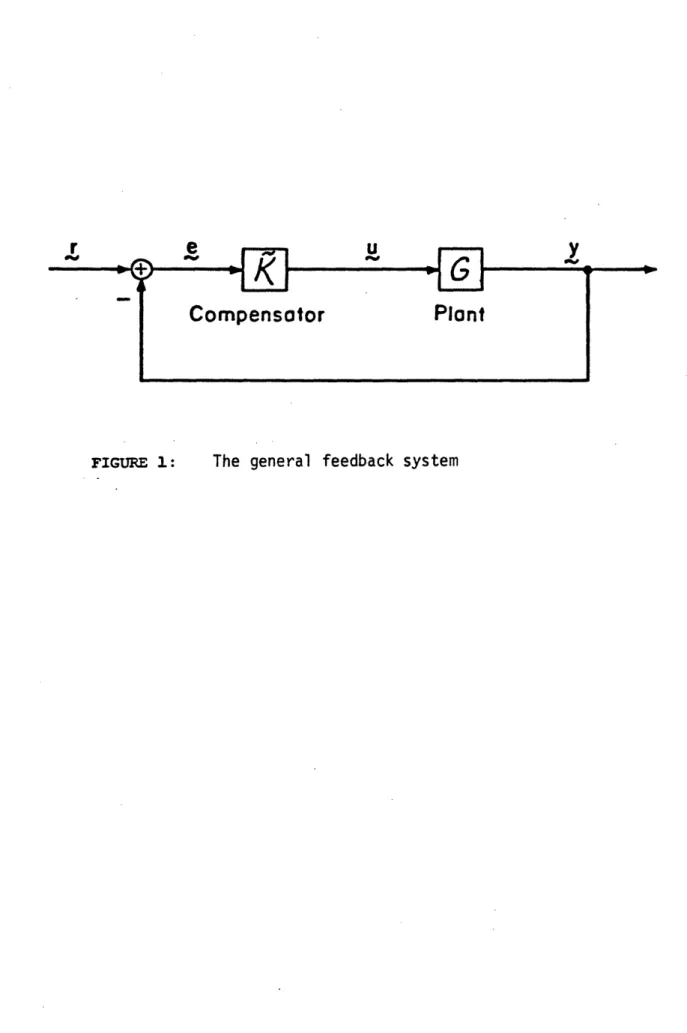
To use conic sectors to determine closed loop stability first divide the feedback system into two relations K and G as shown in Figure 1. Sufficient conditions for closed loop stability are
K is strictly inside cone(C,R) (6a)
-GI is outside cone(C;R) (6b)
These sufficient conditions are a robustness as well as a stability result because stability is determined not just for a particular K and G, but for any such relations which satisfy the above conic sector conditions.
3. THE SAMPLED-DATA FEEDBACK SYSTEM
The sampled-data feedback system is a special case of the general feedback system of Figure 1, and therefore conic sectors can be used to analyze
sampled-data feedback systems. There are two parts to the sampled-sampled-data feedback system: the analog plant and the sampled-data compensator. The analog plant, be it an airplane, helicopter, missile, spacecraft, motor, chemical process, and so on,
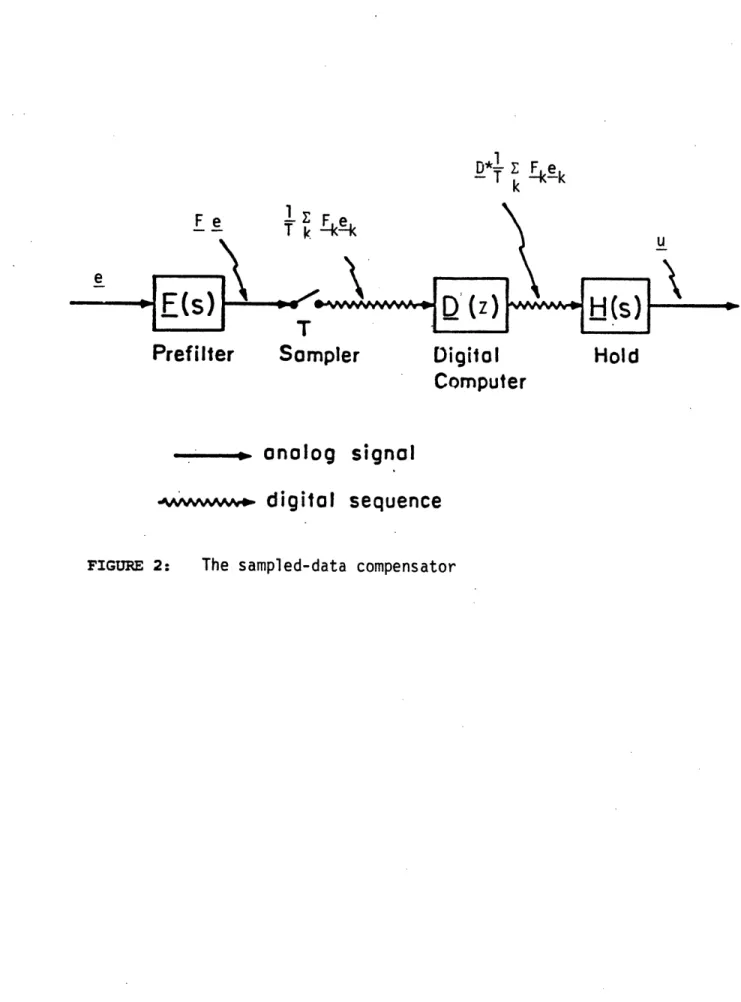
is modelled by the linear time invariant (LTI) operator G. The sampled-data compensator contains a digital computer embedded in a prefilter, sampler, and hold device, as shown in Figure 2, and is modelled by the sampled-data operator
K, which is a linear time varying (LTV) operator. The objective of the conic sector analysis is to construct a cone(C,R) that contains K, and then to show that -GI is outside of the same cone.
Because the analog system is LTI it can be modelled by the Laplace transform matrix G(s). When it is evaluated on the jw-axis then it becomes the Fourier
transform matrix G(jw). Given the Fourier transfrom u(jw) of the input, the Fourier transform of the output y(jw) is
y(jw) = G(jw)u(jw) (7)
Multivariable systems are analyzed using singular values [6,7]. The maximum
and minimum singular values of G(jw) are respectively amax[G(jw)] and amin[G(jw)]. The sampled-data compensator contains a prefilter, modelled by the Laplace transform matrix F(s); a computer, modelled by the z-transform D(z); and a hold device, modelled by the Laplace transform matrix H(s). The sampler is assumed to be synchronous, with a sample period of T seconds. From an input-output point of view the sampled-data compensator transforms an analog signal e into another analog signal a, and using operator notation this transformation is written
a = Ke (8)
Given the Fourier transform e(jw) of the input then the Fourier transform u(jw) of the output is u(jw) = H D* kF (9) where = F(jw-jwsk), s:T (9a) D* = D(z) evaluated at z=ejwT (9b) ( ') = sum from k = -I to X (9c) k
This does not define a transfer function from e(jw) to u(jw), only an input-output transformation. Equations (7) and (9) can be used to find the closed-loop transformations of the sampled-data feedback system, see [8] for more details. This completes the preliminary sections.
4. PRESENTATION AND PROOF OF A NEW CONIC SECTOR
In Theorem 1 a cone(K,R) is presented which contains a sampled-data operator K. Both the center K and the radius R are LTI operators, and hence have associated with them the Fourier transform matrices K(jw) and R(jw),
Theorem 1 Define the sampled-data operator K and the LTI operators K and R. Assume that K, K, R, and RI are L
2e-stable. Then K is strictly inside cone(K,R) if
amin [ R(jw)] = 1
1[ 2
2 max D*F n) + max (T Dk-(l-c) - nfk k nk - m ax
for all w and some e>O (10)
Furthermore, the choice of center
K(jw) = 1 H D* F Il1)
called the "optimal center," minimizes amin
[
R(jw)] for each w. ·Remarks The center K must be open-loop stable but is otherwise arbitrary. It is a LTI approximation to the sampled-data operator. A poor choice of center will make the radius large. The optimal center minimizes the radius and is therefore usually the center that is chosen. The radius R(jw) is periodic with period ws .
Before moving on to the proof of Theorem 1 the critical step in the proof is highlighted as Lemma 1. This is a frequency domain inequality which is in turn a consequence of the Cauchy-Schwartz inequality [9, p. 30]. The notational burden is lessened by the following definition:
1 H(s)D(eST)_ F(s) _ K(s) ; n=O
IK(s) sT (12)
T H(s)D(eST)F(s-j sn) ; nfO
Lemma 1 Define the K (s) as in (12). Then it follows that
-co n -o k n max
-Proof of Lemma 1 Two of the steps leading up to (13) are shown below:
f
i
K (j)ie(jw-jwsn)I12E dw < r ax[Kh(jw)] lle(j-jwsn)E (14)-00 n n
max-n
cc n dm
)
(12)< f(Z amax[ Kn(jW)])(
I
e(jw-jisk)lE)
dw (15)(By the Cauchy-Schwartz inequality. Define an=amax[Kn(j)] and bn= lle(jw-jwsn)IIE. Define
a and b to be t2 vectors with components an and bn for all integers n. Then,
IaTb]
2<hla]]E2 [Ibl2E2 ).< z z amax[ K (ijw-jw sk)
l
t(jw)E dw (16)This completes the proof.
Remarks Between steps (15) and (16) the summation over k is brought outside of the integral, the variable of integration is shifted from w to w+rsk, and
of infinite summations and integrals requires that the condition of Lebesgue Dominated Convergence be satisfied [10, p. 44], but this is assured here because each term of the infinite summation is a positive real number. It may be the case that the infinite summations do not converge, in which case Lemma 1 remains valid, if not particularly informative,
It is of interest to know when the infinite summations in (13) converge. They converge if max[F(jw)] and a max- max [H(jw)] each have at least a 1 pole2 rolloff, which is mathematically stated: if they are upperbounded by alw 1
l/2+
Bfor w sufficiently large and for some a,B>0.
Proof of Theorem 1 The objective is to show that K is strictly inside cone(K,R). Except for the step in which Lemma 1 is applied, this proof is similar to [4, Lemma A4]. Define the truncated function:
(t) (Re)(t) t <T(17) 0 ; t >T
For all ee L2e and all T R+:
II(K-K)e II2= (K-K)R TII T (18)
I< i(k-K)RI e1 2 (19)
2 c 2
<'- f
I|
z Kn R e (jw) rI dw (by Parsevals' Theorem) (20) -a n< e a_(2 [j
(jd
maxK j k)])IR le (j)llE2dw (21) (by Lemma 1)
2nf (l-c)
lie
T(j) E dw [by (10) of Theorem 1] (22):(1
)
l 1~e2
(by Parsevals' Theorem) (23) 2<lReQI2
- E (where s' =eIIR
I)
(24)Inequality (4) has just been verified, and therefore k is inside cone(KR). It still remains to show that the optimal choice for center given by (11) minimizes the radius. This can be shown by inspection, because this choice of center zeros out the single summation over k in (10). This completes the proof.
5. EXAMPLE
In this example a single-input-single-output (SISO) sampled-data feedback
system is defined, a cone is constructed that contains the sampled-data operator K, and then a check is made to see if -GI is outside of the same cone, If this
check succeeds then the sampled-data feedback system is closed-loop stable. Define:
g(s) = plant (25a)
f(s) : s a s + = prefilter (25b)
a
d(z) = computer, which must be stable (25c)
-sT
h(s) = 1 -5 = zero-order-hold (25d)
To keep the example as general as possible only the prefilter and the hold have been specified, and the only restriction is that d(z) is open-loop stable. It is left to the reader to substitute in numerical values,
The cone(K,R) which contains K is now constructed. Choose the optimal center:
The radius, via (10) of Theorem 1, is: 1 2
r(s) = 72 k lhkd*fni (27a)
k nOk
lh k2) ld*2 - El 22 Flhkd*fkl2 (27b)
The double summations have been converted to single summations by adding and then subtracting the n=k term, The single summations can be analytically solved by use of the following identity which is well known from digital filtering:
T
ak2
TT1b b(z) _ (28)k k k = z=ejwT
where b(s) = a(s)a(-s) (28a)
b(z) = z-transform of samples of b(t) (28b)
Hence, after much algebra:
(29)
bl(z) = z1hkl2 =T (29)
b2(z)
=1
zlfn2 2T 2 (30)n2 z Bz+l
where a = e-aTeaT B = e-aT+eaT (30a)
b(Z) T lhf 2 T z + 1 (31)
r(s) = Id(z) [bl((z)b(z)- b3() (32)
z=eT
In the next part of the example a check is made to determine is -GI is outside of cone(K,R). Using [4, Lemma A3], this will be true if (1) the analog system with the loop transfer function k(s)g(s) is closed loop stable and (2) the following inequality is satisfied:
Irg(l+kg) -l(jw) l < 1 for all w
(33)
This inequality can be checked, for instance, using a Bode plot. Whether or not it is satisfied depends, of course, on the numerical values chosen for the sampled-data feedback system. Because conic sectors give only sufficient conditions for closed-loop stability, failure of (33) does not neccessarily mean that the closed-loop system is unstable,
6. OPERATOR GAIN
One of the properties of an operator is its gain, which was defined earlier in Section 2, equation (3). In this section an upperbound for the gain of the sampled-data operator is presented.
Operator gains and conic sectors are closely related. If an operator A is inside cone(C,R) then it follows that
II(A-C)RII1
< 1. Hence, by setting the center C=O, the radius R can be used to find an upperbound for the gain of A. The following result is considered to be a Corollary of Theorem lcCorollary 1 Define the sampled-data operator K. An upperbound for its gain is:
K
< T2k
ax(H D*F (34)Furthermore, this upperbound actually is the gain when H(s), D(z), and H(s) are SISO. U
Proof of Corollary 1 Starting with equation (10) of Theorem 1, substitute K(s)=O for the center, and then maximize over the fundamental frequency range, This procedure yields the upperbound (34) for the gain. For the SISO case the
following input signal achieves the upperbound as T+ -:
e(t) = 7 lanI cos[(w0-wsn)t + Arg(an)] (35)
n
where an = d(e )f(-jwo+jwsn) (35a)
This completes the proof.
Remarks The gain for a multivariable K remains to be found. A conjecture is made that the gain is given by (34), but a signal [a vector version of (35)] has not yet been found that achieves this upperbound.
The gain of k depends on (1) the gain of the computer, (2) the aliasing of the prefilter, and (3) the aliasing of the hold. In particular, when there is no prefiltering, i.e. when F(s)=I, then the operator gain in infinite, thereby indicating extreme sensitivity to noise. This result about infinite gain with no prefiltering was stated previously in [ll].
7. SUMMARY
A conic sector that is useful for the analysis of sampled-data feedback systems is presented as Theorem 1. The crucial step in the proof is an application of the Cauchy-Schwartz inequality, which is highlighted in Lemma 1. A corollary
of Theorem 1 is used to find an upperbound for the gain of a sampled-data operator. The example in Section 5 demonstrates that the cone is computable and that it can be used to determine closed-loop stability. More examples are in [5], where it is shown how to include plant uncertainty in the analysis and thereby
determine robustness margins.
Further research is being conducted to (1) lessen the conservativeness of the stability and robustness results, (2) remove the restriction that the computer must be open-loop stable, and (3) extend conic sector analysis techniques to multi-rate sampled-data problems.
ACKNOWLEDGEMENTS
This work is based on Peter M. Thompson's Ph.D. thesis [5], which was prepared under the supervision of Professors Gunter Stein and Michael Athans.
REFERENCES
[1] G. Zames, On the Input-Output Stability of Time-Varying Nonlinear Feedback Systems, Parts I and II, IEEE Trans. Automat. Control, 11
(1966) 228-238 and 465-476.
[2] C.A. Desoer and M. Vidyasagar, Feedback Systems: Input-Output Properties (Academic Press, New York, 1975).
13] M.G. Safonov, Stability and Robustness of Multivariable Feedback Systems, (The MIT Press, Cambridge, Massachusetts, 1980).
14] M.G. Safonov and M. Athans, A Multiloop Generalization of the Circle Criterion for Stability Margin Analysis, IEEE Trans. Automat. Control, 26 (1981) 415-422.
15] P.M. Thompson, Conic Sector Analysis of Hybrid Control Systems, Ph.D. Thesis, Lab. for Information and Decision Systems, MIT, 1982, Report LIDS-TH-1242.
[6] V.C. Klema and A.J. Laub, The Singular Value Decomposition: Its Computation and Some Applications, IEEE Trans. Automat. Control, 25 (1980) 164-176.
[7] M.G. Safonov, A.J. Laub, and G.L. Hartmann, Feedback Properties of Multivariable Systems: The Role and Use of the Return Difference Matrix, IEEE Trans. Automat. Control 26 (1981) 47-65.
[8] G.F. Franklin and J.O. Powell, Digital Control of Dynamic Systems, (Addison Wesley, Reading, MA, 1980).
[9] S.K. Berberian, Introduction to Hilbert Space, (Chelsea Publishing Co., New York, 1976).
[10] R.G. Bartle, The Elements of Integration, (John Wiley and Sons, Inc., New York, 1966).
111] A. Kostovetsky, Some Investigations of Hybrid Systems, S.M. Thesis, Dept. of ME, MIT, May 1980, Report LIDS-FR-960.
--r e genera f s