HAL Id: hal-01755301
https://hal.archives-ouvertes.fr/hal-01755301
Submitted on 16 May 2019
HAL is a multi-disciplinary open access
archive for the deposit and dissemination of
sci-entific research documents, whether they are
pub-lished or not. The documents may come from
teaching and research institutions in France or
abroad, or from public or private research centers.
L’archive ouverte pluridisciplinaire HAL, est
destinée au dépôt et à la diffusion de documents
scientifiques de niveau recherche, publiés ou non,
émanant des établissements d’enseignement et de
recherche français ou étrangers, des laboratoires
publics ou privés.
sodium clusters
Romuald Poteau, Fernand Spiegelmann
To cite this version:
Romuald Poteau, Fernand Spiegelmann. Distance-dependent Hückel-type model for the study of
sodium clusters. Physical Review B: Condensed Matter and Materials Physics (1998-2015), American
Physical Society, 1992, 45 (4), pp.1878-1888. �10.1103/PhysRevB.45.1878�. �hal-01755301�
Distance-dependent
Hiickel-type
model
for
the study
of
sodium
clusters
Romuald Poteau and Fernand Spiegelmann
Laboratoire dePhysique Quantique, Uniuersite Paul Sabatier,
ll8
Route deNarbonne, 3l062 Toulouse CEDEX,France (Received 3June 1991;revised manuscript received 30September 1991)A distance-dependent extension ofthe Huckel model isproposed and applied to sodium clusters. It
consists primarily ofa two-band monoelectronic formulation expressed in an
s+p
basis set. The s+p
Hamiltonian is reduced into an s-only Hamiltonian by means ofquasidegenerate perturbation theory,with the p band treated perturbatively. The parametrization istaken from accurate calculations ofNa2
and Na&. This formulation allows avery quick determination ofthe potential-energy surfaces, and the
use ofthe Monte Carlo simulated-annealing technique for determining the stable isomers ofclusters.
For the smallest clusters (Na3-Na8), the model provides stabilities and geometries in very good
agree-ment with previous studies involving more sophisticated calculations (ab initio configuration-interaction ordensity-functional theory). Optimization results without constraint are also presented for clusters in
the range Na9-Na». Larger clusters in the range Na» —Na&6i are examined with restricted symmetry constraints (icosahedra, cuboctahedra, and cubic clusters). Beyond n
=147,
the cuboctahedral structureispreferred.
I.
INTRODUCTIONAs prototype candidates for studying transition from the atom tothe metal, alkali-metal clusters have in recent years attracted increasing interest. Unfortunately, due to
their metallic nature, which is related
to
the delocalizedcharacter
of
the wave function, their stability andgeome-trical properties cannot be studied using oversimplified
energy functions such as two- orthree-body potentials or
even diatom-in-molecules schemes. ' Among various treatments, one finds the jellium mode1 or shell mod-el, ' ab initio calculations based on configuration
in-teraction (CI),
"
' or on density-functional theory, 'with or without the use
of
effective core pseudopotentials, and recently the topological Hiickel model, ' which was shown to yield results in fair agreement with moreaccurate calculations.
The spherical jellium model was successful in predict-ing the stabilities
of
alkali-metal clusters, assuming al-most complete screeningof
the nuclei and providing a cluster orbital picture which corresponds to a kindof
su-peratom one, yielding spherical symmetries and rules forshell closing which explains the magic numbers. Spheroidal or ellipsoidal extensions '
of
the jelliummodel were derived in order to study deviations from sphericity and were used to provide general shapes
of
clusters as oblate or prolate ellipsoids, showing also thatwithin the jellium model, special stability at shell closing is associated with vanishing distortion from sphericity. However, the je11ium model may present artifacts such as the metastable character
of
some clusters'
with respectto dissociation. The agreement with experiment in values
for the dissociation energies or ionization potentials falls short
of
being quantitative. Moreover, since the nuclei do not appear explicitly, a descriptionof
the dynamicsof
fragmentation or clustering is apparently inaccessible tosuch a model, as is the study
of
crystallization properties.On the other hand, ab initio calculations" ' were
fairly successfu1 in determining the geometries and
stabil-ities
of
neutral and ionized alkali-metal clusters, as wellas other properties such as ionization potentials and
frag-mentation energetics, in general good agreement with ex-perimental results obtained in beams. The reliability
of
such ab initio calculations was also recently confirmed by the studyof
excited states. Reliable ab initio quantum-chemistry-type calculations require a substan-tial computationa1 effort. The geometry optimization is particularly tedious since the potential-energy surfaces are rather flat and numerous isomers are in competition and often occur in near degeneracy. Gradient procedures have generally been applied only under the self-consistent field (SCF) approximation, andCI
optimization is gen-erally not exhaustive (optimizationof
a scaling factor forthe
SCF
best structures)."
' Thus only relatively small clusters have been studied and optimization is only par-tial or not fully reliable for n &10.
From another pointof
view, it is uncertain that properties observed in super-sonic beams are directly and exclusively related to the descriptionof
geometrically static clusters. Besides, the useof
ab initioCI
potential-energy surfaces (PES) in molecular dynamics or Monte Carlo simulation carries a prohibitive computationalcost.
A similar situation pre-vails for dynamic studies concerning fragmentation orclustering, except perhaps for three- or four-atom
clus-ters.
An alternative ab initio solution was provided by the density-functional approach' (
DFT),
which obtainedresults in general agreexnent with
CI
calculations, espe-cially in the caseof
sodium clusters, yielding smallerin-teratomic distances, and probably overestimates
of
bind-ing energies. Due to its e%ciency, the
DFT
energy may be coupled to molecular-dynaxnics approaches such as the Car-Parinello method which was extensively used on metal and semiconductor clusters. However, fewat-tempts have been done
to
date to use this method for the studyingof
fragmentation and clustering. Although much quicker than GI,DFT
requires the computationof
matrix elements in agiven basis set, and the solutionof
aSCF
problem which is replaced by a coupled-equationproblem in the Car-Parinello formulation.
Quite recently, some authors provided results using the simplest possible quantum-mechanical model,
i.e., the
Huckel topological model, ' the orbitalsof
which are expanded on s atomic orbitals only. The searchof
the best structures consists in sorting a finite numberof
discrete topological structures. The results were found to
bein surprising agreement with more sophisticated
calcu-lations. Although dealing with discrete topological struc-tures, the sorting may turn to be difficult beyond ten atoms, since the exploration
of
discrete topological struc-tures cannot be exhaustive, and the effort tocalculate op-timal graphs quickly becomes burdensome. The successof
this latter model may appear paradoxical, since theonly physics involved in it is delocalization (through the transfer integral
t)
without any explicit accountof
corre-lation, whereas ab initio calculations show that large basis sets and extensive
CI's
are required in order to obtain re-liable results; in other words, correlation effects are strong and cannot be neglected. This paradox was resolved in arecent work'
expressed in a valence-bond formulation where it was shown that the roleof
large basis sets in alkali-metal clusters was essentially tocorre-late and lower the ionic valence-bond forms, increasing
thus the r
IU
ratioof
the Hubbard model, thus bringingthose systems closer to the weakly correlated case (hy-pothesis
of
tight-binding models in solid-state physics). Although providing a very quick quantum-mechanical calculationof
the energy, the topological Huckel model has two drawbacks.(i)
It
provides only topologies and cannot be used forstudying dynamical properties.
(ii)
p
orbitals are not considered in the model, while they were shown to play some role even in smallclus-ters.
"
The scope
of
the present paper is to propose adistance-dependent formulation
of
a Huckel-type model which allows for the obtention and optimizationof
real geometries, thus providing an efficient and realistic wayto describe the potential-energy surfaces
of
alkali-metalclusters. Such a model is combined with gradient or
Monte Carlo search for the optimal geometries
of
sodiumclusters which are investigated in the range n
=2
—14 and compared with other results when available. The model, which takes into account p orbitals in an effective way is introduced in Sec.II.
SectionIII
provides the results forn
=2
—9and presents asystematic comparison with otherexisting data. Results in the range n
=10
—14, for which very few ab initio type calculations have been published, are also given inSec.
III,
as well as partial resultscon-cerning small clusters with n
~
15.
Section IV examines the stability and fragmentation properties that can be de-duced from the present work. Finally, larger clustersof
afew hundred atoms are investigated in
Sec.
V,andextra-polation tothe bulk is considered.
II.
MODEL AND GEOMETRY OPTIMIZATIONTECHNIQUES
The traditional extended Hiickel theory is expressed in a nonorthogonal basis set
of
atomic functions, and the geometry dependence is introduced through the overlapintegrals. In the present work, the supposed basis set will be implicitly defined as composed
of
orthogonalizedatomic functions. Alternatively
to
the previouslymen-tioned topological Huckel model, ' we begin by consider-ing a one-electron Hamiltonian for sodium clusters which is expressed in a space-fixed basis composed
of
one s,.shell and one p; shell [including three
p
functions((p/'J,
p=x,
y, z)
per atomi]
Thus in this formulation, the dimensionof
the matrixto
be diagonalized is 4n, nbeing the size
of
the cluster. The matrix elements are defined as follows.(i)The diagonal elements h;; are sums
of
two-bodyor-bital repulsions pa~
atoms
a'Y&Isp
p p lthe two-body terms
p;.
~, which are functionsof
thein-teratomic distances, also depend on the nature and the
orientations
of
the orbitalsa
and y on both sites (for p orbitals). The scopeof
those diagonal terms is to intro-duce an interatomic repulsion, which is generally lackingor poorly represented in the ordinary and extended Huckel model.
(ii)The off-diagonal elements are assumed tofollow the usual overlap scheme and the one-center
h;;r
(any)
ele-ments are supposed tobe zero. The two-center integrals h;r
(i%j
), also considered hereafter as functionsof
the distances, are taken as distance-dependent transfer in-tegrals t; ~as defined in the Huckel model.We now introduce a simplification
of
the above 4n X4nmodel, by projecting the problem into the basis set
of
s-only orbitals treating the p orbitals by meansof
quasidegenerate-perturbation theory (QDPT) and the theoryof
effective Hamiltonians. In the s-only basis set,the matrix elements h
'
perturbed up to the second order, can then be expressed asatoms (h ) h;*
=h;
+
g
g,
,aE
[p„,
p,
p, ),
kAl a~Ei
atoms Qsag as hss hss+y y
'"
J k~i, a EEik kWjMoreover, in
h,
the s-p repulsion integrals p',~ are neglected, with only the isotropicp"
, repulsions retained and AE,"k is approximated as the asymptotic transitionAE,
-=0.
0773a.
u. for sodium. This means that the s basis set is assumed to account for the main physical effects in alkali-metal clusters (in line with the relative successof
the topological Hiickel model) and is chosen as the model spaceof
theQDPT
theory. Nevertheless, p orbitals, though not treated variationally, are introduced via perturbation terms. In particular, the directinterac-tions between the two bands are explicitly considered in
the perturbation, with the interband separation
hE,
keptconstant. Thus, the repulsion in the s band is lowered
due to mixing with the
p
band, yielding an effective diag-onal term h,.',.'
in the Hamiltonian. The intersite transferh,-"integral is also modified due tointeractions with p or-bitals located on neighboring sites. An interesting prop-erty
of
this perturbative formulation, especially for the off-diagonal terms, is that it introduces explicitly three-body interactions in the h,'J effective transfer integrals, beyond the two-body terms defining the transfer in the s band. Those three-body transfer terms are, in general, smaller than two-body transfer terms. However, they may happento
be the only nonvanishing terms when two centersi
andj
are widely separated but connected via a third center k lying close enough to bothof
them. Thus those three-body terms are likely to introduce some long-range interactions in the Hamiltonian.From a practical point
of
view, there are twoadvan-tages in the final formulation. First, itreduces the size
of
the matrix to be diagonalized, which is now equalto
the numberof
atoms. Second, it reduces the numberof
in-tegralsto
beparametrized in the model, since only the s-sintegrals
p',
and t,'.and the s-p integrals t,'. are kept.The total energy is computed as a sum
of
eigenvaluescorresponding toone-electron eigenfunctions.
kEocc
The integrals
p'
and t'
are isotropic, while the integrals t,'. depend on the natureof
the u space-fixed p-type func-tion and its orientafunc-tion with respect to the internuclear axisij.
In order to provide a simple trigonometric for-mulation, u is decomposed into two terms, respectively, parallel and perpendicular tothe internuclear axis:tJ
=
&s;fh fpj &=
&s;fhfp~ &+&s; Ihfp~ &If
we again follow the usual overlap scheme for thecan-cellation
of
matrix elements, we are left only with the first term which readswhere t,.'. is the transfer integral between the orbital s,.
and ap orbital along the local axis
ij.
0,"
is the angle between the local axisij
and the axis defining the space-fixed initia1 orbital pJ.
In order to determine the three integrals
p',
t',
andt,
',
a least-squares fit was achieved in order to reproduceat any distance the potential-energy curve
of
theX'X+
ground state and the X„+first excited state determined by Jeung(R,
=5.
8ao, andD,
=0.
74 eV, in agreement with experiment ), as well as the dissociation energy(0.41 eV into Naz+Naz)
of
the optimized 'A rhombus, which is the most stable structureof
Na4 taken from the recent workof
Bonacic-Koutecky, Fantucci, andKoutecky, imposing moreover a relation between t,'.
and t,.'. following the usual overlap scheme,
t$$ SSS
IJ /J
S'.
1J LJ
where
S,
"
andS.
are, respectively, the s-s and s-p over-lap integrals. Na4 isthe first cluster exhibiting some non-vanishing s-p mixing allowing a significant influenceof
the t,'
integral. Thep",
t",
andt'
functions are listedm
k k kl
kEocc I m ~&@
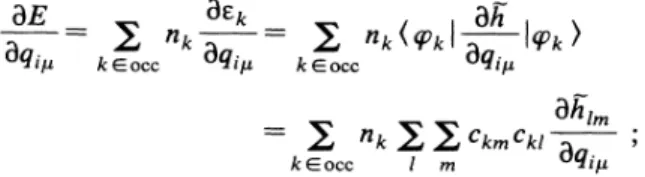
the Bhi /Bq;„derivatives are readily obtained through
cubic spline coefficients interpolation
of
the integralscor-TABLE
I.
Values (in eV)ofthet",
p",
andt'
parameters as functions ofthe internuclear distance.4 5 5.5 6 6.5 7 7.5 8 9 12 15 t$$
—
0.026 747—
0.340 642—
0.373 267—
0.367417—
0.336724—
0.292317—
0.242631—
0.193 626—
0.111534—
0.013 659 0.0 p 0.183 205 0.048189 0.024679 0.012 217 0.005 768 0.002 558 0.000 299 0.000101 0.000082 0.0 0.0 tso 0.005 932 0.164076 0.186633 0.215204 0.215394 0.203 204 0.182579 0.157 192 0.104 541 0.018884 0.0in Table
I.
Finally, the algorithm uses a point gridof
in-tegrals values interpolated through cubic spline functions
at any required distance, which is more efficient than computing exponential-type analytical expressions.
The present method is in the spirit
of
the tight-binding(TB)formulation by Chadi and co-workers in which a
semiempirical distance dependence was added to the tight-binding term in order
to
parametrize the ion-ionin-teraction energy. The parametrization
of
Chadi has beenwidely used in the study
of
silicon solids or surfaces and also in the caseof
silicon clusters, eventually including a Hubbard-type term to penalize two-electron on-site repulsion. Recently, more sophisticated extensionsof
theTB
model were proposed in order to introduceelectro-static terms. One may quote the tight-binding bond
(TBB)
modelof
Sutton etal.
, ' and also the self-consistent tight-binding (SCTB)method proposed byMa-jeski and Vogl and developed by Kohyama et
al.
Theprimary contribution
of
the present method is the devel-opmentof
a perturbative treatment for the 3p shell, which accounts for the hybridization effects in cases where p orbitals are not occupied in the atoms. This per-turbative treatment still provides a rather efficient algo-rithm and can be used in wide-range optimization and simulation requiring numerous calculationsof
the energy function. The parametrizationof
the matrix elements re-lies on ab initio results for the smaller clusters and not on semiempirical formulas.In order to find the optimized geometry
of
clusters,two procedures are used hereafter. The first one is gra-dient optimization without symmetry constraints in the framework
of
the Hellmann-Feynman theorem. We have moreover neglected the derivativesof
thet'
integrals, which are only involved in the perturbation. The energy gradient with respect to the coordinates q,.„can
beex-pressed
BE
BE,k Bhresponding
to
the matrix elements.The second technique is the Monte Carlo simulated-annealing procedure which, in principle, provides a
nonlocal (global) optimization algorithm when the initial temperature is high, but which can also be used as a local
algorithm when the initial temperature is low. Both gra-dient and low-energy simulated annealing can be used simultaneously as mutual checks forreal minima.
For
Monte Carlo optimization, the Metropolisalgo-rithm is used and the conditions
of
the simulatedanneal-ing process are the following.
(i) Start the
T=600
K
with a given arbitrary initialgeometry (the melting temperature
of
solid sodium being371
K).
(ii)Imposing alinear cooling rate
of
—
33 K/step.(iii)
For
each cooling step, the numberof
random con5gurations is proportional to the numberof
atomswith afactor
of 250.
(iv) With regard to moves in configurations space
I
q;„J,
the coordinateq;„
is taken tobe random while itsvariation is kept constant at
5q;„=0.
25 bohr forT~
1.
5K,
and at5q;„=0.
01 bohr forT +
I.
5K.
The signof
the displacement isalso random.(v) The process is assumed to converge when at some temperature step no further displacement isvalidated by
the Monte Carlo process. In the case
of
localoptimiza-tion, the initial temperature ischosen to be &10
K.
C
Q
Na Q (p.72) Na C (-1.07) Na 5.95 C (1.06) 6.02 4 2h a4 C2v (-1.79) 5.95 Na C (-2.39) (-2.27) Na60 (-33p) Na D (-3.25) Na6p2v( 313)FIG.
1. Geometries and total energies (in eV) ofNa2—Nat;clusters.
III.
RESULTSAND DISCUSSIONSFOR CLUSTERSn
=2-14
The equilibrium constants for the dimer yielded by the present model are
R,
=5.
9ao andD,
=0.
72 eV, differing only slightly from the initial inputs. This difference is due todeviations in the least-squares fit. In dealing with cluster energetics, it is importantto
give a fairly correctdescription
of
the dimer. Indeed, it was showntheoreti-cally ' forneutrals and ions and experimentally
in the
case
of
ions that unimolecular dissociationof
alkali-metal clusters is governed by only two dominant dissociation channels, respectively, the evaporationof
amonomer and the evaporationof
a dimer. Thus, the determinationof
the lowest dissociation channel requires some accuracyand consistency for the dimer dissociation energy. This
is not always true in ab initio
CI
calculations for clusters which are generally performed in rather small basis sets, thus underestimating the dimer stability, in particular, nor inDFT
calculations that alternatively tendto
overes-timate this stability.MCSA (Monte Carlo simulated annealing) was used in
order to determine the most stable structures
of
clustersfrom Na3 toNa9, which are depicted in
Fig.
1(Naz—
Na6) andFig.
2 (Na7—
Na9). Other isomers on the potential-energy surfaces are also shown. Up to Na8, the most stable structures are in agreement with the ab initiocal-culations
of
Bonacic-Koutecky, Fantucci, andKoutecky' (Na2
—
Na9) and Spiegelmann and Pavolini'(Na2
—
Na6), including shape, spatial symmetryof
the states (excluding spin which isneglected here) and bonds.It
is interesting tonote that contrary toresultsof
theto-pological Huckel model, the structure
of
the trimer isob-Na D5h {3.92) 7 5b Na C (-3.87) 7 3v 15 6. Na T (-4.87) Nac(48 s Na C (-5-47) 9 2v Va9Cs (-5.44)
FIG.
2. Geometries and total energies (in eV) ofNa7—Na9clusters.
tained in the present model as an isosceles triangle with an apex angle
of
64', that is to say that the Jahn-Tellerdistortion obtained, which is responsible forthe deviation from the equilateral triangle, is in the right direction, al-though it is known that the energy differences between the two isosceles shapes
(8&60'
and8(60')
are very small in alkali-metal trirners.For
the tetramer, the sidesof
the rhombus are larger than the small diagonal,in agreement with the results
of
Bonacic-Koutecky,Fan-tucci, and Koutecky' and
of
Martins, Car, andBut-tet'
'
while all distances were found equal inthe workof
Spiegelmann and Pavolini. ' Another structure withT
shape is found at higher energy. As concerns the penta-mer ground state, which is planar, all bond distances are found almost equal, in agreement with previous authors. The triangular bipyramid is found as an isomer.
For
Na6, the two isomers(C5„pyramid
andD»
bitriangle) are found to be quasidegenerate, although the C5, structure is the ground state. The distortion from planar shape is however slightly accentuated with our model for theC„
pyramid. A third isomer (bicapped tetrahedron) isfound0.
17eV higher. As concerns the Na7 ground state (D5h bipyramid}, its parameters are again consistent with thework
of
Bonacic-Koutecky, Fantucci, and Koutecky'and Martins, Car, and Buttet, '
'
with an axis length larger than the pentagon sides. The two atoms on the axis are nevertheless bonded, contrary to what was ob-tained in the Huckel topological model. Two higher structures are found for Na7, the first one being the tri-capped tetrahedron, the second one being obtained byro-tating symmetrically two
of
the capped atoms around the tetrahedron edges. The ground stateof
Nas is found tobe the Td fuliy capped tetrahedron, as in the work
of
Bonacic-Koutecky, Fantucci, and Koutecky, whereas the
DFT
calculations provided a structure with lower sym-metryD,
I,.
"'
Neither theD»
structure nor the D4„square antiprism are found to be minima on the potential surface, and this is consistent with ab initio
CI
calcula-tions.' We obtain however a second minimum with C,
symmetry which lies
0.
09
eV above the ground state. Inthe case
of
Na9, two isomers are found very close in ener-gy, namely, the singly capped octamer with C2, symme-try (Nas plus one capping atom) and the doubly cappedpentagonal bipyramid (Na7 plus two capping atoms). However, in the present work, the Cz, structure is slight-ly lower, while Bonacic-Koutecky, Fantucci, and
Koutecky provide the C, geometry as the ground state.
One may remark that the same
authors"
' find the C2,structure tobe the lowest for Li9.
The binding energies per atom (taking as zero energy the energy
of
one atom)e(n
)=[nE(l)
—
E(n
)]/n
=
E—(n)/n,
are reported in Table
II
for the ground-state structures and compared toprevious results. As concerns the small-est clusters, accurate ab initio calculations in extensive basis sets are available. Our binding energy for thetri-mer (8.19kcal} agree fairly well with values taken from
the recent ab initio calculation
of
Jeung,7.
94 kcal,while an experimental value
of
8.20 kcal can be deduced from the workof
Hilpert and the dissociation energyof
Na2 (0.74eV). The binding energy
of
Na4 is,of
course, inclose agreement with the ab initio result
of
Bonacic-Koutecky, Fantucci, and Koutecky which was used as
input in the least-squares procedure.
For
larger clusters with 5 n~
9, the only results available areCI
calcula-tions performed in smaller basis sets, ' theDFT
calcula-tionsof
Martins, Buttet, and Car, the very recentDFT
results
of
Rothlisberger and Andreoni using theCar-Parinello method, and results provided by the topological Hiickel model.
'
It
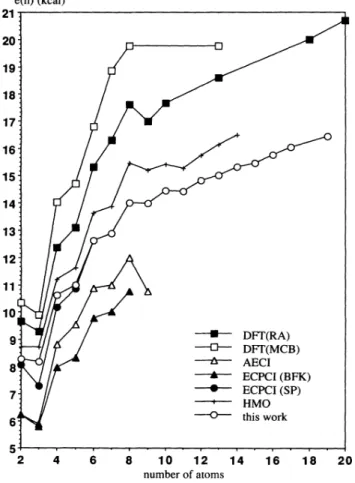
can be seen inFig.
3 that up ton
=
8, the binding energy per atom obtained in the present model follows the trend obtained in ab initiocal-culations and also in the topological Hiickel model. They are very close to the results
of
the calculationsof
Spiegel-mann and Pavolini' which only concern n~
6,and gen-erally above the valuesof
Bonacic-Koutecky, Fantucci,and Koutecky' who used smaller basis sets and did not
TABLE
II.
Binding energies per atoms ofNa„clusters (in kcal/mol). Density-functional theory,Martin, Car, and Buttet (Refs. 18and 19)[DFT(MCB)];density-functional theory, Rothlisberger and
Andreom (Ref.29)[DFT(RA)];all electron CI, Bonacic-Koutecky, Fantucci, and Koutecky (Ref. 14)
(AE-CI); effective core potential CI,Bonacic-Koutecky, Fantucci, and Koutecky (Ref. 14) [ECP-C
(BFK)];Spiegelmann and Pavolini (Ref. 16) [ECP-CI (SP)];topological Huckel Model, Wang et al.
(Refs. 21 and 22) (HMO).
DFT(MCB) DFT(RA) AE-CI ECP-CI(BFK) ECP-CI(SP) HMO This work 2 3 4 5 6 7 8 9 10 11 12 13 14 15 16 17 19 10.34 9.88 14.02 14.71 16.78 18.85 19.77 19.77 9.65 9.27 12.36 13~10 15.32 16.29 17.61 16.98 17.65 6.25 5.90 8.82 9.53 10.87 11.00 12.00 10.75 6.25 5.80 7.96 8.3', 9.77 10.00 10.75 8.07 7.29 10.16 10.85 12.62 8.73 8.73 11.19 11.61 13.64 13.86 15.46 15.19 15.42 15.28 15.73 16.13 16.48 8.276 8.191 10.603
!
0.988 12.636 12.873 14.000 13.977 14.453 14.437 14.816 15.023 15.323 15.456 15.758 16.043 16.439include the core-valence correlation effects. Both
DFT
binding energies are systematically larger than other
cal-culated values, and also exhibit a quicker increase
to-wards the bulk value especially in the calculation
of
Mar-tins, Buttet and
Car. '
One may notice the odd-even al-ternation in the stabilities for all calculations which was however not present in theDFT
resultof
Martins, But-tet, andCar'
for n &6.
If
one assumes that magic num-bers directly reQect the stability properties, according to the predictionof
the spherical jellium model, particularstabilities are expected at shell closings 2 and 8, which
are actually obtained in the present model (as in some
other calculations), with drops for n
=3
and9.
However,in our results, the drop atn
=9
is less pronounced than inother calculations taking into account geometrical
struc-ture
or
in the spherical jellium model.Afurther interesting property
of
the model is that not only the best structures are obtained, but also higher iso-mers are found atenergies consistent with those obtained in ab initio calculations. En particular in the trimer case,the
A,
isosceles structure is very closeto
the B2groundstate, in good agreement with most theoretical
calcula-tions which yield avery Sat surface along the
pseudorota-tion path.
For
Na4, the T-shape isomer is closer to theground state (0.058 eV} than in the work
of
Bonacic-Koutecky, Fantucci, and Koutecky' (0.21eV}.
In the pentamer case, the C2, bipyramid is
0.
12eV,e(n) (kcal)
21.
20.
19.
above the trapezoidal ground state
[0.
22 eV in theAE
(whereAE
denotes all electron) workof
Bonacic-Koutecky, Fantucci, and Koutecky'
].
With regardto
the two lowest quasidegenerate hexamers, the difference is found
to
be0.
046 eV, which can be compared to the0.
024-eV valueof
Spiegelmann and Pavolini' and the0.
040-eV valueof
Bonacic-Koutecky, Fantucci, andKoutecky.
'
One may thus infer that the present modelis not only able to reproduce the optimized ground-state structures, but it also provides a rather fair representa-tion
of
the potential-energy surfacesof
small sodiumclus-ters.
It
should be stressed that the small clusters geometries determined in the present work are close to behomothet-ic to those calculated by Spiegelmann and Pavolini, or
Bonacic-Koutecky, Fantucci, and Koutecky the bond
distances being generally smaller than those
of
the ab ini-tiocalculations.In the range n
=
10-19,
the numberof
quasidegenerate isomers increases, and although we have used the sameMCSA schedule, it cannot
of
course be ensured that all the lowest minima have been found, especially for n~
15.
Apart from the results
of
the jellium model (in eitherver-sion, spherical, ' spheroidal, ' orellipsoidal }, only very
few results are available in this range
of
sizes. Even in the topological Huckel model, optimization for n 10cannot be exhaustive because
of
the numberof
discrete structures to be considered. One should quote in the literature cases treated within theDFT
formalism and the symmetry-based crystal-field estimationsof
Mingos ' forclusters corresponding toshell closings.In the case
of
Na,o, three structures (Fig. 4}are veryclose in energy. Two
of
them have C4„symmetry,name-18.
17.
14.
13.
Na C4v(-6.29) Na 0C& (-6.28) Na10 C2 (6'25)12.
10;
9-Nail C2 CS(687) 87.
6-. 5 210
12 1416
18
20 number ofatoms Na CS(-7-74) Na C2v (-7.73)FIG.
3. Binding energies per atozn forsmall sodium clusters.ly, a tetracapped square bipyramid (our actual ground
state}and a bicapped square antiprism which was also
ob-tained by Lindsay, Wang, and George. We obtain as third structure the Cz„-bicapped octamer (it can be noted
that this geometry is found in the L1&0case by
Bonacic-Koutecky, Fantucci, and Koutecky.
"'
The most stableshape (Fig.4)for Na&& is afully capped trigonal prism as in the work
of
Lindsay, Wang, and George. Thepresent structure is slightly distorted from D3& symmetry
due to the Jahn-Teller effect. An isomer is obtained at
higher energy and corresponds to atetracapped pentago-nal bipyramid. Itsgeometry can, however, be viewed as a fully capped trigonal bipyramid, again distorted from
D3h symmetry due to Jahn-Teller degeneracy. With
re-gard to Na,2, two degenerate isomers (Fig. 4) are found;
both correspond to a double capping
of
the second iso-merof
Na,o (i.e., the doubly capped square antiprism).In one case, the capping takes place on two opposed
faces, while in the second case it takes place on two
adja-cent faces. Although this latter structure presents an
ex-tra bond, its energy is not significantly lowered.
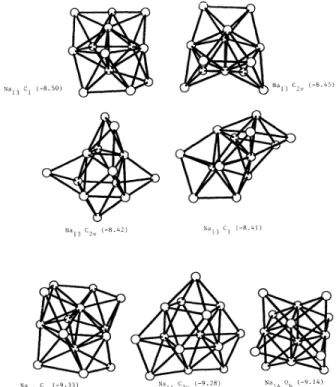
The ground state
of Na»
has C& symmetry and is an hexacapped pentagonal bipyramid (Fig. 5). Three higher isomers were obtained forNa»,
noneof
them being an icosahedron, which is Jahn-Teller forbidden. The lowest isomer has C2, symmetry and can be understood ascon-sisting
of
three embedded pentagonal bipyramids. Twoother isomers are very close. One with
C,
symmetryessentially consists
of
two embedded bipyramids with anextra connecting atom, while the second one (
C2„)
can beobtained by capping with two atoms the second isomer
of
Na».
In the caseof
Na&4, the ground state has C,sym-metry and is obtained by partially capping the faces
of
the pentagonal bipyramid with seven atoms (three above, four below). The second structureof
Na,4 hasCz„sym-metry and is obtained by symmetrically capping the second structure
of
Na,owith four atoms. A thirdstruc-ture higher by
0.
15 eV ismore symmetrical (Oz)andcor-responds to a piece
of
thebcc
lattice. This isomer was found by Fantucci and Koutecky in the caseof Li,
4.'Our investigation was less systematic beyond Na,4.
Na»
has C, symmetry and can be understood as an icosahedron capped with two contiguous atoms. Na,6also has C, symmetry and consists
of
an icosahedron capped by three contiguous atoms. Na&7 has C,symme-try and consists
of
an icosahedron capped by asetof
fouratoms.
Na»
has D5& symmetry and is foundto
be thedouble icosahedron, also found in the case
of Li»
(seeFig. 6}.
' We note that Na&7 can be obtained from Na,9by removing two atoms. Moreover, it should be stressed that the ground-state geometries found for Na9, Na,o,
and Na,3correspond tothose found in the recent work
of
Rothlisberger and Andreoni.
It
is interesting to compare the shapesof
the clusters obtained in the present work taking into account the po-sitionsof
the nuclei with those obtained in the recent spheroidal ' or ellipsoidal versionsof
the jellium model.Table
III
presents the ratiosof
the momentsof
inertia inthe range n
=6
—14 as compared with thoseof
the ellip-soidal jellium model (smaller clusters are planar). Ofcourse Na8, with Td symmetry although not really
spher-ical, has three equivalent axes. Clusters Na6 and Na7 are
oblate, while clusters Na9—Na,z are prolate and
Na»
and Na,4 are again oblate. However, some discrepanciesoccur, the ground state
of
Na,o is oblate in ourcalcula-tion, whereas the first isomer is actually prolate. Also sometimes, two axes are found equivalent in the jellium model, while they di6'er in our work.
Na Cl (-8.50) C (-8.45) 13'2v Na C, (-8.42) 13 2v C (-8.41') 13 1 Na16Cs(-10.97} Na C (-9.33) 14 s 14C,'2v (-9.28 140h (-9.14) Na CS(-11.86)
FIG.
5. Geometries and total energies (in eV) ofNa» andNa,4clusters.
FIG.
6. Geometries and total energies (in eV) ofNa», Na&6,TABLE
III.
Axial ratios ofNa„clusters. The present results are reported inthe first row. The second one refers tothe ellip-soidal jellium results ofSelby et al. (Ref. 7). 10 corresponds to the second structure obtained for n=10,
quasidegenerated withthe ground state.
fragmentation energy (eV)
1.
000.95
0.
90
0.85
10 10* 12 13 14 0.47 0.711 0.66 0.875 1 1 0.91 0.914 0.88 0.88 0.860 0.89 0.809 0.74 0.770 0.69 0.736 0.72 0.711 1.46 1.186 1.22 1.069 1 1 0.93 0.914 1.06 0.88 0.860 0.91 0.917 1.00 0.963 1.08 1.082 1.10 1.186 1.46 1.186 1.22 1.069 1 1 1.18 1.196 1.06 1.28 1.352 1.24 1.348 1.36 1.348 1.34 1.255 1.26 1.1860.80
0.
75
0.
700.65
0.
60
0.55
0.50
0.
450.
400.35
Oa30 & ~ s I ~ i s ~ ~ 2 3 4 5 6 7 8 910
1112
13
14 number ofatomsFIG.
7. Fragmentation energies ofsmall sodium clusters into a monomer[h,
(n)]and a dimer [hz(n )].
IV. STABILITYAND FRAGMENTATION PROPERTIES
For
larger clusters in the range Na&0-Na» the binding energy per atom is continuously increasing, with a lessaccentuated slope than in the range Na2-Na9. The
odd-even alternation in the stabilities still exists but is significantly smoothed with respect to the smaller
clus-ters.
We can use the present results in order to examine the unimolecular fragmentation properties
of
sodium cluster with respectto
energy.It
was shown for the smaller alkali-metal clusters, that two channels are generallypredominant" ' ' in the unimolecular
fragmentation processes, namely the evaporation
of
amonomerNa„~Na„&+
Naand the evaporation
of
adimerNa„~Na„2+
Na2.
The same predominant channels are relevant for the frag-mentation
of
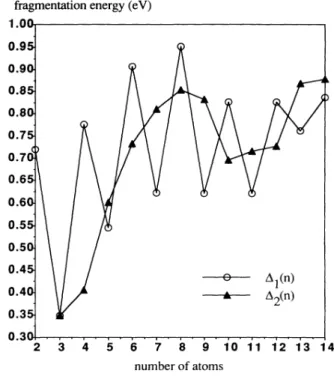
cationic clusters and have been observed ex-perimentally. Figure 7 shows the fragmentation ener-gies corresponding to the evaporationof
a monomer andadimer, respectively, forn
~
14,b,,(n)
=
—
E(n
)+E(n
—1)+E(1),
b2(n )
=
E(n
)+E(n
—
—
2)+E(2)
.These two quantities exhibit rather different behaviors. While
6,
shows a very clear odd-even alternation, which reflects the odd-even alternation in the binding energiesper atom, 52does not present any periodicity atall. This results into a preference for even-numbered clusters to
evaporate a monomer, while fragmentation into a dimer is the lowest fragmentation channel for odd-numbered
ones. The only exception is n
=14.
The dissociation en-ergies (i.e.,the fragmentation energies towards the lowest channel) are given in Table IV and compared to the re-sultsof
other authors. As expected for magic numbers, Na2 and Nas show stronger dissociation energies than their immediate neighbors. Those results are consistentwith other previous theoretical calculations performed
forthe smallest clusters.
"
V. LARGE CLUSTERSAND EXTRAPOLATION TOTHE BULK
We examine in this section calculations
of
larger clus-ters involving up to a few hundredthof
atoms, with specific geometries, namely regular Mackay icosahedra and regular cuboctahedra (piecesof
fcc-like lattice) forn
=55,
147, 309,and 561and also cubes (piecesof
bcc-like lattice for n
=35,
91,
189,341,
and 559correspond-ing to clusters with
2X2X2,
3X3X3, 4X4X4, 5XSX5,
and
6X6X6
primitive cells. These shapes may notcorre-spond to the actual shapes
of
free clusters, however such calculations are likely to provide some information with regardto
the convergencyof
cluster properties towards those in the bulk situation. Moreover, in a recentpubli-cation, Martin, Buttet, and Car report observations
which might correspond to the completion
of
cuboc-tahedral or icosahedral shells
of
atoms for large clusters beyond n=1500
atoms, whereas stabilitiesof
smaller clusters are better characterized by the fillingof
electron-ic shells. Thus, the examination
of
such structures may beof
interest, even although we do not consider in the present work the rangeof
interest (n~
1500)implied in the workof
Martin etal.
For
those structures, there is only one independent geometrical parameter, that hasTABLE IV. Dissociation energies of Na„clusters (De=Min
[h,
(n), 62(n)] in eV).density-functional theory, Martin, Car, and Buttet (Refs. 18 and 19)[DFT(MCB)];density-functional theory, Rothlisberger and Andreoni (Ref.29)[DFT(RA)];all electron CI, Bonacic-Koutecky, Fantucci, and
Koutecky (Ref. 14)(AE-CI); effective core potential CI, Bonacic-Koutecky, Fantucci, and Koutecky [ECP-CI (BFK)];Spiegelmann and Pavolini (Ref. 16)[ECP-CI (SP)];topological Hiickel model, Wang et al. (Refs.21and 22)(HMO). The asterisk denotes fragmentation into a dimer.
Other n DFT (MCB) DFT(RA) AE-CI ECP-CI (BFK) ECP-CI (SP) HMO This work authors
2 3 4 5 6 7 8 9 10 11 12 13 14 0.90 0.39 0.64* 0.76 1.36 1.14 0.47* 0.70 1.00 0.97 1.17 0.52 0.73* 0.54 0.23 0.45* 0.54 0.76* 0.51 0.79* 0.03 0.54 0.21 0.30* 0.42 0.62* 0.49 0.65* 0.70 0.25 0.36* 0.59 0.83 0.76 0.00 0.43* 0.58 0.85 0.66 1.06* 0.57 0.57* 0.60 0.74* 0.91 0.91 0.720 0.349 0.405' 0.545 0.733* 0.622 0.853* 0.621 0.696* 0.621 0.727* 0.762 0.836 0.74' 0330 0.408'
'Verma et al. (Ref. 37).
Deduced from the experimental work ofHilpert (Ref. 55). 'Bonacic-Koutecky, Fantucci, and Koutecky (Ref. 25). been optimized (it corresponds to the expansion
of
thecluster).
It
can be seen inFig.
8 that icosahedral andcuboc-tahedral structures are more stable than cubic structures, which can be understood as minimizing the number
of
surface atoms with respect to the numberof
atoms in the volume.For
n=55,
the icosahedron ismore stable thanthe cuboctahedron. However an inversion occurs, both
structures are almost degenerate at n
=147
andcuboc-tahedra happen to be more stable for n
=309
and561.
Results obtained withDFT
formalism for cuboctahedran
=55
and 147are also illustrated in Fig. 8. In analogy with what was obtained for the smaller clusters theDFT
binding energies are larger than ours.
At very low temperature, sodium bulk ischaracterized
by the
fcc
lattice, whereas at room temperature, thebcc
lattice ismore stable with abinding energy
of 1.13
eV.It
is seen that even for n
=
559 or561,
the bulk value isnotyet reached. This is not surprising since surface atoms
still represent a large proportion
of
the total numberof
atoms. In order
to
get a reasonable estimationof
thebulk energy corresponding to the present calculations,
the total binding energy was separated into di6'erent
con-tributions, namely
ne
=n, e„+n,
e, .e,
and e, represent, respectively, the binding energiesof
volume and surface atoms.e„may
be considered as closeto the bulk energy, while e, isthe energy required to re-move a surface atom.
For
icosahedra and cuboctahedra,the values
e,
and e, are determined from n=309
and561,
whereas for cubic structures, they are determined fromn
=341
and 559(see Table V). The fcc structure, in line with the extrapolationof
cuboctahedral clusters, is foundto be the most stable with a binding energy per atom
(1.
06eV) very close tothe experimental value whereas the extrapolationof
icosahedral clusters yields1.
04 eV and the extrapolationof
bcc-like cubic clusters is1.
05 eV. The extrapolated energies for surface atoms are0.
77and0.
69 eV, respectively, smaller than the0.
89-eVvaluegen-erally admitted.
VI. CONCLUSION
%e
have developed in the present paper a distance-dependent extensionof
the Huckel model, on the basisof
e(n)(eV) Qc
1.
00
0.90
0.
85
0.
800.75
0.
70 0 100 200 cuboctahedral structures (DFT) 300 400 500 600 number ofatomsFIG.
8. Cohesive energies{e,
)oflarge sodium clusters. The bulk value is 1.13eV. Comparison is made with the DFTre-sults ofMartins (Ref.20) for cuboctahedral clusters n
=55
andTABLE V. Binding energy per atom (in eV) for large Na„ clusters.
Cube Icosahedra Cuboctahedra 35 55 91 147 189 309 341 559 561 0.735 0.812 0.857 0.886 0.909 0.818 0.871 0.900
0.920
0.810 0.872 0.9070.929
an effective Hamiltonian including the effects
of p
orbitals in a perturbative way. This model allows for a quick determinationof
thePES.
The useof
Monte-Carlo simu-lated annealing together with this model potential-energy function yields for n=3
—
9geometrical shapesof
sodium clusters which are completely similar toCI
ab initiocal-culations following gradient
SCF
optimization. Binding energies have been shown to present a correct depen-dence as well for small clusters (n &20)as for larger clus-ters with afew hundredthsof
atoms, and extrapolation to the bulk also seems to be consistent, at least from an en-ergetic pointof
view.For
small clusters in the rangen
=10
—
19, some relevant structures are proposed also obtained from Monte Carlo simulated annealing. Our re-sults are fully consistent with the very recent workof
Rothlisberger and Andreoni obtained with the
DFT
formalism and the Parinello-Car method. From the present results, it does not seem that any unique con-struction rule governs the genealogy and growth
of
alkali-metal clusters in the range
n=1-14.
However,some small clusters appear as cores, or pieces
of
larger ones. A frequent constituent occurs tobe the pentagonal bipyramid (Na7). However, some other cores can also beidentified, such as the fully capped tetrahedron (Nas). As
a characteristic example, both substructures can be
identified in the Na9 ground state. As other substruc-tures, one can mention the bicapped square antiprism (the second structure
of
Na,o)which appears in Na,2andone
of
the Na,4isomers. With regard to clusters beyond Na&4, it is interesting to observe that Na,5, Na&6, and Na&7 are piecesof
the Na&9 double icosahedron. Theex-tensive and systematic research
of
all lowest isomers in the range Na»-Na2& is in progress, and may allow abetter understanding
of
the rules concerning the growthof
clusters for n+
15.
However, the numberof
possible degenerate isomers with a rather low energy becomes crucially increasing, and it is very likely that thermo-dynamical or molecular-dynamics simulations should be more adequate for determining observed properties than the obtentionof
afew unique structures, dependingof
the experimental conditions obtained in experiments. Such treatments are feasible, atleast forsmall clusters with the present model. In principle, the studyof
association and fragmentation processes from a dynamical pointof
viewcan also be undertaken, provided that a modification
of
the orbital filling rule and electrostatic corrections should be made in orderto
ensure correct dissociation for atoms with unpaired electrons. Such work isin progress.ACKNOWLEDGMENT
The Laboratoire de Physique Quantique is unite
associee No. 505 au Centre National de la Recherche
Scientifique.
A.L.Companion, Chem. Phys. Lett. 56, 500 (1978).
W.D.Knight,
K.
Clemenger, W.A.de Heer, W.A.Saunders, M.Chou, and M.L.Cohen, Phys. Rev.Lett.52,2141 (1984). W. Ekardt, Phys. Rev. Lett.52, 1925(1984).4K.Clemenger, Phys. Rev.
B
32, 1359 (1985); 86, 619 (1986). 5M.L.
Cohen, M.Y.
Chou, W.D.Knight, and W. A.de Heer,J.
Phys. Chem. 91,3141 (1987).Y. Ishii, S.Ohnishi, and S. Sugano, Phys. Rev. B 31, 1804 (1985).
7K.Selby, M.Vollmer,
J.
Masui, V.Kresin, W. A.deBeer,and W.D. Knight, Phys. Rev.B40, 5417 (1989).8W.Ekardt and Z.Penzar, Phys. Rev.B38,4273(1988). W.A.Saunders, Phys. Rev.B40,1400(1989).
S.Saito and M.L.Cohen, Phys. Rev.B38, 1124 (1988).
I.
Boustani, W.Pewestorf, P.Fantucci, V.Bonacic-Koutecky, andJ.
Koutecky, Phys. Rev.B35, 9437 (1987).I.
Boustani andJ.
Koutecky,J.
Chem. Phys. 88,5652(1988). V. Bonacic-Koutecky,I.
Boustani, M. Guest, andJ.
Koutecky,
J.
Chem. Phys. 89,4861(1988).V. Bonacic-Koutecky, P. Fantucci, and
J.
Koutecky, Phys. Rev.B37, 4369 (1988).' P. Fantucci and
J.
Koutecky, in Elemental and MolecularClusters, edited by G. Benedek,
T.
P. Martin, and G.Pac-chioni (Springer-Verlag, Berlin, 1988),p. 125.
F.
Spiegelmann andD.
Pavolini,J.
Chem. Phys. 89, 4954 (1988).J.
Flad, G.Igel, M. Dolg, H. Stoll, and H. Preuss, Chem. Phys. 75, 331 (1983).J.
L.Martins,R.
Car, andJ.
Buttet,J.
Chem. Phys. 78, 5646 (1983).J.
L.Martins,J.
Buttet, andR.
Car, Phys. Rev. B 31, 1804 (1985).J.
L.Martins, Z.Phys. D12,347(1989).Y.
Wang,T.
F.
George, D.M. Lindsay, and A. C. Beri,J.
Chem. Phys. 86, 3493 (1987).D.M. Lindsay,
Y.
Wang, andT.
F.
George,J.
Chem. Phys. 86, 3500 (1987).D.M.Lindsay, L.Chu,
Y.
Wang, andT.
F.
George,J.
Chem. Phys. 87,1685(1987).V. Bonacic-Koutecky, P.Fantucci, and
J.
Koutecky, Chem. Phys. Lett. 146, 518 (1988).V. Bonacic-Koutecky, P.Fantucci, and
J.
Koutecky, Chem. Phys. Lett. 166,32(1990).V. Bonacic-Koutecky, M. M. Kappes,
P.
Fantucci, andJ.
Koutecky, Chem. Phys. Lett. 170,26(1990).P. Ballone, W. Andreoni,
R.
Car, and M. Parinello, Phys. Rev. Lett. 60, 271 (1988); W. Andreoni in E/cmental and Molecular Clusters, edited byG.
Benedek,T.
P.Martins, andG.Pachioni (Springer-Verlag, Berlin, 1988),p. 206.
U. Rothlisberger and W.Andreoni,
J.
Chem. Phys. 94, 8129 (1991).I.
Stich,R.
Car, and M. Parinello, Phys. Rev. B 39, 4997 (1989)~F.
Spiegelmann, P.Blaise, D. Maynau, andJ.
P.Malrieu, Z. Phys. D 12,341(1989).P. Blaise,
F.
Spiegelmann, D. Maynau, andJ.
P. Malrieu, Phys. Rev. B41,5566(1990).J.
Hubbard, Proc.R.
Soc.London Ser.A 276, 238(1963).E.
Hiickel, Z. Phys. 70, 204 (1931); 72, 320 (1931); 76, 628(1932);83,632 (1933);
R.
Hoffman,J.
Chem. Phys. 39, 1397 (1963).35C.Bloch, Nucl. Phys. 6, 329 (1958);
J.
de Cloizeaux, Nucl. Phys. 20, 321(1960);B.H.Brandow, Rev.Mod. Phys. 39,771 (19671; Adv. Quantum Chem. 10,187(1977); Int.J.
QuantumChem. 15,207 (1979);
I.
Lindgren andJ.
Morisson, AtomicMany Body Theory (Springer-Verlag, Berlin, 1982);
F.
Spiegel-mann and
J.
P.Malrieu,J.
Phys. B17,1259(1984);J.
P.Dau-dey and
J.
P.Malrieu, in Current Aspects ofQuantum Chem istry, edited byR.
Carbo (Elsevier, Amsterdam, 1982).G.Jeung,
J.
Phys. B16,4289(1983).K. K.
Verma,J.
T.
Bahns, A.R.
Rejei-Rizi, W.C.Stwalley, and W.T.
Zemke,J.
Chem. Phys. 78, 3599 (1983).D.
J.
Chadi andR.
M. Martin, Solid State Commun. 19,643 (1976),Phys. Rev. Lett. 41, 1062 (1978);D.J.
Chadi, Phys. Rev.B29,785(1984).W. A. Harrison, Electronic Structure and the Properties of
Solids (Freeman, San Francisco, 1980);O.
F.
Sankey andR.
E.
Allen, Phys. Rev. B33, 7164 (1986); O. L.Alerhand andE.
J.
Mele, ibid. 35,5533(1987);37,2536(1988); A.T.
Paxton and A.P. Sutton,J.
Phys. C21,481(1988);R.
Biswas, C.Z. Wang, C. T. Chan,K.
M. Ho, and C. M. Soukoulis, Phys. Rev. Lett. 63, 1491(1989); C. Z. Wang, C.T.
Chan, andK.
M. Ho, Phys. Rev.
B
42, 11 276(1990);C.H. Xu,C.Z.Wang,C.
T.
Chan, andK.
M. Ho,ibid. 43,5024(1991);C. Z.Wang,C.
T.
Chan andK.
M. Ho, Phys. Rev.Lett.66, 189(1991).~D.
Tomanek and M. H. Schluter, Phys. Rev. Lett. 56, 1055 (1986);Phys. Rev.B36,1208(1987).A. P.Sutton, M. W. Finnis, D. G.Pettifor, and
Y.
Ohta,J.
Phys. C21,35(1988).4~J.A.Majewski and P.Vogl, Phys. Rev.B35, 9666 (1987). M. Kohyama,
R.
Yamamoto,Y.
Ebata, and M. Kinoshita,Phys. Status Solidi B152,533(1989).
~S.
Kirkpatrick, C. D.Gelatt, and M.P.Vecchi, Science 220, 671(1983);S.Kirkpatrick,J.
Stat. Phys. 34,975(1984).45N. Metropolis, A.Rosenbluth, M. N. Rosenbluth, A.Teller,
and
E.
Teller,J.
Chem. Phys. 21,1087(1953).B.
Rao and P.K.
Jena, Phys. Rev. B32,2058(1985);B.
Jena,B.
K.
Rao, andR.
H. Niemienen, Solid State Commun. 59, 509 (1986);B.
K.
Rao, P. Jena, M. Manninen, andR.
M.Niemienen, Phys. Rev. Lett. 58, 1188 (1987).
47C. Brechignac, Ph. Cahuzac,
D.
Pavolini,J.
Ph. Roux, andF.
Spiegelmann,J.
Chem. Phys. 87,5694(1987).R.
L.Martin andE. R.
Davidson, Mol. Phys. 35, 1713 (1978).J.
L.Martins,R.
Car, andJ.
Buttet,J.
Chem. Phys. 78,5646 (1983)~F.
Cocchini, T.H. Upton, and W.Andreoni,J.
Chem. Phys. 88,6068(1988).A.Herrman, H. Hoffman, S.Leutwyler,
E.
Schumacher, andL.Woste, Chem. Phys. Lett.62,216 (1979).
M. Broyer, G.Delacretaz, P.Labastie,
R.
L.Whetten,J.
P.Wolf, and L.Woste, Z.Phys. D3,131(1986).
Ph. Dugourd,
J.
Chevaleyre, M. Broyer,J.
P.Wolf, and L.Woste, Chem. Phys. Lett. 175,555(1990).
54G.H. Jeung, M. Broyer, and P.Labastie, Chem. Phys. Lett. 165, 494 (1990).
H.
K.
Hilbert, Ber.Bunsenges Phys. Chem. 88,263(1984).D.M.Mingos and Z.Lin, Chem. Phys. 137,15(1989). Z.Lin, T.Slee, and D.M.P.Mingos, Chem. Phys. 142,321
(1990)'.
A.L.Mackay, Acta Crystallogr. 15,916(1962).
T.
P.Martin,T.
Bergmann, H.Gahlich, and T.Lange, Chem. Phys. Lett. 172,209(1990).N. W.Ashcroft and N. D.Mermin, Solid State Physics (Holt Saunders, Tokyo, 1976).

![TABLE IV. Dissociation energies of Na„clusters (De=Min [h, (n), 62(n)] in eV). density- density-functional theory, Martin, Car, and Buttet (Refs](https://thumb-eu.123doks.com/thumbv2/123doknet/14404275.510504/10.918.163.740.214.467/dissociation-energies-clusters-density-density-functional-martin-buttet.webp)