
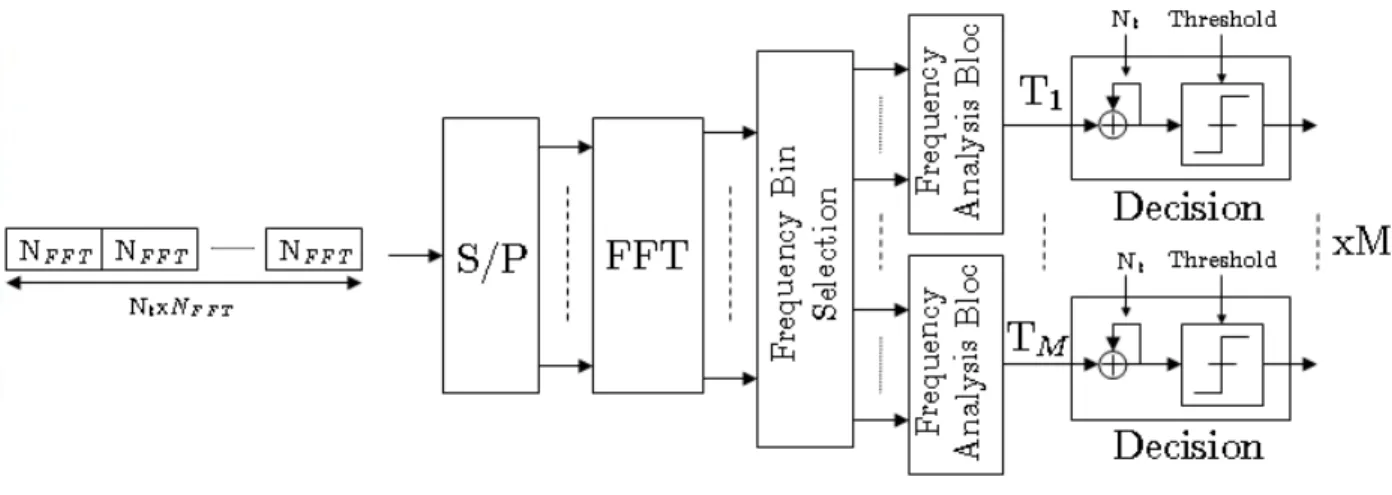
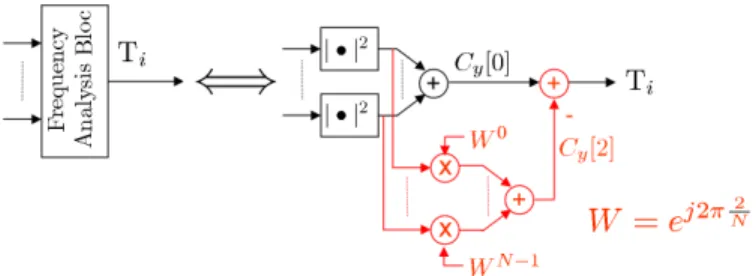
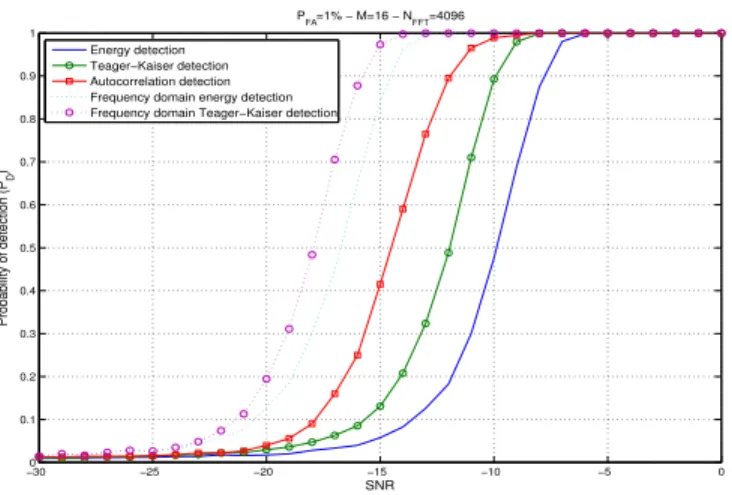
Wideband frequency domain detection using Teager-Kaiser energy operator
Texte intégral
Figure
Documents relatifs
For this, the net present value of the system’s profit, as calculated in Equation (12) for an expected lifetime of about 15 years and a discount factor of 10% is
In this paper, a new focal quality indicator based on Teager- Kaiser Energy Operator is used to estimate the translational kinematic of a moving target.. The results show the
Admittedly, the experiment in which the beam and the target are polarized gives access to the same physics content as those involving polarized beams and recoil
Il est aujourd’hui bien admis que les représentations d’un signal conjointement en temps et en fréquence offrent un réel intérêt : elles permettent une description des signaux
kernel function, number of neighbors L in the adjacency matrix, number of wavelet scales S, wavelet coefficients used in feature extraction for a given scale s (we are using only
Ensemble Empirical Mode Decomposition (EEMD) and Teager-Kaiser Energy Operator (TKEO) Based Damage Identifi- cation of Roller Bearings Using One-Class Support Vector Machine.. EWSHM
4(a,b) illustrates in low frequency the frequency of the fault (2fe) and in high frequency we note the presence of the frequency f MLI -2fe.The table below summarizes the results
To better understand the mechanism through which the combined treatment of GSK-343 and panobinostat increases the pro-angiogenic properties of ECFCs, we measured changes in
