HAL Id: cea-01057203
https://hal-cea.archives-ouvertes.fr/cea-01057203
Submitted on 21 Aug 2014
HAL is a multi-disciplinary open access
archive for the deposit and dissemination of
sci-entific research documents, whether they are
pub-lished or not. The documents may come from
teaching and research institutions in France or
abroad, or from public or private research centers.
L’archive ouverte pluridisciplinaire HAL, est
destinée au dépôt et à la diffusion de documents
scientifiques de niveau recherche, publiés ou non,
émanant des établissements d’enseignement et de
recherche français ou étrangers, des laboratoires
publics ou privés.
Highly Ordered Langmuir-Blodgett Films based on
Semi-Amphiphilic Phthalocyanines
Serge Palacin, André Barraud
To cite this version:
Serge Palacin, André Barraud.
Highly Ordered Langmuir-Blodgett Films based on
Semi-Amphiphilic Phthalocyanines. Chemical Communications, Royal Society of Chemistry, 1989, pp.45-47.
�10.1039/c39890000045�. �cea-01057203�
J . CHEM. S O C . , CHEM. COMMUN., I989
45
Highly Ordered Langmuir-Blodgett Films based
on
Semi-amphiphilic Phthalocyanines
S. Palacin” and A. Barraud
CEA-IRDI-DESICP-DPC-SCM, Cen Sacla y, 91 191 Gif sur Yvette Cedex, France
Semi-amphiphilic phthalocyanines can be built via ion exchange at a fatty acid monolayer-water solution interface and be transferred onto solid substrates to give well-ordered Langmuir-Blodgett films.
Semi-amphiphilic compounds are known to be well-suited for building Langmuir-Blodgett (LB) films.1 Until recently this family of complexes was restricted to metallic fatty acid salts, which can be built either in the expending solution (‘ex-situ’ method) or on the water bath (‘in-situ’). However, work by Kuhn2 and Ruaudel-Teixier3 and the development of conduct-
ing LB films based on charge-transfer complexes has allowed fully organic semi-amphiphilic complexes to be organized as thin films by the LB technique. Using the ‘ex-situ’ method, Kuhn and co-workers have shown that J-aggregates can be formed through adsorption of cyanines supporting short chains under a fatty acid monolayer,4 but the nature of the
Published on 01 January 1989. Downloaded by CEA Saclay on 16/04/2014 12:56:50.
46
J. CHEM. SOC., CHEM. COMMUN., 1989 monolayer of 0C23 was built on a 1 0 - 6 ~ solution of C O S ~ ( H S O ~ ) ~ , and after slow compression, the monolayer was transferred onto calcium fluoride or quartz slides at low speed (0.1 cm min-1) under a nitrogen atmosphere.The compression isotherm of the semi-amphiphilic mono- layer on the CoSl solution exhibits the same features as pure cu-tricosenoic acid on pure water, indicating that the adsorbed species does not cover the entire surface of the fatty acid monolayer; the lateral interactions between the adsorbed macrocycles are not able to modify the thermodynamic behaviour of the cuC23 monolayer.
The u.v.-vis. spectrum (Cary 2390 spectrophotometer) of 100 layers of wC23 built on a CoSI(HSO4)4 solution shows the typical bands of a cobalt(I1) pyridinoporphyrazinium ring; Soret band, 335 nm; Q band, 685 nm, showing that the tetracationic species have been adsorbed by the fatty acid monolayer. The i.r. spectrum of the same sailipit [Perkin- Elmer 180 spectrometer) shows a broad band centred at 1550 cm-1, as previously observed for mixed layers of a fatty acid and the amphiphilic porphyrazine MSI8 (the tetraoctadecyl derivative where M is the central metallic ion).g This indicates that some of the fatty acids have been transformed into carboxylate salts; it seems that ion exchange is responsible for adsorption of the cationic macrocycles under the ionizable monolayer.
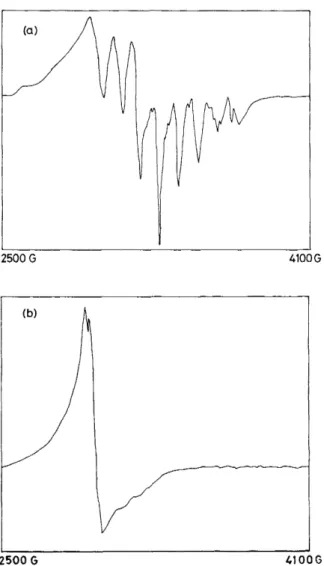
Figure 2 presents the e.s.r. spectra obtained (ER 200 D Brucker spectrometer) for two orientations of the quartz slide in the permanent magnetic field. The experimental values of g
and A (hyperfine coupling constant) calculated from these spectra exactly fit the theoretical values: gll 2.018, All 93.6 X
10-4 cm-1; g, 2.26, A l 34.5 x 10⁻⁴ cm-1. These spectra indicate that the macrocycles lie flat on the substrate, as in the case of the parent amphiphilic porphyrazines.9J0
Our experiments bring out two major results. (i) The adsorption of ionic species on ionizable monolayers proceeds
via ion exchange, even in the case of fully organic water
soluble molecules. In our case, the reaction between the tetracationic dye in the water bath and the L o C ~ ~ monolayer leads to a supermolecular assembly composed of the tet- ramethyl tetrapyridinoporphyrazinium ring and four w-tri- cosenoate anions, by mechanism (1). Some extra molecules of
C O S ~ ( H S O ~ ) ~
+
4C22H43C02H + bath filmFigure 1. The cobalt te trame thyltet rap yridino[ 3,441 : 3 ’ ,4’-g: 3 ” ,4’ ’-1:
3”’ 4”’-q]porphyrazinium nucleus (COSI).
2500 G 4100 G
1
2500 G 41 00 G
Figure 2. E.s.r. spectra recorded at 300 K of 500 layers of the semi-amphiphilic complex [CoSI, oCZ3] deposited on a quartz slide with (a) 0” and (b) 90” angle between the magnetic field and the normal to the sample. The two spectra are not plotted at the same intensity scale (1 G = 10-4 T).
interaction between the amphiphilic and free parts of the semi-amphiphilic compound has not yet been investigated. We have studied the mechanism of this adsorption and the geometry of the ensuing monolayer, using a water-soluble porphyrazine as an example.
tetramethyltetrapyridino[3,4-6 : 3’ ,4’-g : 3”,4”-1: 3’” ,4’-q] porphyrazinium h ydrogenosulp hate [ CoS
-
(HS04)4] (Figure 1) was obtained as described by Scott.5 cu-Tricosenoic acid (c0Cz3) was prepared as described by Peterson.6 The LB multilayers were built at 20-22”C on afully automatic trough patented by Barraud,’ as follows. A
Cobalt
c O s l ( C22H43C02-)4 -k 4H2S04 (1) film bath
~ C 2 3 (four or five according to molecular models) can fill the inner volume of this assembly by standing without any chemical interaction above the central porphyrazinium ring. The exact formula of the supermolecular assembly is therefore uncertain, so the semi-amphiphilic complex will now be called [CoS1, O J C ~ ~ ] . We think that similar ion exchanges are responsible for the behaviour of the cyanine dyes described by Kuhn et a1.4 Lehmann” has already observed that cationic dyes do not adsorb under neutral or cationic monolayers.
(ii) The geometry of the resulting film is, in this case, enforced by the chemical reaction which occurs at the film-bath interface. Indeed, the four pyridinium-o-tricose- noate salts force the planar macrocycle to be parallel to the interface. The four anionic chains thus play exactly the same role as the four covalently bound aliphatic chains in amphi- philic MSls, stabilizing the geometry of the macrocyclic monolayer by extending into the hydrophobic layer the ionic interactions provided by the four pyridinium rings in the polar plane. In the case of the cyanine dyes, anchoring by only one point (there is only one cationic site in the cyanine molecule) allows some flexibility of the cationic part of the semi-
Published on 01 January 1989. Downloaded by CEA Saclay on 16/04/2014 12:56:50.
J . CHEM. SOC., CHEM. COMMUN., 1989 47
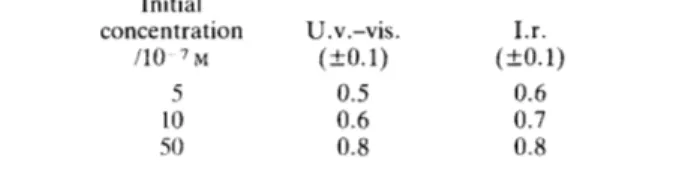
Table 1. Estimated coverage ratio of fatty acid monolayer by adsorbed porphyrazine for three initial concentrations of CoS, (HS04)4 in the water bath. Initial concentration U.v.-vis. 1.r. 5 0.5 0.6 10 0.6 0.7 50 0.8 0.8 /I0 ' M (+O. 1) (f 0.1)
amphiphilic monolayer, allowing lateral interactions in the J-aggregates.
Another important parameter of the chemical adsorption of ionic species under ionizable monolayers is the coverage ratio, which may be directly measured by comparing the reflectance spectra of a pure amphiphilic dye monolayer and the semi-amphiphilic one. However, since reflectance measure- ments were not available, we compared the spectroscopic properties of the ensuing multilayers. u.v.-vis. absorbance gives the number of porphyrazine rings in the [CoS1, coCzs] film, while the i.r. absorbance gives the ratio of free fatty acid to carboxylate anion either in the mixed amphiphilic film (when the monolayer is composed of stearic acid and the amphiphilic porphyrazine MS18) or in the [CoS1, coC23] film. The results are presented in Table 1, for three initial dye concentrations in the water bath. It appears that coverage of the monolayer by the water-soluble porphyrazines is reason- ably high, in spite of the very low concentration in the water bath, and it may be improved by increasing the initial concentration in the water bath.
For cyanine dyes, Lehmannll claimed that the semi- amphiphilic monolayer obtained by adsorption of water- soluble cyanines under a fatty acid monolayer is homogeneous, i.e., that it exhibits the same thermodynamic
behaviour as a pure amphiphilic cyanine monolayer. The lateral interactions between the cyanines, which are enhanced within the semi-amphiphilic monolayer owing to the proximity of the interacting rings, appear to improve the coverage ratio;
the cyanine dyes prefer to build J-aggregates within the semi-amphiphilic monolayer than remain free in the water bath.
For CoSl, Table 1 shows that adsorption is not as easy as for cyanines, probably because it affords no energetic gain: the porphyrazinium ring does not tend to interact when the different macrocycles are confined within the same plane. This may be explained by the high charge carried by the porphyr- azinium ring, the large distance between the neighbouring aromatic rings in the peculiar geometry of the semi-amphi- philic monolayer, and the disappearance of the mobile anions which are able to screen the repulsive interactions between the neighbouring pyridinium rings. Within the semi-amphiphilic monolayer, the anions are amphiphilic and cannot move easily to decrease the repulsive forces between the different ad- sorbed macrocycles.
Generalizing this method should produce shorter synthetic routes to new molecular assemblies and should enhance the number of organic compounds suitable for building well- ordered LB films.
Received, 1st July 1988; Corn. 810262.50
References
1 K. Blodgett and I. Langmuir, Phys. Rev., 1937, 51, 964. 2 H. Kuhn and D. Mobius, Angew. Chem., Int. Ed. Engl., 1971,10,
3 A . Ruaudel-Teixier, A . Barraud, and M. Vandevyver, Mol. Cryst.
4 Y. Yonezama, D. Mobius, and H. Kuhn, Ber. Bunsenges Phys.
5 J. E. Scott, Histochemie, 1970, 21, 277.
6 G . Veale, I. R . Girling, and I. R. Peterson, Thin Solid Films, 1985,
7 A . Barraud and J. Leloup, French Patent No. 83 19770.
8 S. Palacin, P. Lesieur, I. Stefanelli, and A. Barraud, Thin Solid 9 S. Palacin, A . Ruaudel-Teixier, and A . Barraud, J. Phys. Chem.,
620. Liq. Cryst., 1985, 120, 319. Chem., 1986,90, 1183. 127, 293. Films, 1988, 159, 83. 1986, 90, 6237.
10 S. Palacin and A . Barraud, to be published. 11 U. Lehmann, Thin Solid Films, 1988, 160, 257.
Published on 01 January 1989. Downloaded by CEA Saclay on 16/04/2014 12:56:50.