1 Electronic supplementary data
Screening
for
intestinal
carriage
of
ESBL-producing
Enterobacteriaceae in critically ill patients: expected benefits and
evidence-based controversies
Jean-Ralph Zahar,1,2 MD PhD; Stijn Blot,3,4 MNSc PhD; Patrice Nordmann,5,6,7 MD PhD;
Romain Martischang,8 MD; Jean-François Timsit,2,9 MD PhD; Stephan Harbarth,8 MD MSc; and François Barbier,10 MD PhD
Corresponding author:
Dr. François Barbier
Medical Intensive Care Unit La Source Hospital, CHR Orléans Orléans, France
2
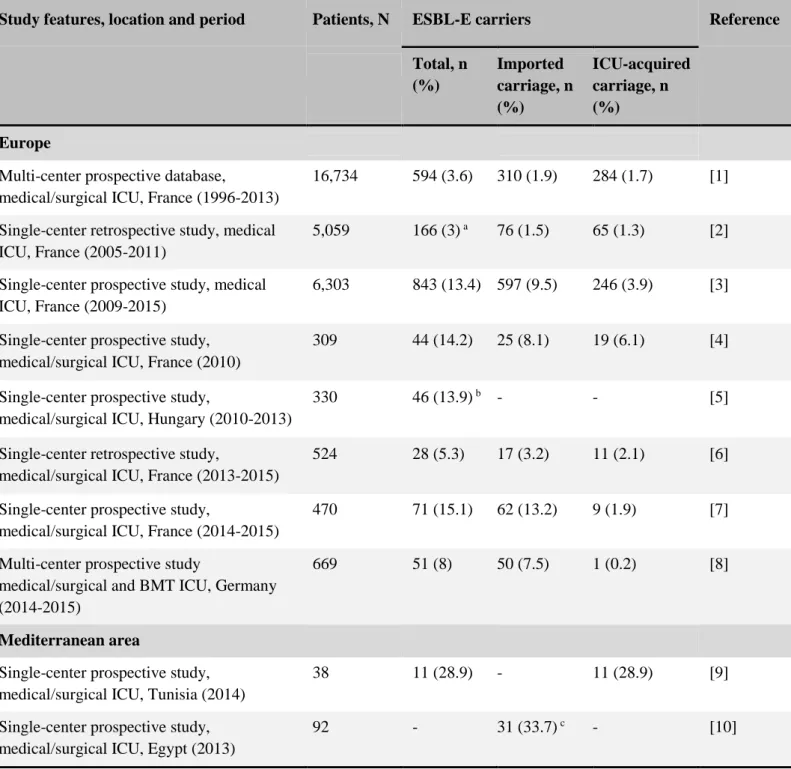
Table S1. Prevalence of intestinal colonization with extended-spectrum beta-lactamase-producing
Enterobacteriaceae in intensive care unit patients: selected studies published after 2010
Study features, location and period Patients, N ESBL-E carriers Reference
Total, n (%) Imported carriage, n (%) ICU-acquired carriage, n (%) Europe
Multi-center prospective database,
medical/surgical ICU, France (1996-2013)
16,734 594 (3.6) 310 (1.9) 284 (1.7) [1]
Single-center retrospective study, medical ICU, France (2005-2011)
5,059 166 (3) a 76 (1.5) 65 (1.3) [2]
Single-center prospective study, medical ICU, France (2009-2015)
6,303 843 (13.4) 597 (9.5) 246 (3.9) [3]
Single-center prospective study, medical/surgical ICU, France (2010)
309 44 (14.2) 25 (8.1) 19 (6.1) [4]
Single-center prospective study,
medical/surgical ICU, Hungary (2010-2013)
330 46 (13.9) b - - [5]
Single-center retrospective study,
medical/surgical ICU, France (2013-2015)
524 28 (5.3) 17 (3.2) 11 (2.1) [6]
Single-center prospective study,
medical/surgical ICU, France (2014-2015)
470 71 (15.1) 62 (13.2) 9 (1.9) [7]
Multi-center prospective study
medical/surgical and BMT ICU, Germany (2014-2015)
669 51 (8) 50 (7.5) 1 (0.2) [8]
Mediterranean area
Single-center prospective study, medical/surgical ICU, Tunisia (2014)
38 11 (28.9) - 11 (28.9) [9]
Single-center prospective study, medical/surgical ICU, Egypt (2013)
3 Table S1 (continued).
Table S1 footnote
ESBL-E, extended-spectrum beta-lactamase-producing Enterobacteriaceae; ICU, intensive care unit; BMT, bone marrow transplant
a Unclassifed ESBL-E carriage (imported or ICU-acquired) in 20 patients; b The proportions of imported and
ICU-acquired carriage were not mentioned; c Rectal swabs were collected at ICU admission only (no surveillance samples); d Surveillance rectal samples were collected in only 91 patients among the 249 patients
without imported carriage, which probably under-estimated the rate of in-ICU acquisitions.
Study features Patients, N ESBL-E carriers Reference
Total, n (%) Imported carriage, n (%) ICU-acquired carriage, n (%) Asia
Single-center prospective study, specialized ICU (tetanus), Vietnam (2004-2005)
174 94 (54) 22 (12.6) 72 (41.4) [11]
Single-center prospective study, medical/surgical ICU, India (2008)
96 - 47 (48.9) c - [12]
Multi-center prospective study,
medical/surgical ICU, China (2009-2010)
686 293 (42.7) 224 (32.6) 69 (10.1) [13]
Single-center prospective study, medical/surgical ICU, Korea (2011)
85 - 32 (37.6) c - [14]
Multi-center prospective study, medical/surgical ICU, Korea (2012)
347 109 (31.4) 98 (28.2) 11 (3.2) d [15]
Single-center prospective study, medical/surgical ICU, India (2016)
4 REFERENCES
1. Barbier F, Pommier C, Essaied W, et al. Colonization and infection with extended-spectrum beta-lactamase-producing Enterobacteriaceae in ICU patients: what impact on outcomes and carbapenem exposure? J Antimicrob Chemother 2016;71:1088-97
2. Vodovar D, Marcadié G, Rousseau H, et al. Predictive factors for extended-spectrum beta-lactamase producing Enterobacteriaceae causing infection among ICU patients with prior colonization. Infection 2014;42:743-748
3. Razazi K, Mekontso Dessap A, Carteaux G, et al. Frequency, associated factors and outcome of multi-drug-resistant intensive care unit-acquired pneumonia among patients colonized with extended-spectrum beta-lactamase-producing Enterobacteriaceae. Ann Intensive Care 2017;7:61
4. Alves M, Lemire A, Decre D, et al. Extended-spectrum beta-lactamase--producing
Enterobacteriaceae in the intensive care unit: acquisition does not mean
cross-transmission. BMC Infect Dis 2016;16:147
5. Ebrahimi F, Mozes J, Monostori J, et al. Comparison of rates of fecal colonization with extended-spectrum beta-lactamase-producing enterobacteria among patients in different wards, outpatients and medical students. Microbiol Immunol 2016;60:285-94
6. Jalalzai W, Boutrot M, Guinard J, et al. Cessation of screening for intestinal carriage of extended-spectrum beta-lactamase-producing Enterobacteriaceae in a low-endemicity intensive care unit with universal contact precautions. Clin Microbiol Infect 2018;24:429 e7-429 e12
7. Repesse X, Artiguenave M, Paktoris-Papine S, et al. Epidemiology of extended-spectrum beta-lactamase-producing Enterobacteriaceae in an intensive care unit with no single rooms. Ann Intensive Care 2017;7:73
8. Valenza G, Schulze M, Friedrich P, et al. Screening of ESBL-producing Enterobacteriaceae concomitant with low degree of transmission in intensive care and bone marrow transplant units. Infect Dis (Lond) 2017;49:405-409
9. Hammami S, Dahdeh C, Mamlouk K, et al. Rectal carriage of extended-spectrum beta-lactamase and carbapenemase-producing Gram-negative bacilli in intensive care units in Tunisia. Microb Drug Resist 2017;23:695-702
10. Fouda R, Soliman MS, ElAnany MG, Abadeer M and Soliman G. Prevalence and risk factors of MRSA, ESBL and MDR bacterial colonization upon admission to an Egyptian medical ICU. J Infect Dev Ctries 2016;10:329-36
5
11. Schultsz C, Bootsma MC, Loan HT, et al. Effects of infection control measures on acquisition of five antimicrobial drug-resistant microorganisms in a tetanus intensive care unit in Vietnam. Intensive Care Med 2013;39:661-71
12. Azim A, Dwivedi M, Rao PB, et al. Epidemiology of bacterial colonization at intensive care unit admission with emphasis on extended-spectrum beta-lactamase- and metallo-beta-lactamase-producing Gram-negative bacteria--an Indian experience. J Med Microbiol 2010;59:955-60
13. Ma X, Wu Y, Li L, et al. First multicenter study on multidrug resistant bacteria carriage in Chinese ICUs. BMC Infect Dis 2015;15:358
14. Ko YJ, Moon HW, Hur M and Yun YM. Risk factors of fecal carriage with extended-spectrum beta-lactamase-producing Enterobacteriaceae in hospitalized patients. Am J Infect Control 2013;41:1241-3
15. Kim J, Lee JY, Kim SI, et al. Rates of fecal transmission of extended-spectrum beta-lactamase-producing and carbapenem-resistant Enterobacteriaceae among patients in intensive care units in Korea. Ann Lab Med 2014;34:20-5
16. Mulki SS, Ramamurthy K and Bhat S. Fecal carriage of extended-spectrum beta-lactamase-producing Enterobacteriaceae in intensive care unit patients. Indian J Crit Care Med 2017;21:525-527