Analyzing the Private Development Model for University Real Estate Development
by
MASSACHUSETTS INST'E
James F. Gerrity IV OF TECHNOLOGY
B.A. History, 2003
SEP
2 2 2009
Williams College
LIBRARIES
Submitted to the Center for Real Estate in Partial Fulfillment of the Requirements for the Degree of Master of Science in Real Estate Development
at the ARCHIVES
Massachusetts Institute of Technology
September, 2009
©2009 James F. Gerrity IV All rights reserved
The author hereby grants to MIT permission to reproduce and to distribute publicly paper and electronic copies of this thesis document in whole or in part in any medium now known or hereafter created.
Signature of Author
/4Cfnter for Real tstate /P"4, 2009
Certified by
Dennis Frenchman
Professor, Department of Urban Studies & Planning
and Department of Architecture
/,A ThesisSuervisor Accepted by_
Brian A. Ciochetti
Chairman, Interdepartmental Degree Program in
Analyzing the Private Development Model for University Real Estate Development by
James F. Gerrity IV
Submitted to the Center for Real Estate on July 24, 2009 in Partial Fulfillment of the Requirements for the Degree of Master of Science in Real Estate Development
ABSTRACT
Universities within the Unites States have long been active in the real estate development market surrounding their respective campuses. However, beginning with the baby boom in the late 1950s, colleges have begun expanding their campuses at ever increasing rates to account for the influx of new students. In order to accommodate this increased need for campus expansion, universities have begun to look increasingly to private development firms as a means to facilitate the development of university real estate product. As these development partnerships between the institution and the private sector become more widespread, in what ways can private firms provide a benefit to the university by building facilities that utilize private market efficiencies of design and construction. The question will be answered by studying three cases of university -private sector development: Harvard University, The University of Pennsylvania, and the Massachusetts Institute of Technology. By focusing on two types of real estate product in particular, student housing and laboratory space, the case studies will compare product developed privately for each university to product developed by the university's internal facilities department. Financial, construction, and design metrics of privately and university developed products will be compared and contrasted to determine where and how private, market influence might provide the university with an advantage in developing real estate.
Thesis Supervisor: Dennis Frenchman
Title: Professor, Department of Urban Studies & Planning and Department of Architecture
Table of Contents
Chapter 1: Introduction and Overview ... 4
Why do Universities Develop ... 6
How do Universities Build ... 10
How do Universities Finance Development ... 15
Chapter 2: Methodology ... 20
Chapter 3: Harvard Case Study ... 24
Chapter 4: MIT Case Study ... .. 37
Chapter 5: Penn Case Study ... 57
Chapter 6: Lessons Learned from Case Analysis ... 72
C hapter 7: C onclusion... ... 77 R isk ... ... 77 Finance ... 78 Control ... 79 Internal Organization ... ... 80 R ecom m endations ... 81 B ibliography ... 86 A p p en d ices... ... 88
Chapter 1
-
Introduction
Universities in the Unites States have long been active in the real estate development market surrounding their campuses. Beginning in the late 1950s, colleges began expanding their campuses at ever increasing rates to account for the influx of new students due to the baby boom. This has continued to today, and from 2009 through 2012, the college age population is expected to grow 4.2% in total enrollments increasing 8% 1. To accommodate this growth, colleges such as the University of Pennsylvania expect to expand at a rate of 50 acres every 75 years.2 In addition to providing "additional support for academic operations," generated by increased enrollment, further motivations for campus expansion also include "strategic land banking...and improving the surrounding community."3 To achieve this increased need for campus expansion in an environment where development is becoming an ever more complex undertaking, universities have begun to look increasingly to private development firms as a means to facilitate the development of university real estate product. The involvement of the private sector provides the universities with financial tools, quality, and efficiency in the development process that the university is often not able to produce with its internal resources.
1 Marcus and Millichamp, National Student Housing Report, First Quarter 2009. 2 Robert Campbell, "Universities are the New City Planners"
Figure 1: College enrollment as a percent of 18 - 24 year olds
To remain competitive, universities have been required to leverage their physical assets to attract the most talented student base. The growth of the student population will no doubt continue to
spur university expansion, and development partnerships between the institution and the private sector will become more widespread. As campus expansion continues, in what ways can private firms provide a benefit to the university by building facilities that utilize private market efficiencies of design and construction? Can private developers effectively utilize private market efficiencies of design and construction to provide better campus buildings at a lower cost? Can they streamline the development process? These questions will be answered by studying three cases of university - private sector development: Harvard University, The University of Pennsylvania, and the Massachusetts Institute of Technology. By focusing on two types of real estate product in particular, student housing and laboratory space, the case studies will compare product developed privately for the university to product developed by the university's internal facilities department. Financial, construction, and design metrics of private and university developed products will be compared and contrasted to determine where and how private market influence might provide the university with an advantage in developing real estate.
V :0
Why do Universities Develop?
Universities within the United States develop real estate for a number of reasons. First, universities develop to provide students and faculty with improved and upgraded facilities. Competition among schools to attract students is continually increasing. With an expanding population of college age students, schools must, "entice youthful prospects with new amenities, social, sports, and cultural facilities."4 These amenities are often found in the form of new buildings designed to provide students with better academic facilities as well as increased options for recreation. Without, "an engaged, vital, and vibrant community with entertainment and nightlife, [the school] loses both faculty and students."5 Thus, if the school is not located in a vibrant area with existing dining and entertainment amenities supported by a strong surrounding community, or if the school possesses aging real estate that cannot support the residential or academic needs of students and faculty, the school is left with no option but to construct new real estate or re-develop existing buildings in order to provide the services the academic market requires.
4 Robert Campbell, "Universities are the New City Planners" 5 Robert Campbell, "Universities are the New City Planners"
Figure 2: University development projects by use6
SMimed Use
oo a Resdeinal
o Other
SResearch
* New (X Saweke Canuiu SAthhtics
o Land Sal or Swap * 1-dicelmeotn.
40,1 .
A driver of university development in the residential housing area is to accommodate more students in university controlled housing. Increasingly, urban universities in particular are being faced with complaints from surrounding communities that student renters drive up housing prices. Indeed, "universities are being pushed, notably in Boston, to house more of their students, in order to relieve pressure on the housing market."7 The impact of students residing in non-university controlled housing stock has a second negative impact on the surrounding community in that, "some universities are surrounded by privately owned housing that caters to students, and those landlords often engage in short term management practices to maximize their profits. Substandard property maintenance, coupled with high turnover of rental units, can lead to rapid deterioration in the housing stock."8 This process can in turn lead to declining property values and neighborhood deterioration, both of which would have long term negative repercussions on the neighborhood, and also on the university through creating a surrounding community less able to accommodate the retail, dining, and recreational amenities that the university needs to attract students and faculty.
6 Wim Wiewel, Kara Kunst, Raymond Dubicki, "University Real Estate Development: Campus Expansion in Urban
Settings"
7 Robert Campbell, "Universities are the New City Planners"
8 Allegra Calder and Rosalind Greenstein, "Universities as Developers"
-In the laboratory area, universities are being driven to develop new facilities because they, "can't get research grants unless they offer better facilities."9 Quality scientists bring in large amounts of money to the university through such programs as National Institutes of Health (NIH) science grants which in turn offset much of the costs the university expends to support its science and technology programs. In addition, NIH grants provide the university with a public benchmark to showcase the quality of its scientists, research, and technology to the greater community of academics and prospective students. This benchmark enables the university to build its reputation, and reputation is a key factor in retaining existing students and faculty in addition to attracting the best and the brightest of prospective students. However, such granting agencies include the quality of laboratory facilities as an important component in their grant making
decisions.
Another reason universities develop laboratory real estate is to, "attract private spinoffs that want to locate near them."' Many of these private spinoffs are headed by scientists or technology experts who had previously taught or studied at the university. Through providing quality laboratory and technology facilities, universities can leverage the academic talent these facilities attract to create a private market for university affiliated professors and students to monetize their ideas. This, in turn, has the cyclical effect of attracting talented faculty and students who are drawn to the university both for its academic offerings, but also for the ability to easily transfer knowledge between the academic and private markets.
9 Robert Campbell, "Universities are the New City Planners" 10 Robert Campbell, "Universities are the New City Planners"
Finally, many universities expand simply to protect the investment they have placed in their campus, both physically and culturally. "Universities typically do not have the option of relocating, so they depend on and contribute to the health and vitality of their surrounding communities to protect their vested interests. The quality of the surrounding environment directly affects the competitive advantage of the university which is crucial to attracting and retaining the best students and faculty." " To protect against the negative effects of a deteriorating surrounding community, a university may purchase land or existing property with no immediate thought of re-development. Through land banking, the university has ensured that its future needs for expansion will be secured, but, equally as importantly, it has retained control over the future of that land with respect to ensuring a use compatible with the needs of the institution.
Land banking also allows the university additional time to proceed with any necessary zoning and community approvals, thereby providing for a longer planning period through which the ultimate needs of the university might be better met. As Robert Campbell argues, this process allows for the university to better match its long term plans to the needs of the surrounding community, as in essence placing the university in the role of urban planner to ensure that the neighboring community is able to support the vibrant environment that the students and faculty require 2.The university is thereby able to mitigate the risk presented by further deterioration of a declining neighborhood, but it is also able to preserve opportunities to enhance the community to reflect the vibrant image the university hopes to portray through its campus.
1 Allegra Calder and Rosalind Greenstein, "Universities as Developers"
How Do Universities Build?
Universities are inherently risk averse, and it is extremely important to a university to maintain control over is future. Thus, while universities employ a number of methods to develop their real estate, such development is almost always undertaken on land the university owns. Through holding fee interest in the land, the university retains control over the parcel and thus reduces the risk associated with a third party exercising decisions outside of the university's sphere of influence.
Figure 3: University acquisition methods for development'3
1 2% 3% 1
Perhaps the most common method for a university to develop campus related real estate is through using its facilities department to control the design and construction of the building. This process can often be convoluted, however, as the facilities department is often simply a
functionary in the process with very little real power over decision making about the type or
13 Wim Wiewel, Kara Kunst, Raymond Dubicki, "University Real Estate Development: Campus Expansion in Urban Settings"
9 Nonpedit N lJeed a Ot h Educaioal Istatmion s P'ate - hdiridal M Rd4ijous Oiganizao a GQoremnent M Campus opeNs a rarM - Coipoata M Not Aalable
nature of development. The ultimate decisions are made by the university administrators, donors, students, and select faculty who will be using the new facility.
A typical process would proceed as follows. The facilities department will prepare a program for the project with the administration, faculty, or housing office, and establish a budget. Architectural services are solicited through a competitive process reviewed by a facilities committee comprised of administrators, project donors, students, and faculty. This committee will then approve a final architect to begin the design process over which the committee will also have ultimate discretion.
Upon completion of the design process, the facilities department will request bids from a number of contractors using the architect's design and specifications. Specifications may include standard provisions provided by the facilities department which are generally applied to all university constructed projects. The construction bids will be reviewed by the facilities department as well as a committee usually comprised of the university president, treasurer, and perhaps an outside consultant. This committee will then award a contractor with the building contract and construction administration will undertaken by the architect and/or a professional project management team from the university's facilities department or an independent firm.
Universities may also develop real estate by outsourcing the actual development of the product to a third party private developer. In a typical process, the university would maintain ownership of the underlying land and lease the developer the right to build and operate the building through a ground lease. This process typically involves substantially less control over the final product by
the university, although the university does retain the right to purchase the building following the expiration of the ground lease and all renewal options, usually a period of between fifty and ninety-nine years. The ground lease minimizes the capital outlay by the university through ensuring that the university is at financial risk only for the cost of the land, as all developments costs are born by the private developer. The ground lease development structure is generally used by universities to mitigate their financial and operational risk associated with developing specialized real estate product that a university might not understand as well as a private developer.
Student housing and laboratory space are excellent examples of such product as both the simplicity of housing and the complexity of lab space are well understood by the private market, and efficiencies of cost and design can be achieved through using the experience of private developers whose primary business is in these products. Further, the ground lease structure enables a university to maintain control of and to receive a return from land for which it might not have a defined long term use. "By retaining ownership of the land, [the university] is capturing the rising land values, and [it] retains the ability to reprogram the land utilization [at the end of the ground lease term]."'14
Generally, development under a ground lease occurs when the university purchases the fee in either vacant land, or land with improvements currently constructed. The university, through a series of committees comprised of faculty, facilities personnel, and administrators, decides what it would like to see built on the purchased land and approaches a select group of developers for proposals to develop the required product. As part of their proposal, the developers will often be
asked to provide the rent that they would be willing to pay the university for the ground lease as well as a preliminary design and specifications for the finished product. In turn, the university will agree to lease back on a long term basis all or a portion of the building from the developer once the product is complete. In some cases however, such as University Park at MIT, the university is simply a financial partner in the development through the ground lease and/or participating equity, and does not occupy any space. This structure can be formed as an additional means of generating returns to the university's endowment, but it can also provide a hedge for future university expansion by allowing the school to lease space in the development when and if it needs to. This creates a hybrid structure through a university using space within the same building for both commercial and academic purposes.
The value creation for a university to structure development through a ground lease with a private developer comes in the form of the private market's use of commercial best practices in designing the building's layout and systems, negotiating pricing with contractors, and choosing materials. The cost savings associated with negotiating increased savings for materials and schedule derived from these commercial best practices is often substantial, and can be generalized to equal a savings of 25-30% below what a university might spend for virtually the same product'". In addition, the infusion of a third party developer into the process can have a significant effect on sheltering the university from any potential downsides associated with community opposition to the school during the entitlement process. Through acting as the public face of the development, the developer bears the brunt of the public exposure. Thus, if a developer has a clean reputation within a community, that developer may be more successful in
achieving entitlements for a project than would a university with an acrimonious community relationship.
Finally, many universities use a hybrid of ground lease structure and internal development to facilitate building real estate. These schools create non-profit organizations that are controlled and funded by the university but publicly appear to be independent. This structure is most often used by larger schools that are seeking to purchase and assemble vast tracts of urban land as well a schools that are located in urban areas where community opposition to university expansion is strong and well organized. Through creating these non-profit development firms, the university shelters its involvement in the purchase and development of the real estate to the larger community, but also retains control over decision making in the design and construction process. The non-profit appears publicly as the owner of the land and the developer of record, while in actuality all major decisions are made by university committees. While this structure has the advantage of potentially accelerating the processes involved with purchasing land and buildings as well as receiving zoning approvals, the danger of schedule and construction cost delays remain due to the beaurocratic decision making structure of the university development committees.
While the methods described above primarily relate to real estate product developed for university use, many schools invest in real estate as a cash flowing investment with the potential to convert the asset to university use at a later date when a need has been established. This structure is more often used by larger schools with sophisticated investment offices that employ a number of real estate specialists to invest in real estate geared to providing returns to the school's
endowment. The Massachusetts Institute of Technology (MIT) is an excellent example of this style of development as a portion of the MIT Investment Office is dedicated to purchasing and developing real estate to service the endowment with a future re-development potential to benefit uses associated with the university. In this case, the university will purchase the real estate with funds directly from the endowment, or, more likely, bond financing, and will hire a third party property manager to manage the asset while re-development plans are finalized. The university will receive a return from the cash flow of the property while retaining the flexibility to re-develop the property to a use that will better serve the school's future real estate needs. In this way, the university retains control of the decision-making surrounding the property while also
reducing its risk through the cash flow the property generates.
How do Universities Finance Development?
The simplest method for universities to finance real estate acquisition and development is to use endowment funds. In this case, funds are withdrawn directly from the university's endowment account and used to facilitate the purchase and development of real estate. However, in keeping with a university's typical desire to minimize risk, the application of endowment funds to real estate development is not the preferred method for many schools and in some cases is not legally allowable. The average endowment return from 1975 through present for a school with endowment assets in excess of one billion dollars is 10.50%16. The average unlevered return on student housing product from 2002 -2008 is roughly 8%17, while the return on laboratory space dedicated to university use is generally 0% as scientists are usually not required to pay rent for their research space, or the university essentially pays itself rent in the form of one department
1
6 NACUBO
17
paying the university controlled real estate department rent. Therefore, through withdrawing endowment funds to invest in either a student housing or a laboratory facility, the university is foregoing the opportunity cost of the lost endowment income, representing 2% for student housing, and 10.50% for laboratory. It should be noted here that at all institutions, overhead charged on research grants offsets the cost of facilities, although it is difficult to calculate this as
a return on investment.
Figure 4: Student housing sales trends
Ave. Price per Bed i-Avg. Cap Rate
02 03 04 05 06 07 08"
A more popular method for universities to finance real estate development is through bond issuance. Depending on their credit rating as non-profit institutions able to issue tax-free debt, universities can typically borrow at significantly more favorable rates than can private developers. Because most universities are able to issue bonds tax-free, the schools are able to pay lower interest rates to bond investors. Current average interest rates for AAA rated universities are between 4 - 5%18 versus 5 - 7%19 for private firms. Universities are also generally not
18 Paul Sehnert, Director of Real Estate, University of Pennsylvania
limited to issuing bonds collateralized by the real estate, and the schools are able to bundle bond offerings into packages cross collateralized by a number of assets as well as a general guarantee tied to the university's credit 2 .This allows the university to finance real estate projects even in down real estate markets by leveraging the financial strength of the institution as a whole. Through utilizing bond financing, universities are not required to de-capitalize endowment funds.
However, bonds still require annual interest payments in addition to the principle repayment at the end of the term. Assuming 100% of development costs have been financed through bonds, and based on the university's assumed unlevered return of 8% on student housing and 0% on laboratory space, we must subtract the bond interest payments of 5% to reach the net return of 3% on student housing and a loss of 5% on laboratory space.
The impact of a bond's effect on the balance sheet of a university cannot be overlooked. Additional debt applied to the balance sheet will have a negative effect on the credit rating of the university. A negative credit rating would increase the interest rate payable on bonds issued by the university, and it may hamper the university's ability to issue bonds in the future. The issuance of bonds also increases the risk profile of the university's involvement in the development, and for an institution that is inherently risk averse and dedicated to preserving the value of its holdings; this increased risk may not be desirable. The figure below illustrates the methods universities use to finance development projects.
Figure 5: Common financing methods for university development projects l
Universities can also finance real estate development through donor financing. In this situation, a single donor, or larger group of donors provides funding for the university to develop a specific asset. The project budget is funded through these donations, and the university s not required to issue bonds, or to use endowment funds. However, because donors specify a pre-determined amount to be applied to the development, the university must be cognizant of 3 factors which could affect the outcome of the development. First, the hard budget requires strong project management skills to ensure that cost overages do not occur, for without looking to other donors or alternative financing options, there are no further funds available for the project beyond the approved budget. Second, the university must be able to achieve the quality of facility it is seeking with the donor funding provided. If the donor funding will allow only for a project budget that will not adequately fulfill the university's requirements, then the school is left with either building an inadequate facility, or once again looking to other funding sources to bridge the budget gap. Third, donors often mandate what type of facility their donation will be used to construct. In this situation, a university could be forced to expend time and resources developing a facility that might not serve as functionally efficient in fulfilling the university's current or future needs.
21 Wim Wiewel, Kara Kunst, Raymond Dubicki, "University Real Estate Development: Campus Expansion in
Urban Settings"
ili-0 private 0 public
Finally, universities can use private developer financing to facilitate development. Under a ground lease or similarly structured development scenario, the university can purchase land using bond financing. The balance of the development costs would then be offloaded to the developer who would access capital markets to finance the development. While a developer would be paying a higher interest rate than a university, and while the developer would likely pass this cost through in the form of lower rent on the ground lease, the university is effectively mitigating its risk through this structure by not subjecting its balance sheet to liabilities other than the relatively small cost of the land, while also saving the lost opportunity cost involved with tying-up notional bond principal in developing the building.
It is clear that universities employ a variety of factors in their consideration of how to design, build, and finance real estate. Each university is affected differently by these factors, and it is important to implement controls when comparing the development process between institutions. These controls between universities can take the form of financial strength, internal development capabilities, and scope of planned development. In the following chapter, the controls used for this thesis will be discussed in greater detail.
Chapter 2 - Methodology
The three case schools, Harvard, Penn, and MIT, were chosen for a number of reasons. Each school has a dedicated real estate office tasked with planning, developing, and operating real estate associated with the university. At each school, the real estate office has the ability to develop a real estate project internally if so desired. The sophistication of the university decision makers involved with the decision to privatize university development is important because a number of complex financial, design, and operational considerations must be evaluated for a university to fully understand the costs and benefits of using a private development model. The ability to understand and satisfy the interests of both a private developer and the university is a complex process, and a more experienced university real estate office provides increased transparency behind the motivations of the university in pursuing privatization of all, or a portion
of their real estate development projects.
A transparent decision making process is integral to providing the most comprehensive understanding of what is a nuanced cost/benefit analysis to the university. A successful analysis of a university/private development model rests on understanding the goals that both the university and the developer hope to achieve through the development project. Without a rational basis for decisions with consideration paid to a number of sophisticated variables, it would be difficult to measure success in a project, especially through a comparison to the original goals the project was set out to fulfill. Therefore, through using schools that possess sophisticated real estate offices, a more complete understanding of the factors that influence development decisions within the university can be understood. In this way, the thesis is able to control for the
experience of the university decision making process that each school relies upon in deciding whether to privatize development projects.
Each school chosen for a case study shared a similar credit rating of AAA by Standard and Poor's (S&P). The strength of the school's credit rating translates into the interest rate required to be paid by the school for bonds it issues. As the interest rate on bonds translates effectively into the university's cost of capital, a control must be placed in ensuring a similar cost of capital among the schools studied for this thesis. Varying costs of capital will impose varying motivations on a school for pursuing private party development for university assets. By controlling for the cost of capital among the schools sampled, the thesis standardizes the base cost of capital and resulting discount rate involved with evaluating the various financial implications of the development projects among the case studies.
The thesis limited the evaluation of real estate product studied to two types of assets: student housing and laboratory buildings with no commercial component. The limitation of study to these two structures imposed a control between the case studies evaluated. Further, each of these types of assets provides a unique motivation for the university and the private developer to pursue a partnership for development.
Student housing is one of the few real estate assets that has the potential to provide a measureable financial return to the university. Student housing facilities are operated in much the same way as apartment housing units, and, "rising construction costs on traditional residence halls have precluded many universities from embarking on housing projects, paving the way for
private developers to increase their presence [in the market]."22 Because of the defined and easily underwritten structure of the student housing cash flow model, with rent paid by students in return for the university providing housing services, a private developer could easily justify its involvement in a student housing development. Further, students are increasingly demanding amenities in student housing product that are normally found in Class A mixed-use apartment complexes and are rarely available in dormitory environments23. The complexity of these projects through their mixed-use nature often requires a market knowledge and development experience beyond the capacity of the university's real estate office. This enables private firms to further expand their influence in the student housing market.
Laboratory space serves as a main driver for universities to attract the most talented scientists, researchers, and professors. The recognition that top scientists provide to a university, coupled with the income realized through grants to scientists engaged in research at the university from a wide variety of sources provide both a reputational and an economic incentive for universities to develop the most technologically advanced laboratory facilities to ensure retention of the best scientists. In many cases, the experience of the private market in controlling costs and ensuring quality through developing laboratory product justifies the university relying on private firms to build laboratory space.
Academic research on the privatization of university real estate development is rare, and therefore published literature on the subject is sparse. While a few academic case studies have been completed on the subject of university real estate development, the vast majority of these 22 Marcus and Millichamp, National Student Housing Report, 1st
Quarter 2009
23 Marcus and Millichamp, National Student Housing Report, 1st
studies have been focused on understanding the process through physical and social means focused on the impact of the university on the surrounding community. Very little has been studied regarding the motivations and effects of privatizing the university development process, and the costs and benefits that such privatization has on the university and the developer.
The previously published case studies serve as useful guides on the background and main themes governing the decision of a university to privatize development. However, projects that have been studied have been generally large scale urban renewal-type of developments that do not directly translate into an analysis of the effects that privatization has on individual projects built by the university. This thesis seeks to undertake a more micro-level analysis of the manner in which the privatization of university real estate development can be undertaken by schools that
do not have the need or the capacity to engage in large scale developments.
Therefore, the vast majority of data and conclusions reached in this thesis will be through a combination of personal interviews and document review associated with the three case studies. Personal interviews were conducted with a number of officials in the development offices of universities, as well as employees of the private developer. These interviews explored the motivations behind both the developer and the university to enter into partnerships for development, the structure of the partnership, as well as the strengths and weaknesses of those partnerships in relation to the finished product. In addition to the interviews, documents were reviewed to understand construction information, constructions costs, and return analyses. These were instrumental in providing much of the quantitative data required to evaluate the relative
Chapter 3 - Harvard Case Study
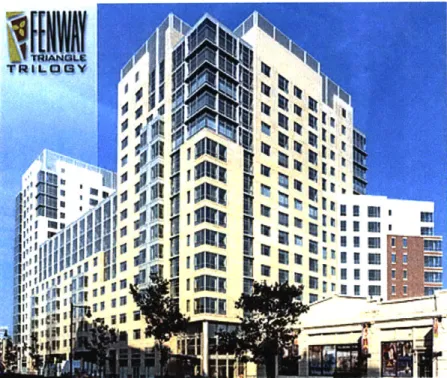
In the late 1990's Harvard University embarked on a 10 year plan to expand its graduate housing to add a total of 1,500 units capable of accommodating 50% of the graduate student population enrolled at the university. Within 7 years, Harvard achieved this goal by developing graduate student housing both through internally controlled development as well as in conjunction with private development firms 24. This case study examines a project Harvard undertook in partnership with a private development firm, Samuels and Associates. Trilogy, located in the Longwood Medical area of Boston, is a residential for-rent apartment project.
Figure 6: Trilogy view looking east on Brookline Avenue
tt
i
liI I i1
A
Through understanding the development process involved with the Trilogy project, the case study seeks examine the planning and delivery methods involved with the project. This chapter
24 Steven Nason, Director of Residential Real Estate, Harvard University
hopes to answer the question: does a private developer possess the market knowledge, the product knowledge, and the entrepreneurial focus on minimizing schedule delays to produce a development more efficiently than Harvard could achieve using its internal facilities agency?
Because the Trilogy project was an opportunistic investment by Harvard into a long term relationship with a private developer, it is a somewhat unique project to compare with an internally Harvard developed project. However, the benefits of a streamlined decision making process as well as cost savings to schedule are two of the major benefits that Harvard experienced as a result of employing the private market to facilitate institutional real estate development.
As Harvard was expanding its medical school presence in the Longwood Medical area of Boston, the school was facing an increased housing shortage for medical students who wanted to live close to the medical campus. The vast majority of the university's graduate student housing was centered near its Cambridge, Massachusetts main campus, a distance of approximately three miles from the Longwood Campus. To alleviate the housing shortage in the Longwood area, Harvard embarked on a search for a suitable site through which it could develop graduate student housing. Harvard eventually settled on three potential sites for development. One site consisted of a vacant parcel of land, the other site involved the demolition of an existing building to facilitate new construction, and the third site consisted of a fully permitted but not yet constructed 576 unit condominium complex controlled by a local developer, Samuels & Associates25
The Longwood area had historically been comprised of a mix of uses. Brigham and Women's Hospital, Dana Farber Cancer Institute, and the Harvard Medical School had long anchored a number of medical uses. In addition, undergraduates from Northeastern University and Boston University occupied a large portion of the rental housing available in the area. Finally, Fenway Park in nearby Kenmore Square supported a number of retail and entertainment uses. However, beginning in the late 1990s, the purchase of the Boston Red Sox by new local owners and the proposed re-development of Fenway Park, as well as growth in area hospitals spurred residential development of increasing density in the Longwood area. The increased density and potential for both higher foot traffic associated with the Red Sox and a growing student population occupying the rental housing led area residents to begin to organize in opposition to further development. While the increased vehicular traffic associated with a Fenway Park expansion was of serious concern to the neighborhood, the noise and unruly behavior by students that would result from an increase in the undergraduate student population was perhaps more central to the neighborhood's opposition to expansion by the various universities in the area. Secondary was the neighborhood's concern that increased development would spur gentrification of the area resulting in increased housing prices pushing home affordability out of the reach of the areas' lower income residents. It was in this environment that Harvard found itself as it attempted to construct graduate student housing in the Longwood Medical area.
Harvard controlled two development sites in the Fenway area, however zoning made it impossible to undertake as-of-right construction for the residential product that Harvard required. Thus, to achieve the required product would involve substantial permitting and zoning relief.
Given the typically difficult permitting process experienced by many projects in the City of Boston, coupled with the recent organization of the surrounding community in opposition to further expansion of university housing in the area, Harvard realized that ground-up development of the two land sites which it owned could be a long and expensive process. Further, there was no guarantee that, at the end of the permitting process, Harvard would actually be able to gain a permit for the number of units it was seeking, or to undertake a design that would meet the University's specifications. Finally, the issue of providing community concessions in return for receiving zoning variances loomed large in Harvard's mind. The University was concerned that the neighborhood would seek to extort above market concessions from Harvard on the belief that the wealthy school could afford virtually any community request26
In light of this, Harvard began to explore Trilogy, the Samuels site. The site had already received zoning approval from the City of Boston, and community concessions such as the affordable housing component had been negotiated by Samuels prior to Harvard's involvement. In addition, the exterior building envelope had been approved through a community design review process, eliminating a potentially expensive unknown. However, the building had originally been permitted for condominiums intended for purchase by young professionals and medical personnel in the area, but market conditions had eroded since Samuels had first proposed the site. At the time of Harvard's entry into the process, the project could no longer justify the market absorption rates for purchase of the condominiums necessary to gain construction project financing. Thus, barring improved external market factors, Trilogy was effectively dead in the water until market demand recovered, or an external factor could be brought in to enhance the
feasibility of the project. Harvard proved to be that external factor enabling the development of Trilogy to proceed27
For Harvard, the Trilogy project appeared to be an excellent way to quickly obtain a critical mass of graduate student housing units with a minimum of time and money spent on the public approval process28. Harvard's risk profile represented through its involvement in Trilogy had been substantially mitigated by the approvals already negotiated and received by Samuels. Through not having to publicly face either the City or the neighborhood, Harvard was able to avoid potential negative backlash against a proposed Harvard project. Thus, when Harvard saw an opportunity to purchase 171 units at Trilogy, the school reacted quickly to seize the opportunity. To accommodate Harvard's desire to own the units outright, Samuels divided the building into four condominium entities comprised of the 600 space parking garage, 43,493 square feet of ground floor retail space, 405 for-rent apartment units controlled by Samuels, and 171 units controlled by Harvard29. Upon receipt of a certificate of occupancy, Harvard agreed to purchase the fee interest in the 171 units as well as rights to 175 parking spaces30
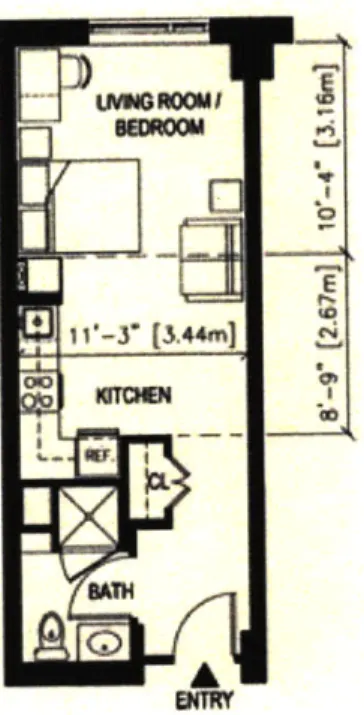
Because Trilogy's construction schedule had been stalled due to lack of available financing, the interior design and layout had not been finalized and was still in the design-development stage with Elkus Manfredi Architects. The original design for Trilogy incorporated a majority of two bedroom units of roughly 1,100 square feet, too large for Harvard's program of studio and convertible 1 bedroom units. However, during the design-development process the architect,
27 Steven Nason, Director of Residential Real Estate, Harvard University 28 Steven Nason, Director of Residential Real Estate, Harvard University
29 www.samuelsre.com
Elkus-Manfredi, worked with Harvard to re-design the 2 bedroom units into 2 separate apartments, a studio and convertible one bedroom unit31
Figure 7: Harvard Trilogy studio32
Figure 8: Harvard Trilogy convertible one bedroom33
31 Steven Nason, Director of Residential Real Estate, Harvard University 32
Harvard Trilogy Open House Flyer, Harvard University 33 Harvard Trilogy Open House Flyer, Harvard University _ _
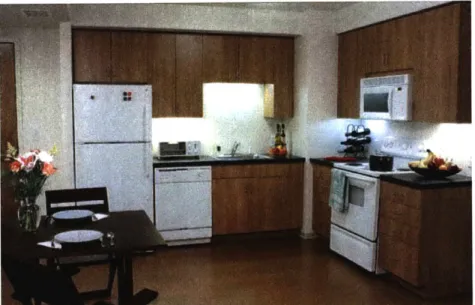
Figure 9: Harvard Trilogy kitchen3 4
Figure 10: Harvard Trilogy living room3 5
34 www.samuelsre.com
35 www.samuelsre.com
Further, the interior mechanical and electrical design was not sufficient to suit Harvard's specifications for its graduate student housing. However, because Harvard was only purchasing
171 units within the 576 unit development, Samuels did not want to re-design the Samuel's controlled units to Harvard's specifications. Reasons for this included Harvard's requirement that HVAC and electrical services be centrally metered, something that Samuels could not support in its for-rent apartment model for the remainder of the building. Here, the efficiency created by Elkus Manfredi's prior involvement in the buildings design created a schedule savings for
Harvard36
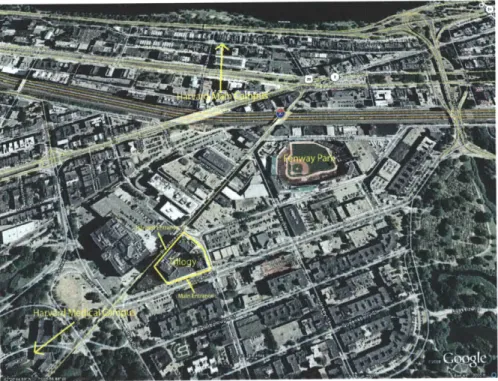
Elkus Manfredi was able to essentially create a building within a building to facilitate Harvard's requirements. In addition to the issues posed by HVAC and electrical services, the entrance to Trilogy created a problem for both Samuels and Harvard. Samuels wanted to maintain a sense of exclusivity among the building's residents, many of whom would be paying upwards of $3,000 per month in rent. Samuels was concerned that allowing student residents to enter into the same lobby as non-student residents would endanger that sense of exclusivity. For its part, Harvard wanted to limit its student residents to a secured lobby that could be controlled by Harvard security personnel 37 . Elkus Manfredi's solution was to create two lobbies with different orientations. The main building lobby was positioned on Boylston Street to gain maximum exposure to pedestrian traffic and to allow residents easy access to the shopping and eating amenities located along Boylston Street. Harvard's lobby was positioned on the opposite side of the building on Brookline Avenue, a smaller feeder street for Boylston Street.
36 Steven Nason, Director of Residential Real Estate, Harvard University
Figure 11: Trilogy location map
Table 1: Harvard Trilogy unit description and rental rates38
Harvard
Trilogy
Unit Description Utilities Included w/ Rent Rental Ranqe/Month Studio heat, hot and cold water, $1,607 - $1,654 Double Studio sewer, electricity, air $2,115 - $2,345 1 Bed Convertible conditioning, Internet $1,988 - $2,078
Separate entrances required separate elevators, so elevator banks were designed to exclusively service Harvard controlled areas as well as non-Harvard controlled areas. In addition, as was previously mentioned, Harvard required the ability to control utilities centrally as opposed to the individual unit control common in most apartment developments. A separate mechanical and electrical system was therefore designed to service the 171 Harvard owned units in the development. The Samuels controlled portion of the project operated off of one set of
mechanical heat pump units and electrical systems, and Harvard's portion was serviced by independent systems including fan coil units served from a central cooling loop39
The Trilogy project was constructed under two sets of construction documents with the same general contractor, Suffolk Construction. Samuels held the overall contract to construct the entire project and retained liability for project delivery. However, Samuel's section of the construction documents was limited to the structure, the faqade, and the parking garage as well as the interiors and common areas of the 405 market rate residential rental units. Harvard retained oversight and control over the interior design and construction documents related to the 171 Harvard owned units, lobbies, elevators, as well as the mechanical, electrical, and plumbing required to service the Harvard space. However, Samuels still controlled the entire project budget and schedule, and the Harvard cost structure was based on a bid-out set of construction documents based on Harvard's specifications and attached to the project GMP40.
Samuels structured a GMP contract with Suffolk Construction based on the two sets of construction documents and specifications. Because Harvard was very sensitive to a mid-summer delivery to enable occupancy of the units for the upcoming academic year, Samuels included a penalty in the Suffolk contract for delivery delays. While Samuels retained risk for cost overages above the GMP contract pricing for the Harvard portion of the project, Harvard absorbed change orders for their portion of the project. By the same token, Samuels was allowed to keep any
savings realized from the Harvard portion of the GMP41.
39 Steven Nason, Director of Residential Real Estate, Harvard University 40 Steven Nason, Director of Residential Real Estate, Harvard University 41 Steven Nason, Director of Residential Real Estate, Harvard University
The Trilogy project was entirely privately financed through Samuels. While Harvard's agreement to purchase 171 units upon receipt of a certificate of occupancy was instrumental to providing Samuels with the ability to achieve funding through a 3rd party lender, Harvard did not contribute any initial equity toward the purchase price, nor did the University provide guarantees other than to purchase the units. However, Harvard did need to issue bonds to finance the acquisition of the units from Samuels. The Trilogy project was entirely funded through the issuance of bonds by Harvard's central treasury. Harvard issued tax free bonds to the market which were then applied as a liability to Harvard's balance sheet. Under this scenario, Harvard's risk profile was increased as additional bond liabilities affect the interest rate that Harvard must pay to it creditors42. Increased debt liabilities also affected the credit rating that the University enjoyed and from which the interest rate it must pay on its debt was derived. If that credit rating fell, Harvard would be required to pay higher interest rates on the bonds it issued, and the total amount of the University's borrowing capacity would be reduced by a downgrade in the institution's credit rating.
The development of Trilogy has proven to be extremely successful for Harvard as evidenced by the oversubscribed demand for the project from medical students. All 171 units in the project have been fully leased since the project opened in 2002. Harvard's commitment to the project enabled Samuels to develop a mixed-use project that, at the time, could not have been developed without Harvard's involvement43. However, Samuels' ability to develop a mixed-use project with retail shopping and dining amenities on-site has provided a draw to both Harvard affiliated and market residents alike. This experience needed to successfully meld the retail and residential
42 Steven Nason, Director of Residential Real Estate, Harvard University 43 Steven Nason, Director of Residential Real Estate, Harvard University
uses together into a successful development is something that Harvard did not possess through its internal real estate capabilities, and the project's occupancy has benefitted from the success of the retail component in providing Trilogy with unique amenities not found elsewhere in Harvard's student housing options.
The real lesson in this case study is understood through efficiencies gained in the design and construction process by the private market's influence on the Trilogy project. The team of design, development, and construction professionals was essential to the success of the Trilogy project. Elkus Manfredi's ability to utilize the design development process effectively was central to cost control through design efficiency and allowed for costs associated with essentially creating "a building within a building"44 to be mitigated through careful design.
In addition, "the personal integrity of the developer was essential to providing Harvard with a
sense comfort of during the project4 5." The involvement of a private developer in the process
increased a number of risks for Harvard that would not have been issues in a Harvard funded and controlled project. Most namely, the risks associated with bankruptcy by the developer or the lending bank were risks that Harvard could not effectively underwrite with certainty. While Harvard mitigated its risk somewhat by deferring ownership of the construction contract, it also gave up a measure of control to Samuels over the contractor and the architect. This was further demonstrated by the fact that Harvard did not control ownership of its portion of the project until the development reached effective completion through receipt of the certificate of occupancy
44 Steven Nason, Director of Residential Real Estate, Harvard University 45 Steven Nason, Director of Residential Real Estate, Harvard University
Therefore, honesty and communication between Harvard and Samuels was essential to providing Harvard with the piece of mind it required to manage its risk profile in the project.
Finally, the involvement of a private developer having overall control of the project streamlined a decision making process for Harvard that was often slowed by beaurocracy, and enabled, "an efficiency of decision making with Harvard often being presented with no other choice" 46 in how certain aspects of the development process would be handled. In addition, the existence of the private developer as the public face of the project shielded Harvard from the permitting process and allowed for the permitting of a structure that the community might not have approved had they known Harvard was involved in the project. Further the ability of the private developer to utilize market knowledge and experience to construct a mixed-use project of retail as well as residential provided a draw for Harvard graduate students and ensured strong occupancy for Harvard's portion of the project.
Chapter 4 - MIT Case Study
This chapter examines and compares two developments at the Massachusetts Institute of Technology, Sidney-Pacific and New Ashdown. Both developments are student housing facilities, although New Ashdown was constructed under the purview of the MIT facilities department, and Sidney-Pacific was built by the MIT Investment Office's Real Estate Group. The key findings of this chapter relate to inefficiencies of design and schedule costs between the 2 projects. The chapter will review the approval process for design and construction between the 2 projects, and it will explain how the complexities involved with MIT's internal development process in the New Ashdown project negatively affected the project cost structure as compared to the Sidney-Pacific project which was developed independently of MIT's typical development controls.
In the late 1990's one-third of undergraduate students at MIT lived off-campus, either in non-MIT controlled rental units, or in fraternities and sororities47. When a freshman student died from an alcohol overdose in 1997, the MIT administration made a commitment to bring all freshman students into on-campus housing by the Fall of 2001 48. This policy change required the construction of new dormitory facilities to house the additional freshman load on campus housing. While the feasibility of building these new dorms was being explored, a study of graduate housing was also initiated to address the housing demand by the 8,000 MIT affiliated graduate students for MIT supplied housing.
47 Pamela Delphenich, Director of Campus Planning and Design, MIT 48 http:Hsiinmons.iit.cdu/prchistory/sh prhistorv 2chaleinges. htnl
The MIT planning department had developed a master plan to accommodate undergraduate housing in a defined zone located in a residential campus near the MIT playing fields and across Massachusetts Avenue and the railroad tracks from the main campus. While the idea of this residential campus was to foster a connection between the undergraduate students living there, the reality of the situation was that the campus was located quite far away from the main campus where the students spent most of their time. This planned residential campus was designed without a great degree of student influence, and was sited primarily as a function of the availability of land to support the development. Through ignoring the opinion of its student base, MIT failed to thoroughly evaluate the market for which it was constructing the housing product, namely undergraduates, and embarked on developing a plan that was locationally unattractive to students who would be living there. In this way, MIT misjudged the market presented by the undergraduate population, and sited a project that was not in close proximately to either classrooms or shopping and food amenities located along Massachusetts Avenue. In fact, the net result of MIT's misjudging the undergraduate response to locating housing in the planned residential campus was the elimination of the campus notion in favor of massing undergraduates into housing located closer to the main campus along Memorial Drive. This move precipitated the construction of New Ashdown as a replacement for housing the graduate student residents of the original Ashdown, a building that would now be converted to undergraduate use.
The residential campus plan was eventually scrapped, but not before the construction of Simmons Hall. The initial phase of the residential campus development involved MIT's facilities department designing and constructing Simmons Hall, a 350 bed undergraduate dorm49 However, no sooner had construction begun, than an abutter to the Simmons site sued MIT citing 49 MIT Tech
shadow infractions by the proposed development. While the merits of the lawsuit were questionable, MIT was nonetheless concerned about the lawsuit causing delays to effect the mid-summer delivery of the dormitory as the timing of delivery was imperative in order to allow for students to move in prior to the upcoming academic year. With the construction delivery of the Simmons project uncertain, MIT was forced to evaluate alternative options for undergraduate housing.
The graduate housing study performed by MIT identified an MIT controlled site located on Pacific Street in Cambridge, Massachusetts as a focus for future graduate housing development. To account for the delay of the Simmons project, the MIT administration decided to commence construction on the Sidney Pacific site with the intention of designing the new building to flexibly accommodate either graduate housing, or to house undergraduates if Simmons was delayed indefinitely5 .
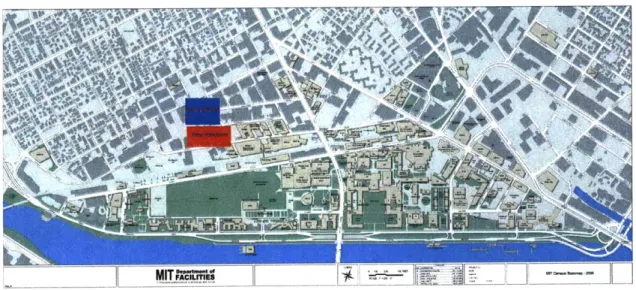
Figure 12: Map of New Ashdown and Sidney-Pacific in relation to MIT campus
4
h
;9
;YV
rq
k
;:r
Litt*~'
0
WOOF_
I~
4'
;c
--Timing was crucial for the delivery of the Sidney-Pacific development. The delays to the Simmons project had left only 2.5 years to permit and deliver a dormitory in order to maintain the original development schedule for accommodating undergraduates in on-campus housing. Faced with this constricted schedule to permit and construct the Sidney-Pacific project, MIT turned to the real estate arm of the MIT Investment Office. The facilities department was already developing the Stata Center and various renovations within the MIT campus, and it did not have the capacity to take on an additional project51. The Investment Office, however, differed significantly from the facilities department in its approach to development. The Investment Office typically invested in cash flowing and for-profit development real estate managed to generate returns to MIT's endowment. In this capacity, the Investment Office operated similarly to a for-profit developer.
Due to the constricted timeline for delivery of the Sidney-Pacific product slated for August 2002, the Investment Office required almost complete autonomy in the development process. The Investment Office agreed to deliver the 750 bed Sidney-Pacific project by August of 2002 at a designated budget approved by the MIT administration. In return, the Investment Office was granted autonomy in fast-tracking the design-development process pursuant to general guidelines regarding the number of beds, as well as common area and study space ratios. However, within the confines of these general guidelines, the MIT Investment Office retained full discretion to select architects and contractors, to negotiate contracts and pricing, and finally to organize and control the development process without interference from other MIT affiliates in the form of the facilities department or oversight committees52
51 Pamela Delphenich, Director of Campus Planning and Design, MIT
This notion of discretion was central to the Investment Office's success in the delivery of the Sidney-Pacific project. The Investment Office's approach to real estate was generally in the capacity of a for-profit owner and developer, although the case of Sidney-Pacific was somewhat unique insofar as the tenant, MIT, was assured and the process was essentially a build-to-suit for the institution as opposed to a spec development with market occupancy risk. However, given its experience in the private commercial real estate markets as an owner and developer in other projects, the Investment Office was able to utilize its contacts and experience in the market to leverage efficiencies in design and construction generated by the current commercial best practices within the industry. In this capacity, the Investment Office was able to use its relationship with various City of Cambridge permitting agencies to negotiate an increase in massing above the as-of-right zoning translating into a 103,000 additional square feet gain from transferring development rights from an abutting MIT owned parcel donated to the City for a public park53
However, the single greatest advantage that the Investment Office provided to the Sidney-Pacific development process was its ability to side-step the internal approval processes for buildings constructed by the MIT facilities department. The MIT approval process is cumbersome, with input required from a number of committees on virtually every aspect of the design and construction process. These committees consist of faculty, administration, and students, and very few, if any of the members of these committees have real estate development experience. In past developments controlled by the facilities department, facilities personnel were required to present the various committees with a number of options for design and construction before the 53 Michael Owu, Director of Real Estate, MIT Investment Management Company