Publisher’s version / Version de l'éditeur:
Vous avez des questions? Nous pouvons vous aider. Pour communiquer directement avec un auteur, consultez la
première page de la revue dans laquelle son article a été publié afin de trouver ses coordonnées. Si vous n’arrivez pas à les repérer, communiquez avec nous à [email protected].
Questions? Contact the NRC Publications Archive team at
[email protected]. If you wish to email the authors directly, please see the first page of the publication for their contact information.
https://publications-cnrc.canada.ca/fra/droits
L’accès à ce site Web et l’utilisation de son contenu sont assujettis aux conditions présentées dans le site LISEZ CES CONDITIONS ATTENTIVEMENT AVANT D’UTILISER CE SITE WEB.
Client Report (National Research Council of Canada. Construction Research Centre); no. A1-013766, 2020-03-20
READ THESE TERMS AND CONDITIONS CAREFULLY BEFORE USING THIS WEBSITE.
https://nrc-publications.canada.ca/eng/copyright
NRC Publications Archive Record / Notice des Archives des publications du CNRC :
https://nrc-publications.canada.ca/eng/view/object/?id=e712e4f5-595c-4118-add7-1738ae6697d7 https://publications-cnrc.canada.ca/fra/voir/objet/?id=e712e4f5-595c-4118-add7-1738ae6697d7
NRC Publications Archive
Archives des publications du CNRC
For the publisher’s version, please access the DOI link below./ Pour consulter la version de l’éditeur, utilisez le lien DOI ci-dessous.
https://doi.org/10.4224/40001931
Access and use of this website and the material on it are subject to the Terms and Conditions set forth at Level 2: Semi-Quantitative Seismic Risk Screening Tool (SQST) for Existing Buildings. Part 1: user’s guide
Fathi-Fazl, Reza; Cai, Zhen; Cortés-Puentes, Leonardo; Jacques, Eric; Kadhom, Bessam
Level 2
– Semi-Quantitative Seismic Risk Screening
Tool (SQST) for Existing Buildings
Part
1: User’s Guide
Reza Fathi-Fazl, Zhen Cai, Leonardo Cortés-Puentes, Eric Jacques, and
Bessam Kadhom
Published by
LEVEL 2
– SEMI-QUANTITATIVE SEISMIC RISK
SCREENING TOOL (SQST) FOR EXISTING BUILDINGS
PART 1: USER’S GUIDE
Prepared by:
Civil Engineering Infrastructure Unit Construction Research Centre National Research Council Canada Ottawa
Funded by:
Public Services and Procurement Canada
Disclaimer:
Public Services and Procurement Canada (PSPC) may reproduce this tool and may distribute such reproductions to its employees and contractors for PSPC use only.
Users other than PSPC wishing to use this tool must seek written permission from the National Research Council Canada (NRC) to do so.
© National Research Council Canada March 2020
ACKNOWLEDGEMENTS
The authors wish to acknowledge the financial support and technical feedback from Public
Services and Procurement Canada (PSPC) in the development of the Level 2 – Semi-Quantitative
Seismic Risk Screening Tool (SQST). Support from Parviz Afrooz, Brian Boyd, Peter Campbell, Bruno Coté, Dextor Edwards, Simon Foo, Clive Kamichaitis, Jocelyn Paquette, Doug Stephenson, Jack Vandenberg, Dave Weidelich, and Andrew Werblinski is also gratefully acknowledged. The authors appreciate the effort made by Professor Dariush Motazedian from the Department of Earth Science at Carleton University in developing the site seismic categories for the
Level 2 – SQST. The authors acknowledge the contributions by Professor Ghasan Doudak from
the Department of Civil Engineering at the University of Ottawa. Professor Doudak provided technical comments and inputs regarding definitions and descriptions of wood buildings.
The authors appreciate the editorial and technical feedback provided by Daniel Cusson and Farrokh Fazileh from the NRC Construction Research Centre and the technical advices provided by Jitender Singh from NRC Codes Canada.
FOREWORD TO THE LEVEL 2
– SQST
The Level 2 – Semi-Quantitative Seismic Risk Screening Tool (SQST) presents a quick seismic risk
screening procedure for exempting existing buildings with acceptable seismic risk from the Level 3 – Seismic Evaluation Guidelines (SEG) and prioritizing existing buildings with potentially
unacceptable seismic risk for the Level 3 – SEG. This procedure is the second level of a
multi-criteria and multi-level seismic risk management framework developed by the National Research
Council Canada, and is preceded by the Level 1 – Preliminary Seismic Risk Screening Tool
(Fathi-Fazl et al., 2018a). The methodology adopted in the Level 2 – SQST is based on identifying the
key building features affecting the building’s seismic risk. The Level 2 – SQST is a new tool consisting of a new quantitative structural seismic risk scoring system and a new qualitative
non-structural seismic risk scoring system; it is not an update of the NRC document entitled “Manual
for Screening of Buildings for Seismic Investigation” (hereinafter referred to as the 1993 NRC Screening Manual). Unlike the 1993 NRC Screening Manual, this new tool allows users to identify
buildings with acceptable seismic risks and exempt them from the Level 3 – SEG, rather than only
prioritizing a large inventory of buildings for the Level 3 – SEG.
The structural seismic risk scoring methodology was primarily developed based on the FEMA P-154 “Rapid Visual Screening of Buildings for Potential Seismic Hazards: A Handbook,” but has been customized to Canadian seismicity, seismic design and construction practices. Major differences with respect to the FEMA P-154 document are:
1. The seismicity has been adapted to Canadian seismicity.
2. The benchmark NBC editions for various model building types have been adapted to Canadian building design and construction practices.
3. The scoring system has been revised to incorporate a number of new features, including building importance, building deterioration and age, remaining occupancy time and consequences of failure of buildings.
4. The cut-off score (acceptable structural seismic risk score threshold) has been revised to address various consequences of failure of different buildings.
5. The data collection form has been extensively revised and expanded to suit the screening
procedure in the Level 2 – SQST.
The non-structural components seismic risk scoring system used a global non-structural component score that qualitatively assesses the seismic risk of the building caused by the most critical non-structural components. New features as compared to the 1993 NRC Screening Manual
and CSA S832-14 “Seismic Risk Reduction of Operational and Functional Components (OFCs)
1. Building deterioration and age and remaining occupancy time have been incorporated into the scoring process.
2. Acceptable non-structural components score thresholds are provided based on consequences of failure of buildings and potential non-structural component seismic hazards.
3. Non-structural component scoring has been incorporated in the Level 2 – SQST screening
form.
Supporting technical documentation for the Level 2 – SQST is provided in Part 2 of this document.
EXECUTIVE SUMMARY
There are thousands of existing buildings in Canada that could potentially suffer severe damage or collapse in the event of strong ground shaking. Assessing and mitigating seismic risk in large portfolios of existing buildings present technical and economic challenges to building owners. To address these challenges, the National Research Council Canada (NRC) developed a series of manuals and technical guidelines for seismic screening (NRC, 1993a), evaluation (NRC, 1993b), and upgrading (NRC, 1995) of existing buildings, based on the 1990 edition of the National Building Code of Canada (NBC 1990). The NRC screening manual (NRC, 1993a) was specifically developed to provide a quick and inexpensive screening procedure to identify and rank Canadian buildings in an inventory for further seismic evaluation. In 2001, Public Services and Procurement Canada (PSPC) issued the Real Property Services (RPS) Policy, which referred to the three aforementioned NRC technical guidelines. The RPS policy provides a seismic risk management approach for existing PSPC buildings.
The existing NRC technical guidelines should capture the current seismic requirements in the National Building Code as well as recent developments in seismic screening. The seismic code requirements in the 2015 edition of the National Building Code of Canada (NBC 2015) are significantly more stringent than those in the NBC 1990, on which the NRC technical guidelines and PSPC RPS Policy were based. Moreover, new methodologies for seismic screening, evaluation and retrofitting of existing buildings in the U.S. and around the world have emerged based on new data and research.
To update the existing PSPC seismic risk management approach, the NRC developed a multi-criteria and multi-level seismic risk management framework (Lounis et al., 2016). The framework consists of three key levels:
Level 1 – PST: Preliminary Seismic Risk Screening Tool (PST);
Level 2 – SQST: Semi-Quantitative Seismic Risk Screening Tool (SQST); and
Level 3 – SEG: Seismic Evaluation Guidelines.
The aim of the framework is to minimize seismic risk while ensuring critical resources are efficiently directed toward existing buildings with potential unacceptable seismic risk by first
using the Level 1 – PST, and subsequently Level 2 – SQST and/or Level 3 – SEG, as required,
according to the results of sequenced screenings. The framework is intended only for typical existing buildings covered by Part 4 of the NBC. Existing buildings under Part 9 of the NBC are outside the scope of the framework.
The Level 1 – PST aims to quickly identify buildings for which the seismic performance can be
assessed with reasonable certainty on the basis of four key criteria, namely: (1) seismicity; (2) benchmark NBC edition; (3) remaining occupancy time; and (4) consequences of failure. The Level 1 – PST also identifies special conditions that immediately trigger Level 3 – SEG: (1)
unknown model building type, (2) federal heritage designation, (3) change of occupancy results in increase of structural loads, (4) consequences of failure higher than original consequences of failure, (5) Site Class F (such as liquefiable soils), and (6) presence of geologic hazards.
It is noteworthy that the Level 1 – PST is not designed to prioritize potential seismically hazardous
buildings for the Level 2 – SQST or Level 3 – SEG. The Level 2 – SQST presented in this document
aims to identify and prioritize existing buildings with unacceptable seismic risk to human lives for
the Level 3 – SEG. In addition, the Level 2 – SQST has the capability to exempt existing buildings
with acceptable seismic risk to human lives from the Level 3 – SEG, based on structural and
non-structural component scores, using the non-structural and non-non-structural component scoring systems.
The Level 2 – SQST identifies main building features that may contribute to inferior or superior
seismic performance. Furthermore, conservative assumptions have been made to develop a structural seismic risk scoring system and a non-structural component seismic risk scoring system.
Given that the Level 2 – SQST is based on a quick visual screening procedure, in some cases,
hazardous details will not be evident and some seismically hazardous structures may not be identified as such. On the other hand, buildings identified as potentially hazardous may prove to be adequate. Such cases should be the exception rather than the rule.
The Level 2 – SQST adopts a methodology based on exterior and interior visual screening of
buildings using the Level 2 – SQST screening forms completed by trained screeners with basic
knowledge in seismic design and assessment of buildings. The Level 2 – SQST screening forms
provide space for documenting collected data, including: building identification, seismic data, model building type, building design information, building occupancy and consequences of failure, building characteristics, geological and falling hazards, building damage, non-structural hazards, photographs, and sketches. Based on this information, structural and non-structural component scores are calculated to estimate the expected seismic risk of buildings. Structural and non-structural component scores are compared with corresponding thresholds to determine whether the seismic risk posed by structural and non-structural components is acceptable. Given this, the building owner is expected to assume the level of risk associated with the structural and non-structural component scores. Buildings identified as potentially hazardous are flagged for Level 3 – SEG, which is conducted by professionals with extensive experience in seismic
evaluation and risk assessment. Similar to the Level 1 – PST, the Level 2 – SQST also identifies
special conditions that immediately trigger Level 3 – SEG: (1) unknown model building type, (2)
federal heritage designation, (3) change of occupancy results in increase of structural loads, (4) current consequences of failure higher than original consequences of failure, (5) Site Class F, (6) presence of geologic hazards, and (7) significant building deterioration or damage.
The Level 2 – SQST can also be used for prioritizing buildings requiring the Level 3 – SEG. Buildings that are spread over a large region or across the country can be ranked based on the structural and non-structural component prioritization indexes that are functions of structural and non-structural scores and consequences of failure of the buildings. Furthermore, the ranking can
be used to develop building inventories for regional and national earthquake damage and loss assessment. All this significantly reduces the time and effort to complete seismic risk assessment
programs on large building portfolios. Compared to the Level 3 – SEG, which requires a higher
level of knowledge in structural and earthquake engineering and takes significantly more time and
labour, the Level 2 – SQST, for well-documented and well-illustrated buildings, may only require
TABLE OF CONTENTS
ACKNOWLEDGEMENTS ... iii
FOREWORD TO THE LEVEL 2 – SQST... v
EXECUTIVE SUMMARY ... vii
TABLE OF CONTENTS ... xi
LIST OF TABLES ... xiii
LIST OF FIGURES ... xv
1.0 Intent and Scope ... 1
2.0 Notice ... 1
3.0 Supporting Technical Documentation ... 1
4.0 Definitions... 2
5.0 Instructions for Completing Level 2 – SQST Screening Forms ... 7
5.1 Selection of Level 2 – SQST Screening Forms ... 7
5.2 Part A: Data collection ... 8
5.3 Part B: structural scoring ... 41
5.4 Part C: non-structural component scoring ... 43
5.5 Part D: Decision support ... 47
6.0 Ranking of a building inventory based on Level 2 – SQST results ... 49
6.1 Structural and non-structural priority indexes ... 49
6.2 Ranking procedure ... 50
APPENDIX A LEVEL 2 – SQST SCREENING FORMS ... A-1
APPENDIX B AN EXAMPLE OF LEVEL 2 – SQST PERFORMED ON AN EXISTING
BUILDING B-1
B.1 Building description ... B-1 B.2 Selection of Level 2 – SQST screening form ... B-1 B.3 Data collection ... B-1 B.4 Completion of Level 2 – SQST screening form ... B-3
APPENDIX C Guidance on identifying model building types from exterior and interior
building views C-1
C.1 Characteristics of construction materials ... C-1 C.2 Characteristics of frame and bearing wall structures ... C-4 C.3 Interior screening for structural type ... C-6 APPENDIX D NBC’s occupancy classes ... D-1
APPENDIX E Guidance on assessing building deterioration and damage ... E-1
E.1 Wood ... E-1 E.2 Steel ... E-2 E.3 Concrete ... E-3 E.4 Masonry ... E-4
LIST OF TABLES
Table 5.1: Seismic zones and corresponding spectral acceleration thresholds ... 8
Table 5.2: Model building types in Level 2 – SQST ... 10
Table 5.3: Applicable benchmark NBC editions for different model building types ... 12
Table 5.4: Consequences of failure of industrial buildings ... 16
Table 5.5: Consequences of failure of educational buildings ... 16
Table 5.6: Consequences of failure of care/treatment buildings (Group B-2/B-3) ... 16
Table 5.7: Consequences of failure of parking buildings ... 17
Table 5.8: Consequences of failure of public assembly buildings ... 17
Table 5.9: Consequences of failure of passenger stations ... 17
Table 5.10: Building irregularities considered in Level 2 – SQST ... 18
Table 5.11: Occupancy types and original building importance in NBC editions ... 30
Table 5.12: Site classification for seismic site response (reproduced from the NBC 2015) ... 31
Table 5.13: Mapping between previous soil types and current Site Classes ... 31
Table 5.14: Minimum separation distances for different seismic zones ... 35
Table 5.15: Pounding types... 35
Table 5.16: Non-structural component basic scores, NSB ... 44
Table 6.1: Structural threshold STH ... 50
Table 6.2: Non-structural component threshold NSTH ... 50
Table 6.3: List of ranked buildings based on priority indexes ... 51 Table D.1: Major occupancy classes in NBC 2015 ... D-1
LIST OF FIGURES
Figure 5.1: Consequences of failure for office, public, commercial, and residential buildings ... 15
Figure 5.2: Wood building with vertical stiffness irregularity due to large openings at the ground storey ... 19
Figure 5.3: Building with vertical stiffness irregularity due to tall piers at the ground storey ... 20
Figure 5.4: Building with weak storey due to narrow piers at one side of the ground storey ... 20
Figure 5.5: Building with out-of-plane offsets at the third storey ... 21
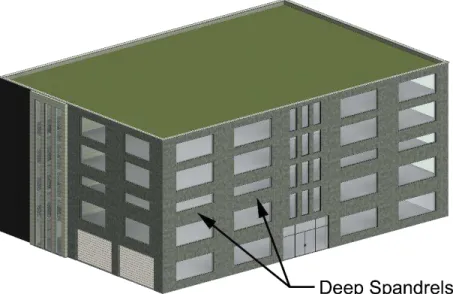
Figure 5.6: Building with short columns due to deep spandrels ... 22
Figure 5.7: Building with short columns due to infill walls ... 22
Figure 5.8: Building with short columns due to irregular wall openings ... 23
Figure 5.9: Building with in-plane discontinuity in vertical lateral-force-resisting element ... 23
Figure 5.10: Building with sloping site irregularity... 24
Figure 5.11: Building with split level irregularity ... 24
Figure 5.12: Building with torsion sensitivity due to C-shaped configuration of walls at ground floor ... 26
Figure 5.13: Corner building with torsion sensitivity due to L-shaped configuration of walls at ground floor ... 26
Figure 5.14: Building with horizontal irregularity due to non-orthogonal systems ... 27
Figure 5.15: Plan views of various building configurations showing re-entrant corners and large diaphragm openings ... 27
Figure 5.16: Building with re-entrant corner irregularity ... 28
Figure 5.17: Building with a large diaphragm opening on the roof... 28
Figure 5.18: Concrete building with beams that do not align with columns ... 29
Figure 5.19: Building with landslide potential ... 37
Figure 5.20: Building with exterior falling hazards ... 38
Figure 5.22: Sample photographs and sketches of buildings ... 40 Figure 6.1: Ranking of existing buildings for the Level 3 – SEG ... 51 Figure C.1: URM wall showing header courses (identified by arrows) and washer plates indicating wall anchors ... C-1 Figure C.2: Types of masonry pattern showing header bricks ... C-2 Figure C.3: Common reinforced masonry construction. Bricks are left out of the bottom course at intervals, creating cleanout holes. The omitted bricks are inserted before grouting. ... C-2 Figure C.4: Schematic illustration of brick veneer panels ... C-3 Figure C.5: Asphalt siding with brick pattern (houzz.com) ... C-3
Figure C.6: Cast-in-place concrete with formwork pattern
(https://www.lifeofanarchitect.com/board-formed-concrete/) ... C-4 Figure C.7: Typical frame structure ... C-4 Figure C.8: Typical bearing wall structure ... C-5 Figure E.1: Wood, Post and Beam ... E-2 Figure E.2: Rotted timber column ... E-2 Figure E.3: Corroded steel section and welded connection (Bélanger, 2014) ... E-3 Figure E.4: Spalled concrete cover ... E-3 Figure E.5: Exposed reinforced steel ... E-4 Figure E.6: Large concrete cracks ... E-4 Figure E.7: “Stair-step” cracking in masonry walls ... E-5
1.0
INTENT AND SCOPE
The Level 2 – Semi-Quantitative Seismic Risk Screening (SQST) is intended as a decision support
tool for Public Services and Procurement Canada (PSPC) in exempting buildings with acceptable
seismic risk to human lives from the Level 3 – Seismic Evaluation Guidelines (SEG) and
prioritizing buildings with potential unacceptable seismic risk for the Level 3 – SEG. The
Level 2 – SQST is intended to cover existing PSPC buildings under Part 4 of the National Building Code of Canada (NBC). It is not intended for small buildings covered by Part 9 of the NBC, such as single-family or small multi-family houses.
The Level 2 – SQST deals with life safety objectives, consistent with the NBC 2015 and does not
address other objectives more stringent than life safety. A building expected to achieve objectives more stringent than life safety (e.g., post-disaster building or a building with a federal heritage
designation) is still eligible for screening with the Level 2 – SQST, but only to determine if its
seismic risk associated with the life safety objective exceeds the acceptable seismic risk.
The Level 2 – SQST was developed and written for trained screeners who are civil or structural
engineering professionals, architects, or graduate students with a basic knowledge in seismic design of buildings. To ensure consistency, high quality data collection and uniformity in
decisions, it is essential to have the completed Level 2 – SQST screening form reviewed by a
licensed structural engineer.
The Level 2 – SQST assumes that existing buildings have been designed and constructed in
conformance with applicable NBC editions. Verification of such conformance is not within the scope of this tool.
2.0
NOTICE
The Level 2 – SQST described herein is intended as a detailed screening tool for exempting existing
buildings with acceptable seismic risk from the Level 3 – SEG and prioritizing existing buildings
with potentially unacceptable seismic risk for the Level 3 – SEG. Obtain written permission from
the National Research Council Canada (NRC) to use the Level 2 – SQST outside PSPC use
requirements.
3.0
SUPPORTING TECHNICAL DOCUMENTATION
Further guidance on the development and use of the Level 2 – SQST can be found in the companion
4.0
DEFINITIONS
Words and terms used in the Level 2 – SQST that are not included in the following list of definitions
shall have the meanings that are commonly assigned to them in the context in which they are used, including the specialized use of terms by the various trades and professions to which the terminology applies.
The words and terms in italics used throughout the Level 2 – SQST shall have the following meanings:
Benchmark NBC edition means an applicable NBC edition in which significantly improved seismic code requirements were adopted and enforced.
Building means any structure used or intended to support or shelter any use or occupancy. If one or more sections of a building are completely separated by expansion joints, each separate section should be considered an individual building in the screening process.
Building age means the number of years since the original construction of the building was completed or the most recent major seismic upgrading was completed.
Building collapse means that any part of the gravity system experiences dynamic instability, leading to the loss of load bearing capacity. Dynamic instability leads to severe structural deformation that is potentially life-threatening in nature, especially the falling of all or portions of a structure.
Building damage means a condition caused by non-engineered modification to the building’s seismic force-resisting system or by previous accidents such as earthquakes, fire, and floods. Building deterioration means a condition caused by weathering, cracking of concrete or masonry
shear walls, corrosion of steel reinforcements in seismic force-resisting elements, etc.
Building redundancy means the quality of having alternative load paths in a structure by which lateral forces can be transferred, allowing the structure to remain stable following the failure of any single element.
Collapse factor means the expected value of collapsed area given that the building is in complete damage state.
Existing building means an already completed building, which was designed as per the code edition that is one cycle or more behind the latest NBC edition.
Falling hazards mean potential threats to human life posed by non-structural components that could fall and hit occupants or people near a building subjected to earthquake excitations. Federal heritage designation means a building that is included in the Directory of federal heritage
designations and meets any one of the following conditions: (1) buildings of any age, designated as recognized or classified federal heritage at the time of screening; and (2) buildings of age not less than 40 years that have not been evaluated by the Federal Heritage Buildings Review Office at the time of screening.
Floor area means the space on any storey of a building between exterior walls, excluding parking area.
Geologic hazard means a condition present at or near the building site that has the potential to
significantly increase the building’s seismic vulnerability, including liquefaction, landslide
potential, and surface fault rupture.
Hazardous materials means toxic or explosive materials, materials having a flash point below 38°C or firefighting fluids.
High consequences mean that the consequences of failure associated with the life safety threat are identified as high.
High Importance buildings are buildings that are likely to be used as post-disaster shelters, including buildings whose primary use is as:
• an elementary, middle or secondary school; • a community centre.
Manufacturing and storage facilities containing toxic, explosive or other hazardous substances in sufficient quantities to be dangerous to the public if released.
Irregularity means a type of building configuration that has the potential to impact the building’s seismic performance.
Landslide potential refers to potential threat to life safety due to a landslide at or near the building site.
Level 1 – PST refers to the preliminary seismic risk screening tool that aims to exempt buildings
from the Level 2 – SQST or flag buildings for the Level 3 – SEG, based on a number of key
criteria and conditions.
Level 2 – SQST refers to a detailed seismic risk screening tool that aims to exempt buildings from Level 3 – SEG and prioritize buildings with potential unacceptable seismic risk for the
Level 3 – SEG by implementing quantitative structural seismic risk scoring and qualitative
non-structural component seismic risk scoring.
Level 3 – SEG refers to seismic evaluation guidelines intended to identify building deficiencies that may pose unacceptable risk to human life or injury as a result of component failure or building collapse.
Life safety means an acceptable maximum annual probability of death or serious injury resulting from structural failure in a building, which is equal to the probability of structural failure times the likelihood of death or serious injury if structural failure occurs.
Liquefaction means a phenomenon whereby a saturated or partially saturated soil substantially loses strength and stiffness under seismic loading.
Low consequences mean that the consequences of failure associated with the life safety threat are identified as low.
Low Importance building means a building that represents a low direct or indirect hazard to human life in the event of structural hazard, including:
• low human-occupancy buildings, where it can be shown that collapse is not likely to cause injury or other serious consequences; and
Model building type means a common building type that is defined in terms of the type of seismic force-resisting system and construction materials.
Medium consequences mean that the consequences of failure associated with the life safety threat are identified as medium.
Moderate vertical irregularity means a type of vertical irregularity that has a less significant adverse effect on building performance.
New building means an already completed building, designed as per the latest edition of the NBC. Normal Importance building means a building that is not listed in a Low, High, or Post-disaster
importance category.
Number of storeys means the number of storeys in a building, counted from the lowest finished grade around the building.
Occupancy means the intended use of a building or part thereof for the shelter or support of persons, animals or property.
Occupants mean the persons for which a building or part thereof is designed.
Original building importance means the importance category that was assigned to the building when it was originally designed.
Original design NBC means the applicable NBC edition to which the building was originally designed. If a provincial or municipal building code was used to design the building, the original design NBC corresponds to the NBC edition on which the provincial or municipal building code was based.
Penthouse means an enclosed, unoccupied rooftop structure used for sheltering mechanical and electric equipment, tanks, elevators and related machinery, and vertical shaft openings. Post-benchmark building means a building that was originally designed to the applicable
benchmark NBC edition or newer.
Post-disaster building means a building that is essential to the provision of services in the event of a disaster, and include:
• hospitals, emergency treatment facilities and blood banks, • telephone exchanges,
• power generating stations and electrical substations, • control centres for air, land and marine transportation,
• public water treatment and storage facilities, and pumping stations,
• sewage treatment facilities and buildings having critical national defence functions, and • buildings of the following types, unless exempted from this designation by the authority
having jurisdiction:
- emergency response facilities,
- fire, rescue and police stations, and housing for vehicles, aircraft or boats used for such purposes, and
- communication facilities, including radio and television stations.
Pounding means the action of two adjacent buildings or two adjacent building sections, completely separated by expansion joints, coming into contact with each other during earthquake
excitation as a result of their close proximity and differences in dynamic response characteristics.
Pre-benchmark code edition means any NBC edition that was released after the NBC edition in which seismic code requirements were first adopted and enforced, but prior to the applicable benchmark NBC edition.
Pre-benchmark building means a building that was designed to an applicable pre-benchmark code edition.
Pre-code NBC edition means an applicable NBC edition in which seismic requirements were first adopted and enforced.
Pre-code building means a building that was originally designed prior to the applicable pre-code NBC edition.
Probability of collapse (also called collapse probability) refers to the product of the probability of a building being in complete damage state and the probability of the building experiencing partial or complete collapse given that the building is in complete damage state.
Remaining occupancy time means the number of years of intended occupancy of an existing building until the lease of the building is terminated or until the building is decommissioned. Seismic risk means the risk to human life and injury due to any of the following earthquake-induced conditions: (1) the entire building collapses, (2) portions of the building collapse, (3) components of the building fail and fall, and (4) exit and entry routes are blocked.
Seismic upgrading means the process of improving the seismic performance of a building’s structural or non-structural components.
Seismic zone refers to a geological area defined by threshold values of spectral response acceleration parameters for design ground motion assuming Site Class C.
Seismicity means the occurrence or frequency of earthquakes in an area of interest.
Severe vertical irregularity means a type of vertical irregularity that has a significant adverse effect on building performance.
Site Class means a site category used to address the effect of foundation soil on building response. Site Class F means a site category including the following soil types: (1) liquefiable soils, quick and highly sensitive clays, collapsible weakly cemented soils, and other soils susceptible to failure or collapse under seismic loading, (2) peat and/or highly organic clays greater than 3 meters in thickness, (3) highly plastic clays (Plasticity Index greater than 75) more than 8 meters thick, and (4) soft to medium stiff clays more than 30 meters thick.
Storey means the portion of a building that is situated between the top of any floor and the top of the next floor above it, and if there is no floor above it, that portion between the top of such floor and the ceiling above it.
Surface fault rupture means a displacement along a fault that reaches the earth’s surface during slip.
Total floor area is the sum of the floor area of all storeys counted from the lowest finished grade around the building.
Trained screener means a person who is properly trained to conduct the seismic risk screening
using the Level 2 – SQST.
Very high consequences mean that the consequences of failure associated with the life safety threat are identified as very high.
Very low consequences mean that the consequences of failure associated with the life safety threat are identified as very low.
5.0
INSTRUCTIONS FOR COMPLETING LEVEL 2
– SQST SCREENING
FORMS
Level 2 – SQST screening forms provided in Appendix A shall be completed by trained screeners
based on the key building information collected in the office and during the site visit. The form is divided into the following parts:
1. Part A: Data collection 2. Part B: Structural scoring
3. Part C: Non-structural component scoring 4. Part D: Decision support
The screening forms have been designed to be completed in a smooth progressive manner, with a minimum amount of writing. Appendix B presents an example of seismic risk screening for an existing building.
Prior to reviewing the forms, the screener needs to determine whether or not the building to be screened is covered by Part 4 of Division B of the NBC, and therefore within the scope of the
Level 2 – SQST. This information may be determined by communicating with the local property
manager or by checking the criteria for buildings covered by Part 4 of Division B of the NBC. A building may be divided into two or more sections by expansion joints. If this is the case, each separate building section should be treated as an individual building when using the Level 2 – SQST.
Buildings may have additions built after the original construction. If that is the case, consider the original building and addition(s) as a single building if the addition(s) is(are) connected to the original building, and consider the original building and addition(s) as separate buildings if there are any gaps or expansion joints between them.
The first step in completing the Level 2 – SQST is to select the appropriate Level 2 – SQST screening form, which is described as follows.
5.1 Selection of Level 2 – SQST Screening Forms
Select the Level 2 – SQST screening form for the corresponding seismic zone based on spectral
accelerations at 0.2 s, 0.5 s, and 1.0 s [Sa(0.2), Sa(0.5), and Sa(1.0), respectively], as provided in Table 5.1. The values of Sa(0.2), Sa(0.5), and Sa(1.0), corresponding to the code level earthquake, are obtained either through Appendix C of the NBC 2015, or through the Natural Resources
Canada earthquake hazard online calculator at the following website address:
http://www.earthquakescanada.nrcan.gc.ca/hazard/interpolator/index_2015-en.php.
Table 5.1: Seismic zones and corresponding spectral acceleration thresholds
Seismic zone Max[Sa(0.2), Sa(0.5)] Sa(1.0)
> ≤ > ≤ Very Low 0.10 g 0.05 g Low 0.10 g 0.20 g 0.05 g 0.10 g Moderate 0.20 g 0.35 g 0.10 g 0.15 g Moderately High 0.35 g 0.75 g 0.15 g 0.30 g High 0.75 g 1.15 g 0.30 g 0.50 g Very High 1.15 g 0.50 g
The seismic zone based on the maximum of the values of Sa(0.2) and Sa(0.5) may be different from
the seismic zone based on the value of Sa(1.0). If that is the case, use the higher of the two seismic
zones for the screening.
Instructions for completing the Level 2 – SQST screening form are provided in the following sections.
5.2 Part A: Data collection
Collect key building information, including building identification (i.e., building name, federal heritage designation, building address), seismic data, model building type, year built, original design NBC, pre-code NBC edition, benchmark NBC edition, number of storeys, total floor area, building occupancy and consequences of failure, building irregularities, building importance category, Site Class, building height configuration, building deterioration and age, redundancy, pounding, seismic upgrading, remaining occupancy time, geologic hazards, building damage, falling hazards, hazardous materials, photograph(s), and sketch(es). Any unknown or uncertain building conditions should be documented in the comments section of Part A of the screening form.
A site visit is essential for successful data collection. Key information collected during a site visit includes building deterioration and damage, pounding, landslide potential, falling hazards, hazardous materials, etc. The site visit is also beneficial for verifying number of storeys, building irregularities, seismic force-resisting system(s), and the presence of expansion joints identified from the building drawings.
In the sections hereunder, instructions for completing Part A are provided in detail. Building name and federal heritage designation
Check “Yes” in the federal heritage designation section if the building is in the Directory of Federal Heritage Designations and meets any one of the following conditions:
1. Buildings of any age, designated as recognized or classified federal heritage at the time of screening; and
2. Buildings of age not less than 40 years that have not been evaluated by the Federal Heritage Buildings Review Office (FHBRO) at the time of screening.
Parks Canada provides the directory of federal heritage of Canada
(https://www.pc.gc.ca/apps/dfhd/search-recherche_eng.aspx). The information may be obtained by contacting Heritage Conservation Services (E-mail: [email protected]). If there is any doubt about the federal heritage designation, a written letter from the building owner or manager is required to determine if the building under screening has a federal heritage designation. Building address
Enter the street address, city, province, and postal code in the building address section. Seismic data
Seismic data can be obtained either from Appendix C of the NBC 2015, or from the Natural Resources Canada earthquake hazard online calculator at the following website address:
http://www.earthquakescanada.nrcan.gc.ca/hazard/interpolator/index_2015-en.php.
Enter the values of Sa(0.2), Sa(0.5), Sa(1.0), PGA in this section. The value of reference peak ground acceleration, PGAref, should be recorded since it is a key parameter in determining site
coefficients in Part A of the form. PGAref is calculated as follows:
• PGAref = 0.8 PGA (peak ground acceleration), for Sa(0.2)/PGA<2, or
• PGAref = PGA, otherwise.
Year built and original design NBC
Record the year when building construction was completed. There may not be a single year built designation. Certain portions of the structure may have been designed and constructed before others. If that is the case, document such in the comments section of Part A of the screening form. If this information is unavailable, leave this section blank.
Enter the applicable NBC edition to which the building was originally designed. If a provincial or municipal building code was used to design the building, the original design NBC corresponds to the NBC edition on which the provincial or municipal building code was based. The original design NBC is best determined based on well-documented sources such as original structural drawings or existing seismic assessment reports. If this information is unavailable, the original design NBC may be estimated based on the year built. In order to consider the lapse in time that
typically occurs between design date and year built, the screener may choose to deduct a few years from the year built to estimate the original design NBC.
Pre-code NBC edition and pre-code building
Enter “NBC 1975” in the pre-code NBC edition section if the building is a precast wall building; otherwise, enter “NBC 1953.”
Model building type
Circle the model building type. The most common buildings covered by Part 4 of the NBC in Canada are grouped into sixteen model building types as shown in Table 5.2, based on the similarities of construction materials and type of seismic force-resisting system (SFRS). Penthouses do not need to be considered as they are unoccupied space (most of time) and thus do not pose significant risk associated with life safety.
Table 5.2: Model building types in Level 2 – SQST
Model building type Description
WLF Engineered Wood Light Frame buildings of up to 6 storeys in height, or having an area exceeding 600 m2
WPB Engineered Wood Post-and-Beam buildings covered by Part 4 of the NBC SMF Steel Moment Frame
SBF Steel Braced Frame SLF Steel Light Frame
SCW Steel frame with Concrete shear Walls SIW Steel frame with Infill masonry shear Walls CMF Concrete Moment Frame
CSW Concrete Shear Walls
CIW Concrete frame with Infill masonry shear Walls PCW Precast Concrete Wall
PCF Precast Concrete Frame
RML Reinforced Masonry bearing walls with Light wood or metal deck diaphragms RMC Reinforced Masonry bearing walls with Concrete diaphragms
URM UnReinforced Masonry bearing wall buildings MH Manufactured Homes
The recommended process for determining the model building type is as follows:
1. Identify the gravity system construction materials. Determine if the building’s structural material is primarily wood, steel, concrete, or masonry. Screen out materials that are not evident. This will result in arriving at one or two materials.
2. Identify the type of seismic force-resisting system, i.e., moment frame, braced frame, shear walls, or other.
3. Based on the material type from the first step and the type of seismic force-resisting system from the second step, eliminate as many model building types as possible. Narrow down the possible model building types to between one and three. For buildings with more than one model building type, select the model building type according to the additional guidance set forth after Step 4 hereunder.
4. Determine the model building type and circle the appropriate model building type on the screening form. Circle “DNK” (Do Not Know) if more than three possibilities remain or the building does not fit any of the sixteen model building types in Table 5.2.
For buildings with more than one model building type, the following additional steps are recommended:
1. Circle all applicable model building types if any of the following conditions apply: • a model building type in one direction and another model building type in the other
direction
• more than one model building type in each direction • one model building type is above another
2. In the exceptional case of an existing building with dual system, select the predominant model building type if the building was designed to resist all lateral forces through the predominant model building type. For example: concrete moment frame buildings with sufficient concrete shear walls around the elevator and stairwell cores. Well-documented evidence or engineering judgement made by an experienced structural engineer is required to support the selection of the predominant model building type.
The model building type is best determined based on well-documented sources such as original drawings or available seismic assessment reports.
Benchmark NBC edition
Enter the applicable benchmark NBC edition for the model building type according to Table 5.3. If more than one model building type was identified, enter applicable benchmark NBC editions for
Table 5.3: Applicable benchmark NBC editions for different model building types
Model building type Benchmark NBC edition
WLF 2005 (≤ 4 storeys); 2015 (4 < storeys≤ 6)
WPB 2005
SMF 2005
SBF 2010 (buckling-restrained braced frames); 2005 (other)
SLF 2005
SCW 2005
SIW N/A
CMF 2015 (two-way slabs without beams); 2005 (other)
CSW 2005 CIW N/A PCW 2015 PCF 2005 RML 2005 RMC 2005 URM N/A
MH 2005 (< 4.3 m wide and 1 storey) 2010 (≥ 4.3 m wide or 2-3 storeys)
Screener information
Identify the screener’s name, initials, or some other type of code. Check “P. Eng./ing.” if the screener is a licensed professional engineer in Canada. The screening date and time should also be recorded.
Number of storeys
Enter the number of storeys above the lowest finished grade elevation around the building under screening. For buildings constructed on a hill or with different roof levels, use the largest number of storeys counted from the lowest finished grade elevation around the building to the corresponding roof. Applicable penthouses at the top of the building should not be considered when counting the number of storeys because the penthouse is typically unoccupied (most of the time) and thus does not pose a significant life safety threat to building occupants.
If the building has stepped levels or has a tower, document the varied numbers in the comments section of Part A of the screening form.
Total floor area (m2)
Enter the total floor area for the building under screening as the sum of the floor areas (in m2) for
each storey above the lowest finished grade elevation around the building. The floor area may be determined based on the dimensions of each floor from the structural drawings. If one or more new floors were added and occupied, these floor areas should also be taken into consideration. The floor area of applicable penthouse(s) should not be considered because they do not pose a significant life safety threat to buildings occupants. Use an asterisk or a note to indicate when the total floor area is estimated.
Occupancy
Determine building occupancy based on the following occupancy types: 1. office buildings 2. public buildings 3. commercial buildings 4. industrial buildings 5. educational buildings 6. residential buildings 7. care/treatment buildings 8. parking buildings
9. public assembly buildings 10. passenger stations
Public buildings refer to buildings, for single or multiple occupancies, to which the public is admitted, and/or where a wide range of government services and benefits can be provided to the public (e.g., service centers, passport offices, etc.).
There are certain buildings that are not classified as any of the aforementioned occupancy types. If that is the case, specify the occupancy under “Other” in the occupancy section.
If the building has more than one occupancy type, such as commercial and residential, circle all applicable occupancy classes. If only a small portion of the building is occupied by a specific occupancy type, the screener may choose to circle the main occupancy type only. The decision should be made based on the judgement of an experienced structural engineer and consultation with the local property manager.
Record the original occupancy type in the original occupancy section, based on available building information. If this information is unavailable, check “DNK” and assume the original occupancy type is the same as the occupancy type identified in the occupancy section.
Check “Yes” if the occupancy change increases structural loads other than seismic. The structural load information may be found on structural drawings. If this information is unavailable, the structural loads from Section 4.1 of Part 4 of Division B of the NBC 2015 can be used.
Consequences of failure
Five levels of consequences of failure, namely Very Low Consequences (VLC), Low Consequences (LC), Medium Consequences (MC), High Consequences (HC), and Very High Consequences (VHC), are defined to describe buildings’ lowest to highest consequences of failure. Check the appropriate box for the building’s consequences of failure based on the number of storeys, total floor area, and applicable occupancy type(s). Certain levels of consequences of failure do not apply to certain occupancy types. For example, Very Low and Very High Consequences do not apply to office, public, residential, commercial, educational, parking, and passenger station occupancy types.
Figure 5.1 shows the consequences of failure for office, public, commercial, and residential buildings as a function of the total floor area and number of storeys. A building’s consequences of failure may fall directly between two consequences. If that is the case, enter the lower of the two consequences as per consequence classification (Fathi-Fazl and Lounis, 2017).
(a) Office and public buildings (b) Commercial buildings
(c) Residential buildings
Figure 5.1: Consequences of failure for office, public, commercial, and residential buildings
Table 5.4 to Table 5.9 provide the consequences of failure for industrial, educational, care/treatment, parking, public assembly, and passenger station occupancy types. Definitions for Group A through Group F are presented in Table D.1 in Appendix D. The number of occupants is required for educational, care/treatment, public assembly, and passenger station occupancy types. This is estimated by multiplying the total floor area by the design occupancy load/density
(person/m2). The design occupancy load density may be found on the structural drawings. If this
information is unavailable in the structural drawings, the following density values, obtained from the NBC 2015, can be used:
1. Educational buildings: 1 person/(0.75 m2)
2. Public assembly: 1 person/(0.75 m2)
3. Passenger station: 1 person/(0.75 m2)
4. Care/treatment buildings: 1 person/(10 m2)
Table 5.4: Consequences of failure of industrial buildings
Low Consequences (LC) Medium Consequences (MC) Very High Consequences (VHC) Group F-3 and the number of
storeys is less than or equal to 3
(ns ≤ 3)
• Group F-3 and ns > 3; or
• Group F-2; or
• Public Utility buildings (do not serve as post-disaster facilities)
• Group F-1; or
• Public Utilities (serve as
post-disaster facilities)
Table 5.5: Consequences of failure of educational buildings
Medium Consequences (MC) High Consequences (HC) One storey (ns = 1)
• Daycare facilities with no more than 150
occupants; or
• Primary or secondary schools with no more than 250 occupants; or
• Colleges or universities with no more than 500
occupants
Exceed one storey (ns > 1)
• Daycare facilities with more than 150
occupants; or
• Primary or secondary schools with more than 250 occupants; or
• Colleges or universities with more than 500
occupants
Table 5.6: Consequences of failure of care/treatment buildings (Group B-2/B-3)
Medium Consequences (MC) High Consequences (HC) Very High Consequences (VHC) • ns ≤ 3 in building height; and
• Accommodate no more than 50 occupants and have no surgery or emergency facilities
• ns > 3 in building height; and
• Accommodate more than 50
occupants and have no
surgery or emergency facilities
• Have surgery or emergency treatment facilities
Table 5.7: Consequences of failure of parking buildings
Low Consequences (LC) Medium Consequences (MC) • ns ≤ 5 in building height; and
• Do not accommodate emergency vehicles
• ns > 5 in building height; and
• Do not accommodate emergency vehicles
Table 5.8: Consequences of failure of public assembly buildings
Medium Consequences (MC) High Consequences (HC) Very High Consequences (VHC) • Open-Air Assembly
(Group A-4) accommodating no more than 2000 occupants; or
• Indoor Assembly (Group A-1, A-2, or A-3)
• accommodating no more than 300
occupants; and
• with a total floor area of 1000 m2 or less
• Open-Air Assembly (Group A-4) accommodating more than 2000 but less than 5000 occupants; or
• Indoor Assembly (Group A-1, A-2, or A-3) accommodating
• more than 300
occupants; or
• with a total floor area more than 1000 m2.
Open-Air Assembly (Group A-4) accommodating more than 5000
occupants.
Table 5.9: Consequences of failure of passenger stations
Medium Consequences (MC) High Consequences (HC) Accommodates no more than 250 occupants. Accommodates more than 250 occupants.
If occupancy is identified as “Other” in the occupancy section, determine the consequences of
failure as follows:
• Check “Very Low Consequences(VLC)” if the building under screening is an agricultural
building.
• Check “High Consequences (HC)” if the occupancy is detention. The description of
detention occupancy is presented in Table D.1 of Appendix D.
• Check “Very High Consequences (VHC)” if the building under screening is intended to be
a post-disaster facility.
• Check “High Consequences (HC)” if the building is not identified as any of above
If there is more than one occupancy identified in the occupancy section, identify the consequences of failure for each applicable occupancy.
Record the original consequences of failure based on the original occupancy, number of storeys, total floor area, and number of occupants (if applicable). For buildings with addition(s), the number of storeys and total floor area should be determined based on the original building configuration.
Check “Yes” if the current consequences of failure are higher than the original consequences of failure.
Building irregularities
Table 5.10 presents the building irregularities adopted from the NBC 2015, with additional irregularities adopted from FEMA P-154. The vertical irregularities are divided into severe vertical irregularities and moderate vertical irregularities according to the level of severity of the irregularity on the building’s seismic performance. The following sections provide the guidelines to identify the building irregularities.
Table 5.10: Building irregularities considered in Level 2 – SQST
Vertical irregularity Horizontal irregularity Moderate Severe NBC 2015 • In-plane discontinuity • Vertical stiffness
irregularity (soft storey) • Vertical geometric irregularity • Out-of-plane offsets • Discontinuity in capacity (weak storey) • Torsional sensitivity • Non-orthogonal systems New • Sloping site
• Split level • Short column • Re-entrant corners • Diaphragm openings
• Beams not aligned with columns
Vertical irregularities
Consider the following to select vertical irregularities in the building irregularities section of Part A:
• If one or more severe vertical irregularities are identified, check severe vertical irregularity.
• If one or more moderate vertical irregularities are identified, check moderate vertical irregularity.
• If there is any doubt about the presence of a specific vertical irregularity, assume this irregularity exists and check the corresponding severity from Table 5.10.
A description of severe and moderate vertical irregularities is provided below.
- Vertical stiffness irregularity (soft storey) or discontinuity in capacity (weak storey)
Vertical stiffness irregularity, also referred as soft storey, exists when the lateral stiffness of the seismic force-resisting system (SFRS) in a storey is less than 70% of the stiffness of any adjacent storey, or less than 80% of the average stiffness of the three storeys above or below. Discontinuity in capacity, also referred as a weak storey, is one in which the shear strength is less than that in the storey above. The shear strength is the total strength of all seismic-resisting elements of the SFRS sharing the storey shear for the direction under consideration. To identify vertical stiffness irregularity and discontinuity in capacity, look for clues that indicate the presence of vertical stiffness irregularity, considering the following conditions:
a) Wood building has an open front at the ground floor for parking (see Figure 5.2).
b) One of the storeys is particularly tall (at least 30% taller) compared to the other storeys (see Figure 5.3).
c) One of the storeys has fewer walls or columns, or more windows and openings (see Figure 5.4).
Figure 5.2: Wood building with vertical stiffness irregularity due to large openings at the ground storey
Figure 5.3: Building with vertical stiffness irregularity due to tall piers at the ground storey
Figure 5.4: Building with weak storey due to narrow piers at one side of the ground storey
Note that it is sometimes difficult to differentiate vertical stiffness irregularity from discontinuity in capacity irregularity using a visual screening procedure. However, both irregularities have a similar detrimental effect on the seismic performance of buildings. If any one of these irregularities are identified, the screener should check the severe vertical irregularity box. - Vertical geometric irregularity and out-of-plane offsets
Consider vertical geometric irregularity when the horizontal dimension of the SFRS in any storey is more than 130% of that of an adjacent storey. Also consider vertical geometric irregularity in
cases when the horizontal dimension of adjacent storeys is significantly different but the corresponding ratio is unknown.
Out-of-plane offsets result in discontinuity of the vertical SFRS elements in a lateral force path. Out-of-plane offset irregularity is typically evident on the exterior walls. The exterior walls of the building, however, may not correctly indicate the location of the SFRS, specifically for interior shear walls that are not visible from the exterior.
Figure 5.5 illustrates a building with out-of-plane offset irregularity. If a vertical geometric irregularity or out-of-plane offset irregularity is identified, the screener should check the severe vertical irregularity box.
Figure 5.5: Building with out-of-plane offsets at the third storey
- Short column
Short columns with height-to-depth ratio 50% smaller than that of adjacent columns attract greater seismic forces due to higher relative stiffness. Vertical irregularity due to short columns can be identified when:
1) Columns or wall piers are narrow compared to the depth of the spandrels (see Figure 5.6). 2) Partial height infill walls shorten the clear height of columns (see Figure 5.7).
Figure 5.6: Building with short columns due to deep spandrels
Figure 5.8: Building with short columns due to irregular wall openings
If any of the above conditions exist, the screener should check the severe vertical irregularity box. - In-plane discontinuity
Consider in-plane discontinuity when there is an offset of a lateral-force-resisting element of the SFRS or a reduction in lateral stiffness of the resisting element in the storey below. This applies to all model building types with the exception of braced and moment resisting frames. If this type of irregularity exists, the screener should check the moderate vertical irregularity box. Figure 5.9 illustrates the in-plane discontinuity irregularity.
- Sloping site
Sloping site irregularity is considered if there is at least a full storey grade change from one side of the building to the other. Figure 5.10 illustrates the sloping site irregularity. If a sloping site irregularity exists, the screener should check the moderate vertical irregularity box.
Figure 5.10: Building with sloping site irregularity
- Split level
Misalignment of floor or roof levels cause discontinuities in diaphragms, which increase the torsional deformation of building structures. This irregularity is considered if there is at least a 0.6 m height difference between two adjacent diaphragms. Figure 5.11 shows an example of split level irregularity. If this type of irregularity is identified, the screener should check the moderate vertical irregularity box.
Horizontal irregularity
The following five types of horizontal irregularities can be present in existing buildings: 1. Torsion sensitivity
2. Non-orthogonal systems 3. Re-entrant corners 4. Diaphragm openings
5. Beams not aligned with columns
Identify any horizontal irregularities in the building as follows:
• If one or more horizontal irregularities are identified, the screener should check the horizontal irregularity box.
• If there is any doubt about the presence of any of the horizontal irregularities, assume they do exist and check the horizontal irregularity box.
Descriptions of each type of horizontal irregularity are provided below. - Torsion sensitivity
Consider torsional sensitivity when the ratio of maximum storey displacement at the extreme points of the structure to the average storey displacement at the extreme points of the structure exceeds 1.7. This value, however, may be unavailable at screening stage without a structural analysis of the building. Torsional sensitivity is considered if any of the following conditions apply:
1) There is a significant distance between the centre of the mass and centre of stiffness of the typical floor of a building.
2) The majority of SFRS elements are located in the centre of the plan without any SFRS on the perimeter.
3) SFRS elements are present only on one side of the building plan. This is especially common among corner buildings when the two adjacent street sides of the building have large window openings, whereas the other two sides are generally solid walls.
Figures 5.12 and 5.13 illustrate buildings with C-shaped and L-shaped configuration of walls at the ground floor, respectively. In buildings with these configurations, vertical stiffness irregularity (soft storey) may also exist. If that is the case, check both severe vertical irregularity and horizontal irregularity.
Figure 5.12: Building with torsion sensitivity due to C-shaped configuration of walls at ground floor
Figure 5.13: Corner building with torsion sensitivity due to L-shaped configuration of walls at ground floor
- Non-orthogonal systems
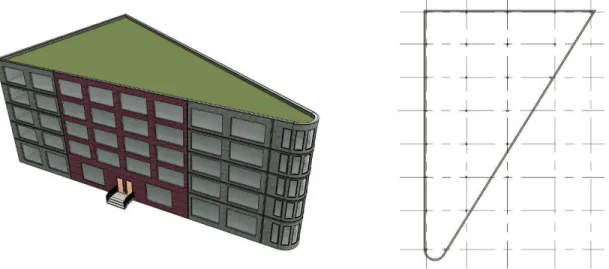
Consider a non-orthogonal system irregularity when the SFRS is not oriented along a set of orthogonal axes. Figure 5.14 shows an example of non-orthogonal system irregularity. Some symmetric non-orthogonal systems (e.g., octagonal and round structures) may be seismically resistant to torsional effects and perform even better than regular buildings. Nevertheless, these systems are considered to have a non-orthogonal system irregularity as per the definition in the NBC, and should be screened as all other non-orthogonal systems.
Figure 5.14: Building with horizontal irregularity due to non-orthogonal systems
- Re-entrant corners
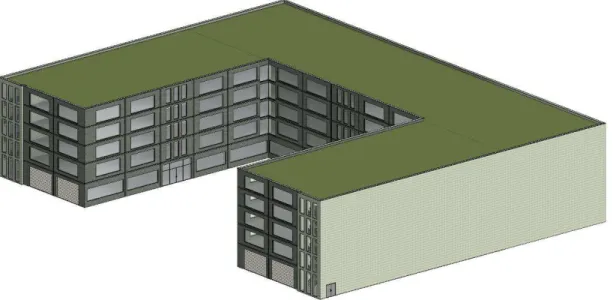
Re-entrant corners are present in buildings with irregular shapes, such as those illustrated in Figure 5.15. Buildings with re-entrant corners are likely to suffer local diaphragm damage due to stress concentrations at re-entrant corners. Figure 5.16 shows an example of a building with a typical re-entrant corner irregularity.
Figure 5.15: Plan views of various building configurations showing re-entrant corners and large diaphragm openings