HAL Id: hal-01113988
https://hal.archives-ouvertes.fr/hal-01113988v2
Submitted on 19 Nov 2015
HAL is a multi-disciplinary open access
archive for the deposit and dissemination of
sci-entific research documents, whether they are
pub-lished or not. The documents may come from
teaching and research institutions in France or
abroad, or from public or private research centers.
L’archive ouverte pluridisciplinaire HAL, est
destinée au dépôt et à la diffusion de documents
scientifiques de niveau recherche, publiés ou non,
émanant des établissements d’enseignement et de
recherche français ou étrangers, des laboratoires
publics ou privés.
Causality Traces
Benoit Cornu, Earl T. Barr, Lionel Seinturier, Martin Monperrus
To cite this version:
Benoit Cornu, Earl T. Barr, Lionel Seinturier, Martin Monperrus. Casper: Debugging Null
Deref-erences with Dynamic Causality Traces . [Research Report] hal-01113988, Inria Lille. 2015.
�hal-01113988v2�
Casper: Debugging Null Dereferences with
Dynamic Causality Traces
Benoit Cornu, Earl T. Barr†, Lionel Seinturier*, Martin Monperrus*
*University of Lille & INRIA
†University College London
contact:[email protected]
Abstract: Fixing a software error requires understanding its root cause. In this paper, we introduce “causality traces”, crafted execution traces augmented with the information needed to reconstruct the causal chain from the root cause of a bug to an execution error. We propose an approach and a tool, called CASPER, based on code transformation, which dynamically constructs causality traces for null dereference
errors. The core idea of CASPER is to replace nulls with
special values, called “ghosts”, that track the propagation of the nulls from inception to their error-triggering dereference. Causality traces are extracted from these ghosts. We evaluate our contribution by providing and assessing the causality traces of 14 real null dereference bugs collected over six large,
popular open-source projects. Over this data set, CASPER
builds a causality trace in less than 1 second.
I. INTRODUCTION
In isolation, software errors are often annoyances, perhaps costing one person a few hours of work when their accounting application crashes. Multiply this loss across millions of people; consider that even scientific progress can be delayed or derailed by software error [10]: in aggregate, these errors are costly to society as a whole.
Fixing these errors requires understanding their root cause, a process that we call causality analysis. Computers are mindless accountants of program execution, yet do not track the data needed for causality analysis. This work proposes to harness computers to this task. We introduce “causality traces”, execution traces augmented with the information needed to reconstruct a causal chain from a root cause to an execution error. We construct causality traces over “ghosts”, an abstract data type that can replace a programming language’s special values, like null or NaN. Ghosts replace such values and track
operations applied to itself, thereby collecting a causality trace whose analysis reveals the root cause of a bug. To demonstrate the feasibility and promise of causality traces, we have instan-tiated ghosts for providing developers with causality traces for null deference errors, they are “null ghosts”.
Anecdotally, we know that null dereferences are frequent runtime errors. Li et al. substantiated this conventional wis-dom, finding that 37.2% of all memory errors in Mozilla and and Apache are null dereferences [9]. Kimura et al. [8] found that there are between one and four null checks per 100 lines of code on average. A null dereference runtime error
1 Exception in thread "main" java.lang.NullPointerException
2 at [..].BisectionSolver.solve(88)
3 at [..].BisectionSolver.solve(66)
4 at ...
Listing 1. The standard stack trace of a real null dereference bug in Apache Commons Math
1 Exception in thread "main" java.lang.NullPointerException
2 For parameter : f// symptom
3 at [..].BisectionSolver.solve(88) 4 at [..].BisectionSolver.solve(66)
5 at ...
6 Parameter f bound to field UnivariateRealSolverImpl.f2
7 at [..].BisectionSolver.solve(66)
8 Field f2 set to null
9 at [..].UnivariateRealSolverImpl.<init>(55)// cause
Listing 2. What we propose: a causality trace, an extended stack trace that contains the root cause.
occurs when a program tries to read memory using a field, parameter, or variable that points to nothing — “null” or “none”, depending on the language. For example, on October 22 2009, a developer working on the Apache Common Math open source project encountered an null pointer exception and reported it as bug #3051.
In low-level, unmanaged runtime environments, like as-sembly or C/C++, null dereferences result in a dirty crash, e.g. a segmentation fault. In a high-level, managed runtime environment such as Java, .NET, etc., a null dereference triggers an exception. Programs often crash when they fail to handle null dereference exceptions properly [2].
When debugging a null dereference, the usual point of departure is a stack trace that contains all the methods in the execution stack at the point of the dereference. This stack trace is decorated with the line numbers where each method was called. Listing 1gives an example of such a stack trace and shows that the null dereference happens at line 88 of
BisectionSolver.
Unfortunately, this stack trace only contains a partial snap-shot of the program execution when the null dereference occurs, and not its root cause. In Listing 1, the stack trace says that a variable is null at line 88, but not when and what assigned “null” to the variable. Indeed, there may be a large gap between the symptom of a null dereference and its root cause [2]. In our evaluation, we present 7 cases where the patch for fixing the root cause of a null dereference error is
not in any of the stack trace’s method. This gap exactly is an instance of Eisenstadt’s cause/effect chasm [4] for a specific defect class: null dereference errors.
This “null dereference cause/effect chasm” has two dimen-sions. The first is temporal: the symptom may happen an arbitrarily long time after its root cause, e.g. the dereference may happen ten minutes and one million method executions after the assignment to null. In this case, the stack trace is a snapshot of the execution at the time of the symptom, not at the time of the root cause. The second is spatial: the location of the symptom may be arbitrarily far from the location of the root cause. For example, the null dereference may be in package
fooand class Awhile the root cause may be in package barand
class B. The process of debugging null dereferences consists
of tracing the link in space and time between the symptom and the root cause.
A causality trace captures the complete history of the propagation of a null value that is incorrectly dereferenced.
Listing 2 contains such a causality trace. In comparison to
Listing 1, it contains three additional pieces of information. First, it gives the exact name, here f, and kind, here parameter
(local variable or field are other possibilities), of the null variable. Second, it explains the origin of the parameter, the call to solveat line 66 with field f2passed as parameter. Third,
it gives the root cause of the null dereference: the assignment of null to the field f2at line 55 of class UnivariateRealSolverImpl.
Our causality traces contain several kinds of trace elements, of whichListing 2shows only three: the name of the wrongly dereferenced variable, the flow of nulls through parameter bindings, and null assignment.Section II details the rest.
In this paper, we present a novel tool, called CASPER,
to collect null causality traces. The tool is going to be used at debugging time by developers. It takes as input the program under debug and a main routine that triggers the null dereference. It then outputs the causality trace of the null dereference. It first instruments the program under debug by replacing nulls with “ghosts” that track causal information
during execution. We have named our tool CASPER, since it
injects “friendly” ghosts into buggy programs. To instrument a program, CASPER applies a set of 11 source code transfor-mations tailored for building causal connections. For instance,
o = externalCall() is transformed into o = NullDetector.check(externalCall())
, where the method check stores causality elements in a null
ghost (Section II-B) and assigns it to o if externalCall returns
null.Section II-Cdetails these tranformations.
We evaluate our contribution CASPER by providing and
assessing the causality traces of 14 real null dereference bugs collected over six large, popular open-source projects. We collected these bugs from these project’s bug reports, retaining
those we were able to reproduce. CASPER constructs the
complete causality trace for 13 of these 14 bugs. For 11 out of these 13 bugs, the causality trace contains the location of the actual fix made by the developer.
Furthermore, we check that our 11 source code transforma-tions do not change the semantics of the program relative to the program’s test suite, by running the program against that test suite after transformation and confirming that it still passes. The limitations of our approach are discussed in Section II-E
and its overhead in paragraph III-C4c. To sum up, our contributions are:
• The definition of causality traces for null dereference errors
• A set of source code transformations designed and
tai-lored for collecting the causality traces.
• CASPER, an implementation in Java of our technique.
• An evaluation of our technique on real null dereference
bugs collected over 6 large open-source projects. CASPER and our dataset can be downloaded from https: //github.com/Spirals-Team/casper.
II. CASPER’SNULLDEBUGGINGAPPROACH
CASPER tracks the propagation of nulls used during application execution in a causality trace. A null dereference causality traceis the sequence of language constructs traversed during execution from the source of the null to its erro-neous dereference. By building this trace, CASPERgeneralizes dynamic taint analysis to answer not only whether a null
can reach a dereference, but how a dereference is reached2
These traces speed the localization of the root cause of null dereferences errors.
Our idea is to replace nulls with objects whose behavior, from the application’s point of view, is same as a null, except that they store a causality trace, defined inSection II-A.
We called these objects null ghosts and detail them in
Sec-tion II-B. CASPER rewrites the program under debug to use null ghosts and to store a null’s causality trace in those null ghosts,Section II-C. An additional set of semantic preserving transformation are required (Section II-D). Finally, we discuss CASPER’s realization inSection II-E. We instantiated CASPER in Java and therefore tailored our presentation in this section to Java.
A. Null Dereference Causality Trace
To debug a complex null dereference, the developer has to understand the history of a guilty null from its creation to its problematic dereference. She has to know the details of the null’s propagation, i.e. why and when each variable became null at a particular location. We call this history the “null causality trace” of the null dereference.
Definition 2.1: A null dereference causality trace is the temporal sequence of language constructs traversed by a dereferenced null.
Developers read and write source code. Thus, source code is the natural medium in which developers reason about programs for debugging. In particular, a null propagates through moves or copies, which are realized via constructs
like assignments and parameter binding. This is why CASPER
defines causal links in a null causality trace in terms of tra-versed language constructs.Table Idepicts language constructs through which nulls originate, propagate, and trigger null pointer exceptions.
2We take the source of a null to be a given, and do not concern ourselves
with its cause. Under this assumption, Casper’s traces, which answer the question of how a dereference is reached, are causal.
Mnemonic Description Examples
L null literal
x =null;
Object x;//Implicit null return null;
foo(null);
Pe null at entry void{. . .foo(} intx)
Pi at invocationnull foo(e)
R null return
x = foo()//foo returns null
foo().bar() bar(foo())
U unboxed null Integer x =e;
inty = x
A null assignment x =e;
D null x.foo()
dereference x.field
X external call lib.foo(e)
TABLE I
NULL-PROPAGATING LANGUAGE CONSTRUCTS. WE USEeTO DENOTE AN ARBITRARY EXPRESSION. IN ALL CASES BUTX,WHEREeAPPEARS,A
N U L LPROPAGATES ONLY IFeEVALUATES TO N U L L. AIS GENERIC ASSIGNMENT;IT IS THE LEAST SPECIFIC N U L L-PROPAGATING LANGUAGE
CONSTRUCT.
Therefore, nulls can originate in hard-coded null literals (L), and in external library return (Pi) or callbacks (Pe). In
our causality abstraction, these links are the root causes of a null dereference. Recall that Java forbids pointer arithmetic, so we do not consider this case.
A null propagates through method parameters, returns (R), and unboxing (U). With the least specificity, a null can propagate through source level assignment (A). D denotes the erroneous dereference of a null.
When nulls are passed as parameter, they can be detected
at parameter binding bound at a call site (Pi) and method
entry (Pe). The reasons are twofold. First, we don’t make
any assumption on the presence, the observability and the manipulability of library code, so even in the presence of external libraries, we can trace that nulls are sent to them (Pi).
Second, it enables to decipher polymorphism in the traces, we trace the actual method that has been called.
Let us consider the snippet “x = foo(bar())); ... x.field” and assume
that x.field throws an NPE. The resulting null causality trace
is R-R-A-D (return return assignment dereference). Here, the
root cause is the return of the method bar3. The trace of
Listing 2, discussed in introduction, is L-A-Pe-Pi-D. L and A
are redundant in this case, since a single assignment statement directly assigns a null to the field f2; Pe and Pi are also
redundant since no library call is involved. Post-processing
removes such redundancy in a causality trace before CASPER
presents the trace to a user.
CASPER decorates the L, A, Pi, and U “links” in a null
dereference causality trace with the target variable name and the signature of the expression assigned to the target For each causal link, CASPERalso collects the location of the language
3The root cause is not somewhere above the returnin bar’s body or the
causality trace would necessarily be longer.
// original type publicMyClass{
privateObject o;
publicString sampleMethod(){ ...
} }
// corresponding generated type publicMyGhostClassextendsMyClass{
publicString sampleMethod(){
// enriches the causality trace to log // that this null ghosts was dereferenced
computeNullUsage();
throw newCasperNullPointerException(); }
...// for all methods incl. inherited ones
}
Listing 3. For each class of the program under debug, CASPERgenerates a null ghost class to replace nulls.
constructs (file, line) as well as the name and the stack of the current thread. Consequently, a causality trace contains a temporally ordered set of information and not just the stack at the point in time of the null dereference. In other words, a causality trace contains a null’s root cause and not only the stack trace of the symptom.
A causality trace is any chain of these causal links. A trace a) starts with a L or, in the presence of an external library, with R or Pe; b) may not end with a dereference (if the null pointer
exception is caught, the null can continue to propagate); and c) may contain a return, not preceded by a method parameter link, when a void external method returns null. A causality trace can be arbitrarily long.
B. Null Ghosts
The special value null is the unique bottom element of Java’s nonprimitive type lattice. Redefining null to trace the propagation of nulls during a program’s execution, while elegant, is infeasible, since it would require the definition and implementation of a new language, with all the deployment and breakage of legacy applications that entails.
For sake of applicability, we leave our host language, here Java, untouched and we use un vanilla unmodified Java virtual machine. We use rewriting to create a null ghost to “haunt” each class defined in a codebase. A null ghost is an object that 1) contains a null causality trace and 2) has the same observable behavior as a null value. To this end, a ghost class contains a queue and overrides all methods of the class it haunts to throw null pointer exceptions.
Listing 3 illustrates this idea. CASPER creates the ghost class MyGhostClass that extends the application class MyClass.
All methods defined in the application type are overridden in the new type (e.g., sampleMethod) as well as all other
methods from the old class (See Section II-E). The new
methods completely replace the normal behavior and have the same new behavior. First, the call to computeNullUsage enriches the causality trace with a causal element of type D by stating that this null ghosts was dereferenced. Then, it acts as if one has dereferenced a null value: it throws a
CasperNullPointerException(a special version of the Java error thrown
when one calls a method on a null value called NullPointerException
Method Explanation
nullAssign(x, position) logs whether x is null at this assignment, returns x if x is a valid object or a ghost, or a new ghost if x is null nullParam(x, position) logs whether x is null when passed as parameter, returns x if x is a valid object or a ghost, or a new ghost if x is null nullPassed(x, position) logs whether x is null when received as parameter at this position, returns void
nullReturn(x, position) logs whether x is null when returned at this position, returns x if x is a valid object or a ghost, or a new ghost if x is null
exorcise(x, position) logs whether x is null when passed as parameter to a library call at this position, returns "null" if x is a ghost, or x nullUnbox(x, position) throws a null pointer exception enriched with a causality trace if a null ghost is unboxed
nullDeref(x, position) throws a null pointer exception enriched with a causality trace if a field access is made on a null ghost TABLE II
EXPLANATIONS OF THEMETHODSINJECTED WITHCODETRANSFORMATION.
the marker interface NullGhost. This marker interface will be used later to keep the same execution semantics between real null and null ghosts.
C.
C
ASPER’s TransformationsCASPER’s transformations instrument the program under debug to detect nulls and construct null dereference causality traces dynamically, while preserving its semantics.
1) Overview: Our idea is to inject a number of method
calls in the program under debug. They are listed in
Ta-ble II. For instance, o = foo() is transformed into o =
nullAssign(foo(), “o, line 24”) where method
“nullAssign” logs whether x is null at this assignment, returns x if x is a valid object or a ghost, or a new ghost if x is null. There are a number of other methods and transformations that we now explain.
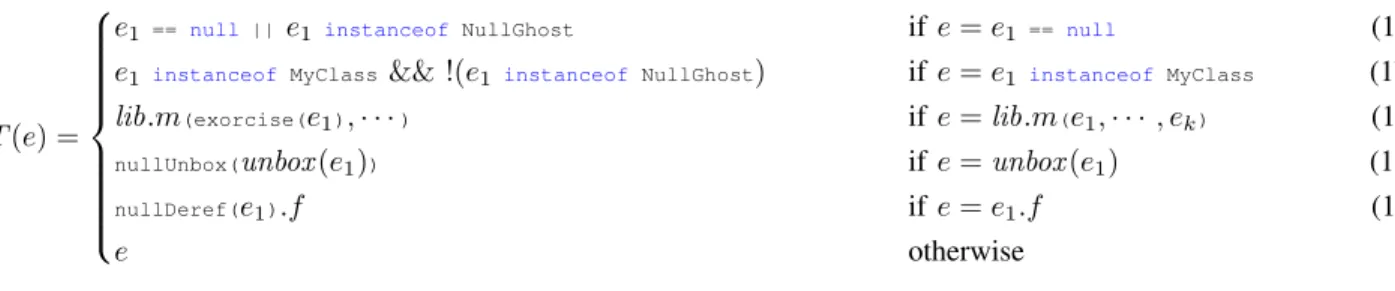
Figure 1 and Figure 2 define CASPER’s transformations. We have separated these rules into these two figures for clarity; in practice, the rules in these two figures are applied simultaneously to a program.Figure 1contains rewriting rules for expressions, with the exception of method calls; Figure 2
contains rules for statements and includes method calls, which are both expressions and statements. In the figures, e and en are Java expressions, and s is a statement. For brevity,
Figure 2 introduces hmethod _decl i for a method declaration and hmethod _bodyi for its body. Since version 5.0, Java automatically boxes and unboxes primitives to and from object wrappers, unbox (e1) denotes this operation. Equations 1a–
1c, in Figure 1, define our semantics-preserving expression transformations.Section II-Ddiscusses them.
The equations inject the following functions into the pro-gram under debug: nullDeref, nullParam, nullPassed, nullAssign, and nullReturn. These functions all check their argument for nullity.
If their argument is null, they create a null ghost and add the causality link built into their name, i.e. nullAssignadds A. If
their argument is a null ghost, they all append the appropriate causality link to the causality trace.
2) Detection of nulls: To provide the origin and causality of null dereferences, one has to detect null values before they become harmful, i.e. before they are dereferenced. This section describes how CASPER’s transformations inject helper methods that detect and capture nulls.
In Java, as with all languages that prevent pointer arithmetic, nulls originate in explicit or implicit literals within the application under debug or from an external library. L in
Table I lists four examples of the former case. CASPER statically detects nulls appearing in each of these contexts.
For explicit null assignment, as in x =null, it applies its
Equation 2a; for implicit, Object o;, it applies Equation 2b.
Both of these rewritings inject nullAssign, which instantiates a
null ghost and starts its causality trace with L–A.Equation 2e
injects nullReturnto handle return null, collecting R.
Not all nulls can be statically detected: a library can produce them. An application may be infected by a null from an external library in four cases: 1) assignments whose right hand side involves an external call; 2) method invocations one of whose parameter expressions involves an external call; 3) boolean or arithmetic expressions involving external calls; and 4) callbacks from an external library into the program under debug.
Equation 2a handles the assignment case, injecting the
nullAssignmethod to collect the causality links R, A.Equation 1c
wraps the parameters of internal method calls with nullParam,
which handles external calls in a parameter list and adds the R and Pe links to a null ghost.Equation 1d handles boolean or
arithmetic expressions. It injects the nullUnboxmethod to check
nullity and create a null ghost or update an existing one’s trace with R and U. Finally,Equation 2dhandles library callbacks. A library call back happens when the application under debug provides an object to the library and the library invokes a method of this object, as in the “Listener” design pattern. In this case, the library can bind null to one of the method’s parameters. Because we cannot know which method may be involved in a callback, Equation 2dinserts a check for each argument at the beginning of every method call, potentially adding Pe to a ghost’s causality trace.
Rewriting Java in the presence of its final keyword is
challenging.Listing 4shows an example application of Equa-tion 2d. The first method is the application method and the
second one is the method after instruction by CASPER. The
use of final variables, which can only be assigned once in
Java, requires us to duplicate the parameter as a local variable. Renaming the parameters (b to b_dup), then creating a local variable with the same name as the original parameter, allows CASPER to avoid modifying the body of the method. D. Semantics Preservation
Using null ghosts instead of nulls must not modify program execution. CASPERtherefore defines the three trans-formations in Equations 1a–1c, whose aim is to preserve se-mantics. We evaluate the degree to which our transformations preserve application semantics inSection III.
a) Comparison Operators: Consider “o ==null". When o
T (e) =
e1 == null||e1 instanceof NullGhost if e = e1 == null
e1 instanceof MyClass&& !(e1 instanceof NullGhost) if e = e1 instanceof MyClass
lib.m(exorcise(e1), · · ·) if e = lib.m(e1, · · · , ek )
nullUnbox(unbox (e1)) if e = unbox (e1)
nullDeref(e1).f if e = e1.f e otherwise (1a) (1b) (1c) (1d) (1e)
Fig. 1. CASPER’s expression transformations (excepting method calls) : rules1a–1cpreserve the semantics of the program under debug (Section II-D); rules
1d–2cinject calls to collect the U, D and Pi causality links (Section II-A); inEquation 1e, f denotes either a function or a field. These rules are applied
simultaneously to those inFigure 2.
T (s) = o ← nullAssign(e); if s = o ← e o ← nullAssign(null); if s = o m(nullParam(p1, · · ·)) if s = m(p1, · · · , pn) m(p1, . . . , pn) { ∀pi, pi←nullPassed(pi);
hmethod _bodyi } if s = hmethod _decl i
returnnullReturn(e); if s =returne;
s otherwise (2a) (2b) (2c) (2d) (2e)
Fig. 2. CASPER’s statement transformations (including method calls) : these rules inject calls into statements to collect the L, A, Pe, and R causality links
(Section II-A); s denotes a statement; hmethod _decl i denotes a method declaration and hmethod _bodyi its body; and pibinds to a function’s formals in a
declaration and actuals in a call. These rules are applied simultaneously to those inFigure 1.
//initial method
voidmethod(Object a,finalObject b){
//method body
}
//is transformed to
voidmethod(Object a,finalObject b_dup){ a = NullDetector.nullPassed(a); b = NullDetector.nullPassed(b_dup);
//method body
}
Listing 4. Illustration of the Source Code Transformation for Causality Connection “Null Method Parameter” (Pe).
ghost, the expression evaluates to false.Equation 1apreserves the original behavior by rewriting expressions, to include the conjunct “!oinstanceofNullGhost". Our example “o ==null" becomes
the expression “o ==null&& !oinstanceofNullGhost". Here, NullGhostis
a marker interface that all null ghosts implement. The rewritten expression is equivalent to the original, over all operands, notably including null ghosts.
Java developers can write “ oinstanceofMyClass" to check the
compatibility of a variable and a type. Under Java’s semantics,
if o is null, no error is thrown and the expression returns
false. When ois a null ghost, however, the expression returns
true.Equation 1bsolves this problem. To preserve behavior, it rewrites appearances of the instanceofoperator, e.g. replacing “
oinstanceofMyClass” with “oinstanceofMyClass && !oinstanceofNullGhost".
b) Usage of Libraries: During the execution of a
pro-gram that uses libraries, one may pass null as a parameter to a library call. For instance, ocould be null when lib.m(o)
executes. After CASPER’s transformation, o may be bound
to a null ghost. In this case, if the library checks whether
its parameters are null, using x ==null or xinstanceofSomeClass
, a null ghost could change the behavior of the library and consequently of the program. Thus, for any method whose source we lack, we modify its calls to “unbox the null ghost”, usingEquation 1c. In our example, lib.m(o)becomes lib.m(exorcise (o)). When passed a null ghost, the method exorcisereturns the
nullthat the ghost wraps.
c) Emulating Null Dereferences: When dereferencing a
null, Java throws an exception object NullPointerException. When
dereferencing a null ghost, the execution must also results in throwing the same exception. InListing 3, a null ghost throws the exception CasperNullPointerException, which extends Java’s
ex-ception NullPointerException. The CASPER’s specific exception contains the dereferenced null ghost and overrides the usual exception reporting methods, namely the getCause, toString, and printStackTrace methods, to display the ghost’s causality trace.
Java throws a NullPointerException in three cases: a) a method
call on null; b) a field access on null; or c) unboxing a nullfrom a primitive type’s object wrapper. CASPERtrivially emulates method calls on a null: it defines each method in a ghost to throw CasperNullPointerException, as Listing 3 shows.
Java does not provide a listener that monitors field accesses.
Equation 1e overcomes this problem; it wraps expressions involved in a field access in nullDeref, which checks for a
null ghost, prior to the field access. For instance, CASPER transforms x.f into nullDeref(e ).f. Since version 5.0, Java has
supported autoboxing and unboxing to facilitate working with its primitive types. A primitive type’s object wrapper may contain a null; if so, unboxing it triggers a null value triggers a null dereference error. For example, Integer a =null;intb = a, a
+ 3or a * 3 all throw NullPointerException.
E. Implementation
CASPER requires, as input, the source code of the program under debug, together with the binaries of the dependencies. Its transformations are automatic and produce an instrumented version of the program under debug. We stack source code transformation at compile time and dynamic binary code transformation at load time. The reasons are low-level details that are specific to the Java platform as explained above.
a) Source Code Transformations: We perform our source
code transformations using Spoon [11]. This is done at com-pile time, just before the compilation to bytecode. Spoon performs all modifications on a model representing the AST of the program under debug. Afterwards, Spoon generate new Java files that contain the program corresponding to the AST after application of the transformations of Figure 1and
Figure 2.
b) Binary Code Transformations: We create null ghosts
with binary code generation using ASM4. The reason is the
Java finalkeyword. This keyword can be applied to both types
and methods and prevents further extension. Unfortunately, we must be able override any arbitrary class and all methods to create null ghost classes. To overcome this protection at runtime, CASPERuses its our own classloader, which ignores the final keyword in method signatures when the class is
loaded. For example, when MyClass must be “haunted”, the
class loader generates MyClassGhost.class on the fly.
c) Limitations: CASPER cannot identify the root cause
of a null pointer dereference in two cases. The first is when the root cause is in external library code that we cannot rewrite. This is the price we pay to avoid assuming a closed world, where all classes are known and manipulatable. The second is specific to the fact that we implemented CASPERin Java: our classloader technique for overriding finalclasses and
methods does not work for JDK classes, because most of these classes are loaded before the invocation of application-specific class loaders. One consequence is that our implementation of CASPERcannot provide causality traces for Java strings.
III. EMPIRICALEVALUATION
We now evaluate the capability of our approach to build correct causality traces of real errors from large-scale open-source projects. The evaluation answers the following research questions:
RQ1: Does our approach provide the correct causality trace? RQ2: Do the code transformations preserve the semantics of the application?
RQ3: Is the approach useful with respect to the fixing process? RQ1 and RQ2 concern correctness. In the context of null deference analysis, RQ1 focuses on one kind of correctness defined as the capability to provide the root cause of the null dereference. In other words, the causality trace has to connect the error to its root cause. RQ2 assesses that the behavior
4http://asm.ow2.org/
of the application under study does not vary after applying our code transformations. RQ3 studies the extent to which causality traces help a developer to fix null dereference bugs. A. Dataset
We built a dataset of real life null dereference bugs. There are two inclusion criteria. First, the bug must be a real bug reported on a publicly-available forum (e.g. a bug repository). Second, the bug must be reproducible.
The reproducibility is challenging. Since our approach is dynamic, we must be able to compile and run the software in its faulty version. First, we need the source code of the software at the corresponding buggy version. Second, we must be able to compile the software. Third, we need to be able to run the buggy case. In general, it is really hard to reproduce real bugs in general and null dereferences in particular. Often, the actual input data or input sequence triggering the null dereference is not given, or the exact buggy version is not specified, or the buggy version can no longer be compiled and executed.
We formed our data set in two ways. First, we tried to replicate results over a published data set [2] as described below. Second, we selected a set of popular projects. For each project, we used a bag of words over their bug repository (e.g. bugzilla of jira) to identify an under approximate set of NPEs. We then faced the difficult challenge of reproducing these bugs, as bug reports rarely specify the bug-triggering inputs. Our final data set is therefore conditioned on reproducibility. We do not, however, have any reason to believe that any bias that may exist in our data set would impact Casper general applicability.
Under these constraints, we want to assess how our ap-proach compares to the closest related work [2]. Their dataset dates back to 2008. In terms of bug reproduction 6 years later, this dataset is hard to replicate. For 3 of the 12 bugs in this work, we cannot find any description or bug report. For 4 of the remaining 9, we cannot build the software because the versions of the libraries are not given or no longer available. 3 of the remaining 5 do not give the error-triggering inputs, or they do not produce an error. Consequently, we were only able to reproduce 3 null dereference bugs from Bond et al.’s dataset.
We collected 7 other bugs. The collection methodology follows. First, we look for bugs in the Apache Commons set of libraries (e.g. Apache Commons Lang). The reasons are the following. First, it is a well-known and well-used set of libraries. Second, Apache commons bug repositories are public, easy to access and search. Finally, thanks to the strong software engineering discipline of the Apache foundation, a failing test case is often provided in the bug report.
To select the real bugs to be added to our dataset we proceed as follows. We took all the bugs from the Apache bug repository5. We then select 3 projects that are well used and well known (Collections, Lang and Math). We add the condition that those bug reports must have “NullPointerEx-ception" (or “NPE") in their title. Then we filter them to
# Bug Id Problem summary Fix summary
McKoi new JDBCDatabaseInterface with null param -> field -> deref Not fixed (Artificial bug by [2]) Freemarker #107 circular initialization makes a field null in
WrappingTemplate-Model -> deref
not manually fixed. could be fixed manually by adding hard-code value. no longer a problem with java 7.
JFreeChart #687 no axis given while creating a plot can no longer create a plot without axis modifying constructor for fast failure with error message
collection #331 no error message set in a thrown NPE add a check not null before the throw + manual throwing of NPE
math #290 NPE instead of a domain exception when a null List provided normalize the list to use empty list instead of null math #305 bad type usage (int instead of double). Math.sqrt() call on an
negative int -> return null. should be a positive double
change the type math #1117 Object created with too small values, after multiple iterations
of a call on this object, it returns null
create a default object to replace the wrong valued one
7 other bugs add a nullity check
TABLE III
ADATASET OF14REAL NULL DEREFERENCE ERRORS FROM LARGE SCALE OPEN-SOURCE PROJECTS. THE DATASET IS MADE PUBLICLY AVAILABLE FOR FUTURE REPLICATION AND RESEARCH ON THIS PROBLEM.
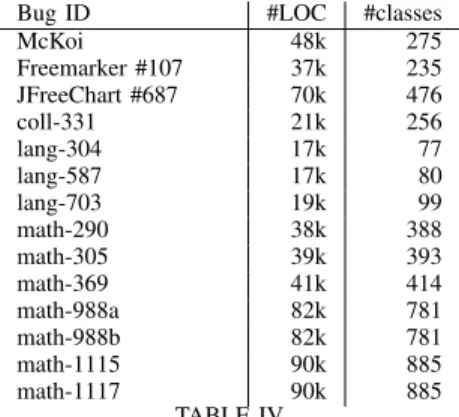
Bug ID #LOC #classes
McKoi 48k 275 Freemarker #107 37k 235 JFreeChart #687 70k 476 coll-331 21k 256 lang-304 17k 77 lang-587 17k 80 lang-703 19k 99 math-290 38k 388 math-305 39k 393 math-369 41k 414 math-988a 82k 781 math-988b 82k 781 math-1115 90k 885 math-1117 90k 885 TABLE IV
DESCRIPTIVESUMMARY OF THEDATASET OFNULLDEREFERENCES
keep only those which have been fixed and which are closed (our experimentation needs the patch). After filters 19 bug reports remain6. Sadly, on those 19 bug reports, 8 are not
relevant for our experiment: 3 are too olds and no commit is attached (COLL-4, LANG-42 and Lang-144), 2 concern Javadoc (COLL-516 and MATH-466), 2 of them are not bugs at all (LANG-87 and MATH-467), 1 concerns a VM problem. Finally, we add the 11 remaining cases to our dataset.
Consequently, the dataset contains the 3 cases from [2] (Mckoi, freemarker and jfreechart) and 11 cases from Apache Commons (1 from collections, 3 from lang and 7 from math). In total, the bugs come from 6 different projects, which is good for assessing the external validity of our evaluation. This makes a total of 14 real life null dereferences bugs in the dataset.
Table III shows the name of the applications, the number
of the bug Id (if existing), a summary of the NPE cause and a summary of the chosen fix. We put only one line for 7 of them because they use the same simple fix (i.e. adding a check not null before the faulty line). The application coverage of the test suites under study are greater than 90% for the 3 Apache common projects (11 out of the 14 cases). For the 3 cases from [2] (Mckoi, freemarker and jfreechart), we do not have access to the full test suites. Table IV gives the main descriptive statistics. For instance, the bug in McKoi is an
6The link to automatically set those filters is given inhttps://github.com/
Spirals-Team/casper
application of 48000+ lines of code spread over 275 classes. This dataset only contains real null dereference bugs and no artificial or toy bugs. To reassure the reader about cherry-picking, we have considered all null dereferenced bugs of the 3 selected projects. We have not rejected a single null dereference that CASPERfails to handle.
B. Methodology
1) Correctness: RQ1: Does our approach provide the
cor-rect causality trace? To assess whether the provided element is responsible for a null dereference, we manually analyze each case. We manually compare the result provided by our technique with those coming from a manual debugging process that is performed using the debug mode of Eclipse.
RQ2: Do the code transformations preserve the semantics of the application?To assert that our approach does not modify the behavior of the application, we use two different strategies. First, we require that the origin program and the transformed program both pass and fail the same tests in the test suite (when it exists). Having the same behavior according to a test suite does not prove semantic equivalence, it is only an indication the program has not been broken. However, this is the only possible technique since current research on formal equivalence is not capable of proving semantic equivalence in a programming language as complex as Java.
This test suite test only addresses the correctness of ex-ternally observable behavior of the program under debug. To assess that our approach does not modify the internal behavior, we compare the execution traces of the original program (prior to code transformation) and the program after transformation. Here, an “execution trace” is the ordered list of all method calls and of all returned values, executing over the entire test suite. This trace is obtained by logging method entry (injecting
package.class\#method( arg.toString \ldots)) and logging return (injecting
package.class\#method():returnedValue.toString). We filter out all calls to the
Casper framework, then align the two traces. They must be identical. As for the test suite, execution trace equivalence is only a proxy to complete equivalence.
2) Effectiveness: RQ3: Is the approach useful with respect to the fixing process? To assert that our additional data is useful, we look at whether the location of the real fix is given in the causality trace. If the location of the actual fix
is provided in the causality trace, it would have helped the developer by reducing the search space of possible solutions. Note that in 7/14 cases of our dataset, the fix location already appears in the original stack trace. Those are the 7 simple cases where a check not null is sufficient to prevent the error. Those cases are valuable in the context of our evaluation to check that: 1) the variable name is given (as opposed to only the line number of a standard stack trace), 2) the causality trace is correct (although the fix location appears in the original stack trace, it does not prevent a real causality trace with several causal connections).
C. Results
1) RQ1: After verification by manual debugging, in all the cases under study, the element identified by our approach is the one responsible for the error. This result can be replicated since our dataset and our prototype software are made publicly available.
2) RQ2: All the test suites have the same external
be-havior with and without our modifications according to our two behavior preservation criteria. First, the test suite after transformation still passes. Second, for each run of the test suite, the order of method calls is the same and the return values are the same. In short, our massive code transformations do not modify the behavior of the program under study and provide the actual causality relationships.
3) RQ3: We now perform two comparisons. First, we look
at whether the fix locations appear in the standard stack traces. Second, we compare the standard stack trace and causality trace to see whether the additional information corresponds to the fix.
Table V presents the fix locations (class and line number) (second column) and whether: this location is provided in the basic stack trace (third column); 2) the location is provided by previous work [2] (fourth column); 3) it is in the causality trace (last column). The first column, “# Bug Id”, gives the id of the bug in the bug tracker of the project (same as Table
III).
In 7 out of 14 cases (the 7 simple cases), the fix location is in the original stack trace. For those 7 cases, the causality trace is correct and also points to the fix location. In comparison to the original stack trace, it provides the name of the root cause variable.
In the remaining 7 cases, the fix location is not in the original stack trace. This means that in 50% of our cases, there is indeed a cause/effect chasm, that is hard to debug [4], because no root cause information is provided to the developer by the error message. We now explain in more details those 7 interesting cases.
The related work [2] would provide the root cause in
only 1 out of those 7 cases (according to an analysis, since their implementation is not executable). In comparison, our approach provides the root cause in 4 out of those 7 cases. This supports the claim that our approach is able to better help the developers in pinpointing the root cause compared to the basic stack trace or the related work.
4) Detailed Analysis:
1
2 private staticCluster<T> getNearestCluster(finalCollection<Cluster> clusters,final
T point) {
3 doubleminDistance = Double.MAX_VALUE;
4 Cluster<T> minCluster =null;//initialisation
5 for(finalCluster<T> c : clusters) {
6 final doubledistance = point.distanceFrom(c.getCenter());//return NaN
7 if(distance < minDistance) {//failing condition
8 minDistance = distance;
9 minCluster = c;
10 }
11 }
12 returnminCluster;//return null
13 }
Listing 5. An excerpt of Math #305 where the causality trace does not contain the fix location.
a) Case Studies: There are two different reasons why our approach does not provide the fix location: First, for one case, our approach is not able to provide a causality trace. Second, for two cases, the root cause of the null dereference is not the root cause of the bug.
In the case of Math #290, our approach is not able to provide the causality trace. This happens because the null value is stored in an Integer, which is a final type coming from the jdk. Indeed, java.lang.Integer is a native Java type and our approach
cannot modify them (seeparagraph II-E0c).
In the case of Math #305, the root cause of the null dereference is not the root cause of the bug. The root cause
of this null dereference is shown in Listing 5. The null
responsible of the null dereference is initialized on line 4, the method call distanceFrom on line 6 return NaN, due to this NaN, the condition on line 7 fails, and the null value is returned (line 9). Here, the cause of the dereference is that a null value is returned by this method. However, this is the root cause of the null but this is not the root cause of the bug. The root cause of the bug is the root cause of the NaN. Indeed, according to the explanation and the fix given by the devel-oper the call point.distanceFrom(c.getCenter()) should not return NaN. Hence, the fix of this bug is in the distanceFrom method, which does not appear in our causality chain because no null is involved.
In the case of Math #1117, the root cause of the null dereference is not the root cause of the bug. The root cause
of this null dereference is shown in Listing 6. The null
responsible of the dereference is the one passed as second parameter of the constructor call on line 10. This null value is stored in the field minusof this SplitSubHyperplane. Here,
the cause of the dereference is that a null value is set in a field of the object returned by this method. Once again, this is the root cause of the null but this is not the root cause of the bug. The root cause of the bug is the root cause of the failing condition global < −1.0e−10. Indeed, according to the
explanation and the fix given by the developer the Hyperplane passed as method parameter should not exist if its two lines are too close from each other. Here, this Hyperplane comes from a field of a PolygonSet. On the constructor of this PolygonSet they pass a null value as a parameter instead of this “irregular” object. To do that, they add a condition based on a previously existing parameter called tolerance, if the distance of the two lines are lower than this tolerance, it returns a null value.
# Bug Id Fix location Fix location in the standard stack trace
Addressed by [2] Fix location in CASPER’s causality trace
Causality Trace Exec. time instru-mented (ms)
McKoi Not fixed No No Yes L-A-R-A-D 382
Freemarker #107 Not fixed No Yes Yes L-A-D 691
JFreeChart #687 FastScatterPlot 178 No No Yes L-Pe-Pi-D 222 collection #331 CollatingIterator 350 No No Yes L-A-D 81 math #290 SimplexTableau 106/125/197 No No No D 107
math #305 MathUtils 1624 No No No L-R-A-R-D 68
math #1117 PolygonSet 230 No No No L-A-R-A-D 191
7 simple cases Yes Yes Yes L-A-D (x6)
L-A-U
147 (average)
Total 7 / 14 8/14 11/14
TABLE V
EVALUATION OFCASPER:IN13/14CASES,A CAUSALITY TRACE IS GIVEN,IN11/13THE CAUSALITY TRACE CONTAINS THE LOCATION WHERE THE ACTUAL FIX WAS MADE.
1
2 publicSplitSubHyperplane split(Hyperplane hyperplane) {
3 Line thisLine = (Line) getHyperplane();
4 Line otherLine = (Line) hyperplane;
5 Vector2D crossing = thisLine.intersection(otherLine);
6 if(crossing ==null) {// the lines are parallel
7 doubleglobal = otherLine.getOffset(thisLine);
8 return(global < −1.0e−10) ?
9 newSplitSubHyperplane(null,this) :
10 newSplitSubHyperplane(this,null);// initialisation
11 }
12 ...
13 }
Listing 6. An excerpt of Math #1117 where the causality trace does not contain the fix location.
(It is interesting that the fix of a null dereference is to return a null value elsewhere.)
b) Size of the Traces: There are mainly two kind of
traces encountered in our experiment. First, the one of size 3 and of kind L-A-D type. The 7 obvious cases (were the fix location is in the stack trace) contains 6 traces of this kind. In all those cases encountered in our experiment, the null literal has been assigned to a field. This means that a field has not been initialized (or initialized to null) during the instance creation, hence, this field is dereferenced latter. This kind of trace is pretty short so one may think that this case is obvious. However, all of those fields are initialized long ago the dereference. In other words, when the dereference occurs, the stack has changed and no longer contains the information of the initialization location.
Second, the one of size ≤ 4 where the null is stored in a variable then passed as argument in one or multiple methods. In all those case, the null value is either returned by a method at least once or passed as a parameter.
c) Execution Time: To debug a null dereference error,
CASPER requires to instrument the code and to run the instrumented version. In all the cases, the instrumentation time
is less 30 seconds. At runtime, CASPER finds the causility
trace of the failing input in less than 1 second (last column of TableV). This seems reasonable from the developer viewpoint: she obtain the causality trace in less than 30 seconds. We have also measured the overhead with respect the original test case trigerring the error: it’s a 7x increase.
IV. DISCUSSION
A. Causality Trace and Patch
Once the causality trace of a null dereference is known, the developer can fix the dereference. There are two basic dimensions for fixing null references based on the causality trace.
First, the developer has to select in the causal elements, the location where the fix should be applied: it is often at the root cause, i.e. the first element in the causality trace. It may be more appropriate to patch the code elsewhere, in the middle of the propagation between the first occurrence of the null and the dereference error.
Second, the developer has to decide whether there should be an object instead of null or whether the code should be able to gracefully handle the null value. In the first case, the developer fixes the bug by providing an appropriate object instead of the null value. In the second case, she adds a null check in the program to allow a null value.
Sometimes, the fix for a null dereference will be an inser-tion of a missing statement or the correcinser-tion of an existing conditional. In this case, the CASPERcausality trace does not contain the exact location of the fix. However, as in the case of bug Math #290 that we have discussed, it is likely that those modifications will be made in the methods involved in the causality trace. According to our experience, those cases are uncommon but future work is required to validate this assumption.
B. Use in Production
As shown in Section III-C4c, the overhead of the current implementation is too large to be used in production. We are confident that advanced optimization can reduce this overhead. This is left to future work.
C. Threats to Validity
The internal validity of our approach and implementation has been assessed through RQ1 and RQ2: the causality trace of the 14 analyzed errors is correct after manual analysis. The threat to the external validity lies in the dataset composition:
does the dataset reflect the complexity of null dereference errors in the field? To address this threat, we took a special care in designing the methodology to build the dataset. It ensures that the considered bugs apply to large scale software and are annoying enough to be reported and commented in a bug repository. The generalizability of our results to null dereference errors in other runtime environments (e.g. .NET; Python) is an open question to be addressed by future work.
V. RELATEDWORK
There are several static techniques to find possible null dereference bugs. Hovemeyer et al. [6] use byte-code analysis to provide possible locations where null dereference may happen. Sinha et al. [14] use source code path finding to find the locations where a bug may happen and apply the technique to localize Java null pointer exceptions symptom location. Spoto [15] devises an abstract interpretation dedicated to null dereferences [15]. Ayewah and Pugh [1] discussed the problems of null dereference warnings that are false positives. Compared to these works, our approach is dynamic and instead of predicting potential future bugs that may never happen in production, it gives the root cause of actual ones for which the developer has to find a fix.
Dobolyi and Weimer [3] present a technique to tolerate null dereferences based on the insertion of well-typed default val-ues to replace the null value which is going to be dereferenced. Kent [7] goes further and, proposes two other ways to tolerate a null dereference: skipping the failing instruction or returning a well-typed object to the caller of the method. In the opposite, our work is not on tolerating runtime null dereference but on giving advanced debugging information to the developer to find a patch.
The idea of identifying the root cause in a cause effect chain has been explored by Zeller [19]. In this paper, he compares the memory graph from the execution of two versions of a same program (one faulty and one not faulty) to extract the instructions and the memory values which differ and presumably had lead to the error. This idea has bee further extended by Sumner and colleagues [16], [17]. Our problem statement is different, those approaches takes as input two different versions of the program or two different runs and compare them. On the contrary, we build the causality trace from a single execution.
The Linux kernel employs special values, called poison pointers, to transform certain latent null errors into fail-fast errors [13]. They share with null ghosts the idea of injecting special values into the execution stream to aid debugging and, by failing fast, to reduce the width of the cause/effect chasm. However, poison values only provide fail-fast behavior and do not provide causality traces or even a causal relationship as we do.
Romano et al. [12] find possible locations of null derefer-ences by running a genetic algorithm to exercise the software. If one is found, a test case that demonstrate the null deref-erence is provided. Their technique does not ensure that the null dereferences found are realistic and represent production problem. On the contrary, we tackle null dereferences for which the programmer has to find a fix.
Wang et al. [18] describe an approach to debug memory
errors in C code. What they call “value propagation chain” corresponds to our causality traces. They don’t provide a
taxonomy of causal elements as we do in Table I and they
take a great care of pointer arithmetic, which is irrelevant in our case.. Their transformations are at the level of x86 code using dynamic instrumentation, while we work on Java source code. This makes a major difference: all the transformations we have described are novel, and cannot be inferred or derived from Wang et al.’s work.
Bond et al. [2] present an approach to dynamically provide information about the root cause of a null dereference (i.e. the line of the first null assignment). The key difference is that we provide the complete causality trace of the error and not only the first element of the causality trace. As discussed in the evaluation (Section III), the actual fix of many null dereference bugs is not necessary done at the root cause, but somewhere up in the causality trace.
Like null ghosts, the null object pattern replaces nulls with objects whose interface matches that of the null-bound variable’s type. Unlike null ghosts, the methods of an instance of the null object pattern are empty. Essentially, the null object pattern turns method NPEs into NOPs. To this extent, the refactoring proposed by [5], does not help to debug null dereferences but avoids some of them. In contrast, null ghosts collect null dereference causality traces that allow a developer to localize and resolve an NPE.
VI. CONCLUSION
In this paper, we have presented CASPER, a novel approach for debugging null dereference errors. The key idea of our technique is to inject special values, called “null ghosts” into the execution stream to aid debugging. The null ghosts collect the history of the null value propagation between its first detection and the problematic dereference, we call this his-tory the ‘causality trace”. We define 11 code transformations responsible for 1) detecting null values at runtime, 2) collect causal relations and enrich the causality traces; 3) preserve the execution semantics when null ghosts flow during program execution. The evaluation of our technique on 14 real-world null dereference bugs from large-scale open-source projects
shows that CASPER is able to provide a valuable causality
trace. Our future work consists in further exploring the idea of “ghost” for debugging other kinds of runtime errors such as arithmetic overflows.
REFERENCES
[1] N. Ayewah and W. Pugh. Null dereference analysis in practice. In Proceedings of the Workshop on Program Analysis for Software Tools and Engineering, pages 65–72. ACM, 2010.
[2] M. D. Bond, N. Nethercote, S. W. Kent, S. Z. Guyer, and K. S. McKinley. Tracking bad apples: reporting the origin of null and undefined value errors. ACM SIGPLAN Notices, 42(10):405–422, 2007. [3] K. Dobolyi and W. Weimer. Changing java’s semantics for handling null pointer exceptions. In Software Reliability Engineering, 2008. ISSRE 2008. 19th International Symposium on, pages 47–56. IEEE, 2008. [4] M. Eisenstadt. My hairiest bug war stories. Communications of the
ACM, 40(4):30–37, 1997.
[5] M. A. G. Gaitani, V. E. Zafeiris, N. Diamantidis, and E. Giakoumakis. Automated refactoring to the null object design pattern. Information and Software Technology, 59:33–52, 2015.
[6] D. Hovemeyer, J. Spacco, and W. Pugh. Evaluating and tuning a static analysis to find null pointer bugs. In ACM SIGSOFT Software Engineering Notes, volume 31, pages 13–19. ACM, 2005.
[7] S. W. Kent and K. Mckinley. Dynamic error remediation: A case study with null pointer exceptions. 2008.
[8] S. Kimura, K. Hotta, Y. Higo, H. Igaki, and S. Kusumoto. Does return null matter? In IEEE Conference on Software Maintenance, Reengineering and Reverse Engineering (CSMR-WCRE), pages 244– 253, 2014.
[9] Z. Li, L. Tan, X. Wang, S. Lu, Y. Zhou, and C. Zhai. Have things changed now?: an empirical study of bug characteristics in modern open source software. In Proceedings of the 1st workshop on Architectural and system support for improving software dependability, pages 25–33. ACM, 2006.
[10] Z. Merali. Computational science: Error, why scientific programming does not compute. Nature, 467(7317):775–777, 2010.
[11] R. Pawlak, M. Monperrus, N. Petitprez, C. Noguera, and L. Seinturier. Spoon v2: Large scale source code analysis and transformation for java. Technical Report hal-01078532, INRIA, 2006.
[12] D. Romano, M. Di Penta, and G. Antoniol. An approach for search based testing of null pointer exceptions. In Software Testing, Verification and Validation (ICST), 2011 IEEE Fourth International Conference on, pages 160–169. IEEE, 2011.
[13] A. Rubini and J. Corbet. Linux device drivers. O’Reilly Media, Inc., 2001.
[14] S. Sinha, H. Shah, C. Görg, S. Jiang, M. Kim, and M. J. Harrold. Fault localization and repair for java runtime exceptions. In Proceedings of the eighteenth international symposium on Software testing and analysis, pages 153–164. ACM, 2009.
[15] F. Spoto. Precise null-pointer analysis. Software & Systems Modeling, 10(2):219–252, 2011.
[16] W. Sumner and X. Zhang. Algorithms for automatically computing the causal paths of failures. In Fundamental Approaches to Software Engineering, pages 355–369, 2009.
[17] W. Sumner and X. Zhang. Comparative causality: Explaining the differences between executions. In Proceedings of the International Conference on Software Engineering, pages 272–281, 2013.
[18] Y. Wang, I. Neamtiu, and R. Gupta. Generating sound and effective memory debuggers. In ACM SIGPLAN Notices, volume 48, pages 51– 62. ACM, 2013.
[19] A. Zeller. Isolating cause-effect chains from computer programs. In Proceedings of the 10th ACM SIGSOFT symposium on Foundations of software engineering, pages 1–10. ACM, 2002.