Publisher’s version / Version de l'éditeur:
Vous avez des questions? Nous pouvons vous aider. Pour communiquer directement avec un auteur, consultez la première page de la revue dans laquelle son article a été publié afin de trouver ses coordonnées. Si vous n’arrivez pas à les repérer, communiquez avec nous à [email protected].
Questions? Contact the NRC Publications Archive team at
[email protected]. If you wish to email the authors directly, please see the first page of the publication for their contact information.
https://publications-cnrc.canada.ca/fra/droits
L’accès à ce site Web et l’utilisation de son contenu sont assujettis aux conditions présentées dans le site LISEZ CES CONDITIONS ATTENTIVEMENT AVANT D’UTILISER CE SITE WEB.
Proceedings of the National Academy of Sciences, 117, 46, pp. 28708-28718,
2020-10-30
READ THESE TERMS AND CONDITIONS CAREFULLY BEFORE USING THIS WEBSITE.
https://nrc-publications.canada.ca/eng/copyright
NRC Publications Archive Record / Notice des Archives des publications du CNRC :
https://nrc-publications.canada.ca/eng/view/object/?id=af82caf2-6edb-4003-bfc1-7611e0572803
https://publications-cnrc.canada.ca/fra/voir/objet/?id=af82caf2-6edb-4003-bfc1-7611e0572803
NRC Publications Archive
Archives des publications du CNRC
This publication could be one of several versions: author’s original, accepted manuscript or the publisher’s version. / La version de cette publication peut être l’une des suivantes : la version prépublication de l’auteur, la version acceptée du manuscrit ou la version de l’éditeur.
For the publisher’s version, please access the DOI link below./ Pour consulter la version de l’éditeur, utilisez le lien DOI ci-dessous.
https://doi.org/10.1073/pnas.2009418117
Access and use of this website and the material on it are subject to the Terms and Conditions set forth at
Copy number variation of TdDof controls solid-stemmed architecture in
wheat
Nilsen, Kirby T.; Walkowiak, Sean; Xiang, Daoquan; Gao, Peng; Quilichini,
Teagen D.; Willick, Ian R.; Byrns, Brook; N’Diaye, Amidou; Ens, Jennifer;
Wiebe, Krystalee; Ruan, Yuefeng; Cuthbert, Richard D.; Craze, Melanie;
Wallington, Emma J.; Simmonds, James; Uauy, Cristobal; Datla, Raju;
Pozniak, Curtis J.
Copy number variation of TdDof controls
solid-stemmed architecture in wheat
Kirby T. Nilsena,b, Sean Walkowiaka,c, Daoquan Xiangd, Peng Gaoe, Teagen D. Quilichinid, Ian R. Willicka, Brook Byrnsa, Amidou N’Diayea, Jennifer Ensa, Krystalee Wiebea, Yuefeng Ruanf, Richard D. Cuthbertf, Melanie Crazeg, Emma J. Wallingtong, James Simmondsh, Cristobal Uauyh, Raju Datlae,
and Curtis J. Pozniaka,1
aCrop Development Centre and Department of Plant Sciences, College of Agriculture and Bioresources, University of Saskatchewan, Saskatoon, SK S7N 5A8, Canada;bBrandon Research and Development Centre, Agriculture and Agri-Food Canada, Brandon, MB R7A 5Y3, Canada;cGrain Research Laboratory, Canadian Grain Commission, Winnipeg, MB R3C 3G8, Canada;dAquatic and Crop Resource Development Research Centre, National Research Council Canada, Saskatoon, SK S7N 0W9, Canada;eGlobal Institute for Food Security, University of Saskatchewan, Saskatoon, SK S7N 4J8, Canada;fSwift Current Research and Development Centre, Agriculture and Agri-Food Canada, Swift Current, SK S9H 3X2, Canada;gNIAB, Cambridge CB3 OLE, United Kingdom; andhJohn Innes Centre, Norwich NR4 7UH, United Kingdom
Edited by James A. Birchler, Division of Biological Sciences, University of Missouri, Columbia, MO, and approved September 23, 2020 (received for review May 14, 2020)
Stem solidness is an important agronomic trait of durum (Triticum turgidum L. var. durum) and bread (Triticum aestivum L.) wheat that provides resistance to the wheat stem sawfly. This dominant trait is conferred by the SSt1 locus on chromosome 3B. However, the molecular identity and mechanisms underpinning stem solid-ness have not been identified. Here, we demonstrate that copy number variation of TdDof, a gene encoding a putative DNA bind-ing with one fbind-inger protein, controls the stem solidness trait in wheat. Using map-based cloning, we localized TdDof to within a physical interval of 2.1 Mb inside the SSt1 locus. Molecular analysis revealed that hollow-stemmed wheat cultivars such as Kronos carry a single copy of TdDof, whereas solid-stemmed cultivars such as CDC Fortitude carry multiple identical copies of the gene. Dele-tion of all TdDof copies from CDC Fortitude resulted in the loss of stem solidness, whereas the transgenic overexpression of TdDof restored stem solidness in the TdDof deletion mutant pithless1 and conferred stem solidness in Kronos. In solid-stemmed cultivars, increased TdDof expression was correlated with the down-regulation of genes whose orthologs have been implicated in programmed cell death (PCD) in other species. Ana-tomical and histochemical analyses revealed that hollow-stemmed lines had stronger PCD-associated signals in the pith cells com-pared to solid-stemmed lines, which suggests copy number-dependent expression of TdDof could be directly or indirectly in-volved in the negative regulation of PCD. These findings provide opportunities to manipulate stem development in wheat and other monocots for agricultural or industrial purposes.
solid stem
|
wheat|
copy number variation (CNV)|
Dof transcription factor|
programmed cell death (PCD)W
heat is the world’s most widely grown crop, with annual global production of∼750 million metric tons (1). The two most commonly grown types are bread wheat (Triticum aestivum L.) used for bread making and biscuits, and durum wheat (Tri-ticum turgidum L. var. durum) used to produce pasta and cous-cous. Wheat consumption accounts for∼20% of the protein and calories consumed by humans (1). By 2050, the demand for wheat is predicted to increase by 50% to sustain a global pop-ulation projected to surpass 9 billion people (1). Wheat pro-duction is threatened by the changing climate, which is expected to produce more severe and prolonged periods of extreme weather events such as heat, drought, and cold. Continuously evolving pathogen and insect populations also threaten wheat production on a global scale. A better understanding of the key genes involved in the physiological traits of wheat, including genes controlling stem development, will help breeders develop resilient cultivars equipped for these challenges to secure sus-tainable global food production.The wheat stem supports the leaves and grain-yielding inflo-rescence (spike), transporting water and minerals from the soil to the aboveground portions of the plant via the interconnected cells that form the xylem (2). Photoassimilates from source tis-sues are translocated through the stem phloem to sink tistis-sues. Water-soluble carbohydrates (WSC), and, to a lesser degree, starch, are stored in the stem and are later remobilized during grain filling (3). Fructan, the primary carbon storage molecule in the wheat stem, accumulates during periods of slow growth or when photosynthetic rates exceed sink tissue demands (4). The remobilization of water and WSC from the stem to the devel-oping grain not only increases grain yield but also provides protection under moisture deficit (5, 6).
The wheat stem is divided into nodes to which the leaf sheaths are attached, and the regions between nodes are known as in-ternodes. Between four and seven internodes elongate from a single internode primordium, depending on genetic and envi-ronmental factors (2). Stem elongation is a developmentally
Significance
Solid-stemmed wheat cultivars are resistant to the wheat stem sawfly, an important agricultural pest. Here, we identify TdDof as the causal gene that controls stem solidness in wheat. We show that copy number gain of TdDof correlates with its in-creased expression and the solid-stem phenotype. Our results suggest TdDof could function as a key regulator of genes in-volved in programmed cell death of the pith parenchyma cells. This research provides the framework to manipulate stem ar-chitecture in wheat and other monocots, which can be applied toward downstream agricultural and industrial applications. These include enhancing wheat stem sawfly resistance, modi-fying carbon partitioning and water-soluble carbohydrate remobilization in plants under drought and temperature stress, and bioenergy production.
Author contributions: K.T.N., S.W., R.D., and C.J.P. designed research; K.T.N., S.W., D.X., P.G., T.D.Q., I.R.W., B.B., A.N., J.E., K.W., Y.R., R.D.C., M.C., E.J.W., J.S., C.U., R.D., and C.J.P. performed research; K.T.N., S.W., D.X., P.G., T.D.Q., B.B., J.E., K.W., M.C., and E.J.W. con-tributed new reagents/analytic tools; K.T.N., S.W., D.X., P.G., T.D.Q., I.R.W., B.B., J.E., K.W., Y.R., M.C., and E.J.W. analyzed data; K.T.N., S.W., P.G., and T.D.Q. wrote the paper; and R.D. and C.J.P. supervised the research.
The authors declare no competing interest. This article is a PNAS Direct Submission.
This open access article is distributed underCreative Commons Attribution License 4.0 (CC BY).
1To whom correspondence may be addressed. Email: [email protected].
This article contains supporting information online athttps://www.pnas.org/lookup/suppl/ doi:10.1073/pnas.2009418117/-/DCSupplemental.
regulated process that begins from one of the lowermost nodes and progresses in succession upward toward the peduncle, which elongates last to support the spike. The intercalary meristem near the base of each internode gives rise to ground tissue comprising parenchyma cells, which differentiate to form the pith, and vascular strands that subsequently differentiate into vascular tissues surrounded by the cortex. In mature wheat stems, vascular bundles are separated by a layer of interfascicular parenchyma cells arranged in a ring surrounding a central cavity (internodal lacuna), which is formed by the collapse and break-down of parenchyma cells that form the pith and causes the stems to become hollow (2). Pith is composed of undifferentiated parenchyma cells, which play important roles in water and WSC (i.e., sucrose, glucose, fructose, and fructan) storage (7). In moisture-limiting environments, the water-holding capacity of the pith parenchyma is proposed to be an important driver of drought and heat tolerance (8).
In some wheat cultivars, stem development has been reprog-rammed to avoid the formation of a hollow stem. The main genetic factor conferring stem solidness resides within a major quantitative trait locus on chromosome 3B in durum (SSt1) and bread wheat (Qss.msub-3BL), hereafter referred to as SSt1 (9–11). The underlying gene, however, has not been identified. Several sources have been used to introduce stem solidness into elite breeding lines, including the commonly used Portuguese wheat landrace S-615 for bread wheat (12), and the German cultivar Biodur for durum wheat (13, 14). The trait in durum wheat is thought to have originated in the North African land-race Golden Ball. In all of these cultivars, the culm becomes partially or completely filled with pith (7).
The wheat stem sawfly (WSS) Cephus cinctus Norton (Hy-menoptera: Cephidae) is a major pest in nearly the entire durum wheat-growing region of North America. Initially considered to be a pest of wild grasses, WSS developed a strong preference for wheat during the rapid expansion of this crop across the North American prairies beginning in the late 19th century (15). The ability of WSS to adapt to host preferences and thrive in new agroecological environments poses a risk to the geographical expansion of wheat that is expected to occur due to climate change. As sawfly populations also exist in Asia and Europe, they could pose a significant threat to wheat production if a similar shift in host preference were to occur (16). In North America, harvest losses attributed to WSS are estimated to exceed $350 million per year (15). Over the last century, the most effective way to minimize damage caused by WSS has been to grow solid-stemmed wheat cultivars (17). Solid stems provide resistance to WSS by deterring oviposition, and impeding larval development and growth inside the stem (18).
In the current study, we generate molecular and functional evidence that TdDof is the causal gene modulating stem solid-ness in wheat. Solid-stemmed cultivars carry multiple copies of TdDof, which correspond to its higher expression levels and the solid-stemmed phenotype. Our findings provide insight into pu-tative TdDof-mediated regulatory functions associated with solid-stemmed architecture in wheat that may include regulation of key genes involved in programmed cell death (PCD). In ad-dition, our results lay the foundation for developing genetic markers for screening and selecting desirable alleles for breeding wheat cultivars with the stem solidness trait.
Results
Fine Mapping of the SSt1 Genomic Interval.To narrow the genomic and genetic interval of SSt1, we performed fine mapping using an F2population derived from a cross between durum (tetraploid) lines Kofa (hollow-stemmed) and W9262-260D3 (solid-stemmed) with markers designed to target the SSt1 region (SI Appendix, Table S1). Of 4,000 F2 lines examined, 24 critical recombinants were identified between flanking markers ek08_5169 and gwm247 (11).
These lines were subsequently evaluated for stem solidness at maturity and used to position the SSt1 gene on the physical map (Fig. 1A). The closest flanking markers to SSt1 were usw306 and usw308, which were anchored to physical positions 828.5 and 830.6 Mb, respectively, on chromosome arm 3BL in the durum wheat reference genome assembly of the cultivar Svevo (19). This allowed us to further narrow the previously identified in-terval from 13 Mb (11) to 2.1 Mb (Fig. 1A). Within this inin-terval, 42 protein-coding genes are annotated in the Svevo genome (SI Appendix, Table S2).
Copy Number Variation of a Putative Dof Transcription Factor (TdDof) Is Associated with Stem Solidness in Wheat.To identify candidate genes within the SSt1 fine-mapping interval, we generated an ethyl methanesulfonate mutant population derived from the solid-stemmed cultivar CDC Fortitude, which led to the selec-tion of a hollow-stemmed mutant line “pithless1.” pithless1 was the only identified mutant exhibiting a complete loss of pheno-typic expression of stem solidness. Within the SSt1 region in pithless1, a large deletion spanning 673.9 kb was detected via coverage analysis of short-read Chromium whole genome se-quencing (10× Genomics). This sese-quencing platform provides long-range information through short reads by incorporating barcode oligos (GemCode) from the originating DNA segment, thereby providing increased power to detect structural variants. The deletion in pithless1 was validated by the presence of GemCode molecule associations between both ends of the de-letion breakpoints (Svevo 3B positions 828,608,858 and 829,282,758 Mb) (Fig. 1B). The deletion contains 11 protein-coding genes, which are annotated to encode the following proteins: a Werner syndrome-like exonuclease, disease resis-tance protein RPM1, vacuolar protein sorting protein 25, two metallothioneins, plant invertase/pectin methylesterase inhibitor superfamily protein G, 30S ribosomal protein S17, 30S ribosomal
protein S19, SANT domain-containing protein 2 G,
very-long-chain (3R)-3-hydroxyacyl-CoA dehydratase, and a Dof zinc finger protein (TdDof) (SI Appendix, Table S2). The hollow-stemmed phenotype of pithless1 and the deletion of these 11 genes suggest that the molecular determinant responsible for SSt1 is located within this region.
In contrast to our observations in pithless1, we identified an increase in read coverage within the SSt1 interval spanning a
34.8-kb interval (Svevo 3B positions: 829,118,858 and
829,153,686 Mb) in the solid-stemmed lines CDC Fortitude and W9262-260D3, indicating that additional copies of this segment are present in each of these lines (Fig. 1B). Importantly, this region of copy number variation (CNV) contains only one gene (TRITD3Bv1G280530) in Svevo that encodes a putative Dof zinc finger protein (TdDof) and is one of the 11 deleted genes in the pithless1 mutant (SI Appendix, Table S2). Analysis of the Gem-Code molecule associations spanning this region in CDC Forti-tude and W9262-260D3 indicated that all copies of TdDof are arranged in tandem (Fig. 1 B and C). In contrast, visualization of the read data for the hollow-stemmed lines Svevo and Kofa in-dicated that a single copy of the region containing TdDof is present in these lines (Fig. 1B). The overlap between the deleted region in pithless1 and the CNV in solid-stemmed lines supports TdDof as a strong candidate for SSt1.
Solid-Stemmed Cultivars Carry Three Identical Copies of TdDof.To resolve the TdDof CNV region in solid-stemmed lines, we per-formed targeted sequencing and assembly of the region in CDC Fortitude following a modified CRISPR-Cas9 protocol from Oxford Nanopore Technologies. The reason we chose this ap-proach was twofold; first, to fully resolve the tandem copies of TdDof, ultralong reads that span the CNV breakpoints are re-quired, and, second, because of the size of the wheat genome, targeted sequencing of the TdDof region was a more efficient
AGRIC
ULTURAL
SCIENC
Fig. 1. CNV of TdDof is associated with stem solidness in wheat. (A) Fine-map interval of SSt1 in the Kofa/W9262-260D3 F2population. The region between closest flanking markers usw306 and usw308 is shown in blue. (B) Chromium read coverage plots within the SSt1 interval on chromosome 3B of five durum lines. The y axis of each coverage plot denotes the minimum and maximum read coverage for each line within the interval. GemCode molecule associations spanning structural variants are indicated by the green bars (CDC Fortitude, W9262-260D3) and red bar (pithless1). Positions are in megabases. (C) Diagram showing the organization of the TdDof CNV region in CDC Fortitude (solid-stemmed) and Kofa (hollow-stemmed) with CNV breakpoints indicated by the black bars. Three copies of TdDof (TdDof1-3) are present in CDC Fortitude vs. a single copy in Kofa. At the CNV breakpoint between TdDof1-2 and TdDof2-3, a unique 25-bp insertion is present that is only found in solid-stemmed cultivars. (D) High-throughput KASP (kompetitive allele-specific PCR) marker usw275 accurately distinguishes stems that are hollow (red) and solid (blue) in both bread and durum wheat.
strategy. We generated an assembly of 230,823 base pairs (bp) that contained three copies of TdDof (TdDof1–3; SI Appendix, Fig. S1A), confirming the presence of two additional copies of TdDof in CDC Fortitude arranged in tandem orientation, each with an identical upstream putative regulatory region (Fig. 1C and SI Appendix, Fig. S1 A and B). A unique 25-bp insertion
sequence (AGATGTCTTAGAACGTCGTCTTAGA) was
identified at the insertion breakpoint between TdDof1 and TdDof2and between TdDof2and TdDof3that was not present in any of the hollow-stemmed lines examined (Fig. 1C andSI Ap-pendix, Fig. S1B). We used Droplet Digital PCR (ddPCR), which provides absolute quantification of target DNA or RNA mole-cules, to confirm the presence of three copies of TdDof and two copies of the unique 25-bp insertion in CDC Fortitude compared to the single copy of TdDof in Kofa and no copies of the insertion sequence (SI Appendix, Fig. S1C). We also developed a domi-nant PCR marker to detect the CNV region and validated it in three lines derived from common representative sources of stem solidness: Golden Ball, Biodur, and S-615 (SI Appendix, Fig. S1D). These results suggest that increased copy number of TdDof is associated with the SSt1 solid-stem phenotype.
TdDof is located between positions 829,151,607 and
829,152,953 on chromosome 3B in the Svevo reference genome (SI Appendix, Table S2). The gene contains two exons and one intron (SI Appendix, Fig. S2), and the coding sequence (CDS) of 1,134 nucleotides encodes a predicted protein of 377 amino acids (SI Appendix, Fig. S2). The predicted protein sequence encoded by TdDof is identical between hollow- and solid-stemmed lines. In solid-stemmed lines, each TdDof copy (TdDof1–3) encodes an identical protein. The predicted protein contains a zinc finger Dof domain (IPR003851) between amino acid residues 110 and 164 (SI Appendix, Fig. S2). The Dof domain is a highly conserved DNA-binding domain that is specific to a family of transcription factors observed in vascular plant species.
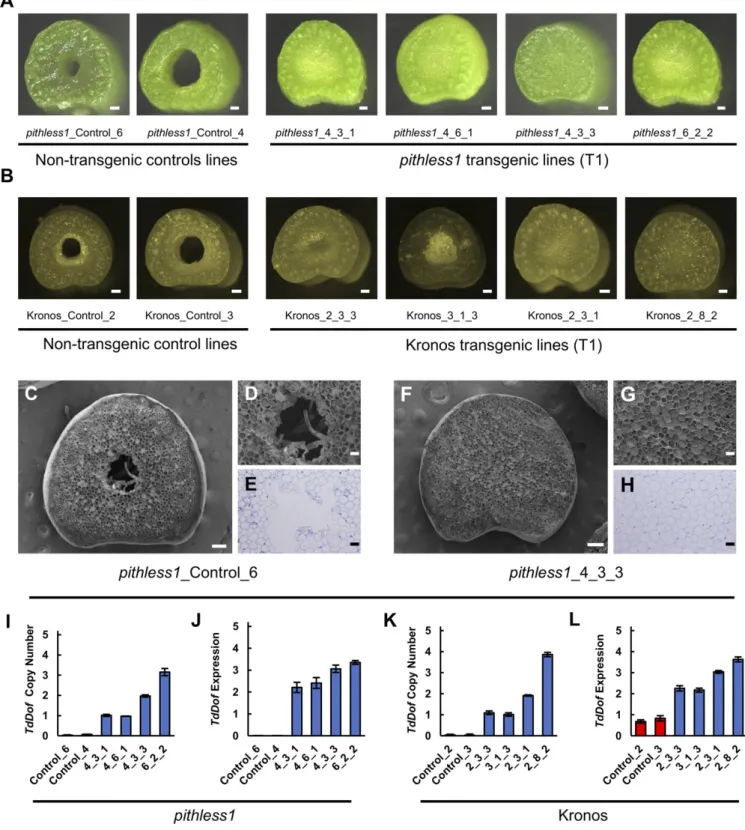
Overexpression of TdDof Induces Stem Solidness in Kronos and pithless1. To investigate the phenotypic effects of increased TdDof gene expression, we generated a series of independent transgenic lines in the hollow-stemmed wheat lines pithless1 and Kronos that overexpress the TdDof CDS under control of the rice ACTIN promoter. All T0lines were analyzed for nptII copy number to confirm the presence of the TdDof transgenic con-struct. Both the pithless1 and Kronos controls regenerated from calli carried 0 transgene copies, whereas the transgenic lines carried between 1 and 4+ copies of the TdDof construct (SI Appendix, Table S3). For the pithless1-derived transgenic plants, 9 out of 10 T0lines had the maximum level of stem solidness, in contrast to the pithless1 control which had hollow stems (SI Appendix, Table S3). For the Kronos-derived transgenic plants, 27 out of 30 T0lines had stems that were solid compared to the Kronos control, which had hollow stems (SI Appendix, Table S3). To further validate these observations, we advanced the T0 plants in both backgrounds to the T1generation. Homozygous T1 plants were phenotypically similar to the controls, except for the accumulation of pith. Some variation in the color of pith was observed between transgenic lines, which ranged between green and white. Importantly, the T1 progeny maintained the stem solidness phenotype that was observed in the T0generation (Fig. 2 A–H). The increased copy number of the TdDof constructs in the transgenic lines was associated with increased TdDof transcript levels (Fig. 2 I–L). Therefore, overexpressing TdDof in two inde-pendent genetic backgrounds (Kronos and the pithless1 mutant) resulted in stem solidness, providing strong evidence that TdDof is the SSt1 locus is a causal genetic factor of stem solidness.
Gene Expression Signatures Identify Candidate Pathways Involved in TdDof-Mediated Stem Solidness.We performed gene expression profiling of six durum wheat lines with hollow- and solid-stemmed
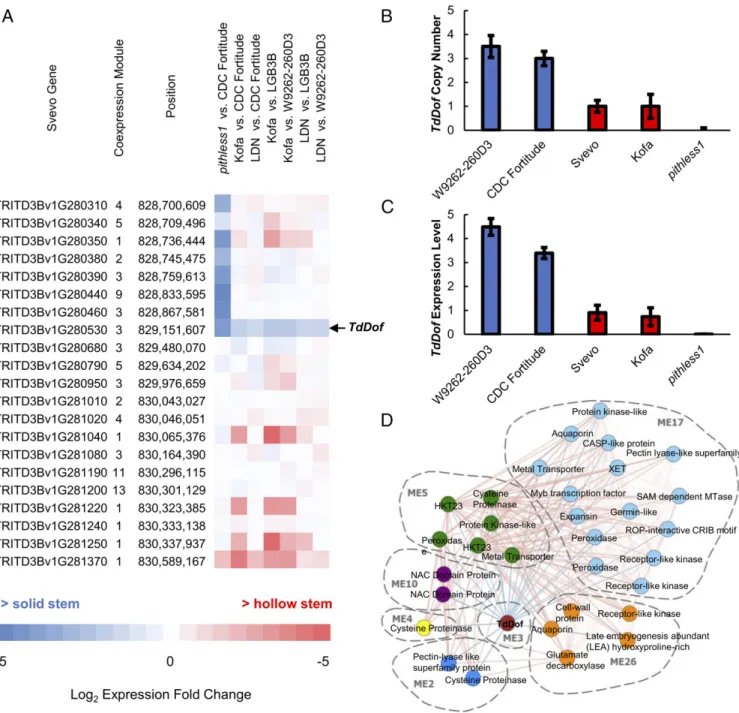
types to identify differentially expressed genes (DEGs) during early internode elongation (Zadoks stage 32). This is typically when the first sign of pith breakdown begins to appear in hollow-stemmed cultivars. The experiment was performed in three replications for each line. Within the SSt1 interval, 21 of the 42 genes were expressed (raw mean read count >15), in-cluding a cluster of eight genes (inin-cluding TdDof) that were differentially expressed between pithless1 and CDC Fortitude (Fig. 3A). All eight genes are contained within the pithless1 dele-tion, and thus were not expressed in the mutant. Of the eight genes, only TdDof was consistently differentially expressed (up-regulated in solid-stemmed lines) across all pairwise comparisons (Fig. 3A). These results indicate that TdDof expression is associ-ated with stem solidness, and its gene expression pattern is positively associated with the genomic copy number of TdDof (Fig. 3 B and C).
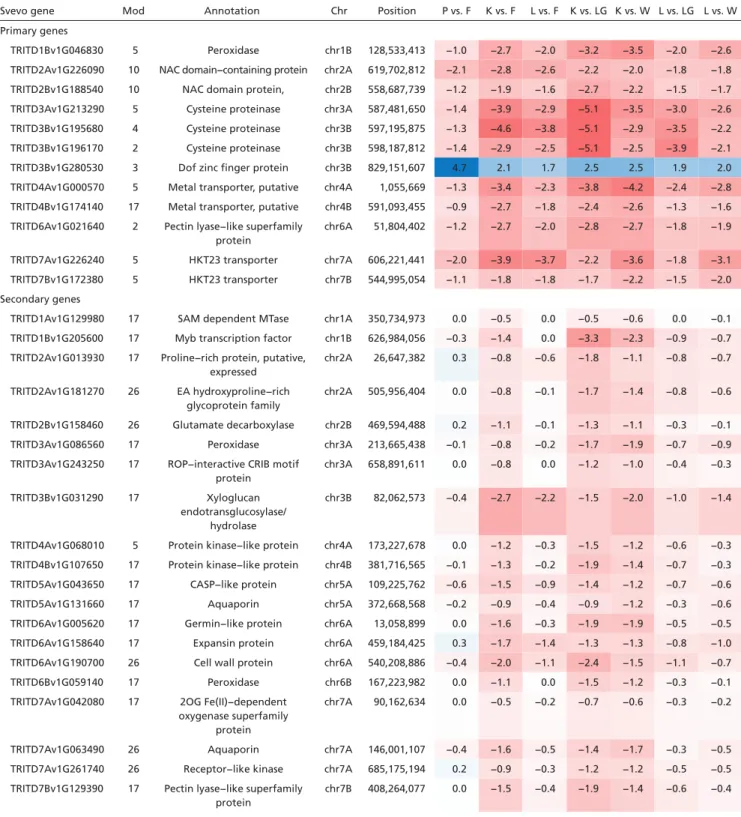
To investigate genome-wide regulatory pathways involved in stem solidness, we performed weighted gene coexpression net-work analysis (Fig. 3D and Table 1). In a pairwise comparison between pithless1 and CDC Fortitude, only 195 DEGs were identified, which were distributed across all chromosomes (adjusted P < 0.01) (Dataset S1). Of these, we identified 12 “primary” genes that were codifferentially expressed in all hollow- by solid-stemmed pairwise comparisons (Table 1). These genes have been annotated to encode the following proteins: peroxidase (TRITD1Bv1G046830), two NAM/ATAF1/2/CUC2 (NAC) do-main proteins (TRITD2Av1G226090 and TRITD2Bv1G188540),
three cysteine proteinases (CEP, TRITD3Av1G213290,
TRITD3Bv1G195680 and TRITD3Bv1G196170), a Dof zinc fin-ger protein, TdDof (TRITD3Bv1G280530), two metal trans-porters (TRITD4Av1G000570 and TRITD4Bv1G174140), a pectin lyase-like superfamily protein (TRITD6Av1G021640),
and two HKT23 transporters (TRITD7Av1G226240 and
TRITD7Bv1G172380). The expression of TdDof in the solid-stemmed lines was negatively correlated with the expression of all 11 other primary genes (Table 1). Notably, this list includes three CEP genes, and two NAC transcription factor genes whose orthologs have been implicated in PCD in other species (Ta-ble 1), and a pectin lyase-like superfamily protein putatively in-volved in cell wall degradation.
Next, we used the list of“primary” genes to extract “second-ary” genes from the weighted gene coexpression network based on their correlated expression patterns (Table 1 andDataset S1). Using this approach, we constructed a subnetwork consisting of 32 genes from seven different coexpression modules (Fig. 3D). Secondary genes were annotated as being putatively involved in cell wall modification/degradation, transcriptional regulation, central metabolism, and signal transduction (Table 1). Taken together, our studies indicate that higher levels of TdDof ex-pression in solid-stemmed cultivars is correlated with the sup-pression of genes involved in several processes including cell wall modification/degradation, and the regulation and execution of PCD.
Developmental and Metabolite Analyses Identify Structural and Metabolomic Consequences of TdDof-Mediated Stem Solidness. To address the developmental pathways involved in the distinct stem solidness phenotypes in wheat, we performed a detailed com-parison of stem pith anatomy between CDC Fortitude and pithless1 using stem cross-sections sampled at Zadoks stage 32 (SI Appendix, Fig. S3). Light and electron microscopy revealed clear differences in the central pith parenchyma cells of pithless1 compared to CDC Fortitude, including irregular, bro-ken, and collapsed parenchyma cells and cell wall buckling. These anomalies in pith parenchyma cell size and shape prompted us to analyze the spatial expression pattern of TdDof in the stem for any potential associations with these morphological changes. We performed in situ PCR using stem cross-sections
AGRIC
ULTURAL
SCIENC
Fig. 2. Transgenic expression of TdDof induces stem solidness in hollow-stemmed lines pithless1 and Kronos. Cross-sections of the second internodes of nontransgenic (Left, hollow stem) and TdDof overexpression T1 transgenic lines (Right, solid stem) derived from pithless1 (A) and Kronos (B) at Zadoks stage 34. Scanning electron microscopy images of stem cross-sections showing the detailed stem anatomy in pithless1_Control_6 (nontransgenic line) (C and D) compared TdDof overexpression T1 transgenic line pithless1_4_3_3 (F and G). Light microscopy images of stem cross-sections (E and H). In the high-magnification view of the central regions of these sections (D, E, G, and H), parenchyma cells in and surrounding the central pith region are intact and more uniform in size in the TdDof overexpression T1 transgenic lines (G and H), whereas, in nontransgenic control lines in the comparable pith region, the cells are irregular or broken and collapsed (D and E). (Scale bars: A–C and F = 2 mm; D, E, G, and H = 500 μm.) Molecular analysis via ddPCR of TdDof transgene copy number and gene expression in independent T1 transgenic lines of pithless1 (I and J) and Kronos (K and L). Error bars denote SD across replicates (I–L). The same lines imaged in A and B were selected for molecular studies.
collected at Zadoks stages 32 and 34, from pithless1, Kofa, and CDC Fortitude (Fig. 4). TdDof transcripts were predominantly expressed in pith parenchyma cells of Kofa and CDC Fortitude during second internode formation (Fig. 4). During stem elonga-tion, hollow pith gradually formed in Kofa (Zadoks stage 34), while TdDof was only expressed in intact parenchyma cells (Fig. 4). By contrast, the expression pattern of TdDof in CDC Fortitude at Zadoks stage 34 remained constant and was similar to
Zadoks stage 32, which was associated with reduced cell death and pith degradation (Fig. 4). As expected, no signals above the background level were detected in pithless1, which is consistent with the deletion of TdDof (Fig. 4).
To investigate the potential cause of cell collapse in the hollow stems of pithless1, we compared cell viability in the pith paren-chyma cells at Zadoks stage 32 in the stem internodes of CDC Fortitude and pithless1 using two complementary cell viability
Fig. 3. TdDof expression and mediated stem solidness pathways are associated with CNV. (A) Heat map of high-confidence genes that were expressed inside the SSt1 fine-mapping interval. Pairwise comparisons (hollow vs. solid) are presented as a heat map of values as Log2fold-change (Log2FC), where blue indicates higher expression was detected in the solid-stemmed line, and red indicates higher expression was detected in the hollow-stemmed line. For each gene, its corresponding coexpression module is indicated. (B) The ddPCR validation of TdDof gene copy number (calculated as the ratio of absolute con-centration [copies per microliter] between each sample and the single-copy reference control gene TaActin), with multiple copies in solid-stemmed W9262-260D3 and CDC Fortitude (blue bars), a single copy in hollow-stemmed Svevo and Kofa, and no copies in pithless1 (red bars). (C) TdDof gene expression levels, with greater expression in solid-stemmed lines W9262-260D3 and CDC Fortitude (blue bars), lower expression in hollow-stemmed lines Svevo and Kofa, and no expression in pithless1 (red bars). (D) Gene expression network plot. Modules (MEs) were defined as clusters of interconnected genes, and each module was assigned a unique color. Lines connecting genes in the network plot indicate correlation in expression patterns across samples. A positive correlation is denoted by red line, whereas a negative correlation is denoted by a blue line.
AGRIC
ULTURAL
SCIENC
stains, fluorescein diacetate (FDA) and propidium iodide (PI), followed by confocal laser scanning microscopy (Fig. 5 A–H). PI stains only nuclei from dead cells with ruptured cell membranes, making them appear fluorescent, whereas nuclei from living cells
are not stained by this dye. FDA stains viable, living cells pro-ducing nuclear and nucleocytoplasmic signals around a dark vacuole where stain is quenched. In our analysis, the absence of nuclear staining by PI alone was not used to determine the
Table 1. List of genes identified in coexpression network analysis
The table presents 12 primary genes that met the criteria of differential expression across all hollow- vs. solid-stemmed comparisons. This list was used to identify secondary genes that were correlated in their expression across samples with at least one of the primary DEGs. The table lists the gene accession from the Svevo annotation, coexpression module (Mod), Svevo gene description, chromosome (Chr), and position. Values on the right of the table are log2 expression fold-change values for each hollow by solid comparison. Positive values indicate expression was greater in the solid-stemmed line denoted by blue shading, and negative values indicate expression was greater in the hollow-stemmed line denoted by red shading. Genotypes used in pairwise com-parisons are labeled as follows: P, pithless1; F, CDC Fortitude; L, Langdon; LG, Langdon-GB-3B; K, Kofa; W, W9262-2603.
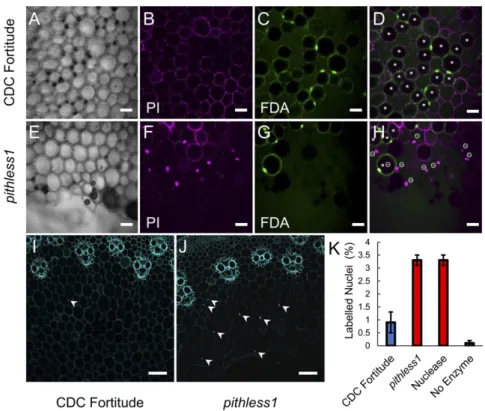
viability status of a cell, as select nuclei may be out of the optical plane or excluded by specimen preparation. Thus, putatively vi-able cells were defined as FDA stain positive, while dead or dying cells were defined by a PI-stained nucleus. The occasional observation of a cell with both FDA-positive staining and a PI-stained nucleus was defined as dead. pithless1 stem sections stained with PI had abundant fluorescent nuclei in parenchyma cells compared to CDC Fortitude, when the same Z-stack thickness and step size were used in image collection, pointing to increased PI uptake and cell death in pithless1 (Fig. 5 A, B, E, and F). In support of the PI staining patterns, a lower proportion of pith parenchyma cells was stained by FDA, indicating the presence of fewer living, viable cells among the cells surrounding the hollow pith of pithless1 stems relative to CDC Fortitude (Fig. 5 C, D, G, and H). In addition to showing that cell viability was reduced in the pith parenchyma cells of pithless1 stems, these data indicate that the cells in pithless1 were undergoing cell death prior to their collapse (Fig. 5 D and H). To assess the potential mechanism underlying cell death in pithless1 pith pa-renchyma cells, we performed a terminal deoxynucleotidyl transferase (TUNEL) assay to quantify in situ DNA fragmen-tation in CDC Fortitude and pithless1, as examined by confocal laser scanning microscopy (Fig. 5 I and J andSI Appendix, Figs. S4 and S5). When the same Z-stack thickness and step size were used to ensure nuclei at multiple depths were captured, there was an approximately threefold increase in the number of posi-tive nuclear signals in the pith cells of pithless1 compared to CDC Fortitude, supporting the notion that PCD occurred in paren-chyma cells prior to cell collapse and cavity formation in the pith (Fig. 5K). Together, these results strongly support the notion that the reduction or loss of TdDof expression is associated with
the activation of PCD of pith parenchyma cells, thereby inducing the formation of a hollow pith within the stem.
To explore the differences in the biochemical compositions between hollow- and solid-stemmed lines, we performed me-tabolite profiling during three stages (Zadoks stages 32, 33, and 34) of stem development. Statistical analyses for pairwise sample comparisons are presented (Dataset S2). CDC Fortitude showed strong differences in glutathione metabolism relative to pithless1 and Kofa, both of which accumulated high amounts of glutamate and gamma-glutamyl acids; these compounds function as strong osmolytes and accumulate in tissues undergoing con-trolled desiccation (SI Appendix, Fig. S6 and Dataset S2). By Zadoks stage 34, the levels of 60 metabolites differed in pithless1 and Kofa compared to CDC Fortitude, pointing to differences in biochemical activity between hollow- and solid-stemmed types. The levels of most amino acids and their me-tabolites were higher in pithless1 than CDC Fortitude, whereas the levels of almost all lipids were lower in these lines. The levels of nitrogen-rich compounds asparagine, glutamine, spermidine, and allantoin were higher in pithless1 than in CDC Fortitude, with levels up to>100-fold higher in the mutant. The levels of several compounds in the glutathione cycle were much higher in pithless1 than in CDC Fortitude (5-oxoproline, the gamma-glutamyl amino acids), as were the levels of amino acids that function as strong osmolytes (proline, trigonelline). WSC (1-kestose, glucose, fructose, sucrose) content in the stem varied among lines and developmental stages. Notably, CDC Forti-tude accumulated high levels of 1-kestose by Zadoks stage 34. At this stage, the sucrose content was similar between CDC Forti-tude and Kofa but significantly lower in pithless1 (SI Appendix, Fig. S6andDataset S2). Taken together, these results indicate that the hollow-stemmed lines Kofa and pithless1 have increased levels of osmolytes (indicators of controlled desiccation and PCD), as well as differences in WSC content compared to CDC Fortitude.
Developing a DNA Marker for Breeding Solid-Stemmed Cultivars.A high-throughput universal marker for the solid-stemmed trait that can be used in both durum and bread wheat germplasm has remained elusive. We previously described the marker usw204, which is currently used in some breeding programs (20); how-ever, this marker scores hexaploid and tetraploid cultivars in-versely (SI Appendix, Fig. S7A). To overcome this limitation, we mined the Chromium sequence datasets to call single-nucleotide polymorphisms and designed additional markers. We identified a region spanning position 828.9 Mb to 829.6 Mb on chromo-some 3B of the Svevo assembly in which the allelic states of solid-stemmed hexaploid and tetraploid cultivars were identical (SI Appendix, Fig. S7B). This interval is consistent with the fine-mapped interval in durum wheat that contains the SSt1 gene TdDof. We successfully developed a marker (usw275) tightly linked (<4.3 kb) to TdDof that produces accurate results in both bread and durum wheat and, most importantly, is ame-nable to high-throughput genotyping and the tracking of stem
solidness in breeding programs (Fig. 1D and SI Appendix,
Table S4). Discussion
Here, we identified TdDof (TRITD3Bv1G280530), which en-codes a putative Dof (DNA binding with one finger) protein, as the causal gene conferring stem solidness corresponding to SSt1 on chromosome arm 3BL. We confirmed this via transgenic overexpression of TdDof in two independent hollow-stemmed durum wheat genotypes which yielded transformants with solid stems. Although all cultivars we examined carry the genetic se-quence to encode identical functional TdDof proteins irre-spective of stem type, our findings indicate the solid-stemmed phenotype is caused by increased expression of the TdDof gene.
Fig. 4. In situ PCR demonstrating enrichment of TdDof messenger RNA in internode parenchyma cells in pithless1, Kofa, and CDC Fortitude. Purple staining (labeled by red arrows) indicates the presence of in situ PCR am-plified TdDof transcripts. Representative micrographs of internode cross-sections from Zadoks stages 32 and 34 show similar high expression levels of TdDof in parenchyma cells in which the negative controls were generated under the same conditions but with the reverse transcription steps omitted. Three panels from Left to Right represent internode tissues from pithless1, Kofa, and CDC Fortitude. (Scale bars= 200 μm.)
AGRIC
ULTURAL
SCIENC
Three identical copies of TdDof in solid-stemmed durum wheat are tandemly arranged within a 34.8-kb triplicated segment within the SSt1 locus. The expression of TdDof during early stem elongation is positively correlated with its genomic copy number, and higher expression likely induces the solid-stem phenotype. Given that the upstream putative regulatory region is present for each of the three TdDof copies, coupled with an approximate threefold increase in gene expression, it is likely that all three copies are expressed in solid stemmed cultivars. However, we cannot rule out the possibility that one or more copies of TdDof contribute more to the observed expression levels.
Stem solidness is a trait that has been deployed in wheat to control devastating outbreaks of the WSS in North America. The conventional sources used to introgress stem solidness into wheat were the Portuguese landrace S-615 (hexaploid bread wheat), the South African landrace Golden Ball (tetraploid durum wheat), and the German cultivar Biodur (tetraploid durum wheat) (12–14). Despite their diverse global origins and differing ploidy levels, the unique TdDof CNV signature is found in all three of these sources of stem solidness. This finding, combined with an accurate DNA marker that predicts stem solidness within both wheat species, not only supports that TdDof is responsible for stem solidness in both durum and bread wheat but also indicates that stem solidness originated from a common genetic progenitor. However, the original source has not been identified, and it remains to be determined whether stem solid-ness in wheat originated pre- or postdomestication.
TdDof is part of a large family of plant-specific transcription factors that were first identified in maize (21). Since their
discovery, Dof transcription factors have been shown to regulate a wide range of developmental and physiological processes, in-cluding carbon and nitrogen assimilation (22), hormone signaling (23), light responses (24), seed germination and development (25), flowering time (26–28), pollen development (29), shoot branching (30), interfascicular cambium/vascular tissue devel-opment (31), biotic stress tolerance (32), and drought and salt tolerance (28). There are 62 Dof genes in durum wheat and 116 in bread wheat. The recent release of the first genome sequences for durum and bread wheat (19, 20), along with high-quality gene models, has set the stage for unraveling the functions of this diverse gene family and their associated regulatory functions. Here, we demonstrated that TdDof controls stem architecture, and leads to reduced expression of genes putatively involved in PCD such as NAC (TRITD2Av1G226090 and TRITD2Bv1G188540) and CEP (TRITD3Av1G213290, TRITD3Bv1G195680, and TRITD3Bv1G196170). Furthermore, TdDof may also impact response to oxidative stress (peroxidase: TRITD1Bv1G046830), metal ion transport (TRITD4Av1G000570 and TRITD4Bv1G174140), cell wall modification (pectin lyase-like superfamily: TRITD6Av1G021640) and cation transport (HKT2: TRITD7Av1G226240 and TRITD7Bv1G172380).
Our findings suggest that TdDof may impact PCD pathways through direct or indirect regulation of NAC and CEP genes, as supported by histochemical evidence of PCD of the pith paren-chyma in hollow-stemmed cultivars during the early stages of stem elongation. PCD is an important regulatory mechanism used by plants to eliminate unwanted cells, a process required for normal plant growth and development (33, 34). One example of
Fig. 5. Cell viability in the pith parenchyma cells of CDC Fortitude and pithless1 stems. Stem cross-sections from the second internodes of CDC Fortitude (A–D and I) and mutant pithless1 (E–H and J) plants viewed as single frame images. Viability staining of pith cells viewed by confocal laser-scanning microscopy phase contrast image (A and E), PI signal (B and F), FDA signal (C and G), and PI and FDA merged view (D and H). Parenchyma cell walls stained with PI in CDC Fortitude (B) and pithless1 (F), with fluorescent nuclei indicating penetration of the dye into cells surrounding the hollow pith of pithless1 stem sections. Penetration and conversion of nonfluorescent FDA stain into green fluorescent fluorescein by CDC Fortitude (C) and pithless1 (G) pith parenchyma cells. The * symbol indicates a putatively viable cell, with bright FDA signal around a dark vacuole, and theΘ symbol indicates a cell considered to be dead, with PI-positive nucleus. The viability status of cells without labels is undetermined. TUNEL assay for DNA fragmentation in CDC Fortitude (I) and pithless1 (J) stems, as viewed by confocal laser scanning microscopy. Arrowheads indicate positive nuclear signals in pith cells. (K) Quantification of TUNEL assay results for three biological replicates of CDC Fortitude (Fort), pithless1 (P1), positive control using TACS nuclease treatment (+), and unlabeled experimental control (−), with the labeled nuclei per the total number of pith parenchyma cells plotted as the mean percentage±SD. (Scale bars: A−H = 20 μm; I and J = 100 μm.)
PCD is the hypoxia-driven occurrence of pith autolysis, a wide-spread phenomenon in many plant species that is necessary for eliminating pith parenchyma cells and forming aerenchyma to facilitate gas exchange within the stem (35). In the current study, we provided several key lines of evidence suggesting PCD is as-sociated with stem hollowness in wheat. Gene coexpression analysis identified two NAC genes on chromosomes 2A and 2B and three CEP genes on chromosomes 3A and 3B that were strongly up-regulated in hollow stems where TdDof expression was low. In Arabidopsis, the close ortholog to TRITD2Av1G226090, TRITD2Bv1G188540 is the gene KIRA1, whose expression was implicated as a key regulator of PCD-associated genes in the stigma (36). Recent studies identified the D gene (Sobic.006G147400) in sorghum (Sorghum bicolor L.), encoding an NAC transcription factor that functions as a transcriptional switch to regulate PCD in stems (37, 38). The D gene activates various cell death-related enzymes, including the direct activation of the cysteine protease CEP1 (37, 38). The most closely related genes to the sorghum D gene in the durum wheat annotations share 86% protein sequence similarity with NAC protein TRITD2Bv1G188540 encoded on chromosome 2B and 66% sequence similarity with NAC protein TRITD2Av1G226090 encoded on chromosome 2A, indicating that these proteins are orthologous between sorghum and wheat. Cysteine protease genes, including CEP1 that is regulated by the sorghum D gene, belong to a large family of enzymes that are ubiquitous across plants, animals, and microbes. These enzymes function downstream of transcription factors and are involved in protein degradation and PCD (39, 40). The Arabidopsis ortholog, CEP1, has been implicated in PCD during xylem development (41). Along with CEP1, several other known protease genes are often coexpressed in cells that are actively undergoing PCD (42–44). Given the strong negative correlation we observed be-tween the expression of TdDof and PCD-related genes, this ob-servation suggests that NAC and CEP genes could be target genes that are negatively regulated by TdDof. Nevertheless, the direct link between TdDof expression and the occurrence of PCD re-mains unclear and warrants further investigation.
We also obtained histochemical evidence suggesting the cells in pithless1 undergo PCD prior to collapsing into the culm lu-men. However, unlike stems in sweet and juicy sorghum culti-vars, whose pith remains largely intact, the complete collapse of the pith in most hollow-stemmed wheat occurs during the early stages of stem elongation. Despite this difference, our findings suggest that the physiological processes identified in sorghum (37, 38) are likely similar to the processes that occur in hollow-stemmed wheat cultivars. Targeting genes involved in pith PCD, including those identified in this study such as the NAC and CEP genes, might represent a new avenue for enhancing the expres-sion of stem solidness in crop species. For example, because solid stems have higher mass per unit length than hollow stems, this could have positive implications for biomass partitioning and may be useful in the production of bioethanol. If PCD pathways are conserved within the stem between species, genetic engi-neering involving TdDof could be one strategy to increase acces-sible WSC content in other monocot crops such as switchgrass (Panicum virgatum L.), which is used in the biofuel industry for ethanol production (45). Increasing WSC content in straw could increase the extraction efficiency of ethanol while lowering the amount of enzymatic pretreatment required during processing (46). Our findings lay the foundation for future research aimed at optimizing the expression of stem solidness, which could have additional downstream agricultural and industrial applications. An important breeding target should be to maximize pith production
when female WSS are actively laying eggs, which would provide maximum levels of resistance to this insect. However, it may be beneficial to begin degrading the pith during grain filling to enhance water and WSC remobilization capacity to the devel-oping grain, particularly during periods of abiotic stress. Drought poses the single largest constraint to crop production in many parts of the world and is expected to become more widespread due to the changing global climate. Increasing the capacity of the pith to store water and WSC for later remobili-zation under periods of abiotic stress has been suggested (8), but remains largely unexplored as a breeding target for enhancing drought stress tolerance. Indeed, in the current study, we ob-served the accumulation of higher levels of the fructan 1-kestose in the stems of CDC Fortitude relative to the hollow-stemmed controls. Consistent with this possibility, during periods of drought, hexose sugars from hydrolyzed fructans reduce leaf intracellular water potential to maintain turgor and to promote continued leaf expansion (4). Higher sugar concentrations also increase the chemical potential of water, which lowers the freezing point in nonfrozen tissues or promotes the melting of ice in frozen tissues (47), making it possible for plants with solid stems to have better cold stress tolerance than hollow-stemmed plants.
In summary, we determined that TdDof controls pith devel-opment in wheat. We propose that CNV of TdDof drives in-creased gene expression and the solid-stemmed phenotype. When we deleted all copies of TdDof in the solid-stemmed parent CDC Fortitude to generate the mutant pithless1, we ob-served a corresponding loss of the solid-stemmed phenotype associated with this deletion. Adding TdDof back into the pithless1 genetic background via exogenous overexpression re-stored the solid-stemmed dominant phenotype of this mutant. This gain of function was also observed in the unrelated genetic background of hollow-stemmed cultivar Kronos. Our newly de-veloped molecular marker usw275 will be useful for tracking TdDof-mediated stem solidness to facilitate research and breeding efforts. Our results also provide insight into the downstream pathways that may be regulated by TdDof, particu-larly the repression of PCD as a plausible mechanism for stem solidness.
Materials and Methods
Details regarding sample preparation, experimental procedures, and data analysis, along with the associated references, are presented inSI Appendix, SI Materials and Methods. The 10× Genomics Chromium whole-genome sequencing data and Oxford Nanopore and RNA-seq (Illumina) data have been submitted to Sequence Read Archives at National Center for Biotechnology Information (NCBI) under BioProject accession number PRJNA630287 (48).
Data Availability. Sequencing data have been deposited in NCBI (PRJNA630287) (48). All study data are included in the article andSI Appendix.
ACKNOWLEDGMENTS. We acknowledge the Canadian Triticum Applied Genomics project, with funding provided by Genome Canada (adminis-tered by Genome Prairie), Western Grain Research Foundation, Govern-ment of Saskatchewan, Saskatchewan Wheat DevelopGovern-ment Commission, Alberta Wheat Commission, Manitoba Agriculture, Viterra, Manitoba Wheat and Barley Growers Association, and Secan. We acknowledge the funding support from the National Research Council Wheat Flagship Program and the Global Institute for Food Security. We also thank the Western College of Veterinary Medicine Imaging Centre (University of Saskatchewan, Canada) for assistance with histological sample prepa-ration, and we thank Charline Soraru for characterization of T0 wheat lines.
1. Food and Agricultural Organization of the United Nations, FAOSTAT. www.fao.org/ faostat/en/. Accessed 15 March 2020.
2. E. J. M. Kirby, Botany of the wheat plant. www.fao.org/3/y4011e05.htm. Accessed 25 March 2020.
3. G. N. Scofield et al., Starch storage in the stems of wheat plants: Localization and temporal changes. Ann. Bot. 103, 859–868 (2009).
4. W. G. Spollen, C. J. Nelson, Response of fructan to water deficit in growing leaves of tall fescue. Plant Physiol. 106, 329–336 (1994).
AGRIC
ULTURAL
SCIENC
5. C. J. Pollock, Tansley review no. 5 fructans and the metabolism of sucrose in vascular plants. New Phytol. 104, 1–24 (1986).
6. A. Blum, Improving wheat grain filling under stress by stem reserve mobilisation. Euphytica 100, 77–83 (1998).
7. M. A. Ford, R. D. Blackwell, M. L. Parker, R. B. Austin, Associations between stem solidity, soluble carbohydrate accumulation and other characters in wheat. Ann. Bot. 44, 731–738 (1979).
8. C. Saint Pierre, R. Trethowan, M. Reynolds, Stem solidness and its relationship to water-soluble carbohydrates: Association with wheat yield under water deficit. Funct. Plant Biol. 37, 166–174 (2010).
9. J. P. Cook, D. M. Wichman, J. M. Martin, P. L. Bruckner, L. E. Talbert, Identification of microsatellite markers associated with a stem solidness locus in wheat. Crop Sci. 44, 1397–1402 (2004).
10. S. Houshmand, R. E. Knox, F. R. Clarke, J. M. Clarke, Microsatellite markers flanking a stem solidness gene on chromosome 3BL in durum wheat. Mol. Breed. 20, 261–270 (2007).
11. K. T. Nilsen et al., High density mapping and haplotype analysis of the major stem-solidness locus SSt1 in durum and common wheat. PLoS One 12, e0175285 (2017). 12. H. J. Kemp, Studies of solid stem wheat varieties in relation to wheat stem sawfly
control. Sci. Agric. 15, 30–38 (1934).
13. K. T. Nilsen, J. M. Clarke, B. L. Beres, C. Pozniak, Sowing density and cultivar effects on pith expression in solid-stemmed durum wheat. Agron. J. 108, 219–228 (2016). 14. C. Pozniak, K. Nilsen, J. Clarke, B. Beres, CDC Fortitude durum wheat. Can. J. Plant Sci.
95, 1013–1019 (2015).
15. B. L. Beres, L. M. Dosdall, D. K. Weaver, H. A. Carcamo, D. M. Spaner, Biology and integrated management of wheat stem sawfly and the need for continuing research. Can. Entomol. 143, 105–125 (2011).
16. V. Lesieur et al., Phylogeography of the wheat stem sawfly, Cephus cinctus Norton (Hymenoptera: Cephidae): Implications for pest management. PLoS One 11, e0168370 (2016).
17. B. L. Beres et al., Host plant interactions between wheat germplasm source and wheat stem sawfly Cephus cinctus Norton (Hymenoptera: Cephidae). II. Other germplasm. Can. J. Plant Sci. 93, 1169–1177 (2013).
18. M. A. Hayat, J. M. Martin, S. P. Lanning, C. F. McGuire, L. E. Talbert, Variation for stem solidness and its association with agronomic traits in spring wheat. Can. J. Plant Sci. 75, 775–780 (1995).
19. M. Maccaferri et al., Durum wheat genome highlights past domestication signatures and future improvement targets. Nat. Genet. 51, 885–895 (2019).
20. The International Wheat Genome Sequencing Consortium (IWGSC) et al., Shifting the limits in wheat research and breeding using a fully annotated reference genome. Science 361, eaar7191 (2018).
21. S. Yanagisawa, K. Izui, Molecular cloning of two DNA-binding proteins of maize that are structurally different but interact with the same sequence motif. J. Biol. Chem. 268, 16028–16036 (1993).
22. T. Kurai et al., Introduction of the ZmDof1 gene into rice enhances carbon and ni-trogen assimilation under low-nini-trogen conditions. Plant Biotechnol. J. 9, 826–837 (2011).
23. D. H. Park et al., The Arabidopsis COG1 gene encodes a Dof domain transcription factor and negatively regulates phytochrome signaling. Plant J. 34, 161–171 (2003). 24. S. Yanagisawa, J. Sheen, Involvement of maize Dof zinc finger proteins in
tissue-specific and light-regulated gene expression. Plant Cell 10, 75–89 (1998). 25. M. Papi et al., Identification and disruption of an Arabidopsis zinc finger gene
con-trolling seed germination. Genes Dev. 14, 28–33 (2000).
26. J. Yang, M. F. Yang, W. P. Zhang, F. Chen, S. H. Shen, A putative flowering-time-related Dof transcription factor gene, JcDof3, is controlled by the circadian clock in Jatropha curcas. Plant Sci. 181, 667–674 (2011).
27. A. R. Corrales et al., Multifaceted role of cycling DOF factor 3 (CDF3) in the regulation of flowering time and abiotic stress responses in Arabidopsis. Plant Cell Environ. 40, 748–764 (2017).
28. A. R. Corrales et al., Characterization of tomato Cycling Dof Factors reveals conserved and new functions in the control of flowering time and abiotic stress responses. J. Exp. Bot. 65, 995–1012 (2014).
29. J. Peng, X. Qi, X. Chen, N. Li, J. Yu, ZmDof30 negatively regulates the promoter ac-tivity of the pollen-specific gene Zm908. Front. Plant Sci. 8, 685 (2017).
30. H. F. Zou et al., The transcription factor AtDOF4.2 regulates shoot branching and seed coat formation in Arabidopsis. Biochem. J. 449, 373–388 (2013).
31. Y. Guo, G. Qin, H. Gu, L.-J. Qu, Dof5.6/HCA2, a Dof transcription factor gene, regu-lates interfascicular cambium formation and vascular tissue development in Arabi-dopsis. Plant Cell 21, 3518–3534 (2009).
32. C. L. Wen et al., Identification and characterisation of Dof transcription factors in the cucumber genome. Sci. Rep. 6, 23072 (2016).
33. R. I. Pennell, C. Lamb, Programmed cell death in plants. Plant Cell 9, 1157–1168 (1997). 34. T. Van Hautegem, A. J. Waters, J. Goodrich, M. K. Nowack, Only in dying, life: Pro-grammed cell death during plant development. Trends Plant Sci. 20, 102–113 (2015). 35. E. P. Beers, Programmed cell death during plant growth and development. Cell Death
Differ. 4, 649–661 (1997).
36. Z. Gao et al., KIRA1 and ORESARA1 terminate flower receptivity by promoting cell death in the stigma of Arabidopsis. Nat. Plants 4, 365–375 (2018).
37. M. Fujimoto et al., Transcriptional switch for programmed cell death in pith paren-chyma of sorghum stems. Proc. Natl. Acad. Sci. U.S.A. 115, E8783–E8792 (2018). 38. A. L. Casto, B. A. McKinley, K. M. J. Yu, W. L. Rooney, J. E. Mullet, Sorghum stem
aerenchyma formation is regulated by SbNAC_D during internode development. Plant Direct 2, e00085 (2018).
39. M. Solomon, B. Belenghi, M. Delledonne, E. Menachem, A. Levine, The involvement of cysteine proteases and protease inhibitor genes in the regulation of programmed cell death in plants. Plant Cell 11, 431–444 (1999).
40. D. J. Sueldo, R. A. L. van der Hoorn, Plant life needs cell death, but does plant cell death need Cys proteases? FEBS J. 284, 1577–1585 (2017).
41. J. Han et al., The papain-like cysteine protease CEP1 is involved in programmed cell death and secondary wall thickening during xylem development in Arabidopsis. J. Exp. Bot. 70, 205–215 (2019).
42. C. P. Trobacher, A. Senatore, J. S. Greenwood, Masterminds or minions? Cysteine proteinases in plant programmed cell death. Can. J. Bot. 84, 651–667 (2006). 43. R. A. Buono, R. Hudecek, M. K. Nowack, Plant proteases during developmental
pro-grammed cell death. J. Exp. Bot. 70, 2097–2112 (2019).
44. Y. Olvera-Carrillo et al., A conserved core of programmed cell death indicator genes discriminates developmentally and environmentally induced programmed cell death in plants. Plant Physiol. 169, 2684–2699 (2015).
45. M. A. Sanderson, P. R. Adler, A. A. Boateng, M. D. Casler, G. Sarath, Switchgrass as a biofuels feedstock in the USA. Can. J. Plant Sci. 86, 1315–1325 (2006).
46. K. V. Krasileva et al., Uncovering hidden variation in polyploid wheat. Proc. Natl. Acad. Sci. U.S.A. 114, E913–E921 (2017).
47. D. P. Livingston 3rd, D. K. Hincha, A. G. Heyer, Fructan and its relationship to abiotic stress tolerance in plants. Cell. Mol. Life Sci. 66, 2007–2023 (2009).
48. K. T. Nilsen et al, Triticum turgidum subsp. durum solid stem locus SST1. NCBI Se-quence Read Archive. https://www.ncbi.nlm.nih.gov/bioproject/PRJNA630287. De-posited 4 May, 2020.