HAL Id: tel-02436759
https://hal.archives-ouvertes.fr/tel-02436759
Submitted on 13 Jan 2020HAL is a multi-disciplinary open access
archive for the deposit and dissemination of sci-entific research documents, whether they are pub-lished or not. The documents may come from teaching and research institutions in France or abroad, or from public or private research centers.
L’archive ouverte pluridisciplinaire HAL, est destinée au dépôt et à la diffusion de documents scientifiques de niveau recherche, publiés ou non, émanant des établissements d’enseignement et de recherche français ou étrangers, des laboratoires publics ou privés.
Simplifying Transducers using Sequentiality
Didier Villevalois
To cite this version:
Didier Villevalois. Simplifying Transducers using Sequentiality. Formal Languages and Automata Theory [cs.FL]. Aix-Marseille Université (AMU), 2019. English. �tel-02436759�
AIX-MARSEILLE UNIVERSITÉ
E.D. 184 MATHEMATIQUES ET INFORMATIQUE
U.F.R. SCIENCES
LABORATOIRE D’INFORMATIQUE ET SYSTÈMES, CNRS U.M.R. 7020
Thèse présentée pour obtenir le grade universitaire de docteur
Discipline : Informatique
Didier VILLEVALOIS
Thesis: Simplifying Transducers using Sequentiality
Titre de la thèse : Simplification de transducteurs en utilisant la séquentialitéSoutenue le 26/11/2019 devant le jury composé de :
Olivier CARTON IRIF, CNRS, Université Paris-Diderot Rapporteur Anca MUSCHOLL LaBRI, CNRS, Université de Bordeaux Rapporteure Christof LÖDING RWTH Aachen University Examinateur Benjamin MONMEGE LIS, CNRS, Aix-Marseille Université Examinateur Jean-Éric PIN IRIF, CNRS, Université Paris-Diderot Examinateur Pierre-Alain REYNIER LIS, CNRS, Aix-Marseille Université Directeur de thèse
Cette œuvre est mise à disposition selon les termes de la Licence Creative Commons Attribution - Pas d’Utilisation Commerciale - Pas de Modification 4.0 International.
Abstract
Synthesis is a field of computer science that consists in generating programs from abstract specifications. Specifications are often described via a logical for-malism and programs are obtained as models of transformation. While, in the specifications, it is useful to express properties of the desired programs using some forms of non-determinism, we usually want to avoid it in the outcome of synthesis, for obvious efficiency reasons. Generally speaking, this leads us to the need to simplify the synthesised transformation models, in order to optimise their evaluation or translation into practical applications.
In this thesis, the transformation models we are interested in are expressed as Streaming String Transducers (SST) [AˇC10;AˇC11]. An SST is a deterministic finite-state automaton equipped with a finite count of registers that can be used to construct an output word. These registers can be updated by using register concatenation or by prepending or appending finite words. We are interested in the challenging problem of register minimisation, which consists, given an SST, in computing an equivalent SST with a minimal number of registers. As a first step to support this general model, we constrain how the registers can be operated on : namely, the registers cannot be concatenated one to another.
We present two main contributions. First, we devise a procedure allowing to minimise registers in the class of copyless appending SSTs (in this class, registers can only be appended to). Second, we show, given a copyful concatenation-free SST, how to decide whether there exists an equivalent concatenation-free SST with a single register.
When considering the simplification of Finite-State Transducers (FST), a clas-sical problem is the sequentiality problem [Cho77], which asks whether a given FST admits an equivalent sequential one (that is with a deterministic underlying input automaton). For both our results, the proof techniques generalise the fra-mework created around the sequentiality problem.
Keywords : minimisation, sequentiality, transducers, twinning property
Résumé
La synthèse est un domaine de l’informatique consistant à générer des pro-grammes à partir de spécifications abstraites. Les spécifications sont souvent dé-crites à l’aide d’un formalisme logique et les programmes sont obtenus sous la forme de modèles de transformation. Alors qu’il est utile de pouvoir exprimer les propriétés des spécifications avec du non-déterminisme, nous souhaitons en général obtenir des modèles déterministes pour des raisons évidentes d’efficacité. Ceci nous amène à vouloir simplifier les modèles synthétisés afin d’optimiser leur évaluation ou leur représentation concrète dans un programme.
Dans cette thèse, les modèles de transformations qui nous intéressent sont ex-primés par des Streaming String Transducers (SSTs) [AˇC10;AˇC11]. Un SST est un automate fini déterministe équipé d’un nombre fini de registres qui peuvent être utilisés pour élaborer un mot de sortie. Ces registres peuvent être mis à jour en utilisant la concatenation de registres ou en les préfixant ou suffixant par des mots finis. Nous sommes intéressés par le problème ambitieux de la minimisation de registres, qui consiste, étant donné un SST, à calculer un SST équivalent avec un nombre minimal de registres. Comme première étape à la prise en compte de ce modèle très expressif, nous contraignons la manière dont les registres sont manipulés : ils ne peuvent pas être concaténés les uns aux autres (cette classe est appelée Concatenation-Free SST).
Nous présentons deux contributions principales. Tout d’abord, nous élabo-rons une procédure permettant de minimiser le nombre de registres dans la classe des Copyless Appending SSTs (dans cette classe, les registres ne peuvent qu’être suffixés par un mot). Ensuite, nous montrons, étant donné un Copyful Concatenation-Free SST, comment décider s’il existe un Concatenation-Free SST équivalent à un seul registre.
Lorsque l’on considère la simplification des Finite-State Transducers (FST), un problème classique est le problème de la séquentialité [Cho77], qui demande si un FST donné admet un FST séquentiel équivalent. Pour nos deux résultats, les techniques de preuves utilisées généralisent le cadre créé autour du problème de séquentialité.
Mots clés : minimisation, séquentialité, transducteurs, propriété de jumelage
Remerciements
Le manuscrit entre vos mains marque le point d’orgue d’une tranche de cinq années de vie. Il contient à la fois les doutes, déceptions, sueurs et douleurs, et les surprises, joies et bonheurs qui ont été les miens durant le cheminement qui a mené à son écriture. Heureusement, j’ai eu de nombreuses personnes autour de moi pour m’accompagner.
Quelle idée de reprendre ses études à 40 ans pour se lancer dans une thèse. On me l’a bien fait remarquer quand cette « lubie » m’a prise. Pourtant deux personnes ont accueilli cette idée avec la plus grande bienveillance. C’est à vous, Liva et Pierre-Alain, que j’adresse mes premiers remerciements. Un grand merci, autant pour m’avoir mis en garde, à juste titre, sur mon possible manque de mal-léabilité dû à mon âge, et pour avoir cru en moi malgré tout et m’avoir soutenu coûte que coûte.
Un an de Master et quatre ans de thèse, c’est une longue période à devoir me supporter et je te remercie encore Pierre-Alain pour ta patience, notamment face à mes régulières démotivations, ralentis, et autres débrayages. . . Malgré ma grande gueule, je pense n’avoir jamais vraiment été capable de t’exprimer la gratitude que j’ai pour toi.
Je remercie Anca Muscholl et Olivier Carton d’avoir accepté d’être rappor-teur.e.s de ce manuscrit, ainsi que les autres membres du jury, Christof Löding, Benjamin Monmège et Jean-Éric Pin pour le temps qu’ils m’ont consacré.
Je remercie aussi les collègues du Master 2 – Célia, Sébastien, Bastien, Éloi ! – ainsi que les doctorants et post-doctorants – Guillaume, Luc, Laure, Matthieu, Christina, Antoine, Makki, Léo – qui m’ont tous merveilleusement bien accueilli parmi eux. Je suis heureux de vous avoir eu à mes côtés durant ces quelques années et j’ai la chance de pouvoir compter certains d’entre vous parmi mes amis pour encore longtemps ! Un coup de coude aux collègues de bureau : Damien, Florian et Éloi. Éloi, je compte sur toi pour en finir rapidement à ton tour.
Je n’aurai pu survivre sans les bulles d’air que m’ont offert mes amies et amis, danseuses et danseurs de Blues, Forró et autres, militantes et militants de la protection animale, et usagères et usagers du Cabas Vert. Je ne peux pas tous vous nommer mais vous vous reconnaîtrez.
Enfin, je remercie ma famille et mes amis proches, qui n’ont jamais mis en doute mes choix de vie et sans qui je n’aurai pu relever ce nouveau défi.
Contents
Abstract iii Résumé v Remerciements vii Contents ix Introduction 1 About Transformations . . . 1Formal Methods for Safer Systems . . . 2
Efficient Evaluation of Models . . . 2
Models of Transformations . . . 3
General Methodology . . . 6
Outline of this Thesis . . . 7
1 Models of Transducers 9 1.1 Preliminaries . . . 9
1.2 Finite-State Transducers (FST) . . . 12
1.3 Two-way Finite-State Transducers (2FST) . . . 14
1.4 Deterministic Streaming String Transducers (DSST) . . . 15
1.5 String-to-Context Transducers (S2C) . . . 19
1.6 Summary . . . 22
2 Comparison of Expressiveness 25 2.1 Functional Two-way Finite-State Transducers . . . 25
2.2 Functional Finite-State Transducers . . . 26
2.3 Sequential Finite-State Transducers . . . 29
2.4 Multi-Sequential Functional Finite-State Transducers . . . 30
2.5 Functional String-to-Context Transducers . . . 31
2.6 Sequential String-to-Context Transducers . . . 34
2.7 Summary . . . 34
3 Sequentiality of Finite-State Transducers 39 3.1 Characterisation of Sequential Functions . . . 40
3.2 Construction of a Sequential Equivalent . . . 45
x Contents
3.3 Deciding Sequentiality . . . 47
3.4 Sequentiality in Other Contexts . . . 50
4 k-Sequentiality of Finite-State Transducers 51 4.1 Preliminaries . . . 52
4.2 Characterisation of k-Sequential Functions . . . 53
4.3 Construction of a k-Sequential Equivalent . . . 58
4.4 Deciding k-Sequentiality . . . 62
4.5 Minimisation of the Degree of Sequentiality . . . 67
5 Sequentiality of String-to-Context Transducers 69 5.1 Preliminaries . . . 70
5.2 Characterisation of Sequential S2Cs . . . 73
5.3 Combinatorial Analysis . . . 77
5.4 Construction of an Equivalent Sequential S2C . . . 90
5.5 Deciding Sequentiality of S2Cs . . . 100 5.6 Related Work . . . 102 Conclusion 105 List of Figures 107 List of Tables 109 Bibliography 111
Introduction
About Transformations
In our everyday lives, everyone of us interacts with machines, be it at work or at home or in between. We feed information to all kinds of computer systems, ranging from smartwatches to autonomous vehicles, to desktop workstations, and expect processed information in return. Each of these devices acts as some form of data transformation. A transformation takes some input data and returns some output data.
Computer science is the study of both computer hardware and software design. In this discipline, we need means to define and realise these transformations. Computer programs are a way to express those: developers use programming languages to encode what input is expected from the user and how the output is computed from it.
Programming languages often have complex syntaxes and semantics, which make them suitable to express complex behaviours in a succinct way. However, their complexity also makes them hard to reason about and prone to error. His-tory is full of hardware and software problems that have led to financial, or more importantly, human disasters [LT93;Ari96].
A basic way to ensure program safety is testing. We confirm, by repeatedly executing the program with a set of valid and invalid inputs, that it behaves correctly and produces the correct output or error message. Nevertheless, the set of valid and invalid inputs is often infinite and thus the program cannot be fully tested. Also, the (often) informal specifications of systems can’t describe precisely all the valid and invalid behaviours.
In order to address these issues, a number of mathematically based techniques have evolved over the years: first, some models to abstract transformations, mak-ing them easier to reason about and yet expressive enough to model many com-plex behaviours; second, some formal methods to guarantee the safety of the models we design. We will now introduce some of them, which are of interest to this thesis.
2 Introduction
Formal Methods for Safer Systems
The goal of formal methods is to allow the use of mathematical reasoning on the behaviours of the program being developed.
One typical such formal method is model-checking. First, a description of the system to verify is provided, represented as a mathematical model, along with a specification of the admitted behaviours of the system, often expressed us-ing some logical formalism (for example Linear-time Temporal Logic [Pnu77]). Then, a model-checking algorithm is used to verify that the model indeed satis-fies the logical formula of the specification. See [Cla+18] for a general overview of model checking.
Another formal method is model synthesis. Here, only a specification of the system, that can also be expressed using a logical formalism, is used as a driver to directly generate a candidate model for the system. This synthesised model is in turn used to produce part or all of the programming language code of the system.
Realisability (also called uniformisation) [CL11] is a particular case of syn-thesis. In this approach, the specification is directly given as a (maybe non-deterministic) transformation model that expresses a relation between inputs and outputs of the system. From that relation, is extracted a function that has the same domain and behaves equally on that domain.
Efficient Evaluation of Models
When using synthesis, while we have formal guarantees that the synthesised model describes a system that satisfies the specification, this model may not be optimal in a number of ways, like performance or resource consumption. This leads to the need to simplify the synthesised models. Some usual examples for the simplification of models are, for example, the minimisation of their size or the removal of non-determinism.
In this thesis, we focus on the removal, if ever possible, of non-determinism in models. Whereas non-determinism can be useful to express compact system spec-ifications in a logical formalism, it is notoriously impractical in the synthesised models. In fact, the execution of non-deterministic algorithms can sometimes blow up because we can’t ensure any bound on the number of parallel evalua-tion contexts required to complete the computaevalua-tion. This constitutes the main motivation for our work: removing part or all non-determinism in transforma-tion models to allow for their efficient evaluatransforma-tion.
Models of Transformations 3
Models of Transformations
As explained above, programming languages, being Türing-complete, are too expressive and many program properties are thus undecidable. We are in need for abstractions that we can reason about more easily. Finite-state models, such as finite-state automata, are a good start. They enjoy good closure and decidabil-ity properties and yet are expressive enough to model many complex behaviours. We can extend finite-state automata to obtain some models of transformations that are also adequate for formal reasoning. In this thesis, we will use such transformation models obtained from finite-state automata: some that are still finite-state and some others that use registers in a carefully restricted way. We will see that we can draw equivalences between those models.
A first aim of this manuscript is to summarise the equivalences between finite-state machines and classes of machines with registers that inter-est us. We will also summarise the main known results for the problems of functionality, sequentiality and equivalence on these models.
Finite-State Transducers
Finite-state automata can be viewed as functions from words to boolean val-ues, and thus describe languages. Finite-state transducers [Ber13;Sak09] extend finite-state automata by adding output labels in order to produce a word at each transition. The produced words are concatenated along a run in the transducer. Then, given an input word, the output of the transducer is the set of words pro-duced by the runs inpro-duced by this input word. As such, finite-state transducers describe relations from words to words.
A finite-state transducer is functional if the relation it realises is a function. The class of functions realised by functional finite-state transducers is called the class of rational functions [Ber13]. We focus in this thesis on functional transducers.
Sequentiality of Finite-State Transducers
A finite-state transducer is sequential (some authors say input-deterministic) if its underlying input automaton is deterministic. Regarding efficient evaluation, sequential finite-state transducers are the silver bullet. Indeed, being sequential, only one evaluation context is required. One can even take the input as a stream of letters and stream the output word in return, thus occupying a constant mem-ory space.
However, not every finite-state transducer can be made into a sequential one. The problem of the sequentiality of finite-state transducers then consists in
decid-4 Introduction
ing whether a finite-state transducer admits an equivalent sequential one. This problem has been extensively studied [Cho77;WK94;Béa+00;BC02].
A second aim of this manuscript is to provide a self-contained presenta-tion of known results on sequentiality of finite-state transducers and an original presentation of the decision of the sequentiality problem. Both will serve as a basis for the understanding of our main contributions.
Deterministic Streaming String Transducers
[AˇC10;AˇC11] recently introduced the model of deterministic streaming string transducers. They are deterministic finite-state automata equipped with regis-ters to store intermediate output words. These regisregis-ters can be concatenated together or with word constants. A transition in a deterministic streaming string transducer then boils down to a register update.
Register Complexity of Deterministic Streaming String Transducers
A deterministic streaming string transducer is sequential by nature. One way to simplify a deterministic streaming string transducer would be to minimise its number of registers. This is known as the register minimisation problem.
However challenging, a first step has been taken in [DRT16] where this prob-lem is solved for the subclass of copyful appending deterministic streaming string transducers. An appending deterministic streaming string transducer forbids the concatenation of two registers and only allows registers to be appended with some words constants.
When translating between the model of copyful appending deterministic stream-ing strstream-ing transducers and the model of functional finite-state transducers, we can observe that the use of registers in one translates in non-determinism in the other. In [DRT16], the authors gave a characterisation of the copyful append-ing deterministic streamappend-ing strappend-ing transducers that admit an equivalent one with only k registers, for a given k ∈ N. This work demonstrated that there is a strong connection between register minimisation and sequentialisation. Indeed, when k = 1, the register minimisation problem of copyful appending determin-istic streaming string transducers is equivalent to the sequentiality problem of finite-state transducers.
It is worth noticing that the class of functions realised by copyful appending deterministic streaming string transducers coincides with the class of rational functions [Alu+13].
This strong connection between the different models of transformations is an invitation to study further the links between sequentiality and register minimisa-tion.
Models of Transformations 5
A Family of Models and Sequentiality Problems
k-Sequentiality of Functional Finite-State Transducers
A state transducer is k-sequential if it is the union of k sequential finite-state transducers. It is multi-sequential if it is k-sequential, for some k ∈ N. As not all state transducers can be made sequential, multi-sequential finite-state transducers appear to be a good compromise in terms of efficient evalua-tion. Given a functional multi-sequential finite-state transducer, we argue that one can evaluate each member of the union in a separate thread. No communi-cation is required between threads and a single final join is needed in order to collect the output of the only accepting member.
Characterising the finite-state transducers that admit an equivalent multi-se-quential one, has been studied in [CS86] for the functional case and in [JF15] for the relational case. The ensuing simplification task would then be to reduce the size of the union. Following in their footsteps, we studied in [Dav+17] the problem of the k-sequentiality of functional finite-state transducers, which is to decide, given k ∈ N, whether a functional finite-state transducer admits an equivalent k-sequential one.
The first main contribution of this manuscript is to devise an effective characterisation of the functional finite-state transducers that admit an equivalent k-sequential one, for a given k ∈ N. We will present this result directly in the setting of finite-state transducers, contrarily to the initial publication, but with some original and more direct proofs.
A copyless deterministic streaming string transducer only allows for registers to be used once in a whole register update of a transition, whereas a copyful de-terministic streaming string transducer does not have this restriction. Whereas functional finite-state transducers are equivalent to copyful appending determin-istic streaming string transducers, functional k-sequential finite-state transducers are equivalent to copyless appending deterministic streaming string transducers with k registers. This means that the k-sequentiality problem of functional finite-state transducers is equivalent to the problem of the minimisation to k registers of copyless appending deterministic streaming string transducers.
Sequentiality of Functional String-to-Context Transducers
It is tempting to generalise the link between sequentiality and register minimi-sation further above the rational functions. As functional finite-state ers are equivalent to copyful appending deterministic streaming string transduc-ers, the next step would be to handle copyful concatenation-free deterministic
6 Introduction
streaming string transducers. But there is no equivalent class on the side of finite-state models.
This leads us to define a new model: the string-to-context transducers. Finite-state transducers were able to append to the already produced word (just like copyful appending deterministic streaming string transducers append to their registers). Now, string-to-context transducers can, at each transition, simulta-neously prepend and append to the already produced word (just like copyful concatenation-free deterministic streaming string transducers both prepend and append to their registers).
The minimisation to 1 register of copyful appending deterministic streaming string transducers did correspond to the sequentiality of functional finite-state transducers [DRT16]. Being able to decide the sequentiality problem for func-tional string-to-context transducers would then establish a base case for a fu-ture register minimisation of copyful concatenation-free deterministic streaming string transducers.
The second main contribution of this manuscript is to devise an effec-tive characterisation of the functional string-to-context transducers that admit an equivalent sequential one. This constitutes an important first step towards the register minimisation of copyfull concatenation-free deterministic streaming string transducers.
General Methodology
Throughout this manuscript, we will extensively use two main tools:
— properties to characterise classes of functions, mathematically describing in what way their outputs are tied to their inputs, and
— properties to characterise classes of machines, describing a structural pat-tern that these machines must adhere to.
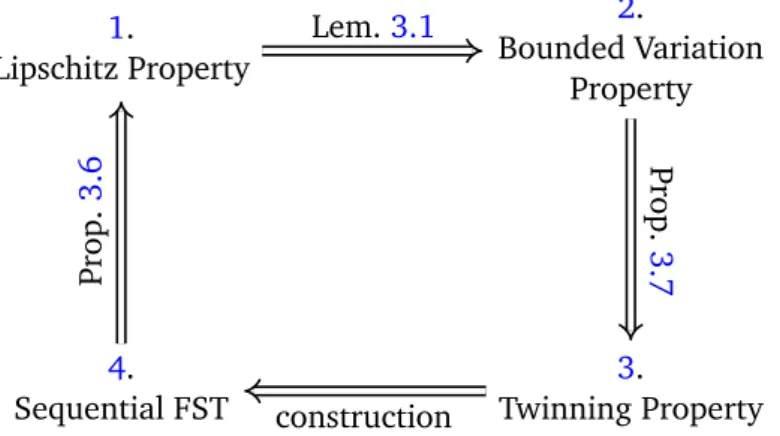
It is interesting to note that all the main results developed in this manuscript follow the same principles. They are based on the general shape of the sequen-tialisation theorem of Choffrut [Cho77], that we will recall later. For C1 a class
of machines, and C2 the subclass of C1 that we wish to characterise, the main theorem will ressemble to:
Theorem. Let T a machine of class C1. The following assertions are equivalent:
1. the function realised by T satisfies the . . . property, 2. the machine T satisfies the . . . structural property,
Outline of this Thesis 7
Each one of theses assertions plays a different role: 1is a machine independent characterisation,2is a property expressed by means of a pattern on a machine of class C1, that can be used to derive efficient decision procedures, and3denotes the class C2 of machines we wish to characterise.
We will often use a similar overall proof strategy, even if the individual proofs might employ different techniques. This main theorem will always be accompa-nied by a construction for the C2 equivalent machine, used as part of the proof for the theorem, and also a decision procedure to identify the machines of C1
that we characterise.
Outline of this Thesis
This thesis is divided in five chapters.
We start in Chapter 1 by presenting the different models of transducers that we will use. We also recall the main results for the classical problems of function-ality, sequentiality and equivalence for these models.
In Chapter 2, we carry out a systematic comparison of the expressiveness of the various equivalent models, by exhibiting constructions from one to another.
Chapter 3 is devoted to the presentation of the main known results around the sequentiality of functional finite-state transducers. We recall the two known properties to characterise the functions realised by finite-state transducers that are sequential or admit a sequential equivalent, along with two different presen-tations of the structural property to characterise the corresponding finite-state transducers themselves. We then recall the construction of the sequential equiv-alent when it exists. Finally, we discuss the decision of the sequentiality problem and give a new presentation of the decision procedure.
In Chapter 4, we characterise the functional finite-state transducers that ad-mit a k-sequential equivalent. We present a property of the functions that are realised by a k-sequential finite-state transducer and the corresponding struc-tural property for the functional finite-state transducers that admit a k-sequential equivalent. From this, we draw a construction as well as a decision procedure for the k-sequentiality problem.
Chapter 5 presents our work around string-to-context transducers. We first devise a property to characterise the functions that are realised by a sequen-tial string-to-context transducer, along with a structural property to characterise the functional string-to-context transducers that admit a sequential equivalent. We then undertake the combinatorial analysis of those transducers that admit a sequential equivalent, to obtain a more combinatorial version of the struc-tural property. This combinatorial property is later used as a foundation for our construction to build an equivalent sequential string-to-context transducer, if it exists. Finally, we exhibit a decision procedure for the sequentiality problem of string-to-context transducers.
Chapter
1
Models of Transducers
1.1 Preliminaries . . . 9
1.1.1 Alphabets and Words . . . 9
1.1.2 Contexts . . . 10
1.1.3 Functions and Relations . . . 11
1.1.4 Models and Associated Problems . . . 11
1.2 Finite-State Transducers (FST) . . . 12
1.3 Two-way Finite-State Transducers (2FST) . . . 14
1.4 Deterministic Streaming String Transducers (DSST) . . . 15
1.5 String-to-Context Transducers (S2C) . . . 19
1.6 Summary . . . 22
1.1 Preliminaries
1.1.1 Alphabets and Words
Let A be a finite alphabet. The set of finite words (or strings) over A is denoted by A∗. The empty word is denoted by ε. We denote the concatenation of a word u and a word v by u · v, and sometimes omit the dot, as in uv, when the meaning is clear from context. The length of a word u is denoted by |u|. The number of occurrences of the letter a in a word u is denoted by |u|a. We denote by last(u)
the last letter a non-empty word u. We denote by ˜uthe mirror of the word u, i.e. for u = u1· · · uk, where ui ∈ A for all 1 6 i 6 k, ˜u = uk· · · u1
We say that a word u is a prefix (resp. suffix) of a word v if there exists a word
ysuch that uy = v (resp. yu = v). We say that two words u, v ∈ A∗are conjugates if there exist two words t1, t2 ∈ A
∗
such that u = t1t2 and v = t2t1. If this holds,
we write u ∼ v. The primitive root of a word u ∈ A∗, denoted by root(u), is the shortest word x such that u = xp for some p > 1. A word is said to be primitive,
10 1. Models of Transducers
if it is equal to its primitive root. Given a word u ∈ A∗, we say that v is a factor of u if there exist words x, y such that u = xvy.
Given an alphabet B, we denote by FB the free group over B. For a word
x ∈ FB, we denote by x−1 its inverse in FB. For two words x, y ∈ B∗, if x is a
prefix of y, resp. a suffix, then we write x−1y, resp. yx−1, for the unique word
z ∈ B∗ such that y = xz, resp. y = zx.
Given two words u, v ∈ A∗, the longest common prefix (resp. suffix) of u and v is denoted by lcp(u, v) (resp. lcs(u, v)). We define the prefix distance between u and v, denoted by distp(u, v), as |u| + |v| − 2|lcp(u, v)|.
Given a set of words W ⊆ A∗, the longest common prefix (resp. suffix) of words in W is denoted by lcp(W ) (resp. lcs(W )).
In the following lemma, we recall a classical result of combinatorics that we will use in this thesis. For two integers n > 0 and m > 0, we denote by gcd(n, m) the greatest common divisor of n and m.
Lemma 1.1 (Fine and Wilf, [FW65], Chapter 9 of [Lot02]). Let x, y ∈ A∗ and
m, n ∈ N. If xmand ynhave a common factor of length at least |x|+|y|−gcd(|x|, |y|),
then the primitive roots of x and y are conjugates.
1.1.2 Contexts
Given a finite alphabet B, a context on B is a pair of words (u, v) ∈ B∗×B∗. The set of contexts on B is denoted by C(B). The empty context is denoted by cε. For a context c = (u, v), we denote by ←−c (resp. −→c) its left (resp. right) component: ←−c = u (resp. −→c = v). The length of a context c is defined as |c| = |←−c | + |−→c |. The lateralized length of a context c is defined as kck = (|←−c |, |−→c |). For a context
c ∈ C(B)and a word w ∈ B∗, we write c[w] for the word ←−c w−→c. We define the
concatenation of two contexts c1, c2 ∈ C(B) as the context c1c2 = (←c−1←c−2, −→c2−→c1).
Last, given a context c and a word u, we denote by c−1[u]the unique word v such that c[v] = u, when such a word exists.
Example 1.1. Let B = {a, b, c}. Let c1 = (aa, bb), c2 = (bc, c) ∈ C(B) and
w = cc ∈ B∗. Then ←c−1 = aa, −→c1 = bb and c1[w] = aaccbb. Also |c1| = 4, |c2| = 3
kc1k = (2, 2) and kc2k = (2, 1). Finally we have c1c2 = (aabc, cbb).
Given a set of contexts C ⊆ C(B), we denote by lcc(C) the longest common
context of elements in C, defined as lcc(C) = (lcs({←−c | c ∈ C}), lcp({−→c | c ∈ C})).
We also write C.lcc(C)−1 = {c0 | c0.lcc(C) ∈ C}.
Example 1.2. Let B = {a, b, c}. Let c1 = (abab, bbba), c2 = (acabab, bbbb), c3 =
(ccabab, bbbc) ∈ C(B), and let C = {c1, c2, c3}. Then lcc(C) = (abab, bbb). And
1.1. Preliminaries 11
1.1.3 Functions and Relations
We consider two sets X, Y . Given a (binary) relation ∆ ⊆ X × Y , we let dom(∆) = {x ∈ X | ∃y ∈ Y such that (x, y) ∈ ∆}. We denote the set of partial functions from X to Y by F (X, Y ). Given f ∈ F (X, Y ), we write f : X ,→ Y , we denote by dom(f ) its domain and, for X0 ⊆ X, we define f (X0) = {f (x) |
x ∈ dom(f ) ∩ X0}. When more convenient, we may also see elements of F (X, Y )
as subsets of X × Y . Last, given ∆ ⊆ X × Y , we let choose(∆) denote some ∆0 ∈ F (X, Y ) such that ∆0 ⊆ ∆ and dom(∆) = dom(∆0).
Remark. Throughout this thesis, we consider that all the functions we manip-ulate, be it the ones that we characterise or the ones that our models realise, are potentially partial. Therefore, we generally omit to say that they are indeed partial. Sometimes, however, we will explicitly insist that a function is partial if this is important for the understanding of the matter at hand.
1.1.4 Models and Associated Problems
In this thesis, we will manipulate transducers that realise functions from words to words or (binary) relations between words. We call class of transducers a set of transducers that either are described using the same model or satisfy some common properties.
In our domain, we often study whether (and how) some general problems can be solved with respect to a particular class of machines. We now introduce some classical problems of interest.
We consider a class C of transducers. The following problem asks, given a transducer in C, whether this transducer is a member of the subclass of C consist-ing only of transducers realisconsist-ing functions.
Problem 1.1 (Functionality). Given a transducer of class C, decide whether it realises a function.
The models of transducers we are interested in are all extensions of finite-state automata on words. From a transducer considered here, we can always extract the underlying automaton. If this underlying automaton is deterministic, then the transducer is said to be sequential. This leads to the following problem which, given a transducer in C, asks whether this transducer admits an equivalent transducer in the subclass of C consisting only of sequential transducers.
Problem 1.2 (Sequentiality). Given a transducer of class C, decide whether it can be realised by an equivalent sequential transducer of class C.
The following problem is also a natural problem and asks, given two transduc-ers in C, whether these transductransduc-ers are equivalent.
Problem 1.3 (Equivalence). Given two transducers of class C, decide whether they realise the same function or relation.
12 1. Models of Transducers
For each of the class of transducers that we introduce hereafter, we will recall the existing results for these classical problems. All these results are summarised in Table1.1.
1.2 Finite-State Transducers
Like finite-state automata, finite-state transducers read their input on a one-way left-to-right input tape. In addition, they can write to a one-one-way left-to-right output tape. For a comprehensive review, see [Ber13] or [Sak09].
Definition 1.1. Let A, B be two finite alphabets. A finite-state transducer (FST for short) T from A∗ to B∗ is a tuple (Q, tinit, tfinal, T )where Q is a finite set of states, tinit : Q ,→ B∗ (resp. tfinal : Q ,→ B∗) is the initial (resp. final) function, and T ⊆ Q × A × B∗× Q is the finite set of transitions.
A state q is said to be initial (resp. final) if q ∈ dom(tinit) (resp. q ∈ dom(tfinal)). We depict as −→w T q (resp. q w −→ T ), or just w
−→ q (resp. q −→) if it is clear from thew context, the fact that tinit(q) = w (resp. tfinal(q) = w). A run ρ from a state q1 to a state qk+1 on a word u = u1· · · uk ∈ A
∗
where for all 1 6 j 6 k, ui ∈ A, is
a sequence of transitions (q1, u1, w1, q2), (q2, u2, w2, q3), . . . , (qk, uk, wk, qk+1). The
output of such a run is the word w = w1w2. . . wk ∈ B
∗, and is denoted by out(ρ).
We depict this situation as q1 u|w
−−→
T qk+1, or just q1 u|w
−−→ qk+1 if it is clear from the
context. The run ρ is said to be accepting if q1 is initial and qk+1 final. This
finite-state transducer T computes a relation [[T ]] ⊆ A∗× B∗ defined as the set of pairs (u, v1v2v3)such that there are p, q ∈ Q with v1
−→ T p u|v2 −−→ T q v3 −→ T an accepting run.
Given an FST T = (Q, tinit, tfinal, T ), we define the constant MT as MT =
max{|w| | (p, a, w, q) ∈ T or (q, w) ∈ tinit ∪ tfinal}. Given ∆ : Q ,→ B∗, we
de-note by T∆the FST obtained by replacing tinit with ∆.
An FST is trimmed if each of its states appears in some accepting run. W.l.o.g., we assume that the finite-state transducers we consider are trimmed. Indeed, we are in this thesis only interested in the accepting runs and an equivalent trimmed FST can be built in linear time in the number of states.
The union of two finite-state transducers Ti = (Qi, tiinit, tifinal, Ti), for i ∈ {1, 2},
is defined as T1∪ T2 = (Q1∪ Q2, t1init∪ t2
init, t1final∪ t2final, T1∪ T2). States can always
be renamed to ensure disjointness. It is trivial to verify that [[T1∪ T2]] = [[T1]] ∪ [[T2]]. This operation can be generalized to the union of k finite-state transducers.
An FST T from A∗ to B∗ is functional if the relation [[T ]] is a function from
A∗ to B∗. The class of functions realised by functional finite-state transducers is called the class of rational functions [Ber13] and is denoted by Rat.
An FST T = (Q, tinit, tfinal, T )is sequential if dom(tinit)is a singleton and if for
every transitions (p, a, w, q), (p, a, w0, q0) ∈ T, we have q = q0 and w = w0. As it computes a unique run per input word, a sequential FST is always functional. An
1.2. Finite-State Transducers (FST) 13
FST is k-sequential if it is the union of k sequential FSTs. It is multi-sequential if it is k-sequential for some k ∈ N.
Figure 1.1 describes the graphical notations used to depict finite-state trans-ducers throughout this thesis.
q1 ab tinit(q1) = ab q2 ab tfinal(q2) = ab q3 a, b|ab q4 (q3, a, ab, q4), (q3, b, ab, q4) ∈ T
Figure 1.1 – Graphical notations used to depict FSTs.
Example 1.3. Two examples of functional, but non-sequential, finite-state trans-ducers are depicted on Figure1.2. Tlast, on Figure 1.2a, computes the function
flast : u ∈ {a, b}+ 7→ last(u)|u|. Tlast first non-deterministically guesses the last letter of the input word, and hence decides which of the initial states qa or qb
to start from. While in qa or qb, it also guesses whether the current input letter
is the last letter of the input word, and hence whether it should move to the final state qf. Tlast∗, on Figure1.2b, computes the function flast∗ : u1#· · ·#un 7→
last(u1)|u1|#· · ·#last(u
n)
|un| where for all 1 6 i 6 n, u
i ∈ {a, b}
+. T
last∗
oper-ates similarly to Tlast and makes the same non-deterministic guesses but for the
current#-separated input subword.
qa ε qf ε qb ε a, b|a a| a a, b|b b|b (a) Tlast qa ε qf ε qb ε a, b|a a| a a, b|b b|b #| # #|# (b) Tlast∗ Figure 1.2 – Two example FSTs: Tlast and Tlast∗.
The problem of the functionality of FSTs has long been studied [Sch75;GI83;
Béa+00] and proved by [FMR18] to be NLOGSPACE-complete. The problem
of the sequentiality of FSTs has also been studied extensively [Cho77; WK94;
Béa+00;BC02] and again proved by [FMR18] to be NLOGSPACE-complete. The equivalence problem for sequential FSTs and functional FSTs has been studied in [BH79] and [BH77] respectively. Regarding complexity, we can show it is NLOGSPACE-complete for sequential FSTs and PSPACE-complete for func-tional FSTs. The equivalence problem has been shown to be undecidable for FSTs in general [Iba77].
14 1. Models of Transducers
1.3 Two-way Finite-State Transducers
Two-way finite-state transducers are analogous to finite-state transducers
ex-cept that they use a two-way input tape, as two-way finite-state automata do [AHU69]. The input word can therefore be traversed in both directions arbitrar-ily. As such, the transducer needs to know when it reached the boundaries of the input word. Therefore we enrich the input alphabet with some begin and end markers (namely ` and a) used to flank the input word.
Definition 1.2. Let A, B be two finite alphabets. A two-way finite-state transducer (2FST for short) T from A∗to B∗ is a tuple (Q, tinit, tfinal, T )where Q is a finite set of states, tinit : Q ,→ B∗ (resp. tfinal : Q ,→ B∗) is the initial (resp. final) function,
and T ⊆ Q × A`a × B∗ × Q × {−1, +1} is the finite set of transitions, where
A`a = A ∪ {`, a}.
A configuration of a 2FST is a pair (q, i) ∈ Q × N where q is a state, and i is the current position on the input tape. A state q is said to be initial (resp. final) if q ∈ dom(tinit) (resp. q ∈ dom(tfinal)). A run ρ from a state q1 to a state qk+1 on
a word u = u1· · · un ∈ A∗`a where for all 1 6 i 6 n, ui ∈ A`a, is a sequence of
configurations (q1, i1), (q2, i2), . . . , (qk+1, ik+1)such that, for all 1 6 j 6 k, we have
1 6 ij 6 n and there exists (qj, uij, wj, qj+1, mj) ∈ T, such that mj = ij+1− ij.
The output of such a run is the word w = w1w2. . . wk ∈ B∗, and is denoted by out(ρ). The run ρ is said to be accepting if q1 is initial, qk+1 is final, i1 = 1
and ik+1 = n + 1. This two-way finite-state transducer T computes a relation
[[T ]] ⊆ A∗ × B∗ defined as the set of pairs (u, tinit(p) · out(ρ) · tfinal(q)) such that there are two states p, q ∈ Q and an accepting run ρ from p to q on the word ` u a.
A 2FST T from A∗ to B∗ is functional if the relation [[T ]] is a function from A∗ to B∗. Based on the equivalence of this model with Courcelle’s monadic second-order logic definable string transductions [EH01], the class of functions realised by functional two-way finite-state transducers is called the class of regular
func-tions and is denoted by Reg.
A 2FST T = (Q, tinit, tfinal, T )is sequential if dom(tinit)is a singleton and if for every transitions (p, a, w, q, m), (p, a, w0, q0, m0) ∈ T, we have q = q0, w = w0 and
m = m0. As it computes a unique run per input word, a sequential 2FST is always
functional.
Figure1.3describes the graphical notations used to depict two-way finite-state transducers throughout this thesis.
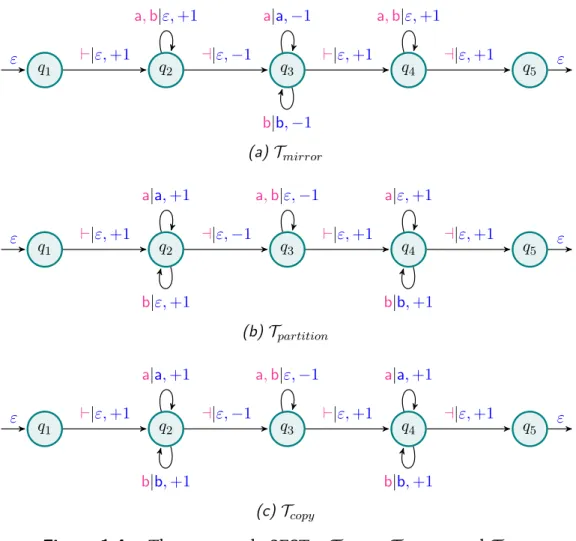
Example 1.4. Three examples of functional two-way finite-state transducers are depicted on Figure 1.4. Tmirror, Tpartition and Tcopy all operate by making three
traversals of the input word. All three of them are sequential. Tmirror, on Fig-ure1.4a, computes the function fmirror: u ∈ {a, b}
∗
1.4. Deterministic Streaming String Transducers (DSST) 15 q1 ab tinit(q1) = ab q2 ab tfinal(q2) = ab q3 q4 a, b|ab, +1 (q3, a, ab, q4, +1), (q3, b, ab, q4, +1) ∈ T
Figure 1.3 – Graphical notations used to depict 2FSTs.
to the end of the input word (in state q2), copies the letters while moving back-ward to its beginning (in state q3), and finally moves forward back to its end (in state q4). Tpartition, on Figure 1.4b, computes the function fpartition : u ∈
{a, b}∗ 7→ a|u|ab|u|b. T
partition moves forward while collecting the a letters (in state
q2), moves backward to the beginning of the input word (in state q3), and finally
moves forward again while collecting the b letters (in state q4). Tcopy, on Fig-ure 1.4c, computes the function fcopy : u ∈ {a, b}
∗
7→ uu. Tcopy moves forward
while copying the input word a first time (in state q2), moves backward to its
beginning (in state q3), and finally moves forward again while copying the input word a second time (in state q4).
The problem of the functionality of 2FSTs has been shown to be PSPACE
-complete [CK87]. [EH01] proved that the class of functional 2FSTs and the class of sequential 2FSTs coincide. As such, functional 2FSTs can always be re-alised by an equivalent sequential 2FST and [CK87] makes the problem of the sequentiality of 2FSTs to be PSPACE-complete.
The equivalence problem for sequential 2FSTs has been shown to be PSPACE -complete [Gur80]. This complexity also holds for functional 2FSTs as explained in [MP19]. As the problem of the equivalence is undecidable for FSTs in general [Iba77], it is also undecidable for 2FSTs in general.
1.4 Deterministic Streaming String Transducers
Alur and ˇCerný recently proposed a new model, deterministic streaming string
transducers, to capture the class of regular functions [AˇC10; AˇC11].
Contrar-ily to finite-state transducers and two-way finite-state transducers, deterministic streaming string transducers are not finite-state. Although they read the input word on a simple one-way left-to-right input tape, they employ a finite number of output registers, that can be concatenated altogether and with finite words, and thus recover a lot of expressiveness.
The following three definitions explain how registers are operated on.
Definition 1.3 (Register selectors). Given a finite set of registers X and an alphabet
B, we denote bySel(X , B)the set of register selectors defined as (X ∪ B)∗.
Definition 1.4 (Valuations). Given a finite set of registers X and an alphabet B, we define valuations as mappings from X to B∗. LetVal(X , B)be the set of such
16 1. Models of Transducers q1 ε q 2 q3 q4 q5 ε `|ε, +1 a|ε, −1 `|ε, +1 a|ε, +1 a, b|ε, +1 a|a, −1 b|b, −1 a, b|ε, +1 (a) Tmirror q1 ε q2 q3 q4 q5 ε `|ε, +1 a|ε, −1 `|ε, +1 a|ε, +1 a|a, +1 b|ε, +1 a, b|ε, −1 a|ε, +1 b|b, +1 (b) Tpartition q1 ε q 2 q3 q4 q5 ε `|ε, +1 a|ε, −1 `|ε, +1 a|ε, +1 a|a, +1 b|b, +1 a, b|ε, −1 a|a, +1 b|b, +1 (c) Tcopy
Figure 1.4 – Three example 2FSTs: Tmirror, Tpartition and Tcopy.
valuations. For ν ∈ Val(X , B), we lift ν to a morphism on Sel(X , B) by setting
ν(a) = afor all a ∈ B.
Definition 1.5 (Update functions). Given a finite set of registers X and an alphabet
B, the set of update functions X → Sel(X , B) is denoted by Upd(X , B). For σ ∈
Upd(X , B), we lift σ to a morphism onSel(X , B)by setting σ(a) = a for all a ∈ B. For ν ∈ Val(X , B)and σ ∈Upd(X , B), we write σ(ν) ∈Val(X , B) to denote the application of σ to ν, where for all X ∈ X , σ(ν)(X) = ν(σ(X)). Finally, for
σ1, σ2 ∈ Upd(X , B), we write σ1σ2 ∈Upd(X , B)to denote the composition of σ1 and σ2, where for all X ∈ X , σ1σ2(X) = σ2(σ1(X)).
For the purpose of depicting update functions, we use sets of assignments of the form “X = s” where X ∈ X and s ∈Sel(X , B).
Example 1.5. Let X = {X, Y } and B = {a, b, c}. Let ν = {X 7→ ab; Y 7→ ε} be a valuation. Let σ = {X = XY ; Y = Xc} be an update function. Then
1.4. Deterministic Streaming String Transducers (DSST) 17
we have σ(ν) = {X 7→ ab; Y 7→ abc}, σσ(ν) = {X 7→ ababc; Y 7→ abc}, and
σσσ(ν) = {X 7→ ababcabc; Y 7→ ababcc}.
Definition 1.6. Let A, B be two finite alphabets. A deterministic streaming string
transducer (DSST for short) T from A∗ to B∗ is a tuple (Q, X , qinit, ν, δ, µ) where
Qis a finite set of states, X is a finite set of registers, qinit ∈ Q is the initial state,
ν ∈Val(X , B)is the initial valuation, δ : Q×A ,→Upd(X , B)×Qis the transition function, µ : Q ,→Sel(X , B)is the final selection function.
Remark. Note that in most presentations of this model, as for example in [AˇC10], the initial valuation always associates every registers to the empty word. How-ever, we choose here to have an explicit initial valuation, as it will simplify the presentation of our results. It can easily be shown that both ways are equivalent.
We depict as −→ν
T qinit, or just
ν
−
→ qinit if it is clear from the context, the fact that qinit is the initial state and ν the initial valuation. A state q is said to be
final if q ∈ dom(µ), and we depict as q −→s
T , or just q
s
−
→ if it is clear from the context, the fact that µ(q) = s. A run ρ from a state q1 to a state qk+1 on a word u = u1· · · uk ∈ A
∗
where for all 1 6 i 6 k, ui ∈ A, is a
se-quence of transitions (q1, u1, σ1, q2), (q2, u2, σ2, q3), . . . , (qk, uk, σk, qk+1) such that
for all i, δ(qi, ui) = (σi, qi+1). The update of such a run is the update function
σ = σ1σ2· · · σk ∈ Upd(X , B). We depict this situation as q1
u|σ
−−→
T qk+1 or just
q1 u|σ
−−→ qk+1 if it is clear from the context. The run ρ is said to be accepting if q1 is
initial and qk+1 final. This deterministic streaming string transducer T computes a function1 [[T ]] : A∗ ,→ B∗ such that [[T ]](u) = σ(ν)(s), for all u ∈ A∗, for which there are p, q ∈ Q with−→ν
T p u|σ −−→ T q s −→ T an accepting run.
A DSST is trimmed if each of its states appears in some accepting run. W.l.o.g., we assume that the deterministic streaming string transducers we consider are trimmed. Indeed, we are in this thesis only interested in the accepting runs and an equivalent trimmed DSST can be built in linear time in the number of states.
Definition 1.7 (Copyless/Copyful). We say that a register selector s ∈Sel(X , B)is
copyless if each X ∈ X occurs at most once in s. An update function σ is copyless
if each X ∈ X occurs at most once in σ(X ). A DSST is copyless if all its transitions are labelled with copyless update functions or register selectors. If a DSST is not copyless, then it is copyful.
Remark. The copyless restriction is also called linear by some authors. As a mat-ter of fact, it is very similar to the linear constraint of tree transducers [Com+07].
Figure1.5describes the graphical notations used to depict deterministic stream-ing strstream-ing transducers throughout this thesis.
18 1. Models of Transducers
q1
ν
q1is the initial state and ν is the initial valuation
q2 s µ(q2) = s
q3 a|σ q4 δ(q3, a) = (σ, q4)
Figure 1.5 – Graphical notations used to depict DSSTs.
Example 1.6. Two examples of deterministic streaming string transducers are depicted on Figure1.6. Slast and Slast∗ are equivalent to T
last and Tlast∗ of
Exam-ple1.3.
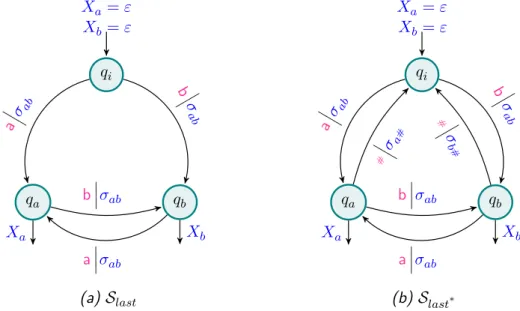
Slast, on Figure 1.6a, computes the function flast : u ∈ {a, b}+ 7→ last(u)|u|. Slast replaces non-determinism by the use of two registers Xa and Xb to store
both the words that would be produced if the last input letter were to be an a or a b. It also remembers in states qa and qb whether the last read letter is an a or a b, and selects the corresponding register Xa or Xb if this is indeed the last
input letter. Slast∗, on Figure 1.6b, computes the function f
last∗ : u1#· · ·#un 7→
last(u1)|u1|#· · ·#last(u
n)
|un| where for all 1 6 i 6 n, u
i ∈ {a, b}+. Slast∗ operates
similarly to Slast. Additionally, when it reads a# from states qa and qb, it copies
the content of the register Xa or Xb to the other register in order to commit to
the word produced accordingly to the last letter. As a result, Xa and Xb always have equal content up to their last# letter. Note that whereas Slast is copyless,
Slast∗ is copyful, because of the parallel copies of the register X
a (resp. Xb) in the
update function σa#(resp. σb#).
qi Xa= ε Xb = ε qa Xa qb Xb a σab a σab b σ ab b σab (a) Slast qi Xa= ε Xb = ε qa Xa qb Xb a σab a σab b σ ab b σab # σ a# # σ b# (b) Slast∗
Figure 1.6 – Two example DSSTs: Slast and Slast∗. The updates are abbreviated:
σab = {Xa = Xaa; Xb = Xbb}, σa# = {Xa = Xa#; Xb = Xa#} and
1.5. String-to-Context Transducers (S2C) 19
Example 1.7. Three additional examples of deterministic streaming string trans-ducers are depicted on Figure 1.7. Smirror, Spartition and Scopy are equivalent to
Tmirror, Tpartition and Tcopy of Example 1.4. They all replace the two-way traver-sals by the use of a unique register X. Smirror, on Figure 1.7a, computes the
function fmirror : u ∈ {a, b}
∗
7→ ˜u. Smirror prepends the read letters to X, thus
obtaining the mirror of the input word. Spartition, on Figure 1.7b, computes the function fpartition : u ∈ {a, b}
∗ 7→ a|u|a
b|u|b. S
partition prepends the read a letters
and appends the read b letters, thus obtaining the partitioning of those letters. Scopy, on Figure 1.7c, computes the function fcopy : u ∈ {a, b}
∗
7→ uu. Scopy
appends the read letters to X and finally uses two copies of X.
q X = ε X a|X = aX b|X = bX (a) Smirror q X = ε X a|X = aX b|X = Xb (b) Spartition q X = ε XX a|X = aX b|X = bX (c) Scopy Figure 1.7 – Three example DSSTs: Smirror, Spartition and Scopy.
Definition 1.8 (Appending/Concatenation-free). We define two subsets ofSel(X , B):
Selapp(X , B) = X · B∗ and Selcf(X , B) = B∗ · X · B∗. We say that a regis-ter selector s is appending (resp. concatenation-free) if s ∈ Selapp(X , B) (resp.
s ∈ Selcf(X , B)). An update function σ is appending (resp. concatenation-free) if, for all X ∈ X , σ(X) ∈ Selapp(X , B) (resp. σ(X) ∈ Selcf(X , B)). A DSST is
ap-pending (resp. concatenation-free) if all its transitions are labelled with apap-pending
(resp. concatenation-free) update functions or register selectors.
Example 1.8. Slastand Slast∗are appending, and thus concatenation-free. Smirror
and Spart are concatenation-free but not appending. Scopy is neither appending nor concatenation-free.
The equivalence problem for copyless DSSTs has been shown to be in PSPACE
[AˇC11]. It has also been shown to be decidable for copyful DSSTs [FR17].
1.5 String-to-Context Transducers
In this section, we introduce the string-to-context transducers, that are the ba-sis for some of the work presented in this theba-sis. They stand as an alternative presentation of the (copyless) concatenation-free DSSTs with 1 register. Unlike two-way finite-state transducers, that extend the finite-state transducers with a
20 1. Models of Transducers
two-way input tape, string-to-context transducers keep a one-way input tape but extend their output tape. The output tape can now be written to at both ends simultaneously, i.e. the output word is both prepended and appended to at each transition.
Definition 1.9. Let A, B be two finite alphabets. A string-to-context transducer (S2C for short) T from A∗ to B∗ is a tuple (Q, tinit, tfinal, T ) where Q is a finite set of states, tinit : Q ,→ C(B) (resp. tfinal : Q ,→ C(B)) is the initial (resp. final) function, and T ⊆ Q × A × C(B) × Q is the finite set of transitions.
A state q is said to be initial (resp. final) if q ∈ dom(tinit) (resp. q ∈ dom(tfinal)). We depict as −→c T q (resp. q c −→ T ), or just c −
→ q (resp. q −→) if it is clear from thec context, the fact that tinit(q) = c (resp. tfinal(q) = c). A run ρ from a state q1 to
a state qk+1 on a word u = u1· · · uk ∈ A
∗
where for all 1 6 j 6 k, ui ∈ A,
is a sequence of transitions (q1, u1, c1, q2), (q2, u2, c2, q3), . . . , (qk, uk, ck, qk+1). The
output of such a run is the context c = ckck−1· · · c1 ∈ C(B), and is denoted by
out(ρ). We depict this situation as q1 u|c
−→
T qk+1, or just q1 u|c
−→ qk+1 if it is clear
from the context. The run ρ is said to be accepting if q1 is initial and qk+1 final.
This string-to-context transducer T computes a relation [[T ]] ⊆ A∗× B∗ defined as the set of pairs (u, d3d2d1[ε]) such that there are p, q ∈ Q with d1
−→ T p u|d2 −−→ T q d3 −→ T an accepting run.
Remark. Because of the insertion of an empty word inside the context produced by runs, the output of S2Cs are words and not contexts. This effectively makes S2Cs string-to-string transducers.
Given an S2C T = (Q, tinit, tfinal, T ), we define the constant MT as MT =
max{|c| | (p, a, c, q) ∈ T or (q, c) ∈ tinit ∪ tfinal}. Given ∆ : Q ,→ B∗, we
de-note by T∆ the S2C obtained by replacing tinit with ∆. An S2C is trimmed if each of its states appears in some accepting run. W.l.o.g., we assume that the string-to-context transducers we consider are trimmed. Indeed, we are in this thesis only interested in the accepting runs and an equivalent trimmed S2C can be built in linear time in the number of states.
An S2C T from A∗ to B∗ is functional if the relation [[T ]] is a function from A∗ to B∗. An S2C T = (Q, tinit, tfinal, T )is sequential if dom(tinit)is a singleton and if for every transitions (p, a, c, q), (p, a, c0, q0) ∈ T, we have q = q0 and c = c0. As it computes a unique run per input word, a sequential S2C is always functional.
Figure 1.8 describes the graphical notations used to depict string-to-context transducers throughout this thesis.
Example 1.9. Two examples of string-to-context transducers are depicted on Figure 1.9. Tmirror0 and T
0
partition are equivalent to Tmirror and Tpartition of
Exam-ple1.4. They both are sequential and replace the two-way traversals by the use of prepending. Tmirror0 , on Figure1.9a, computes the function fmirror: u ∈ {a, b}
∗
1.5. String-to-Context Transducers (S2C) 21 q1 (a, b) tinit(q1) = (a, b) q2 (a, b) tfinal(q2) = (a, b) q3 q4 a, b|(a, b) (q3, a, (a, b), q4), (q3, b, (a, b), q4) ∈ T
Figure 1.8 – Graphical notations used to depict S2Cs.
˜
u. Tmirror0 prepends the read letters, thus obtaining the mirror of the input word.
Tpartition0 , on Figure1.9b, computes the function fpartition : u ∈ {a, b}∗ 7→ a|u|ab|u|b.
Tpartition0 prepends the read a letters and appends the read b letters, thus obtaining
the partitioning of those letters.
q cε cε a|(a, ε) b|(b, ε) (a) Tmirror0 q cε cε a|(a, ε) b|(ε, b) (b) Tpartition0
Figure 1.9 – Two example S2Cs: Tmirror0 and T
0
partition.
Remark. The classical model of finite-state transducers can be recovered from the one of string-to-context transducers. A string-to-context transducer T = (Q, tinit, tfinal, T ) is a string-to-string transducer from A∗ to B∗ if, for all (q, c) ∈
tinit ∪ tfinal, ←−c = ε, and for all (q, a, c, q0) ∈ T, ←−c = ε.
The problem of the functionality for S2Cs can be decided thanks to the de-cidability of the functionality for non-deterministic streaming string transducers which has been shown to be in PSPACE[AD11].
We have proved that the problem of the sequentiality of functional S2Cs is in
CONPTIMEin [RV19] and this result is fully detailed in Chapter5of this thesis.
In Chapter 2, we will see that sequential S2Cs are equivalent to 1-register (hence copyless) concatenation-free DSSTs. Therefore we can reuse [AˇC11] to state that the equivalence problem for sequential S2Cs is in PSPACE.
Let us discuss the equivalence problem for functional S2Cs. Functional S2Cs can also be viewed as 1-register concatenation-free non-deterministic stream-ing strstream-ing transducers (NSST, cf. [AD11]). To decide the equivalence between two functional S2Cs, we can proceed using the usual technique of first testing the equality of their domains and then testing the functionality of their disjoint union. Testing the equality of two non-deterministic finite-state automata is in PSPACE. Finally, the disjoint union of two 1-register NSSTs is still a 1-register NSST2, hence it is copyless, and its functionality can be decided in PSPACE
22 1. Models of Transducers
[AD11]. Therefore, the equivalence problem for functional S2Cs is in PSPACE.
Again, the undecidability of the problem of the equivalence for S2Cs in general stems from the undecidability of the equivalence for FSTs [Iba77].
1.6 Summary
We have seen four different models of transducers that will be used in this thesis: finite-state transducers, two-way finite-state transducers, deterministic streaming string transducers and string-to-context transducers. In Chapter 2, we will compare the expressiveness of these models. However, we can already recapitulate the latest results on the classical problems mentioned throughout this chapter. They are summarised in Table1.1. A recent survey can be found in [MP19].
1.6. Summary 23
Class of transducer Functionality Sequentiality Equivalence
Sequential FST n/a n/a NLOGSPACE-c [BH79]
Functional FST n/a NLOGSPACE-c [FMR18] PSPACE-c [BH77] FST NLOGSPACE-c [FMR18] NLOGSPACE-c [FMR18] undecidable [Iba77]
Sequential 2FST n/a n/a PSPACE-c [Gur80]
Functional 2FST n/a always true PSPACE-c [Gur80]
2FST PSPACE-c [CK87]
PSPACE-c
[EH01;CK87] undecidable
Copyless DSST n/a n/a PSPACE
[AˇC11]
Copyful DSST n/a n/a decidable
[FR17]
Sequential S2C n/a n/a PSPACE
[AˇC11]
Functional S2C n/a CONPTIME [RV19] PSPACE [AD11] S2C PSPACE [AD11] PSPACE [AD11;RV19] undecidable
Table 1.1 – Summary of the results for the classical problems. "n/a" means non-applicable.
Chapter
2
Comparison of Expressiveness
2.1 Functional Two-way Finite-State Transducers . . . 25 2.2 Functional Finite-State Transducers . . . 26 2.2.1 From Copyful Appending DSSTs to Functional FSTs . . . 27 2.2.2 From Functional FSTs to Copyful Appending DSSTs . . . 28 2.3 Sequential Finite-State Transducers . . . 29 2.4 Multi-Sequential Functional Finite-State Transducers . . . 30 2.4.1 From Copyless Appending DSSTs to Multi-Sequential Functional FSTs. . 30 2.4.2 From Multi-Sequential Functional FSTs to Copyless Appending DSSTs. . 30 2.5 Functional String-to-Context Transducers . . . 31 2.5.1 From Copyful Concatenation-Free DSSTs to Functional S2Cs . . . 32 2.5.2 From Functional S2Cs to Copyful Concatenation-Free DSSTs . . . 33 2.6 Sequential String-to-Context Transducers . . . 34 2.7 Summary . . . 34
In this chapter, we will study the expressiveness of the functional finite-state transducer models that we introduced in Chapter1. Specifically, we will look at how they compare to the deterministic streaming string transducer model and its different restrictions (copyless/copyful, appending/concatenation-free).
2.1 Functional Two-way Finite-State Transducers
As defined in Section1.3, the class of functions realised by functional 2FSTs is the class of regular functions [EH01].
[AˇC10] introduced the copyless DSST model and proved that the class of func-tions it realises is exactly the class of regular funcfunc-tions, by providing construc-tions from sequential 2FSTs to copyless DSSTs and from copyless DSSTs to de-terministic Monadic Second Order Transductions.
From these results, we draw the following proposition.