HAL Id: inserm-02297744
https://www.hal.inserm.fr/inserm-02297744
Submitted on 26 Sep 2019
HAL is a multi-disciplinary open access
archive for the deposit and dissemination of
sci-entific research documents, whether they are
pub-lished or not. The documents may come from
teaching and research institutions in France or
abroad, or from public or private research centers.
L’archive ouverte pluridisciplinaire HAL, est
destinée au dépôt et à la diffusion de documents
scientifiques de niveau recherche, publiés ou non,
émanant des établissements d’enseignement et de
recherche français ou étrangers, des laboratoires
publics ou privés.
therapy: the “APAD1” randomized controlled trial
Marion Carayol, Gregory Ninot, Pierre Senesse, Jean-Pierre Bleuse, Sophie
Gourgou, Hélène Sancho-Garnier, Chakib Sari, Isabelle Romieu, Gilles
Romieu, William Jacot
To cite this version:
Marion Carayol, Gregory Ninot, Pierre Senesse, Jean-Pierre Bleuse, Sophie Gourgou, et al..
Short-and long-term impact of adapted physical activity Short-and diet counseling during adjuvant breast cancer
therapy: the “APAD1” randomized controlled trial. BMC Cancer, BioMed Central, 2019, 19 (1),
pp.737. �10.1186/s12885-019-5896-6�. �inserm-02297744�
R E S E A R C H A R T I C L E
Open Access
Short- and long-term impact of adapted
physical activity and diet counseling
during adjuvant breast cancer therapy:
the
“APAD1” randomized controlled trial
Marion Carayol
1,2,3*, Gregory Ninot
2,4, Pierre Senesse
2, Jean-Pierre Bleuse
2, Sophie Gourgou
2,
Hélène Sancho-Garnier
2, Chakib Sari
2, Isabelle Romieu
5,6, Gilles Romieu
2and William Jacot
2,7Abstract
Background: Patients with breast cancer undergoing chemotherapy and radiotherapy experience fatigue and other treatment side effects. Integrative therapies combining physical activity and dietary counseling are recommended; however to date no large randomized controlled trial has been conducted during adjuvant therapy. The Adapted Physical Activity and Diet (APAD) intervention was evaluated for its ability to decrease fatigue (primary outcome), anxiety, depression, body mass index (BMI), and fat mass, and enhance muscular and cognitive performances, and quality-of-life (QoL).
Methods: Women diagnosed with early breast cancer (N = 143, mean age = 52 ± 10 years) were randomized to APAD or usual care (UC). APAD included thrice-weekly moderate-intensity mixed aerobic and resistance exercise sessions and 9 dietetic consultations. Patient-reported outcomes (PROs) and anthropometric, muscular, and cognitive variables were measured at baseline, 18 weeks (end of chemotherapy), and 26 weeks (end of radiotherapy and intervention), and at 6- and 12-month post-intervention follow-ups. Multi-adjusted linear mixed-effects models were used to compare groups over time.
Results: Significant beneficial effects of the APAD intervention were observed on all PROs (i.e., fatigue, QoL, anxiety, depression) at 18 and 26 weeks. The significant effect on fatigue and QoL persisted up to 12-month follow-up. Significant decreases in BMI, fat mass, and increased muscle endurance and cognitive flexibility were observed at 26 weeks, but did not persist afterward. Leisure physical activity was enhanced in the APAD group vs UC group at 18 and 26 weeks. No significant effect of the intervention was found on major macronutrients intake.
Conclusions: A combined diet and exercise intervention during chemotherapy and radiotherapy in patients with early breast cancer led to positive changes in a range of psychological, physiological and behavioral outcomes at the end of intervention. A beneficial effect persisted on fatigue and QoL at long term, i.e., 1 year post-intervention. Diet-exercise supportive care should be integrated into the management of early breast cancer patients.
Trial registration: The APAD study was prospectively registered on ClinicalTrials.gov (NCT01495650; date of registration: December 20, 2011).
Keywords: Breast cancer, Adjuvant, Exercise, Diet, Intervention, Fatigue, Quality of life, Supportive care
© The Author(s). 2019 Open Access This article is distributed under the terms of the Creative Commons Attribution 4.0
International License (http://creativecommons.org/licenses/by/4.0/), which permits unrestricted use, distribution, and
reproduction in any medium, provided you give appropriate credit to the original author(s) and the source, provide a link to the Creative Commons license, and indicate if changes were made. The Creative Commons Public Domain Dedication waiver (http://creativecommons.org/publicdomain/zero/1.0/) applies to the data made available in this article, unless otherwise stated. * Correspondence:[email protected]
1IAPS laboratory“Impact of Physical Activity on Health”, University of Toulon,
Avenue de l’Université, 83957 La Garde, France
2Val d’Aurelle Montpellier Cancer Institute (ICM), 208, Avenue des
Apothicaires, Parc Euromédecine, 34298 Montpellier Cedex 5, France; Montpellier University, 34000 Montpellier, France
Background
With more than 1.6 million new cases in 2012 worldwide, breast cancer (BCa) remains the highest incident cancer in women [1]. In France, it was responsible for 31.2% of all women cancer cases in 2015 which induces a large number of women being treated with adjuvant cancer therapy and then living with its side effects. Indeed, current cancer receiving chemotherapy and/or radiothe-rapy produce deleterious physiological and psychological effects [2–6] including pain, decreased cardiac function, muscle wasting, weight gain, cancer-related fatigue, and psychological distress.
With a 70–100% prevalence, cancer-related fatigue was reported as the most distressing and common symptom by cancer patients undergoing adjuvant cancer therapy, even more than pain, nausea and vomiting which can ge-nerally be managed by medications [2, 7–9]. Cancer-related fatigue has been defined by the National Compre-hensive Cancer Network as “a distressing, persistent, subjective sense of physical, emotional and/or cognitive tiredness or exhaustion related to cancer or cancer treat-ment that is not proportional to recent activity and inter-feres with usual functioning” [7]. Fatigue commonly occurs within a symptom cluster [3,5,6,10–15] including depression, anxiety, pain, reduced activity level, cognitive functioning impairment, comorbidities, nutritional and anthropometry changes, etc., resulting in impaired quality-of-life (QoL) [4] and affecting cancer prognosis for some of them [16–19]. Exercise and nutrition consulta-tions are two integrative therapy components recom-mended by the National Comprehensive Cancer Network to relieve side effects, and especially cancer-related fatigue during active treatment [7]. Exercise for cancer patients should associate moderate intensity aerobic exercise and muscle strengthening exercises [20]. Nutrition should be based on the World Cancer Research Fund (WCRF) guidelines after a cancer diagnosis [21] i.e., keep a healthy weight, eat more plant-based foods, limit red and pro-cessed meat, limit energy-dense foods, salt, sugary drinks, alcohol, and do not rely on dietary supplements. Exercise may help improve physical fitness, fatigue, QoL, psy-chological distress and cognitive abilities [22–27], while nutritional consultations may help manage nutritional dis-orders such as anemia, diarrhea, nausea, and vomiting that contribute to cancer related-fatigue [7, 28, 29]. In addition, the combination of exercise and dietary inter-ventional components has led to significant weight loss in BCa survivors after adjuvant chemotherapy/radiotherapy [30–32]. In patients undergoing adjuvant chemotherapy and/or radiotherapy for BCa, to our knowledge two RCTs assessed exercise and diet in combination, but both were designed as pilot trials with less than 30 patients par randomization group [33,34]. Therefore, there is a need to evaluate the benefits of an exercise-diet intervention
during adjuvant chemotherapy and radiotherapy in a well-powered RCT.
Moreover, most of the RCTs that assessed exercise and/or diet interventions during chemotherapy/radio-therapy had a relatively short-term follow-up (no more than 6 months [34–40]). In their recent meta-analysis, Furmaniak et al. [23] concluded that longer-term eva-luation is required due to long-term side effects of adju-vant treatment.
The Adapted Physical Activity and Diet counseling (APAD) trial was designed to assess the 1-year follow-up effects of an exercise-diet intervention delivered during a 6-cycle adjuvant chemotherapy regimen followed by radiotherapy in patients with early BCa. We hypothesized that APAD would yield beneficial effects as compared to usual care (UC) on cancer related-fatigue as a primary outcome. Secondary outcomes of our study include QoL, anxiety and depressive symptoms, body mass index (BMI), body composition, cognitive and muscular functions, chemotherapy adherence, physical activity practice, and nutritional intake.
Methods
The protocol of the APAD1 study has been described previously [41]. The APAD1 study has been designed and implemented in order to evaluate the impact of a exercise and nutrition-based supportive care interven-tion named APAD during chemotherapy and radiothe-rapy in BCa patients. The APAD1 study was located in a cancer health center from south of France (the Montpel-lier Cancer Institute). The APAD intervention was eva-luated as compared to UC that did not involve specific exercise or nutrition care for BCa patients.
Experimental design and population study
The APAD1 study was a two-armed, randomized, con-trolled, prospective trial (see Aditional file 1: Figure S1). Eligible participants were women aged 18–75 years with histological proven and newly (less than 6 months) diag-nosed non-metastatic BCa, whatever their baseline phys-ical activity level or dietary intakes. The patients were enrolled after undergoing curative surgery. All patients were planned for 6 cycles of adjuvant chemotherapy (in-cluding epirubicin / cyclophosphamide / 5-fluorouracil for 3 cycles every 3 weeks [FEC100 protocol], followed by do-cetaxel for 3 cycles every 3 weeks), followed by 6 weeks of radiotherapy administered at the Montpellier Cancer In-stitute [ICM, Montpellier, France]) [42]. All participants were recruited at the ICM. Exclusion criteria were medical contra-indications to moderate intensity physical activity, inability to attend intervention sessions or assessments, and a difficulty or disability preventing the patient from correctly understanding the trial information or require-ment. The study received agreement from ethical and
institutional review boards and was prospectively tered on ClinicalTrials.gov (NCT01495650; date of regis-tration: December 20, 2011).
Procedure
Before chemotherapy, potential participants were identified by the hospital medical oncologists with help from clinical research assistants. All of the patients that were proposed to be part of the APAD1 study were informed about the objective of the study and the potential benefits of diet and exercise on fatigue during adjuvant therapy. The patients who provided written informed consent and completed baseline assessments were then randomly assigned in a 1:1 ratio to the APAD experimental arm or to the UC control arm (Additional file 1: Figure S1) using a computer-generated program. Block randomization (block size = 4) was performed at the ICM Biometric Unit by using the Stata software version 12 (StatCorp, LLC, College Station, TX, USA). The allocation assignment was concealed from the project directors. Participants, interventionists, and as-sessors were not masked to group assignment.
Interventions Overview
The APAD program was implemented during chemo-therapy and radiochemo-therapy (approximately 26 weeks) and included: (i) exercise sessions planned thrice-weekly in-cluding individually supervised hospital-based exercise sessions and non-supervised home-based sessions, com-bining one muscle strength session and two aerobic sessions each week. Hospital-based supervised exercise sessions were planned every 3 weeks on the same days of chemotherapy and radiotherapy to avoid any additional cost; the program included 9 supervised sessions at the ICM hospital center and all other sessions were home-based unsupervised sessions. (ii) Nine hospital-based and face-to-face nutritional therapeutic education ses-sions targeting body weight control and to modify feed-ing behaviors accordfeed-ing to the WCRF recommendations [21]. The nutritional sessions were planned on the same days as supervised hospital-based exercise sessions. For the participants who met exercise and/or dietary intakes guidelines at baseline, the intervention was tailored as they had to maintain their exercise level and their die-tary intakes in accordance with the guidelines all along the intervention period. The content of the APAD inter-vention has been previously described [41].
Exercise
The exercise program was delivered by exercise specialists who are certified (or is eligible to certification) in adapted physical activity by the French University of Sports Sciences and combined aerobic and muscle strengthening exercises in compliance with the recommendations established for
cancer patients [20,43]. About the exercise dose, guidelines of 150 min of moderate to vigorous physical activity (MVPA) per week associated with strength training have been advanced for cancer patients whatever cancer site or treatment period [20, 44]. Exercising while receiving chemotherapy or radiotherapy involves specific brakes, es-pecially the loss of physical condition induced by chemo-therapy in BCa patients is an important brake in doing relatively high doses of MVPA, as compared to exercising after adjuvant therapy as a cancer survivor. In a meta-analysis, we have investigated the optimal dose of exercise to be prescribed to BCa patients undergoing chemotherapy and/or radiotherapy [22]. Inverse dose–response
relation-ships were observed for fatigue and QoL, supporting the hypothesis of greater improvements of fatigue and QoL with lower weekly prescribed exercise doses (< 12 Meta-bolic Equivalent of Task (MET).h/week). These findings generated the hypothesis that the prescription of a program targeting 8–10 MET h/week could be well adapted for pa-tients with BCa receiving adjuvant therapy [22]. An adapted program then could consist in one resistance session for principal muscular groups and two moderate intensity 30 to 45 min aerobic sessions per week. This is the prescribed dose that was tested in the APAD1 study.
Exercise sessions were planned thrice-weekly including individually supervised hospital-based exercise sessions and non-supervised home-based sessions, combining one muscle strength session and two aerobic sessions each week. Every session starts with warm-up for 10 min in-cluding joint rotations (fingers, wrists, elbows, shoulders, neck, hips, knees, ankles, feet and toes) for 3 min, slow jogging for 5 min, and cross-over stepping, thighs lift and heels to buttocks for 2 min. Every session ends with cool-down followed by flexibility exercises (10 min).
Strength sessions (once a week) targeted 6 main muscle groups (hamstrings, quadriceps, buttocks, ab-dominal, back, shoulders/arms) by asking patients to achieve 6 different tasks. Each task was performed for 2 to 5 sets with 6 to 12 repetitions. Two to 5 different tasks with increasing difficulty were available for each muscle group. Every 6 weeks the exercise specialist pro-posed a 2-repetition or 1-set increase, and/or shift for more difficult task according to patient’s physical condi-tion and progression.
Aerobic exercise sessions were performed at moderate intensity and adapted to patient’s physical condition and progression in the range of 50–75% of the maximum heart rate for 30 to 45 min. Initial exercise intensity was individualized but generally began at 50 to 55% of the maximum heart rate and progressed to 65 to 75% of the maximum heart rate by weeks 20 to 26. Initial exercise duration was also individualized but generally began between 25 to 35 min per session and achieved 40 to 50 min per session by weeks 20 to 26. The starting point
for exercise prescription was determined according to the maximum heart rate estimated as 220 – age of the patient [45], and patient exercise history and current practice. Rate of progression was individualized according to the severity of treatment-related side effects. When pa-tients presented health troubles, important fatigue, or any symptom that could limit exercise, an adapted decreased dose was proposed to patients by the exercise specialist. Supervised hospital-based sessions were achieved on a cycloergometer. For home-based practice, patients were proposed various modalities of aerobic exercise (e.g., walk-ing, joggwalk-ing, cyclwalk-ing, dancing/fitness, swimming) to aid compliance to the program and promote enjoyment [46].
Hospital-based supervised exercise sessions aimed to provide the patients with relevant instructions to allow reproducibility at home and increase autonomy. Every supervised session was based on theoretically grounded specific behavioral targets (e.g., problem-solving barriers, self-efficacy, social support) [47] and behavior change techniques (e.g., provide information about behavior-health link and consequences of practice, provide instruc-tion and demonstrate the behavior, set graded tasks, prompt self-monitoring of behavior, plan social support or social change) [48] (see Additional file2: Table S1) [41] to improve behavioral change and patient’s adherence. Hospital-based supervised exercise sessions were sche-duled on the same day as chemotherapy administration and during radiotherapy, at the frequency of one every 3 weeks. In total, 9 hospital-based supervised exercise ses-sions were planned in the course of the intervention. Each session lasted approximately 50 to 70 min.
Home-based non-supervised sessions were planned 3 times per week, except that only 2 home-based sessions a week were scheduled on the weeks involving one super-vised hospital-based exercise session. Precise written instructions for home-based sessions were given to pa-tients in the educational and personable APAD-Moving workbook (French language, available on request) inclu-ding information about disease and reasons for being physically active during cancer active treatment, written instructions illustrated with pictures for performing home exercises (e.g., warm-up content, muscle tasks, prescribed number of series/repetitions with space for potential incrementation, aerobic intensity and duration, flexibility tasks), schedule for planned home-based sessions, and patient log to evaluate patient adherence. The strength-based exercise that were taught to participants during the supervised sessions did not need any particular material so that they could easily be done at home. Patients were asked to fill in the adherence log at home with whether planned sessions were achieved or not, number of achieved muscular exercises, duration of session, rating of perceived exertion (on scale of 1 to 10), reason for missed session and, any commentary that they would like to
discuss with the exercise specialist at the next supervised session. The APAD-Moving workbook included a range of behavior changes techniques [48] (e.g., provide informa-tion about behavior-health link and consequences of prac-tice, provide instruction and demonstrate the behavior, set graded tasks, prompt self-monitoring of behavior).
Diet counseling
APAD patients received 9 face-to-face individual ses-sions of diet counselling from a dietician who is certified (or is eligible to certification) by a French University. Each session lasted approximately 30 min.
In the course of chemotherapy, 6 diet sessions were scheduled to reach balanced dietary intakes advising patients for controlling weight and for managing with chemotherapy potential toxicities and side-effects. Then 3 more sessions planned in the course of radiotherapy for all APAD patients: in patients with BMI < 30, weight control was pursued; in patients with BMI≥ 30, weight normalization was targeted (i.e., decreasing BMI below to 30 by the end of adjuvant therapy).
Each consultation involved(i) nutritional status evalu-ation, (ii) nutrition care tailored to the patient’s caloric needs and potential toxicities related to treatment and, (iii) nutritional education.
Nutritional status evaluation Nutritional status was evaluated based on the usual weight, the current weight and the weight measured one to six months prior to study enrolment according to the French National Au-thority for Health criteria. The dietician assessed the pa-tient’s daily energy requirement by computing the basal metabolic rate (BMR) [49]; the BMR was multiplied by 1.3 to allow for energy needed for daily living activities, and then in APAD patients only the BMR was multiplied by 1.2 to allow for energy needed for exercise.
Nutrition care Nutrition care aimed at weight control through balanced dietary intakes tailored to the patient’s energy intake needs and potential toxicities related to treatment. At each session, the dietician evaluated diet-ary intakes with 24 h-recall and appetite using a 10-point visual analogue scale. Calories and nutrients were computed by entering food intakes on a nutritional ana-lysis software [50]. Then the dietician verified the pa-tient’s intakes to be in line with the following guidelines: (i) daily energy intake was compared to the estimated daily energy needs,(ii) patients were guided to regularly distribute their dietary intakes as 3 main meals with an optional snack in the afternoon, (iii) macronutrient dis-tribution was compared to the French dietary reference intakes for balanced diet (i.e., 30–35% of lipids, 50–55% of carbohydrates, and 10–15% of proteins) [35] and,(iv) food groups intake were guided to meet the
recommendations of the WCRF [21]. If either patient’s
habits did not correspond to these guidelines, or daily en-ergy intake was higher or lower than 10% of the estimated daily energy needs, the dietician counselled modifications regarding foods, nutrients, meals, and calories distribution. When patient’s BMI was higher than 30 by the end of chemotherapy, a new weight goal was settle by decreasing the patient’s BMI within the range of 25 to 30. A new range of daily energy need was then estimated with a correspond-ing distribution accordcorrespond-ing to foods groups balance and WCRF guidelines [21]. Patients were given a printed ex-ample of food groups, servings and distribution they may eat on a typical day. In the following sessions, the dietician computed again patient’s intakes and adapted her advice ac-cording to the evolution of patient’s intakes. Specific advice was given to patients for the management of chemotherapy potential toxicities and side-effects [51]. In case of nausea or vomiting, patients were recommended to eat foods at room or cold temperature, to avoid sugary, fatty, and highly flavored foods, to eat steamed vegetables, dry foods (e.g., toasted or crisp bread), fresh foods (e.g., yogurts, fresh fruits, sorbet), to take cool drinks outside meals, to elimin-ate exciting drinks (e.g., tea, coffee, alcohol). In case of mu-cositis, patients were advised to avoid acid and spicy foods (e.g., lemon, mustard, vinegar), to keep their month wet by drinking frequently, to eat smooth and cooked foods at room temperature. Patients were recommended to: in-crease or diminish dishes seasoning (e.g., spices, herbs, salt, sugar) according to patient’s tasting in case of taste disor-ders; increase starchy foods (e.g., potatoes, rice, pasta), béchamel sauce with green vegetables, and white meat, eggs or fish rather than red meat; and to start meals by taking acid beverages or fruits (e.g., grapefruit, pineapple) in case of metallic taste.
Nutritional education Nutritional education aimed to teach the patients with the principles of a well-balanced and healthy diet based on WCRF guidelines [21], inform about industrial food products packaging, and fight against preconceived ideas, by using practical applica-tions and educational games. Each session was based on specific education targets (Additional file 3: Table S2). Nutritional education was tailored to patients’ habits and means, precariousness level, and cultural and social environment.
Missed sessions
During chemotherapy Regarding hospital-based super-vised sessions, missed supersuper-vised exercise or diet counse-ling sessions were not possible to be rescheduled as patients only come to the hospital once every three weeks during chemotherapy. In case of missed supervised session, a phone call was made to the patient by the exercise and/or
dietician specialists. Discussion focused on reasons for not attending the session, patient adherence in the last three weeks, encourage the patient attending future exercise or diet counseling sessions taking into account its difficulties and deliver education targets and content (if possible) of the missed session.
During radiotherapy As most of the patients come to the hospital every weekday during radiation therapy, supervised hospital-based missed sessions were resche-duled as soon as possible.
Control
The control group was a UC group without any diet or exercise intervention. There was no particular material delivered period to the control group during the inter-vention. The UC patients were not asked to limit exer-cise practice or eat/avoid specific foods during the intervention period.
Outcome measures
Five repeated assessments were conducted at the ICM. These occurred at baseline, just before the start of adju-vant chemotherapy (T0); the end of chemotherapy (T1); end of radiotherapy; immediately post-intervention (T2); 6-month follow-up (T3); and 1-year follow-up (T4) (Additional file1: Figure S1).
Details about the assessment planning and tools employed were published previously [41]. Subjective patient-reported outcomes (PROs) were evaluated at all assessment times. Cancer-related fatigue (primary out-come) was assessed using the Multidimensional Fatigue Inventory (MFI) [52]. QoL was assessed by using the EORTC QLQ-C30 [53]. Anxiety and depression symp-tomatology was evaluated using the Hospital Anxiety Depression Scale [54]. All questionnaires were available and validated in French. Objective outcomes were mostly assessed at T0, T2, T3, and T4. Power and strength of 10 successive vertical jumps allowing a 10-s interval were measured by the Myotest® accelerometer system [55]. The power/strength maintained during the task was estimated by the ratio of the last two to the first two jumps that was considered as an indicator of muscular fatigue in healthy individuals and athletes [56–58]. Lower limb muscle endurance was measured at 15 s and 30s using the 30-s chair stand test [59]; the ratio of 15–30s to 0–15 s number
of repetitions was computed to assess an index of lower limb muscle fatigability. Attentional capabilities (i.e., alert-ness, working memory and flexibility) were assessed using the Test of Attentional Performance (TAP software, ver-sion 2.3) [60]. Physical activity during the past week was collected by face-to-face interviews using the Global Phys-ical Activity Questionnaire (GPAQ) [61] at all of the as-sessment times. The SenseWear Pro Armband™ (version
3.0) [62] accelerometer data were collected at T0 and T2 and were included in the analysis if patients provided at least 3 days of wear for≥ 10 h/day. Several variables were considered in the analysis: total duration of physical acti-vity (min/day), total duration of moderate physical actiacti-vity (min/day), average METs (METs.h/day) and, sedentary time (min/day). Moderate intensity physical activity cor-responded to measured intensity from 3 to 6 METs and sedentary time corresponded to less than 3 METs.
Anthropometry measures included weight, height, and BMI at all of the assessment times, and body composition at T0, T2, T3, and T4 by using Bioelectrical Impedance Analysis [63]. Dietary intakes were measured at T0, T2, and T4 by asking patients to complete a 3-day food record [64], with the foods and beverages consumed for 3 con-secutive days (of which one weekend day), and were en-tered into nutritional analysis software to compute calories and nutrient intake [50]. Chemotherapy obser-vance was recorded in order to calculate the relative dose-intensity (RDI) as the ratio of delivered dose dose-intensity of chemotherapy to standard dose intensity.
Statistical analysis
A two-point reference for the general fatigue MFI sub-scale was established as a valuable minimal clinically important difference in cancer patients with active treat-ment by Purcell et al. [65]. With 70 participants per group, our trial had 90% power to detect a between-group differ-ence of 2 points (standard deviation [SD] = 4 [65, 66]), which corresponded to a 0.5 effect size, on the general fa-tigue scale of the MFI [52] at each time point (T1, T2, T3, T4), considering the general fatigue mean level observed in the APAD group at baseline (Table2), and allowing for a repeated measures design [67] and a 10% loss-to-follow-up. A two-tailedP value was set at .05.
Linear mixed models were used to model each outcome measure over post-randomization time points (maximum of 4) and to compare the mean differences between groups across time based on the interaction effect between time (T1, T2, T3 and T4) and group (APAD, UC). An un-structured covariance matrix for residuals was assumed. Participants were considered as random effects and group, time, and arm-by-time interaction as fixed effects. Models were adjusted for the baseline value of the outcome, age, and surgery type. First, analyses were conducted following the intention-to-treat principle, using all available data without any missing data imputation.
Because of a drop-out difference in APAD vs Control, the risk of selection bias was explored by comparing base-line characteristics (i.e., sociodemographic, clinical, PRO, muscular, anthropometry, and behavioral variables) of the included patients with complete data (i.e., the primary outcome was collected at all of the assessment times) and
incomplete data (i.e., the primary outcome was missing at one [or more than one] of the assessment times).
All statistical tests were two-sided, with a 5% level of significance. Effect size of 0.2 should be considered as a ‘small’ effect size, 0.5 represents a ‘medium’ effect size and 0.8 a‘large’ effect size. Statistical analyses were con-ducted in Stata version 12 (StatCorp, LLC, College Sta-tion, TX, USA).
Results
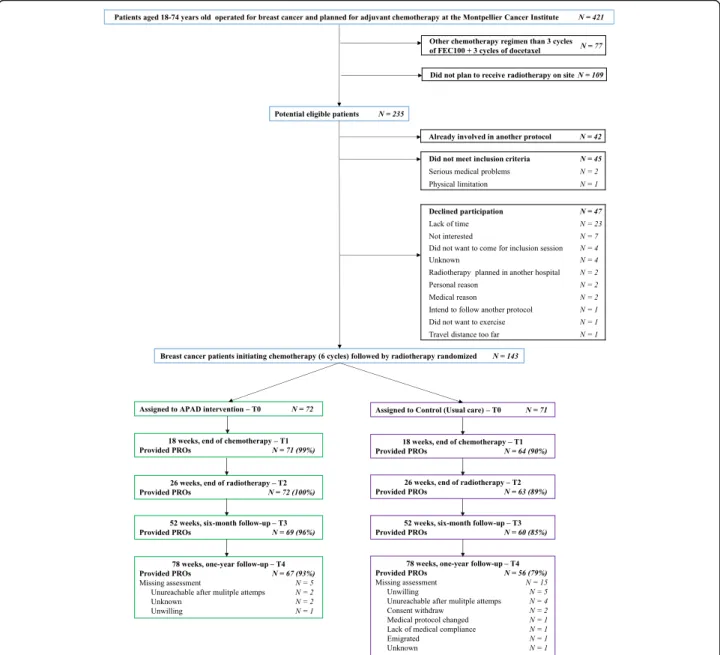
From December 2010 to April 2013, 143 patients out of 235 (61%) eligible patients were randomized to APAD (N = 72) or UC (N = 71) and followed during 1.5 year (Fig.1). PRO data were collected from 94, 94, 90, and 86% of patients at T1, T2, T3, and T4, respectively. Baseline characteristics of the patients are presented in Table1and include women with a median age of 52 years and a median BMI of 25.5 kg/m2. On average, APAD participants attended 67% of the planned exercise sessions (n = 48 of 72), 67% of the supervised sessions (n = 6 of 9), and 67% of the home-based sessions (n = 42 of 63). On average, 71% of the aerobic exercise sessions (n = 34 of 48) with 41 ± 25 min duration and 58% of the resistance exercise sessions (n = 14 of 24) were completed. The number of exercise sessions achieved each week by the APAD patients are pre-sented on the Additional file4: Figure S2. A large majority of the APAD patients have completed at least one exercise session every week of the program (from 81% on week 18 to 98% on week 1), and in general a majority of the APAD patients have completed 3 or more exercise sessions each week on the program (from 44% on week 11 to 80% on week 3). Reasons for not achieving exercise planned ses-sions reported by patients are displayed on Additional file5: Figure S3. The stated reasons from the most to the less frequent were fatigue (33%), lack of motivation (24%), pain (13%), health problem (9%), nausea (6%), professional or familial imperative (5%), refusal (2%), bad weather (2%), and other (6%). Regarding dietary counseling, APAD parti-cipants attended 97% of the planned consultations (on ave-rage,n = 9 of 9). No serious adverse events were related to exercise or diet intervention.
Tables 2, 3 and 4, and Figs. 2 and 3 present data and outcome changes due to the intervention.
Fatigue
All dimensions of fatigue were significantly decreased in APAD vs UC at T1, with an effect size (ES) of− 0.28 for general fatigue (Table 2). The difference persisted at T2 for all fatigue scores, although significance was not reached for general fatigue (P < 0.10). At T3, mental fa-tigue and reduced activities were significantly reduced. At T4, general fatigue was significantly decreased (ES,− 0.16) as well as physical fatigue (ES, − 0.18) and reduced acti-vities (ES,− 0.17) (Fig.2).
QoL, and psychological distress
Global QoL was significantly increased in APAD vs UC at T1, T2, T3, and T4. At T4, significant increases were seen for global QoL (ES, 0.26), physical function (ES, 0.25), role function (ES, 0.18), and social function (ES, 0.23). Anxiety and depression were both significantly reduced at T1 and T2 (ES, − 0.24 and − 0.38 at T2, respectively), but no between-group difference was found afterward.
Physical, attentional, and anthropometry measures
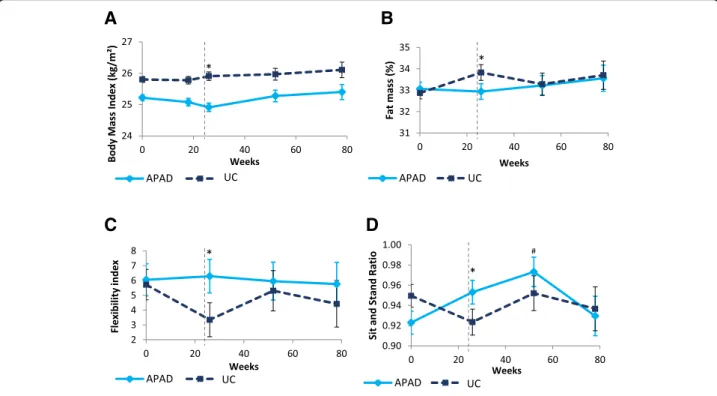
Lower limb muscle endurance (e.g., sit-and-stand ratio) was significantly increased in APAD vs UC at T2 (ES, 0.22) (Fig.3). However, there was no evidence of power
or force increase (Table 3). An increase in cognitive flexibility (index and number of errors) was observed at T2, but the alert phase index and working memory were not improved. BMI was significantly reduced by − 0.46 kg/m2 (ES, − 0.21) in APAD vs UC at T2, and weight was decreased by − 1.19 kg (ES, − 0.21), with borderline significance (P = 0.051). Total fat mass was significantly decreased by − 1.10% (ES, − 0.21) at T2. No between-group difference was seen for total muscle mass. Muscle mass from the legs was significantly increased at T3 and T4 (ES, 0.17). Between-group differences regarding muscle endurance, cognitive flexibility, BMI, and fat mass did not persist at the T3 and T4 follow-up points.
Fig. 1 CONSORT flow diagram of patients with breast cancer participating in the APAD1 study. Note: The primary outcome (assessed by the Multidimensional Fatigue Inventory) is part of the Patient-Reported Outcomes (PROs)
Physical activity and dietary intake
Based on the GPAQ, declared leisure physical activity was significantly increased at T1 (ES, 0.29) and T2 (ES, 0.32), but not afterward (Table4). No between-group difference was observed in total physical activity and sedentary.
Based on accelerometer valid measurements at T0 (n = 106) and T2 (n = 86) moderate intensity physical activity was not significantly increased at T2 (P = 0.094). No sig-nificant effect of the intervention was observed on energy and major macronutrient intake at T2 and T4.
Table 1 Characteristics of included patients with breast cancer Total (N = 143) UC (N = 71) APAD (N = 72) Age, mean (sd) 51.6 (10.1) 52.1 (9.3) 51.2 (10.9) Weight, mean (sd) 68.5 (13.9) 69.6 (14.1) 67.5 (13.7) BMI, mean (sd) 25.5 (5.3) 25.8 (5.3) 25.2 (5.4) Obese, N (%) 26 (18.2) 15 (21.1) 11 (15.3) Post-menopausal, N (%) 67 (46.8) 37 (52.1) 30 (41.7) Tobacco smoking, N (%) Non-smoker 65 (45.4) 30 (42.2) 35 (48.6) Smoker 36 (25.2) 22 (31.0) 14 (19.4) Former smoker 42 (29.4) 19 (26.8) 23 (31.9) Marital status, N (%) Single/divorced/widowed, no child 3 (2.1) 2 (2.8) 1 (1.4)
Single/divorced/widowed, with child 15 (10.5) 7 (9.9) 8 (5.6)
Married/Living together, no child 7 (4.9) 3 (4.2) 4 (2.8)
Married/Living together, with child 118 (82.5) 59 (83.1) 59 (81.9)
Education level, N (%)
No qualifications 23 (16.1) 14 (19.7) 9 (12.5)
Secondary level 29 (20.3) 15 (21.1) 14 (19.4)
Completed high school 31 (21.7) 11 (15.5) 20 (27.8)
Completed≥2 years at University 60 (42.0) 31 (43.7) 29 (40.3)
Usual professional status, N (%)
Full or part-time employed 95 (66.4) 43 (60.5) 52 (72.2)
Retired 36 (25.2) 19 (26.8) 17 (23.6) Unemployed/Medical leave 12 (8.4) 9 (12.7) 3 (4.2) Surgery type, N (%) Lumpectomy 60 (42.0) 26 (36.6) 34 (47.2) Quadrantectomy 57 (39.9) 37 (52.1) 20 (27.8) Mastectomy 26 (18.2) 8 (11.3) 18 (25.0) Cancer stagea , N (%) Stage I 62 (43.3) 33 (46.5) 29 (40.3) Stage IIa/IIb 62 (43.3) 29 (40.8) 33 (45.8) Stage IIIa/IIIc 18 (12.6) 9 (12.7) 9 (12.5)
Breast cancer subtype, N (%)
Triple negative 32 (22.4) 13 (18.3) 19 (26.4)
HER2+, ER+, and/or PR+ 17 (11.9) 9 (12.7) 8 (11.1)
HER2+, ER−, and PR− 1 (0.7) 1 (1.4) 0 (0.0)
HER2-, ER+, and/or PR+ 93 (65.0) 48 (67.6) 45 (62.5)
Abbreviations: APAD Adapted Physical Activity and Diet counseling intervention, UC Usual Care
a
Table 2 Mean values at baseline, and between-group differences and at the end of chemotherapy, the end of radiotherapy and at 6-month and 1-year follow-up for PROs T0 Baseline T1 –18 weeks Mid-intervention T2 –26 weeks End of intervention T3 –52 weeks 6-month follow-up T4 –78 weeks 1-year follow-up Mean (SD) AMD (95% CI)* ES P† AMD (95% CI)* ES P† AMD (95% CI)* ES P† AMD (95% CI)* ES P† Fatigue (MFI) General fatigue UC 9.2 (3.4) − 1.72 (− 2.72; − 0.71) − 0.28 0.002 − 0.92 (− 1.98; 0.13) − 0.14 0.081 − 0.95 (− 2.22; 0.31) − 0.12 0.103 − 1.46 (− 2.96; 0.05) − 0.16 0.038 AP AD 9.9 (3.7) Physical fatigue UC 9.2 (4.2) − 2.08 (− 3.11; − 1.04) − 0.33 0.001 − 1.96 (− 3.03; − 0.88) − 0.30 0.002 − 0.78 (− 2.02; 0.46) − 0.10 0.207 − 1.54 (− 2.96; − 0.11) − 0.18 0.034 AP AD 9.5 (4.2) Mental fatigue ‡ UC 7.6 (3.4) − 0.15 (− 0.26; − 0.04) − 0.22 0.015 − 0.18 (− 0.3; − 0.06) − 0.25 0.004 − 0.15 (− 0.3; − 0.01) − 0.17 0.031 − 0.09 (− 0.27; 0.09) − 0.08 0.244 AP AD 8.1 (3.7) Reduced activities ‡ UC 9 (3.8) − 0.2 (− 0.31; − 0.09) − 0.30 0.002 − 0.17 (− 0.29; − 0.06) − 0.25 0.010 − 0.21 (− 0.34; − 0.07) − 0.25 0.005 − 0.17 (− 0.33; 0) − 0.17 0.044 AP AD 9.1 (3.9) Reduced motivation ‡ UC 6.7 (2.6) − 0.18 (− 0.29; − 0.07) − 0.28 0.007 − 0.15 (− 0.26; − 0.04) − 0.22 0.026 − 0.09 (− 0.22; 0.04) − 0.11 0.203 − 0.1 (− 0.26; 0.05) − 0.11 0.196 AP AD 6.9 (3.4) Quality-of-life (EORTC QLQ C30) Global QoL UC 69.5 (18.9) 7.08 (2.22; 11.95) 0.24 0.012 7.69 (2.6; 12.78) 0.25 0.008 7.58 (1.46; 13.69) 0.20 0.018 11.87 (4.52; 19.21) 0.26 0.002 AP AD 66.9 (18) Physical function UC 88.8 (11.1) 8.54 (4.56; 12.5) 0.35 0.000 7.44 (3.34; 11.5) 0.30 0.001 2.84 (− 2; 7.69) 0.10 0.199 8.69 (2.98; 14.4) 0.25 0.002 AP AD 86.5 (13.7) Role function UC 84.5 (23.1) 13.5 (8.26; 18.6) 0.42 0.000 9.27 (3.83; 14.7) 0.28 0.003 3.98 (− 2.48; 10.45) 0.10 0.198 8.61 (0.96; 16.3) 0.18 0.022 AP AD 82.9 (18.9) Emotional function UC 66.3 (21.7) 9.38 (3.5; 15.3) 0.26 0.014 2.88 (− 3.3; 9.05) 0.08 0.472 1.73 (− 5.5; 8.97) 0.04 0.695 6.4 (− 2.08; 14.9) 0.12 0.172 AP AD 66.5 (19) Cognitive function UC 85.5 (17.9) 8.48 (3.13; 13.8) 0.26 0.008 3.87 (− 1.7; 9.45) 0.11 0.219 2.26 (− 4.18; 8.7) 0.06 0.486 5.64 (− 1.78; 13.1) 0.12 0.129 AP AD 85.9 (18.6) Social function UC 82.1 (23.3) 6.22 (− 0.13; 12.58) 0.16 0.234 7.04 (0.45; 13.62) 0.18 0.174 0.77 (− 7.03; 8.56) 0.02 0.946 13.0 (3.80; 22.3) 0.23 0.025 AP AD 84.7 (22.5) Anxiety and depression (HADS) Anxiety UC 11.3 (3.3) − 1.57 (− 2.28; − 0.87) − 0.36 0.000 − 1.08 (− 1.83; − 0.33) − 0.24 0.009 − 0.23 (− 1.18; 0.72) − 0.04 0.533 − 0.3 (− 1.48; 0.88) − 0.04 0.515 AP AD 11.9 (3.2) Depression UC 9.7 (3.3) − 1.36 (− 2.05; − 0.68) − 0.32 0.001 − 1.66 (− 2.37; − 0.95) − 0.38 0.000 − 0.4 (− 1.28; 0.47) − 0.08 0.305 − 0.59 (− 1.69; 0.5) − 0.09 0.243 AP AD 10.1 (3.4) Abbreviations :AMD Adjusted Mean Differences, EF Effect Size of difference between groups, CI Confidence Interval, MFI Multidimensional Fatigue Inventory, HADS Hospital Anxiety Depression Scale, APAD Adapted Physical Activity and Diet counseling intervention, UC Usual Care NOTE: Bold font indicates significant difference *Baseline value, surgery type and age-adjusted mean differences and their associated 95% confidence interval estimated with linear mixed model †P-value for time*arm interaction estimated with linear mixed model ‡Log transformed variables: Mental fatigue – MFI, Reduced activities – MFI, Reduced Motivation – MFI
Chemotherapy completion rates
On average, the RDI was 96.0% in UC and 96.7% in APAD (P = 0.39). The percentage of participants who re-ceived more than 95% of their planned RDI was 65.1% in UC and 78.8% in APAD (Chi-squared,P = 0.083).
Sensitivity analyses
The drop-out rate was significantly different in APAD vs UC at T4 (7% vs 21%, respectively; Chi-squared, P = 0.001). There was no significant difference in baseline characteristics in the included patients with complete data vs incomplete data (P > 0.05) (Additional file 6: Table S3).
Discussion
The results of the APAD1 study support that an exercise and diet intervention relieves cancer-related fatigue and QoL during chemotherapy and radiotherapy, with sus-tainable effects seen at the 1-year follow-up post-intervention, in patients with early BCa. Consistent with our hypotheses, salutary effects were also found on anx-iety, depression, leisure physical activity, BMI, fat mass, muscle endurance (sit-and-stand test) and cognitive flexibility at the end of radiotherapy. Although these ef-fects were not maintained at all follow-up times, lean body mass in the legs was significantly increased at the 1-year follow-up. Contrary to our hypotheses, there was no significant effect of the intervention on nutri-tional intakes, objective physical activity (as measured by accelerometer), working memory, alertness, and completion rates of chemotherapy.
This is the first study to demonstrate that a multicom-ponent exercise-diet intervention delivered during BCa chemotherapy and radiotherapy had significant benefits on fatigue that are sustainable 1 year after the end of the intervention. According to our knowledge, two previous studies have investigated the effects of a combined diet and exercise intervention during adjuvant therapy for BCa [33,34]. However, they have not assessed fatigue. In studies that investigated the effect of exercise interven-tion only during adjuvant therapy for BCa, numerous have reported beneficial effects on fatigue immediately after the intervention [23]; but these trials presented follow-up periods that did not exceed 6 months, and did not include a diet interventional component. These studies reported mixed findings about fatigue at follow-up times [35–40].
Another original finding is the sustainable 1-year post-intervention beneficial effect of the APAD post-intervention on QoL. Indeed, previous studies testing a combined diet and exercise intervention during adjuvant therapy for BCa [33,34] did not found any beneficial effects on QoL. In addition, exercise only intervention studies
reported mixed findings about QoL at follow-up times (6-month follow-up maximum) [35–40].
Cancer-related fatigue was significantly improved in the APAD vs the UC group at the end of chemother-apy and the end of radiotherchemother-apy. The effect of the APAD intervention on general fatigue (ES =− 0.28) at the end of chemotherapy was, as a matter of size, comparable to the average effect size observed on fa-tigue in a recent meta-analysis that included 22 pooled exercise interventions during adjuvant therapy for BCa (ES =− 0,28) [23].
Other PROs i.e., QoL, anxiety and depression, yielded significant positive results at the end of chemotherapy and at the end of radiotherapy, with small to moderate effect sizes. Regarding QoL, the ef-fect size of the APAD intervention at the end of chemotherapy or radiotherapy (ES = 0.24) was higher than the average effect size observed on QoL in the 13 pooled exercise interventions during adjuvant ther-apy for BCa (ES = 0,12) [23]. The APAD impact on depression (ES of − 0.38 at the end of radiotherapy) was higher as well than in the 6 pooled exercise stud-ies that measured depression (ES =− 0.15) [23]. In addition, the impact of the APAD intervention per-sisted with small but significant positive on fatigue and QoL results 1 year after the end of radiotherapy. Post-diagnosis deteriorations in fatigue, QoL and psy-chological distress have generally been associated with poorer BCa survival in BCa patients [16, 17], making the long-term efficacy (i.e., 1 year follow-up) of the APAD intervention particularly relevant in clinical practice.
Previous combined diet and exercise interventions delivered during chemotherapy [33, 34] did not report any benefits on body fat (%) and BMI. The APAD inter-vention was efficient to decrease body fat (%) and BMI at the end of intervention. This is a particularly relevant effect in the clinical context of BCa as BMI before and after BCa diagnosis and weight gain after diagnosis have recently been associated with increased mortality in meta-analyses [18,19].
Mixed findings were observed in the APAD study about muscular outcomes: muscular endurance (as measure by the 30s sit-and-stand test) was improved at the end of the intervention whereas lower limb force or power did not change. Previous combined diet and exer-cise interventions did not measure these outcomes [33,
34]. However, a recent meta-analysis of the studies with exercise only interventions in BCa receiving adjuvant therapy has reported a pooled significant improvement on strength [23]. Although individual studies effects were inconsistent, it seems that high doses training or important focus on resistance training led to better ef-fects on strength [36,40,68].
Table 3 Mean values at baseline, and between-group differences and at the end of chemotherapy, the end of radiotherapy and at 6-month and 1-year follow-up for muscular, body composition and attentional outcomes T0 Baseline T1 –18 weeks Mid-intervention T2 –26 weeks End of intervention T3 –52 weeks 6-month follow-up T4 –78 weeks 1-year follow-up Mean (SD) AMD (95% CI)* EF P† AMD (95% CI)* EF P† AMD (95% CI)* EF P† AMD (95% CI)* EF P† Muscular tests Sit-and-stand 30s ‡ UC 16.4 (4.9) –– – 0.07 (0.02; 0.12) 0.25 0.005 0.04 (− 0.03; 0.11) 0.09 0.203 0.07 (− 0.03; 0.17) 0.12 0.125 AP AD 15.3 (3.7) Sit-and-stand ratio UC 0.95 (0.12) –– – 0.04 (0.01; 0.08) 0.22 0.013 0.036 (− 0.007; 0.078) 0.14 0.081 0.01 (− 0.05; 0.06) 0.02 0.563 AP AD 0.92 (0.11) Power ratio UC 0.94 (0.14) –– – − 0.01 (− 0.06; 0.04) 0.09 0.541 − 0.07 (− 0.13; − 0.01) − 0.19 0.041 − 0.02 (− 0.1; 0.06) − 0.05 0.508 AP AD 0.96 (0.15) Force ratio UC 0.99 (0.14) –– – 0.00 (− 0.04; 0.04) 0.01 0.978 − 0.02 (− 0.07; 0.04) − 0.05 0.529 − 0.04 (− 0.11; 0.03) − 0.09 0.313 AP AD 1.00 (0.15) Attentional performances (TAP) Alertness index UC − 0.002 (0.099) –– – − 0.01 (− 0.04; 0.01) − 0.09 0.359 0.00 (− 0.03; 0.04) 0.02 0.918 0.01 (− 0.04; 0.06) 0.04 0.700 AP AD 0.010 (0.069) Flexibility index UC 6.7 (9.4) –– – 2.58 (0.54; 4.62) 0.21 0.044 0.281 (− 2.46; 3.03) 0.02 0.841 0.972 (− 2.49; 4.44) 0.05 0.594 AP AD 7.2 (9) Flexibility: errors ‡ UC 2 (4.1) –– – − 0.29 (− 0.48; − 0.09) − 0.24 0.024 − 0.05 (− 0.32; 0.22) − 0.03 0.741 − 0.023 (− 0.38; 0.34) − 0.01 0.898 AP AD 1.8 (3.4) Working memory: errors -omissions ‡ UC 5.9 (6.5) –– – − 0.06 (− 0.26; 0.14) − 0.05 0.915 0.14 (− 0.16; 0.43) 0.08 0.217 − 0.113 (− 0.51; 0.28) − 0.05 0.854 AP AD 3.7 (4.1) Anthropometry and body composition Weight (kg) UC 69.7 (14.1) − 0.44 (− 1.27; 0.39) − 0.09 0.576 − 1.19 (− 2.13; − 0.25) − 0.21 0.051 − 0.45 (− 1.8; 0.91) − 0.05 0.680 − 0.52 (− 2.33; 1.29) − 0.05 0.690 AP AD 67.5 (13.8) BMI (kg/m 2) UC 25.8 (5.3) − 0.17 (− 0.48; 0.15) − 0.09 0.515 − 0.46 (− 0.82; − 0.11) − 0.21 0.033 − 0.16 (− 0.66; 0.34) − 0.05 0.664 − 0.17 (− 0.84; 0.49) − 0.04 0.706 AP AD 25.3 (5.4) FM (%) UC 32.9 (7.7) –– – − 1.10 (− 1.97; − 0.22) − 0.21 0.041 − 0.27 (− 1.53; 1.00) − 0.03 0.717 − 0.35 (− 2.05; 1.35) − 0.03 0.708 AP AD 33.1 (7.7) MM (kg) UC 45.4 (5.4) –– – − 0.16 (− 0.65; 0.33) − 0.05 0.741 0.33 (− 0.36; 1.02) 0.08 0.279 0.56 (− 0.34; 1.47) 0.10 0.174 AP AD 44.2 (4.9) MM to FM ratio § UC 0.5 (0.2) –– – 0.03 (0; 0.07) 0.17 0.093 0.02 (− 0.03; 0.07) 0.06 0.469 0.01 (− 0.06; 0.08) 0.02 0.836 AP AD 0.5 (0.2) FM -trunk (kg) UC 12.2 (5.6) –– – − 0.88 (− 1.49; − 0.27) − 0.24 0.027 − 0.02 (− 0.85; 0.8) 0.00 0.985 − 0.23 (− 1.28; 0.83) − 0.04 0.734 AP AD 12.2 (5.4)
Table 3 Mean values at baseline, and between-group differences and at the end of chemotherapy, the end of radiotherapy and at 6-month and 1-year follow-up for muscular, body composition and attentional outcomes (Continued) T0 Baseline T1 –18 weeks Mid-intervention T2 –26 weeks End of intervention T3 –52 weeks 6-month follow-up T4 –78 weeks 1-year follow-up Mean (SD) AMD (95% CI)* EF P† AMD (95% CI)* EF P† AMD (95% CI)* EF P† AMD (95% CI)* EF P† MM -trunk (kg) UC 23.4 (2.9) –– – − 0.13 (− 0.37; 0.11) − 0.09 0.468 0.02 (− 0.32; 0.37) 0.01 0.779 0.06 (− 0.4; 0.52) 0.02 0.689 AP AD 22.9 (2.6) FM -legs (kg) § UC 8.7 (2.9) –– – − 0.06 (− 0.11; − 0.01) − 0.20 0.071 0.02 (− 0.05; 0.09) 0.04 0.555 0.01 (− 0.08; 0.1) 0.02 0.734 AP AD 8.4 (3) MM -legs (kg) UC 16.5 (1.9) –– – 0.00 (− 0.21; 0.21) 0.00 0.743 0.30 (0.00; 0.59) 0.17 0.038 0.40 (0.01 ; 0.79) 0.17 0.032 AP AD 16 (1.7) Abbreviations :AMD Adjusted Mean Differences, EF Effect Size of difference between groups, CI Confidence Interval, TAP Test of Attentional Performance, APAD Adapted Physical Activity and Diet counseling intervention, UC Usual Care, FM Fat Mass, MM Muscle mass NOTE: Bold font indicates significant difference. T1 columns contain empty cells because muscular, body composition and attentional outcomes were not measured at T1, except weight and BMI *Baseline value, surgery type and age-adjusted mean differences and their associated 95% confidence interval estimated with linear mixed model †P-value for time*arm interaction estimated with linear mixed model ‡Log transformed variables: Sit-and-stand 30s, Flexibility: errors – TAP, Working memory: errors and omissions – TAP §Square root transformed variables: Muscle to fat mass ratio, Fat mass -legs only
Table 4 Mean values at baseline, and between-group differences and at the end of chemotherapy, the end of radiotherapy and at 6-and 12-month follow-up for beh avioral outcomes T0 Basel ine T1 –18 weeks Mid-interven tion T2 –26 we eks End of intervent ion T3 –52 weeks 6-m onth follow-up T4 –78 weeks 1-year follow-up Mean (SD) AMD (95 % CI)* EF P† AMD (95 % CI)* EF P† AMD (95% CI)* EF P† AMD (95% CI)* EF P† Declared physical activity in MET .min/semain e (GP AQ) Total (MET.min/wk) ¶ UC 1671 (1788 ) 5.82 (− 0.04; 11.67) 0.16 0.10 8 4. 31 (− 1.62 ; 10.23) 0.12 0.219 3.92 (− 2.7; 10.55) 0.10 0.2 83 − 1.05 (− 8.51; 6. 41) −0.02 0.93 6 AP AD 1506 (1617 ) Mod erate intens ity (ME T.min /wk) UC 1659 (1791 ) 293.7 (− 140.2; 727. 6) 0.11 0.17 9 220.8 (− 21 9.5; 661) 0.08 0.273 41 8.1 (− 87.9; 92 4.2) 0.14 0.1 10 10 5.4 (− 489.2; 700) 0.03 0.55 0 AP AD 1428 (1427 ) Leisu re (MET.min/w k) UC 663 (121 4) 8.77 (3 .87; 13. 66) 0 .29 0.001 9.6 1 (4 .66; 14. 56) 0.32 0.000 3.89 (− 1.62; 9. 39) 0.12 0.0 71 2.29 (− 3.88; 8. 46) 0.06 0.20 3 AP AD 343 (559 ) Seden tary ti me (m in/day) UC 431 (178 ) 28.8 (− 18.9; 76.6) 0.10 0.31 1 − 28 .1 (− 78 .0; 21.4) −0.09 0.450 − 31.4 (− 91.2; 28 .3) −0.09 0.4 40 − 55.0 (− 126.2; 16.3 ) −0.13 0.20 5 AP AD 415 (143 ) Ach ieved physical activit y for an average day (A rmBand) Total (min) ‡ UC 88 (79) 0. 24 (− 0.11 ; 0.59) 0.11 0.166 AP AD 84 (62) Mod erate intens ity (min) UC 86 (76) 14 .6 (− 11 .6; 40.9) 0.09 0.094 AP AD 83 (61) Average inte nsity (MET.h ) UC 2 (0) 0. 05 (− 0.08 ; 0.18) 0.06 0.279 AP AD 2 (0) Seden tary ti me (m in) UC 776 (211 ) 13 .3 (− 50 .9; 77.5) 0.03 0.432 AP AD 755 (162 ) Nutrient inta ke per day (3-day reco rd) Total energy (kcal) ‡ UC 1418.2 (414. 1) − 0. 03 (− 0.11 ; 0.05) −0.07 0.248 − 0.03 (− 0.23; 0.16) −0.03 0.60 0 AP AD 1538.6 (427. 4) Protei ns (g) UC 64.1 (20.2 ) 3. 89 (− 0.85 ; 8.63) 0.13 0.367 2.2 (− 7.09; 11 .5) 0.04 0.83 0 AP AD 66.7 (17.4 ) Anim al protei ns (g ) UC 35.4 (19.6 ) 3. 35 (− 1.69 ; 8.39) 0.11 0.366 8.92 (− 5.49; 23 .33) 0.10 0.27 4 AP AD 36.9 (17.4 ) Vege tal prot eins (g) UC 12.8 (7.7) − 0. 03 (− 1.92 ; 1.85) 0.00 0.885 − 1.45 (− 6.28; 3. 39) −0.05 0.53 9 AP AD 13.3 (6.9) Lipids (g) UC 60 (20.6) − 4.9 (− 10 .3; 0.54) −0.15 0.091 − 11.2 (− 23.6; 1. 1) − 0.15 0.06 6 AP AD 64.2 (22.5 ) Saturated fat (g) ‡ UC 21.9 (7.8) − 0. 02 (− 0.13 ; 0.09) −0.03 0.517 − 0.05 (− 0.34; 0.24) −0.03 0.64 8
Table 4 Mean values at baseline, and between-group differences and at the end of chemotherapy, the end of radiotherapy and at 6-and 12-month follow-up for beh avioral outcomes (Continued) T0 Basel ine T1 –18 weeks Mid-interven tion T2 –26 we eks End of intervent ion T3 –52 weeks 6-m onth follow-up T4 –78 weeks 1-year follow-up Mean (SD) AMD (95 % CI)* EF P† AMD (95 % CI)* EF P† AMD (95% CI)* EF P† AMD (95% CI)* EF P† AP AD 24.8 (9.8) Monou nsaturated fat (g) UC 22.7 (8.3) − 2. 27 (− 4.61 ; 0.07) −0.16 0.081 − 4.28 (− 9.32; 0. 75) − 0.14 0.08 9 AP AD 24.1 (9.6) Polyu nsaturated fat (g) ‡ UC 7.8 (7.2) − 0. 07 (− 0.21 ; 0.07) −0.08 0.408 − 0.05 (− 0.35; 0.25) −0.03 0.74 8 AP AD 7 (3.2) Total carbohydrates (g) UC 145.4 (51.6) − 4. 17 (− 17 .09; 8.76) −0.05 0.365 9.01 (− 23.57; 41.59) 0.05 0.69 2 AP AD 160.6 (52.6) Fibre s (g) UC 15.2 (5.8) − 0. 43 (− 2.07 ; 1.2) −0.04 0.708 0.35 (− 3.58; 4. 28) 0.01 0.83 4 AP AD 14.7 (5.7) Abbreviations :AMD Adjusted Mean Differences, CI Confidence Interval, EF Effect Size, GPAQ Global Physical Activity Questionnaire, APAD Adapted Physical Activity and Diet counseling intervention, UC Usual Care NOTE: Bold font indicates significant difference *Baseline value, surgery type and age-adjusted mean differences and their associated 95% confidence interval estimated with linear mixed model †P-value for time*arm interaction estimated with linear mixed model ‡Log transformed variables: Total physical activity – ArmBand, Total energy – 3-day record, Saturated fat – 3-day record, Polyunsaturated fat – 3-day record, Linoleic acid – 3-day record, Linolenic acid – 3-day record ¶Square root transformed variables: Total physical activity – GPAQ, Leisure physical activity – GPAQ
The APAD intervention yielded improvements on cog-nitive flexibility at the end of the intervention. To our knowledge, two previous studies investigated the impact of exercise interventions on cognitive function by using the trail-making test (assessing concentration and cogni-tive flexibility) in BCa patients receiving adjuvant the-rapy [69, 70]. Although intervention group improved at post- vs pintervention, none of the two studies re-ported a significant difference in the intervention vs the control group. The longer duration of the APAD inter-vention (i.e., 24 weeks), as compared to 12 weeks in these two previous studies [69, 70] could explain the greater impact of the APAD intervention on cognitive flexibility. About behavioral outcomes, previous combined inter-ventions including diet and exercise components delivered during chemotherapy [33, 34] both yielded significant changes in dietary intakes, and one in declared total phy-sical activity in the intervention group (post vs pre-intervention) [34]. The APAD intervention had significant favorable impact on leisure time physical activity at the end of chemotherapy and at the end of radiotherapy, but improvements in total physical activity were not signifi-cant. Physical activity done in the framework of the APAD intervention was reported in the leisure category, which explain the enhancement of the physical activity type in our study. Regarding dietary intakes, no significant changes were observed in our study in the APAD vs the UC group. The 3-day record method (and foods to nutri-tion conversion software) we used generated large stan-dard deviations (see Table4, baseline values for nutrients) that have possibly impair statistical power to detect a between-group difference. The two abovementioned pre-vious studies [33, 34] that demonstrated dietary changes have analyzed dietary data that were collected by food frequency questionnaires.
Except the long term effects on fatigue and QoL, most of the significant outcomes (i.e., anxiety, depres-sion, fat mass, BMI, muscular endurance, cognitive flexibility, physical activity) in the APAD study were limited to the end of chemotherapy (mid-intervention) or the end of radiotherapy (immediately post-intervention) and were not maintained after the end of intervention. In studies with diet and/or exercise inter-vention, a few have included follow-up measures (6 months follow-up maximum) [35–40], but most of them did not showed effects after the end of the inter-vention as well [35, 37, 39, 40], except for some PROs [36, 38] as in the APAD study for fatigue and QoL (measured as PROs). One study reported improvements in the 6-min walk test at 6 months post-intervention [38]. Difficulties in maintaining positive outcomes after the intervention could be related to the cessation of supervision and support for keeping behavior changes. This finding may promote the necessity of setting
longer intervention models that could include for in-stance the APAD“in-treatment” module during the 24 weeks of chemotherapy and radiotherapy, followed by a 6-month internet-based “survivor” module designed to maintain behavior change and support autonomy with limited cost. Several telephone- or internet-based diet-exercise interventions in BCa survivors have been tested and yielded health benefits [71–73] with moder-ate to good adherence rmoder-ates (from 41 to 87% of adher-ent patiadher-ents) [74].
In the APAD study, adherence was estimated to 67 and 97% of completed planned sessions in the exercise and diet components, respectively. Previous diet-exercise interventions delivered to BCa patients during adjuvant therapy did not report completed exercise sessions but only telephone counselling sessions completed as adhe-rence rates, one was 80% [33] and the other one was 92% [34]. In mixed supervised / non-supervised exercise interventions, adherence rates when reported were in the range of 60–80% [75–77] that is in the order of mag-nitude of the APAD study exercise adherence rate. In the APAD study, adherence was higher for exercise aerobic sessions (71%) than for resistance exercise ses-sions (58%). In our clinical experience, patients found generally easier to integrate aerobic exercise (e.g., speed walking) in their daily life rather than resistance exercise. In aerobic and resistance exercise interventions that reported separate aerobic and resistance adherence data, the aerobic adherence rate was systematically superior to the resistance rate [36, 78, 79], as we observed in the APAD study.
The APAD1 study was designed to primarily assess in a pragmatic context the effectiveness of exercise and diet in combination compared to the standard of care that was delivered in France; this is why a UC control was chosen. The main drawback of this design is that it does not allow disentanglement of the independent effects of exercise and dietary components. Another limitation is the differential drop-out rate in the APAD vs UC groups. However, according to sensitivity analyses, there was no indication of a selection bias leading to an overesti-mation of the intervention effect. Although many out-comes were significantly improved in APAD vs UC over time, and an increase was observed in declared leisure physical activity, the between-group difference was not significant for objectively measured physical activity. The physical activity level of the UC group may have partly diluted the effects of the APAD intervention. Given the number of comparisons we made at each time point for the secondary outcomes without adjustment for multiple testing, we would expect a few false discoveries by chance.
Strengths involve the long follow-up of 1.5 years in total for each patient, with assessments repeated five
times; and a wide range of outcomes, including both subjective and objective measures. The intervention was theoretically grounded using multiple components and specifically addressing common barriers present in this highly vulnerable population. It was thought to limit patients’ travel-related costs by mixing supervised and home-based sessions. These sessions have been though and tailored to fit with the comings and goings at the hospital of the patients receiving their BCa adjuvant therapy, making of the APAD model an easily transfe-rable model to other hospitals. Sessions content has been described in this article and the protocol of the study [41]. The adherence rates were 67 and 97% for the exercise and diet components, respectively, proving a well-received intervention with high acceptance in our target population. Results should be therefore easily generalizable at other care centers.
Conclusions
In patients with early BCa, APAD1 was the first trial to address and demonstrate durable improvements in fa-tigue and QoL at the 1-year follow-up due to a
diet-exercise intervention delivered during chemotherapy and radiotherapy. In addition, a beneficial impact of the APAD intervention was found on BMI, fat mass, muscle endurance, cognitive flexibility, anxiety and depression, and declared physical activity at the end of chemothe-rapy/radiotherapy, with effect sizes indicating small to moderate associations. Therefore, a mixed hospital- and home-based diet-exercise intervention during chemo-therapy and radiochemo-therapy provided relief from several treatment-related side effects to women undergoing adjuvant therapy for BCa. Improvements in fatigue, QoL, BMI, and fat mass outcomes are of particular cli-nical relevance as they have been associated with long term survival of BCa patients [16–19]. In general, most women were willing to participate in the APAD inter-vention and provided good adherence rates. The APAD study adds evidence to support the role of diet-exercise behavior interventions in BCa patients, and bring new evidence in the particular period of adjuvant chemothe-rapy and radiothechemothe-rapy. Future studies using a 2 × 2 factorial design to test the superiority of a diet-exercise intervention vs exercise alone and diet alone are
A
B
C
D
Fig. 2 Effects of the APAD intervention on (a) fatigue, (b) QoL, (c) anxiety, and (d) depression in women with breast cancer at the end of chemotherapy, end of radiotherapy, and the 6-month and 1-year post-intervention follow-ups after the end of radiotherapy. Note: Means and standard errors are estimated from adjusted linear mixed analyses. Baseline score is the adjusted score. APAD: Adapted Physical Activity and Diet counseling intervention; UC: Usual Care
warranted, as well as trials evaluating a long term exercise-diet intervention integrating during- and after-treatment periods. Cancer care centers should consider integrating diet-exercise supportive care into the man-agement of patients with BCa receiving chemotherapy and/or radiotherapy.
Additional files
Additional file 1:Figure S1. The APAD1 study design. (TIF 95 kb)
Additional file 2:Table S1. Timeline and education targets of supervised APAD exercise sessions. (DOCX 18 kb)
Additional file 3:Table S2. Timeline and education targets of face-to-face APAD diet counseling sessions. (DOCX 18 kb)
Additional file 4:Figure S2. Number of exercise sessions achieved each week by the APAD patients. (TIF 94 kb)
Additional file 5:Figure S3. Reasons for not achieving planned exercise sessions reported by the APAD patients. (TIF 90 kb)
Additional file 6:Table S3. Baseline characteristics of included breast cancer patients with complete data (i.e., the primary outcome has been collected at all of the assessment times) and incomplete data (i.e., the primary outcome is missing at one (or more than one) of the assessment times). (DOCX 26 kb)
Abbreviations
APAD:Adapted Physical Activity and Diet; BCa: Breast cancer; BMI: Body mass index;; ES: Effect size; GPAQ: Global Physical Activity Questionnaire;
ICM: Montpellier Cancer Institute; MFI: Multidimensional Fatigue Inventory; MVPA: Moderate to vigorous physical activity; PRO: Patient-reported outcome;; QoL: Quality-of-life; RCT: Randomized controlled trial; RDI: Relative dose index; SD: Standard deviation; UC: Usual care
Acknowledgements
We would like to acknowledge the significant contributions of the care teams of the Montpellier Cancer Institute—ICM [Institut Régional du Cancer de Montpellier] who make this study being carry out and especially, medical oncologists that have contributed to participant recruitment, including Anna Durigova, Véronique D’Hondt, and Stéphane Pouderoux; exercise
physiologists trainees, including Samuel Deaux, Camille Deravet, and Marjorie Devais; clinical research assistants, including Chloé Janiszewski and Silène Launay. Finally, the women who participated in this trial also need to be acknowledged for their significant contributions, in particular for their willingness to participate despite knowing they may not be allocated to their desired group.
Authors’ contributions
MC, GN, JPB, HSG, PS, GR were involved in the design of the study and in seeking funding for it. MC, GN, WJ, JPB, CS, PS, GR were responsible for conducting the study. MC wrote the first draft of the paper, and coordinated contributions from other co-authors. SGB and MC wrote the analysis plan used for this paper, and MC completed all analyses in collaboration with IR. SGB managed the data collection with input from other members of the study team. All authors made critical comments on drafts of the paper. All authors read and approved the final manuscript.
Funding
This work was supported by a Project Grant from the national French Cancer League (Ligue contre le Cancer) as well as the regional French Cancer League of Hérault and Languedoc-Roussillon (8FI10347LQOP). Marion Carayol was supported by the Fondation de France (2014–00050542) and the Grant
A
B
C
D
Fig. 3 Effects of the APAD intervention on (a) BMI, (b) fat mass, (c) cognitive flexibility, and (d) sit-and-stand ratio in women with breast cancer at the end of chemotherapy, end of radiotherapy, and at the 6-month and 1-year post-intervention follow-ups after the end of radiotherapy. Note: Means and standard errors are estimated from adjusted linear mixed analyses. Baseline score is the adjusted score. APAD: Adapted Physical Activity and Diet counseling intervention; UC: Usual Care