HAL Id: tel-01971349
https://hal.archives-ouvertes.fr/tel-01971349
Submitted on 7 Jan 2019HAL is a multi-disciplinary open access archive for the deposit and dissemination of sci-entific research documents, whether they are pub-lished or not. The documents may come from teaching and research institutions in France or abroad, or from public or private research centers.
L’archive ouverte pluridisciplinaire HAL, est destinée au dépôt et à la diffusion de documents scientifiques de niveau recherche, publiés ou non, émanant des établissements d’enseignement et de recherche français ou étrangers, des laboratoires publics ou privés.
Synthesis and Self-Assembled Monolayers of
”Push-Pull” Molecules
Volodymyr Malytskyi
To cite this version:
Volodymyr Malytskyi. Synthesis and Self-Assembled Monolayers of ”Push-Pull” Molecules. Organic chemistry. Université d’Aix-Marseille (AMU), 2015. English. �tel-01971349�
UNIVERSITE D’AIX-MARSEILLE
ECOLE DOCTORALE : Physique et Sciences de la Matière
UFR Sciences
Institut Matériaux Microélectronique Nanosciences de Provence
& Centre Interdisciplinaire de Nanoscience de Marseille
Thèse présentée pour obtenir le grade universitaire de docteur
Discipline : Matière Condensée et Nanosciences
Volodymyr MALYTSKYI
Synthèse et Monocouches Auto-assemblées
de Molécules "Push-Pull"
Soutenue le 3 avril 2015 devant le jury :
Rémi CHAUVIN Professeur Université Paul Sabatier, LCC, Toulouse Rapporteur Philippe LECLERE Chercheur Qualifié FRS-FNRS, Université de Mons Rapporteur Philippe BLANCHARD Directeur de Recherche CNRS, Moltech, Angers Examinateur Bruno JOUSSELME Ingénieur de Recherche, CEA-Saclay Examinateur Lionel PATRONE Chargé de Recherche CNRS, IM2NP, Toulon Directeur Jean-Manuel RAIMUNDO Maître de Conférences AMU, CINAM, Marseille Co-Directeur Jean-Jacques SIMON (invité) Maître de Conférences AMU, IM2NP, Marseille Co-Directeur
2
Résumé
Au cours des dernières décennies, les chromophores organiques “push-pull” (c’est-{-dire donneur-espaceur-accepteur) ont vu leur intérêt grandir en raison de leurs applications potentielles dans les domaines des transistors { effet de champ, de l'optique non linéaire, des OLEDs, et du photovoltaïque. Parmi les différents systèmes pi-conjugués connus, les structures basées sur le thiophène ont conduit { une large variété d'applications en science des matériaux en raison notamment de la flexibilité de leur synthèse permettant de modifier aisément leurs propriétés optiques et électrochimiques. En revanche, { ce jour les couches auto-assemblées des chromophores ”push-pull” sur une surface et leurs applications n’ont pas fait l’objet d’études approfondies. Dans le cadre de la conception de cellules photovoltaïques, ces structures moléculaires correctement organisées sur une surface devraient permettre d’améliorer l’interface donneur/accepteur, l’absorption optique, et d’augmenter le volume de la couche active. Ces deux derniers points peuvent bénéficier de multicouches organiques, qui ouvrent la voie aux cellules PV tandem ou multi-jonctions, et d’effets plasmoniques par l’insertion de nanoparticules de métaux nobles.
Dans cette perspective nous avons développé une synthèse en plusieurs étapes de nouvelles molécules “push-pull” comportant une tête réactive thiol autorisant la formation de monocouches moléculaires auto-assemblées (SAM) sur surfaces d’or ou d’ITO. En variant les groupements donneur, accepteur, et l’espaceur il a été possible de moduler les propriétés optiques et électroniques des “push-pull” comme le montrent la voltampérométrie cyclique et la spectroscopie d’absorption UV-Visible. En particulier, la position de la LUMO peut être contrôlée par le choix de l’accepteur.
Les produits obtenus possèdent une forte absorption de lumière (λmax près de 550 nm
et 610 mn) et peuvent donc être efficaces pour le photovoltaïque. Les SAMs incorporant des nanoparticules d’or ont été préparées sur or et ITO et la cinétique de croissance des couches successives a été suivie par voltampérométrie cyclique et par spectroscopie d’abosrption UV-Vis. Les monocouches moléculaires finales des chromophores avec ou sans nanoparticules d’or ont été étudiées principalement par angles de contact, techniques de spectroscopie IR, UV-Vis, XPS, et par microscopie { sonde locale (STM, AFM). Les matériaux ainsi obtenus { base de SAMs de chromophores “push-pull” et de nanoparticules de métaux nobles ont ensuite caractérisés électriquement et optiquement pour évaluer leur utilisation potentielle pour la conversion de l’énergie photovoltaïque.
Mots-clés : molécules “push-pull”, monocouches auto-assemblées, nanoparticules d’or, thiols, or, ITO, photovoltaïque
3
Abstract
During the past decades, the synthesis of organic donor-acceptor (D/A) “push-pull” chromophores has been of considerable interest because of their potential use in nonlinear optics, LEDs, field effect transistors, and photovoltaics (PV). Most often, the molecules have traditionally a 1-D structure in which a D/A pair is connected via a π-conjugated spacer. Among the different known π-π-conjugated systems, thiophene-based structures have led to a wide range of applications in materials science due to their synthetic flexibility and easiness of fine tuning of both their optical and electrochemical properties. Meanwhile, self-assembling properties of “push-pull” chromophores onto surface for such applications are not well studied. As a part of the design of the PV cells, these molecular structures correctly arranged on a surface should improve the donor/acceptor interface, the optical absorption, and increase the volume of the active layer. These last two points could be achieved by the insertion of noble metal nanoparticles allowing organic multilayer stacks, opening the way for tandem or multijunction solar cells and the appearance of plasmonic effects.
In this context, we have developed a multi-step synthesis of new “push-pull” molecules bearing a thiol reactive group enabling to form self-assembled monolayers (SAM) on gold or ITO surfaces. Combining various donor, acceptor, and spacer moieties we could tune the “push-pull” optical and electronic properties as shown by cyclic voltammetry and UV-Visible absorption spectroscopy. In particular, the LUMO position could be controlled by the choice of the acceptor.
The obtained “push-pull” products exhibit a high light absorption (λmax near 550 nm
and 610 nm) and can thus be effective in PV applications. SAMs with gold nanoparticle layers were prepared on gold and ITO surfaces and growth kinetics of successive layers was followed using cyclic voltammetry and UV-visible absorption. Final SAMs with and without nanoparticles were studied mainly by contact angles, UV-vis, IR and XPS spectroscopy, ellipsometry and near-field microscopy (STM and AFM). As-obtained organic layers were then electrically and optically characterized to assess their potential use in the field of PV energy conversion.
Keywords: “push-pull” organic molecules, self-assembled monolayers, gold nanoparticles, thiols, gold, ITO, photovoltaics
4
Table des matières
Résumé 2
Abstract 3
Table des matières 4
Introduction 5
List of abbreviations 6
Chapter 1. “Push-pull” chromophores and molecular layers 8
1.1 General characteristics of donor – acceptor structures 8
1.2 D-A molecules in materials engineering 11
1.3 Ultrathin organic films 23
1.4 Self-organized monolayers of donor-acceptor molecules. 35
Chapter 2. Thin film characterization technics 40
2.1. Ellipsometry 40
2.2 Contact angles measurements 41
2.3. Scanning probe microscopy 44
2.3.1. Scanning tunneling microscopy 44
2.3.2. Atomic force microscopy 45
2.4. UV-Visible absorption spectroscopy 46
2.5. X-ray photoelectron spectroscopy 48
2.6. Cyclic voltammetry 50
2.7. Characterization of synthesized compounds by physic-chemical analysis 51
Chapter 3. Synthesis of “push-pull” chromophores 53
3.1 Synthetic methods for preparation of functionalized π-conjugated systems 53 3.2 Multi-step approach to surface-active D – A molecules 56 3.3 Physicochemical properties of obtained “push-pull” chromophores 66
3.4 Experimental part 75
Chapter 4. Self-assembled monolayers of “push-pull” chromophores 88
4.1 SAMs of a model aliphatic and aromatic thiols deposited on gold 88
4.2 SAMs of “push-pull” molecule on gold 95
4.3 SAMs on ITO and incorporation of gold nanoparticles 105
Conclusions and prospects 113
5
Introduction
The finest control of bulk composition and molecular organization is critical for the development of novel materials. The nature inspires us by monomolecular manipulation in living cells, but such accurate processes are far to be accessible for human-made devices. The closer look at biological living reactors, transporting or data storage systems demonstrate that they are functioning thanks to the self-assembling processes based on hydrogen, metal-ligands bonds, hydrophobic and other interactions. The self-assembly approach is the way to ameliorate artificial materials also. Contrary to bulk voluminous materials, the 2D organization can be easily obtained by surface-based self-assembly. Starting from the 90’s, the domain of self-assembled monolayers is confidently growing and enriching with new applications. In particular, this approach appeared in electronic development, notably in organic transistors, light-emitting diodes or photovoltaics.
Meanwhile, the newest applications ask for more and more complicated and sophisticated constituents. Among others, the donor-acceptor or “push-pull” molecules attract a lot of attention thanks to their remarkable optical and electrical properties, dipolar structure and synthetic diversity. In particular, they found a large number of applications in the preparation of organic solar cells. For this application, aspects of the organization are crucial influencing critical steps of the exciton separation and charge transport. That is why we became interested in studying the self-assembly of “push-pull” chromophores on surface.
In the first chapter, “push-pull” molecules and main features and applications of self-assembled monolayers are presented. First of all, we detail what the “push-pull” π-conjugated molecule is. This kind of structure can be found in a very large number of works. Meanwhile, an exact engineering depends strongly on the targeted application. All those aspects are reviewed in part 1.1. Further, the concept of self-assembly on surface is expanded in part 1.2 and examples of possible devices based on ”push-pull” SAMs are mentioned in part 1.3. In chapter 2 we present different experimental technics used for SAM preparation and characterization.
At the beginning of chapter 3, the often used synthetic methods for the construction of π-conjugated structures are described. Based on this information we developed our synthetic approach to the donor-acceptor molecules possessing additional reactive sites for surface modification. Those molecules were characterized by UV-visible absorption spectroscopy and electrochemical methods.
The last part (chapter 4) is dedicated to the SAM preparation from solution of thiol-based molecules on the gold or indium-tin oxide samples and characterization of obtained films.
6
List of abbreviations
AFM – atomic force microscopy
Alq3 - tris(8-hydroxyquinolinato)aluminium
BDT – benzodithiophene BHJ - bulk-heterojunction BLA - bond length alternation BT – benzothiadiazole CA – contact angle CB - conduction band CV - cyclic voltammetry DCV – dicyanovinyl DDT – dodecanethiol
DETA – diethyl thiobarbituric acid DFT - density functional theory DMF – dimethylformamide
DSSC(s) - dye-sensitized solar cell(s) DTS – dithienosilole
Eg - bandgap energy
ESI - electrospray ionization Fc – ferrocene
FF - fill factor
FTIR – Fourier transformed infrared spectroscopy HMDS – hexamethyldisilazane
HOMO - highest occupied molecular orbital HOPG - highly oriented pyrolytic graphite HUT – 11-hydroxyundecanethiol
ICT - intramolecular charge transfer ISC - short-circuit current
ITO – indium-tin oxide
LB film - Langmuir-Blodgett film
LUMO - lowest unoccupied molecular orbital MEMS - microelectro-mechanical systems NLO - nonlinear optic
NMR - nuclear magnetic resonance NP(s) – nanoparticle(s)
OFET(s) – organic field effect transistor(s) OLED(s) - organic light emitting diode(s)
7 OPV organic photovoltaic
OSC(s) - organic solar cell(s) ODT - octadecylthiol
OTS – octadecyltrichlorosilane
P3HT - poly(3-hexylthiophene-2,5-diyl)
PCBM - [6,6]-phenyl-C61-butyric acid methyl ester
PCE - power conversion efficacy PDMS – polydimethylsiloxane PHJ - planar-heterojunction
PICT - planar intramolecular charge transfer Por – porphyrin
SAM – self-assembled monolayer SHG - second-harmonic generation SPM - scanning probe microscope STM – scanning tunneling microscopy TCV – tricyanovinyl
THF – tetrahydrofuran
TICT - twisted intramolecular charge transfer TPA – triphenylamine
UV – ultraviolet VB –valence band
VOC - open-circuit voltage
WCA – water contact angle
8
Chapter 1. “Push-pull” chromophores and
molecular layers
1.1 General characteristics of donor – acceptor
structures
Donor-acceptor π-conjugated molecules, also referred to “push-pull chromophores”, are currently of crucial interest due to their potential uses for next-generation electronic and optical applications1 such as in data storage, signal-processing, energy and
telecommunication technologies. Both theoretical and experimental investigations have provided the main guidelines for a rational design of such molecules
Scheme 1.1. General structure of a “push-pull” chromophore.
Thus “push-pull” chromophores typically comprise a π-conjugated framework (e.g., polyenic, polyaromatic, polyheteroaromatic chain acting as an electron relay) end-capped by electron-donating (D) and electron-withdrawing (E) groups in order to increase the polarizability (Scheme 1.1). The degree of the ground-state polarization strongly depends on the relative contribution of the two limit forms 1.1.1 (neutral and aromatic) and 1.1.2 (dipolar and quinoid) (Scheme 1.2).
Scheme 1.2. Structure of a “push-pull” chromophore (neutral 1.1.1 and dipolar 1.1.2).
Based on the polyenic archetype, molecular engineering of one-dimensional 1-D, 2-D or 3-D scaffolds featuring intense intramolecular charge transfer (ICT) interactions have been extensively studied as an active component in nonlinear optical materials (NLO). Indeed, in such chromophores the dominant first hyperpolarizability component is along the direction of charge transfer. In addition, most of the work on charge transfer in organic systems has been motivated by the search for organic materials that exhibit
-conjugated relay
Donor Acceptor
9
conductive or photoconductive properties and by the aim to understand the mechanism of electron transport in molecular systems.
ICT is a photophysical process in which an excited state of the donor is deactivated to a lower-lying state by transferring the energy to the acceptor, which is thereby raised to a higher energy state. It formally corresponds to the low-energy transition between the highest occupied molecular orbital (HOMO) and the lowest unoccupied (LUMO) molecular orbital. In addition, a variety of investigations have been focused on planar intramolecular charge transfer (PICT) or twisted intramolecular charge transfer (TICT) in donor-acceptor substituted polyaromatics.. As expected, the energies of the ICT excited stated vary significantly with the nature of the donor and acceptor. Indeed in “push-pull” molecules the HOMO level is mostly related to the nature of the donor group while the LUMO level is associated with the acceptor group. This implies that small modifications on the donor or acceptor part would lead to a more or fewer predictable changes in MO energy levels and consequently in the ICT.
Generally speaking, the optimization of ICT encompasses with the control of the energy bandgap (Eg) in π-conjugated systems.2 The bandgap control has been
extensively studied and is determined by five energetic contributions (Scheme 1.3) namely, the energy related to the bond length alternation BLA (BLA i.e., the average difference in length between single and double bonds in the molecule, EBla), the mean
deviation from planarity (E), the aromatic resonance energy of the cycle (ERes), the
inductive or mesomeric electronic effects of eventual substitution along the π-conjugated backbone (ESub) and the intermolecular or interchain coupling in the solid
state (EInt)
Eg = EBla + E+ ERes+ ESub + Eint (Eq. 1.1)
Scheme 1.3. Energetic contributions determining the bandgap Eg.
Thus, from equation 1.1 it is clear that any structural modification has to be mastered in order to control the electrooptical properties of the “push-pull” chromophores. Taking into consideration that specific criterion molecular engineering leads to optimize structures that could find a use not only in nonlinear applications but also as active components in organic solar cells (OSCs), dye-sensitized solar cells (DSSCs) and organic light emitting diodes (OLEDs).
10
For instance, introduction of aromatic or heteroaromatic cycle along the π-conjugated backbone leads to an improvement of their environmental stability compared to the polyenic archetype but reduces the electron transfer due to their nondegenerate ground state. Nevertheless, use of fewer aromatic units such as thiophene unit might constitute a satisfactory compromise between stability and efficiency as an electron relay compared to the polyenic backbone.
Hence, theoretical studies performed on “push-pull” chromophores confirm the expected results as evidenced in the paper of Mandal.3 Calculations based on simple
structures used as models were carried out and some representative molecular hardness parameters η (η = (ELUMO - EHOMO)/2) and BLA values are presented in Table
1.1.
Table 1.1. Calculated values of molecular hardness parameter (η, eV) and bond length alternation parameter (BLA, Å) for small “push-pull” structures 1.1.3 - 1.1.5.3
η, eV BLA, Å η, eV BLA, Å η, eV BLA, Å 3.691 0.041 3.599 0.048 3.571 0.078 3.488 0.041 3.435 0.043 3.400 0.077 4.098 0.040 3.970 0.041 3.965 0.078 4.041 0.026 3.795 0.052 3.811 0.089 3.778 0.030 3.655 0.051 3.641 0.087 4.470 0.025 4.267 0.052 4.297 0.089
These data clearly show that the thiophene-based structures 1.1.4a-f possess the molecular hardness parameter η (and respectively energy gap; Eg = 2η) which is the
most closer to the polyenic 1.1.5a-f structures and is significantly lower than for the benzenic 1.1.3a-f ones. The reduced bandgap for compounds 1.1.4a-f leads to a bathochromic shift of the maximum of absorption compared to 1.1.3a-f and concomitantly a 40% decrease of the BLA versus 1.1.5a-f. Taking into consideration these facts thiophene units represent a good compromise between efficiency and stability as electron relay and makes them suitable for the development of π-conjugated organic materials.
11
In addition, from Table 1.1 it is notably noticed that the bandgap can be easily adjusted and modulated, throughout a defined series, by changing either the acceptor and/or the donor groups. For instance, changing the N,N-dimethylamino donor group by the methoxy group (from a-c to d-f) increases the η parameter due to the lowering HOMO level caused by lower donor strength for the methoxy group. Similarly, increasing the acceptor strength in tricyanovinyl (TCV) end-caped structures related to the dicyanovinyl (DCV) leads to a lowered LUMO level and consequently a reduced Eg
bandgap. This effect is always considered for the development of new “push-pull” molecules and, the use of amino derivatives as donor and di-, tricyanovinyl groups as acceptor have found a large dissemination in different works.
Hence, the main electrooptical properties including the HOMO and LUMO levels can be fine-tuned by varying both the nature and strength of donor or acceptor end-groups, the -conjugated skeleton and its length. Moreover, packing and intermolecular interactions in the solid state should be also considered and for main applications soluble structures have to be designed and synthesized.
By varying all these parameters, a myriad of new “push-pull” chromophores can be designed and synthesized. The electrooptical properties have to be adjusted regarding the foreseen applications and will be discussed in the next section.
1.2 D-A molecules in materials engineering
During the last decades, the design and synthesis of “push-pull” chromophores became the spotlight of scientific interest owing their intrinsic properties useful in numerous optoelectronic applications. From chronological point of view, “push-pull” molecules have been firstly envisioned as active component in the field of nonlinear optics before finding their interest in others fields such as field effect transistors, light-emitting diodes, photovoltaic cells, sensors and so on.
1.2.1 Non-linear optics materials
Since the pioneering work of Davydov4 in the 70s and further developed by Chemla,5– 7 the field of organic nonlinear optics became of crucial interest and is now being applied
in emerging electronic and photonic technologies. Indeed, in the modern optical communication systems, tailored organic NLO (organometallic, molecular and polymeric systems) are replacing the existing technology based on inorganic single crystals, which are expensive to produce and difficult to incorporate into devices due to poor processability. The interaction via a molecular dielectric response of an electromagnetic field with a non-linear material can give rise to the creation of the radiation different to the source-one. The incident field can be derivatived from an electrical current (used in electrooptic devices) or from a high-field laser (used in the optical device). The properties of nonlinear optical materials can be applied in a host of applications including frequency doubling (second-harmonic generation (SHG)), optical rectification, optical imaging, etc…
12
When an electromagnetic field is applied to a molecule, the resulting polarized species behaves as an oscillating dipole producing its radiation. The molecule will, therefore, emit energy of the same frequency and phase as that which has been applied. Nevertheless, under certain criteria the molecule can deviate from this behavior introducing additional terms that are responsible for the nonlinear effect as follow (Eq.
1.2):
PM= E + E2 + E3 + ….etc (Eq. 1.2)
In equation 1.2, PM is the polarization of a single molecule and E is the linear
response, where = 0 (0 is the permittivity of free space, linear susceptibility
defined by r (r is the relative permittivity) and E is the applied field. The terms
responsible for non-linearity are β (first molecular hyperpolarizability) and γ (the second molecular hyperpolarizability) which are second-order and third-order effects respectively. The polarization of a molecule compared to that of a bulk material is somewhat different. Indeed, the local field effects of neighbouring molecules complicate the electric fields experienced by the single species in the bulk. Thus, the nonlinear optical behavior of a material at the macroscopic level is defined by the eq. 1.3 and introduces the terms (1), (2) and (3) as follow:
PM= (1)E + (2)E2 + (3)E3 + ….etc (Eq. 1.3)
In Equation 1.3, χ(1) is the linear susceptibility; χ(2) is the second-order susceptibility,
which describes processes such as second harmonic generation; and χ(3) is the
third-order susceptibility, which describes processes such as third-harmonic generation and the intensity-dependent refractive index.8
During the past decades extensive research efforts into the synthesis of novel NLO systems has resulted in a myriad of “push-pull” chromophores (linear, or octopolar9
systems possessing orthorhombic (D2), hexagonal (D3h) or cubic (T) symmetry groups).
The current state of the art is driven by the desire to increase the hyperpolarizability (Table 1.2), thermal and chemical stability, optical transparency and processability of the materials. However, in most cases it is seen that an improvement of one of these characteristics is accompanied by the breakdown of another. Nevertheless, recent reports have showed that the trade-off between these properties can be reduced by tuning the molecular structure (donor/acceptor strength, optimization of the conjugated link (rigid structures, introduction of more stable aromatic rings), introduction of groups promoting non-centrosymmetric packing etc…). Furthermore, the use of NLO active chromophores in polymers systems (embedded into the polymer matrix as part of a guest-host system, covalently linked as side chains to the polymer or incorporated as part of the main chain) has been developed to overcome the problem of macroscopic centrosymmetric packing. In each case, the chromophores are aligned during the polymer poling process giving rise to the bulk nonlinearity also referred to as ‘merit’
Table 1.2. Examples of optimization of the hyperpolarizability of traditional linear NLO chromophores10
13
Chromophore base R Nonlinearity, µβ, esu × 10-48
-NO2 140 275 (n = 0) 580, 482 (n = 1) 813 (n = 2) 1074 (n = 3) 1700 (n = 4) 800 370 (n = 0) 1457 (n = 1) 3945 (n = 2) 9831 (n = 3) 312 (n = 0) 1202 (n = 1) 3156 (n = 2) 8171 (n = 3) 4100 560 (X = O) 700 (X = S) 2400 28500 18000 >30000
value.11 Another way to align the NLOphores into the bulk can be achieved by fabricating
14
Over a relatively short period, researchers have elucidated several of the physic-structural relationships, which govern the level of NLO activity in “push-pull”-based materials. Accordingly, the incorporation of such chromophores into poled polymeric materials seems to be promising for industrial applications. Some improving trade-offs between thermal stability and transparency while maintaining high nonlinear activity appears to be also realistic. The future of organic NLO is promising, however, further progress needs to be made before these materials can be driven towards the commercial market. Hence, the on-going strategies needed to be improved as well the development of novel structural possibilities by the scientists.
1.2.2 Organic field-effect transistors
The concept of field-effect controlled current dates back to 1930.12 Apart from a few
preliminary works, the first organic-based transistor was reported in 1986.13 This
device has been using an electrochemically grown polythiophene film as a semiconducting material. A small molecule-based device has been firstly reported soon after in 1989.14
Nowadays, a majority of small molecules used as semiconducting materials in this application are based on pentacene or oligothiophenes and their derivatives with the highest mobilities close to few cm2/V·s units.15 Most OFETs use an insulator made of an
oxide (mainly silicon oxide), on which the organic material is vacuum evaporated. The organization issues on oxide-organic interface is proved to be very important, good results were obtained by modifying the surface of the oxide with an organic monomolecular layer by the technique of self-assembled monolayers (SAM) of octadecyltrichlorosilane (OTS)16 and hexamethyldisilazane (HMDS)17.
Besides oxides, more recently polarizable molecules such as “push-pull” compounds have been used as self-assembled nanodielectrics on Si, indium-tin oxide showing high values of the dielectric constant k18 and are also envisioned as good alternatives to the
poor quality oxides of germanium and III-V semiconductors.a
For OFET applications, the charge mobilities are the most critical parameters. Different types of structures were tested, namely polyaromatic cycles, oligothiophenes, porphyrins, combinations of those, polymers and so on.19, 20 While the energy levels of
molecules are not so important as conductivity properties, their small variations by addition of donor or acceptors part(s) were studied. This is, for instance, the case of oligothiophene series.
1.2.3 Organic light-emitting diodes
In a typical OLED architecture, a layer of organic electroluminescence materials is placed between two electrodes. Those organic molecules should possess an electrical conductance and thus conjugated π-structures are mostly used. Originally, first
a ANR project SAGE III-V number ANR-11-BS10-0012:
15
examples of OLEDs consisted of a single layer. Apart from conductive properties, both charge injection and blocking of the transverse current between the opposites electrodesshould be considered. Many OLEDs incorporate a bilayer structure, consisting of a conductive layer and an emissive layer. In same time, recent developments in OLED architecture have improved quantum efficiency (up to 19%) by using a graded heterojunction in which the composition of hole and electron-transport materials varies continuously within the emissive layer with a dopant emitter.21
In an operational device, a voltage is applied across the OLED. Electrons are injected into the LUMO of the organic layer at the cathode and holes are injected into the HOMO at the anode. After, they recombine forming an exciton, i.e., a bound excited state of the electron and hole. Its deactivation results in a relaxation of the energy, preferably in the form of light radiation. The wavelength can be controlled by the difference in energy between the HOMO and LUMO (Eg).
A lot of experimental research has been done on OLEDs’ architecture, morphology, layer interfaces, stability, encapsulation and so forth. Herein, only organic materials for light-emission applications will be briefly overlooked.
Efficient OLEDs using small molecules were first developed by Tang et al.22 based on
organometallic chelate tris(8-hydroxyquinolinato)aluminium, Alq3. Among other
materials like polymers23 and phosphorescent species, fluorescent dyes are commonly
used in OLEDs. Modern devices operate in low-current conditions with the light-luminescent molecules dispersed in a solid matrix of host molecules providing a good charge transport.
The donor-acceptor structures found their place in the OLED domain. Classical “push-pull” systems with strong acceptors and donors usually provide light emission in the red part of the spectrum. An instructive example of the optical property modulation was demonstrated on D–A–D series molecules with triphenylamine (TPA) fragments as donors (D) and benzothiadiazole (BT) as central electron withdrawing (A) group (Sch. 1.4).24
16
Scheme 1.4. Control of light absorption and emission (in brackets) maxima by variation of the chemical structure of D-A-D chromophores.
A well-considered change of donor groups and π-conjugated spacers permitted to change the absorption and, more importantly, the emission maxima from 389 nm to 529 nm and from 512 nm to 698 nm respectively. From OLED application point of view, this enables tailoring diode emission from green to red.
The need for solution processable technologies, as the spin-coating or the printing, promoted research in a domain of “push-pull” dyes that are usually more soluble than polyaromatic species. Once again, TPA-BT-based molecules were described in the work of Li’s group (Sch. 1.5).25
17
Scheme 1.5. Structures of soluble chromophores 1.1.6 – 1.1.8 for the preparation of red-emitting diodes
The branched structures were designed to avoid the luminescence quenching by aggregation. One of the highest performances for solution-processable devices in that time was achieved for linear 1.1.6 structure.
While red and green emitting diodes are very good examples of well-working devices with an efficacy close to 20%, the development of blue-emitting materials is still challenging. “Push-pull” concept also found its application here. To obtain the blue emission, i.e., a light absorption of high energy, it is better to construct a short structure with low-strength donor and acceptor separated by small conjugated chain. For example, such structure 1.1.9 based on bipyridine as acceptor, dialkoxybenzene as donor and only one double bond connecting them (Sch. 1.6) was prepared in the work of Berner et al.26 and used for the preparation of blue emitting diode with λmax = 450 nm
and 2% efficiency which is considered as a good value for blue-emitting devices.
Scheme 1.6. Structure of blue-emitting “push-pull” dye 1.1.9.
In conclusion, even if “donor-acceptor” molecules are not playing first roles in the development of new electroluminescent devices, they have already demonstrated their utility in the domain.
18
1.2.4 Organic photovoltaic materials
Photovoltaic deals with the conversion of light into an electric current using the photoelectric effect. It can occur in a semiconducting material having valence (VB) and conduction bands (CB) with the energy gap (Eg) between them close to the energy of the
solar spectrum (Fig. 1.1).
Figure 1.1. Band diagram of a semiconductor-based solar cell under short circuit conditions.
The absorbed light photon can excite an electron from VB to CB promoting creation of a hole and electron pair. Subsequently, charge carriers can be separately extracted to the different two electrodes giving external electrical current. This concept was proved to work very well for the inorganic semiconductors; different devices were developed. The power conversion efficacies (PCE) are passed 40% values in space applications and more than 20% for mass-produced solar cells for solar plants or domestic installations.b
However, these technologies mainly require crystalline silicon in the role of the doped semiconductor which is quite expensive.
Newest research aims at reducing the production cost. To achieve this, during the past decade, the organic-based photovoltaics (OPV) has risen rapidly. This kind of materials provides several advantages compared to silicon-based materials:
higher light absorption providing possibility of application of very thin films; this also means that less material is needed and that cell’s weight is lower;
organic synthesis could provide much cheaper materials than crystalline silicon; fabrication of OPV by solution-processed methods is also cheaper than
vacuum-processed technologies for silicon-based devices;
possibility of cells construction on flexible support or/and in semitransparent design opens wider applications in urban conditions;
b The detailed efficiency statistic in the field of PV cells prepared by different technologies can be found
19
while silicon cells in the conditions of the lower light flux and the high working temperature lose their performance, OPV usually gains even small rise of PCE. Meanwhile, drawbacks of these technologies are very serious concerning mostly lower conversion efficacy due to much poorer electrical properties of organic semiconductors and also a lower stability of organic materials.
The classical approach to OPV cell engineering embraces the use of two compounds with different electronic energy levels. First one is mostly responsible for photon absorption and generating of an exciton, i.e., the connected electron (on LUMO level) and hole (at HOMO level) pair in one molecule. The main drawback of organic semiconductors is that this pair is strongly connected (the binding energy, EB is close to
0.1 – 0.5 eV) and also that lifetime and diffusion length (around 5 - 10 nm depending on material nature and crystallinity27) of this exciton are very low. This was the reason for
the low efficiency of the first devices based on a single product.28 For the purpose of
efficient dissociation of charges the second product is needed. Such approach was firstly demonstrated by Tang in 1985 by preparation of bilayer (PHJ) cell with 1% effectiveness.29 This substance is playing the role of an acceptor of electrons and often
the molecules based on fullerenes are used. Nevertheless, the need for the utilization of two different compounds creates the problem of the active layer morphology. The best performances were demonstrated in of bulk-heterojunction type (BHJ) cells providing maximal interface surface where exciton dissociation occurs. In this type of active layer design domains of so-called “donor” (mainly poly-hexyl-thiophene, P3HT) and “acceptor” (usually PCBM) materials are interpenetrating each other, creating favorable conditions for the charge separation. The organization of molecules or macromolecules in the active layer, the size of domains and their nature (crystalline or not) are the factors of great importance together with their optical and electrical properties.
The “donor” molecular structure is responsible for light absorption and can be very variable. However, the major part of small organic dyes tested in OPV can be attributed to “push-pull” type. D – A structures have also found wide application in the dye-sensitized solar cells (DSSC), although those devices, having good performances,30 use
the liquid electrolytes and are not well suitable for massive applications. Further, a few examples of donor-acceptor dyes as OPV materials will be reviewed.
Characterization of working cell is usually made under standard 100mW/cm2 1.5AM
illumination conditions and is illustrated by current-voltage curve. Main parameters that could be extracted from this curve are short-circuit current (ISC), open-circuit voltage
(VOC) and fill factor (FF) has been described in a lot of papers dedicated to device
engineering.31 ISC determines a maximal number of charge carriers that could be
extracted, VOC corresponds to the maximal potential of a given cell and FF shows
working effectiveness under conditions of maximum power produced by the device. Meanwhile, the correlation between those parameters and chemical structure of absorbing dye is not trivial. Some examples of the structure-properties relationships will be demonstrated further.
20
The simplest donor-acceptor chromophores consist of only one pair of a donor and acceptor. However, only last few years ago they obtained a significant rise of interest. First examples of such chromophores were based on oligothiophenes framed with donor and acceptor moieties in Wong’s group.32,33 However, those polyaromatic molecules
suffered from a lack of solubility and so, photovoltaic cells were prepared only by vacuum-processed methods.
Small molecules, on the other part, possess better solubility and are also usually much easier to prepare. One of the teams to refer in this field is the group of Roncali at Moltech Anjou (Angers, France). They studied the structures based on triarylamine groups as donors, dicyanovinyl as acceptor and phenyl or thiophene rings for construction of conjugated bridges. They showed how the small molecular modifications permit to optimize molecular properties carefully.
The comparison of the simple dicyanovinyl (1.1.10) with the thieno-fused-dicyanoindene (1.1.11) derivatives demonstrated a significant 110 nm red-shift.34 The
exclusion of thiophene ring (from 1.1.10 to 1.1.12) results in a 55 nm hypsochromic shift while elimination of benzene ring (from 1.1.10 to 1.1.13, 1.1.14 or 1.1.15) gives only 27 nm hypsochromic shift proving once again that structures with benzene ring has higher resonance energy and are less suitable for PV application compared to thiophene-based analogues.35 1.1.13, 1.1.14 or 1.1.15 has showed close PV
performances with best values of VOC = 0.65 V, JSC = 6.80 mA·cm-2 and PCE = 1.92 %.
Implication of Nitrogen atom in heterocyclic carbazole analogous 1.1.16 lowers accessibility of an electron pair on it and so, lower its donor power. In consequence, this decreases Eg and light absorption maximum leading to decrease of power conversion
efficacy. (Sch. 1.7)
Scheme 1.7. Several examples of small D-A molecules used for PV applications
The variation of different acceptor groups often is the easiest way to modulate the optical and electrochemical properties of “push-pull” molecules. Especially this concerns LUMO energy level. This kind of study was performed in Würthner’s group (Sch. 1.8). In their series, the best performances were achieved with compound 1.1.18 leading to PCE up to 3.0% in blended films with PC61BM 55 wt %. Upon devices optimization, even a
21
higher value of 4.5%36 was attained. The interesting particularity of this series concerns
the structure 1.1.18 which showed better efficacy that 1.1.17c possessing the same chromophore system. Probably it can be explained by better film morphology in solid state but this kind of optimization by variation of alkyl substituents seems to be often unpredictable.
Scheme 1.8. Examples of small D-A molecules prepared by Würthner’s group36
The lowering of LUMO level could be a good way for the reduction of Eg and accession
to less energetic light absorbers. Besides the introduction of the newest acceptor moieties, it could be also achieved by incorporation of second acceptor group in already existing structure. This way was nicely demonstrated in works of Lin et al.37–39 by
insertion of electron deficient heterocycles as the benzothiadiazole (BT) or pyrimidine units.
One of the basic types of chromophores in material chemistry is oligothiophene derivatives.40 Within intermediate position between small molecules and polymers,
these derivatives can present advantages of both: the easiness of synthesis as well as the ameliorated charges mobilities due to longer conjugated chain. Fine modulation of properties for this class is accessible in two ways – changing of framing acceptors groups or transformation of aromatic polycyclic core. While those acceptor groups in most cases are identical, Yin et al. demonstrated the effect of desymmetrization. In this context, three molecules based on a septithiophene core with two acceptors namely the dicyanovinyl (DCV) and the diethylthiobarbituric (DETA) acid were obtained (Sch. 1.9).
Scheme 1.9. Oligothiophene-based A-D-A structures
The replacement of one DCV by DETA (1.1.19 to 1.1.21) leads to a 31 nm red shift; of the second one (1.1.21 to 1.1.20) provides another 21 nm red shift of the λmax.
22
Surprisingly, while a reduction of the band gap was attained, it results in a diminution of the power conversion efficiency for a PHJ configuration with a spin-coated donor layer and a vacuum deposited C60 layer (1.64% for 1.1.19, 1.21% for 1.1.21 and 0.36% for
1.1.20 respectively).41 From these observations it appears that the molecule
desymmetrization affects both the optical properties as well as the packing arrangement in the solid state. The latter seems to be responsible for the lowering effect on the PCE. Further investigations in BHJ solar cells, based on a blend of 1.1.19 and PC61MB (in 1:1.4
(w/w) ratio), led to an improvement of the PCE value up to 2.45%42 and 3.7%.43
Following developments were made by modification of the π-conjugated systems with various central aromatic rigid blocks. For instance, the dithienosilole (DTS) derivative demonstrated greater light harvesting efficiency. BHJ devices based on this chromophore showed a PCE of 5.84% along with a noticeably high fill factor of 0.64.44 A
series of work describes a benzodithiophene structure (BDT) as a central core.45,46 The
further research leads to the study of 2D structures expanded laterally by thiophene-based substituents (1.1.22b – 1.1.22d, Sch. 1.10).47 Solution-processed BHJ devices
were fabricated from these chromophores and PC71BM as the electron acceptor in the
optimal weight ratio 1:0.8 and with addition of PDMS as an additive (0.2 mg·mL−1). For
instance, optimized device performance based on 1.1.22b showed an exceptional PCE value of 8.12% with a VOC= 0.93 V, JSC= 13.17 mA·cm-2) and a fill factor of 0.66. The last
value seems to be the highest to date and as could be seen was obtained after a lot of optimization steps starting from chromophore molecular engineering and completing by the careful donor-acceptor ratio variations and the choice of a solvent additive.
Scheme 1.10.
While oligothiophene molecules could be seen as structures with central donor core modified by acceptor groups, an inversion to this architecture can be also envisaged. A lot of aromatic systems were evaluated in the role of central acceptor, as examples, benzothiadiazole48, (dicyanomethylene)-pyran49, derivatives of
thieno[3,4-c]-pyrrole-4,6-dione50, thiadiazoloquinoxaline51, thiazolothiazole52,53 and diketopyrrolopyrrole54–56
can be mentioned
By combining of donor and acceptor heterocyclic fragments framed with bithiophenic moieties, a series of highly efficient chromophores were developed in the group of Bazan. They used DTS core as a molecular scaffold for the construction of chromophore for SMOSCs with D-A-D-A-D structure in association with thiadiazolo pyridine as
23
acceptor and deeply studied the parameters affecting their photovoltaic performances.57
The impact of the N atom and its position on thiadiazolo pyridine was deeply investigated in a works this group (Sch. 1.11).58,59 The small molecules BHJ solar cells
were fabricated with the structure of ITO/MoOx/1.1.23: PC71BM/Al and tested using
0.25% v/v DIO as solvent additive. High PCEs up to 6.70% were observed.
Scheme 1.11.
In conclusion, the structure-properties relationships for organic PV-active molecules are described by series of compromises. The open-circuit voltage is determined by an energy difference between LUMO level of the acceptor molecule and HOMO of donor one. Keeping in mind that as an acceptor in most cases fullerene derivatives are used, a low HOMO level of donor is responsible for high VOC. At same time, short circuit current
depends on the light absorption properties and effectiveness of exciton separation. While amelioration of optical properties usually demands a lowering of bandgap, the effective charge separation cannot occur if LUMO of donor is less than ≈0.3 eV higher than LUMO of a fullerene-derivative. So, obviously, there is a competition to find an optimal donor molecule with a low enough HOMO level, a high enough LUMO and at the same time not large bandgap between them. The fill factor generally characterizes efficacy of cell structure. It could be dependent on very various factors between which the active layer morphology and charge carrier mobilities are very important. So, solubility properties of active compounds and their solid state electrical properties should be also taken into consideration during a molecular engineering of new organic materials for photovoltaic application. Usually, alkyl-chains substituents help to modulate those properties. However, the structure-property relations in those cases are not straight and should be studied individually for the every structural type.
1.3 Ultrathin organic films
1.3.1 Overview of deposition methods
In the last few decades, organic thin films found very broad applications in the development of new materials.60 Among others, remarkable progress was made in the
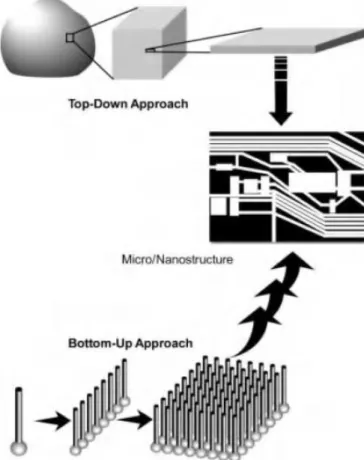
domain of organic electronics and photoelectronic materials. The historical retrospective of electronics progress demonstrates the usual “top-down” approach: starting from bulk materials one is trying to develop devices making them smaller, more complex and more effective. At same time, “bottom-up” approach is still more in the
24
stage of fundamental development. In this sense, monomolecular layer is among the smallest operational unit that can be used for bottom-up construction (Fig. 1.2)
Figure 1.2. Top-down and bottom-up strategies for fabrication of micro/nanostructures.
Although it is possible to prepare organic monolayers by vacuum evaporation61, it is
believed that the solution-driven processes could lead to a wider circle of applications. Two methodologies are most known for this purpose: Langmuir-Blodgett (LB) films and self-assembled monolayers (SAMs). Both of them have special requirements on chemical structures of molecules to be organized at the surface. In the first case, an amphiphilic substance or surfactant is needed while in the second a SAM forming molecule should bear the special surface-reactive chemical group.
Self-assembled-monolayers are assemblies that are forming spontaneously once an appropriate substrate is placed into a solution of an active compound. Typically, this compound could be described having three basic parts: the head group which reacts with the substrate, the body of molecule responsible for intermolecular interactions in the layer and the end group determining the properties of the modified surface. (Fig. 1.3)62
25
Figure 1.3. Schematic view of the surface-active molecule and main forces involved in a self-assembled monolayer.
The head group helps to connect in a covalent way the molecule to the surface. A great number of different systems were studied. Among them should be outlined thiols (and derivatives) on gold, silver substrates, organosilicon products on oxidized substrates, alkenes on clear Si surface, carboxylic and phosphonic acids on metal oxides. Sometimes alcoholic and amino-groups can also be used as anchoring moieties.
The second part, a molecular body, is responsible for the intermolecular interaction inside a layer. The nature of such interactions could be very different. In classical SAMs formed by the products with long aliphatic chains, the van der Waals forces helped to obtain dense and well-packed structures. In more complex molecules, π-π or dipole-dipole interaction as well as hydrogen bonds could interconnect molecules stronger. However, at the same time disorder may be introduced by steric hindrance.
The end group is in charge of obtained physical as well as chemical properties of the modified surface.
All together those different parts of the molecule can be modulated in order to get the well-organized, dense, and uniform molecular layer.
The main features of the self-assembled monolayer concept could be described as:
easiness of preparation;
tunability of surface properties is possible by a modification of the molecular structure and appropriate functional group design;
use of SAM as an elementary brick in a “bottom-up” construction and preparations of multilayers films with fine controlling of thickness;63
designing of 2D structures could be controlled at the nanometer scale by the utilization of few different surface-active molecules creating separated domains with different properties.64
All those characteristics open interesting perspectives for SAM applications in different fields from the surface treatment to the construction of microelectronics devices.
26
1.3.2 Preparation of self-assembled monolayers on gold as a model
substrate
One of the first examples of the self-assembling monolayer formation of the sulfur-caped products on the gold surface was demonstrated in 1983 in a work by Nuzzo and Allara.65 Although later it has been demonstrated that sulfur-derivatived compounds
could react well not only with the gold surface but also with silver, copper and platinum, the first one remains as the model surface of choice for the study and comparison of different molecules or conditions of adsorption process. The main reason for this lies in the fact that gold does not form a stable oxide layer on its surface and could thus be used at ambient conditions.
Besides disulfides utilized in mentioned work, a lot of other sulfur-contained compounds were also used, like thiols, xantanes, thiocarbonates and so forth. Among non-sulfur classes, phosphines, amines, isocyanates and carboxylic acids have also shown a good affinity to the gold surface.
For the SAMs preparation, a freshly cleaned gold substrate is dipped into a dilute solution of a surface-active compound, usually with the millimolar concentration. For thiols, relatively short treatment times are needed, up to few hours. However, other groups could be less reactive and may require a day or more for completing the self-assembling process.
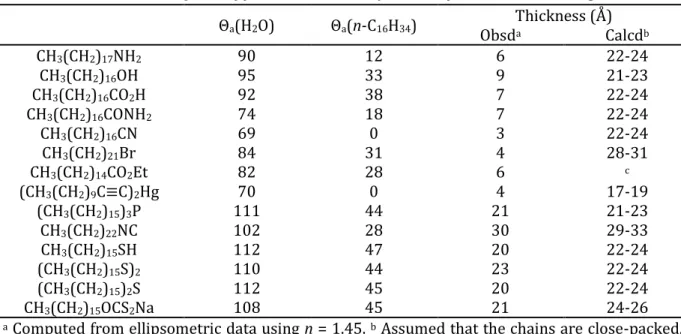
Bain et al. did an example of remarkable pioneer work on the influence of the head group nature.66 As criteria of quality, the contact angles of water and hexadecane, as well
as the thickness, were measured. The results are summarized in Table 1.3. Clearly, the sulfur and phosphorus headed molecules provide strong interaction with the gold substrate and the formation of a close-packed, ordered monolayer. The isonitrile, although with poorer quality, also demonstrated formation of packed monolayers with ΘH2O > 100° and thickness close to the predicted one.
In further discussion, thiols will be reviewed as the model compounds for the demonstrations of general features of SAMs’ preparation and characterization.
Mechanism of SAM formation
It is usually proposed that SAMs are formed in a two-step mechanism: the first fast one represents physical sorption of molecules on the surface and their anchorage; the second slower one corresponds to the progressive organization of the layer.67 It has
been demonstrated that the molecules with longer alkyl chain length, although adsorbed slowly due to decreased diffusion rate, organize themselves faster because of stronger van der Waals interactions. The same tendency has also been demonstrated for non-aliphatic molecules.68
The nature of chemical reaction undergoing on the surface remains unclear. It seems to be logical that in a SAM, sulfur-contained molecules such as thiols, disulfides or thioacetates exist as thiolate (RS-) species connected to Au+ ions on the gold surface at
27
way. For thiol, the remained atom H could be lost by a reductive elimination from the gold surface or an oxidation with a casual oxidant such as dissolved O2 (Sch. 1.11).
Table 1.3: Adsorption of functionalized alkyl chains from ethanol onto gold
Θa(H2O) Θa(n-C16H34) ObsdThickness (Å) a Calcdb
CH3(CH2)17NH2 90 12 6 22-24 CH3(CH2)16OH 95 33 9 21-23 CH3(CH2)16CO2H 92 38 7 22-24 CH3(CH2)16CONH2 74 18 7 22-24 CH3(CH2)16CN 69 0 3 22-24 CH3(CH2)21Br 84 31 4 28-31 CH3(CH2)14CO2Et 82 28 6 c (CH3(CH2)9C≡C)2Hg 70 0 4 17-19 (CH3(CH2)15)3P 111 44 21 21-23 CH3(CH2)22NC 102 28 30 29-33 CH3(CH2)15SH 112 47 20 22-24 (CH3(CH2)15S)2 110 44 23 22-24 (CH3(CH2)15)2S 112 45 20 22-24 CH3(CH2)15OCS2Na 108 45 21 24-26
a Computed from ellipsometric data using n = 1.45. b Assumed that the chains are close-packed,
trans-extended and tilted between 30° and 0° from the normal to the surface. c An ester group is
too large to form a close-packed monolayer.
Scheme 1.11. The adsorption of thiol on the gold surface.
For more complicated species, participation of solvent or contaminant water molecules could be possible.
Calculations69 of absorption features showed that the hollow site on the Au(111)
surface is the more stable binding site. Fig. 1.4 shows the arrangement of metal atoms (the open circles) of the (111) surface. The black (filled) circles denote hollow sites that are arranged in a hexagonal relationship type (√3 × √3)R30. These hollow sites are 4.99 Å apart, which is in agreement with different experimental data.70
28
Figure 1.4: Model coverage scheme for thiols on Au(111) surface.
In parallel with adsorption, desorption processes can also occur. However, it has been shown that the exchange of a sorbed thiolate with an alkanethiol in solution is going slowly67. At the same time, a temperature boost can promote such processes and heating
Au-thiolate based SAM under vacuum up to 200°C can result in complete desorption65. It
is believed that the exchange process can play an important role in the quality of a monolayer helping to reach the most thermodynamically stable organization corresponding to the densest state with a maximum of the interchain interactions.
Important assembling parameters
The kinetics of organization and the quality of monolayer are very dependent on conditions during the assembling process. Different parameters can be listed.
Quality of substrate
Gold surface possesses a high surface energy and so often is can be quite polluted by organic molecules or water. However, due to very high affinity of sulfur atoms to gold ones, those contaminants can be easily replaced by the surface active compounds. So, they do not play a crucial role in assembling process but could slow it down. The main method for the samples cleaning consists in UV-ozone treatment that oxidizes all organic pollutants. At the same time, a formation of oxidized layer or an increasing of roughness can also occur. The oxide coating can be removed by an ethanol rinsing. Meanwhile, the increased roughness can result in the rise of the quantity of adsorbed molecules but also in the less organized layer formation. The SAMs’ planarity is also important for nanoscale studies and is very dependent on the crystallinity of the primary gold surface. Usually, to promote molecular organization and low roughness, vacuum-evaporated atomically flat Au(111) surfaces are used (see Fig. 1.4).
Solvent effects
A lot of different solvents can be used for the SAMs’ preparation. Usually, the choice is based on the solubility of the film-forming molecules. Bain et al. had studied hexadecanethiol monolayers formed in different solvents such as THF, DMF, ethanol, hexadecane, CCl4, toluene, acetonitrile and cyclohexane.67 No much difference was
29
to be incorporated into the SAM due to its close chemical nature with hexadexanethiol. Lee et al. studied SAM formation of propanethiole and cystamine from water, ethanol, DMF and toluene solutions. Using STM they have demonstrated that the size of organized domains is bigger in aprotic solvents like DMF or toluene. Especially strong influence has been observed for an amine-terminated cystamine SAM.71 Ulman and
co-workers performed a remarkable work with a concurrent adsorption of two compounds on the gold surface.72 They used mixtures of DDT and HUT and have demonstrated that
in THF solution the ratio of adsorbed CH3- or OH-terminated species is related to their
concentration in solution while use of ethanol as a solvent provides almost only CH3
-terminated assembly due to the stronger interaction between HUT and alcohol molecules via a formation of hydrogen bonds disturbing its incorporation into a layer.
In summary, solvent plays an important role in the SAMs’ formation and it is essential to choose the most convenient one comprising either as a single component or as a mixture of different solvents. This should be made by checking on product solubility, solvent polarity and also by keeping in mind the possibility of a hydrogen bonding or hydrophobic interactions.
Concentration and kinetics effects.
In the most cases, it has been found that an adsorption on a surface pass by two steps. During the first one almost 80 – 90% coverage is observed. It typically takes few minutes for usual millimolar concentrations. Subsequently, absorption occurs with the much slower rate.67,73 Usually, this behavior is explained by occurrence of the
several-steps process. Firstly, the physical and chemical sorption occurs and is determined by the concentration of active compound in solution and the amount of active sites onto surface. Diffusion can also limit this step. The sorption process is then followed by the reorganization of the layer to most dense and stable phase. The study of alkanethiols as model substrates showed that the overall rate is decreasing with molecular weight. Later fact is usually interpreted by a lower mobility of big molecules.
The influence of alkylthiol concentration on the kinetics of SAM formation was found to be linear: higher concentration promotes sorption and provides the higher adsorption rate. Typically, for one millimolar concentration the first-rate value is measured in minutes against hundreds of minutes for micromolar67. However, the lack
of the solubility can provide a deposition of uncontrolled multilayers or aggregates.
Temperature effects.
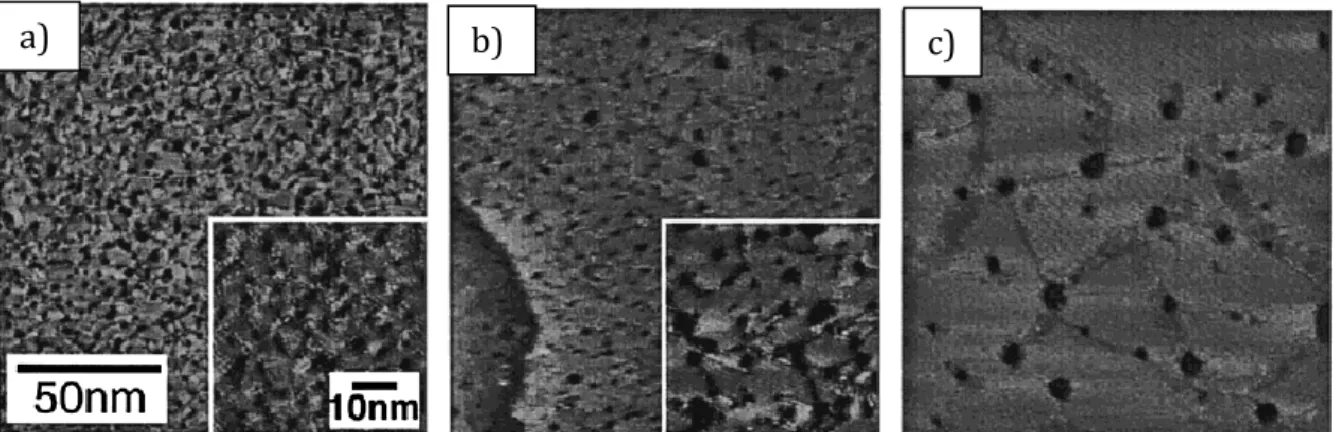
Temperature has been shown to be crucial too. As been mentioned before, not only the sorption but also the desorption process is important for the formation of a well-organized layer. The second process can help to eliminate from the surface weakly-packed molecules and replace them with new ones helping to create larger organized domains. The desorption process is entropy driven and could be favored at higher temperatures. Clearly this fact was demonstrated by Yamada and co-workers in an example of decanethiol SAM prepared from ethanol solution in a wide range of temperatures from -20°C to 78 °C (Fig. 1.5).74
30
Figure 1.5. STM images of decanethiol SAM on the gold surface obtained at different temperatures:74 a) -20°C; b) 25°C; c) 78°C.
While at low-temperature a poor quality of SAM was observed, the boiling ethanol solution provides large organized domains of decanethiol molecules. In addition to heating in solution, annealing of a SAM sample also favors organization reducing the density of defects such as etch pits or grains and increasing the surface of well-organized domains.75
1.3.3 Modification of indium-tin oxide
Indium-tin oxide (ITO) is a transparent conducting material.76 It became universal
material for transparent electrodes in large variety of applications including organic light-emitting diodes (OLEDs), liquid crystal displays, electroluminescent devices, sensors and photovoltaic cells. Many of these applications require a self-assembled monolayer (SAM) to be formed on ITO substrates as interfacial layer before deposition of organic active materials, with the aim to promote structural organization of the organic thin films and/or to adjust the electronic level difference between the active materials and the substrate. The typical product capable of forming SAM on ITO surface bears organosilane, carboxylic, phosphonic or thiol group.
While the bond formed between silanes, carboxylic acids and phosphonic acids on ITO seems to be created by condensation with surface hydroxyls, the interaction between thiols and ITO surface has not been clarified yet. Meanwhile, some comparative studies have been done. While Yan and co-workers77 observed that fatty acids
preferentially adsorb over thiols when both are present in the solution, the group of Golowitz78 postulated that thiol surface group helps to obtain denser (accordingly to
water contact angle measurements) and more stable (against sonication) layer. They concluded that the bond created between thiol molecules and surface is stronger but is forming more slowly that in the case of acid derivatives.
In the work of Brewer et al.79 the thiol surface-active group was compared with
phosphonic acid. Based on FTIR and XPS studies they made the conclusion that obtained monolayers had close-packed and ordered structures. However, thiol derivatives provide slightly stronger attenuation effect on indium 3d5/2, 3d3/2 and tin 3d5/2, 3d3/2
31
XPS signals, which means a more complete layer formation. DFT calculations made have showed a binding energy of 1-hexadecanethiol molecule on ITO surface close to -118 and -155 kJ/mol for the S-Sn (2.55 Å) and S-In (2.45 Å) bonds, respectively. Similar simulation of the binding of the deprotonated phosphonate (RPO32-) formed from
12-phosphonododecanoic acid with tin or indium active sites demonstrated binding energies of -98 (2.97 Å) and -116 (2.82 Å) kJ/mol, respectively. This indicates thiols should bind to ITO stronger than phosphonate and more robustly with indium atoms than with tin-ones.
1.3.4 Application fields of SAM-functionalized surfaces
Self-assembled monolayer appears to be the excellent tool for controlling and fine tuning of the surface properties. Since first experiments with thiols adsorbed on a gold surface, it has been clearly demonstrated possibility to control surface hydrophilic-hydrophobic character by simply changing the nature of the terminal group from CH3 to
OH. Further development brought a large variety of new functional groups introduced into the SAM as terminal ones. Those works described main horizons for SAM applications such as surface coating and nanopatterning, sensors, tribology, molecular devices. Herein, only a few examples will be mentioned to give an idea of the available applications for SAMs.
Passivation, surface coating, nano-patterning
Dense monomolecular layers are useful in the prevention of corrosion. While noble metals usually do not suffer from it, copper protection has a practical interest. A work by Azzaroni et al.80 demonstrated that copper passivation by dodecanethiol could hinder
copper oxide formation and copper dissolution in electrolyte solutions.
Superhydrophobic surfaces have attracted great attention due to their important applications in surface self-cleaning, stiction prevention and drag reduction.81 They have
also been suggested to improve tribological performances of various devices such as microelectromechanical systems (MEMS)82 consisting of several moving parts. It has
been proven that chemical modification of a smooth silicon surface can only lead to water contact angle value (WCA) of up to 120°83. However, the combination of a surface
topography modification with a formation of SAM on it gives an access to the WCAs values above 150°. This has been demonstrated in the work of Y. Song where superhydrophobic surfaces were fabricated by applying an octadecyltrichlorosilane (OTS) self-assembled monolayer (SAM) on silicon micro- or nanotextured surfaces produced by the aluminum-induced crystallization of amorphous Si. This technique helps to archive WCA of 155° while OTS SAM on smooth Si showed usual value of 112°.84
The construction of novel molecular devices asks for well-defined two-dimensional structure. Due to strong covalent connection of molecules to a surface and relatively fast kinetics, the great utility of SAMs for microcontact printing process has been shown. The group headed by Whitesides used poly(dimethylsiloxane) (PDMS) stamp inked by a solution of different thiol molecules to create nanopatterned surface. They achieved to