
Double-Target Antisense U7 snRNAs Promote Efficient Skipping of an Aberrant Exon in Three Human β-Thalassemic Mutations
9
0
0
Texte intégral
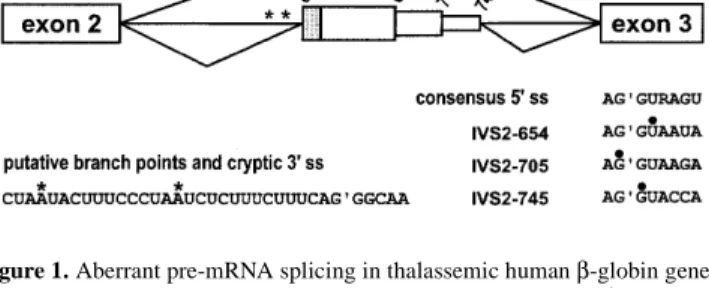
(2) 2416 Human Molecular Genetics, 1999, Vol. 8, No. 13. Table 1. Antisense U7 snRNAs used in this study Name. Sequencea. Antisenseb. U7-3′c. AAGCAUUAUUGCC’CUGAAAGAAUUUUUGGAG. 19. U7-3′/24c. AAUCAUUAUUGCC’CUGAAAGAAAGAAUUUUUGGAG. 24. U7-5′654. AAGCUAUUAC’CUUAACCCAGAAUUUUUGGAG. 20. U7-BP. AAGAUUAGGGAAAGUAUUAGAAUUUUUGGAG. 21. U7-BP/3′. AAUCAUUAUUGCC’CUGAAAGAAAG–. 44. –AGAUUAGGGAAAGUAUUAGAAUUUUUGGAG U7-3′+5′654(7.12). AAUUGCUAUUAC’CUUAACCCgGUACCUUUCCGCA–. 21. –AUugUUAUUGCC’CUGAAgGUACCUAGAAUUUUUGGAG. 19. U7-3′+5′654(0.0). AAGAAAUAUUGCUAUUAC’CUUAACCCAG(A)–. 28. –AAUCAUUAUUGCC’CUGAAAGAAAGAAUUUUUGGAG. 25. U7-BP+5′654(0.0). AAUUGCUAUUAC’CUUAACCCgG–. 21. –(A)GAUUAGGGAAAGUAUUAGAAUUUUUGGAG. 21. U7-BP+5′654(0.5). AAUUGCUAUUAC’CUUAACCCgGUACUC–. 21. –AGAUUAGGGAAAGUAUUAGAAUUUUUGGAG. 21. U7-BP+5′654(0.10). AAUUGCUAUUAC’CUUAACCCgGUACUCUACUC–. 21. –AGAUUAGGGAAAGUAUUAGAAUUUUUGGAG. 21. U7-BP+5′654(7.5). AAUUGCUAUUAC’CUUAACCCgGUACUC–. 21. –GAUUAGGGAAAGUAUUgGUACCUAGAAUUUUUGGAG. 18. aOnly nucleotides from the U7 RNA 5′ end to the SmOPT sequence (underlined) are shown. Antisense sequences are in bold, nucleotides forming G-U wobble pairs in lower case. Splice sites in the target RNA are marked by apostrophes. Italic Us base-pair with putative branch point adenosines. bLength of each antisense sequence in nucleotides. cThese constructs were previously used in ref. 6 and were called U7.3 and U7.324, respectively.. mutation (6). Here, we present analyses of the other two IVS2 mutations. In particular, we have sought and found ways to improve the efficiency of splicing correction in the context of the highly resistant IVS2-654 mutation. New U7 derivatives, capable of binding to two different targets and forcing intron 2 into a looped secondary structure, correct splicing of IVS2-654 β-globin pre-mRNA with improved efficiency and are also highly effective against the other two mutations. Besides the obvious advantage of providing a single tool for treating three different thalassemic mutations, this double-target strategy should be applicable to a wide variety of splicing interventions. RESULTS Correction of β-globin pre-mRNA splicing is inefficient in IVS2-654-expressing cells We showed previously that a derivative of a modified U7 snRNA called U7 SmOPT (7,8), carrying at its 5′ end a 24 nucleotide (nt) sequence complementary to the cryptic 3′ ss in human β-globin intron 2 (U7-3′/24; for sequence see Table 1), restored ∼65% of correctly spliced β-globin mRNA in HeLa cells expressing the mutant IVS2-705 β-globin gene (6). In principle, this so far most efficient antisense U7 snRNA should also restore correct β-globin splicing in the context of the other two IVS2 mutations, IVS2-654 and -745, that use the same. Figure 1. Aberrant pre-mRNA splicing in thalassemic human β-globin genes. Mutations at positions 654, 705 and 745 of intron 2 create new 5′ splice sites (5′ ss). This activates a cryptic 3′ ss at position 579/580. The β-globin reading frame (shaded area) terminates within the aberrant exon. Two putative branch points upstream of the cryptic 3′ ss are indicated by asterisks. Solid circles indicate mutated nucleotides. The picture is not drawn to scale.. cryptic 3′ ss in combination with the 5′ ss created by the respective mutation (Fig. 1). This was tested by transfecting HeLa cell lines stably expressing each of the three human thalassemic β-globin genes (5) with the plasmid encoding U7-3′/24 snRNA. Total RNA from these cells was analysed by reverse transcription– polymerase chain reaction (RT–PCR) using primers located in exons 2 and 3 (see Materials and Methods). Analysis of RNA from mock-transfected cells yielded mainly products of 304, 357 and 396 nucleotides (nt), respectively, corresponding to aberrantly spliced β-globin mRNA (Fig. 2A, lanes 1, 4 and 7,.
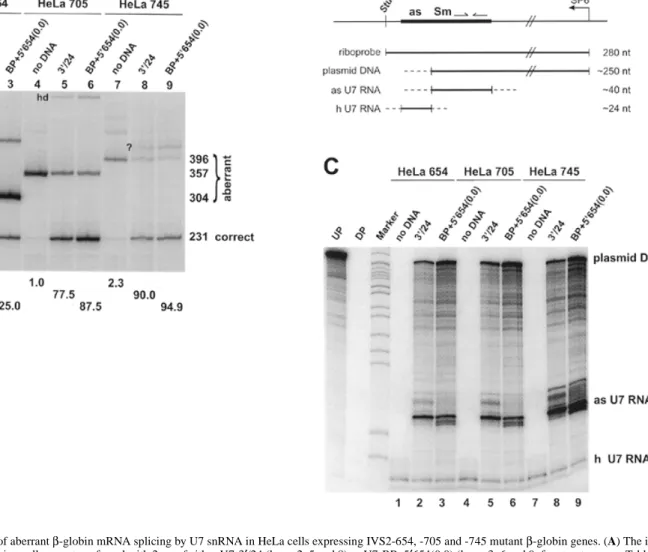
(3) Human Molecular Genetics, 1999, Vol. 8, No. 13 2417. Figure 2. Correction of aberrant β-globin mRNA splicing by U7 snRNA in HeLa cells expressing IVS2-654, -705 and -745 mutant β-globin genes. (A) The indicated β-globin-expressing cells were transfected with 2 µg of either U7-3′/24 (lanes 2, 5 and 8) or U7-BP+5′654(0.0) (lanes 3, 6 and 9; for structures see Table 1). Lanes 1, 4 and 7, mock-transfected controls. Total RNA extracted after 48 h was analyzed by RT–PCR with primers located in exons 2 and 3 of the β-globin gene followed by non-denaturing gel electrophoresis and exposure to PhosphorImager screen (see Materials and Methods). Lane M, marker (HpaII-digested, endlabeled pBR322; sizes in bp are listed on the left). The sizes (in bp) of PCR bands representing aberrantly and correctly spliced mRNAs are indicated on the right. The percentage of correctly spliced β-globin mRNA is written below each lane (for calculation see Materials and Methods). Heterodimers between correctly and aberrantly spliced bands (hd) and a band of unknown origin (?) are marked in the gel area. (B) Structure of the riboprobe used for RNAse mapping in (C) and of the resulting protected bands. The ∼280 nt riboprobe was obtained by run-off transcription with SP6 RNA polymerase to the StuI site of U7SmOPT (7). Plasmid DNA, the extraction and RNAse mapping methods do not completely discriminate between RNA and DNA, hence input plasmid DNAs result in protected bands of ∼250 nt as only the 5′ end of the particular U7 gene that differs from U7 SmOPT is digested; as U7 RNA, antisense U7 snRNAs expressed from transfected genes are complementary to U7 Sm OPT over ∼40 nt including the SmOPT sequence and the 3′ terminal hairpin; h U7 RNA, endogenous human U7 snRNA differs in the Sm binding site and the 3′ hairpin leaving a protected fragment of ∼24 nt that can be used to monitor total RNA recovery. (C) The RNAs from (A) (lane numbers corresponding) were analyzed by RNAse protection with the riboprobe shown in (B) (see Materials and Methods). Undigested (lane UP) and digested probe hybridized to 10 µg of yeast tRNA (lane DP) were run on the left. Signals of ∼250 and ∼24 nt corresponding to input plasmid DNA and endogenous human U7 snRNA, respectively, as well as the ∼40 nt signal resulting from the transfected antisense U7 RNAs, are indicated on the right.. respectively). Transfection of U7-3′/24 yielded 7.2 ± 3.8% (n = 4) of a 231 nt RT–PCR product corresponding to correctly spliced RNA in HeLa 654 cells (Fig. 2A, lane 2; the efficiency obtained in this particular experiment is indicated below the lane). This was considerably less compared with 60–80% of correctly spliced β-globin mRNA obtained in HeLa 705 cells (Fig. 2A, lane 5) and 80–90% in HeLa 745 cells (lane 8). These differences in splicing correction between the three cell lines follow the same trend as previously described for antisense oligonucleotides (5). Since the HeLa 654 cells showed the highest amount of aberrantly spliced β-globin mRNA, it might. be argued that the lower efficiency of splicing correction obtained in these cells could be due to a more unfavorable ratio of antisense to sense RNA. However, we have previously found that the levels of unspliced β-globin mRNA precursor show an inverse distribution with HeLa 745 containing the highest and HeLa 654 the lowest amount (5). Thus the ratio of antisense to sense RNA is actually most favorable in the HeLa 654 cells, provided that the U7 snRNAs are expressed to similar levels in all three cell lines. The levels of U7 RNAs produced in these cells were estimated by an RNase protection assay (7). Total RNA was.
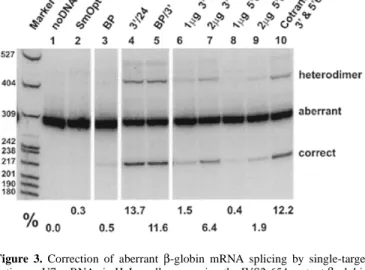
(4) 2418 Human Molecular Genetics, 1999, Vol. 8, No. 13. Figure 3. Correction of aberrant β-globin mRNA splicing by single-target antisense U7 snRNAs in HeLa cells expressing the IVS2-654 mutant β-globin gene. HeLa 654 cells were transfected with 2 µg of the indicated U7 snRNA genes (for structures see Table 1), except for lanes 6 and 8, where only 1 µg DNA was used, and lane 10, where the cells were cotransfected with 1 µg each of U7-3′ and U7-5′654. Total RNA was extracted and analyzed by RT–PCR as described for Figure 2A. The percentage of correctly spliced β-globin mRNA is indicated below each lane. All samples were analyzed on the same gel, but certain lanes were omitted from the figure; some of these are shown in Figure 4A.. hybridized to a riboprobe of 280 nt derived from the U7 SmOPT gene (Fig. 2C, lane UP). The structure of the probe and the protected hybridization products obtained with endogenous human U7 snRNA (h U7 RNA), input plasmid DNA present in the RNA samples of transfected cells, and antisense U7 RNAs transcribed from the transfected plasmids (as U7 RNA) are explained in Fig. 2B. The intensity of the ∼40 nt band corresponding to U7-3′/24 RNA expressed from the transfected gene was very similar in HeLa 654 and HeLa 705 cells (Fig. 2C, lanes 2 and 5, respectively) and somewhat higher in HeLa 745 cells (lane 8). Despite this minor difference, we conclude that the different efficiencies of β-globin splicing correction were not mainly due to different efficiencies of transfection or U7-3′/24 expression, but rather due to different abilities of U7-3′/24 RNA to correct β-globin splicing in the three mutant backgrounds. The results obtained with construct U7-BP+5′654(0.0) (Fig. 2A and C, lanes 3, 6 and 9, respectively) will be discussed later. The optimum length for a single antisense sequence is close to 24 nt To be of more general value for modifying the splicing patterns of selected genes, the U7 antisense method should also be effective for strong splice sites. We therefore tried to improve the efficiency of splicing correction for the most resistant IVS2-654 mutation. We first analyzed which of three potential target sites important for the aberrant splicing caused by the IVS2-654 mutation allowed the most efficient correction of βglobin splicing. To this end, we transfected HeLa 654 cells with U7 genes containing 19–21 nt sequences complementary to the cryptic 3′ ss (U7-3′), the 5′ ss created by the IVS2-654 mutation (U7-5′654) or two potential branch point adenosines. upstream of the cryptic 3′ ss (U7-BP; for sequences see Table 1). Transfection with either 1 or 2 µg of U7-3′ allowed for 1.5 and 6.4% of correct β-globin splicing, respectively (Fig. 3, lanes 6 and 7, respectively). Only 0.4 and 1.9% of correct splicing product were obtained with 1 and 2 µg of U7-5′654, respectively (Fig. 3, lanes 8 and 9, respectively). The least efficient was U7-BP which at 2 µg input DNA resulted in only 0.5% of correct splicing product (Fig. 3, lane 3). Although this activity was close to background, additional experiments revealed activities of ∼3 and ∼50% in IVS2-654-expressing NIH 3T3 cells and in IVS2-705-expressing HeLa cells, respectively (data not shown). However, even in those cells, U7-BP was less active than U7-3′. Thus the cryptic 3′ ss was the target allowing for most efficient correction of β-globin splicing. We then analyzed the effects of different lengths of antisense sequence for the cryptic 3′ ss target. Increasing the length to 24 nt in construct U7-3′/24 caused 13.7% of correct β-globin splicing in this experiment (Fig. 3, lane 4), indicating that the transfection efficiency was somewhat higher than in the experiment shown in Fig. 2. This variability from one transfection to another did not, however, affect the differences in the correction of splicing between individual constructs. Thus, the length increase from 19 to 24 nt did improve the efficiency of splicing correction, similarly as had been observed in HeLa 705 cells (6). In construct U7-BP/3′, we increased the complementarity to β-globin pre-mRNA to 44 nt, so that it essentially encompassed the antisense sequences of both U7-3′/24 and U7-BP (Table 1). This construct was slightly less efficient than U7-3′/24 at restoring β-globin splicing in HeLa 654 cells (Fig. 3, lane 5; 11.6%). We also increased the length of the complementarity to include further downstream sequences of the aberrant β-globin exon. Gradual reductions in the amounts of correctly spliced β-globin mRNA were observed, when the hybrid length was increased from the 24 nt present in U7-3′/24 to 30 or 35 nt and a construct with the potential to form a 40 nt hybrid was totally inactive (data not shown). Thus, increasing the length of the potential hybrid to >24 nt in either the 5′ or 3′ direction reduced the ability to correct β-globin pre-mRNA splicing suggesting that this length must have been close to optimal. Increased efficiency of splicing correction obtained by coexpressing two different antisense U7 snRNAs We further tried to improve the efficiency of splicing correction by cotransfecting two separate U7 snRNA genes containing antisense sequences to the 3′ and 5′ ss flanking the aberrant exon. The cotransfection of 1 µg each of U7-3′ and U7-5′654 led to 12.2% splicing correction (Fig. 3, lane 10). This was considerably more than the added effects of separate transfections with 1 µg (Fig. 3, lanes 6 and 8) or even 2 µg (lanes 7 and 9) of each plasmid. However, the efficiency obtained by this approach was still not higher than that obtained with 2 µg of U7-3′/24 alone (Fig. 3, lane 4). It was not practical to use higher concentrations of the two plasmids because this would have led to an inadequate charge ratio between the negatively charged DNA and the cationic lipids used for transfection, resulting in a reduced transfection efficiency (6; R. Tomasini and D. Schümperli, unpublished data). We therefore did not explore this strategy further..
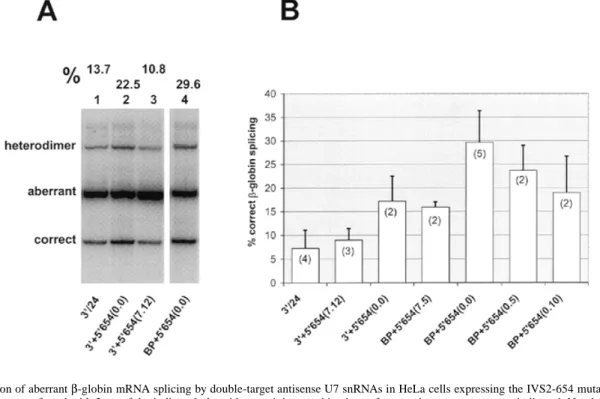
(5) Human Molecular Genetics, 1999, Vol. 8, No. 13 2419. Figure 4. Correction of aberrant β-globin mRNA splicing by double-target antisense U7 snRNAs in HeLa cells expressing the IVS2-654 mutant β-globin gene. HeLa 654 cells were transfected with 2 µg of the indicated plasmids containing combinations of two antisense sequences as indicated. Numbers in parentheses indicate the numbers of non-complementary nt separating the SmOPT sequence from the first and the first from the second antisense sequence, respectively (for structures see Table 1). Total RNA was extracted and analyzed by RT–PCR as described for Figure 2A. (A) Electrophoretic analysis of samples from the same transfection and gel shown in Figure 3. Lane 1 is the mirror image of lane 4 of Figure 3. The percentage of correctly spliced β-globin mRNA is indicated above each lane. (B) Average percentage of correctly spliced β-globin mRNA from several independent transfection experiments. The variability was mostly caused by different transfection efficiencies whereas the ratios between different constructs remained relatively constant.. Maximal splicing correction by double-target U7 snRNAs (containing two antisense sequences) However, encouraged by this result, we tested whether it was possible to offer two different antisense sequences as part of a single modified U7 SmOPT derivative (hereafter designated as a double-target construct). Sometimes these sequences were separated from the Sm binding site and/or from each other by short spacer sequences that were not complementary to βglobin pre-mRNA (Table 1). The plasmids were named U7-, followed by short designations of the two antisense sequences, separated by a plus sign (+). This was followed by two arabic numbers in parentheses, separated by a period, that represented the numbers of non-complementary spacer nt between the Sm binding site and first antisense sequence and between the two antisense sequences, respectively. Thus, U7-3′+5′654(7.12) contains in 3′ to 5′ direction: the SmOPT Sm binding site, a 7 nt spacer, a 19 nt antisense sequence to the cryptic 3′ ss, a 12 nt spacer and a 21 nt antisense sequence to the 5′ ss created by the IVS2-654 mutation (Table 1). In the experiment shown in Figure 4A, U7-3′+5′654(7.12) induced 10.8% of correct βglobin mRNA splicing (lane 3) in HeLa 654 cells. This was similar to the splicing correction obtained with U7-3′/24 alone (Fig. 4A, lane 1) or to that obtained by cotransfection of 1 µg each of U7-3′ and U7-5′654 (Fig. 3, lane 10). Another construct, U7-3′+5′654(0.0), lacking the spacer sequences but containing elongated antisense sequences of 25 and 28 nt against the cryptic 3′ ss and IVS2-654 5′ ss, respectively, even led to 22.5% of correct β-globin mRNA splicing (Fig. 4A, lane 2). Most importantly, construct U7-BP+5′654(0.0), combining. an antisense sequence directed against the putative branch points upstream of the cryptic 3′ ss with one directed against the 5′ ss of IVS2-654 induced 29.6% of correct β-globin mRNA splicing, i.e. so far the most efficient correction obtained against the IVS2-654 mutation (Fig. 4A, lane 4). Figure 4B shows a quantitative comparison of double-target constructs with different combinations of antisense and spacer sequences. All double-target constructs shown corrected βglobin splicing in HeLa 654 cells as efficiently or more so than U7-3′/24, the most efficient single-target construct. The highest correction (29.6 ± 6.7%, n = 5) was achieved with U7BP+5′654(0.0). Constructs with spacers of 5 nt [U7BP+5′654(0.5)] and 10 nt [U7-BP+5′654(0.10)] between the two antisense sequences led to gradually reduced levels of correctly spliced β-globin mRNA. Construct U7BP+5′654(7.5), which had a 7 nt spacer separating the Sm binding site from the anti-branch point sequence, was slightly less efficient than U7-BP+5′654(0.5) and almost two times less efficient than U7-BP+5′654(0.0). Thus, all spacers had negative effects, whether they were located between the Sm binding site and the first or between the first and second antisense sequence. Generally, the combinations of antisense sequences to the 3′ and 5′ ss were less efficient than those to the branch points and 5′ ss. Plasmid U7-3′+5′654(7.12), with two spacers, corrected splicing to a similar extent as U7-3′/24 (see also Fig. 4A, lanes 1 and 3). Construct U7-3′+5′654(0.0), devoid of spacers and with the longer antisense sequences, induced a similar splicing correction as U7-BP+5′654(7.5)..
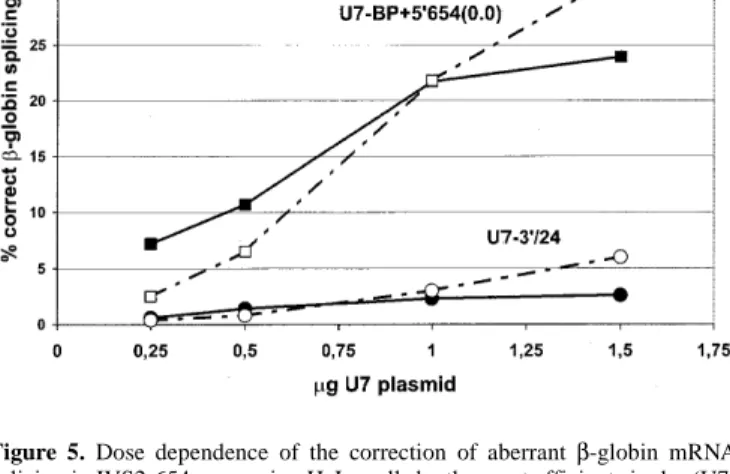
(6) 2420 Human Molecular Genetics, 1999, Vol. 8, No. 13. Figure 6. Efficient permanent restoration of β-globin mRNA splicing and protein production by double-target construct U7-BP+5′654(7.5) in IVS2-654expressing HeLa cells. (A) RT–PCR analysis carried out as in Figure 2A, except that the products were labelled with [32P]dATP. (B) Analysis of βglobin by western blot probed with polyclonal anti-hemoglobin antibody (see Materials and Methods). Lanes 1, HeLa cells expressing the wt β-globin gene; lanes 2, untreated IVS2-654 cells; lanes 3, IVS2-654 cells stably transformed with U7-BP+5′654(7.5). Figure 5. Dose dependence of the correction of aberrant β-globin mRNA splicing in IVS2-654-expressing HeLa cells by the most efficient single- (U73′24) and double-target [U7-BP+5′654(0.0)] constructs, respectively. The cells were transfected with increasing amounts of the indicated plasmids (dashed lines). In a second experiment (solid lines) the total amount of transfected DNA was adjusted to 2 µg by addition of pSP65.. We next compared the most efficient single- and doubletarget constructs, U7-3′/24 and U7-BP+5′654(0.0), in more detail. We varied the amounts of the two plasmid DNAs used for transfection between 0.25 and 1.5 µg. In one of the two experiments shown (Fig. 5, solid lines), the total amount of plasmid DNA was adjusted to a constant 2 µg by supplementing the active U7-3′/24 and U7-BP+5′654(0.0) DNAs with appropriate amounts of inactive pSP65, whereas in the other experiment (dashed lines) only the indicated amounts of the two active DNAs were used. In both experiments the proportion of correctly spliced β-globin mRNA increased with increasing amounts of U7 plasmid. Moreover, at all concentrations tested, U7-BP+5′654(0.0) was more efficient and induced at least 5 times more correctly spliced β-globin mRNA than U7-3′/24. Construct U7-BP+5′654(0.0) was also compared with U73′/24 in HeLa cells expressing β-globin genes with each of the three IVS2 mutations (Fig. 2). In this experiment, the efficiency of β-globin splicing correction obtained with 2 µg of U7-BP+5′654(0.0) was ∼25% in HeLa 654 cells (Fig. 2A, lane 3), ∼87% in HeLa 705 cells (lane 6) and ∼95% in HeLa 745 cells (lane 9). Thus this double-target construct was also highly active (slightly more so than U7-3′/24) in the background of the other two mutations. As for U7-3′/24 (discussed above), the RNase mapping revealed similar expression levels of U7BP+5′654(0.0) snRNA in the HeLa 654 and HeLa 705 cells (Fig. 2C, lanes 3 and 6, respectively) and only slightly higher levels in HeLa 745 cells (lane 9), indicating that the increasing levels of correctly spliced β-globin mRNA in the order IVS2654 < -705 < -745 were mostly due to inherent differences in the ability of the double-target construct to correct splicing in the three mutant backgrounds. Most importantly, the levels of U7-3′/24 and U7-BP+5′654(0.0) snRNAs within each cell line were very similar, indicating that the dramatically different levels of correctly spliced β-globin mRNA reflected a true difference between the abilities of the two antisense RNAs to promote the skipping of the aberrant exon.. Efficient permanent correction of IVS2-654 β-globin premRNA splicing by stable expression of a double-target construct For U7-BP+5′654(7.5), one of the highly efficient doubletarget constructs that combined antisense sequences against the putative branch points and the 5′ ss created by the IVS2-654 mutation, we tested whether its stable co-expression with IVS654 β-globin pre-mRNA would lead to an efficient and permanent correction of splicing. We therefore isolated stable doubly transformed cells by introducing U7-BP+5′654(7.5) into HeLa 654 cells, along with a hygromycin-resistance plasmid. A hygromycin-resistant clone expressing U7-BP+5′654(7.5) produced ∼50% of correctly spliced β-globin mRNA (Fig. 6A, lane 3). We tested this cell line for the production of β-globin protein by western blotting. A HeLa cell line expressing the wild-type human β-globin gene produced readily detectable βglobin (Fig. 6B, lane 1). This band could not be detected, however, in the original HeLa 654 cells (lane 2). Most importantly, the doubly transformed cells co-expressing U7BP+5′654(7.5) along with the IVS2-654 mutant β-globin gene, produced levels of β-globin (lane 3) similar to the cells expressing the wild-type gene. This showed that efficient and permanent correction of aberrant splicing could be obtained, even in the case of the IVS2-654 mutation whose aberrant splice sites were poorly accessible to single-target antisense RNAs. DISCUSSION HeLa cell lines expressing the three thalassemic mutant βglobin genes IVS2-654, -705 and -745 showed remarkable differences in the efficiencies with which aberrant β-globin pre-mRNA splicing could be corrected, e.g. by U7-3′/24, a modified antisense U7 RNA directed against the common cryptic 3′ ss used in all three mutant genes (Fig. 2A). This phenomenon was not due to different efficiencies of transfection or U7-3′/24 snRNA accumulation as shown by an RNase mapping experiment (Fig. 2C). Very similar differences in the ability to correct β-globin splicing have previously been observed when treating the same cells with antisense oligonucleotides and possible reasons for this difference have been discussed (5)..
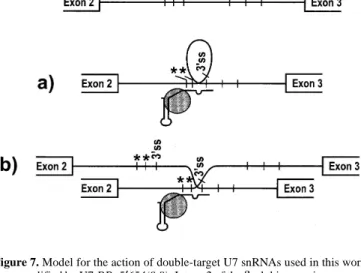
(7) Human Molecular Genetics, 1999, Vol. 8, No. 13 2421 Here, we have primarily tried to optimize the correction of βglobin mRNA splicing by antisense U7 snRNAs in the background of the IVS2-654 mutation. One reason for this was that the mutations IVS2-654 and -745 are much more common among thalassemic patients, especially in China and South East Europe, respectively, than the rare IVS2-705 mutation used in our previous study (2). Moreover, the availability of a transgenic mouse model for IVS2-654 (9) made this the most attractive of the three thalassemic mutations for further preclinical trials. However, it was also evident from our earlier work (6) that the principle of targeting antisense U7 snRNAs to splice sites could be used in a broader sense to affect alternative splicing decisions, thus widening the scope beyond the particular thalassemic mutations we were studying. Yet, if this strategy was to be of a general use, it would have to work in the context of efficient splice sites. Among the three thalassemic mutations, IVS2-654 is the least accessible to the correction of β-globin mRNA splicing by antisense sequences and thus, operationally defined, has the most strongly used aberrant splice sites. Therefore, it also seemed most suitable for optimizing a general exon-skipping strategy with antisense U7 snRNAs. An optimal single-target construct for IVS2-654: U7-3′′/24 In single-target constructs, we tested antisense sequences against three regions of intron 2 that were likely to be important for the aberrant, but not the correct, splicing pathway. Antisense sequences of similar length (19–21 nt) were most active when targeted against the cryptic 3′ ss, intermediately active against the 5′ ss created by the IVS2-654 mutation and only very weakly active when targeted against the region containing two putative branch points upstream of the cryptic 3′ ss (Fig. 3). The difference between the constructs targeted to the 5′ and 3′ ss were not expected, because no such difference had been observed with U7 constructs in the IVS2-705 mutant background (6). Moreover, antisense oligonucleotides applied to the same IVS2-654-expressing HeLa cells used here even showed an inverse trend: an oligonucleotide directed to the 5′ ss was efficient but one directed to the 3′ ss was only weakly active (5). Although the activity of U7-BP targeted to the putative branch point region was very low in HeLa 654 cells (Fig. 3), the more efficient correction of splicing observed in IVS2654-expressing NIH 3T3 cells and in IVS2-705-expressing HeLa cells (data not shown) suggested that the targeted region does indeed play a role in the aberrant splicing pathway. However, the lower efficiency compared with antisense RNAs targeted to the 3′ and 5′ ss could mean that the splicing machinery can use alternative adenosines as branching nucleotides in the first step of splicing. We previously showed that increasing the length of the single antisense sequence directed against the cryptic 3′ ss from 19 to 24 nt led to a corresponding increase in the efficiency of splicing correction in HeLa 705 cells (6). This was also the case in HeLa 654 cells, although U7-3′/24 still induced only ∼7% of correctly spliced β-globin mRNA. An increase in efficiency was also found in HeLa 745 cells (data not shown). In contrast, further extending the single antisense sequence present in U7-3′/24 in either direction led to a decrease, rather than an increase, in the efficiency of splicing correction (Fig. 3 and data not shown). This was unexpected, especially in the. case of U7-BP/3′ where the antisense sequence was not only longer, but also covered two potentially important targets. In summary, construct U7-3′/24, already analyzed in the context of the IVS2-705 mutation (6), also proved to be the most efficient single-target construct for the IVS2-654 mutation, both for its target (the cryptic 3′ ss) and for the length of the antisense sequence (24 nt). However, because the actual efficiency with which it corrected β-globin pre-mRNA splicing in HeLa 654 cells was still low, it did not seem an attractive candidate either for preclinical studies for the IVS2654 mutation or as a general model for modulating strong splice sites. Two are better than one: synergistic effects obtained with double-target constructs When we used two antisense sequences simultaneously, either by cotransfecting two separate single-target constructs (Fig. 3, lane 10) or in the context of so-called double-target constructs (Fig. 4), this induced higher levels of correctly spliced β-globin mRNA in HeLa 654 cells than either of the corresponding single-target constructs. In fact, the two antisense sequences seemed to act synergistically, as was most pronounced for the optimal double-target RNA, U7-BP+5′654(0.0), whose corresponding single-target constructs were very weakly (U7-BP) or weakly active (U7-5′654). This synergistic activity cannot have been due simply to increasing the total length of antisense sequence, because the length variations discussed above clearly indicate that single antisense sequences of ∼40 nt are less efficient at correcting the pattern of β-globin mRNA splicing than the 24 nt present in U7-3′/24. Another possibility is that, with two antisense sequences, the likelihood of at least one of them base-pairing with β-globin pre-mRNA increases. This certainly applies to double-target constructs where the concentration of antisense sequences is actually doubled. Whether it is also the case in cotransfections of two single-target constructs is questionable. There, the total antisense concentration is identical, whether 2 µg of a single construct is used or 1 µg each of two separate ones. The only difference is the identity of the targets: in single transfections only one target is available, in cotransfections there are two. Most likely, therefore, the synergism observed with two antisense sequences is due to a new kind of antisense mechanism. When a single pre-mRNA molecule is simultaneously occupied by both antisense sequences, the total antisense ‘load’ of the pre-mRNA increases and could more strongly disfavour aberrant splicing than base-pairing at a single site. The more than additive effect observed in cotransfections is almost certainly due to such a phenomenon. Double-target constructs even offer additional possibilities: first, base-pairing of the two antisense sequences might be cooperative in the sense that, when either one binds to its target, the likelihood that the other one will bind increases; second, the resulting simultaneous binding will force the intervening intron sequences into a looped structure (Fig. 7) which may strongly inhibit the aberrant splicing pathway; alternatively, the two antisense sequences of a single U7 snRNA molecule could also bind to two different β-globin pre-mRNA molecules resulting in a ‘cross-linked’ structure (Fig. 7) that might again disfavour the.
(8) 2422 Human Molecular Genetics, 1999, Vol. 8, No. 13. intron 2 mutations, such preclinical studies with the transgenic mice will have a wider implication for a greater number of human patients. Furthermore, as we have improved our antisense strategy for the most resistant of the three thalassemic IVS2 mutations, it is likely that the double-target strategy presented here may also be working efficiently to induce skipping of natural exons in other genes that would be interesting for gene therapy or biotechnological applications. The more established antisense oligonucleotides have also been successfully used to modify specific splicing events in cellular genes such as dystrophin (10–12), c-myc (13) and E-selectin (14) or in genes of viral (15,16) and protozoan (17) pathogens. Using our optimized U7 antisense strategy in these or other clinical contexts conceivably would have the advantage of more permanent modification of splicing requiring less frequent applications. Figure 7. Model for the action of double-target U7 snRNAs used in this work as exemplified by U7-BP+5′654(0.0). Intron 2 of the β-globin gene is proposed to be forced into a looped secondary structure (a) that disfavours inclusion of the aberrant exon. Alternatively, a double-target U7 snRNA may interact with two different pre-mRNA molecules by base-pairing (b). Two putative branch points upstream of the cryptic 3′ ss are indicated by asterisks.. aberrant splicing pathway more strongly than just the occupation of a single site by one antisense U7 snRNP. Several lines of evidence favour such a specialized structure, most likely a looped one, as the mechanistic basis for the high efficiency of double-target constructs. First, U7BP+5′654(0.0) is not only the most active construct for IVS2654, but also in combination with the other two intron 2 mutations, IVS2-705 and -745 (Fig. 2). There, however, the sequence in β-globin pre-mRNA at position 654 is wild-type (leading to a C/A mismatch in the possible 20 bp hybrid) and should not directly interact with splicing factors. Accordingly, the single-target construct U7-5′654 is inactive when tested against the IVS2-705 or -745 mutations (data not shown). Second, an additional double-target construct not presented in this paper contained sequences antisense to a region ∼60–80 nt upstream of the cryptic 3′ ss and to the 5′ ss created by IVS2654. This construct even corrected β-globin mRNA splicing in the context of IVS2-705 and -745, i.e. when none of the two target sequences had any obvious involvement in β-globin premRNA splicing (data not shown). Taken together, these data strongly suggest that forcing the aberrant exon into a looped or cross-linked configuration as shown in Fig. 7 strongly disfavours the inclusion of this exon. With this new double-target strategy, we have considerably improved the efficiency of splicing correction with antisense U7 snRNAs. Even in the case of the IVS2-654 mutation that is highly resistant to correction by a single antisense sequence, we have reproducibly obtained ∼30% of correctly spliced βglobin mRNA in transient transfections. This value was even exceeded in a permanently transformed cell line (Fig. 6; 50%) where we also detected permanent production of β-globin protein. The in vivo applicability of this approach can now be tested in a transgenic mouse line that expresses the human IVS2-654 thalassemic β-globin gene in erythrocyte precursors (9). As U7-BP+5′654(0.0) is the most efficient double-target construct not only for IVS2-654 but also for the other two. MATERIALS AND METHODS Plasmid constructs Plasmid U7SmOPT carries the mouse U7 snRNA gene cloned in pSP64 (Promega, Madison, WI) as a 570 bp HaeIII fragment with StuI and HpaI sites engineered 5′ and 3′ of the U7 coding sequence and the U7-specific Sm binding site (AAUUUGUCUAG) replaced by the consensus Sm sequence (AAUUUUUGGAG) (7). The 18 nt sequence complementary to histone pre-mRNAs was replaced with β-globin antisense sequences by PCR using a mutagenic primer covering the StuI site and the 5′ end of U7 RNA and a reverse primer located in the ampicillin resistance gene. The PCR product was cut by StuI and HindIII and the fragment carrying the mutated U7 gene with 3′ flanking sequences reinserted into U7SmOPT. All clones were verified by DNA sequencing (18,19). Details of the constructions are available on request. Plasmids pIVS2-654, -705 and -745 contain the thalassemic human β-globin genes transcribed from the cytomegalovirus immediate early promoter (4,5). Cell lines HeLa cells stably expressing thalassemic human β-globin genes were obtained by cotransfection of the appropriate βglobin plasmid with pSV2neo (Clontech, Palo Alto, CA) followed by selection with 300–800 µg/ml G418 (4,5). For cell lines stably expressing modified U7 snRNAs, cotransfection included the hygromycin-resistance plasmid pY3 (a gift of Dr M. Thali, Lausanne, Switzerland) and was followed by selection with 200 µg/ml hygromycin B. All cells were grown as monolayers in Dulbecco’s modified Eagle’s medium/F12 (Gibco, Basel, Switzerland) supplemented with 10% fetal calf serum (Amimed, Muttenz, Switzerland), 100 U/ml penicillin, 100 µg/ml streptomycin (Gibco) at 37°C in a humid atmosphere containing 5% CO2. Transfection Usually 8–16 h before transfection, the cells were seeded in 24-well plates at 105 cells/well. If not indicated otherwise, 2 µg of plasmid DNA was complexed with 6 µl (12 µg) LipofectAmine (Gibco) in 0.2 ml of OptiMEM (Gibco) at 26°C during 30 min. Then the complexes were diluted with OptiMEM to a final volume of 1 ml and allowed to precipitate.
(9) Human Molecular Genetics, 1999, Vol. 8, No. 13 2423. in the well for 6–10 h. Medium was then replaced by normal growth medium. Gene expression Total cellular RNA was usually isolated 48 h after the start of transfection using Tri-Reagent (MRC, Cincinnati, OH), precipitated using glycogen as a carrier, and dissolved in diethylpyrocarbonate-treated water. To detect β-globin mRNAs, 200 ng of RNA was analyzed by RT–PCR using rTth DNA polymerase in a final volume of 50 µl as directed by the manufacturer (Perkin-Elmer, Branchburg, NJ) with forward and reverse primers spanning positions 21–43 of exon 2 and positions 6–28 of exon 3, respectively, in β-globin mRNA. To maintain a linear concentration-dependent response, the PCR was carried out for 18–22 cycles (20) with addition of 0.1 µCi of [α-32P]dCTP (or dATP) per reaction. RT–PCR products were separated on 7.5% non-denaturing polyacrylamide gels. Dried gels were exposed to storage phosphor screens (Molecular Dynamics, Sunnyvale, CA) and analyzed with the ImageQuant program. The results were corrected to account for different numbers of labeled nucleotides in the various PCR products. RNase protection analysis of U7 snRNA was performed essentially as described (7). Two micrograms of total RNA was coprecipitated with 100 fmol 32P-labeled riboprobe derived from pU7SmOPT. The pellet was resuspended in 30 µl hybridization buffer (40 mM piperazine-N,N′-bis(2-ethanesulfonic acid) pH 6.4, 1 mM EDTA, 400 mM NaCl, 80% formamide), heated for 10 min to 85°C, and, after slow cooling to 48°C, incubated at this temperature overnight. Then, 300 µl of RNase digestion-mix (300 mM NaCl, 5 mM EDTA, 10 mM Tris pH 7.5, 20 µg/ml RNase A and 100 U/ml RNase T1) was added and tubes incubated for 90 min at 37°C. RNA was then prepared by acid phenol extraction and ethanol precipitation and analyzed on an 8% denaturing polyacrylamide gel. Hemin treatment of cells, protein isolation and western blot detection of β-globin were performed as described (4,6). ACKNOWLEDGEMENTS This work was supported by grant 4037-44704 of the National Research Program 37 of the Swiss National Science Foundation and by a National Institutes of Health grant. REFERENCES 1. Krawczak, M., Reiss, J. and Cooper, D.N. (1992) The mutational spectrum of single base-pair substitutions in mRNA splice junctions of human genes: causes and consequences. Hum. Genet., 90, 41–54. 2. Schwartz, E. and Benz, E.J. (1995) Thalassemia syndromes. In Hoffman, R. et al. (eds), Hematology, Basic Principles and Practice. Churchill Livingstone, New York, NY, pp. 586–610.. 3. Dominski, Z. and Kole, R. (1993) Restoration of correct splicing in thalassemic pre-mRNA by antisense oligonucleotides. Proc. Natl Acad. Sci. USA, 90, 8673–8677. 4. Sierakowska, H., Sambade, M.J., Agrawal, S. and Kole, R. (1996) Repair of thalassemic human β-globin mRNA in mammalian cells by antisense oligonucleotides. Proc. Natl Acad. Sci. USA, 93, 12840–12844. 5. Sierakowska, H., Sambade, M.J., Schümperli, D. and Kole, R. (1999) Sensitivity of splice sites to antisense oligonucleotides in vivo. RNA, 5, 369–377. 6. Gorman, L., Suter, D., Emerick, V., Schümperli, D. and Kole, R. (1998) Stable alteration of pre-mRNA splicing patterns by modified U7 small nuclear RNAs. Proc. Natl Acad. Sci. USA, 95, 4929–4934. 7. Grimm, C., Stefanovic, B. and Schümperli, D. (1993) The low abundance of U7 snRNA is partly determined by its Sm binding site. EMBO J., 12, 1229–1238. 8. Stefanovic, B., Hackl, W., Lührmann, R. and Schümperli, D. (1995) Assembly, nuclear import, and function of U7 snRNPs studied by microinjection of synthetic U7 snRNA into Xenopus oocytes. Nucleic Acids Res., 23, 3141–3151. 9. Lewis, J., Yang, B., Kim, R., Sierakowska, H., Kole, R., Smithies, O. and Maeda, N. (1998) A common human β globin splicing mutation modeled in mice. Blood, 91, 2152–2156. 10. Pramono, Z.A., Takeshima, Y., Alimsardjono, H., Ishii, A., Takeda, S. and Matsuo, M. (1996) Induction of exon skipping of the dystrophin transcript in lymphoblastoid cells by transfecting an antisense oligodeoxynucleotide complementary to an exon recognition sequence. Biochem. Biophys. Res. Commun., 226, 445–449. 11. Dunckley, M.G., Manoharan, M., Villiet, P., Eperon, I.C. and Dickson, G. (1998) Modification of splicing in the dystrophin gene in cultured Mdx muscle cells by antisense oligoribonucleotides. Hum. Mol. Genet., 7, 1083–1090. 12. Wilton, S.D., Lloyd, F., Carville, K., Fletcher, S., Honeyman, K., Agrawal, S. and Kole, R. (1999) Specific removal of the nonsense mutation from the mdx dystrophin mRNA using antisense oligonucleotides. Neuromusc. Disord., 9, 330–338. 13. Giles, R.V., Spiller, D.G., Clark, R.E. and Tidd, D.M. (1999) Antisense morpholino oligonucleotide analog induces missplicing of c-myc mRNA. Antisense Nucleic Acid Drug Dev., 9, 213–220. 14. Condon, T.P. and Bennett, C.F. (1996) Altered mRNA splicing and inhibition of human E-selectin expression by an antisense oligonucleotide in human umbilical vein endothelial cells. J. Biol. Chem., 271, 30398–30403. 15. Daum, T., Engels, J.W., Mag, M., Muth, J., Lucking, S., Schröder, H.C., Matthes, E. and Müller, W.E. (1992) Antisense oligodeoxynucleotide: inhibitor of splicing of mRNA of human immunodeficiency virus. Intervirology, 33, 65–75. 16. Vinogradov, S.V., Suzdaltseva, Y., Alakhov, V.Y. and Kabanov, A.V. (1994) Inhibition of herpes simplex virus 1 reproduction with hydrophobized antisense oligonucleotides. Biochem. Biophys. Res. Commun., 203, 959–966. 17. Ramazeilles, C. Mishra, R.K., Moreau, S. Pascolo, E. and Toulmé, J.J. (1994) Antisense phosphorothioate oligonucleotides: selective killing of the intracellular parasite Leishmania amzonensis. Proc. Natl Acad. Sci. USA, 91, 7859–7863. 18. Sambrook, J., Fritsch, E.M. and Maniatis, T. (1989) Molecular Cloning: A Laboratory Manual, 2nd edn. Cold Spring Harbor Laboratory Press, Cold Spring Harbor, NY. 19. Sanger, F., Nicklen, S. and Coulson, A.R. (1977) DNA sequencing with chain termination inhibitors. Proc. Natl. Acad. Sci. USA, 74, 5463–5467. 20. Chen, I.T. and Chasin, L.A. (1993) Direct selection for mutations affecting specific splice sites in a hamster dihydrofolate reductase minigene. Mol. Cell Biol., 13, 289–300..
(10)
Figure
+3
Documents relatifs
Aucune importance Une légère importance Une certaine importance Une moyenne importance Une importance considérable Une énorme importance Une extrême importance 0 1
Mouse hybridoma cells having CD44 cell surface receptors and anti- CD44 antibodies were used to establish a proof-of-concept for this method.. Both the capture antibodies and the
En % Éléments variables de la rémunéra- tion Des éléments variables de la rémunéra- tion (2) Heures supplé- mentaires et complé- mentaires Des heures
Premières Informations - Février 2007 - N° 06.2 4 par rapport à l’année précédente (%) par rapport au trimestre précédent (%) au 3 ème trimestre 2006 Évolution trimes-
Anaïs a touché un objet dans le sac noir sans avoir le droit de le regarder et elle le décrit à ses camarades pour qu’ils le retrouvent parmi leur collection :?. - Il a au moins
il ne pourra pénétrer dans cette zone que lorsque le ballon sera parvenu dans les pieds d’un partenaire du gardien de but. Le tacle
Si vous avez beaucoup d’équipes, séparé le plateau en 2 poules de 8 soit 4 terrains par poule afin d’éviter les déplacements des enfants sur l’ensemble du site. Afin de mettre
[r]
