Academic and Research Staff Prof. D. Kleppner D. C. Burnham Dr. M. T. Myint Graduate Students D. E. Pritchard P. F. Winkler A. SPIN-EXCHANGE SCATTERING 1. Apparatus
During the past quarter construction on our spin-exchange scattering apparatus was largely completed and the apparatus was successfully brought into operation. We have observed differential spin-exchange scattering between potassium and molecular oxygen. Our results establish the feasibility of this new scattering technique and, to the best of our knowledge, represent the first direct observation of a differential spin-exchange
process.
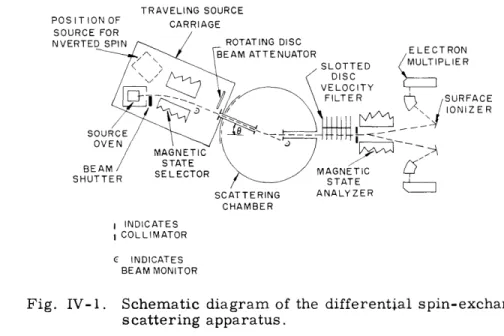
A schematic diagram of the scattering apparatus is given in Fig. IV-i. An alkali atomic beam passes through a magnetic state selector. The emerging beam of polarized atoms enters a scattering region where it collides with a crossed beam of atoms or ions, or, as in our preliminary experiment, with a cold background gas of molecules.
TRAVELING SOURCE
POSITION OF CARRIAGE SOURCE FOR
NVERTED SPIN ROTATING DISC
BEAM ATTENUATOR ELECTRON
K SLOTTED MULTIPLIER DISC VELOCITY S AFILTER SURFACE IONIZER SOURCE i-OVEN MAGNETIC BEAM STATE
SHUTTERM SELECTOR MAGNETIC
SHUTTER STATE SCATTERING ANALYZER CHAMBER i INDICATES COLLIMATOR C INDICATES BEAM MONITOR
Fig. IV-1. Schematic diagram of the differential spin-exchange scattering apparatus.
This work was supported by the Joint Services Electronics Programs (U. S. Army, U. S. Navy, and U. S. Air Force) under Contract DA28-043-AMC-02536(E), and in part by the U. S. Navy (Office of Naval Research) under Contract N00014-67-A-0204-0006.
Atoms scattered through a given angle, 0, pass through defining slits, a velocity selec-tor, and a magnetic state selector which splits the beam into two components according to the atomic polarization. The emerging beams are each detected by a hot-wire ionizer followed by a magnetic mass separator and electron multiplier. Further details of the
apparatus follow. (i) Source
The source is a conventional alkali oven which we operate somewhat above the effu-sive limit. We have observed "jet" action in this oven when the first collimating slit (the skimmer) was removed. Since the jet source is of interest as a high-intensity beam source, additional details are given at the end of this report.
(ii) Velocity Selector
The slotted-disk velocity selector is similar in design to others, except for the disk fabrication and the rotor mounting technique. The disks are photo-etched from .005" beryllium copper, and have 360 slots. Above 3000 rpm, the disks become flat and parallel because of the centrifugal force and they remain undistorted up to 27,000 rpm, the top speed of our motor. The rotor bearings are deep-grooved ball bearings with metal retainers, and Versilube 300 grease is used as the lubricant. The outer races are positioned by Viton O-rings which have been cut away enough to give a compliant suspension. Because the Viton is a very lossy material, there are no serious vibration problems, even though the principal resonance frequency of the suspension system lies within the operating range, and in spite of the fact that we have not dynamically balanced
the rotor.
(iii) Detectors
Each of the two detectors consists of a surface ionizer, mass separator, and elec-tron multiplier. Because of the low counting rates at large scattering angle, unusually low detector background is required. To achieve this, an iridium filament is used, .028" wide and .00018" thick. The multipliers are Bendix Type M-306 strip multipliers. (Thus far, only one detector has been used, because of high background in one of the multipliers.) The counting efficiency is approximately 40%. The background counting rate is approximately 5 counts per second, with the chief contribution coming from the filament. In the present work, the primary beam is chopped and the detector output is synchronously gated between two scalars.
2. Experimental Procedure
Although the apparatus is designed to be used in a crossed-beam configuration, our initial experiments have been to scatter a potassium beam from a background gas. The
reasons for this were largely practical; the crossed beams sources were not yet com-pleted, while background gas could be introduced into the system easily. The disadvan-tage of this method is that resolution is sacrificed, on account of the uncertainty in the
center-of-mass motion of the collision partners. In the present case, however, the 02 gas was cooled to 77 'K, whereas the potassium beam was jetting at 900 *K, with the result that motion of the 02 did not affect the relative velocity by more than 20%.
Oxygen was admitted into the scattering manifold to a gauge pressure of 1-2 X 10⁻⁵ torr. The effective scattering volume was defined by the beam geometry. (Multiple scattering was significant at these high pressures and probably had an appreciable effect on the results for small-angle scattering. This problem will be eliminated when a crossed beam is introduced.) Since only one of the detectors was available, separate counting rates were determined for both source polarizations at each scattering angle. The source polarization was changed by moving the source with respect to its magnetic state analyzer.
3. Results
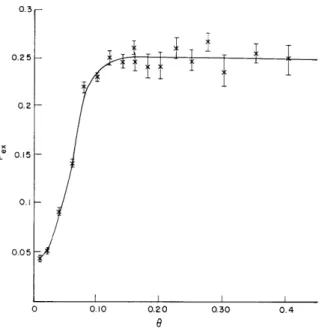
Results for differential spin-exchange scattering are conveniently displayed by giving Pex' the probability that spin exchange occurs during a collision, vs the scattering angle, 0. A summary of data for the K-O 2 system is given in Fig. IV-2. Since spin exchange occurs when the electron clouds overlap, it is clear that the probability for exchange should vanish for sufficiently weak collisions, that is, for small-angle scat-tering. The transition from weak to strong collisions is evident.
0.3-0.25 0.2 ,_ 0.15 0.1 -0.05 0.10 0.20 0.30 0.4
The mean value of Pex for strong collisions yields information about the relative size of scattering amplitudes for the two spin states. For the present case, a spin 1/2 system interacting with a spin 1 system, it can be shown that in the strong-collision region
0.451, if f4 = 0
P ex(strong) = 0. 241, if f4 =f2 0. 180, if f2 = 0
where f4 and f2 are the quartet and doublet scattering amplitudes, respectively. (These
results have been corrected for nuclear spin through a rigorous theory, for this has not yet been completed.) From Fig. IV-2 it can be seen that P ex(strong) = 0.25 ± 0.01, so
that f4 = f2"
In well-collimated atom-atom exchange collisions, P exhibits oscillatory behavior ex
as the collision strength is increased, thereby indicating successive exchanges of the electrons. This behavior is not shown in the present results because of the lack of definition of the center-of-mass scattering angle and relative velocity. Also, inelastic collisions with molecular oxygen may eliminate structure in Pex
In addition to measuring Pex' we have also observed da/dQ. For the angles of interest the collisions are dominated by Van der Waals interactions, and one expects that In (da/dQ2) = C - 7/3 In 0. Our results appear to be consistent with this although we have not yet made a precise determination.
At the present time, we do not have a detailed theory for spin exchange between atoms and molecules. Work on this is in progress.
4. Jet Source
Since a high-intensity alkali beam is an important asset to our scattering investiga-tions, we have used our source to produce a jet beam.2 The source appears to operate in the anticipated manner. A brief description of its principles and performance follows.
A jet source operates in the region where the Knudsen number, n = (mean-free path)/ (source diameter), is much less than one. (A conventional atomic beam source operates with n > 1.) The emerging gas expands adiabatically into the vacuum. The temperature
falls until the gas is so rare that there are insufficient atomic collisions to maintain thermal equilibrium. At this point, the beam is composed of a low-temperature gas possessing a directed velocity. Enthalpy is conserved in such an expansion, and it fol-lows that for a monatomic ideal gas the final velocity is given by v = 5 =
T
72
a,where a is the most probable velocity in the source.
diameter. The required large pumping speed for the source is provided by a cold jacket which surrounds the oven. (We found that the source operated satisfactorily with the usual beam skimmer removed, although the skimmer was used when a well-collimated beam was required.)
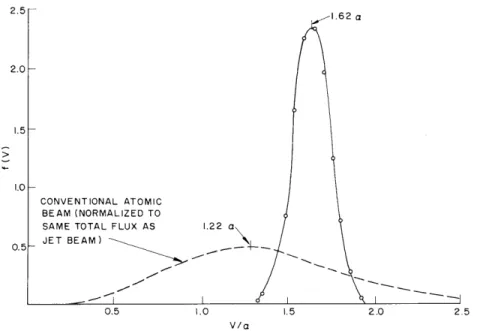
A measured velocity profile for the oven is shown in Fig. IV-3. For con-trast, a conventional atomic beam velocity distribution at the same oven
tem-perature is also shown. The oven operated at an exit temtem-perature of 632 °C,
and at a pressure of 21 mm, which yields a Knudsen number of approximately 1/2000. The measured value of the most probable beam velocity is v (expt.) = 1. 62 a, as contrasted with the theoretical value v (theor.) = 1. 58 a. The slightly high experimental value may be due to the presence of dimers or trimers in the beam. (Their presence would be revealed by magnetic state selection; how-ever, the state selectors were out of the apparatus while the data in Fig. IV-3 were obtained.) 2.5 1.62 a 2.0 1.5 1.0 CONVENTIONAL ATOMIC BEAM (NORMALIZED TO
SAME TOTAL FLUX AS 1.22 a
0.5 JET BEAM)
0.5 1.0 1.5 2.0 2.5
V/a
Fig. IV-3. Measured velocity distribution from the alkali jet source.
The measured beam intensity at a detector . 028" wide X .187" high at a distance of 30" is 2 X 10¹² pps. This figure is uncertain by a factor of two, chiefly as a result of uncertainty in the transmission of a rotating disc beam attenuator. (This attenuator reduces the beam intensity by approximately 106, in order to reduce contamination of the detector by the direct beam.)
References 1. G. Kwei, U.C.R. L. Report No. 11966 (n. d.).
2. J. B. Anderson, R. P. Andres, and J. B. Fenn, Advances in Atomic and Molecular Physics, Vol. I, edited by D. R. Bates and Immanuel Estermann (Academic Press, Inc. , New York, 1965).