HAL Id: hal-00866446
https://hal.archives-ouvertes.fr/hal-00866446
Preprint submitted on 30 Sep 2013
HAL is a multi-disciplinary open access archive for the deposit and dissemination of sci-entific research documents, whether they are pub-lished or not. The documents may come from teaching and research institutions in France or abroad, or from public or private research centers.
L’archive ouverte pluridisciplinaire HAL, est destinée au dépôt et à la diffusion de documents scientifiques de niveau recherche, publiés ou non, émanant des établissements d’enseignement et de recherche français ou étrangers, des laboratoires publics ou privés.
Improving the Clean Development Mechanism
Post-2012 : A Developing Country Perspective
Nhan-T Nguyen, Minh Ha-Duong, Sandra Greiner, Michael Mehling
To cite this version:
Nhan-T Nguyen, Minh Ha-Duong, Sandra Greiner, Michael Mehling. Improving the Clean Develop-ment Mechanism Post-2012 : A Developing Country Perspective. 2010. �hal-00866446�
C.I.R.E.D.
Centre International de Recherches sur l'Environnement et le Développement
UMR8568CNRS/EHESS/ENPC/ENGREF
/CIRAD /METEO FRANCE
45 bis, avenue de la Belle Gabrielle F-94736 Nogent sur Marne CEDEX
Tel : (33) 1 43 94 73 73 / Fax : (33) 1 43 94 73 70 www.centre-cired.fr
DOCUMENTS DE TRAVAIL / WORKING PAPERS
No 19-2010
Improving the Clean Development Mechanism
Post-2012:
A Developing Country Perspective
Nhan T. Nguyen
Minh Ha-Duong
Sandra Greiner
Michael Mehling
Improving the Clean Development Mechanism Post-2012: A Developing Country Perspective
Abstract:
In this article, we assess the future prospects of the Clean Development Mechanism (CDM) from the perspective of a developing country, drawing on Vietnam as a case study. First, we review the performance of the CDM and describe the evolution of carbon markets on the path towards a post-2012 climate regime. Next, we place Vietnam in a post-2012 context, and assess potential project resources, challenges, and opportunities that could arise for the country from a future climate policy framework. Our analysis suggests that the CDM should remain in place and be improved to facilitate more meaningful participation by developing countries in climate mitigation efforts beyond 2012. Finally, the article sets out eight proposals that could help improve the CDM as the world progresses towards a new international climate policy framework.
Keywords: Clean Development Mechanism, CDM, Climate policy, international framework,
Developing country, Vietnam.
Améliorer le Mécanisme de Développement Propre post-2012 : perspective pour les Pays en développement.
Résumé:
Dans cet article nous évaluons les perspectives à venir du Mécanisme de Développement Propre (MDP) du point de vue d’un Pays en développement, en s’appuyant sur le Vietnam comme étude de cas. D’abord, nous reconsidérons les performances du MDP en décrivant l’évolution des marchés carbone sur la trajectoire d’un régime climatique post-2012. Puis nous replaçons le Vietnam dans un contexte post-2012 pour évaluer les ressources potentielles du projet, les défis, et les opportunités qui peuvent survenir pour le pays dans le cadre d’une politique climatique future. Notre analyse suggère que le MDP devrait être maintenu en place et amélioré pour faciliter une participation plus significative des pays en développement aux efforts d’atténuation climatique au-delà de 2012. Finalement, l’article dégage huit propositions pouvant aider à l’amélioration du MDP tandis que le monde s’avance vers un nouveau cadre international de politique climatique.
Mots-clés : Mécanisme de Développement propre, MDP, politique climatique, cadre
5
To be published online by the Carbon & Climate Law Review, March 2010.
Improving the Clean Development Mechanism Post-2012: A Developing
Country Perspective
Nhan T. Nguyen, Minh Ha-Duong, Sandra Greiner and Michael Mehling
Nhan T. Nguyen and Minh Ha-Duong, Centre International de Recherche sur l'Environnement et le Développement (CIRED), Nogent-sur-Marne Cedex, France; Sandra Greiner, Climate Focus, Amsterdam, Netherlands; Michael Mehling, Ecologic Institute, Washington DC, USA. Corresponding author: Nhan T. Nguyen, contact: Campus du Jardin Tropical, 45bis ave. de la Belle Gabrielle, Nogent-sur-Marne Cedex, France. Tel: +33 (1) 43 94 73 65. Fax: +33 (1) 43 94 73 70, eMail: [email protected]. Research for this article has been carried out at CIRED under a Ph.D. research grant offered by the Centre National de la Recherche Scientifique (CNRS) of France. All errors and opinions remain those of the authors.
6
1. Introduction
As one of the flexible mechanisms created under the Kyoto Protocol,1 the Clean Development Mechanism (CDM) allows developed countries to co-finance projects realized in developing countries in exchange for certificates of greenhouse gas emission reductions. Identifying a future for this mechanism has become an urgent matter for international climate negotiations, given that the first commitment period of the Kyoto Protocol expires at the end of 2012. Also, the CDM remains the only established instrument allowing an active role for the developing world in mitigation activities. In recent years, this mechanism has attracted a lot of criticism, but has also seen a variety of proposals to improve its effectiveness. Both are discussed in this text from a developing country's perspective, based on the case of Vietnam.
Accordingly, Section II reviews the past performance and future prospects of the CDM in the context of global carbon markets. Section III reviews the performance of the CDM and its prospects from the point of view of Vietnam. It shows that, while there is a large potential for mitigation projects in the country, to date the mechanism has not been used as much as might be expected, suggesting that numerous opportunities could be created through a new international climate regime. Based on this analysis, Section IV offers eight suggestions to improve the CDM that would allow it to continue expanding post-2012 as a major instrument to finance climate mitigation activities in developing countries. Section V summarises the main conclusions.
2. The CDM and the Carbon Market
2.1. Performance of the CDM
The Clean Development Mechanism (CDM) is a flexible mechanism created by the Kyoto Protocol to the United Nations Framework Convention on Climate Change (UNFCCC).2 A central objective of the CDM is to lower the cost of compliance with emissions reductions commitments entered by developed countries (Annex I countries, as defined in the UNFCCC); but it equally seeks to increase the level of foreign investment, promote the transfer of advanced climate-friendly technologies, and ensure the sustainable development of developing (or non-Annex I) countries.
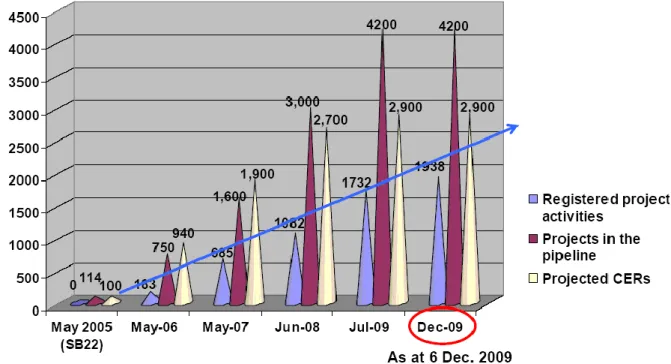
Figure 1 shows that, from 2005 to 2010, the CDM has experienced strong and continuous growth, as expressed by the number of projects registered or in the pipeline. The first project was registered on 16 February 2005; by 14 April 2008, or three years later, the 1.000th project had been registered. Less than two years after that, the 2.000th registered project milestone was passed, with 2.067 registered projects registered as of since as of 1 March 2010.3 More than 1.7 billion Certified Emission Reductions (CERs) are expected from these projects and projects in the pipeline by the end of 2012. As each CER represents one ton of CO2 not
emitted into the atmosphere, this quantity is not negligible. For instance, it is roughly equivalent to the amount emitted in one year by Japan and France together.
1
Kyoto Protocol to the United Nations Framework Convention on Climate Change (Kyoto Protocol), Kyoto, 10 December 1997, in force 16 February 2005, 37 International Legal Materials (1998) 22.
2
See Art. 12 of the Kyoto Protocol, supra, note 1; for the UNFCCC, see United Nations Framework Convention on Climate Change (UNFCCC), 9 May 1992, in force 21 March 1994, 1771 United Nations Treaty Series (1992) 107.
3
Figures provided by the UNFCCC Secretariat, ―CDM Statistics‖, available on the Internet at <cdm.unfccc.int/Statistics/index.html> (last accessed on 1 March 2010).
7
By early 2010, over 4.200 CDM projects were in the pipeline. Yet, the relative stagnation in the second half of 2009 apparent in Figure 1 suggests that the window of opportunity offered by Kyoto's first commitment period is closing. As one group of authors described it, the CDM has experienced a ―gold rush‖ period between late 2005 and late 2008, with more than a hundred CDM project design documents entering the validation process each month.4
The distribution of projects by economic sector and by country is not uniform. In January 2010, about 60% of registered projects lay in the energy industries (renewable and non-renewable), while the transport and construction sectors were virtually absent. Over 75% of registered projects are currently being carried out in Asia. China alone represents 36% of projects, followed by India with 24% and Brazil with 8%. A limited number of projects are being implemented in other developing countries, and even fewer projects are located in least-developed countries (LDCs). According to Axel Michaelowa and Benito Müller, credits issued up to the end of May 2009 indicate a very good performance of the CDM.5 Three types of project, including projects to destroy the industrial gases N2O and HFC-23, outperformed
expectations.
Still, the CDM has also been subject to ample criticism. Several authors have noted that industrial gas destruction projects receive high windfall profits because these gases have a higher global warming potential than CO2 and relatively low abatement costs.6 Others have
4
Axel Michaelowa and Benito Muller, ―The Clean Development Mechanism in the Post-2012 Climate Change
Regime‖ Climate Strategies Final Report, May 2009, available on the Internet at
<www.climatestrategies.org/our-reports/category/39/205.html> (last accessed on 1 March 2010). 5
Michaelowa and Müller, supra, note 4. 6
Michael Wara and David Victor, ―A Realistic Policy on International Carbon Offsets‖, PESD Working Paper No. 74, April 2008, available on the Internet at <iis-db.stanford.edu/pubs/22157/WP74_final_final.pdf> (last accessed on 1 March 2010); Andrew B. Schatz, ―Discounting the Clean Development Mechanism‖, 20
Georgetown International Environmental Law Review (2008), 704.
8
pointed out that high windfall profits prevent resources from being used more effectively elsewhere.7
At the same time, the environmental effectiveness of the CDM has been questioned because it does not reduce emissions itself, but offsets the increase in emissions elsewhere. Whether the emissions reduced by a CDM project are ―additional‖ to mitigation measures the host country would have implemented in the absence of the project is an issue of ongoing controversy.8 Concerns have also been voiced about administrative and institutional constraints linked to the CDM project cycle, such as lengthy and expensive approval procedures, or the need for complex methodologies determining whether projects actually reduce greenhouse gas emissions, and about the role of the CDM Executive Board (CDM EB) and Designated Operational Entities (DOEs).9
A number of improvements and reform options have been put forward to improve the CDM and scale it up for the expected needs under an international climate regime beyond 2012. Such reforms commonly focus on expanding the already existing programmatic CDM, creating a new sectoral CDM, or exploring options for a policy-based CDM. Some of these options form part of an ongoing improvement process, while others are currently still in the negotiation stage.
2.2. Copenhagen and the Future of the CDM
When parties to the UNFCCC met in Copenhagen in December 2009 for the 15th Session of the Conference of the Parties (COP15), they failed to define the details of a new global climate regime. Developing countries, notably large emerging countries, refused to enter legally binding commitment on emissions reductions for the short to medium-term, although they agreed to implement necessary mitigation actions. Additionally, they insisted that climate mitigation actions only be measured, reported, and verified to the extent that developed countries comply with their promises of financial resources for mitigation, adaptation, technology transfer and capacity building.
Many developing countries attended COP15 with expectations for an extensive reform of the CDM or adoption of new, complementary mechanisms to better support implementation of their mitigation and adaptation efforts. And indeed, considerable progress was made with a number of technical documents, including a decision on various improvements to the CDM
7
Stefan J.A. Bakker, Harro D. van Asselt, Joyeeta Gupta, Constanze Haug, and M.A. Raouf Saïdi, ―Differentiation in the CDM: Options and Impacts‖, Report 500102 023 ECN-B-09-009, May 2009, available on the Internet at <www.rivm.nl/bibliotheek/rapporten/500102023.pdf> (last accessed on 1 March 2010).
8
Axel Michaelowa and Purohit Pallav, ―Additionality Determination of Indian CDM Projects: Can Indian CDM Project Developers Outwit the CDM Executive Board?‖, Climate Strategies Report, February 2007, available on the Internet at <www.climatestrategies.org/component/reports/category/39/162.html> (last accessed on 1 March 2010); Lambert Schneider, ―Is the CDM Fulfilling its Environmental and Sustainable Development Objectives? An Evaluation of the CDM and Options for Improvement‖, November 2007, available on the Internet at <www.oeko.de/oekodoc/622/2007-162-en.pdf> (last accessed on 1 March 2010); Martin Cames, Nils Anger; Christoph Böhringer et al., ―Long-term Prospects of CDM and JI‖, July 2007, available on the Internet at <www.umweltdaten.de/publikationen/fpdf-l/3294.pdf> (last accessed on 1 March 2010); Wara and Victor, supra, note 6.
9
Charlotte Streck, ―The Governance of the Clean Development Mechanism: The Case for Strength and Stability‖, 15 Environment Liability (2007), 91; Jolene Lin and Charlotte Streck, ―Making Markets Works: A Review of CDM Performance and the Need for Reform‖, 19 European Journal of International Law (2007), 409; Paula Castro and Axel Michaelowa, ―Empirical Analysis of Performance of CDM Projects‖, Climate
Strategies Final Report, June 2008, available on the Internet at
<www.climatestrategies.org/component/reports/category/39/138.html> (last accessed on 1 March 2010); Grant Boyle, Jennifer Kirton, Rudi M. Lof, and Tanya Nayler, ―Transitioning from the CDM to a Clean Development Fund‖, 3 Carbon and Climate Law Review (2009), 16.
9
titled ―Further Guidance Relating to the Clean Development Mechanism‖.10
Under this decision, the CDM Executive Board will have the ability to streamline the procedures governing registration and CER issuance for CDM projects, and provide new funding to accelerate the development of CDM projects in countries with fewer than 10 approved CDM projects in operation. Lex de Jonge, chairman of the CDM Executive Board, predicted that the reforms would serve to ―enhance the efficiency of the mechanism, expand its reach, and maintain its environmental integrity.‖11
But for a variety of environmental and political reasons, negotiations on future commitment periods of the Kyoto Protocol stalled at the Copenhagen climate summit, an impasse that also affects the further role of the Kyoto flexible mechanisms. Currently, the future of the Kyoto Protocol remains unclear beyond 2012, leaving the global carbon markets, including the CDM offsetting market, in a state of uncertainty.
2.3. Carbon Markets in a Post-2012 Climate Regime
At the moment, demand and supply dynamics for CERs post-2012 depend on various factors. On the supply side, these are: the fate of CERs issued if Kyoto is or is not extended; constraints on the development of new projects due to an issuance bottleneck; and new projects entering the pipeline. On the demand side, they include: the demand for CERs from the European Union beyond 2012; the introduction of mandatory cap-and-trade systems in other developed countries, including Japan and the United States, and the extent to which these allow for compliance through use of CERs or similar credits; the introduction of new project categories, such as carbon capture and storage (CCS) or reduced emissions from deforestation and forest degradation (REDD); the further development of the CDM in terms of governance and eligibility rules post-2012.
The market for CERs beyond 2012 is vitally linked to the future architecture of the broader carbon market. It is unclear whether and how the CDM or a CDM-like mechanism will be included in the post-2012 regime, and, if it is, what the demand for and supply of credits will be. Despite significant uncertainties at the international level, regional and domestic initiatives continue unfolding in a number of jurisdictions. In many cases, these will continue to operate independently of the progress – or lack thereof – with negotiations for a post-2012 climate agreement.
Currently, the biggest driver for the global carbon market is the European Emission Trading Scheme (EU ETS), which caps emissions of the largest point sources in Europe. It is followed in size by the CDM market, consisting of the primary, secondary, and options market for CERs.12 The latter is closely interlinked with the EU ETS: prices for CERs are highly correlated with the prices of European Union Allowances (EUA), given that CERs are a fungible compliance unit for EU ETS participants. Given the current uncertainties at the international level and excess supply in the market for Assigned Amount Units (AAUs) in the international emissions trading system created by the Kyoto Protocol, this fungibility of CERs under the EU ETS has been considered strategic for the CDM. Importantly, the EU ETS has already been extended beyond 2012 with a 3rd Phase (2013-2020), regardless of the fate of the international climate regime post-2012. This provides an important message to the developing
10
Draft Decision -/CMP.5, Further Guidance Relating to the Clean Development Mechanism, December 2009, available on the Internet at <unfccc.int/files/meetings/cop_15/application/pdf/cmp5_cdm_auv.pdf> (last accessed on 1 March 2010).
11
NDRC Press Release, ―Copenhagen Greenlights Plan to Streamline CDM‖, 25 December 2009, available on the Internet at <cdm.ccchina.gov.cn/english/NewsInfo.asp?NewsId=4160> (last accessed on 1 March 2010). 12
See Karan Capoor and Philippe Ambrosi, State and Trends of the Carbon Market 2009 (Washington, DC: World Bank, 2009), 5 and 31.
10
world that the EU ETS, a key carbon market in the first Kyoto commitment period, will continue serving as the main driver for emissions reductions within Europe.
Carbon markets are also emerging in the United States at the regional level, and may eventually also be introduced at the federal level. Under the rules framing these markets, international credits, such as EUAs and CERs, might be eligible for compliance purposes under specified conditions. Other countries, such as Japan, Australia and New Zealand, are also actively interested in carbon markets. Over time, such national and regional markets may converge to form a global carbon market from the bottom-up, through linkages across carbon markets, both North-North and North-South.13
Carbon markets are and will remain politically driven, as supply and demand for credits are determined to a substantial degree by political decisions. However, economic forces are a strong underlying driver of policy decisions. Current trends in the growth of increasingly integrated carbon markets may lead to a global reference price for CO2 emissions by 2020.14
Observers have argued that a global price for CO2 would benefit low-income countries;15 they
would profit from a wider range of carbon-reducing technologies, and have opportunities for ―leapfrogging‖ beyond the technologies already installed in high-income countries.
13
See Michael Mehling and Erik Haites, ―Mechanisms for Linking Emissions Trading Schemes.‖ 9 Climate
Policy (2009), 169; Andreas Tuerk, Michael Mehling, Christian Flachsland, et al., ―Linking Carbon Markets:
Concepts, Case Studies and Pathways‖, 9 Climate Policy (2009), 341. 14
Point Carbon, ―Carbon 2008—Post-2012 Is Now‖, 27 March 2008, available on the Internet at <www.pointcarbon.com/research/carbonmarketresearch/analyst/1.912721> (last accessed on 1 March 2010); in this study, Point Carbon forecasts a global carbon market worth €2 trillion by 2020 and assumes a market volume of 38 Gt and a carbon price of €50 by 2020 .
15
Frank Ackerman, ―Carbon markets and Beyond: The Limited Role of Prices and Taxes in Climate and Development Policy‖, G-24 Discussion Paper Series No. 53, December 2008, available on the Internet at <www.unctad.org/en/docs/gdsmdpg2420084_en.pdf> (last accessed on 1 March 2010).
Box 1: Vietnam: A suitable Host for the First Carbon Capture and Storage Project Registered under the CDM?
Domestic coal reserves, geological potential, rapid expansion of coal-fired electricity generation and pronounced climate change vulnerability all make carbon capture and storage technology (CCS) highly interesting mitigation options for Vietnam. Indeed, the White Tiger (Bach Ho) Field project in Vietnam was an early proposal to include a CCS project under the CDM. It involves CO2 capture from Natural Gas Combined Cycle
(NGCC) plants, pipeline transport, storage in offshore/onshore oil fields and enhanced oil recovery. As the first commercial CCS project in Asia, it would have a high demonstration value, and could potentially generate emission reductions of approximately 7.7 million tCO2 per year, facilitating the recovery of an average of 50 thousand barrels of crude oil
per day. Work to include CCS in the CDM started in 2006, but has not yet been concluded as of December 2009. There are pending methodological issues, given that the technology is still evolving, and the scale is out of proportion relative to the average CDM project: out of 2236 requested and registered projects in February 2010, only 7 are larger than the White Tiger project in terms of avoided emissions.
11
3. Vietnam: A Case Study
3.1. Vietnam as a CDM Project Host: A Large and Untapped Potential
Vietnam has significant potential for the implementation of CDM projects.16 Most of this potential lies in the energy sector: between 1996 and 2007, the demand for electricity increased by more than 14% each year. It is expected to continue growing at a faster pace than GDP from 2010 to 2030, rising between 15% and 18% per year. In order to satisfy this rapid growth in demand, the Vietnamese government is expanding generation capacity mainly through construction of coal-fired plants. In the baseline case, simulations by Nguyen and Ha-Duong suggest that about 70 GW of power generation based on coal-fired plants could be installed by 2030 in Vietnam.17 Yet many cleaner development options exist:
Vietnam is endowed with an abundance of natural resources and geophysical conditions that can be leveraged to generate significant amounts of renewable energy, including hydropower, wind, geothermal, sun, biogas and biomass,18 and various forms of waste.19
Fuel switching in a number of sectors20 and improved energy efficiency in both industry and buildings could offer great opportunities for hosting CDM projects.21
Vietnam has large onshore and offshore sedimentary basins that could provide significant potential for storing CO2. The country is expected to have sufficient
capacity to store approximately 20 to 60 Gt of CO2 emissions.22 This is a significant
fraction of the total global need for CO2 emissions reductions (145 Gt) over
2010-2050. Box 1 presents the possibility for carbon capture and storage in Vietnam under the CDM.
Inclusion of reduced emissions from deforestation and degradation (REDD) in the CDM is now considered under the UNFCCC negotiations. Vietnam is one of the nine countries that has promising potential and is supported by the UN-REDD Programme for development of REDD readiness. The country has 48% forest and forestland area (equal to 16.2 million hectares). It grew an average of 236 thousand hectares of forest per year between 1990 and 2000, equivalent to a 2.5% annual increase. The growth rate remained at 2.1% annually from 2000 to 2005.23
16
Germany Trade & Invest, ―CDM Market Brief: Vietnam Case Study‖, 2009. 17
T. Nhan Nguyen and Ha-Duong Minh, ―CO2 Emissions Mitigation Potential in Vietnam’s Power Sector‖,
DEPOCEN Working Paper 2009/22, 25 November 2009, available on the Internet at
<depocenwp.org/index.php> (last accessed on 1 March 2010). 18
Mainly in the form of residues from sugar, rice, agriculture, and wood. 19
Mainly waste from landfills, animal farms, tapioca starch. 20
Notably electricity generation, beverage, iron, steel, cement, pulp, paper, and rubber. 21
For details, see Manh Hoa Hoang, ―Main CDM Activities in Vietnam‖, presentation held at the Consultative Workshop on a Regional Strategy for CDM/Carbon Financing, Bangkok, Thailand, 30-31 March 2006; T. Nhan Nguyen, Minh Ha-Duong, Sandra Greiner and Michael Mehling, ―Clean Development Mechanism in Vietnam: Potential and Limitations‖, forthcoming in Michael Mehling, Amy Merrill and Karl Upston-Hooper, Improving the Clean Development Mechanism: Legal and Institutional Challenges (Berlin: Lexxion, 2010).
22
Didier Bonijoly, ―Potential for Capturing and Storing CO2 Emissions in Vietnam: Where is the Potential?‖,
presentation held at the Vietnam-French Forum of Economic and Finance: Energy and Sustainable Development, Bureau de Recherches Géologiques et Minières (BRGM), Orléans, France, 2009.
23
Gesellschaft für Technische Zusammenarbeit (GTZ), ―Designing a REDD compliant benefit distribution system for Vietnam: Executive summary. UN-REDD Programme, November 30, 2009
12
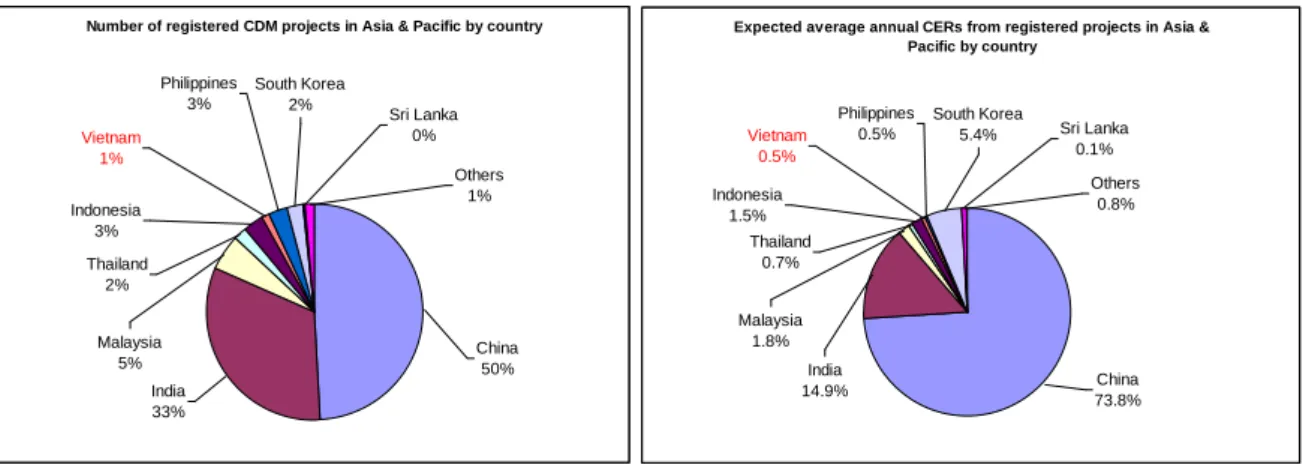
This potential is currently mostly untapped. By 26 January 2010, Vietnam only had 20 projects registered with the CDM Executive Board (CDM EB). As Figure 2 shows, that number accounts for only 1% of the total CDM projects registered within the Asia and Pacific region. This fraction is unlikely to grow in the near future; in addition to having only 1% of overall projects in the pipeline, Vietnam also accounts for only 1% of credit volume expected by 2012.24
In a separate study, the authors have examined barriers preventing fuller implementation of CDM projects in Vietnam. We have found that regulatory barriers, barriers arising from an unfavorable business environment, difficulties in access to information, weak local capacity, and the structure of the projects portfolio constitute the main barriers to greater success of the CDM in Vietnam. We conclude that proper government policies and actions are necessary for Vietnam to benefit more fully from the CDM or any future mechanism similar to the CDM.
3.2. Vietnam’s Role in a Post-2012 Climate Regime
As a developing country with significant potential for hosting CDM projects, Vietnam could bear risks if it continues pursuing this investment vehicle in the context of an uncertain post-2012 climate regime. In the event that future rules restrict developing country access to the carbon market or revoke the mechanism, Vietnam could fail to receive benefits from the implementation of CDM projects, exposing the government and investors to significant investment risks. Moreover, given current uncertainties over market prices beyond 2012, it cannot be ruled out that investors will be forced to sell emission reductions credits from CDM projects at very low prices or even prove unable to sell them altogether. Such risks are borne both by the host country government and the project investors.
As the year 2012 approaches, the window of opportunity created by the first commitment period under the Kyoto Protocol will narrow and eventually close. Project developers launching CDM projects at this point in time will run into the 2012 deadline and may hence suffer investment risks, both due to the time required for implementing a project and the increasing shortage of CER buyers. At present, most commercial CER buyers – such as EU ETS compliance buyers, Japanese buyers, and speculative funds – are not committing to a purchase of post-2012 CERs, except for a minority of buyers willing to commit to forward purchases of post-2012 CERs as part of an offer to purchase pre-2012 CERs. Currently, the most concrete opportunity for sales of post-2012 credits arises from a number of post-2012 carbon funds set up by multilateral institutions. Most of these funds assume the continued
24
See UNEP Risoe Centre on Energy, Climate and Sustainable Development (URC), ―CDM Projects by Host Region‖, January 2010, available on the Internet at <cdmpipeline.org> (last accessed on 15 January 2010).
Figure 2: Registered CDM projects, Asia & Pacific, by host party as of 28 January 2010. Source: <cdm.unfccc.int>
Number of registered CDM projects in Asia & Pacific by country
China 50% India 33% Malaysia 5% Thailand 2% Indonesia 3% Vietnam 1% Philippines 3% South Korea 2% Sri Lanka 0% Others 1%
Expected average annual CERs from registered projects in Asia & Pacific by country China 73.8% India 14.9% Malaysia 1.8% Thailand 0.7% Indonesia 1.5% Vietnam 0.5% Philippines 0.5% South Korea 5.4% Sri Lanka 0.1% Others 0.8%
13
existence of a project-based GHG market, and focus on development objectives. In Vietnam, such funds have been set up by the World Bank, the Asian Development Bank, the European Investment Bank, and the Nordic Environment Finance Corporation (NEFCO), among others.25
One of the most controversial issues addressed during the climate negotiations in Copenhagen was the adoption of emission reduction targets, both directly or indirectly, by developing countries and especially by emerging economies. While many of these countries show hesitation or openly refuse any engagement in this debate, scientific evidence suggests that meaningful participation by all parties to the UNFCCC will be needed to meet the climate challenge, even if the future policy framework remains based on the principle of common but differentiated responsibilities. Under such a framework, developing countries would take on commitments in line with their different levels of economic development. Over time, domestic policies and practices can evolve into low-carbon growth plans, with financial and technical assistance where needed.
In Vietnam, the opportunities and challenges raised by more ambitious climate policies are necessarily featured in the national development agenda, not only because Vietnam is one of the countries most vulnerable to the dangerous impacts of climate change, but also because effective climate action offers prospects for sustainable development: aided by financial support for adaptation and mitigation from developed countries, it can drive investment and clean growth, incentivize job creation, provide opportunities for poverty eradication, and help elevate the standard of living. A discussion of the potential benefits for Vietnam of a reformed CDM follows below.
A number of sectors in the Vietnamese economy offer substantial opportunities for the implementation of mitigation projects, with the energy sector accounting for the largest overall potential. This potential largely rests in the field of renewable energy, an area dominated by small-scale hydropower and wind energy, as well as in energy efficiency improvements both for industry and buildings.26 In Vietnam, however, small-scale projects may face greater technical and financial barriers than large projects,27 suggesting that the CDM process and modalities for small-scale energy projects would need to be simplified and streamlined before the potential for such projects can be fully exploited: small-scale projects implemented under similar environmental conditions and socio-economic settings, using the same technology, methodology, and so on, should be cleared through a fast-track procedure rather than being required to go through all stages of the regular project cycle. In order to harness the potential for such projects most effectively, this process should be as standardized as possible, including establishment of emission reduction baselines for different sectors, systematic definition of positive lists for technologies, simplification of project description formats, and other measures to facilitate participation in the mechanism.
Additionally, Vietnam offers significant potential for small industrial projects and scattered mitigation actions, such as demand-side energy efficiency improvements, measures for increased boiler efficiency in small industries, biomass-fired cooking stoves, biogas digesters, solar water heating, geothermal energy, small hydropower, and wind energy. CDM Programmes of Activities (PoAs) would appear the most effective mechanism to support such actions in Vietnam, given that PoAs have already proven successful for small-scale projects to include on-grid/off-grid applications using renewable energy. More specifically, registration
25
Climate Focus, Renewable Energy Small Power Producers in Vietnam, Final Report prepared for the Ministry of Industry and Trade and the World Bank (Rotterdam: Climate Focus, 2009).
26
See Nguyen et al., supra, note 21. 27
14
of renewables as PoAs would result in large benefits for electrification and poverty reduction in remote areas, where more than 70% of the Vietnamese population currently lives.
Further, the adoption of carbon capture and sequestration (CCS) technology in the Vietnamese power sector, which has high CO2emissions due to the large share of coal-fired generation,
could offer significant potential for financial investment and technology transfer to Vietnam if large-scale CCS projects are included as eligible projects in a post-2012 climate regime. Likewise, the inclusion of REDD in the CDM, a proposition currently under discussion, might also create new opportunities for climate finance based on program funding from developed countries or through new climate mechanisms. Specifically, implementation of REDD activities offers one of the most effective ways to alleviate rural poverty and improve biodiversity conservation in Vietnam.
3.3. National Climate Policy for the Post-2012 Period
In 2008, Vietnam approved the National Target Programme to Respond to Climate Change (NTP). With the NTP, the government prepared a set of specific policies and action plans for climate mitigation activities over both the short and the long term, focusing on a number of sectors that may be eligible for crediting under a climate regime beyond 2012: energy generation, industry (enhancing energy efficiency, fossil fuel switching, promoting renewable energy, nuclear energy, early application of CCS for cement and electricity generation, and others), agriculture, forestry and waste (a 5 million hectares reforestation program, restoration of cultivated peaty soils and degraded lands, landfill CH4 recovery, and others), and so on.
Nonetheless, the government has acknowledged the need for financial and technological support from developed countries as well as other international funding sources.28
Coming to the Copenhagen summit, the Vietnamese government expressed its firm adherence to the principle of common but differentiated responsibilities as a premise for participation by all nations around the globe in the international efforts to mitigate climate change:
(i) Developed countries should take the lead in making strong midterm and long term commitments on GHG emissions reductions, although developing countries could make a more active contribution to the global GHG abatement efforts by elaborating and implementing measures such as National Appropriate Mitigation Actions (NAMAs) with adequate support from developed countries and the international community through flexible mechanisms enabling financial and technology transfer.
(ii) The Kyoto Protocol should be retained and expanded beyond 2012 to incorporate new provisions for large GHG emitting countries. Similar to many other developing countries, Vietnam also supports extending the CDM or creating improved CDM-like mechanism to encourage more meaningful participation from developing countries in climate activities. With regard to the CDM,29 the Vietnamese government will issue new legal documents this year in order to favor investment in mitigation projects from both domestic and foreign investors and project developers.
(iii) A future international climate regime should be revised to afford greater priority to the specific needs of developing countries like Vietnam, which are most vulnerable to the threat of climate change, and assist them in strengthening capacity to respond to climate change effectively.30
28
Vietnam, National Target Program to Respond to Climate Change, Decision No. 158/QĐ-TTg, 2 December 2008; Institute of Strategy and Policy on Natural Resources and Environment, Vietnam Assessment Report on
Climate Change (Ha Noi: ISPNRE, 2009).
29
Information provided by the Ministry of Natural Resources and Environment at Side-event on the climate change in Vietnam, which was held at the Copenhagen (2009).
30
15
4. Improving the CDM: Eight Proposals
In spite of ongoing concerns about the mechanism’s effectiveness and uncertainties about the climate regime beyond 2012, many observers believe that the CDM will prove versatile enough to survive and evolve so as to play a key function in a future international climate regime, whatever shape this may take.31 In view of this developing country perspective, we propose eight options for reforming the CDM below.
First, the CDM should be extensively improved to reduce perceived administrative and organizational constraints: (i) at the CDM EB: actions proposed during the Copenhagen climate change summit to improve the CDM32 should be implemented promptly, including actions to reduce delays in project registration and certification (by streamlining and simplifying administrative procedures for projects and further improving methodologies and additionality criteria), as well as actions to improve the performance of Designated Operational Entities (DOEs) (by providing regional workshops to train and empower DOEs), to the point where the EB can delegate most project reviewing work to DOEs and focus on managing the vetting process rather than projects review. (ii) at host parties: implementing necessary corrective actions by looking at international practices and lessons learnt from more advanced developing countries to alleviate major barriers and administrative constraints in host countries, as well as provision of additional support measures (for instance in the shape of guidelines, workshops and training sessions, local capacity building initiatives, and so on) by developed countries.
Second, the CDM can be reasonably extended as a major source of emissions credits for Kyoto signatories. Moreover, if developed countries are allowed to make use of offset credits, this may create an incentive for developing countries to join a new international climate agreement. For the next phase of the EU ETS and other emerging domestic carbon markets in the United States, Japan, New Zealand and Australia, restrictions on the import of CERs or similar credits from developing countries should therefore be adopted cautiously. A more specific option would be, for instance, to allow companies within developed countries to satisfy at least 10% of their national emissions commitment through CDM credits.33
Third, wider implementation of PoAs (programmatic CDM) should be facilitated both by the CDM EB and potential host countries, as this option potentially enhances the efficiency of the CDM and offers more opportunities for small and low-income developing countries to access the CDM.
Fourth, positive lists of projects and technologies that are deemed additional by default should be adopted, helping streamline the operational process and reducing barriers both at the CDM EB and at the Designated National Authority (DNA) of host countries. Such a positive list could be based on the usage of certain technologies and both small and large scale projects. Fifth, new project categories – such as CCS – should be included in the CDM in order to enrich the CDM project portfolio and increase the overall volume of credits. Specifically, the motivation to include CCS projects is that the developing world contributes a rapidly increasing share of global CO2 emissions, with growing energy demand largely satisfied
31
Andrew G. Keeler and Alexander Thompson, ―Industrialized Country Mitigation Policy and Resource Transfers to Developing Countries: improving and Expanding Greenhouse Gas Offsets‖, Discussion Paper 08-05, available on the Internet at <belfercenter.ksg.harvard.edu/files/KeelerWeb4.pdf> (last accessed on 15 January 2010); Noriko Fujiwara, ―Flexible Mechanisms in Support of a New Climate Change Regime: The Clean Development Mechanism and Beyond‖, CEPS Task Force Report, available on the Internet at <www.ceps.be/ceps/download/2679> (last accessed on 15 January 2010).
32
UNFCCC, ―Prospects of the CDM and CDM Executive Board‖, Question and Answer Session at UNFCCC COP15/CMP5, Copenhagen, 10 December 2009.
33
16
through coal-fired power plants; in industrialized countries, CCS technology is already being explored as an important option for deep cuts in CO2 emissions.34
Sixth, differentiated approaches should be considered, affording disadvantaged and vulnerable developing countries preferential treatment under the CDM.35 Such treatment could include: (i) giving preferential treatment to certain project categories, sectors, or regions, or allowing for preferential treatment in procedures and methodology (for instance a simplified additionality test or its omission altogether) and preferential access to resources (for instance specific funds for project financing); (ii) differentiating eligibility of potential sellers to host projects or of potential buyers to use CERs for compliance; (iii) introducing a premium rate to incentivize investment and development of certain projects.
Seventh, the criteria for CDM approval could be expanded to allow for a ―policy CDM‖, allowing the focus to shift from ―real, verified, and permanent reductions‖ to climate mitigation and adaptation actions in developing countries.36 CDM resources could then benefit a wider set of policies and activities, such as energy efficiency standards, renewable energy portfolio standards, and reductions of energy subsidies, that are not eligible within the current framework of the CDM.
Eight, and finally, the CDM should be used to encourage developing country engagement under a new proposed financing framework for nationally appropriate mitigation actions (NAMAs) that is called for by the Bali Action Plan. However, it is necessary to clearly determine how NAMAs can interact with the CDM, and what types of projects may qualify as a NAMA. This is likely easier to negotiate in tandem with an expanded CDM than by merely requesting developing countries to take on explicit emissions caps for the short and medium term.
5. Conclusion
In this article, we assessed the evolving framework of the CDM and identified possible reform proposals beyond 2012 from a developing country perspective. Acknowledging the mechanism’s performance over time, the incomplete outcome of negotiations at COP-15, and the reluctance of developing countries to enter legally binding mitigation commitments in the near term, we argue that continuation of the mechanism remains an effective way to reduce greenhouse gases emissions.
An analysis of Vietnam’s current climate policy and its position regarding the shape of a future international climate regime both suggest that the CDM should be retained and improved for more flexible mitigation options post-2012. Ideally, a reformed CDM would allow for more active and meaningful participation by developing countries in the global efforts to mitigate climate change, while still upholding the principle of differentiated responsibilities. Also, it can be reasonably assumed that developing countries will exert pressure in upcoming negotiations to extend the CDM and enhance its operation.
Finally, the article provides eight proposals to reform the CDM and increase its usefulness in a future international climate change framework. These range from streamlining and simplifying the CDM project cycle and extending it to include additional project categories
34
International Energy Agency, ―CO2 Capture and Storage: A Key Carbon Abatement Option‖ (Paris:
IEA/OECD, 2008). 35
Lambert Schneider, ―Options to Enhance and Improve the Clean Development Mechanism (CDM)‖, ETC/ACC Technical Paper 2008, 15 December 2008, available on the Internet at <air-climate.eionet.europa.eu/docs//ETCACC_TP_2008_15_future_CDM.pdf> (last accessed on 15 January 2010); Bakker, supra, note 7.
36
17
over improving accessibility for developing countries through differentiation and capacity building to exploring completely new approaches, such as crediting of mitigation policies in addition to projects. As negotiations on the future climate regime resume in 2010, decision makers must carefully these options and also ensure that any project-based mechanism emerging from the CDM find an appropriate role alongside other market instruments and nationally appropriate mitigation actions.