HAL Id: hal-01449806
https://hal.sorbonne-universite.fr/hal-01449806
Submitted on 30 Jan 2017HAL is a multi-disciplinary open access archive for the deposit and dissemination of sci-entific research documents, whether they are pub-lished or not. The documents may come from teaching and research institutions in France or abroad, or from public or private research centers.
L’archive ouverte pluridisciplinaire HAL, est destinée au dépôt et à la diffusion de documents scientifiques de niveau recherche, publiés ou non, émanant des établissements d’enseignement et de recherche français ou étrangers, des laboratoires publics ou privés.
Alain Combes
To cite this version:
Alain Combes. Mechanical Circulatory Support for End-Stage Heart Failure. Metabolism, Elsevier, 2017, �10.1016/j.metabol.2017.01.009�. �hal-01449806�
ACCEPTED MANUSCRIPT
Mechanical Circulatory Support for End-Stage
Heart Failure
Alain Combes
1,21. Medical–Surgical Intensive Care Unit, Hôpital Pitié–Salpêtrière, Assistance Publique– Hôpitaux de Paris, F-75013 Paris, France
2. Sorbonne University, UPMC Univ Paris 06, INSERM, UMRS_1166-ICAN, Institute of Cardiometabolism and Nutrition, F-75013 Paris, France
Address:
Alain Combes, MD, PhD,
Service de Réanimation Médicale,
iCAN, Institute of Cardiometabolism and Nutrition Groupe Hospitalier Pitié-Salpêtrière
47, boulevard de l’Hôpital, 75651 Paris Cedex 13, France Phone: 33.1.42.16.38.16
ACCEPTED MANUSCRIPT
Abstract
Mechanical circulatory assistance has become a frequent therapeutic option for patients with advanced heart failure. For patients with acute cardiogenic shock and impaired organ function, short-term assistance with venoarterial extracorporeal membrane oxygenation is the leading therapeutic option. It enables a “bridge to decision-making” i.e. withdrawal of the device after myocardial recovery or after recognition of therapeutic futility, or as a bridge-to-transplantation or to long-term mechanical support.
For Interagency Registry for Mechanically Assisted Circulatory Support (INTERMACS) class 2-6 patients, implantation of a long-term ventricular assist-device (VAD) should be considered before progression to multiple organ failure if heart transplantation is not a first-line option. Most patients receive a miniaturized axial or centrifugal fully implantable left VAD as a bridge-to-transplantation or as “destination therapy” in this setting.
Keywords: Shock, Cardiogenic, Mechanical circulatory support, Extracorporeal membrane
oxygenation (ECMO), Left ventricular assist device (LVAD), Total artificial heartACCEPTED MANUSCRIPT
Introduction
Despite major advances in pharmacologic therapies for heart failure with left ventricular pump dysfunction, the number of hospitalizations for decompensated heart failure is increasing with most patients ultimately dying of disease complications. Heart
transplantation remains the only treatment providing substantial individual benefit for patients with advanced disease, but <3000 organ donors are available worldwide per year, limiting its overall impact. Therefore, alternative approaches such as mechanical circulatory support have been the subject of intense research over recent decades [1-4].
The development of mechanical circulatory devices parallel that of cardiac surgery and cardiac transplantation. The first clinical implantation of a pneumatically-driven
ventricular assist-device (VAD) was performed by De Bakey in 1966. Since then, collaborative efforts between scientists, engineers and clinicians have resulted in major improvements in the design, biocompatibility and performance of these machines [5, 6]. Traditional
indications or strategies for mechanical circulatory support included bridge-to-bridge, in which a first device is used as a bridge to another long-term machine, bridge-to-recovery of heart function, bridge-to-transplantation and destination therapy [7].
Short-term indications for mechanical support
Rescuing the “crash and burn” patient and bridging others to recovery
Short-term mechanical circulatory support devices are indicated in patients with medical conditions (acute myocardial infarction, myocarditis, intoxication with cardiotoxic drugs, end-stage dilated cardiomyopathy), post-cardiotomy or post-transplantation acute
ACCEPTED MANUSCRIPT
therapy after having already developed signs of multiple organ failure. In these situations, mechanical assistance is used as a bridge to decision-making if the patient survives the first days to reach the “decision-making” point. In patients with potentially reversible cardiac failure (e.g. myocarditis, myocardial stunning post-myocardial infarction), a short-term device may also be used as a bridge to recovery [8].
Devices used as first-line and short-term cardiac support systems
Devices inserted in such situations are catheter- or cannula-based pumps. In the last decade, venoarterial extracorporeal membrane oxygenation (VA-ECMO) has become the first-line therapy in the setting of acute cardiogenic shock. It provides both respiratory and cardiac support, is easy to insert, even at the bedside, provides stable flow rates, and is associated with less organ failure after implantation compared to large biventricular assist-devices that require open-heart surgery [8, 9]. Several considerations must be taken into account before instituting ECMO. First, the device should be inserted before the patient has developed multiple organ failure or myocardial failure has led to refractory cardiac arrest, since these conditions are associated with significantly poorer outcomes [9, 10, 13]. Second, highly unstable patients may benefit from urgent on-site ECMO initiation by a rapid resuscitation team able to operate a portable and quick-to-prime ECMO circuit before transportation to the ECMO referral center [11]. Third, cardiac failure and other organ injuries should be deemed reversible and the patient’s underlying condition should not contraindicate a bridge to a more permanent device or to transplantation. Fourth, management of patients on ECMO for refractory cardiogenic shock is complex and should be conducted in experienced medical-surgical centers [14]. ECMO can also be configured using central cannulation where right atrium, ascending aorta and sometimes left atrium or left ventricle are directly
ACCEPTED MANUSCRIPT
cannulated [15]. This configuration is used first-line with cardiotomy or
post-transplantation cardiogenic shock, or if peripheral ECMO has failed to deliver adequate flow or is complicated by severe pulmonary edema.
ECMO weaning is considered when there has been partial or full cardiac recovery, or as a bridge to transplantation or VAD implantation because of absence of LV functional recovery [16]. ECMO can also be simply withdrawn in cases of therapeutic futility (severe brain lesions, end-stage multiple organ failure or absence of myocardial recovery in the context of a definitive contraindication to transplantation or VAD implantation). Long-term survival after VA-ECMO is 70-80% after myocarditis or cardiotoxic drug poisoning, 40-50% after myocardial infarction and 15-25% when the device was used to rescue refractory cardiac arrest [9, 10, 13, 16-18]. Survivors reported a preserved quality of life, despite some limitations in physical activities and social functioning in previous series [9, 10, 13].
Complications are frequently observed under veno-arterial ECMO. They include local
hemorrage 20%), pulmonary edema due the increased afterload of the left ventricle (10-15%), cannulation site infection (10-(10-15%), limb ischemia (5-10%), ischemic or hemorrhagic stroke (5%) [9, 10, 13, 19, 20].
Other short term devices used in this setting are the Impella (ABIOMED Inc.,
Danvers, MA, USA) that is a catheter-based axial flow pump with a propeller at the tip of the catheter which is positioned retrogradely across the aortic valve into the left ventricle. The Impella directly vents the left ventricle and provides more physiologic support than VA-ECMO, which increases LV afterload [21-23]. The TandemHeart (TandemLife, Pittsburgh, PA, USA) is a percutaneous ventricular assist-device consisting of an extracorporeal centrifugal continuous flow pump that drains blood from the left atrium via a cannula introduced trans-septally through the femoral vein. Blood is then pumped back to the
ACCEPTED MANUSCRIPT
femoral artery at a flow rate of up to 3.5 L/min [8, 24]. Compared to VA-ECMO, these systems are more expensive and are not adapted to support patients with severe biventricular failure.
Long-term indications for mechanical support
Patient selection and indications
In the large Interagency Registry for Mechanically Assisted Circulatory Support (INTERMACS) registry, indications for VAD implantation at the time of surgery were bridge to
transplantation (53%), destination therapy (46%) and bridge to recovery (<1%) [7]. Before surgery, patients should undergo thorough clinical and psychosocial evaluation, specifically assessment of severity of cardiac failure, co-existing life-limiting or psychiatric illnesses and evaluation of the surgery-associated risk. The INTERMACS severity classification (table 1) is commonly used to classify the different degrees of clinical severity of patients with New York Heart Association class III-IV symptoms, and helps to define the appropriate timing for device insertion [7]. The most common indications for left ventricular assist device (LVAD) placement are cardiogenic shock (INTERMACS level 1, 15%), worsening of symptoms in inotrope-dependent patients (INTERMACS level 2, 35%), stable but truly inotrope-dependent patients (INTERMACS level 3, 30%) and patients with resting symptoms (INTERMACS level 4, 15%). However, as previously stressed, the most severe patients (INTERMACS level 1) may benefit from insertion of a first-line device such as ECMO and later be bridged to a long term cardiac-assist machine after clinical and hemodynamic stabilization. For INTERMACS class 2 patients, an increase in inotrope dose, use of vasopressors or signs of end-stage organ failure should indicate urgent device placement. Stable but truly inotrope-dependent patients (INTERMACS level 3) are those who might derive the greatest benefit from heart
ACCEPTED MANUSCRIPT
transplantation or VAD insertion. At this stage of the disease, VAD insertion may be elective, especially for patients expected to have a long waiting time on the transplantation list. VAD implantation in INTERMACS class 5-7 patients is still controversial and depends on the evolution of the disease, its impact on the patient’s functional status and quality of life. Newest generation devices, which are better tolerated and have fewer complications, may significantly increase the number of patients implanted at that stage.
Device selection
Selecting the appropriate device depends on many considerations, including the anticipated duration of support, the need for associated right-sided support, patient’s body size,
experience of the medical-surgical team with the machine and its surveillance, and the cost of the whole procedure [25]. First generation pneumatic or electrical intracorporeal pulsatile VAD that were large and associated with very high rates of complications and poor durability have been replaced in the last decade by miniaturized and more durable axial and
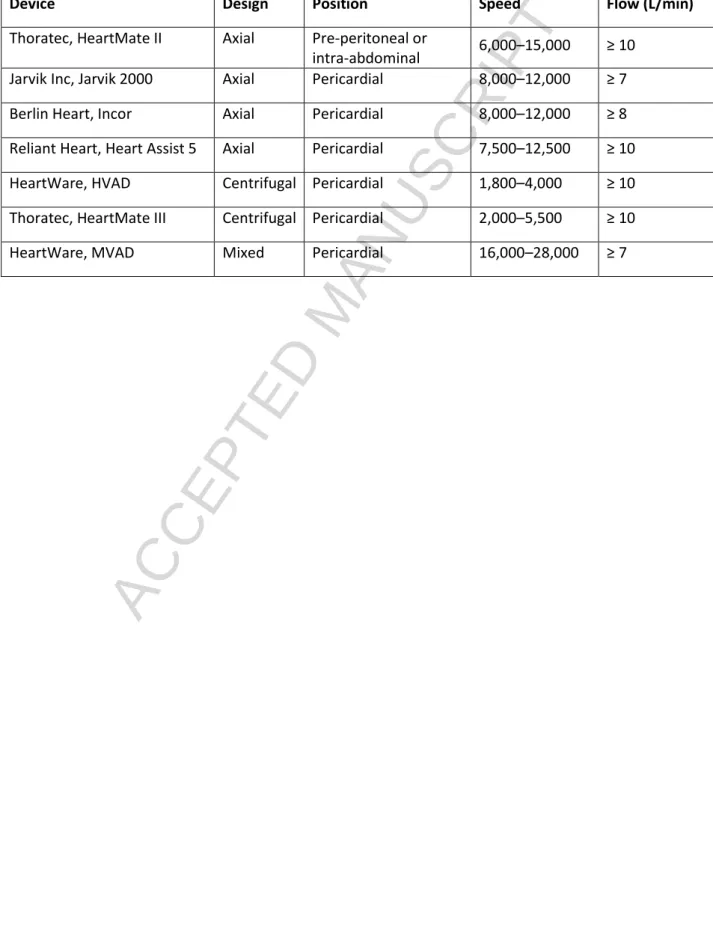
centrifugal pumps. Second-generation axial pumps have the impeller outflow directed parallel to the axis of rotation (HeartMate II [Thoratec, Inc., Pleasanton, California], Jarvik 2000 [Jarvik Heart, New York, New York], HeartAssist 5 [ReliantHeart, Houston, Texas] and Incor [Berlin Heart, Berlin, Germany]). Third-generation centrifugal pumps have the impeller outflow directed perpendicular from the axis of rotation (HeartWare HVAD [HeartWare, Framingham, Massachusetts] and HeartMate III). These non-pulsatile devices deliver up to 10 L/min and their small size facilitates placement and explantation. They also have
extended durability because of simpler mechanics, fewer moving parts and points of friction, and they operate more quietly than larger pulsatile pumps. Successful implantation of left
ACCEPTED MANUSCRIPT
VAD relies on preserved right ventricular function, which should be carefully evaluated prior to surgery [5, 6].
Orthotopic artificial hearts have also been developed. These have unique advantages over other machines as they solve problems of persistent ventricular arrhythmias, RV failure or severe heart valve disease. The only currently available device is the SynCardia total artificial heart (SynCardia, Tucson, AZ). This biventricular, pneumatic, pulsatile pump totally replaces the native ventricles [1].Over 1,000 implantations have been performed worldwide over the last 3 decades and the recent development of a smaller driving console may allow greater patient mobility. The Carmat (Vélizy Villacoublay, France) total artificial heart is an
implantable, electro-hydraulically-driven, pulsatile-flow device with four bioprosthetic valves that is currently under clinical evaluation. However very few patients have been supported since the first implant in December 2013 [26]. Recent data from the INTERMACS registry indicate that >95% of the devices implanted are continuous flow LVAD, and <3% total artificial hearts [7].
Outcomes
The landmark REMATCH trial demonstrated for the first time in 2001 that “destination therapy” strategy with an LVAD was an acceptable alternative strategy in selected patients who are not candidates for cardiac transplantation [2]. The trial randomized 129 patients with end-stage heart failure who were ineligible for cardiac transplantation to receive a LVAD (HeartMate XVE) or optimal medical management [2]. The Kaplan–Meier estimates of survival at one year were 52 percent in the device group and 25 percent in the medical-therapy group (relative risk, 0.52; 95 percent confidence interval, 0.34 to 0.78; P=0.001). A more recent randomized trial compared outcomes of patients who
ACCEPTED MANUSCRIPT
received the HeartMate II or the first-generation electric HeartMate XVE as destination therapy [3]. At 2 years, survival free from disabling stroke and reoperation was achieved in 46% of patients with continuous-flow devices but only 11% with pulsatile-flow devices (P<0.001). Patients with continuous-flow devices had superior two-year survival rates (58% vs. 24%, P=0.008). Adverse events and device replacement were also less frequent in patients with the continuous-flow device. the HeartWare HVAD was recently shown to be noninferior to other latest generation implanted LVADs, improving functional capacity and quality of life, and having a favourable adverse event profile [4]. Lastly, a nonrandomized prospective study showed that the Syncardia CardioWest total artificial heart could rescue transplant-eligible patients at risk of imminent death from irreversible biventricular cardiac failure [1].
Despite the improved survival, long-term complications associated with CF-LVADs are still frequent [25]. In the post-approval HeartMate II destination therapy study [27], rates of device-related adverse events at 2-year follow-up were as follows: bleeding (54%), driveline infections (19%), sepsis (19%), strokes (12%), thrombus formation (4%), mechanical failures requiring replacement (4%), and right heart failure (18%). Acquired von Willebrand’s disease also constantly occurs after LVAD implant [28]. In 2011, an unexpected increased rate of pump thrombosis was reported [29]. Reasons for this observation are still unclear, and might relate to less frequent use of perioperative heparin, lower target INR ranges due to the high incidence of bleeding, and inadequate antiplatelet therapy [28, 29].
In the latest INTERMACS registry, 6-month and one-year survival after VAD implantation were 88% and 80%, respectively [7]. One year post-implantation 31% had been transplanted and 55% were alive with the device still in place [7]. Overall survival was worse for older patients, those in INTERMACS class 1 status, patients with higher bilirubin and creatinine and
ACCEPTED MANUSCRIPT
those who received a BiVAD or a total artificial heart because of more advanced disease or complicated conditions such as RV failure.
Conclusion
Mechanical circulatory assistance is now a frequent therapeutic option for patients with advanced heart failure. Indications for device implantation have significantly changed in the last decade. For patients with acute cardiogenic shock and impaired organ function, short-term assistance is the leading therapeutic option and enables a “bridge to decision-making” i.e. withdrawal of the device after myocardial recovery or after recognition of therapeutic futility, or as a bridge-to-transplantation or to long-term mechanical support. For
INTERMACS class 2-6 patients, implantation of a long-term VAD should be considered before progression to multiple organ failure. Most patients receive a VAD as a
bridge-to-transplantation or as “destination therapy” in this setting. Ongoing major technological and engineering advances making newer devices more reliable, less invasive and associated with fewer complications will undoubtedly further increase the number of patients eligible for long-term mechanical heart support.
ACCEPTED MANUSCRIPT
References
[1] Copeland JG, Smith RG, Arabia FA, Nolan PE, Sethi GK, Tsau PH, et al. Cardiac replacement with a total artificial heart as a bridge to transplantation. N Engl J Med. 2004;351:859-67.
[2] Rose EA, Gelijns AC, Moskowitz AJ, Heitjan DF, Stevenson LW, Dembitsky W, et al. Long-term mechanical left ventricular assistance for end-stage heart failure. N Engl J Med. 2001;345:1435-43.
[3] Slaughter MS, Rogers JG, Milano CA, Russell SD, Conte JV, Feldman D, et al. Advanced heart failure treated with continuous-flow left ventricular assist device. N Engl J Med. 2009;361:2241-51.
[4] Aaronson KD, Slaughter MS, Miller LW, McGee EC, Cotts WG, Acker MA, et al. Use of an Intrapericardial, Continuous-Flow, Centrifugal Pump in Patients Awaiting Heart
Transplantation. Circulation. 2012;125:3191-200.
[5] Matthews JC, Koelling TM, Pagani FD, Aaronson KD. The right ventricular failure risk score a pre-operative tool for assessing the risk of right ventricular failure in left ventricular assist device candidates. J Am Coll Cardiol. 2008;51:2163-72.
[6] Cowger J, Sundareswaran K, Rogers JG, Park SJ, Pagani FD, Bhat G, et al. Predicting survival in patients receiving continuous flow left ventricular assist devices: the HeartMate II risk score. J Am Coll Cardiol. 2013;61:313-21.
[7] Kirklin JK, Naftel DC, Pagani FD, Kormos RL, Stevenson LW, Blume ED, et al. Seventh INTERMACS annual report: 15,000 patients and counting. J Heart Lung Transplant. 2015;34:1495-504.
[8] Werdan K, Gielen S, Ebelt H, Hochman JS. Mechanical circulatory support in cardiogenic shock. Eur Heart J. 2014;35:156-67.
ACCEPTED MANUSCRIPT
[9] Combes A, Leprince P, Luyt CE, Bonnet N, Trouillet JL, Leger P, et al. Outcomes and long-term quality-of-life of patients supported by extracorporeal membrane oxygenation for refractory cardiogenic shock. Crit Care Med. 2008;36:1404-11.
[10] Mirabel M, Luyt CE, Leprince P, Trouillet JL, Leger P, Pavie A, et al. Outcomes, long-term quality of life, and psychologic assessment of fulminant myocarditis patients rescued by mechanical circulatory support. Crit Care Med. 2011;39:1029-35.
[11] Beurtheret S, Mordant P, Paoletti X, Marijon E, Celermajer DS, Leger P, et al. Emergency circulatory support in refractory cardiogenic shock patients in remote institutions: a pilot study (the cardiac-RESCUE program). Eur Heart J. 2013;34:112-20.
[12] Abrams D, Combes A, Brodie D. Extracorporeal Membrane Oxygenation in Cardiopulmonary Disease in Adults. J Am Coll Cardiol. 2014;63:2769-78.
[13] Muller G, Flecher E, Lebreton G, Luyt CE, Trouillet JL, Brechot N, et al. The ENCOURAGE mortality risk score and analysis of long-term outcomes after VA-ECMO for acute myocardial infarction with cardiogenic shock. Intensive Care Med. 2016.
[14] Barbaro RP, Odetola FO, Kidwell KM, Paden ML, Bartlett RH, Davis MM, et al.
Association of hospital-level volume of extracorporeal membrane oxygenation cases and mortality. Analysis of the extracorporeal life support organization registry. Am J Respir Crit Care Med. 2015;191:894-901.
[15] Rastan AJ, Dege A, Mohr M, Doll N, Falk V, Walther T, et al. Early and late outcomes of 517 consecutive adult patients treated with extracorporeal membrane oxygenation for refractory postcardiotomy cardiogenic shock. J Thorac Cardiovasc Surg. 2010;139:302-11, 11 e1.
[16] Aissaoui N, Luyt CE, Leprince P, Trouillet JL, Leger P, Pavie A, et al. Predictors of successful extracorporeal membrane oxygenation (ECMO) weaning after assistance for
ACCEPTED MANUSCRIPT
refractory cardiogenic shock. Intensive Care Med. 2011;37:1738-45.
[17] Chen YS, Lin JW, Yu HY, Ko WJ, Jerng JS, Chang WT, et al. Cardiopulmonary resuscitation with assisted extracorporeal life-support versus conventional cardiopulmonary resuscitation in adults with in-hospital cardiac arrest: an observational study and propensity analysis. Lancet. 2008;372:554-61.
[18] Sheu JJ, Tsai TH, Lee FY, Fang HY, Sun CK, Leu S, et al. Early extracorporeal membrane oxygenator-assisted primary percutaneous coronary intervention improved 30-day clinical outcomes in patients with ST-segment elevation myocardial infarction complicated with profound cardiogenic shock. Crit Care Med. 2010;38:1810-7.
[19] Schmidt M, Brechot N, Hariri S, Guiguet M, Luyt CE, Makri R, et al. Nosocomial infections in adult cardiogenic shock patients supported by venoarterial extracorporeal membrane oxygenation. Clin Infect Dis. 2012;55:1633-41.
[20] Cheng R, Hachamovitch R, Kittleson M, Patel J, Arabia F, Moriguchi J, et al.
Complications of extracorporeal membrane oxygenation for treatment of cardiogenic shock and cardiac arrest: a meta-analysis of 1,866 adult patients. Ann Thorac Surg. 2014;97:610-6. [21] O'Neill WW, Kleiman NS, Moses J, Henriques JP, Dixon S, Massaro J, et al. A prospective, randomized clinical trial of hemodynamic support with Impella 2.5 versus intra-aortic
balloon pump in patients undergoing high-risk percutaneous coronary intervention: the PROTECT II study. Circulation. 2012;126:1717-27.
[22] Lauten A, Engstrom AE, Jung C, Empen K, Erne P, Cook S, et al. Percutaneous left-ventricular support with the Impella-2.5-assist device in acute cardiogenic shock: results of the Impella-EUROSHOCK-registry. Circ Heart Fail. 2013;6:23-30.
[23] Engstrom AE, Cocchieri R, Driessen AH, Sjauw KD, Vis MM, Baan J, et al. The Impella 2.5 and 5.0 devices for ST-elevation myocardial infarction patients presenting with severe and
ACCEPTED MANUSCRIPT
profound cardiogenic shock: the Academic Medical Center intensive care unit experience. Crit Care Med. 2011;39:2072-9.
[24] Burkhoff D, Cohen H, Brunckhorst C, O'Neill WW. A randomized multicenter clinical study to evaluate the safety and efficacy of the TandemHeart percutaneous ventricular assist device versus conventional therapy with intraaortic balloon pumping for treatment of
cardiogenic shock. Am Heart J. 2006;152:469 e1-8.
[25] Mancini D, Colombo PC. Left Ventricular Assist DevicesA Rapidly Evolving Alternative to Transplant. Journal of the American College of Cardiology. 2015;65:2542-55.
[26] Carpentier A, Latremouille C, Cholley B, Smadja DM, Roussel JC, Boissier E, et al. First clinical use of a bioprosthetic total artificial heart: report of two cases. Lancet.
2015;386:1556-63.
[27] Jorde UP, Kushwaha SS, Tatooles AJ, Naka Y, Bhat G, Long JW, et al. Results of the destination therapy post-food and drug administration approval study with a continuous flow left ventricular assist device: a prospective study using the INTERMACS registry (Interagency Registry for Mechanically Assisted Circulatory Support). J Am Coll Cardiol. 2014;63:1751-7.
[28] Uriel N, Pak SW, Jorde UP, Jude B, Susen S, Vincentelli A, et al. Acquired von Willebrand syndrome after continuous-flow mechanical device support contributes to a high prevalence of bleeding during long-term support and at the time of transplantation. J Am Coll Cardiol. 2010;56:1207-13.
[29] Starling RC, Moazami N, Silvestry SC, Ewald G, Rogers JG, Milano CA, et al. Unexpected abrupt increase in left ventricular assist device thrombosis. N Engl J Med. 2014;370:33-40.
ACCEPTED MANUSCRIPT
Glossary
Venoarterial extracorporeal membrane oxygenation (VA-ECMO):
Temporary extracorporeal mechanical support system that allows gas exchange and hemodynamic support while blood is pumped from the venous to the arterial side.
IMPELLA pump:
Percutaneous, catheter-based device, temporary cardiac support device that is inserted via through the femoral artery, into the ascending aorta, across the aortic valve and into the left ventricle to pump the blood into the aorta.
Left ventricular-assist device (LVAD)
Mechanical pump that pumps the blood from the left ventricle to the aorta to support heart function.
Total artificial heart (TAH):
An artificial device that replaces the two ventricles of the heart.
INTERMACS:
Interagency Registry for Mechanically Assisted Circulatory Support, to collect and analyze clinical and laboratory data from patients who are receiving mechanical circulatory support devices for end-stage heart failure.
ACCEPTED MANUSCRIPT
Table 1: Interagency Registry for Mechanically Assisted Circulatory Support level of
limitation at time of implant.
Profile Description Device Time frame for
intervention 1 “Crash and burn”:
Patient with life-threatening hypotension despite rapidly escalating inotropic support, critical organ hypoperfusion with increasing lactate levels and/or systemic acidosis. ECMO, other percutaneous devices Needed within hours 2 “Sliding on inotropes”
Patient with declining function despite intravenous inotropic support may be manifest by worsening renal function, nutritional depletion, and inability to restore volume balance.
ECMO, other percutaneous devices LVAD TAH
Needed within few days
3 “Stable but inotropes dependent”
Patient with stable BP, organ function, nutrition, and symptoms on intravenous inotropic support, but demonstrating repeated failure to wean due to recurrent symptomatic hypotension or renal dysfunction.
LVAD TAH
Elective over a few weeks
4 “Frequent flyer”
Patient can be stabilized with near-normal volume status but experiences frequent relapses into fluid retention, generally with high diuretic doses. Symptoms are recurrent rather than refractory. More intensive management strategies should be considered which, in some cases, reveal poor compliance. LVAD TAH Elective over weeks to months as long as treatment of episodes restores stable baseline, including nutrition 5 “Housebound”
Patient is living predominantly within the house, performing activities of daily living and walking from room to room with some difficulty. Patient is
comfortable at rest without congestive symptoms, but may have underlying refractory elevated volume status, often with renal dysfunction.
LVAD TAH
Variable, depends upon nutrition, organ function, and activity
6 “Walking wounded”
Patient without evidence of fluid overload is comfortable at rest and with activities of daily living and minor activities outside the home, but fatigues after the first few minutes of any meaningful activity.
Discuss LVAD As option
Variable, depends upon nutrition, organ function, and activity
7 “Limited activity”
Advanced NYHA III patients without recent unstable fluid balance, living comfortably with meaningful activity limited to mild exertion.
Circulatory support not currently indicated
ACCEPTED MANUSCRIPT
Table 2: Summary of long‐term implantable continuous-flow left ventricular assist device
(LVAD) systems.
Device Design Position Speed Flow (L/min)
Thoratec, HeartMate II Axial Pre-peritoneal or
intra-abdominal 6,000–15,000 ≥ 10 Jarvik Inc, Jarvik 2000 Axial Pericardial 8,000–12,000 ≥ 7 Berlin Heart, Incor Axial Pericardial 8,000–12,000 ≥ 8 Reliant Heart, Heart Assist 5 Axial Pericardial 7,500–12,500 ≥ 10 HeartWare, HVAD Centrifugal Pericardial 1,800–4,000 ≥ 10 Thoratec, HeartMate III Centrifugal Pericardial 2,000–5,500 ≥ 10