READ THESE TERMS AND CONDITIONS CAREFULLY BEFORE USING THIS WEBSITE.
https://nrc-publications.canada.ca/eng/copyright
Vous avez des questions? Nous pouvons vous aider. Pour communiquer directement avec un auteur, consultez la première page de la revue dans laquelle son article a été publié afin de trouver ses coordonnées. Si vous n’arrivez pas à les repérer, communiquez avec nous à [email protected].
Questions? Contact the NRC Publications Archive team at
[email protected]. If you wish to email the authors directly, please see the first page of the publication for their contact information.
NRC Publications Archive
Archives des publications du CNRC
This publication could be one of several versions: author’s original, accepted manuscript or the publisher’s version. / La version de cette publication peut être l’une des suivantes : la version prépublication de l’auteur, la version acceptée du manuscrit ou la version de l’éditeur.
Access and use of this website and the material on it are subject to the Terms and Conditions set forth at
Maintaining water pipeline integrity Makar, J. M.; Kleiner, Y.
https://publications-cnrc.canada.ca/fra/droits
L’accès à ce site Web et l’utilisation de son contenu sont assujettis aux conditions présentées dans le site LISEZ CES CONDITIONS ATTENTIVEMENT AVANT D’UTILISER CE SITE WEB.
NRC Publications Record / Notice d'Archives des publications de CNRC: https://nrc-publications.canada.ca/eng/view/object/?id=59cd0b4f-1f93-42b3-be50-2bba0a82d524 https://publications-cnrc.canada.ca/fra/voir/objet/?id=59cd0b4f-1f93-42b3-be50-2bba0a82d524
Maintaining water pipeline integrity
Makar, J. M. ; Kleiner, Y.
A version of this paper is published in / Une version de ce document se trouve dans : AWWA Infrastructure Conference and Exhibition, Baltimore, Maryland, March 12-15,
2000, pp.
www.nrc.ca/irc/ircpubs
Maintaining Water Pipeline Integrity
Jon Makar and Yehuda KleinerUrban Infrastructure Rehabilitation Institute for Research in Construction
National Research Council Canada 1500 Montreal Road, Ottawa, Ontario
K1A 0R6 Canada
Abstract
Recent developments in the field of diagnostic techniques for water distribution and transmission systems have given water utilities new options for inspecting and assessing the condition of their pipelines. These new techniques include the remote field effect for inspecting both metallic and prestressed concrete pipes, refinements to leak detection systems for inspecting plastic and large diameter pipes, and impact echo, spectral analysis of surface wave and acoustic emission monitoring systems for the inspection or monitoring of prestressed concrete pipes. These techniques can provide specific information on the condition of the pipes and may indicate the depth of corrosion pits in a cast iron pipe, the number of wires broken in a prestressed concrete pipe or the precise location of leaks in a plastic pipe. However, the best uses of the data from the new techniques are not necessarily clear. While the presence of a leak would normally call for repairs, the appropriate action to deal with a corrosion pit of a specific depth or a particular number of broken wires depends on many factors, including the size and type of the pipe, past break histories, surrounding environmental conditions and the way in which the pipe is likely to fail.
This paper gives an overview of an approach to using diagnostic and other information tools for maintaining pipeline integrity. The key components to the approach will be presented. Some of these components include knowledge of the failure mechanisms for the various pipe materials, the diagnostic techniques themselves, methods for estimating the likelihood of pipe failure, and techniques for prioritising pipe replacements or repairs. Areas where further research is needed will be indicated and the implications of the approach for pipeline management will be discussed.
Introduction
Pipeline management is a complex process requiring knowledge of physical, social and economic processes. In the past, the major tools for managing and preventing pipeline failures have been simple statistical approaches based on numbers of pipe breaks per kilometer and reactive inspection techniques such as leak detection. These approaches have been useful for managing pipeline failures. However, new technologies and knowledge about water system piping make it possible to develop more efficient and accurate approaches to maintaining pipeline integrity. Many of these techniques are in their infancy and not all of the knowledge needed to fully apply them is currently
available to the water industry. This paper describes a framework for using these new techniques, discusses most of the elements within that framework and identifies key areas where further research is needed. It also deals with how these new techniques can be used to manage pipelines before the required research and development has been completed.
A major component of the framework for pipeline management is the use of non-destructive evaluation techniques to provide information about the condition of the pipeline. The emphasis in this paper is on techniques that have the potential to anticipate failures in order to prevent them, rather than provide tools that detect failures after they have happened. It will also focus on tools that can be used for inspecting and monitoring metallic pipes and prestressed concrete cylinder pipe (PCCP), rather than ones that are applicable to plastic pipes. All pipes will eventually fail, but the rate of failure will depend on both the pipe material and the pipe’s exposure to environmental and operational conditions. Most utilities are currently experiencing the majority of their pipe failures in gray cast iron pipes. PCCP typically has a low failure rate on per kilometre basis, but its use for transmission mains makes its inspection particularly important. It should be noted that although inspection techniques for plastic pipes beyond leak detection have not yet been developed, the basic principles of the approach presented here can be applied to plastic pipes once suitable inspection techniques have been developed.
The Pipeline Management Cycle
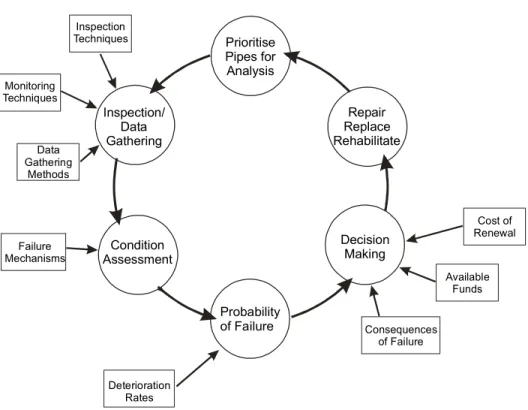
Figure 1. The management cycle Prioritise Pipes for Analysis Inspection/ Data Gathering Decision Making Condition Assessment Repair Replace Rehabilitate Inspection Techniques Monitoring Techniques Data Gathering Methods Failure Mechanisms Probability of Failure Deterioration Rates Consequences of Failure Available Funds Cost of Renewal
Figure 1 illustrates the pipeline management cycle that forms the management framework that will be discussed below. The most important feature is the cyclical nature of pipeline management – no pipe can be left in the ground and forgotten. Each pipe in the system must be examined periodically, its condition assessed and what action that should be taken to maintain or upgrade its condition determined. Even if the required action is simply to repair breaks as they occur, that decision must be made consciously, based on the best information available to the water utility. All pipe materials will eventually deteriorate. It is up to the water utility engineer to manage that deterioration in such a way that the maintenance and improvement of the water system produces the lowest long term, life-cycle costs, not just the lowest up front costs.
Many of the elements in Figure 1 are discussed in more detail below. This includes not just the key areas shown as circles above, but also the major inputs to those areas that are shown as squares. It should be remembered that the results produced in each of the key areas also form an input to the area that follows in the cycle. The one element that lies outside of this paper is the determination and completion of particular methods of rehabilitation or replacement.
It should be noted that the entry point to the cycle is the area labeled as pipe selection. A pipeline must first be selected for analysis before any additional work can be done on it. A second important point is that the approach taken differs between distribution systems and transmission systems. This is largely due to the much higher consequences of failure that are associated with a transmission pipeline failure as compared to a typical distribution failure. Approaches that may not be economically viable for a distribution system can therefore be employed in a transmission system to prevent failure. Essentially, the low consequences associated with a single distribution failure mean that the emphasis in distribution systems is on failure management in order to minimize life-cycle costs. In contrast, the high consequences associated with transmission failures means that minimizing life-cycle costs normally requires failure prevention.
Inspection and Data Gathering
There are essentially two ways to gather information about pipe damage. The first is through direct inspection and monitoring techniques (non-destructive evaluation). The second is through collection of data that can be used as indirect indicators of pipe problems, such as water audits, soil corrosivity measurements, half cell potentials and pipe breakages. The latter indicator is the one that has most commonly been used in the past as a means of deciding when pipes should be replaced. Non-destructive evaluation (NDE) has certain advantages in detecting problems in pipes over data gathering and statistical methods in that the latter assume that each pipe in a length that is being analysed has the same condition. NDE can detect problems in individual pipes or at a particular point along an individual pipe, providing better information about pipe condition.
Non-Destructive Monitoring and Inspection Techniques
The last decade has seen the development of a number of new techniques for the inspection and evaluation of water supply distribution and transmission systems. These techniques provide a variety of information about the condition of pipes, ranging from numbers of wires broken in a single section of PCCP through the depth of corrosion pitting in a ductile iron pipe to the presence of leaking water. However, with the exception of leak detection, water utilities are just beginning to use these evaluation techniques. In addition, little information or advice is available on the best ways to use the techniques, how to translate their outputs into pipe condition ratings and how to select pipes for inspection.
A full description of currently available monitoring and inspection techniques has been published recently in the Journal AWWA1. Reactive techniques such as leak detection and water audits are widely known in the water industry and require no further discussion here. The following text provides a brief description of the three techniques that appear to offer the best potential for detecting damaged pipes before a failure has occurred.
Remote Field Inspection for Metallic Pipes
Remote field inspection is currently the only inspection method available for determining the condition of gray cast iron and ductile iron pipes before they fail. It could also be used for inspecting steel pipes. The technique involves placing inside the pipe an inspection tool that has an “exciter” coil that generates an electromagnetic field and one or more “detector” coils that detect that field. If the detector coils are placed more than 2.5 pipe diameters away from the exciter coil, the field that passes through the pipe wall at the exciter and travels on the outside of the pipe before re-entering it near the detector coil is stronger than the one that travels down the inside of the pipe. The behaviour of the outside field depends on the thickness of the pipe wall, so the technique can detect corrosion pitting and overall wall loss. It is currently in use primarily for the inspection of small diameter pipes. Some physical models of pipe deterioration require complete mapping of corrosion pit defects. It is likely that the remote field effect could also produce this type of measurement in the future.
Acoustic Emission Monitoring for PCCP
Like acoustic leak detection, acoustic emission monitoring uses hydrophones, but in this case a pair or an array of hydrophones are placed within an operating pipeline to listen for the sounds produced by breaking prestressing wires. The number and rate of breaking wires recorded during the monitoring period is considered to give an indication of the overall condition of the pipeline, while locations of specific wire breaks are given by the technology vendors in a process similar to that used by the leak detection process. The technique is particularly useful when it records a number of wire breaks in rapid succession, as this is likely to be an indication of an approaching pipe failure. A recent
evaluation of this technology by the National Research Council Canada showed that the sounds produced by breaking wires had different characteristics from the sounds produced by typical background noises such as traffic noises, water flow and construction noises. It is therefore possible to differentiate between these background noises and the actual sounds of the wires breaking.
Remote Field/Transmission Coupling Inspection for PCCP
This technique is similar to the remote field effect inspection method for metallic pipes described earlier. It also has an exciter and a detector coil located a distance apart within the pipe. However, the technique is used to detect already broken prestressing wires in the pipe. In this case, the electromagnetic field produced by the exciter coils interacts with the coil of prestressing wire buried in the concrete. The resulting field is then measured by the detector coil. Wire breaks interrupt the coil, changing the measured field and allowing for break detection. This inspection technique is presently available only for use in embedded type PCCP, although development work is underway to apply it to lined and bar wrapped pipe.
Prioritisation of Pipes for Analysis and Selection of Appropriate Techniques
There are a variety of methods available for analysing the condition of water distribution and transmission systems, including monitoring techniques, non-destructive evaluation techniques and indirect data based methods such as the statistical analysis of water main breaks. The choice of the appropriate technique for an individual water line depends on issues such as the likely consequence of a pipe failure, the goal of the inspection or analysis and the past failure history. These issues and the cost of the technique determine which pipes are likely to be chosen for analysis. In general, the more detailed the report on a pipe produced by an inspection technique, the more expensive it will be to perform. The water utility engineer must therefore make sure that the benefits of the inspection will outweigh its costs.
This issue can be most easily resolved in PCCP transmission systems, where the consequences of failure may be very high. The simplest approach is to inspect or monitor all pipes. As will be discussed later in this paper, the high costs of failure associated with these pipes makes statistical approaches considerably less attractive than the former two methods. Statistical approaches are most suitable for failure management schemes, rather than those that promote failure prevention. As understanding of failure mechanisms and deterioration rates in these pipes improves, this approach will likely be refined so that resources can be concentrated on the pipes that are most likely to fail, rather than automatically inspecting all pipes within the transmission system. Until that point has been reached, inspection of all pipes provides the best route for preventing failures. This is also the approach adopted by the oil and gas industry, where most major utilities inspect their transmission systems on a periodic basis.
Statistical approaches, water audits and leak detection have typically been applied in the past to significant portions of or entire water distribution systems. The correct use of the former two techniques requires dividing the system up into zones or pipe segments respectively, so it is also possible that smaller areas that are known to be troublesome could be analysed by these approaches. Leak detection has been used in the past in two different ways. Many water utilities conduct leak detection campaigns, checking the entire city for water leaks over the course of two or more years. Other utilities combine leak detection with water audits, checking for leaks whenever the total water consumed per person within a zone exceeds a standard value. In some cases the water audits are conducted continuously with automatic data logging equipment, allowing quick repairs to leaking pipes. The correct application of leak detection is an area where further research is needed, since some utilities report continued high rates of unaccounted water despite leak detection campaigns. One approach that water utilities should consider is the re-examination of areas that have had a high rate of leaks in order to track how these problems develop. Examining records of past leak detection campaigns in combination with selective re-inspection may indicate the presence of leak concentrations where further analysis is warranted.
There are many models in the literature for the statistical analysis of historical water main breaks. Some models require extensive data sets while others can be implemented with fewer data at the expense of accuracy. Ideally, good data will include pipe material, size, age, type of bedding, native soil characteristics, operating pressures, over-burden characteristics, ambient and water temperatures, and the time, place, and type of all historical breaks. Experience show however, that most utilities have only partial sets.
Choosing pipes for examination by the remote field effect is a more complicated process. The technique gives much more detailed information about the condition of pipes than any of the other methods. It is also proactive in nature, providing the opportunity to prevent failures, rather than react to them. However, remote field effect inspection also has higher costs than the other inspection techniques. Water utilities using the technique therefore need to use it selectively, rather than attempting to inspect every kilometre of pipe in their systems. One possible use is to determine the condition of critical pipelines such as those supplying hospitals or schools within the distribution system. A second use is as a decision support tool, to ensure that decisions to replace or rehabilitate pipelines are made on the basis of the condition of the pipe itself. A third use is to check on the condition of water mains that the owner believes are likely to have deteriorated but have not yet shown signs of failure. Other uses can be determined by the utility based on their long term benefit to the health of the water system.
Causes of Metallic Pipe and PCCP Failure
The process of pipe failure is not yet completely understood for any of the different pipe materials in use today. However, the basic causes of failures in metallic and prestressed concrete pipes are known. Corrosion is largely responsible for both metallic pipe and PCCP failure, although the way in which the failures happen in each
type of pipe is different. More research is required to understand the failure process in all types of water pipe.
Steel, ductile iron and gray cast iron pipes fail due to corrosion pitting. In this case, a corrosion pit in the pipe wall grows from either the inside or the outside surface until the pipe has been completely penetrated and water leaks from the pipe. This is the only failure mode recorded for the first two materials, although there is some anecdotal evidence for ductile iron pipes also failing in the same manner as gray cast iron pipes.
Gray cast iron is a brittle material and can therefore also fail through cracking. Typical failure modes include bell splits, circumferential cracking and longitudinal cracking (Makar, 1999). It is generally believed that these failures are also associated with corrosion pits or with the “pits” formed by the graphitisation process, where the iron content of the pipe is leached away in a region resembling a corrosion pit, leaving the carbon flake matrix behind. External forces such as frost loads, truck loads, ground loads or water pressure that cause the weakened pipe to break. Although most of the pipes examined by the National Research Council Canada (NRC) have indeed shown corrosion pitting or graphitisation at the break, it is worth noting that other sources of weakness, such as porosity in the metal and excessively large graphite flakes can also cause pipe failures. The latter problems are more likely to be encountered in the larger pipes than the small ones, but examples of 150 mm (6”) diameter water pipes from the 19th century with a high degree of porosity have also been encountered. It is also still unclear whether corrosion pitting is required for brittle pipe failures or whether some failures will take place in previously undamaged pipe.
PCCP is made of concrete applied to the inside of a metal canister. Another layer of concrete may be applied to the outside of the canister as well to create a larger diameter, “embedded” type pipe. Prestressing steel is then wrapped around the cured concrete, with the steel in tension to about 70% of its yield strength. This places the concrete in compression, allowing it to withstand internal water pressures. The steel is then coated with an alkali mortar coating to provide protection against corrosion. This type of pipe will fail when enough of the prestressing wires or bars corrode and break that a section of the concrete is no longer in compression. At that point the internal pressure will rupture the pipe. There does not appear to be any agreement within the water industry as to the exact number of wires that need to rupture in order to cause a failure. This is likely due to the number being dependent on both manufacturing technique and diameter, but models of this failure process have not yet been developed. However, the number of wires that can be broken in a pipe without causing a failure can be quite large, providing an opportunity to detect the breaks and take remedial action.
Another area of PCCP failure behaviour that does not appear to be covered in the literature is the effect of wire breaks on the concrete in the pipe before a failure. A number of inspection techniques exist that have some success based on detecting concrete damage as opposed to wire breaks, but a correlation between the two does not appear to be available. It is possible that internal concrete damage may not occur until a minimum number of wire breaks in a given area of a pipe have occurred. A recent NRC study on
the use of acoustic emissions monitoring in a lined type PCCP system produced evidence that the outside mortar on the pipe remained intact within at least ¼ of the pipe circumference away from a single wire break (Makar and Baldock, 2000). However, cracking in the mortar was observed in an area where ten adjacent wire breaks were created. This result would suggest that the damage in the initial stages of a pipe failure would be difficult to detect by examining the interior concrete, especially since examination showed that the mortar was directly bonded to the prestressing wires in the pipes, while the interior concrete may have been protected by the steel canister.
Determining the Probability of Water Main Failures
The probability of failure can be determined by either statistical or physical approaches, both of which predict the structural deterioration of the pipe. Pipes can also fail due to degradation in water quality and hydraulic capability, but these topics are outside the scope of this paper. Kleiner and Rajani (1999) and Rajani and Kleiner (1999) provided a comprehensive review of both classes of models.
The physical mechanisms of pipe failure involve three principal aspects: (a) pipe structural properties, material type, pipe-soil interaction, and quality of installation, (b) internal loads due to operational pressure and external loads due to soil overburden, traffic loads, frost loads and third party interference, and (c) material deterioration due largely to the external and internal chemical, bio-chemical and electro-chemical environment. The structural behaviour of buried pipes is fairly well understood, however, issues such as frost loads and how material deterioration affects structural behaviour and performance are still being investigated. The existing physical models can broadly be classified into deterministic and probabilistic, and most cannot simultaneously address all three principal aspects listed above. It appears that the physical mechanisms that lead to pipe breakage are often very complex and not completely understood, and little data are available to validate models based on these mechanisms. Obtaining the complete set of necessary data is likely to be particularly useful in managing large transmission water mains or sensitive distribution mains, where the cost of failure is significant.
The statistical methods for predicting water main breaks use available historical data on past failures to identify pipe breakage patterns. These patterns are then assumed to continue into the future in order to predict the future breakage rate of a water main or its probability of breakage. Subsequently, the expected cost of failure is derived (the increasing curve in Figure 2) and the optimal time of replacement/rehabilitation can then be approximated. Kleiner and Rajani (1999) categorised the statistical methods into deterministic, probabilistic multi-variate and probabilistic single-variate models that are applied to grouped data. These categories vary in the way they model the projected breakage rates (or probabilities of failure) and in the number of factors they can consider in these models. The statistically derived models can be applied with various levels of input data and may thus be particularly useful for water mains for which there are few data available or for which the low cost of failure does not justify expensive data acquisition campaigns.
Decision Making
Consequences of Water Main Failure
The potential consequence of a failure in a given pipeline segment is the most important factor in determining the level and type of effort that should be invested into collecting various types of data about the water main. The consequences of water main failure may be divided into three categories:
1. Direct costs to the water purveyor:
• cost of breakage repair (affected by pipe type, size, type of break, pipe location, etc.),
• cost of lost water (affected by the pipe size and the severity of the failure),
• cost of direct damage to property (e.g., basement flooding, road cave-ins, damage to the foundation of adjacent structures, etc.),
• liabilities (e.g., death or injury resulting from a traffic accident caused by flooding, electrical shock, etc.).
2. Indirect costs:
• loss of production and or business in a plant, workshop or commercial property due to water outage,
• accelerated deterioration of trenches, roads, sewers, underground cables, etc.,
• loss due to fire that could not be effectively extinguished due to water outage (in the immediate vicinity) or diminished hydraulic capacity (elsewhere in the system).
3. Social costs:
• adverse effects of pipe failure on water quality due to intrusion of contaminants into the pipe that was de-pressurised for repair:
♦ intrusion of contaminants from the surrounding soil (e.g., leaky sewers, waste disposal sites, etc.) through corrosion holes and leaky gaskets in the de-pressurised segment of the system
♦ increased likelihood of backflow due to cross-connection into the de-pressurised segment of the system
♦ intrusion of debris through the broken pipe
The consequences here may be discomfort, illness or even loss of life (e.g., Chicago, 1939 in which 1409 people contracted amoebic dysentery and 98 died - Anderson, 1981),
• costs due to service disruption (quality of life, public confidence),
• costs due to disruption of traffic and business (affected by the location of the failed pipe),
• costs due to disruption of service to special facilities (e.g., hospitals, schools, etc.).
While direct costs are currently relatively easy to quantify in monetary terms, indirect consequences may require much more effort and social consequences are often the most
difficult to describe in this way. More research is required to gain a better understanding of the true magnitude of indirect and social consequences of water main failure. It may also be necessary to incorporate non-monetary measures as objectives or constraints within the model in order to consider social costs that can not be readily expressed in monetary terms such as loss of life or loss of public confidence.
Making Decisions Based on Economic Principles
Economic decision processes for pipe renewal minimise the total costs that are associated with the pipe, while conforming to a set of operational constraints. Figure 2 illustrates the costs of repair and replacement/rehabilitation of pipes as a function of the pipe replacement timing. The declining cost curve depicts the fact that the present value of the cost of pipe replacement or rehabilitation decreases as its implementation is delayed due to time discounting. Conversely, the failure frequency (or probability of failure) increases if the rehabilitation or replacement is delayed, due to the aging and deterioration of the pipe. The total expected cost of failure is calculated by multiplying the time-discounted cost of a single failure, including direct, indirect and social costs, by the frequency (or probability) of failure. This frequency (or probability) of failure is predicted through deterioration models that use historical failure data or repeated NDE inspections. The total expected cost is the sum of the two curves. It typically forms a convex curve, whose minimum point depicts the optimal time of rehabilitation/replacement (t*).
Figure 2. Deciding when to renew a water main with low cost of failure.
In distribution water mains the cost of failure is relatively small in relations to cost of pipe renewal. Consequently, the optimal time of replacement t* would typically depict a point in the pipe deterioration stage where a given breakage frequency can be tolerated, e.g., three breaks per kilometre as in Figure 2. Here the pipe owner is better off economically to manage failures, rather than trying to prevent them entirely.
In large transmission mains entire pipe replacement is a rare practice that is taken only in extreme cases, due to the very high costs involved. The goal of pipeline management is
Time of rehabilitation
(present value)
Total expected cost
min. cost t* Cost Total expected cost of failure Cost of replacement or rehabilitation Breakage frequency (br/km) 1 2 3 4
therefore failure prevention, rather than failure management and the typical intervention will consist of a localised repair or reinforcement. Thus, the cost of failure is typically much larger in relation to the cost of intervention, resulting in the cost curves depicted in Figure 3. Here the optimal intervention timing in the figure depicts a breakage frequency that is smaller than one, which means that for this particular pipe breakage should be avoided.
Figure 3. Deciding when to renew a water main with high cost of failure.
When the cost of failure is relatively low, and a certain breakage frequency can be tolerated, it is often (but not always) sufficient to rely on historical breakage rate to derive a pipe deterioration model to predict future breakage rates. However, when the cost of failure is high a proactive approach is required in anticipating failure and preventing it. In these cases NDE techniques should be used to assess the condition of the pipe on two levels: first, as a snapshot of its condition at a given point in time in order to determine if immediate intervention is required, and second, using subsequent inspections to determine the rate of deterioration. When the costs of failure are low proactive NDE techniques are best employed as decision support tools rather than in an attempt to find every damaged pipe.
It should be noted that as NDE techniques grow in popularity, it is inevitable that the costs of applying them will be reduced. Consequently, their use will become economically viable for larger portions of the distribution system, until eventually all water mains will be periodically inspected by NDE techniques.
Conclusions
A framework for a complete system for structural water main management has been presented. The system uses data gathering techniques and non-destructive evaluation and monitoring techniques to provide the information necessary to make the best decisions on the repair, rehabilitation and replacement of water mains. Other issues
Time of intervention
(present value)
Total expected cost
min. cost t* Cost Total expected cost of failure Cost of intervention Breakage frequency (br/km) 1 2 3 4
considered within the framework include consequences of pipe failure, models of pipe deterioration, failure mechanisms, prioritisation of pipes for analysis and the actual decision making process. Rehabilitation and replacement techniques form an integral part of the framework, but have not been considered in detail here.
The framework is cyclical in nature. Water delivery systems can not be buried and forgotten, but instead must be constantly managed to provide the lowest life cycle costs and ensure that unwanted failures do not take place. The framework also points out the need to treat distribution systems, which have generally low consequences of failure, differently from transmission systems, which generally have high consequences of failure. In the former case the issue is typically one of failure management and a low number of water main breaks per kilometre of distance may be acceptable, while in the latter the issue is typically failure prevention and the water utility is likely to desire to prevent all pipe failures.
While the framework provides an initial approach to maintaining pipeline integrity, it is apparent that considerable research still needs to be done to build a complete decision support model for managing pipelines. Some key goals include:
• Improvements to the corrosion pit mapping capability of the remote field effect in cast iron pipes;
• Extending of the remote field effect/transformer coupling inspection method to lined and bar wrapped PCCP;
• Improved understanding of the pipe failure and deterioration processes;
• Development of appropriate management techniques for the use of NDE technology within water mains, including the selection of the right techniques for use on the right pipes;
• Better understanding of the indirect and social consequences of water main failure;
• Extending current economic decision making models to include the effects of NDE technology and to fully account for the decisions that need to be taken to manage transmission line systems; and
• The complete integration of the results of the above information into the framework described above to provide a usable tool for water utilities.
Improvements to the inspection technologies will likely be met by the technology vendors. Many of the remaining needs are active areas of research for the authors and their colleagues.
References
1. Makar, J.M. and Chagnon, N. (1999) “Diagnostic Techniques for Water Transmission and Distribution Systems”, Journal American Water Works
Association, July
2. Makar, J.M. (1999) “A Preliminary Failure Analysis of Grey Cast Iron Pipes”,
Engineering Failure Analysis, December
3. Makar, J.M. and Baldock, B., “An evaluation of acoustic emission as a method for monitoring pre-stressed concrete cylinder pipe” to be submitted to J.
4. Kleiner Y., and Rajani, B. B. (1999). “Comprehensive review of structural deterioration of water mains: Statistical models.” Submitted to J. Infrastructure
Systems, ASCE.
5. Rajani, B. B., and Kleiner, Y. (1999). “Comprehensive review of structural deterioration of water mains: Physical models.” Submitted to J. Infrastructure
Systems, ASCE.
6. Anderson, D.C. (1981) “Cross-connections - Their Importance and Control”