Application of the Design Structure Matrix (DSM) to the Real Estate Development Process
By
Benjamin Bulloch AND John Sullivan
B.Sc., Social Sciences, 2002 B.A., Engineering Studies, 2004 B.A., Economics and Business, 2004 University of Edinburgh, Scotland Lafayette College
Submitted to the Center for Real Estate in Partial Fulfillment of the Requirements for the Degree of Master of Science in Real Estate Development
at the
Massachusetts Institute of Technology ©2009 Benjamin Bulloch and John Sullivan
All rights reserved
The authors hereby grant to MIT permission to reproduce and to distribute publicly paper and electronic copies of this thesis document in whole or in part in any medium now known or hereafter created.
Signatures of authors ___________________________________________________ Benjamin Bulloch & John Sullivan
Center for Real Estate July 24, 2009
Certified by _________________________________________________________ David Geltner
Professor of Real Estate Finance, Department of Urban Studies and Planning
Thesis Supervisor
Accepted by ________________________________________________________ Brian A. Ciochetti
Chairman, Interdepartmental Degree Program in Real Estate Development
Application of the Design Structure Matrix (DSM) to the Real Estate Development Process By
Benjamin Bulloch AND John Sullivan
Submitted to the Center for Real Estate on July 24, 2009 in Partial Fulfillment of the Requirements for the Degree of Master of Science in Real Estate Development
Abstract
This thesis presents a pioneering application of an engineering systems framework, the Design Structure Matrix (DSM), to model the real estate development (RED) process. The DSM is a process modeling tool that originated recently in the branches of engineering systems and
management science, and is primarily used to study product development processes. The DSM is an n-squared graphical matrix representation of a process that is particularly well suited to model both the sequential and iterative informational relationships between tasks in a product development process. The similarities between product development and the real estate development process make DSM an excellent fit for applying the DSM.
The thesis first reviews existing models of the RED process but finds them lacking a
combination of granularity and ability to model the highly iterative nature of the RED process. This limits their effectiveness for conveying information useful to practitioners. No previous RED model describes the process at a task level or has the ability to model iterative or sequential information flows between tasks.
The DSM developed in this thesis first presents a normative or baseline model of a RED project. The model was developed through the participation and assistance of MIT/CRE industry partner, Jones Lang LaSalle (Boston Office). Through a series of interviews and meetings, the authors first developed a Six Stage Event Sequence model of RED with decision-gates found to occur during the process. The six stages were then expanded with JLL’s assistance into a table of 91 individual tasks necessary for successful completion of a RED project. Finally, again with JLL’s engagement, the 91X91 ‘Baseline’ RED process DSM was constructed, identifying 1,148 planned informational inter-task interactions (out of 8,281 potential interactions). The ‘Baseline’ DSM model was then manipulated to highlight important aspects of the RED process including the iterative and interdisciplinary nature of RED. Several typical development scenarios are then modeled to
highlight the utility of DSM as a management tool in practice. The models show how unplanned iteration can become a significant cause of project risk and failure. They also highlight the risks and opportunities that task re-sequencing can have on a project.
This thesis demonstrates the DSM to be a useful and effective model of the RED process enabling new insight and understanding. The highly complex and iterative RED process can be graphically modeled in great detail in a visually appealing manner. Additionally, the RED DSM proves to bean adaptive and manipulative tool that allows for a multi-layer grasping of the RED process, able to assist in project management, change management, identification of risks and opportunities, and firm-level organizational structure and procedures. Additionally, the RED DSM model proves to be a useful pedagogical device for teaching real estate students.
Thesis Supervisor: David M. Geltner Title: Professor of Real Estate Finance
Table of Contents
Abstract ... 3
Table of Figures ... 7
Acknowledgements ... 9
Preface ... 11
Chapter 1: The Real Estate Development Process ... 15
James Graaskamp on Real Estate Development ... 16
Five Contemporary Approaches to the Real Estate Development Process ... 20
Agency models ... 21
Structure models... 25
Event sequence models ... 26
Economic models ... 29
Systems model ... 31
Chapter Summary ... 33
Chapter 2: Systems Thinking in Real Estate Development ... 35
Systems Engineering – Engineering & Management Disciplines ... 35
Engineering Systems – Engineering, Management & Social Sciences Disciplines ... 37
Product development ... 39
Process Management Tools Currently Used in Real Estate Development ... 42
Chapter 3: Introducing the Design Structure Matrix (DSM) ... 45
Informational relationships between tasks ... 45
Design Structure Matrix (DSM) ... 46
Chapter 4: The Real Estate Development Process DSM ... 51
Methodology ... 51 Stages of Development ... 51 Idea Inception ... 53 Feasibility ... 54 Preconstruction ... 55 Construction ... 57 Stabilization ... 57
Asset Management and/or Sale ... 58
Tasks and Interactions ... 59
Interactions between tasks ... 60
Reading the Baseline DSM ... 61
The Baseline Real Estate Development DSM – A New RED Process Model ... 62
Chapter 5: Applications of the Real Estate Development DSM ... 65
Modeling Different Types of Information Flows ... 66
Functional Interaction DSM ... 67
Internal vs. External DSM ... 68
Modeling Change in the RED Process ... 70
Market Change DSM ... 71
Legal / Political Change DSM ... 73
Financial Change DSM ... 73
Overlapping Change DSM ... 74
Re-sequencing Tasks in the RED Process ... 74
Construction before Design Complete DSM ... 75
Design before Entitlements DSM ... 76
Construction before Tenants DSM ... 77
Summary ... 78
Chapter 6: DSM in Real Estate Development: Observations & Takeaways... 81
Using DSM to Understand the Development Process ... 81
DSM at the Firm Level ... 83
DSM at the Project Level ... 84
DSM as a Teaching Tool ... 84
Chapter 7: Future Research Opportunities ... 87
Case Study Approach ... 87
Finer Granularity ... 88
Quantitative Analysis ... 88
Other Engineering Systems Opportunities ... 89
Chapter 8: Conclusion ... 91
Bibliography ... 93
Appendix A: Stages and Tasks Glossary ... 97
Idea Inception ... 97
Feasibility ... 99
Preconstruction ... 101
Construction ... 104
Stabilization ... 106
Asset Management and/or Sale ... 107
Appendix B: Tasks by Stage and Quadrant ... 109
Appendix C: Real Estate Development Process DSMs ... 112
C-1 Baseline DSM ... 114
C-2 Functional Interaction DSM ... 115
C-3 Internal vs. External DSM ... 116
C-4 Market Change DSM ... 117
C-5 Physical / Design Change DSM ... 118
C-6 Legal / Political Change DSM ... 119
C-7 Financial Change DSM ... 120
C-8 Combined Change DSM ... 121
C-9 Construction Started Before Design Finished DSM ... 122
C-10 Design Final before Entitlements Final ... 123
Table of Figures
Figure 1 - RED Investment vs. Risk (Geltner et al, 2007) ... 16
Figure 2 - The Development Process (Peca, 2008) ... 17
Figure 3 - Graaskamp's Real Estate Process (Jarchow ed., 1991) ... 18
Figure 4 - Graaskampian Decision Making Process (Geltner et al, 2007) ... 19
Figure 5 - Agency model of the development process (Goodchild et al., 1985) ... 23
Figure 6 - The development process (Barrett, et al., 1978) ... 24
Figure 7 - RED in Marxist 'circuits of capital' (Harvey, 1985) ... 26
Figure 8 - Miles' 8 Stages of the RED Process (Miles, et al., 2007) ... 28
Figure 9 - DiPasquale-Wheaton 4-Quadrant Model (DiPasquale & Wheaton, 1996)... 30
Figure 10 - System Structure Diagram (Trevillion, 2002) ... 32
Figure 11 - System engineering process (Blanchard, 2008) ... 37
Figure 12 - Three possible sequences for two design tasks (Eppinger et al., 1994) ... 46
Figure 13 - Possible sequences for two design tasks (in DSM) - (Pektas & Pultar, 2006) ... 47
Figure 14 - Suspended Ceiling Design – Initial DSM (Pektas & Pultar, 2006) ... 48
Figure 15 - Suspended Ceiling Design – Partitioned DSM (Pektas & Pultar, 2006) ... 49
Acknowledgements
This thesis would not have been possible without the advice and support of many people and organizations.
Dr. David Geltner from the MIT Center for Real Estate and MIT Engineering Systems Division originally conceived the idea of applying DSM to the real estate development process and has been an excellent advisor and guide on this intellectual journey. Dr. Steven Eppinger from MIT Sloan School of Management and MIT Engineering Systems Division gave freely of his time and expertise as we explored the application of the DSM to real estate development.
Jones Lang LaSalle was an incredibly gracious research host. We had unfettered access to managers including Kirstin Brown (MIT MSRED 1998), John Myers, Anthony Warren, Chip Weintraub (MIT Sloan 2006) and Nat Wysor. Our research would have been impossible
without these gifted real estate development practitioners guiding our way.
We would like to thank our classmates, faculty and staff at the MIT Center for Real Estate for a memorable and amazing year despite the trying economic circumstances.
Ben would like to thank his wife and partner Dr. Christine Sylvest for her love and encouragement.
John would like to thank his family and his fiancée Kristen Chiusano for their support and encouragement throughout the years.
When we mean to build,
We first survey the plot, then draw the model;
And when we see the figure of the house,
Then must we rate the cost of the erection;
Which if we find outweighs ability,
What do we then but draw anew the model
In fewer offices, or at last desist
To build at all?
William Shakespeare
Henry IV, Part II
Act 1, Scene 3
“Someone rolled a rock to the entrance of a cave and created an enclosed space for
his family – a warmer and more defensible shelter, distinct from the surrounding
environment. This can be called the first real estate development.”
James Graaskamp
Preface
Real estate development is the process of creating value by making tangible
improvements to real property. The development process ranges from land speculation and new construction to the renovation of existing buildings. The development of real estate is the process by which physical products where we live and work are conceptualized, refined,
constructed and managed. Successful implementation of this process is crucial to our economy along with our everyday lives. As Winston Churchill has famously stated, "We shape our buildings, and afterwards our buildings shape us.”
The real estate developer, whether in the public or private sector, is responsible for coordinating the tasks required to deliver a real estate product. This is done through the management of thousands of individual tasks. While each task involves numerous players and information, it is the developer’s job to ensure that information generated in individual tasks is efficiently being shared between all the parties involved. Throughout this process, the developer manages the information being generated with the intention of ultimately delivering a product intended to meet a specific market demand.
Throughout the development process, tradeoffs are made as information is developed. For example, a high quality building may achieve the highest rents, but it will most likely come at a higher costs. These types of tradeoffs make the real estate development process iterative as well as multi-disciplinary. The process can also take years to complete, leaving it subject to many internal and external changes along the way. Additionally, the location and timing of each product differs as well. This uniqueness leads practitioners to often believe each development process is unique. While the real estate development process from one project to the next is not identical in every step or in all details, we believe that important commonalities can be observed across most projects and can be captured in a general framework. Such a framework can be useful both in learning about the process and helping improve standard operating procedures of development firms.
A review of real estate development literature to date provides scant useful insight for a developer to identify and understand the tasks and the relationship to one another. This approach would provide a developer with a true understanding of how the process works. The
current literature is usually done at too broad, or too specific of a level. The broad work identifies stakeholders and explains the many reasons why real estate is developed. On the opposite end of the spectrum, much work has been done to explain specific parts of the process, such as the design, construction, determining product types, etc. Our understanding of the real estate development process needs something in-between that identifies specific tasks in the process, but also explains characteristics of the process and how they are all tied together. This, however, is no easy task. Illustrating or explaining how numerous tasks are related in a long and complicated process is confusing and may leave the reader no better off than when he began.
This problem of modeling and explaining complex development processes is not unique to real estate. In the industrial arena, product development projects are often as long, iterative and complex (rockets, satellites, microchips, fighter planes, automobiles, etc). Decades ago, engineers in these fields faced similar problems with trying to model and understand the process of their complex development projects. They discovered that information generated during the development process was unique and specific for each product, however the method they went about developing products was similar each time. This discovery allowed for the creation of frameworks and tools to analyze these processes. One of the most successful tools established to model these product development processes and the flows of information is the Design Structure Matrix (DSM). By buildings and using a DSM, engineers created a simple way to visually demonstrate the information flows between tasks in a product development process. Over the last 20 years, this framework has been continuously enhanced and has become accepted as a tool in the product development industry.
The issues that the engineering and manufacturing industries faced decades ago are very similar to those currently faced in real estate development. While the products are very
different, both include the general stages of coming up with an idea, refining that idea, committing to the idea and finally executing. Along the way, information is shared between tasks to get to milestones where a decision is made whether or not to move forward. We believe that, because of the similarities between the two fields, there is room to use engineering
techniques, specifically DSM, to analyze the real estate development process.
Before applying the engineering systems DSM tool to the real estate development process, we first review existing academic models and conceptualizations and highlight
weaknesses of current approaches (Chapter 1). Then, we examine the engineering systems and product development analysis to understand the similarities and differences between their disciplines and real estate development (Chapter 2). Chapter 3 then focuses on the history, applications and mechanics of the DSM.
These first three chapters give us a framework for applying DSM to the real estate development process. In Chapter 4, we outline our methodology for constructing the real estate development DSM and describe our findings from analysis of this Baseline scenario. Chapter 5 then puts the DSM to work and demonstrates how DSM can graphically illustrate and highlight valuable information for the developer. Chapter 6 explains and summarizes the benefits of the DSM to the developer as well as to academia. Finally, Chapter 7 outlines future research topics that the authors believe have potential to yield further insights into real estate development.
Chapter 1: The Real Estate Development Process
Chapter Summary: In this Chapter, we review historical and contemporary frameworks that conceptualize the process of real estate development. These approaches are drawn from many academic disciplines and contribute to our understanding of the actors involved in real estate development and the political, social, financial, physical and economic contexts in which development occurs. While interesting from an academic perspective, we ultimately find these frameworks offer scant practical advice for improving the delivery process of “real-world” development projects. Readers with advanced knowledge of the real estate development process may skip this Chapter and to proceed directly to Chapter 2 where we propose adapting Engineering Systems approaches to real estate development.
The real estate development process is a lengthy and complex process that starts with an idea for a physical product to serve a need. This then initiates a process that may or may not lead to a product being built. Throughout the process of developing real estate, questions are being asked and answered and information is being gathered and analyzed by the developer. As the specific project starts to take shape and information is generated, the unknowns are reduced. As with any investment, as the uncertainties are reduced, so too is the risk. This can be seen simply by looking at how the market prices the investment in real estate development. In the early stages, the opportunity cost of capital (OCC) can be as high as 40% (Geltner et al. 2007, p. 759). It is the developer’s job to navigate the process and eventually deliver a stabilized, cash-flowing asset, with lower risk and a much more modest OCC of approximately 8%. As information is gathered during the early stages of the development process, risk is significantly reduced, even though the amount of capital being invested is relatively small relative to the total investment. This high capital cost of development suggests that any reduction in uncertainty (and therefore OCC) can have a significant impact of the returns and viability of a project. This concept can be shown graphically in Figure 1.
Figure 1 - RED Investment vs. Risk (Geltner et al, 2007)
One way to lower the risk of development is to model it and improve the way in which the process is managed. By efficiently gathering and sharing information, the developer can lower these risks, speed the process up and spend less capital before the land acquisition and construction occur. The rest of the chapter attempts to identify and explain some of the models that have been created to model the development process.
James Graaskamp on Real Estate Development
Real estate development has been described by celebrated Wisconsin real estate professor James Graaskamp as the creation and management of “space-time units”. Any improvement of real property has the three dimensions of space (length, width, and height). Real estate has a fourth dimension of time for possession and benefit. Individuals, businesses or
institutions can control the created space unit for a period of time in exchange for a corresponding monetary value. (Jarchow, Stephen P., ed., 1991, p. 230)
The creation of these space-time units is a highly creative process in which physical ingredients such as land and buildings are combined with financial and marketing resources to create an environment where people live, work, and play. (Peca, 2009, p. 8) A real estate developer brings together a variety of physical, financial and marketing resources to create a development plan. The implementation of the development plan is an iterative process often lasting many years where the developer combines financial resources with physical resources to determine costs; financial resources with market resources to determine revenues; and physical resources with market resources to determine design as shown below in Figure 2. (Peca, 2009, p. 13) This creative process occurs in the context of complex relationships between the participants and the economic, political, financial, and social institutions of the environment in which they operate.
Figure 2 - The Development Process (Peca, 2008)
Graaskamp (Jarchow, Stephen P., ed., 1991) believes that a critical component of
understanding real estate development is the enterprise concept which portrays development and its operations as a business unit primarily concerned with cash solvency, requiring active and aggressive management to achieve its goals. Each individual real estate development has all the critical attributes of an enterprise such as revenues, expenses, income, employees and taxes. As such, a real estate development enterprise begins with financial resources to purchase raw
materials and services (land and consultants), adds value through expertise and management, and converts finished products (buildings) into inventory which it sells for accounts receivable and back to cash. A full cash cycle is complete. All enterprises must maintain cash solvency as a prerequisite for continued survival. A surplus of cash above that required for enterprise survival is profit which owners (or investors) can appropriate for their personal use.
A real estate development in this framework is the result of continuous feedback between space users, space production entities, and public infrastructure entities. These relationships are defined and constrained by exogenous systems that give meaning and context to each entity:
political systems, social systems and enterprise systems. This is illustrated in Figure 3.
In the conceptualization illustrated in Figure 3, the process of real estate development is the highly iterative outcome of analysis from four distinct disciplines: urban economics drives decisions about space markets, architecture and engineering guides physical design, legal and political
analysis defines the permissible potential outcomes, and financial economics drives decisions about
capital markets and real estate asset markets. The function of the space production group is to synthesize information from each of these four disciplines. Graphically, this has been illustrated in Figure 4, where each quadrant represents one of the four disciplines. The iterative manner, illustrated by the black line, shows that a balance of these four aspects is required to create a feasible cash-solvent enterprise. Each iteration represents a balancing of the issues from the four quadrants to refine the plan and move closer to reality. Though out the process go, no go,
and go back decisions are being made based on the information generated in the process.
(Geltner, Miller, Clayton, & Eichholtz, 2007, pp. 758-759).
Figure 4 - Graaskampian Decision Making Process (Geltner et al, 2007)
Graaskamp’s approach to the real estate development process is intuitively satisfying because it abstracts and synthesizes a wide range of complex interactions and processes into a concise framework that appears to mesh well with reality. Graaskamp’s writings can be described as eclectic because he freely adopts a variety of disciplinary approaches to the real estate development process. Graaskamp was a phenomenally prolific thinker on almost all aspects of real estate but he rarely published or applied intense academic rigor to his
pronouncements. His published analysis of the development process, while useful and intuitive, lacks academic depth and rigor. Writers such as Zuckerman have expanded upon Graaskamp’s basic concepts to develop practically focused ‘manuals’ that outline the procedures to develop a successful real estate development. (Zuckerman & Blevins, 2003) By reviewing other literature on the real estate development process, we can understand the context of his analysis and gain an appreciation for his intellectual predecessors and contemporaries and the evolution of real estate development academic analysis.
Five Contemporary Approaches to the Real Estate Development Process
Many author besides James Graaskamp have developed models to analyze the property development process from a particular theoretical perspective. The models described below are intended to provide theoretical frameworks for understanding and conceptualizing the real estate development process. These varied approaches seek to address the notion that the real estate development process is a complex and adaptive process and the participants are not autonomous entities. On the contrary, developments and developers exist in a wider context of fact patterns that influence or, in some cases, determine the process of development and the eventual outcome. These perspectives and models synthesize a variety of academic disciplines and draw insights from established fields of enquiry such as sociology, economics, finance, management, and engineering.
Each model of the real estate development process provides unique insights that vary depending on the academic discipline of origin. For simplicity, we have categorized the models, frameworks and approaches that exist in the literature on real estate development processes into five major groups. (Healey, 1991; Trevillion, 2002)
Agency models – deal with the actors in the development process and their relationships. These models attempt to describe the development process by focusing on sociological or behaviorist perspectives.
Structure models – focus on the forces, institutions, and conventions that organize and constrain relationships in the development process. These models are generally informed by political economics.
Economic models – primarily econometric in nature and deal with supply and demand as a driver for the development process as reflected in rents, costs, occupancy, investment yields, etc.
Event sequence models – focus on the management and sequencing of the stages and processes of real estate development. These models are practical and industry focused and historically the least theoretical in nature.
Systems models – view the real estate development process holistically and attempt to synthesize and reconcile the practicality of event sequence models, the actor focus of agency models, and the impact of institutions and power relations of structural models.
Agency models
Agency models are concerned with the participants (‘actors’) in the development process and the networks of interests and events that inform their strategic decisions. The
distinguishing characteristic of agency models is a concern with the roles of agents in the
development process, the networks of interests that influence their actions and decision-making, and the characteristics of the actors themselves. (Healey, 1991, p. 225) Agency models allow insights into the complexity of the development process by highlighting how actors and agents in the development process tend to cluster together and interact.
William Form (1954) from Michigan State University was one of the first writers to study the development process in the US. Form was a “social ecologist”, a precursor to modern academic sociology, and was concerned with identifying and understanding the social forces and relationships that affect land use decisions and the land market. Form posited that the land market was highly organized and dominated by four interacting “social congeries” with a discernable “ecological” structure that reacts over time to institutional pressure. Form’s four “social congeries” were: real estate and building businesses; large businesses and utilities; homeowners; and government agencies. Form believed the land development process was the result of a process of “struggles” between these groups and the process of negotiation and concessions among these groups. He proposed analyzing the real estate development process in terms of each congeries’ available economic resources, functionality, internal organization, accountability pattern, and image of the city the groups are operating within. (Form, 1954, pp. 319-320)
University of North Carolina researchers Edward Kaiser and Shirley Weiss (1970) began to look at the real estate development process in the context of neo-classical economics. Kaiser and Weiss looked at residential land conversion and the decision-making process that led actors to their actions in each stage of the development sequence. They focused on the
pre-development landowner, developer, and household purchasing the end product and the rational decision process each party undergoes in response to their contextual conditions. Weiss and Kaiser proposed a “linked decision agent model” to quantitatively predict the likelihood that specific undeveloped parcels in North Carolina suburbs would convert to suburban residential development. The qualitative portion of their analysis was among the first to highlight the complex, highly-interdependent decision processes of owners, producers and consumers of residential land. They argued that the “three-dimensional spider web can be moved by impact in any corner” of the chain of decisions that culminates in a real estate development. (Kaiser & Weiss, 1970) This model of contextual decision-making is in contrast to Form’s model of actors constrained by social relations which circumscribe and direct their actions.
Goodchild and Munton (1985) extend the analysis of Kaiser and Weiss by explicitly relating actors involved in a decision process to the actions they can choose. By identifying three key stylized roles in the development process (landowner, developer, and planner) and two key stages (identification and initiation), Goodchild and Munton describe alternative event sequence ‘routes’ and the roles and relationships that characterize these ‘routes’. This work also acknowledges that sites vary and that events do not follow a set sequence. In Figure 5
Goodchild and Munton outline six possible “routes” for a property to traverse prior to construction commencing. Each development “route” must interact with a landowner, developer and planner in some fashion and must pass through the universal stages of
“identifying” the property and “initiating” the development process. Routes 1 through 3 are typically associated with land development in Western capitalist contexts (Goodchild & Munton, 1985, p. 90).
Figure 5 - Agency model of the development process (Goodchild et al., 1985)
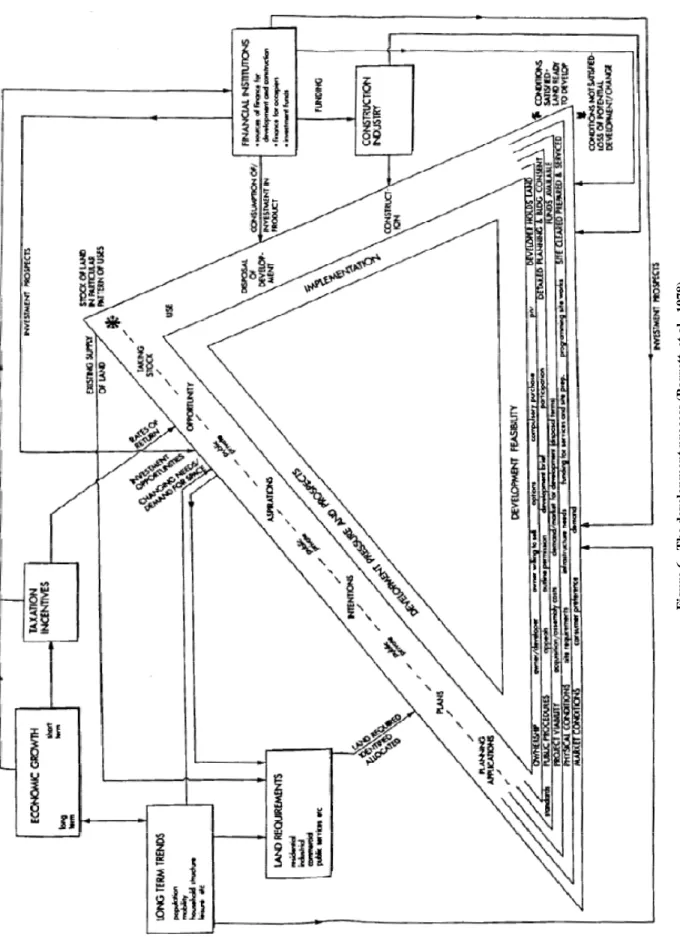
Barrett, Stewart and Underwood (1978) assume the roles in the development process are more varied and the relationship between roles and actors are more complex. They describe a “dynamic pipeline” of structured event sequences that display iterative characteristics. Barrett et
al. place events within the development process in a broad context of demographic, political,
and economic change similar to the assumptions of the econometric models but emphasize the sequencing of events can be parallel or linear. In Figure 6, Barrett et al. outline their
conceptualization of real estate development as a series of events and interactions anchored by ‘development pressure and prospects’. This leads a developer to determine ‘development feasibility’ which can lead to ‘implementation’ if all tasks and conditions are successfully
concluded. This concept of progression through time is an interesting connection to the Event Sequence models to be discussed later in the chapter.
Figure 6
The
development pr
ocess (Barrett,
Agency models of the real estate development process are contributions to our
understanding because they articulate and explicate important information about participants in the process and how they are connected. A major shortcoming of agency models, however, is the difficulty they have in clearly and concisely conveying exactly who is interacting with whom and why that interaction is important. The diagrams that accompany these models are clear examples of the shortcomings of agency models. The diagrams purport to elucidate the RED process and illuminate the complexity inherent to the development process but do little in practice to accomplish that goal. These diagrams are difficult to understand, provide limited opportunities for analysis, and cannot dynamically adjust to changing conditions. They provide a glimpse of the relationships between participants but little of the context and complexity found in reality. Additionally, agency models are focused at a high level of abstraction and therefore do not provide specific guidance or understanding at the project or firm levels.
Structure models
Structure models of real estate development are generally derived from the Marxist school of political economy which analyzes the processes of production from the perspective of power relationships between capital, labor and landowner. This is a distinct theoretical
perspective from the neo-classical school of economics which is more concerned with the processes and consequences of supply and demand in response to market signals (Healey, 1991, p. 232).
The most influential structural theorist of real estate development is David Harvey (1985, pp. 59-89) who has written several books on real property in the context of market-based, communist, statist, and socialist economic systems. Harvey argues that the links between production (land and property for use), finance capital (land and property for investment and the state (public policy) can be viewed through the Marxist (as adopted by Keynes) ‘circuits of capital’ framework. The Marxist circuits of capital (Figure 7) are the Primary or Production Circuit where capital is produced by labor; the Secondary Circuit where capital flows into fixed assets and consumption assets; and the Tertiary Circuit where capital flows into
science/technology and social expenditure. This focuses attention on linking events and agency behavior to the varied ways that different types of economies regulate their modes of
state-market. Harvey believes that the historical/geographical politics of “accumulation” give rise to “class struggles” between those who control capital and those who contribute their labor. These tensions are resolved by cycles of prosperity and crisis and mediated by the state.
Figure 7 - RED in Marxist 'circuits of capital' (Harvey, 1985)
Like all structural analysts, Harvey essentially believes that all details of real world real estate developments are dependent variables of the structural relationships that surround each project. Structural models like Harvey’s do not postulate many of the core assumptions Western developers believe are axiomatic. As such, structural models can be useful tools for
decomposing the underlying assumptions implicit in a particular geography at a particular time. While an interesting framework for conceptualizing development in varying economic contexts, this model fails to give an actor in a US-based, capitalist context any useful information about how to proceed with the conceptualization, production and management of a real-world project.
Event sequence models
The most practical descriptive models for developers to conceptualize the development process are event sequence models that break the land development process into a discrete set of events and activities. Lichfield (1956) was the first contemporary author to conceptualize the real estate development process in terms of its constituent activities. Goodchild and Munton
adapted Litchfield’s work to derive the following widely referenced seven step real estate development process:
The development process begins when a parcel of land is considered suitable for a different or more intensive use and it is completed when the necessary changes have taken place and the land is re-occupied.
1. The ‘maturing of circumstances’ that makes possible a change in the use of land. 2. Purchase of the land by a person prepared to develop it.
3. Preparation of the land for development including both ‘physical’ construction work and ‘abstract’
operations such as establishing legal title.
4. Preparation of the development scheme including obtaining all necessary consents, especially planning
permission.
5. Arrangement of finance to carry out the development. 6. Construction of the development scheme.
7. Its occupation by the developer, a new owner, or tenant. (Goodchild & Munton, 1985, p. 65)
This event sequence model suggests the level of complexity that successful completion of a real estate development process must undergo to reach a conclusion. It also illustrates the temporal dimension as projects move from one phase to the next.
Mike Miles et al. propose an eight-stage framework that represents a typical sequence for a real estate development (Miles, Berens, Eppli, & Weiss, 2007) that has been widely adopted by the development community in the United States and advocated by the Urban Land Institute as a practical guide for developers. While Miles et al. accept that specific developments and
developers are highly idiosyncratic his eight-stage framework details a sequence of activities that adequately characterizes a majority of real estate projects. Miles acknowledges that the sequence is not always followed exactly and the activities within each stage are often occurring
concurrently or iteratively but argues that conceptualizing development as a series of stages provides a practical framework for evaluating individual projects.
1. Idea inception – A developer generates an idea for a particular project in terms of size,
scope, product type for a particular geographical area. This is conceptualized by Graaskamp as “a site looking for a use” or “a use looking for a site”. The developer begins to conceive the type of users that the project would serve and the rough income streams that user could generate. This income stream can generate a potential capitalized
value of the project which compared to cost, quickly allows the developer to determine viability of the idea.
2. Idea refinement – The developer begins to identify sites with appropriate locational
characteristics and economics and attempts to gain control of the site. Preliminary physical feasibility is evaluated in terms of soils condition, environmental mitigation, and ability of the site to physically contain and legally construct the envisioned project. Financial feasibility is further tested in terms of potential income, cost of complete, and availability of financing.
3. Feasibility – A formal feasibility process is started where the developer hires consultants
to conduct market and marketability research, begins a formal design process, initiates entitlements and approval negotiations, arranges debt and equity financing, and evaluates costs and constructability.
4. Contract negotiations – Written contractual agreements are initiated with all key
participants. Construction and permanent debt and equity are negotiated and structured. A contractor is retained to build the project. Government approvals are negotiated and finalized.
5. Commitment point – All the contracts negotiated in Stage 4 are ratified and come into
effect.
6. Construction – The project is constructed by the contractor and the developer manages
the process.
7. Initiation of operations – The construction is completed and operating managers begin
the process of preparing the building for occupancy.
8. Asset management over time – All aspects of managing the capital improvements over
their economic lifecycle are initiated. These include maintenance, releasing, refinancing, and disposition.
Event sequence models are often criticized for offering little more than a vocabulary for describing the development process (Healey, 1991, p. 224) without a specification of the
participants in the process and the conflicts interests they represent. Additionally, it is
contended, that there is no description of the development process that can manage the level of complexity and iteration that actually occurs during a development process. Miles implicitly accepts this criticism but contends that some framework for understanding the real estate development process in terms of its constituent events and activities is better than none at all. While the eight stages are not a completely satisfactory model of the real-life complexity of a real estate project, they are a useful framework for conceptualizing events and activities from a developer’s perspective.
Economic models
Economic models of the real estate development process are primarily econometric in nature and utilize rigorous quantitative analysis to understand supply and demand equilibriums and the endogenous and exogenous changes to the system driving the occurrence of
development processes. Economic models are highly data driven and are often combined with advanced statistical techniques to project variables such as future prices, rents, returns, activities, etc. Real estate econometric modeling is equally adept at microeconomic analysis at the
property level or macroeconomic analysis at the city, regional or national levels. These models and analyses are very well established in Urban Economics literature. Many concepts
illuminated by econometric models are articulated using financial analysis grounded by the “time value of money”.
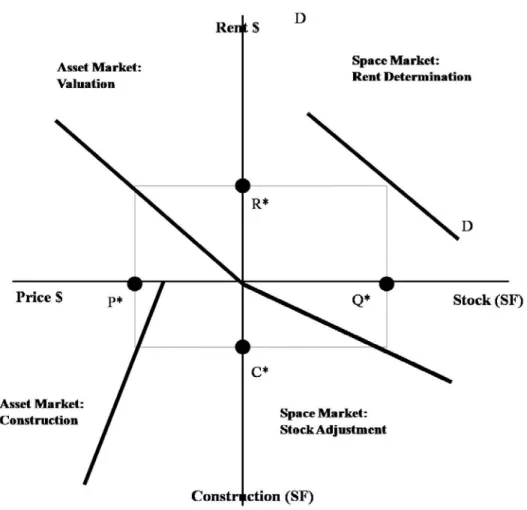
Economic models are generally concerned with the supply and demand equilibriums of built real estate and the effect that urban spatial theory has on land availability and pricing. Economic models of the development process generally posit that new developments are spurred by the value of existing stock exceeding the cost of new construction. Disequilibrium occurs and development happens to bring the system back into balance. (DiPasquale & Wheaton, 1996, pp. 7-10)
The DiPasquale-Wheaton 4-Quadrant Model (Figure 9) is a succinct summary of real estate property and asset markets viewed from an economics perspective. Demand (D) is a
function of rent and macroeconomic conditions prevalent at the time. Supply and demand for built space determines market-determined rents for space in the “space-market” depicted in the upper-right quadrant. The upper-left quadrant takes those rents and via the ratio of rents to market-determined asset prices determined in the asset markets establishes current property values. The line in the upper-left quadrant is the current yield (capitalization rate) or valuation that investors are requiring for real property assets as a function of their current rents. When prices for existing assets are greater than or equal to replacement cost, new development and construction will occur in accordance with a supply function in the lower-left quadrant. Passing through the lower-right quadrant, this new inventory of real estate space is now long-run stock (Q) and part of the supply-side in the market’s determination of rents in the upper-right quadrant. This framework allows sophisticated quantitative analysis and makes forecasting possible. As rents, prices, and construction changes, the model adjusts to model the new equilibrium levels. (DiPasquale & Wheaton, 1996).
In this 4-Quadrant framework, real estate development occurs in the lower-left quadrant as a result of market disequilibrium. The slope and shape of the supply function in this quadrant depict the realization of real estate development projects in the market. Developers (and their financial backers) employ financial analysis tools to determine the costs of new development and the value they can attribute today to the stream of future cash flows based on the asset market in the upper-left quadrant. Development occurs to maximize the residual value between the value of the capitalized stream of rents and the cost of development and construction. The residual is the land value. A rational developer will build a project that maximizes the residual (land) value, typically by generating the largest stream of rents. He will choose a development program that maximizes the risk-adjusted net present value (NPV) of the future cash flows over all other mutually exclusive alternatives (Geltner et al., 2007).
If the developer owns the land, one alternative is to wait for a more advantageous time to build in the future (speculating that conditions will improve). In this formulation, the development of land into a real estate project is the exercise of a real option. A developer can choose to incur high capital costs and significant risk now in order to capture an income stream, or he can wait to exercise the option later. (Geltner et al., 2007)
While economic models of the development process are very useful in understanding where to build a new project, how much to pay for land, or how much rent is justifiable, they do not provide much useful project level information to the developer about the process of
identifying property in the real world and navigating the contentious and politicized entitlement and design process that ultimately leads to construction and tenant turnover.
Systems model
Recently scholars have begun to view real estate development as a complex and adaptive system whose participants and processes exist in specific contexts of economic and political meaning. Viewed through this lens, real estate development can be analyzed by observing and measuring the system dynamics of development and developers.
Edward Trevillion (Trevillion, 2002) is the leading proponent of approaching real estate as a system of interacting components. Trevillion argues that real estate development is a highly dynamic and adaptive system that responds to changes in the surrounding cultural, political and
economic environment. In order to understand the adaptations of the system, one must understand the underlying structural relationships that shape and constrain the components of the system and mold the development process. These underlying relationships give rise to dynamic feedback loops that influence behavior of participants and the evolution of process and behavior. In this systems model, the reaction of a system component to an exogenous force is not entirely deterministic. The system’s evolving structure will influence and control the action of the component part through transmission of information. The real estate development system will demonstrate emergent properties that individual components of the system do not display individually. Thus real estate development can be viewed from a systems perspective as a structure of elements, interconnections and feedback loops that characterize and describe the behavior observed in reality. This is illustrated in Figure 10.
In the System Structure Diagram above (Figure 10), Trevillion highlights the notion of a distinct boundary for factors endogenous to the real estate development system (supply and demand cycles, stocks and flows) and those which are exogenous (interest rates, investment yields, economic activity). The arrows indicate the communication of information from one factor to another or the transmission of behavioral influence. System dynamics are
demonstrated by the feedback loops (positive or negative) that reinforce or compensate the internal activities of the sub-systems (Trevillion, 2002, pp. 181-193). This System Structure Diagram conveys a great deal of information however the presentation is rather confusing and offers limited opportunities for modeling system dynamics or process change.
Chapter Summary
This chapter has presented a series of frameworks for understanding the real estate development process. Each perspective contributes to our comprehensive conceptualization of the actors, relationships, structures and systems that impact a real estate development and the process by which Graaskamp’s “space-time units” are conceptualized, analyzed, constructed, and managed. However, all of these models of the development process lack a level of granularity regarding the specific micro-level tasks required to develop real estate and the relationships between the tasks. If we stipulate a particular conglomerate of economic, political, financial, social, and physical systems, what does a useful and practical task-oriented process look like for a real estate development project? Existing models lack the ability to analyze or articulate the level of detail necessary to be a real world aid to development decision-making. We believe that tools adapted from the field of engineering systems can explicate these tasks and relationships, contribute to enhanced understanding of the real estate development process and aid decision-making that can reduces cost, shorten schedules, and lower risk and uncertainty.
Chapter 2: Systems Thinking in Real Estate Development
Chapter Summary: In this chapter we introduce the interdisciplinary fields of systems engineering (engineering & management) and engineering systems (engineering, management & social sciences) and discuss insights from these fields that contribute to understanding the product development process. We then review the applicability of these analytical perspectives to the real estate development process. We describe the applicability of these insights to the real estate development process and review tools currently used to manage real estate development. The many shortcomings of existing tools used in real estate development sets the stage for applying DSM.
Real estate development is a process. As we saw in the Graaskamp spiral (Figure 4), the process starts with an idea. Then, as information is gathered and tasks are completed, the idea becomes further defined, and moves closer to reality. None of these tasks, however, can be completed in isolation, or in a prescribed linear sequence. Each relies on information from another. This results in a complicated web of linked information that must be managed by the real estate developer. This cyclical, interdependent nature of development is not unique to just real estate. The same can be said for the development of any product where information is being shared between tasks and across disciplines in the process. While the products we have developed over the last century have grown increasingly more complicated, so too has the task of managing how they are developed.
Systems Engineering – Engineering & Management Disciplines
The increased complexities of products and how they are developed have led to the demand for innovative methods of managing and modeling these processes. Prior to World War II, most industrial engineering “was carried out by a small group of designers or a single generalist designer. The products were simpler; the production processes were simpler.” The period after WWII, “was characterized by the diffusion and further development of methods originated in wartime production of weapons.” (Anumba, Kamara, & Cutting-Decelle, 2007) Engineers and managers began to realize that, “in a complex system it is often found that even though individual components satisfy all specifications, the system as a whole will not work.” (Schlager, 1956) In response to these issues, a field of study known as systems engineering
developed to solve the interdisciplinary problems that were occurring in complex development projects. Systems engineering became concerned with integrating disciplines and specialists into
teams that develop a structured development process in all stages of development from design to operation. Systems engineering approaches synthesize business needs with technical
requirements to provide customers with quality products that meet user needs. One accepted definition of systems engineering is:
‘Systems engineering is a rational approach to decision-making related to the solution of complex problems in engineering, planning, design and operation.” (Boardman, 1990, p. 2)
By integrating engineering and management techniques, systems engineering looks to improve the way individual parts of a system work as a whole. Since the name was first coined at the Bell Telephone Laboratories almost 70 years ago, the concept has matured to become an accepted interdisciplinary engineering field of study. Today, product development industries ranging from computer chip design, software integration, and building construction are utilizing systems engineering techniques to improve the development process.
Systems engineering is a practically oriented subject that allows for problem solving and management through the use of models as a tool to visualize and analyze a process. These models can show how subsystems are related and how information is shared between tasks, showing both qualitative and quantitative aspects of the process. The idea of using models to describe a process came before any formal recognition of the field itself. As Boardman states, “systems engineering may not be anything new, but is just good engineering dressed up in new clothes.” (Boardman, 1990, p. 3). The creation of the subject, however, has allowed for people to formally study the way these models are being used. Over the years, the field has been able to provide tools and techniques to aid in the development of different products.
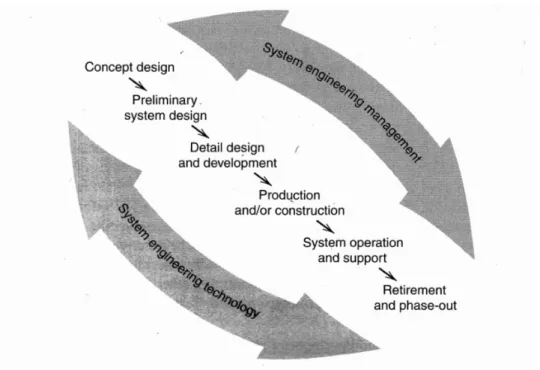
The need for systems engineering tools has increased with the development of new technologies over the last half century. Technological improvements have led to the increased complexities of our products and their development, but at the same time, have also given us effective tools to manage those processes. These tools, such as computers and the models they generate, however, cannot improve the system alone. Proper management must also be in place to oversee and execute based on their output. “There is no guarantee for success unless the proper organizational environmental has been created and an effective and efficient
management structure is in place.” (Blanchard, 2008, pp. 45-46) This is further illustrated by Blanchard in Figure 11 below.
Figure 11 - System engineering process (Blanchard, 2008)
The framework of systems engineering discussed above can be applied to any type of development system, including that required to create real estate. While a review of the literature indicates that system engineering has never been formally applied to real estate development, the currently practiced process of real estate development embodies many characteristics of contemporary systems engineering and product development practice. The development of real estate, similar to any product, starts with an idea looking to meet a demand. Once that demand has been understood, a feasibility analysis is completed to further investigate and refine how this demand can be met in a profitable way. If it appears the demand can be met profitably, the plan is finalized, and financing is procured and structured. The product is then constructed to meet the requirements that were determined in earlier stages. Throughout the development process, the business entity gains knowledge of the product being developed. This knowledge can be further refined on subsequent projects as well, improving the delivery
process.
Engineering Systems – Engineering, Management & Social Sciences Disciplines
Systems engineering is the integration of management and engineering disciplines to build successful technological systems, but the field generally ignores the rich interactions
between these systems and their social, environmental, political and technological context. The new field of Engineering Systems initially conceptualized by the MIT Engineering Systems Division (ESD) seeks to build upon the insights of systems engineering by integrating
approaches and methodology from social sciences. Engineering systems has become a distinct field of enquiry with graduate-level programs at over 30 universities internationally. Engineering systems analysis complements systems engineering by expanding the field of examination
beyond the micro-level analysis of specific systems to incorporate macro-level analysis of the system’s socio-technical context. Scholars have devised two key meanings of engineering systems:
1. A class of systems characterized by a high degree of technical complexity, social intricacy, and elaborate processes, aimed at fulfilling important functions in society
2. An emerging field of scholarship that seeks solutions to important, multi-faceted socio-technical problems.
Engineering systems approaches analysis of complexity through perspectives and methodologies that balance quantitative rigor with qualitative insights while always examining systems from a multiplicity of stakeholder perspectives. The primary engineering systems approaches currently advocated by MIT’s ESD include:
1. “The Interface of Humans and Technology: Examining the ways in which human attitudes and behaviors affect the successful use of technologies, as well as design methodologies that explicitly account for the human interface.
2. Uncertainty and Dynamics: Including modeling the sources of uncertainty and dynamics of complex systems as well as the effects of uncertainty in each domain area.
3. Design and Implementation: Applying life-cycle concepts to capture the value and cost of flows over time, as well as analyzing enterprise architectures and developing change management processes that are required for successful implementation.
4. Networks and Flows: Representing, analyzing and designing systems as interdependent multi-layered networks with multiple types of flows.
5. Policy and Standards: Taking into account the role of government policy, industry standards, and other factors, which traditionally have been taken as external constraints, but instead are treated as design variables by ESD researchers.”
(MIT Engineering Systems Division, 2008, p. 6)
Engineering systems researchers currently focus on domains that highlight the complex relationships between people and technology such as critical infrastructure (electrical grid, transportation, information, communication); extended enterprises (product & service
design-manufacture-delivery, flows of goods/information/money/knowledge); and energy &
sustainability (energy production-distribution-use, resource availability & conservation, policy). The real estate development process incorporates and synthesizes most key
programmatic interests of engineering systems which makes it ideally suited for extending the approaches outlined above. Real estate technology is always progressing and adapting and humans interact with building technology at work, home and during recreational pursuits. The real estate development process is fraught with many types of risk and uncertainty that can be quantified and analyzed. Complex organizations design and build real estate projects in response to customer demand. In the United States, efficient and environmentally sensitive buildings are crucial to sustainability and conservation efforts. The real estate development process is highly regulated at local, state and federal levels and is the outcome of networks of stakeholders and policy decisions. It is also vital to economic development and our social interactions. Enhanced understanding of real estate development is crucial to our continued progress and success as a species, society and culture.
We believe real estate development is a legitimate and important focus of engineering systems approaches. The applications of engineering systems tools and methodologies to real estate development processes will lower risks, lower costs (financial, environmental, social, etc.) and improve the long-term viability of our society. Our understanding of real estate
development will benefit from engineering systems analysis and the nascent field of engineering systems will benefit from studying a complex socio-technical system such as the real estate development process.
Product development
One way to apply systems thinking to real estate development is through analysis of the product development process. Systems approaches are applicable to all stages of a product’s lifecycle. Real estate is a product that is developed in a rich context over time and is thus suitable for analysis using established product development systems methodology.
Early in a product development process, the focus is on conceptualizing a design that meets the anticipated demands of the consumer or user of the product. Once these initial requirements have been established, the focus becomes internal, as a product is designed to
efficiently meet these demands. “Trade-off studies are conducted, with the objective of
providing a well-balanced system design. There are many different design objectives that must be met, some of which may be somewhat conflicting.” (Blanchard, 2008, pp. 30-32) As
information is gathered and interpreted, “the role of system engineering is to identify, prioritize, integrate, and to cause the development of a system configuration that will meet all customer requirements in a timely, effective, and efficient manner.” Throughout the production stage, systems techniques are utilized to ensure that the product still meets the original specified requirements. Throughout the process, “there is a continuous product/process improvement feedback loop…which is critical in the implementation of system engineering.” (Blanchard, 2008, pp. 30-32)
By reviewing the work done in product development, we can observe many similarities between generic product development processes and those of real estate development.
Therefore, by taking a systems approach to real estate development, one is able to apply proven tools and methodologies to improve the practice and knowledge of the real estate development industry. As a result of evaluating and understanding the process in which development is conducted, the developer is able to reduce the number of uncertainties and rework that takes place in the process. This creates value for users and consumers by reducing risk, lowering costs, and improving product quality.
The risks associated with product development can be put into four main categories:
technical risk, market risk, schedule risk and financial risk. A product development
process can be deemed successful if it is capable of identifying, managing and mitigating these risks. (Unger & Eppinger, 2009) These risks can be viewed and measured from an outcome distribution perspective as the possibility the realized ex post outcome deviates from the intended
ex ante outcome. This view of risk highlights the dynamic nature of product development
processes and the inherent uncertainty of the new product development process. To improve a product development process, models are created to visualize, conceptualize and manage the process. “By listing the activities to be done and their dependencies, planners can get an idea of a project’s critical path, duration, etc.” and can “explore opportunities to reduce duration.” An attempt to model a product development process can be extremely difficult and should not be taken lightly. “Ambiguities, uncertainties,
and interdependencies of activities, their results, their assigned people, and their tools make the product development process extremely complex and challenging to model.” (Browning, Fricke, & Negele, 2006, p. 105). “Given the uncertainties inherent in product development, iteration is inevitable and must be managed effectively.” (Unger & Eppinger, 2009, p. 389)
Numerous product development process models have been established that depict business processes. To successfully manage a development process, one first needs to understand the differences and similarities between product development and other business processes. Most business processes, “strive to do the same thing repeatedly, whereas product development projects seek to do something new, once.” As a result, “conventional business processes tend to be more sequential, driven by firm dependencies on specific materials and data, whereas product development processes tend to be more parallel1, since dependencies on information are ‘softer’ in the sense that they can be replaced (for better or worse) by
assumptions and early estimates.” (Browning, Fricke, & Negele, 2006)
It is evident in systems engineering that iteration is necessary to develop products. The back and forth of ideas between tasks allows for innovation to efficiently solve problems. Too little iteration leads to no new ideas or a sub-optimal product whose design is not sufficiently honed. Too much iteration, however, can be highly resource consuming and deliver small incremental value per iteration. There must, therefore, be a balance between too little iteration and too much. A product developer must constantly manage iteration in the development process to ensure that balance is maintained between iteration that improves the product in a time-efficient, cost-effective manner and iteration whose improvements are marginal (or
negative) and simply consume limited resources. These concerns are particularly appropriate for real estate developers who must carefully balance development cost, project timeline, and
product characteristics in order to deliver a viable product to market that maximizes value over time.
1 In DSM terms, “parallel” means independent tasks (no information flow between tasks is required) however it is
Process Management Tools Currently Used in Real Estate Development
Real estate developers use a variety of project management software tools to manage the flow of information, control schedules and track costs. Most commercially available project management software tools are designed for coordinating design and construction activities which forces developers to attempt to adapt this software to their more complicated reality. Much of the value created by real estate developers comes from conceptualizing a deal, assembling land, designing the project and getting the project entitled through the political system all of which is outside the functionality offered by commercial software systems. Other software systems focus on managing real estate development accounting and financial analysis but this offers little help to project management or information flow activities.
MS Project is an example of an “off-the-shelf” generic project management system that manages tasks and timelines with limited cost management functionality. MS Project has some utility but tasks and durations must be input manually and it must be adapted to the particular project. MS Project has no ability to handle iterative tasks which severely lowers its utility for use in the real estate development process.
Some software tools are specifically designed to manage and coordinate development and construction activities and costs.2 Most of these tools used in real estate development come from the construction industry, where tasks are completed in a sequential order. Some software packages are based on PERT/CPM3 analysis and Gantt charts (Primavera, Virtual Premise, Buzzsaw), and display graphical descriptions of the sequence in which tasks are completed. PERT/CPM and Gantt are not well suited to modeling the real estate development process because they are very poor at representing iteration in tasks. Additionally, the diagrams generated using these techniques can rapidly get so complicated that they tend to overwhelm
2 Primavera P6 by Oracle – Project & Portfolio Management (www.oracle.com/primavera/index.html)
Timberline Office by Sage -Suite integrates with accounting systems (www.sagecre.com) Virtual Premise – Real Estate Portfolio Management with PM module (www.virtualpremise.com)
Quickbase by Intuit – Project Management integrates with financial analysis and accounting (quickbase.intuit.com) ProjectCenter by Bricsnet – Project Management integrates with portfolio management (www.bricsnet.com) Constructware by Autodesk – Project Management integrates with Design Suite (usa.autodesk.com) Buzzsaw by Autodesk – Project Management integrates with Design Suite (usa.autodesk.com)
Developer by ARGUS – Limited project management integrates with financial analysis (www.argussoftware.com)