HAL Id: hal-02023133
https://hal.archives-ouvertes.fr/hal-02023133
Submitted on 3 Mar 2021
HAL is a multi-disciplinary open access
archive for the deposit and dissemination of
sci-entific research documents, whether they are
pub-lished or not. The documents may come from
teaching and research institutions in France or
abroad, or from public or private research centers.
L’archive ouverte pluridisciplinaire HAL, est
destinée au dépôt et à la diffusion de documents
scientifiques de niveau recherche, publiés ou non,
émanant des établissements d’enseignement et de
recherche français ou étrangers, des laboratoires
publics ou privés.
Palladium(ii) complexes with planar chiral ferrocenyl
phosphane-(benz)imidazol-2-ylidene ligands
Pauline Loxq, Nathalie Debono, S. Gulcemal, Jean-Claude Daran, E.
Manoury, Rinaldo Poli, B. Cetinkaya, A. Labande
To cite this version:
Pauline Loxq, Nathalie Debono, S. Gulcemal, Jean-Claude Daran, E. Manoury, et al.. Palladium(ii)
complexes with planar chiral ferrocenyl phosphane-(benz)imidazol-2-ylidene ligands. New Journal
of Chemistry, Royal Society of Chemistry, 2014, 38 (1), pp.338-347. �10.1039/C3NJ00863K�.
�hal-02023133�
Journal Name
Cite this: DOI: 10.1039/c0xx00000x
www.rsc.org/xxxxxx
Dynamic Article Links
►
ARTICLE TYPE
Palladium(II) complexes with planar chiral ferrocenyl
phosphane/(benz)imidazol-2-ylidene ligands
Pauline Loxq,
a,bNathalie Debono,
a,bSüleyman Gülcemal,
cJean-Claude Daran,
a,bEric Manoury,
a,bRinaldo Poli,
a,b,dBekir Çetinkaya,
cand Agnès Labande*
a,bReceived (in XXX, XXX) Xth XXXXXXXXX 20XX, Accepted Xth XXXXXXXXX 20XX
5
DOI: 10.1039/b000000x
We describe here the first examples of planar chiral ferrocenyl phosphane/benzimidazol-2-ylidene ligands and their coordination chemistry with palladium(II). All ligand precursors, namely enantiopure ferrocenyl phosphane/(benz)imidazolium salts, and all enantiopure palladium complexes have been fully characterised by 1H, 31P and 13C NMR, mass spectrometry and X-ray diffraction methods for seven examples. The
10
potential of these very bulky bidentate ligands in catalysis was evaluated and compared to their imidazol-2-ylidene analogues. The influence of sterics was shown to be non-negligible as the bulkiest ligand gave the lowest activities in the asymmetric Suzuki-Miyaura reaction.
Introduction
The synthesis and coordination chemistry of functionalised N-15
heterocyclic carbene (NHC) ligands and their applications in catalysis has attracted the attention of several groups,1-3 including
ours.4-7 These strong -donor ligands proved very efficient in
catalysis, even surpassing phosphanes in many cases.8 One
advantage of using N-heterocyclic carbenes is the high stability 20
conferred to the metal complexes, thus avoiding the use of excess ligand or catalyst deactivation. Fine tuning the stereoelectronic properties of the N-heterocyclic carbene may allow us finding useful trends in the search of the best catalyst, particularly in terms of enantioselectivity. Recently, we described the synthesis of 1,1’-25
disubstituted ferrocenyl phosphane/benzimidazol-2-ylidene ligands for applications in rhodium-catalysed hydrosilylation of carbonyl groups. It was shown in this case that the replacement of the imidazol-2-ylidene moiety by the more bulky, electron-rich benzimidazol-2-ylidene bearing two methyl groups on the 30
aromatic ring enhanced the catalytic activity dramatically.6
It is now commonly admitted that strongly electron-donating, bulky ligands favour oxidative addition on palladium and help stabilise the intermediate species in C-C coupling reactions such as for instance the Suzuki-Miyaura reaction.9-11 Furthermore, we
35
have recently turned our attention to the asymmetric version of this reaction, obtaining encouraging results with the use of palladium complexes containing enantiomerically pure phosphane/imidazol-2-ylidene ligands (Figure 1).7 We therefore turned our efforts
towards the synthesis of palladium complexes containing novel 40
chiral 1,2-disubstituted ferrocenyl phosphane/(benz)imidazol-2-ylidene ligands in enantiomerically pure form and describe here their synthesis. Their catalytic properties in the asymmetric Suzuki-Miyaura reaction11-15 have been evaluated and compared to
those of the above mentioned phosphane/imidazol-2-ylidene 45
complexes.7 Finally, the activity of a
phosphane/imidazol-2-ylidene ligand in the asymmetric 1,2-addition of phenylboronic acid to 4-nitrobenzaldehyde has been evaluated.16-19
Scheme 1 Palladium(II) complexes described in our previous work.7
50
Results and Discussion
Synthesis of (benz)imidazolium saltsWith the intention of varying the stereoelectronic properties of the ferrocenyl phosphane-NHC ligands in a rational way, we decided to focus on the NHC moiety without changing the 55
diphenylphosphano group. The σ-donating properties of benzimidazol-2-ylidene ligands are situated between those of unsaturated imidazol-2-ylidenes and of saturated imidazolin-2-ylidenes, which has been demonstrated in several examples of catalytic applications.20,21 Apart from the electronic properties,
60
their structure should bring more bulkiness to the bifunctional ligands. In order to probe the effect of bulky substituents on both
2 | Journal Name, [year], [vol], 00–00
activity and enantioselectivity, we have also changed the nature of the N-substituent.
The synthesis of the phosphane/imidazolium salts with R = Me (3a) has already been described, both in racemic 5 and
enantiomerically pure form.7 The synthesis of other racemic and
5
enantiomerically pure imidazolium and benzimidazolium salts was carried out following these established protocols.5 Racemic
alcohol rac-1 was used mainly to develop and optimise the synthesis of various salts and palladium complexes, but only enantiopure (S)-palladium complexes were used in catalytic 10
reactions since we expected them to exhibit similar levels of activity compared to the previously described neutral palladium complex [PdCl2(ImMe)] (Scheme 1).7 Imidazolium salt 2b was
obtained in moderate yield from ferrocenyl alcohol 1 and N-[(2,4,6-trimethylphenyl)methyl] imidazole (Scheme 2).
15
Scheme 2 Synthesis of phosphane-(benz)imidazolium salts. The synthesis of benzimidazolium salts 2c,d, however, proved more difficult. Benzimidazoles are poorer nucleophiles compared to imidazoles, thus giving greater amounts of side products and 20
lower yields of benzimidazolium salts. Their purification was also less straightforward: the excess of N-substituted benzimidazoles that are not consumed during the reaction cannot be removed with aqueous acidic washings due to their lower hydrophilicity and have a tendency to trail on silica when the same eluting conditions as for 25
the imidazolium salts are applied. Eventually, their purification was successful by eluting the N-substituted benzimidazole excess with pure diethyl ether and then the benzimidazolium salts with a DCM/acetone mixture on a silicagel chromatography column.The
1H NMR spectra of (benz)imidazolium salts 2b-d show the
30
expected signal above δ 8.5, characteristic of the acidic C2 proton. AB systems were observed for the diastereotopic protons of the methylene bridge situated between the ferrocenyl and
(benz)imidazolyl moieties for all salts, as well as for protons of the methylene bridge linking the (benz)imidazolyl and mesityl groups 35
(salts 2b and 2d), which is consistent with the introduction of planar chirality at ferrocene and with the generation of rather rigid structures due to steric crowding.
40
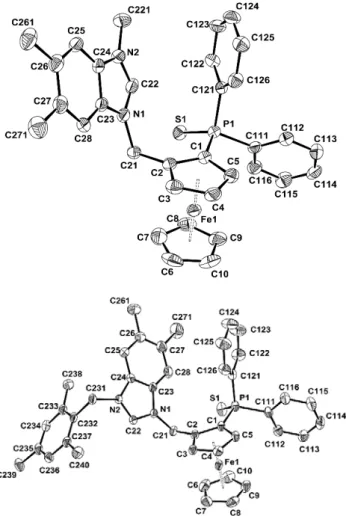
Fig. 1 ORTEP representations of benzimidazolium salts rac-2c (top) and
rac-2d (bottom). Ellipsoids are shown at the 50% level. All hydrogens are
omitted for clarity. Selected bonds (Å), rac-2c: C(23)-C(24) = 1.388(8);
rac-2d: C(23)-C(24) = 1.390(3).
The structure of the intermediates 2c and 2d (Figure 1) was 45
confirmed by X-ray diffraction methods. The structures of the two salts as well as the one of 2a ‡,7 are very close: the only notable
structural difference resides in the length of the C-C bond in the imidazolium motif, which is significantly shorter in the imidazolium salt (C(7)-C(8) = 1.344(4) Å) than in the 50
benzimidazolium salts. This has already been observed in similar structures and indicates delocalisation of the C-C bond -electron density over the fused benzene ring.6
The imidazolium and benzimidazolium salts exhibited different reactivity during the diphenylthiophosphano group deprotection by 55
Raney nickel. Indeed, whereas the desulfurisation of the thiophosphane/imidazolium salt 2b to give 3b went to completion at room temperature in 16 h, longer reaction times and moderate heating (40°C) were necessary to achieve complete desulfurization of the thiophosphane/benzimidazolium salts 2c,d to give 3c,d (31P
60
is more important in the benzimidazolium family, with possible implications in catalysis. As expected, upon deprotection of the diphenylthiophosphano group, the 31P NMR signal of
(benz)imidazolium salts shifted from δ ca. 40.5 for 2 to ca. -27 for
3.
5
Synthesis of palladium(II) complexes
The synthesis and X-ray structural characterisation of complex 4a, obtained by deprotonation of 3a both in racemic and enantiopure forms, has been previously published. ‡,7 We have now extended
this procedure to the synthesis of the analogous complexes with 10
the NHC ligands obtained from 3b, 3c and 3d.
Fe PPh2 N N R BF4 -+ Fe P Ph2 N N R Pd Cl Cl PdCl2(PhCN)2 tBuONa, MeCN 50°C 4a (57%) Im, R = Me 4b (61%) Im, R = CH2Mes 4c (54%) BIm, R = Me 4d (35%) BIm, R = CH2Mes 3a-d
Scheme 3 Synthesis of neutral NHC-phosphane palladium(II) complexes. All phosphane/(benz)imidazolium salts were deprotonated with 15
tBuONa in the presence of the palladium precursor PdCl2(PhCN)2
to give neutral N-heterocyclic carbene/phosphane palladium complexes 4b-d in moderate yields. All products are air-stable and could be purified by column chromatography on silicagel. The absence of the acidic proton characteristic of (benz)imidazolium 20
salts in the 1H NMR spectra indicated carbene formation. The 31P
NMR spectra of all complexes showed a major species with a signal between δ 3.86 and 4.56, along with ca. 2% of a second species around δ 15. This minor species was obtained whatever the complex and mass spectrometry analysis of the mixture by 25
electrospray revealed a small amount of palladium dimer along with the expected monomeric structure. The carbenic carbon in 13C
NMR was found at δ 156.0 for complex 4b bearing an imidazol-2-ylidene moiety and went downfield for complexes 4c,d possessing the benzimidazol-2-ylidene group with, respectively, δ 166.70 and 30
166.74. The same trend has been observed for other neutral palladium(II) NHC complexes in the literature.21,22
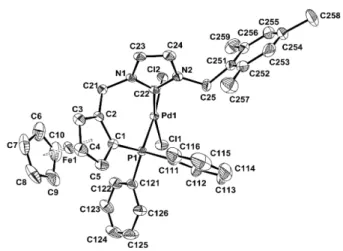
The structures of all new complexes were established by X-ray crystallography and compared with that of 4a.7 The bond lengths
and angles are all within the expected range for neutral palladium 35
complexes with a slightly distorted square-planar geometry (Figures 2 and 3, Table 1). Pd-C(NHC) (1.973(2) Å, 4b, to 1.992(6) Å, 4d) and Pd-P (2.2444(8) Å, 4a, to 2.2546(19) Å, 4d) bond lengths compare well with those in other previously published neutral palladium complexes bearing chelating 40
NHC/phosphane ligands 21,22 As observed previously for complex
4a,9 the Pd-Cl bonds trans to the NHC are all slightly but
significantly shorter than the Pd-Cl bonds trans to the diphenylphosphano groups, which is surprising since the more
donating NHC should exert a greater trans influence than the 45
phosphane, but this was also observed elsewhere.21,22 Similarly to
the (benz)imidazolium salts, the C-C bond of the heteroaromatic unit is slightly longer in the case of benzimidazol-2-ylidenes (1.372(5) Å for 4c and 1.391(8) Å for 4d) than in the case of imidazol-2-ylidenes (1.350(6) Å for 4a and 1.345(4) Å for 4b), 50
which could denote some delocalisation of the double bond due to the presence of the fused benzene ring. No other significant differences in bond lengths are notable between the four structures. However, the C(NHC)-Pd-P bite angle is significantly narrower in complex 4a with 84.95(9)° and increases with the steric bulkiness 55
of the ligand to reach 91.94(19)° in complex 4d.
Fig. 2 ORTEP representation of complex (S)-4b. Ellipsoids are shown at
the 50% level. All hydrogens are omitted for clarity.
Table 1 Selected distances (Å) and angles (°) for complexes 4b-d and
60
comparison with those of 4a.7
Distance (Å) 4a 4b 4c 4d Pd-C(NHC) 1.991(3) 1.973(2) 1.975(4) 1.992(6) Pd-P 2.2444(8) 2.2449(5) 2.2475(9) 2.2546(19) Pd-Cl(trans-NHC) 2.3397(8) 2.3414(6) 2.3043(12) 2.3395(16) Pd-Cl(trans-P) 2.3614(9) 2.3798(5) 2.3347(10) 2.3725(18) C=C (NHC) 1.350(6) 1.345(4) 1.372(5) 1.391(8) Angle (°) N-C(NHC)-N 106.4(3) 106.1(2) 106.4(3) 107.3(5) C(NHC)-Pd-P 84.95(9) 88.90(6) 89.94(10) 91.94(19) N-C(CH2)-C(Cp) 112.2(3) 109.22(19) 111.1(3) 110.7(5) N-C(CH2)-C(Mes) - 115.3(2) - 114.7(5)
4 | Journal Name, [year], [vol], 00–00
Fig.3 ORTEP representations of complexes (S)-4c (top) and rac-4d
(bottom). Ellipsoids are shown at the 50% level. All hydrogens are omitted for clarity.
5
Asymmetric Suzuki-Miyaura reaction
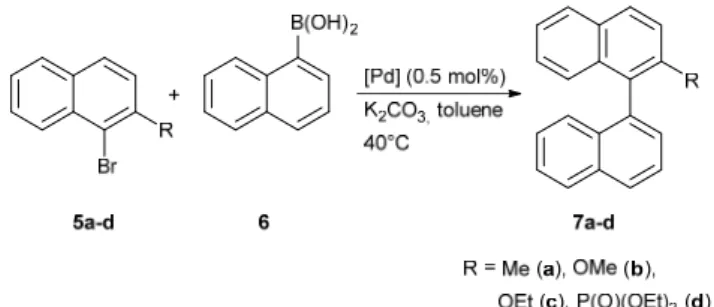
Palladium(II) complexes 4b-d were evaluated in the asymmetric version of the Suzuki-Miyaura cross-coupling reaction between naphthyl bromides and naphthylboronic acid. We previously demonstrated that complex 4a is active for the coupling of 10
substituted naphthyl bromides with naphthylboronic acid at low catalyst loadings and gives, as expected, similar levels of enantioselectivities with the (R) and (S) enantiomers.7 Therefore,
the other complexes were tested directly under the same conditions with the enantiomerically pure ligands possessing the (S) 15
configuration. As expected, all complexes are active for the coupling of various naphthyl bromides with a catalytic charge of 0.5 mol% at 40°C. All reactions were stopped after 24 h to maximise conversions and allow comparison of the results. The first observation to be made is that steric hindrance in the 20
catalyst indeed plays a role since for each reaction the product yield decreases as the steric crowding on the complex increases. Whereas 4a gives excellent yields of the expected coupling product for most substrates, 4b gives the products in only moderate yields and the unexpectedly low yield for the ethoxy substrate cannot be 25
rationally explained.
Scheme 4 Asymmetric Suzuki-Miyaura reaction between 2-substituted
α-naphthyl bromides and α-α-naphthylboronic acid.
Table 2 Catalytic performances of complexes 4a-d in the reaction of
30
Scheme 4.
Entry R Pd cat. Conv (%)b Yield (%)c e.e. (%)d
1 Me e (S)-4a n.d. 88 40 (S) f 2 (R)-4a 95 88 42 (R) f 3 (S)-4b 63 58 46 (S) 4 (S)-4c 60 48 9 (S) 5 (S)-4d 62 47 37 (S) 6 OMe (S)-4a n.d. 95 35 (R) f 7 (R)-4a n.d. 93 33 (S) f 8 (S)-4b 88 65 31 (R) 9 (S)-4c 67 54 17 (S) 10 (S)-4d 67 57 22 (R) 11 OEt (S)-4a n.d. 95 23 (R) f 12 (R)-4a n.d. 92 24 (S) f 13 (S)-4b 22 22 26 (R) 14 (S)-4c 80 65 13 (S) 15 (S)-4d 79 62 23 (R) 16 (S)-4d 75 54 28 (R) g 17 P(O)(OEt)2 (S)-4a 26 0 - 18 (S)-4b 28 0 -19 (S)-4c 35 0 -20 (S)-4d 8 0
-a Reagents and conditions: naphthyl bromide (1.0 equiv), boronic acid
(1.2 equiv), Pd cat. (0.5 mol%), K2CO3 (2.4 equiv), toluene, 24h. b
Determined by integration of characteristic 1H NMR signals in the crude mixture. c Isolated yield. d Determined by HPLC with a Chiracel-OJ
35
column. e The commercial 1-bromo-2-methylnaphthalene contains ca. 6%
of 2-methylnaphthalene. f reference 7. g 2 mol% of Pd catalyst were used.
Complexes 4c and 4d bearing the more bulky benzimidazol-2-ylidene backbone also give moderate yields of the expected 40
coupling products. Although the yields were low with all complexes except for 4a, it seems that steric bulk could be slightly beneficial for the asymmetric induction in some cases, since slightly better e.e.s were obtained with 4b (up to 46%), bearing a CH2Mes substituent in place of a methyl group. Again,
45
unexpectedly low e.e.s were obtained with complex 4c, which cannot only be explained in terms of steric congestion since complex 4d, which possesses the bulkiest ligand, gives better e.e.s than complex 4c. Increasing the catalytic charge from 0.5 mol% to 2 mol% did not improve the level of enantioselectivity or the yield 50
of coupling product (entry 16). The naphthyl bromide bearing a phosphonate substituent at the 2-position has been widely used in asymmetric Suzuki-Miyaura reactions and usually gives better e.e.s than other substrates, as it seems that a chelating functionality on one coupling partner is beneficial to achieve good 55
enantioselectivities.11,14 However, in our case none of the expected
coupling product was obtained whatever the complex used, only a mixture of naphthyl bromide and the corresponding dehalogenated product. Hydrodehalogenation has already been observed in the
conditions of the Suzuki-Miyaura coupling23 and this could
indicate that the oxidative addition takes place but the following step, i.e. the transmetallation of the boronic acid, does not occur. One of the reasons could be the bulkiness of our ligands, but chelating diphosphanes have also been reported not to give 5
conclusive results with this substrate.13 Therefore, the chelating
nature of our ligands, which have two strongly coordinating groups, could be detrimental to the reaction in certain cases.
Asymmetric 1,2-addition of phenylboronic acid to 4-nitrobenzaldehyde
10
The addition products such as diarylmethanols, are very important intermediates in the synthesis of biologically active compounds.24
This reaction has been well studied with rhodium complexes, with the first example of enantioselective 1,2-addition of boronic acids to aldehydes described by Miyaura in 1998.25 Diarylmethanols
15
have thus been obtained with very good enantioselectivities (up to 94% ee),26 but the use of cheaper palladium complexes in the
asymmetric version of this reaction is much less common.17-19
Indeed, only two recent examples show poor to moderate enantioselectivities, using a planar chiral ferrocenyl phosphine (up 20
to 11% ee) 18 or axially chiral NHC ligands (up to 65% ee).19 We
thus turned to the 1,2-addition of PhB(OH)2 to
4-nitrobenzaldehyde, hoping to improve the previously measured enantioselectivities. As the synthesis of 4a is more straightforward than that of 4b-d, we therefore carried out preliminary tests with 25
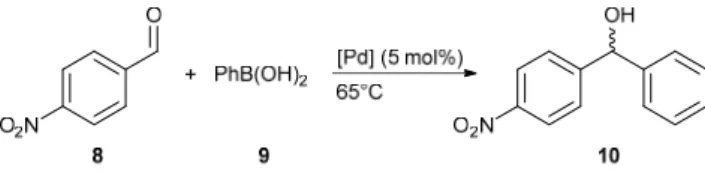
enantiopure (R)-4a only. The reaction was first conducted in THF using KOH as base and 5 mol% of palladium complex (entry 1).
Scheme 4 1,2-Addition of phenylboronic acid to 4-nitrobenzaldehyde.
30
Table 3 Catalytic performances of complex (R)-4a in the reaction of
Scheme 5.
Entry t (h) Solvent Base Yield (%)c E.e. (%)d
1a 24 THF KOH 22 13 (R)
2 b 24 dioxane CsF 22 3 (R)
3 b 4 dioxane CsF 32 7 (R)
4 b 24 toluene K2CO3 69 12 (R)
5 b 4 toluene K2CO3 45 11 (R)
a Reagents and conditions: 4-Nitroenzaldehyde (1 equiv), phenylboronic
acid (2 equiv), KOH (3 equiv), THF (5 mL), 24h. b Reagents and
conditions: 4-Nitroenzaldehyde (1 equiv), phenylboronic acid (1.5 equiv), 35
base (2 equiv), solvent (1 mL). c Isolated yield. d Determined by HPLC
with a Chiracel-AD-H column and compared with published results.18,19 The selectivity with THF/KOH was not satisfactory as a non-negligible amount of 4-nitrobenzyl alcohol from the Canizzarro reaction, as well as other minor by-products, were observed in the 40
1H NMR spectrum of the crude mixture. Changing the solvent/base
couple to dioxane/CsF was no better: although the 1H NMR
spectrum of the crude mixture showed almost complete consumption of the starting aldehyde, several unidentified by-products were also observed (entries 2,3). Only the toluene/K2CO3
45
couple gave interesting results in terms of selectivity and yield (entries 4,5). Unfortunately, the levels of enantioselectivity
measured for complex (R)-4a were poor, with up to 13% e.e. in THF (entry 1), and are comparable to those obtained by Suzuma et al.18 However, this is a preliminary work and a more thorough
50
study of the reaction conditions with this and other chiral palladium complexes will be carried out in order to improve the efficiency of this challenging reaction.
Conclusions
We have described in this paper the synthesis of a new family of 55
chiral Pd complexes, containing enantiomerically pure phosphane/(benz)imidazol-2-ylidene ligands. A first application of these complexes to the asymmetric Suzuki-Miyaura reaction has revealed that the bulkiness of ferrocene conjugated with that of benzimidazol-2-ylidene seems detrimental to the catalytic activity. 60
The influence of the NHC structure on enantioselectivity is not entirely predictable and the best e.e. of 46% was obtained with 4b, only a 4% improvement compared to the previously investigated complex 4a, and to the detriment of the yield. Preliminary tests in the catalysed 1,2-addition of phenylboronic acid to 4-65
nitrobenzaldehyde with complex 4a showed moderate activities and low enantioselectivities. Future work will aim at designing other types of chiral functionalised N-heterocyclic carbenes in order to find the best compromise between activity and enantioselectivity.
70
Acknowledgements
We thank the CNRS, the Ministère de l’Enseignement Supérieur et de la Recherche (doctoral grant to P.L.), the Institut Universitaire de France (grant to S.G.) and the Agence Nationale de la Recherche (ANR-07-JCJC-0041, postdoctoral grant to N.D.) for 75
financial support of this work.
Experimental
General considerations
All manipulations were performed under an inert atmosphere of dry argon by using vacuum line and Schlenk tube techniques. 80
Solvents for syntheses were dried and degassed by standard methods before use. 1D- and 2D-NMR spectra were recorded on Bruker AV500 and Bruker AV300 spectrometers. 1H and 13C
chemicals shifts (δ) are given in ppm (the residual peak of deuterated solvent was used as reference). 31P chemicals shifts are
85
reported in ppm. Peaks are labeled as singlet (s), doublet (d), triplet (t), multiplet (m) and broad (br). The proton and carbon assignment were performed by COSY, NOESY, HSQC, 1H-13C HMBC, 1 H-31P HMBC experiments. MS spectra were performed by the mass
spectrometry service of the Paul Sabatier University. Optical 90
rotations were measured in a 1 dm cell with a Perkin-Elmer 241 photopolarimeter. GC chromatograms were recorded on a HP 4890A GC equipped with a DB-5 MS UI capillary column and the products were identified by comparison with authentic samples. HPLC chromatograms were recorded on a Shimadzu LC-95
2010A(HT) equipped with a Chiralcel OJ column. Commercial chemicals were from Acros, Aldrich, Alfa Aesar, or Fluka and used as received. 1,2-Ferrocenyl alcohol 1,27 imidazolium salts 2a,3a 5
and palladium complex 4a 7 were prepared according to previously
reported procedures. Abbreviations: CpA: cyclopentadienyl ring
6 | Journal Name, [year], [vol], 00–00
with PPh2 or PPh2(=S) substituents; CpB: unsubstituted
cyclopentadienyl ring; Fc: ferrocenyl; Im: imidazolyl; BIm: benzimidazolyl; Mes: mesityl. Cq: quaternary carbon.
Syntheses
FcPPh2(=S)CH2Im+CH2MesBF4- 2b 5
To a solution of ferrocenyl alcohol 1 (100 mg, 0.23 mmol) in dry CH2Cl2 (10 mL) was quickly added HBF4 (54%wt in Et2O, 50 µL,
0.35 mmol), immediately followed by N-2,4,6 trimethylbenzylimidazole (110 mg, 0.55 mmol). After 5 minutes, the mixture was washed with 2M aq. HCl, water, sat. aq. NaHCO3
10
and water, dried (MgSO4), filtered and concentrated in vacuo. The
residue was purified by precipitation with methyl tert-butyl ether from a CH2Cl2 solution to give a yellow solid (80 mg, 50% yield). 1H NMR (300 MHz, CDCl3, 298K) δ 8.61 (1H, s, NCHN), 7.78-7.71 (2H, m, CH PPh2), 7.60-7.47 (4H, m, CH PPh2), 7.40 (1H, m, 15 CH PPh2), 7.30 (3H, m, CH PPh2), 7.15 (1H, s, CH Mes), 6.88 (2H, s, NCH=CH), 6.51 (1H, s, CH Mes), 6.40 (1H, AB syst., JHH=14 Hz, CH2-Fc), 5.22 (1H, AB syst., JHH=14 Hz, CH2-Fc), 5.21 (1H, br. s, CpA), 5.14 (1H, AB syst., JHH=14 Hz, CH2-Mes), 4.91 (1H, AB syst., JHH=14 Hz, CH2-Mes), 4.53 (1H, br. s, CpA), 4.35 (5H, 20 s, CpB), 3.86 (1H, br s., CpA), 2.28 (3H, s, p-CH3 Mes), 2.13 (6H, s, o-CH3 Mes). 13C{1H} NMR (75.5 MHz, CDCl3, 298K) δ 139.88
(Cq Mes, C-CH2), 137.93 (2 Cq Mes, C-o-CH3), 134.91 (NCHN),
134.66 (d, JCP=86 Hz, Cq PPh2 ), 132.08 (d, JCP=56 Hz, Cq PPh2),
131.90 (d, JCP=11 Hz, CH PPh2), 131.70 (d, JCP=3 Hz, CH PPh2),
25
131.25 (d, JCP=10 Hz, CH PPh2), 129.89 (2 CH, NCH=CH),
128.47 (d, JCP=11 Hz, CH PPh2), 128.33 (d, JCP=12 Hz, CH PPh2),
125.35 (Cq Mes, C-p-CH3), 122.04 (CH Mes), 120.24 (CH Mes),
83.44 (d, JCP=12 Hz, CqCpA), 76.76 (d, JCP=10 Hz, CH CpA), 76.00
(d, JCP=11 Hz, CH CpA), 73.55 (d, JCP=93 Hz, Cq CpA), 71.39 (d,
30
JCP=9 Hz, CH CpA), 71.23 (5 CH CpB), 47.91 (CH2-Fc or CH2
-Mes), 47.40 (CH2-Fc or CH2-Mes), 21.04 (p-CH3 Mes), 19.61
(o-CH3 Mes). 31P{1H} NMR (121 MHz, CDCl3, 298K) δ 40.65. MS
(ESI) m/z 615 [M+] (100), 415 [M+- C13H16N2] (8). HRMS (ES+)
calcd for C36H36N2PSFe 615.1687; found 615.1688. (S)-2b:
35
[α]20D=-11 (c=0.55, CH2Cl2).
FcPPh2(=S)CH2BIm+CH3BF4- 2c
To a solution of ferrocenyl alcohol 1 (418 mg, 0.97 mmol) in dry CH2Cl2 (20 mL) was quickly added HBF4 (54%wt in Et2O, 330
µL, 2.42 mmol), immediately followed by N-methyl 40
benzimidazole (466 mg, 2.91 mmol). After 5 minutes, the mixture was washed with 2M aq. HCl, water, sat. aq. NaHCO3 and water,
dried (MgSO4), filtered and concentrated in vacuo. The residue
was purified by precipitation with a mixture of petroleum ether and methyl tert-butyl ether (80/20) from a CH2Cl2 solution to give an
45
orange solid (193 mg, 27% yield). X-ray quality crystals of rac-2c were obtained by slow diffusion of diethyl-ether from a dichloromethane solution. 1H NMR (300 MHz, CDCl3, 298K) δ 8.79 (1H, s, NCHN), 7.73-7.69 (3H, m, CH PPh2+BIm), 7.55-7.47 (4H, m, CH PPh2), 7.21-7.15 (3H, m, CH PPh2), 6.95-6.93 (3H, m, 50 CH PPh2+BIm), 6.57 (1H, AB syst., JHH=14 Hz, Fc-CH2), 5.23 (1H, br. s, CpA), 5.21 (1H, AB syst., JHH=14 Hz, Fc-CH2), 4.58 (1H, br. s, CpA), 4.48 (5H, s, CpB), 3.78 (1H, br. s, CpA), 3.64 (3H, s, NCH3), 2.37 (3H, s, CH3 BIm), 2.16 (3H, s, CH3 BIm). 13C{1H} NMR (75.5 MHz, CDCl3, 298K) δ 140.47 (NCHN), 55 136.95+136.98 (Cq BIm), 133.08 (d, JCP=80 Hz, Cq PPh2), 131.99 (d, JCP=86 Hz, Cq PPh2), 131.85 (d, JCP=2 Hz, CH PPh2), 131.77 (d, JCP=12 Hz, CH PPh2), 131.25 (d, JCP=11 Hz, CH PPh2), 130.94 (d, JCP=2 Hz, CH PPh2), 129.78+129.24 (Cq BIm), 128.34 (d, JCP=13 Hz, CH PPh2), 127.61 (d, JCP=12 Hz, CH PPh2), 60 114.22+111.58 (CH BIm), 82.37 (d, JCP=13 Hz, Cq CpA), 77.24 (CH CpA), 76.38 (d, JCP=10 Hz, CH CpA), 75.27 (d, JCP=91 Hz, Cq CpA), 71.39 (5 CH CpB), 71.18 (d, JCP=10 Hz, CH CpA), 45.60 (CH2-Fc), 33.37 (NCH3), 20.64+20.52 (CH3 BIm). 31P{1H} NMR (121.5 MHz, CDCl3, 298K) δ 40.34. MS (ESI) m/z 575 [M+] (100), 65
415 [M+ - C10H12N2] (18). HRMS (ES+) calcd for C33H32N2PSFe
575.1374; found 575.1367. (S)-2c: [α]20D=-81 (c=0.54, CH2Cl2).
FcPPh2(=S)CH2BIm+CH2MesBF4- 2d
To a solution of ferrocenyl alcohol 1 (474 mg, 1.09 mmol) in dry CH2Cl2 (20 mL) was quickly added HBF4 (54%wt in Et2O, 380
70
µL(2.75 mmol, 2.5 equiv), immediately followed by N-2,4,6 trimethylbenzyl benzimidazole (800 mg, 2.88 mmol, 2.7 equiv). After 5 minutes, the mixture was washed with 2M aq. HCl, water, sat. aq. NaHCO3 and water, dried (MgSO4), filtered and
concentrated in vacuo. The residue was purified by precipitation 75
with a mixture of petroleum ether and methyl tert-butyl ether (80/20) from a CH2Cl2 solution, followed by column
chromatography on silica gel (eluents: diethyl ether, then CH2Cl2,
then CH2Cl2/Acetone 90/10) to give an orange solid (481 mg, 57%
yield). X-ray quality crystals of rac-2d were obtained by slow 80
diffusion of diethyl ether into a dichloromethane solution. 1H NMR
(500 MHz, CDCl3, 301K) δ 8.68 (1H, s, NCHN), 7.72-7.68 (3H, m, CH PPh2+BIm), 7.58-7.55 (1H, m, CH PPh2), 7.51-7.47 (2H, m, CH PPh2), 7.22-7.18 (1H, m, CH PPh2), 7.07-7.00 (3H, m, CH PPh2+BIm), 6.94 (2H, s, CH Mes), 6.90-6.85 (2H, m, CH PPh2), 85 6.48 (1H, AB syst., Fc-CH2), 5.51 (1H, AB syst., Fc-CH2), 5.40
(1H, br, CpA), 5.32 (1H, AB syst., CH2-Mes), 4.98 (1H, AB syst.,
CH2-Mes), 4.57 (1H, br s, CpA), 4.42 (5H, s, CpB), 3.81 (1H, s,
CpA), 2.34-2.33 (9H, m, CH3 BIm+p-CH3Mes), 2.17 (6H, s, o-CH3
Mes). 13C NMR{1H} (125.8 MHz, CDCl
3, 301K) δ 139.97 (Cq
p-90
CH3C Mes), 139.51 (NCHN), 137.94 (Cq o-CH3C Mes),
137.23+137.20 (Cq CH3CBIm), 134.01 (d, JCP=86 Hz, Cq PPh2), 132.00 (d, JCP=11 Hz, CH PPh2), 131.99 (d, JCP=87 Hz, Cq PPh2), 131.92 (d, JCP=3 Hz, CH PPh2), 131.20 (d, JCP=3 Hz, CH PPh2), 130.83 (d, JCP=11 Hz, CH PPh2), 130.07 (CH Mes), 95 129.72+129.60 (Cq BIm), 128.66 (d, JCP=13 Hz, CH PPh2), 127.75 (d, JCP=12 Hz, CH PPh2), 124.95 (Cq NCH2C Mes), 114.79+112.33 (CH BIm), 83.05 (d, JCP=12 Hz, Cq CpA), 77.28 (CH CpA, seen by HSQC{31P}), 76.12 (d, JCP=12 Hz, CH CpA), 73.91 (d, JCP=94 Hz, Cq CpA), 71.59 (CH CpB), 71.17 (d, JCP=10 100 Hz, CH CpA), 46.72 (CH2-Fc), 45.77 (CH2-Mes), 21.10 (p-CH3
Mes), 20.73+20.69 (CH3 BIm), 20.03 (o-CH3 Mes). 31P{1H} NMR
(202.5 MHz, CDCl3, 301K) δ 40.88. MS (ESI) m/z 693 [M+] (100).
HRMS (ES+) calcd for C42H42N2PSFe 693.2156; found 693.2164.
(S)-2d: [α]20D=-158 (c=0.53, CH2Cl2).
105
General procedure for the synthesis of (benz)imidazolium salts FcPPh2CH2Im/BIm+RBF4- 3b-d: Raney nickel (50 to 100 equivalents) was washed with degassed methanol (3 X 10 mL), degassed diethyl ether (3 X 10 mL) and, finally degassed acetonitrile (3 X 10 mL). A solution of (benz)imidazolium salt 2b-110
d in acetonitrile (20 mL) was added and the mixture was heated at
40°C for 20h. After cooling to room temperature, the supernatant was filtered through a short path of Celite® and the Raney nickel
was rinsed with acetonitrile. The filtrate was concentrated and the solid residue was dried in vacuo.
115
FcPPh2CH2Im+CH2Mes BF4- 3b: yellow solid (220 mg, 88% yield). 1H NMR (300 MHz, CDCl3, 298 K) δ 8.73 (1H, s, NCHN),
7.49 (2H, m, CH PPh2), 7.39 (3H, m, CH PPh2), 7.16 (3H, m, CH PPh2), 6.97 (2H, m, CH PPh2), 6.87 (2H, br s, CH Mes), 6.82 (1H, br s, NCH=CH), 6.42 (1H, br s, NCH=CH), 5.50 (1H, AB syst., JHH=15 Hz, CH2-Fc), 5.37 (1H, AB syst., JHH=15 Hz, CH2-Fc), 5.09 (2H, s, CH2-Mes), 4.93 (1H, br s, CH CpA), 4.48 (1H, br s, 5 CH CpA), 4.11 (5H, s, CH CpB), 3.92 (1H, br s, CH CpA), 2.27 (3H,
s, p-CH3 Mes), 2.01 (6H, s, o-CH3 Mes). 13C{1H} NMR (75.5
MHz, CDCl3, 298K) δ 139.98 (Cq Mes), 138.94 (d, JCP=7 Hz, Cq PPh2), 138.00 (Cq Mes), 135.56 (d, JCP=7 Hz, Cq PPh2), 135.10 (NCHN), 134.71 (d, JCP=21 Hz, CH PPh2), 132.19 (d, JCP=19 Hz, 10 CH PPh2), 129.89 (CH Mes), 129.68 (CH Mes), 128.43 (d, JCP=8 Hz, CH PPh2), 128.32 (d, JCP=7 Hz, CH PPh2), 124.93 (CqMes), 121.48 (NCH=CH), 120.06 (NCH=CH), 84.23 (d, JCP=28 Hz, Cq CpA), 76.92 (d, JCP=9 Hz, Cq CpA), 73.73 (CH CpA), 72.93 (d, JCP=4 Hz, CH CpA), 71.52 (CH CpA), 70.25 (CH CpB), 49.00 (d, 15 JCP=11 Hz, CH2-Fc), 47.40 (CH2-Mes), 22.63 (p-CH3 Mes), 21.01 (o-CH3 Mes). 31P{1H} NMR (121.5 MHz, CDCl3, 298K) : δ -27.18. MS (ESI) m/z 583 [M+] (85) 383 [M+ - C13H16N2] (100).
HRMS (ES+) calcd for C
36H36N2PFe 583.1966; found 583.1962.
(S)-3b: [α]20D=-161 (c=0.51, CH2Cl2).
20
FcPPh2CH2BIm+Me BF4- 3c: orange solid (164 mg, 90% yield).
1H NMR (300 MHz, CDCl3, 298 K) δ 8.75 (1H, s, NCHN), 7.51 (1H, s, CH BIm), 7.46-7.37 (4H, m, CH PPh2), 7.28 (1H, s, CH PPh2), 7.08 (1H, s, CH BIm), 7.01 (1H, m, CH PPh2), 6.83 (2H, m, CH PPh2), 6.65 (2H, m, CH PPh2), 5.79 (1H, AB syst., JHH=15 Hz, 25 CH2-Fc), 5.34 (1H, AB syst., JHH=15 Hz, CH2-Fc), 5.06 (1H, br s, CH CpA), 4.50 (1H, br s, CH CpA), 4.22 (5H, s, CH CpB), 3.84 (1H, br s, CpA), 3.67 (3H, s, N-CH3), 2.37 (6H, br s, CH3 BIm). 13C{1H} NMR (75 MHz, CDCl3, 298K) δ 140.35 (NCHN), 138.10 (d, JCP=7 Hz, Cq PPh2), 136.92 (Cq CH3CBIm), 136.82 (Cq CH3CBIm), 30 135.28 (d, JCP=7.5 Hz, Cq PPh2), 134.62 (d, JCP=20 Hz, CH PPh2), 131.81 (d, JCP=19 Hz, CH PPh2), 130.93 (Cq BIm), 129.94 (Cq BIm), 129.55 (CH PPh2), 128.38 (d, JCP=8 Hz, CH PPh2), 127.88 (CH PPh2), 127.65 (d, JCP=6.5 Hz, CH PPh2), 113.11 (CH BIm), 111.89 (CH BIm), 83.97 (Cq Cp A), 77.21 (Cq CpA), 74.30 (CH 35 CpA), 72.94 (CH CpA), 71.06 (CH CpA), 70.30 (CH CpB), 46.26 (d, JCP=9 Hz, CH2-Fc), 32.93 (CH3-N), 20.61+20.47 (CH3 BIm). 31P{1H} NMR (121.5 MHz, CDCl3, 298K) δ -26.43. MS (ESI) m/z 543 [M+] (100), 575 [M+ + S] (70), 383 [M+ - C 10H12N2] (65).
HRMS (ES+) calcd for C33H32N2PFe 543.1699; found 543.1662.
40
(S)-3c: [α]20D=-201 (c=0.55, CH2Cl2).
FcPPh2CH2BIm+CH2Mes BF4- 3d: yellow solid (500 mg, 82% yield). 1H NMR (500 MHz, CDCl 3, 301 K) δ 8.90 (1H, s, NCHN), 7.50-7.47 (3H, m, CH BIm+PPh2), 7.44-7.38 (3H, m, CH PPh2), 6.98 (1H, t, JHH=7.5 Hz, CH PPh2), 6.94 (2H, s, CH Mes), 6.81 45 (2H, t, JHH=7.5 Hz, CH PPh2), 6.79 (1H, s, CH BIm), 6.63-6.60 (2H, m, CH PPh2), 5.78 (1H, dd, JHH=14.9 Hz, JPH=1.8 Hz, CH2 -Fc), 5.57 (1H, AB syst., JHH=14.9 Hz, CH2-Fc), 5.33 (1H, AB syst., JHH=14.7 Hz, CH2-Mes), 5.26 (1H, AB syst., JHH=14.6 Hz, CH2 -Mes), 5.08 (1H, br. s, CH CpA), 4.49 (1H, br. s, CH CpA), 4.13 (5H, 50 s, CH CpB), 3.88 (1H, br. s, CH CpA), 2.33 (3H, s, p-CH3 Mes),
2.23 (6H, s, CH3 BIm), 2.17 (6H, s, o-CH3 Mes). 13C{1H} NMR
(125.8 MHz, CDCl3, 301K) δ 139.88 (Cq p-CH3CMes), 139.83 (d, JCP=1.8 Hz, NCHN), 139.11 (d, JCP=8 Hz, Cq PPh2), 138.00 (Cq o-CH3CMes), 136.81 (Cq CH3CBIm),136.10 (d, JCP=6 Hz, Cq PPh2), 55 135.02 (d, JCP=21 Hz, o-CH PPh2), 131.28 (d, JCP=18 Hz, o-CH PPh2), 130.04 (CH Mes), 129.70 (d, p-CH PPh2), 129.68 (Cq BIm), 129.45 (d, p-CH PPh2), 128.34 (d, JCP=8 Hz, m-CH PPh2), 127.58 (d, JCP=6 Hz, m-CH PPh2), 127.48 (Cq BIm), 124.65 (Cq NCH2C
Mes), 113.62 (d, JCP=5 Hz, CH BIm),112.46 (CH BIm), 85.17 (d,
60
JCP=28 Hz, Cq CpA), 76.21 (d, JCP=9 Hz, Cq CpA), 73.82 (d, JCP=3.7
Hz, CH CpA), 72.79 (d, JCP=4.5 Hz, CH CpA), 71.39 (CH CpA),
70.35 (CH CpB), 46.53 (dd, JCP=9.6 Hz, CH2-Fc), 46.28 (d, CH2
-Mes), 21.07 (p-CH3 Mes), 20.59+20.46 (CH3 BIm), 19.75 (o-CH3
Mes). 31P{1H} NMR (202.5 MHz, CDCl
3, 301K) δ -25.68. MS
65
(ESI) m/z 677 [M+ + O] (10), 661 [M+] (100), 383 [M+ - C19H22N2]
(10). HRMS (ES+) calcd for C42H42N2PFe 661.2435; found
661.2443. (S)-3d: [α]20D=-224 (c=0.55, CH2Cl2).
General procedure for the synthesis of PdCl2[L] complexes
4b-d
70
A mixture of PdCl2(PhCN)2 (1 equiv), FcPPh2CH2Im/ BIm+RBF4
-3b-d (50 mg, 1 equiv.) and NaOtBu (1.1 equiv) in dry CH3CN (50
mL) was heated at 50°C for 16h. The solution was allowed to cool to room temperature, concentrated in vacuo and the residue was purified by flash chromatography on silica gel (eluent : 75
CH2Cl2/MeOH 9/1).
4b: orange solid (35 mg, 61% yield). X-ray quality crystals of (S)-4b were obtained by slow diffusion of petroleum ether in a solution
of dichloromethane. 1H NMR (500 MHz, CDCl 3, 298 K) δ 7.92 (2H, m, CH PPh2), 7.51 (1H, m, CH PPh2), 7.44 (2H, m, CH PPh2), 80 7.41 (1H, m, CH PPh2), 7.32 (2H, m, CH PPh2), 7.18 (2H, m, CH PPh2), 6.79 (1H,s, NCH=CH), 6.78 (2H, s, CH Mes), 6.54 (1H, AB syst., JHH=15 Hz, CH2-Fc), 5.97 (1H, s, NCH=CH), 5.94 (1H, AB
syst., JHH=15 Hz, CH2-Mes), 4.75 (1H, AB syst., JHH=15 Hz, CH2
-Fc), 4.74 (1H, br s, CH CpA), 4.42 (1H, br s, CH CpA), 4.28 (5H,
85
s, CH CpB), 4.00 (1H, AB syst., JHH=15 Hz, CH2-Mes), 3.70 (1H,
br s, CH CpA), 2.24 (3H, s, p-CH3 Mes), 1.91 (6H, s, o-CH3 Mes). 13C{1H} NMR (125.8 MHz, CDCl3, 298 K) δ 156 ppm (Cq
NCN-Pd, determined by HMBC), 139.03 (2 Cq Mes, C-o-CH3), 138.72
(Cq Mes, C-p-CH3), 135.75 (d, JCP=10 Hz, CH PPh2), 134.46 (d, 90 JCP=54 Hz, Cq PPh2), 131.33 (d, JCP=11 Hz, CH PPh2), 131.16 (CH PPh2), 130.68 (CH PPh2), 129.18 (CH Mes), 128.86 (d, JCP=54 Hz, Cq PPh2), 128.71 (d, JCP=11 Hz, CH PPh2), 127.39 (d, JCP=11 Hz, CH PPh2), 126.78 (Cq Mes, C-CH2), 121.00 (NCH=CH), 119.00 (NCH=CH), 86.99 (d, JCP=14 Hz, Cq CpA), 74.85 (CH CpA), 72.90 95 (d, JCP=56 Hz, CH CpA), 71.83 (d, JCP=58 Hz, Cq CpA), 71.43 (5 CH CpB), 70.13 (CH CpA), 50.08 (CH2-Fc), 48.03 (CH2-Mes),
20.92 (p-CH3 Mes), 20.60 (o-CH3 Mes). 31P{1H} NMR (202.5
MHz, CDCl3, 298 K) δ 4.56. MS (ESI) m/z 723 [M- Cl-] (100),
242 [PdCl2Im] (80). HRMS (ES+) calcd for C36H35N2PFePdCl
100
723.0623; found 723.0652. (S)-4b : [α]20D=-5 (c=0.5, CH2Cl2).
4c: orange solid (30 mg, 54% yield). X-ray quality crystals of (S)-4c were obtained by slow diffusion of acetone in a solution of
dichloromethane. 1H NMR (500 MHz, CD2Cl2, 298 K) δ 8.08 (2H, m, CH o-PPh2), 7.61 (1H, m, CH p-PPh2), 7.52 (2H, m, CH m-105 PPh2), 7.28 (1H, m, CH p-PPh2), 7.20 (1H, s, CH BIm), 7.06 (2H, m, CH o-PPh2), 6.83 (1H, s, CH BIm), 6.76 (2H, m, CH m-PPh2), 6.64 (1H, AB syst., JHH=15 Hz, CH2-Fc), 5.21 (1H, AB syst., JHH=15 Hz, CH2-Fc), 4.94 (1H, br s, CH CpA), 4.43 (1H, br s, CH CpA), 4.42 (1H, br s, CH CpB), 3.62 (3H, s, N-CH3), 2.38 (3H, s, 110 CH3-BIm), 2.32 (3H, s, CH3-BIm). 13C{1H} NMR (125.8 MHz, CD2Cl2, 298 K) δ 166.70 (Cq NCN-Pd), 136.02 (d, JCP=10 Hz, o-CH PPh2), 134.31 (d, JCP=55 Hz ,CqPPh2), 133.49 (Cq BIm), 133.10 (2 Cq CH3-C BIm), 131.40 (d, JCP=2.5 Hz, p-CH PPh2), 130.90 (Cq BIm), 130.65 (d, J CP=11 Hz, o-CH PPh2), 130.00 (d, 115 JCP=2.5 Hz, p-CH PPh2), 128.34 (d, JCP=10 Hz, m-CH PPh2), 127.58 (d, JCP=54 Hz, Cq PPh2), 127.48 (d, JCP=11 Hz, m-CH
8 | Journal Name, [year], [vol], 00–00 PPh2), 110.45 (CH BIm), 109.71 (CH BIm), 86.80 (d, JCP=14 Hz, Cq CpA), 74.23 (d, JCP=2.5 Hz, CH CpA), 73.51 (d, JCP=8 Hz, CH CpA), 71.36 (5 CH CpB), 71.00 (d, JCP=58 Hz, Cq CpA), 70.39 (d, JCP=6 Hz, CH CpA), 46.15 (CH2-Fc), 33.60 (N-CH3), 20.04 (CH3 BIm), 19.95 (CH3 BIm). 31P{1H} NMR (202.5 MHz, CD2Cl2, 298 5 K) δ 4.38. MS (ESI) m/z 683 [M - Cl-] (100), 647 [M – 2Cl-] (33).
HRMS (ES+) calcd for C
33H31N2PFePdCl 683.0309; found
683.0313.(S)-4c: [α]20D=-59 (c=0.54, CH2Cl2).
4d: yellow solid (20 mg, 35% yield). X-ray quality crystals of rac-4d were obtained by slow diffusion of diethyl ether in a solution of
10 dichloromethane. 1H NMR (500 MHz, CDCl 3, 298 K) δ 8.00 (2H, m, CH PPh2), 7.52-7.46 (2H, m, CH PPh2), 7.31-7.29 (2H, m, CH PPh2), 7.12 (1H, m, CH BIm), 6.96-6.94 (2H, m, CH PPh2), 6.77 (2H, s, CH PPh2), 6.78 (2H, 2s, CH Mes), 6.77 (1H, AB syst., JHH=15 Hz, Fc-CH2), 6.28 (1H, AB syst., JHH=15 Hz, CH2-Mes), 15 5.41 (1H, s, CH BIm), 5.14 (1H, AB syst., JHH=15 Hz, Fc-CH2), 4.85 (1H, br. s, CpA), 4.40 (1H, br. s, CpA), 4.32 (5H, s, CpB), 4.31 (1H, AB syst., JHH=15 Hz, CH2-Mes), 3.65 (1H, br. s, CpA), 2.29
(6H, s, CH3 BIm), 1.95 (6H, s, o-CH3 Mes), 1.91 (3H, s, p-CH3
Mes). 13C{1H} NMR (125.8 MHz, CDCl3, 298 K) δ 166.74 (Cq 20 NCN-Pd), 138.47 (Cq BIm), 135.93 (d, JCP=10 Hz, o-CH PPh2), 134.19 (d, JCP=54 Hz, Cq PPh2), 133.49 (Cq BIm), 132.45 (Cq CH3 -C BIm), 132.34 (-Cq CH 3-C BIm), 131.47 (Cq Mes, C-p-CH3), 131.18 (Cq Mes, C-o-CH3), 131.02 (d, JCP=11 Hz, CH PPh2), 129.
89 (CqMes, C-o-CH3), 129.10 (CH Mes), 128.79 (d, JCP=55 Hz,
25
Cq PPh2 ), 127.43 (d, JCP=11 Hz, CH PPh2), 128.49 (d, JCP=10 Hz,
CH PPh2), 126.84 (CH Mes), 112.45 (CH BIm), 109.23 (CH BIm),
86.52 (d, JCP=14 Hz, Cq CpA), 74.42 (CH CpA ), 72.05 (Cq, CpA),
72.93 (d, JCP=1.5 Hz, CH CpA), 71.39 (5 CH,CpB), 70.16 (d,
JCP=1.5 Hz, CH CpA), 49.00 (CH2-Mes), 46.52 (CH2-Fc), 21.12
(o-30
CH3 Mes), 20.92 (CH3 BIm), 20.37 (p-CH3 Mes), 20.26 (CH3
BIm). 31P{1H} NMR (202.5 MHz, CDCl3, 298 K) δ 3.86. MS
(DCI-CH4) m/z 801 [M- Cl] (100), 767 [M- 2Cl] (58). HRMS
(Cl+) calcd for C42H41N2PFePdCl 801.1080; found 801.1118.
(S)-4d: [α]20D=-32 (c=0.51, CH2Cl2).
35
General procedure for Suzuki-Miyaura coupling reactions: in
a typical run, a mixture of naphthyl halide (0.29 mmol, 1 equiv), naphthylboronic acid (0.34 mmol, 1.2 equiv), potassium carbonate (0.69 mmol, 2.4 equiv) and catalyst (0.5 mol%) in 2 mL of toluene (+ 50 μL of CH2Cl2 for complete solubilisation) was stirred for 24h
40
at 40°C. The solution was allowed to cool to room temperature, washed with water and the aqueous phase was extracted with diethyl ether. The organic phase was dried over MgSO4, filtered
and concentrated in vacuo. The residue was purified by flash chromatography on silica gel (hexane or hexane/ethyl acetate 9/1). 45
Enantiomeric excesses were determined by HPLC with a Chiralcel OJ column (eluent: Hexane/iPrOH 9/1, rate: 1 mL/min, T=30°C). Retention time for 2-methylbinaphthyl: 6.42 min (R isomer) – 9.93 min (S isomer). Retention time for 2-methoxybinaphthyl: 9.22 min (S isomer) – 15.66 min (R isomer). Retention time for 2-50
ethoxybinaphthyl: 7.66 min (S isomer) – 11.90 min (R isomer).
General procedure for 1,2-addition reactions: A mixture of
4-nitrobenzaldehyde (0.2 mmol, 1 equiv), phenylboronic acid (0.4 mmol, 2 equiv (THF) or 0.3 mmol, 1.5 equiv (other solvents)), base (0.6 mmol, 3 equiv (THF) or 0.4 mmol 2 equiv (other solvents)) 55
and catalyst (5 mol%) in a solvent (THF: 5 mL, other solvents: 1 mL) was stirred for 24h at 65°C. After cooling to room temperature, water was added and the aqueous phase was extracted
with tBuOMe. The organic phases were washed with brine, dried (MgSO4), filtered and concentrated in vacuo. After analysis by 1H
60
NMR (d6-acetone), the residue was purified by flash
chromatography on silica gel (petroleum ether/EtOAc 8/1 then 4/1) to give pure (4-nitrophenyl)(phenyl)methanol as a yellow solid. It was analysed by chiral HPLC using a Chiracel AD-H column, (hexane/2-propanol = 80:20, flow rate = 0.5 mL/min, wavelength 65
= 214 nm, 13.9 min (R isomer) and 16.4 min (S isomer).
X-ray structural analyses.
Single crystal of each compound was mounted under inert perfluoropolyether at the tip of glass fiber and cooled in the cryostream of either an Oxford-Diffraction XCALIBUR CCD 70
diffractometer for rac-2c and (S)-4c, a Bruker APEXII diffractometer for rac-2d and (S)-4b or an Agilent Technologies GEMINI EOS diffractometer for rac-4d.
The structures were solved by direct methods (SIR97 28) and
refined by least-squares procedures on F2 using SHELXL-97.29 All
75
H atoms attached to carbon were introduced in calculation in idealised positions and treated as riding models. In four of the five compounds, rac-2d, (S)-4b, (S)-4c and rac-4d, it was difficult to locate some disordered solvents, and the SQUEEZE option from PLATON 30 has been used. The absolute configuration for
80
compounds (S)-4b and (S)-4c has been determined by refining the Flack’s parameter.31 The drawing of the molecules was realised
with the help of ORTEP32.32
Crystallographic data (excluding structure factors) have been deposited with the Cambridge Crystallographic Data Centre as 85
supplementary publication no. CCDC 940117-940121. Copies of the data can be obtained free of charge on application to the Director, CCDC, 12 Union Road, Cambridge CB2 1EZ, UK (fax: (+44) 1223-336-033; e-mail: [email protected]).
Notes and references
90a CNRS, LCC (Laboratoire de Chimie de Coordination), 205 route de Narbonne, BP 44099, F-31077 Toulouse Cedex 4, France.
Fax: (+33) 561553003; Tel: (+33) 561333158; E-mail: [email protected]
b Université de Toulouse, UPS, INPT, F-31077 Toulouse Cedex 4,
95
France.
c Department of Chemistry, Ege University, 35100 Bornova-Izmir, Turkey.
d Institut Universitaire de France, 103 bd Saint-Michel, F-75005 Paris, France.
100
† Electronic Supplementary Information (ESI) available: ORTEP representations of compounds 2a and 4a; crystal data and refinement parameters for 2c-d and 4b-d. See DOI: 10.1039/b000000x/
‡ ORTEP representations of compounds 2a and 4a are given in the Supplementary Information.
105
1 Selected reviews: H. M. Lee, C. C. Lee and P. Y. Cheng, Curr. Org.
Chem., 2007, 11, 1491 ; O. Kuhl, Chem. Soc. Rev., 2007, 36, 592; A.
T. Normand and K. J. Cavell, Eur. J. Inorg. Chem., 2008, 2781 ; A. John and P. Ghosh, Dalton Trans., 2010, 39, 7183.
2 NHC-P, selected papers: C. Yang, H. M. Lee and S. P. Nolan, Org. 110
Lett., 2001, 3, 1511; N. Tsoureas, A. A. Danopoulos, A. A. D. Tulloch
and M. E. Light, Organometallics, 2003, 22, 4750; H. Seo, H.-J. Park, B. Y. Kim, J. H. Lee, S. U. Son and Y. K. Chung, Organometallics, 2003, 22, 618; E. Bappert and G. Helmchen, Synlett, 2004, 1789; L. D. Field, B. A. Messerle, K. Q. Vuong and P. Turner, Organometallics, 115
2005, 24, 4241; F. E. Hahn, M. C. Jahnke and T. Pape,
Organometallics, 2006, 25, 5927; F. Visentin and A. Togni, Organometallics, 2007, 26, 3746; C.-C. Lee, W.-C. Ke, K.-T. Chan,
L. Lai, H. Hu and H. M. Lee, Chem. Eur. J., 2007, 13, 582; C.-C. Ho, S. Chatterjee, T.-L. Wu, K.-T. Chan, Y.-W. Chang, T.-H. Hsiao 120
and H. M. Lee, Organometallics, 2009, 28, 2837; E. Kühnel, I. V. Shishkov, F. Rominger, T. Oeser and P. Hofmann, Organometallics, 2012, 31, 8000; S. Gaillard, J.-L. Renaud, Dalton Trans., 2013, 42, 7255.
3 M. Bierenstiel, E. D. Cross, Coord. Chem. Rev., 2011, 255, 574 and 5
references therein ; C. Fliedel and P. Braunstein, Organometallics, 2010, 29, 5614 ; H. V. Huynh, D. Yuan and Y. Han, Dalton Trans., 2009, 7262 ; D. Krishnan, S. A. Pullarkat, M. Wu, Y. Li, and P.-H. Leung, Chem. Eur. J., 2013, 19, 5468; Y.-H. Chang, Z.-Y. Liu, Y.-H. Liu, S.-M. Peng, J.-T. Chen and S.-T. Liu, Dalton Trans., 2011, 40, 10
489; C. Lohre, T. Dröge, C. Wang and F. Glorius, Chem. Eur. J., 2011,
17, 6052; H. V. Huynh and Q. Teng, Chem. Commun., 2013, 49, 4244;
Y.-C. Lin, H.-H. Hsueh, S. Kanne, L.-K. Chang, F.-C. Liu, I. J. B. Lin, G.-H. Lee and S.-M. Peng, Organometallics, 2013, 32, 3859. 4 J. Wolf, A. Labande, M. Natella, J.-C. Daran and R. Poli, J. Mol. Catal. 15
A: Chem., 2006, 259, 205; J. Wolf, A. Labande, J.-C. Daran and R.
Poli, Eur. J. Inorg. Chem., 2007, 5069 ; A. Labande, N. Debono, A. Sournia-Saquet, J.-C. Daran and R. Poli, Dalton Trans., 2013, 42, 6531.
5 A. Labande, J.-C. Daran, E. Manoury and R. Poli, Eur. J. Inorg. 20
Chem., 2007, 1205.
6 S. Gülcemal, A. Labande, J.-C. Daran, B. Çetinkaya and R. Poli, Eur.
J. Inorg. Chem., 2009, 1806.
7 N. Debono, A. Labande, E. Manoury, J.-C. Daran and R. Poli,
Organometallics, 2010, 29, 1879.
25
8 S. Díez-González, N-Heterocyclic Carbenes : From Laboratory Curiosities to Efficient Synthetic Tools, RSC Publishing, Cambridge,
UK, 2011; F. Glorius, N-Heterocyclic Carbenes in Transition Metal
Catalysis, Springer-Verlag, Heidelberg, Germany, 2007; D.
Bourissou, O. Guerret, F. P. Gabbaï and G. Bertrand, Chem. Rev., 30
2000, 100, 39; F. E. Hahn and M. C. Jahnke, Angew. Chem. Int. Ed., 2008, 47, 3122; S. Díez-González, N. Marion and S. P. Nolan, Chem.
Rev., 2009, 109, 3612; J. C. Y. Lin, R. T. W. Huang, C. S. Lee, A.
Bhattacharyya, W. S. Hwang and I. J. B. Lin, Chem. Rev., 2009, 109, 3561; P. L. Arnold and I. J. Casely, Chem. Rev., 2009, 109, 3599; chiral 35
NHCs : V. César, S. Bellemin-Laponnaz and L. H. Gade, Chem. Soc.
Rev., 2004, 33, 619.
9 General reviews on Suzuki-Miyaura cross-coupling reaction: N. Miyaura in Metal-Catalyzed Cross-Coupling Reactions, 2nd Edition (Eds: A. de Meijere, F. Diederich), Wiley-VCH, Weinheim, Germany, 40
2004, Ch. 2, pp. 41–123; N. Miyaura and A. Suzuki, Chem. Rev., 1995,
95, 2457; G. A. Molander and B. Canturk, Angew. Chem. Int. Ed.,
2009, 48, 9240; A. Suzuki, Angew. Chem. Int. Ed., 2011, 50, 6722; G. C. Fortman and S. P. Nolan, Chem. Soc. Rev., 2011, 40, 5151. 10 D. Ortiz, M. Blug, X.-F. Le Goff, P. Le Floch, N. Mézailles and P. 45
Maître, Organometallics, 2012, 31, 5975; R. J. Lundgren and M. Stradiotto, Chem.- Eur. J., 2012, 18, 9758; S. Doherty, J. G. Knight, N. A. B. Ward, D. M. Bittner, C. Wills, W. McFarlane, W. Clegg and R. W. Harrington, Organometallics, 2013, 32, 1773.
11 X. Shen, G. O. Jones, D. A. Watson, B. Bhayana and S. L. Buchwald, 50
J. Am. Chem. Soc., 2010, 132, 11278.
12 O. Baudoin, Eur. J. Org. Chem., 2005, 4223, and references therein; M. Genov, A. Almorin and P. Espinet, Chem.- Eur. J., 2006, 12, 9346; Y. Uozumi, Y. Matsuura, T. Arakawa and Y. M. A. Yamada, Angew.
Chem. Int. Ed., 2009, 48, 2708; T. Yamamoto, Y. Akai, Y.-U. Nagata
55
and M. Suginome, Angew. Chem. Int. Ed., 2011, 50, 8844; T. Kamei, A. H. Sato and T. Iwasawa, Tetrahedron Lett., 2011, 52, 2638; X. Urbaneja, A. Mercier, C. Besnard and E. P. Kündig, Chem. Commun., 2011, 47, 3739; A. Ros, B. Estepa, A. Bermejo, E. Alvarez, R. Fernandez and J. M. Lassaletta, J. Org. Chem., 2012, 77, 4740; W. 60
Wu, S. Wang, Y. Zhou, Y. He, Y. Zhuang, L. Li, P. Wan, L. Wang, Z. Zhou and L. Qiu, Adv. Synth. Catal., 2012, 354, 2395; A. Balanta Castillo, B. F. Perandones, E. Zangrando, S. Gladiali, C. Godard and C. Claver, J. Organomet. Chem., 2013, 743, 31.
13 A. N. Cammidge and K. V. L. Crepy, Chem. Commun., 2000, 1723; J. 65
Yin and S. L. Buchwald, J. Am. Chem. Soc., 2000, 122, 12051. 14 W. Tang, N. D. Patel, G. Xu, X. Xu, J. Savoie, S. Ma, M.-H. Hao, S.
Keshipeddy, A. G. Capacci, X. Wei, Y. Zhang, J. J. Gao, W. Li, S. Rodriguez, B. Z. Lu, N. K. Yee and C. H. Senanayake, Org. Lett., 2012, 14, 2258.
70
15 NHC ligands in asymmetric Suzuki-Miyaura: G. Shigeng, J. Tang, D. Zhang, Q. Wang, Z. Chen and L. Weng, J. Organomet. Chem., 2012,
700, 223; L. Wu, A. Salvador, A. Ou, M. W. Shi, B. W. Skelton and
R. Dorta, Synlett, 2013, 24, 1215.
16 S. Gibson, D. F. Foster, G. R. Eastham, R. P. Tooze and D. J. Cole-75
Hamilton, Chem. Commun., 2001, 779; T. Yamamoto, T. Ohta and Y. Ito, Org. Lett., 2005, 7, 4153; K. Suzuki, T. Arao, S. Ishii, Y. Madea, K. Kondo and T. Aoyama, Tetrahedron Lett., 2006, 47, 5789; C. Qin, H. Wu, J. Cheng, X. Chen, M. Liu, W. Zhang, W. Su and J. Ding, J.
Org. Chem., 2007, 72, 4102; S. Lin and X. Lu, J. Org. Chem., 2007,
80
72, 9757; P. He, Y. Lu, C.-G. Dong and Q.-S. Hu, Org. Lett., 2007, 9,
343; M. Kuriyama, R. Shimazawa and R. Shirai, J. Org. Chem., 2008,
73, 1597.
17 A. Novodomskà, M. Dudičovà, F. R. Leroux and F. Colobert,
Tetrahedron: Asymmetry, 2007, 18, 1628.
85
18 Y. Suzuma, S. Hayashi, T. Yamamoto, Y. Oe, T. Ohta and Y. Ito,
Tetrahedron: Asymmetry, 2009, 20, 2751.
19 R. Zhang, Q. Xu, X. Zhang, T. Zhang and M. Shi, Tetrahedron:
Asymmetry, 2010, 21, 1928.
20 F. E. Hahn, L. Wittenbecher, R. Boese and D. Bläser, Chem. Eur. J., 90
1999, 5, 1931; O. Buisine, G. Berthon-Gelloz, J.-F. Briere, S. Sterin, G. Mignani, P. Branlard, B. Tinant, J.-P. Declercq and I. E. Marko,
Chem. Commun., 2005, 3856; C. J. O'Brien, E. A. B. Kantchev, G. A.
Chass, N. Hadei, A. C. Hopkinson, M. G. Organ, D. H. Setiadi, T.-H. Tang and D.-C. Fang, Tetrahedron, 2005, 61, 9723.
95
21 F. E. Hahn, M. C. Jahnke and T. Pape, Organometallics, 2006, 25, 5927.
22 N. Tsoureas, A. A. Danopoulos, A. A. D. Tulloch and M. E. Light,
Organometallics, 2003, 22, 4750; H. M. Lee, P. L. Chiu and J. Y.
Zeng, Inorg. Chim. Acta, 2004, 357, 4313. 100
23 O. Navarro, H. Kaur, P. Mahjoor and S. P. Nolan, J. Org. Chem., 2004,
69, 3173 ; O. Navarro, N. Marion, Y. Oonishi, R. A. Kelly and S. P.
Nolan, J. Org. Chem., 2006, 71, 685; S. Berardi, M. Carraro, M. Iglesias, A. Sartorel, G. Scorrano, M. Albrecht and M. Bonchio, Chem.
Eur. J., 2010, 16, 10662.
105
24 F. Schmidt, R. T. Stemmler, J. Rudolph and C. Bolm, Chem. Soc. Rev., 2006, 35, 454.
25 M. Sakai, M. Ueda and N. Miyaura, Angew. Chem. Int. Ed., 1998, 37, 3279.
26 H.-F. Duan, J.-H. Xie, W.-J. Shi, Q. Zhang and Q.-L. Zhou, Org. Lett., 110
2006, 8, 1479; T. Nishimura, H. Kumamoto, M. Nagaosa and T. Hayashi, Chem. Commun., 2009, 5713; S. Morikawa, K. Michigami and H. Amii, Org. Lett., 2010, 12, 2520.
27 L. Routaboul, S. Vincendeau, J.-C. Daran and E. Manoury,
Tetrahedron: Asymmetry, 2005, 16, 2685; N. Mateus, L. Routaboul,
115
J.-C. Daran and E. Manoury, J. Organomet. Chem., 2006, 691, 2297. 28 A. Altomare, M. C. Burla, M. Camalli, G. L. Cascarano, C.
Giacovazzo, A. Guagliardi, A. G. G. Moliterni, G. Polidori and R. Spagna, J. Appl. Cryst., 1999, 32, 115.
29 G. M. Sheldrick, Acta Cryst. A, 2008, 64, 112. 120
30 A. L. Spek, J. Appl. Cryst., 2003, 36, 7. 31 H. D. Flack, Acta Cryst. A, 1983, 39, 876.
32 L. J. Farrugia, J. Appl. Cryst., 1997, 30, 565; M. N. Burnett and C. K. Johnson, ORTEPIII. Report ORNL-6895, Oak Ridge National Laboratory, Tennessee, USA, 1996.