HAL Id: hal-01320335
https://hal.archives-ouvertes.fr/hal-01320335
Submitted on 23 May 2016
HAL is a multi-disciplinary open access
archive for the deposit and dissemination of
sci-entific research documents, whether they are
pub-lished or not. The documents may come from
teaching and research institutions in France or
abroad, or from public or private research centers.
L’archive ouverte pluridisciplinaire HAL, est
destinée au dépôt et à la diffusion de documents
scientifiques de niveau recherche, publiés ou non,
émanant des établissements d’enseignement et de
recherche français ou étrangers, des laboratoires
publics ou privés.
Effect of pressure on Hydrogen/Oxygen coupled
flame-wall interaction
Raphaël Mari, Bénédicte Cuenot, Jean-Philippe Rocchi, Laurent Selle, Florent
Duchaine
To cite this version:
Raphaël Mari, Bénédicte Cuenot, Jean-Philippe Rocchi, Laurent Selle, Florent Duchaine. Effect of
pressure on Hydrogen/Oxygen coupled flame-wall interaction. Combustion and Flame, Elsevier, 2016,
168, pp.409-419. �10.1016/j.combustflame.2016.01.004�. �hal-01320335�
Open Archive TOULOUSE Archive Ouverte (OATAO)
OATAO is an open access repository that collects the work of Toulouse researchers and
makes it freely available over the web where possible.
This is an author-deposited version published in :
http://oatao.univ-toulouse.fr/
Eprints ID : 15676
To link to this article :
DOI:10.1016/j.combustflame.2016.01.004
URL :
http://dx.doi.org/10.1016/j.combustflame.2016.01.004
To cite this version :
Mari, Raphaël and Cuenot, Bénédicte and Rocchi, Jean-Philippe and
Selle, Laurent and Duchaine, Florent Effect of pressure on
Hydrogen/Oxygen coupled flame-wall interaction. (2016)
Combustion and Flame, vol. 168. pp. 409-419. ISSN 0010-2180
Any correspondence concerning this service should be sent to the repository
administrator:
[email protected]
Effect
of
pressure
on
hydrogen/oxygen
coupled
flame–wall
interaction
Raphael
Mari
a ,∗,
Benedicte
Cuenot
a,
Jean-Philippe
Rocchi
a,
Laurent
Selle
b,
Florent
Duchaine
aa CERFACS, 42 av G. Coriolis, 31057 Toulouse, France b CNRS, IMFT, F-31400 Toulouse, France
Keywords:
Real-gas thermodynamics Flame–wall interaction Conjugate heat transfer
a
b
s
t
r
a
c
t
Thedesign and optimizationofliquid-fuelrocketenginesis amajorscientific and technological chal-lenge.Oneparticularly criticalissueisthe heatingofsolidpartsthat aresubjectedtoextremely high heatfluxes whenexposed tothe flame. Thisinturn changesthe injector liptemperature, leading to possiblydifferentflamebehaviorsandafullycoupledsystem.Asthechamberpressureisusuallymuch largerthanthecriticalpressureofthemixture,supercriticalflowbehaviorsaddevenmorecomplexity tothethermalproblem.Whensimulatingsuchphenomena,thesethermodynamicconditionsraiseboth modelingandnumericalspecificissues.Inthispaper,bothsubcriticalandsupercriticalhydrogen/oxygen one-dimensional,laminarflamesinteractingwithsolidwallsarestudiedbyuseofconjugateheattransfer simulations,allowingtoevaluatethewallheatfluxand temperature,theirimpactontheflameaswell astheirsensitivitytohighpressureandrealgasthermodynamicsupto100barwhererealgaseffects areimportant.Atlow pressure,resultsare foundingoodagreementwithpreviousstudiesintermsof wallheatfluxand quenchingdistance,and thewallstaysclosetoisothermal.Onthecontrary,dueto importantchangesofthefluidtransportpropertiesandthe flamecharacteristics,the wallexperiences significantheatingathighpressureconditionandtheflamebehaviorismodified.
1. Introduction
Mostofhighperformancepropulsion devicessuch asturbines,
rocket engines or scramjets operate in wall-bounded flows. The
interaction betweenflame andwalls hasa direct andstrong
im-pact on combustion, pollutant emissions and combustion
cham-berlifetime. Understandingthemechanismsatplayinflame–wall
interaction (FWI) is therefore necessary to further gain in
per-formance, safety,fuel consumption andunburnt gasemission. As
shown in [1,2] , local FWI may be described in simple laminar
flowswheregenericflameconfigurationsmaybeintroduced.
Dur-ingtheflame–wallinteractionprocess,theflamespeedand
thick-ness decrease,beforefull quenchingata few microns awayfrom
the wall. When the flame approaches the wall, the temperature
decreases fromburnt gases (approximately 3000 Kfor hydrogen
(H2)/oxygen(O2)flamesat1bar)towalllevelsthataremaintained
in the 300–800 K range to avoid damaging. This high
tempera-turevariation occursina very thinlayer,lessthan 1mm , leading
toverystrongtemperaturegradientsandmakingexperimental
ob-servationofFWIquitedifficult.
∗ Corresponding author.
E-mail address: [email protected] (R. Mari).
Ezekoye et al. [3] experimentally studied the impact of wall
temperature and the equivalence ratio on the wall heat flux for
propane and methane flames. It was shown that the maximum
wall heatflux decreaseswhen thewalltemperatureincreases.Lu
et al. [4] investigated FWI in the side wall quenching
configura-tion where the flame propagates along the wall and found that
the ratioofthewall heat fluxto theheat releaseintheflame is
roughlyconstantandequalto0.3–0.4.Basedonexperimental
cor-relations, Boustetal.[5] proposed a theoreticalrelation between
the normalized wall heat flux andthe quenching Pecletnumber,
defined astheflame positionnormalized by theflame thickness,
formethane-airflameswheretheyobservethatthewallheatflux
isinverselyproportionaltotheflamequenchingdistance.
Many numerical studies have been conducted on laminar
flame–wall interactions [6–10] . It has been shown by Popp
et al. [9] that in the low wall temperature regime (300 K <
T w < 400 K) the wall can be assumed chemically inert. Kim
et al.[11] experimentallyconfirmed thisresultusingseveral
sur-face materials andwall temperatures. Dabireauet al.[7] , Gruber
et al.[12] andOwstonetal.[10] ,demonstrateda strongly
differ-entbehaviorforhydrogenflamescomparedtohydrocarbonflames.
Hydrogen flame quenching occurs much closer to the wall
rela-tively to the flame thickness. Normalized wall heat flux is also
largelydifferentfromhydrocarbonflamesandequalto∼0.12.
Nomenclature
Symbol Units Description
Cp J K −1 kg −1 Heat capacity
Dth m 2 s −1 Thermal diffusivity
e J m −2 K −1 s −1/2 Effusivity Pc Pa Critical pressure
Pe – Peclet number based on heat release rate
PeF – Peclet number based on fuel consumption rate
Q W m −3 Heat release rate
Q∗ – Heat release rate non-dimensionalized with Q 0
l /δ
Q0
l W m −2 Laminar flame power
S0
l m s −1 Flame speed
Sc – Schmidt number
Tc K Critical temperature
TS K Solid temperature
Tw K Fluid-solid interface temperature
Z – Compressiblity factor
Greek symbols
δl m Thermal flame thickness
δ m Diffusive flame thickness
1H J kg −1 Heat per kg of fuel
κ – Ratio of wall and fluid effusivities
λ W m −1 K −1 Thermal conductivity
8w W m −2 Heat flux 8∗
w – Heat flux non-dimensionalized with Q l0
τ s Flame characteristic time
Superscripts
IF F Infinitely Fast Flame C Coupled U Uncoupled b burnt u unburnt Subscripts Q quenching w wall
Inallthesestudies,resultshavebeenprovidedforwall
bound-ary conditions either adiabatic or isothermal. However in reality
heattransferoccurringbetweenthesolidwallandthefluidresults
inapossibleincreaseofwalltemperatureandanon-zeroheatflux,
i.e. neitherisothermalnoradiabaticwallbehavior.Inaddition,the
wall temperatureisusually unknownandintroduces asignificant
uncertainty onthe predictedheatflux. Finally,FWI beinga
tran-sientphenomenon,eventuallyleading toflamequenching,the
so-lution cannotbe searchedforasa steadystatesolution and
sim-ulations describing the unsteady coupling of heat conduction in
the wall withfluid dynamicsandheat transfer arerequired [13] .
Such approachavoids toimposethe walltemperatureatan
arbi-traryvalue,andallowsittoadapttothevaryingfluidtemperature,
consequentlysignificantlymodifyingthewallheatflux.
Toaddressthisissue,thepresentstudyconsiderstheunsteady
behavior of a stoichiometric laminar one-dimensional premixed
hydrogen–oxygenflameimpingingonacoldwallincluding
conju-gateheattransfer.Thecontextisliquid-fuelrocketengines(LREs),
which operateat verylow temperature andhighpressurewhere
thethermodynamicpropertiesdepartfromidealgaslaws.Indeed,
beyondthe critical point ,definedby(P c , T c )valuesspecifictoeach
species, surface tension disappears and the distinction between
gaseous andliquid phasesvanishes.This stateof matteris called
supercritical, wherephasechangeisreplaced byasteep but
con-tinuous variation of the density and thermodynamic properties.
Therefore the objective of the study istwofold: first, the role of
conjugate heat transfer inFWI is studied; second, theimpact on
FWIofhighpressure,uptosupercriticalconditions,isevaluated.
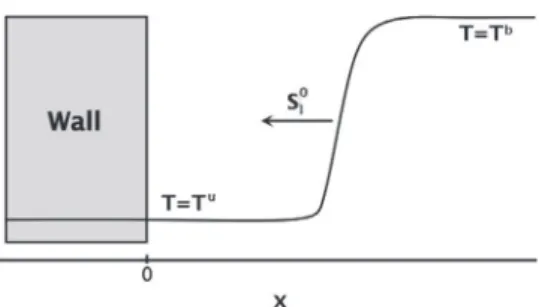
As shown in Fig. 1 , the chosen configuration corresponds to
head-on quenching (HOQ), where the flame propagates towards
the wall with the characteristics of a free flame before
interact-ingwiththewall.Inthissimplifiedconfigurationin-depthanalysis
canbemadeandagoodunderstandingofbasicphenomenacanbe
achieved. TheHOQconfigurationappearsasanecessaryfirststep
Fig. 1. Flame–wall interaction (FWI): head-on quenching (HOQ) configuration. Ini- tial wall temperature T i
w is set equal to fresh gas temperature T u .
tostudyboth effectsofhighpressureandconjugateheat transfer
priortothethermalstudyofrealisticconfigurations.
2. Numericalsetupandmethodology
Simulationswereperformedbyrunningsimultaneouslyafluid
(AVBP) and a thermal (AVTP) solver in a coupled framework.
Forcomparisonpurposes,uncoupled simulationswithan
isother-mal wall were also computed. In AVBP, the compressible
re-active Navier–Stokes equations are solved with a third order
in space and fourth order in time, two-steps Taylor–Galerkin
scheme [14,15] along with a second order Galerkin scheme for
diffusion terms.The parallel conductionsolver AVTP is based on
thesame datastructure thanAVBP andalsouses a second order
Galerkindiffusion scheme. Timeintegration is done with an
im-plicitfirst orderforward Eulerscheme.The resolutionofthe
im-plicitsystemisdonewithaparallelmatrixfreeconjugategradient
method.
Thecouplingmethodologyconsistsinan exchangeofvariables
at the wall surface between both codes: the fluid solver sends
a heat flux and the heat conduction code sends back a
temper-ature. Data are exchanged through a supervisor using OpenPalm
libraries [16] . Between two coupling events, the flow and wall
thermalconductionare advancedintime by aquantity
α
fτ
f andα
wτ
w respectively, whereτ
f andτ
w are the flow andheatcon-duction characteristictimes.To respect simultaneity,the physical
timecomputedbythecodesmustbethesamebetweentwodata
exchanges:
α
fτ
f =α
wτ
w .Thisensures continuityoftheheatfluxandtemperatureatthewallsurface.Moredetailsandvalidationof
thecouplingmethodologycanbefoundin[17] .
Computationswererun onuniformgrids,ofsimilargrid
spac-ing(seeTable 4 ),inboththefluidandthesolid.Theywere
initial-ized witha free stationarypremixed flame previously calculated
underthesamethermodynamic conditions(pressure and
temper-ature),andlocatedfarenoughfromthewalltoassumeno
interac-tionatthestartofthesimulation.Forthesamereasontheinitial
walltemperature T w i wastakenequaltothefreshgastemperature
T u . The fluid boundary condition at the open endis a
pressure-imposedoutlet,usingthecharacteristicformulationfor
compress-ibleflow[18] .Thetemperatureisimposedattheleftsolid bound-arytotheinitialwalltemperature T w i .Thesolidissufficientlylong
toensurethatthisboundaryconditiondoesnotinfluenceFWI.
3. Chemicalkinetics
Computationswerecarriedoutwitha purehydrogen(H2)and
pureoxygen(O2)mixtureatstoichiometry.Thecombustionof
hy-drogen and oxygen is modeled using a skeletal mechanism
ac-countingfor8speciesand12reactionsfromBoivinetal.[19] ,
re-portedinTable 1 .Itisderivedfromthe21-stepSanDiegodetailed
mechanism[20] ,usedinmanyhydrogencombustionapplications.
Fig. 2. 1D flame profiles of (a) temperature T , (b) heat release rate Q , (c) HO 2 and (d) H mass fractions for (–) San Diego [20] and (- -) Boivin [19] mechanisms. Case 2a:
pressure is 1 bar and fresh gas temperature 300 K.
Table 1
Rate coefficients in Arrhenius form k = AT n exp (
−E/R 0 T ) as in [19] . Reaction Aa n Ea R1 H + O 2 ⇌ OH + O kf 3.52 10 16 −0 .7 71 .42 kb 7.04 10 13 −0 .26 0 .60 R2 H 2 + O ⇌ OH + H kf 5.06 10 4 2 .67 26 .32 kb 3.03 10 4 2 .63 20 .23 R3 H 2 + OH ⇌ H 2 O + H kf 1.17 10 9 1 .3 15 .21 kb 1.28 10 10 1 .19 78 .25 R4 H + O 2 + M → HO 2 + M b k0 5.75 10 19 −1 .4 0 .0 k∞ 4.65 10 12 0 .44 0 .0 R5 HO 2 + H → 2 OH 7.08 10 13 0 .0 1 .23 R6 HO 2 + OH ⇌ H 2 + O 2 kf 1.66 10 13 0 .0 3 .44 kb 2.69 10 12 0 .36 231 .86 R7 HO 2 + OH → H 2 O + O 2 2.89 10 13 0 .0 −2 .08 R8 H + OH + M ⇌ H 2 O + M c kf 4.00 10 22 −2 .0 0 .0 kb 1.03 10 23 −1 .75 496 .14 R9 2 H + M ⇌ H 2 + M c kf 1.30 10 18 −1 .0 0 .0 kb 3.04 10 17 −0 .65 433 .09 R10 2 HO 2 → H 2 O 2 + O 2 3.02 10 12 0 .0 5 .8 R11 HO 2 + H 2 → H 2 O 2 + H 1.62 10 11 0 .61 100 .14 R12 H 2 O 2 + M → 2 OH + M d k0 8.15 10 23 −1 .9 207 .62 k∞ 2.62 10 19 −1 .39 214 .74 a Units are mol, s, cm 3 , kJ and K.
b Chaperon efficiencies H
2 : 2.5, H 2 O: 16.0, 1.0 for all other species. Troe falloff
with F c = 0 . 5 .
c Chaperon efficiencies H
2 : 2.5, H 2 O: 12.0, 1.0 for all other species. d Chaperon efficiencies H
2 : 2.5, H 2 O: 6.0, 1.0 for all other species. Troe falloff
with F c = 0 . 265 exp (−T / 94) + 0 . 735 exp (−T / 1756) + exp (−T / 5182) .
predictpremixedflamespeed,autoignitiondelay,burntgases
tem-peratureandextinctionlimitsundermanyconditionsofpressure,
temperatureandcomposition[21] andisconsideredasareference.
InordertovalidateBoivin’sschemeinthethermodynamic
condi-tionsofinterest,i.e.,freshgasat150K,300Kand750Kand
pres-sure up to 100 bar, premixed flames have been computedusing
CANTERA[22] andcomparedwiththedetailedmechanism.Results
are shown here forflames corresponding to Cases 2a and 2c of
Table 3 .Thestoichiometriclaminarflamespeedsobtainedwiththe Boivin scheme(10.76ms−1 and9.03ms−1, respectively)are very
close to the values computed with the reference scheme of San
Diego (10.61ms−1 and9.46ms−1, respectively). Theflame
struc-tures shownin Figs. 2 and 3 demonstratethat both mechanisms
are inverygoodagreementintermsoftemperature,heat release
rate, andspecies(includingradicals)massfractionprofiles,atlow
andhighpressure.Inparticular,thegoodpredictionofspecieslike
HO2 is criticalforFWI,aswillbe seenlater. Similar resultswere
obtainedfortheothercasesconditions.
4. Real-gasequations
For high pressure computations, real-gas thermodynamics
are accounted for through the Peng–Robinson equation of
state [23] (PR-EOS).Thegeneralformofacubicequation ofstate
isgivenby:
P
(
v
,T)
= RTv
− b−a
(
T)
(
v
+δ
1b)(
v
+δ
2b)
(1)where P is the pressure, T the temperature, v the molar
vol-ume and R theperfect-gasconstant. The coefficients a and b
ac-count respectivelyforlong-rangeandshort-rangeinteractions
be-tween molecules.In the Peng–Robinson equation the parameters
(
δ
1,δ
2)are(
1+√2,1−√2)
.Allthermodynamiccoefficientsmustbemodifiedtotakeintoaccountrealgaseffects.Atlowpressure,a
standard technique consistsintabulatingorusingpolynomial fits
Fig. 3. 1D flame profiles of (a) temperature T , (b) heat release rate Q , (c) HO 2 and (d) H mass fractions for (–) San Diego [20] and (- -) Boivin [19] mechanisms. Case 2c:
pressure is 100 bar and fresh gas temperature 300 K.
Table 2
Species critical-point temperature T c and pressure P c , and Schmidt numbers.
Parameters H 2 O 2 H 2 O O H OH H 2 O 2 HO 2 Tc [K] 33 154 .6 647 .1 105 .3 190 .8 105 .3 141 .3 141 .3
Pc [bar] 12 .6 49 .7 217 .7 70 .0 306 .0 70 .0 47 .3 47 .3
Sc 0 .28 0 .99 0 .77 0 .64 0 .17 0 .65 0 .65 0 .65
extended toaccountforpressuredependencebykeepingthe
tab-ulation forlow pressurereferencevaluesandusedeparture
func-tions basedontheEOStocomputetheinfluenceofpressure[24] .
For example to calculate the constant-pressure heat capacity C p ,
onestartstowritetheGibbsfunctionGas:
G
(
P,T)
=G0+Pv
− RT+Z v0 v
P
(
v
¯,T)
dv
¯ (2)where v 0 and G 0arerespectivelythemolarvolumeandtheGibbs
energyatareference low pressure.Theenthalpy h isthen
classi-callydefinedas:
h=G− T
µ ∂
∂
GT
P
(3)
aswellastheconstant-pressureheatcapacity:
Cp =
µ ∂
∂
Th
P
(4)
Thispointsoutthatlow-pressuredata,combinedwiththePR-EOS,
allowtocomputeallthermodynamicpropertiesofthefluidathigh
pressure.
The viscosity and thermal conductivity are modeled
follow-ing the method of Chung [25] , based on the theory of
corre-sponding states, linking low- and high-pressure values through
semi-empirical functions expressedin reduced variables T /T c and
P /P c .The low-pressure (ideal gas) reference values are computed
from the Chapman–Enskog equation. Species diffusion velocities
are expressed as functions of the species gradients using the
Hirschfelder–Curtisapproximation andconstant Schmidtnumbers
S c .Itwasindeedverifiedwithdetailedcalculationsusingthe
soft-ware CANTERA [22] , that in the considered cases the Schmidt
numbersofmostspeciesdonot stronglyvarythrough theflame,
andtake thevaluesreportedinTable 2 .Soret andDufoureffects
arenotincluded.
The criticalpoint coordinates of theintermediate speciesOH,
O, H, H2O2, HO2 (for which no experimental values are
avail-able)are estimatedasin[26] ,usingtheLennard–Jones
potential-welldepth,andthemolecular diameter,takenfromthetransport
databaseoftheSanDiegomechanism[20] .
The ability of the AVBP solver to accurately reproduce
super-criticalandtranscriticalflows andflames hasbeen demonstrated
invarious configurationscorresponding toLRE conditions[27,28] .
Notethatreal-gasthermodynamicsalsohaveanimpactonthe
for-mulationofboundaryconditionsandJacobianmatricesofthe
nu-mericalschemes.
5. Flamewallinteraction(FWI)
Flame–wallinteractionisfirstcharacterizedwiththewallheat
8
w =λ
w∂
∂
Tx¯
¯
¯
¯
w (5)where
λ
w isthethermalconductivityofthefluidevaluatedatthewall.Thewallheatfluxisstronlgylinkedtotheflame
characteris-tics:thethermalflamethickness
δ
l iscalculatedfromthetemper-aturegradient:
δ
l = Tb − Tu
(
∇
T)
max (6)where(
∇
T )max isthemaximumofthetemperaturegradient.Thisflamethicknessmaybealsoestimatedfromtheflameparameters
usingthediffusiveflamethickness
δ
[7] givenby:δ
=λ
u
ρ
u Cu p Sl 0(7) where S l 0isthelaminarflamespeed.Thelaminarflamepower Q l 0
isdefinedas:
Ql 0=
ρ
u YF u S0l1
H (8)where Y F u is the fuel mass fraction in unburnt gases and
1
H[Jkg−1]theheatproducedperkilogramoffuelconsumed.The wallheatflux isnon-dimensionalizedby theflamepower
as
8
∗w =
8
w /Q 0l ,whereasthenon-dimensionalflameheatrelease
rateis Q ∗=Q
δ
/Q 0l .Inaddition,the flamecharacteristictime
τ
=δ
/S 0l is used to non-dimensionalize the time as t ∗=t/
τ
, whilespacedimensionsarenon-dimensionalizedby theflamethickness
as x ∗= x/
δ
.Becauseofcomplexchemistry,thedefinitionoftheflame
posi-tionisnotunique.Itcanbeeitherlocatedatthemaximumofheat
releaserate Q max (x Q max) oratthemaximumoffuel consumption
rate
ω
˙F,max (x ω˙F,max).BothlocationsaredifferentandmaybeusedtodefinePecletnumberswhichcharacterizetheratiobetween
dif-fusionandconvectivecharacteristictimes:
• theheatreleasePecletnumberis
Pe=xQ max
δ
(9)• thefuelPecletnumberis
PeF =xω˙F,max
δ
(10)Assumingthat noreactionoccursatthewall,thetemperature
difference T b − Tu divided by the flamequenching distancegives
anestimateofthewalltemperaturegradient.Asshownin[5] ,this
leads to a simplerelationship betweenthe non-dimensional wall
heat flux andthePecletnumber(either fromthe heatreleaseor
fuelconsumption)
8
∗w ∼ 1/Pe or,takingintoaccountthewallheat loss:
8
∗w ∼ 1/
(
1+Pe)
(11)Theoretical model: the infinitely fast flame model
Theroleandimportanceofthecouplingbetweenthesolidand
thefluidthermalproblemsmaybeunderstoodfromthelimitcase
ofinfinitelyfastflame[17] (IFF),inwhichthecharacteristicflame
time scaleisnegligiblecomparedtothesolidconductiontime.In
thiscasetheconfigurationreducestothesimplerproblemoftwo
semi-infinite domains having different temperatures and a
com-mon contact surface. Solving this classical heat transfer problem
leadstothefollowingexpressionfortheinterfacetemperature:
Tw IF F =ew eTw +ef Tf
w +ef (12)
where T w (T f )isthesolid(resp.fluid)temperature,and e w (e f )the solid(resp.fluid)effusivitydefinedby
e=
p
λρ
Cp (13)Table 3
Summary of test cases: fresh gases properties at stoichiometry and compressibility factor calculated using NIST software REFPROP [30] . Case Tu Pressure ρu Compressibility factor
[K] [bar] [kg m −3 ] [Dimensionless] 1 750 1 0.1931 1.0 0 0 2a 1 0.4824 1.0 0 0 2b 300 10 4.8476 0.995 2c 100 48.342 0.998 3 150 100 108.75 0.887
where
λ
isthe heat conductivity,ρ
the density and C p the heatcapacityofthesolid(w )orthefluid(f ).
Introducing the effusivity ratio parameter
κ
=e w /e f ,Eq. (12) canbewritten Tw IF F =
κ
Tκ
w +Tf+1 (14)
Eq. (14) showsthat theinterfacetemperaturedependsonthe
pa-rameter
κ
: for large values of this ratio, the temperature atthesolid/fluid interface stays close to the wall temperature and the
wall may be considered isothermal; on the contrary, low values
of
κ
allow significant heating of the wall which is then neitherisothermal nor adiabatic. In this last case the resolution of the
unsteady coupledproblemisnecessarytoobtain thecorrectwall
heatflux.
6. Casesdescription
Several FWI cases for laminarstoichiometric premixed flames
were performedandaresummarizedinTable 3 .Forallcases,the
initial wall temperature T w i andthe freshgas temperature T u are
takenthesameandnon-coupled,isothermalsimulations(denoted
U ) are compared to fluid-thermal solid coupled simulations
(de-noted C ).Case 1is presentedforvalidation purposesandwill be
compared toprevious studies [7,10,12] .Cases 2a,2band2callow
to evaluate the influenceof thepressure on FWI andextendthe
results tovery highpressure.FinallyCase 3corresponds to
cryo-genic flames typical of LREs operatingconditions, with very low
freshgastemperature.
Thefirsteffectofpressureincreaseisthereductionoftheflame
thickness,whichmaybeapproximatedbyapowerlaw:
δ
l(
P)
=δ
l(
P0)
³
PP0
´
α(15)
where P 0 is a reference pressure and
α
dependson thetemper-ature andthefuel.Inthe caseofstoichiometrichydrogen/oxygen
mixtureat300K
α
∼ −1.21[29] wasfound,whichmeansthatthethermalflamethicknessdecreaseswithpressure.Thisaprioriwill
have a strong impact on FWI, withan expectedincrease of wall
heatfluxwithpressure.
As shown inTable 3 ,the freshgasdensity
ρ
u increasesdras-ticallywithincreasingpressureanddecreasingtemperature,upto
200 times(Case 3) higherthanthe reference Case2a atambient
conditions.Lookingatthecompressibilityfactor,givenby:
Z=
ρ
PrT (16)where r isthe specific gasconstant,the deviationfromthe ideal
gas lawstays closeto1aslongasthetemperatureremains
rela-tivelyhigh.Forthesecasesnostrongrealgaseffectsareexpected.
Withthedecreaseofthefreshgastemperature, Case3leadstoa
compressibility factor of0.887, i.e. presentingsignificant realgas
Case Tu P Tb− T u S 0
l δl δ Ql0 Mesh cell size [K] [bar] [K] [m s −1 ] [m] [m] [W m −2 ] [m]
1 750 1 2380 34.27 2.59e −4 1.07e −5 8.66e7 2.0e −6 2a 1 2770 10.76 2.23e −4 6.96e −6 6.87e7 2.0e −6 2b 300 10 3090 12.49 1.21e −5 5.85e −7 8.22e8 2.0e −7 2c 100 3430 9.03 1.18e −6 9.46e −8 6.25e9 1.0e −8 3 150 100 3544 3.96 1.23e −6 5.93e −8 5.47e9 1.0e −8
Table 5
Fluid and wall thermal effusivity, effusivity ratio κand interface temperature predicted by the IFF model T IF F
w . Thermal effusivity unit is [W m −2 K −1 s −1/2 ]. Case Ti
w Pressure Fluid effusivity e f Wall effusivity e w κ T IF Fw [K] [bar] [SI] [SI] [Dimensionless] [K]
1 750 1 6 .09 9280 1524 751.6
2a 1 4 .47 6186 1383 302
2b 300 10 13 .92 6186 4 4 4 307
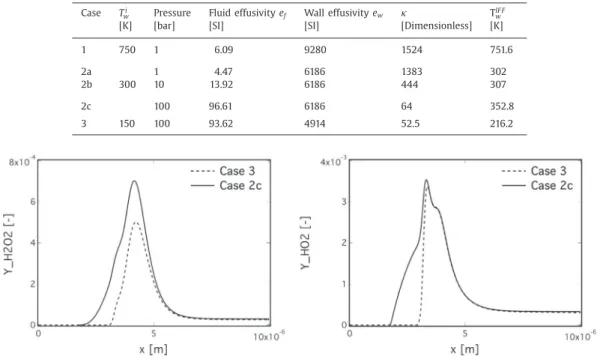
2c 100 96 .61 6186 64 352.8
3 150 100 93 .62 4914 52.5 216.2
Fig. 4. Comparison of H 2 O 2 (left) and HO 2 (right) profiles in free propagating flames between Case 2c (solid line) and Case 3 (dashed line).
Flameproperties,computedwiththeBoivinscheme,areshown
inTable 4 forthevariouscases,togetherwiththemeshresolution.
The temperature difference T b − Tu and flame thickness change
largely whenthepressure increases,from2770Kand223
µ
m forCase 2a to 3430K and1.18
µ
m for Case2c. The flame thicknesshasadirectconsequenceonthemeshcellsizethatischanged
ac-cordinglytoresolvetheflamefront.
The flame speed first increases with pressure, until ∼15bar,
where it reaches ∼12.5m s−1, before decreasing for higher
pres-sure, to reach ∼9.0m s−1. This non-monotonic behavior was
al-ready shownin[31] andisduetothechangeofchain-branching
tostraight-chainkinetics.Theflamespeedalsoincreaseswiththe
freshgas temperature T u ,whichhasa directeffecton the
chem-istrybutalsomodifiesthethermaldiffusivity D u th =
λ
u /ρ
u C p u .In-creasingthefreshgastemperatureatambientpressureleadstoa
strongincreaseoftheflamevelocityandmoderatechangeofburnt
gastemperatureandflamethickness(Case1).Finallythecryogenic
condition (Case 3)givesa hotbutslowflame.Its structureis
de-tailedbelow.
6.1. Cryogenic premixed flame
The cryogenic, supercritical flame (Case 3) exhibits a
particu-lar structure.When compared to Case 2c, thefirst impact ofthe
lowertemperature,amplifiedbytherealgasthermodynamics,isto
significantly increase thedensityinthe freshgas,from48kgm−3
(Case2c)to108kgm−3 (Case3),whiletheburntgastemperature
isonlyslightlylower.Theimportantdecreaseofthelaminarflame
speedis mostlyrelatedtothe decreaseofthe thermaldiffusivity
D u th ,from9.2610−7m2s−1inCase2cto2.2310−7m2s−1inCase3,
associatedto supercriticaltransport properties.The most
remark-ablefeatureofCase3isthechangeofthechemicalstructureinthe
inductionzoneaheadoftheflame.Figure 4 showsHO2 andH2O2
massfraction profilesfor Cases2c and3.As alreadyobserved in
manystudies[6,7,12] ,premixedflamesarecharacterizedby
chem-ical reactions occurring in the induction zone between reactants
and radical species that diffuse from the main reaction zone. In
thecaseofH2/O2flames,thesereactionsleadtotheformationof
HO2 andH2O2intheinductionzone.InCase3,realgastransport
strongly limits radical diffusion, so that even zero-activation,
re-combinationreactionssuchasR4,R8orR9ofTable 1 cannotoccur.
As aconsequence,radical speciesdo notappear inthe induction
zoneinCase3,asclearlyvisibleinFig. 4 .Cryogenic,supercritical
flamesthereforehavenoreactiveinductionzoneandallreactions
start simultaneously when thetemperature reachesa sufficiently
highvalue. Thiswillhavedirect consequenceson theflame–wall
interactionfortheseflames.
Table 5 summarizesthe fluid andwall effusivities for all test
cases.Bothquantitiesincrease withtemperature, but e f increases
evenmorestronglywithpressure.Theresultinginterface
temper-atures predicted by the IFF model, where the wall temperature
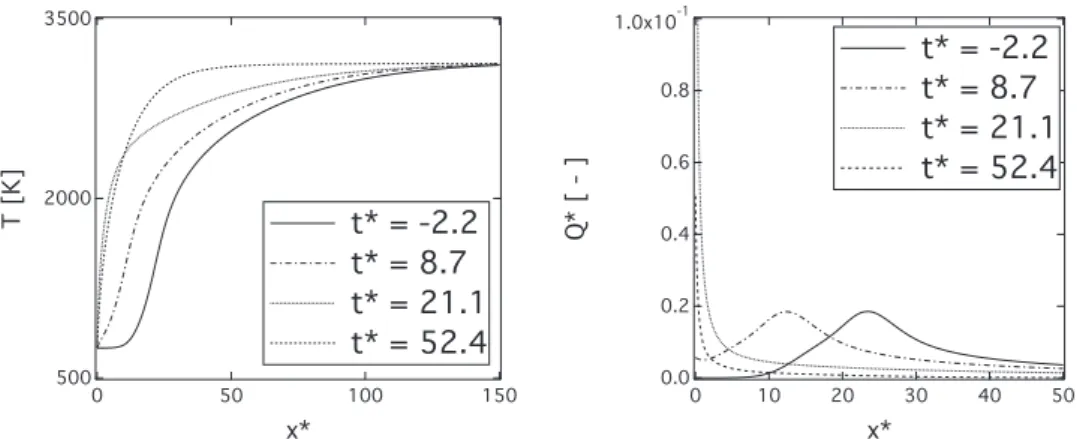
Fig. 5. Profiles of temperature (left) and dimensionless heat release rate (right) at various instants of FWI. Maximum non-dimensional heat release rate is 0.352. Case 1, coupled.
Fig. 6. Profiles of HO 2 (left) and H 2 O 2 (right) mass fractions at various instants of FWI. Case 1, coupled.
fluid temperature has been taken to the burnt gas temperature
T b , stays close to the initial interface temperature for high
val-ues of
κ
, in Cases 1 and 2a. As the fluid thermal effusivityin-creases from Cases 2a to 2c, the ratio
κ
decreases and the finalwalltemperaturemovesawayfromtheinitialtemperature.Finally
Cases 2cand 3,withlow
κ
, show a significantwall temperatureincrease.
7. Resultsanddiscussion
7.1. Validation case 1
Case1isfirstpresentedforvalidationpurposes,asitiscloseto
theisothermalwallcasestudiedinpreviouspublications[7,10,12] .
Indeed in this case the high effusivity ratio
κ
=1524 leads to atheoretical wall temperature T w IF F =751.6K,very closetothe
ini-tial wall temperature, so that the isothermal wall assumption is
fullyvalid,andnostrongdifferenceswiththecoupledsolutionare
expected. Figure 5 (left)showsthetemperatureprofilesatseveral
instants,illustratingthetime-dependencyofFWIandthe
quench-ingprocess.Toallowcomparisonbetweencases,timeissetto0at
thestartofFWI,i.e.,whenthewallheatfluxstartstoincrease.As
a consequencetheflame firstpropagates freely towardsthe wall,
keepingafree flamestructure until t ∗ ∼ 0.Then theflame starts
to interactwith the wall, and becomes thinner while
approach-ing thewall until t ∗ ∼ 20. Atthis time,there isno sufficient
re-mainingfuelinthecoldgasandtheflamequenches.Inthesame
time, a transient process occurs fromthe start of FWI, where a
verylargeincreaseoftheheatreleaserateatthewallisobserved
(Fig. 5 (right)).Thisislinkedtoachangeofthechemicalbehavior
oftheinductionzonewhenapproachingthewall.Infreely
propa-gating flames,preliminarydecompositionofthefueloccursinthe
inductionzonethroughhigh-energy-activationreactionswith
rad-icals suchas R 2and R 3(Table 1 ).DuringFWI,thetemperaturein
the induction zone decreases down to the wall temperature and
these reactions get frozen, leading to a longer persistence of O2
than H2 near thewall. At the same time, andfor the same
rea-son, zero-activation-energy, exothermic,radical recombination
re-actions suchas R 4and R 8becomedominant, andlead tothe
ob-servedpeakofheatreleaserateandproductionrateofHO2(Fig. 6
(left)).Hence,throughthelow-activation-energy,propagation
reac-tion R 10hydrogenperoxide(H2O2)isalsoproduced(Fig. 6 (right)).
All thesechemicalmechanisms werealreadyobservedin
isother-malFWI[7,10,12] .Byincreasingthewalltemperaturegradient,this
strongpeakofheatreleaseatthewallhasadirectimpactonthe
wall heat flux. Inaddition, it leads to a zero quenching distance
which can thereforenot be used to evaluate the heat flux as in
Eq. (11) .
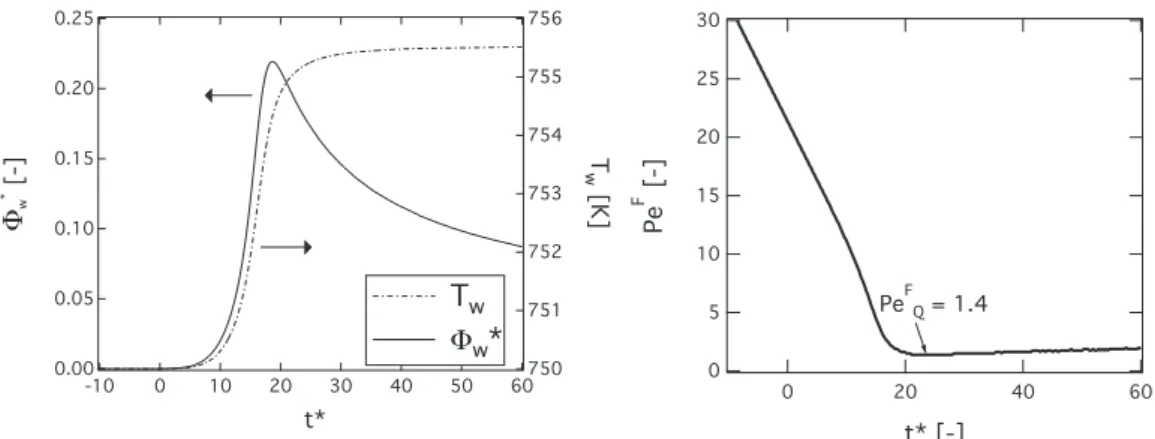
Figure 7 (left) showsthe time evolution ofthe wall heat flux
and walltemperature duringFWI.The wall temperature
progres-sively increasesto avalueof755.5K,i.e.,slightlyhigherthan the
IFF model value of 751.6K. The maximum wall heat flux is
ob-tained when theflame quenchesat t ∗ ∼ 18,andreaches
8
w,Q =18.9MW m−2 (
8
∗w,Q =0.218).Afterflamequenching,thewallheat
fluxexperiencesfirstafastdecrease,thenamuchslowerdecrease
(∝1/√t ∗) corresponding to theheat diffusion inthe fluid andin
the solid.DuringFWI,theflamepropagates towardthewalluntil
the remaining fuel is toolow to sustain the flame and
compen-sate for thewall heat loss. Thefuel quenchingdistance is
there-foremainlycontrolled bytheflamepowerandthewall
tempera-ture. Inthe present case, thefuel Peclet numberatquenchingis
Fig. 7. Temporal evolution of (left) wall heat flux and wall temperature and (right) fuel Peclet number. Case 1, coupled.
Fig. 8. Time evolution of temperature profiles in the solid wall T S . Case 1, coupled.
evolution of the fuel Peclet number during FWI. Both the
non-dimensionalfluxandthequenchingfuelPecletnumberaresmaller
than usualvaluesobtainedinFWI(∼ 0.3and∼ 3.0respectively)
andmaybeexplainedbythehighwalltemperature.Thedecrease
of themaximumwall heat fluxwithincreasing wall temperature
was alsodescribed in[3] .Thismaybe enhancedby thehigh
dif-fusivityofH2 andthehighheatreleaseatthewallduetoradical
recombinationasalreadymentioned.Thistrendandthevaluesof
the wallheat fluxandquenchingdistanceobtainedinCase1are
ingoodagreementwiththeresultsof[7,12] or[10] wherea
max-imumwallheatflux∼18MWm−2 wasfoundforthesamecase.
Finally,Fig. 8 showsthetemporalevolutionofthetemperature
inthesolid wall.Onecanobservethat thecouplingmethodology
is able to transfer the heat flux to the wall, whichthen diffuses
inthesolid.Notethattheheatpenetrationismuchslowerinthe
solid than inthe fluid, which isconsistent with thehigher solid
effusivity.
7.2. Effect of pressure
InthissectiontheeffectofpressureonFWIisinvestigatedwith
Cases2a(1bar)to2c(100bar).AlthoughCase2cisathigh
pres-sure,therelativelyhightemperatureleadstoacompressibility
fac-torcloseto1andnorealgaseffectsareexpectedhere.Fromthe
above IFFanalysis, resultsareexpectedtobecomparabletothose
obtainedinFWI withan isothermalwall forCases 2aand2b.
In-deed,theIFFinterfacetemperaturedoesnotexceedtheinitialwall
temperature by more than 2K and 7K, respectively. In Case 2c
however, theburnt gaseffusivity e f =96.6Wm−2K−1s−1/2 being
much higher,the predictedinterface temperatureincreasesup to
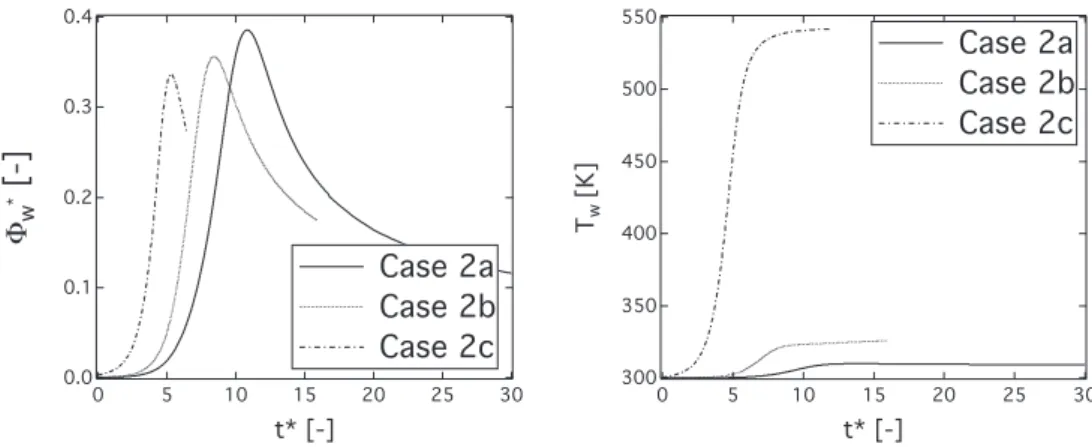
Fig. 9. Temporal evolution of the non-dimensional maximum heat release at the wall for Cases 2a, 2b and 2c, coupled. For all cases, time is set to 0 at the start of FWI.
T w IF F =352Kandthecoupledsimulationisexpectedtogive
signif-icantlydifferentresultsfromthecorrespondingisothermalFWI.
Overall, similar trends as in the validation caseare observed,
withaheatreleasepeakandproductionofH2O2 andHO2radicals
occurringatthe wall duringthe FWI.However, asthe wall
tem-peratureissmaller,theeffectissignificantlyamplifiedin
compari-sontoCase1.Indeedthenon-dimensionalmaximumheatrelease,
showninFig. 9 isabout2ordersofmagnitudelargerduringFWI
thaninthe freeflame inCase2a,whereas itwas onlyone order
ofmagnitude larger inCase 1 (Fig. 5 (right)).The effectis
how-everdecreasingwithpressure,comingbackinCase2ctothesame
orderofmagnitudethaninCase1.
Figure 10 showsthetemporalevolutionofthenon-dimensional
heat flux and the temperature at the wall for the three cases.
Duetofasterchemistryandsmallerflamethickness, FWIisfaster
athighpressure. The maximum wall heat flux isobtained when
flame quenches at t ∗ ∼ 11, t ∗ ∼ 8 and t ∗ ∼ 5 for Cases 2a, 2b
and 2c respectively, and slightly decreases with pressure, from
8
∗w,Q =0.388forCase2ato
8
∗w,Q =0.333forCase2c,consistentlywiththe lower wall heat release effectat highpressure. Overall,
themaximumwallheatfluxislittlesensitivetopressureandstays
inthe range0.3–0.4,i.e., similar tohydrocarbonflames withlow
wall temperatures [4,32,33] . Note however that the dimensional
wallheatflux increaseswithpressure,from
8
w,Q =26.4MWm−2forCase 2ato
8
w,Q =2.09GWm−2 for Case2c, i.e., reachingex-tremelyhighvalues.
AsexpectedfromtheIFFmodel,theinterface temperature
in-creasesonlyslightlyatlowpressure(Cases2aand2b),butreaches
Fig. 10. Temporal evolution of non-dimensional wall heat flux (left) and wall temperature (right). Cases 2a, 2b, 2c, coupled.
Fig. 11. Time evolution of wall heat flux difference 18w = 8Uw −8Cw between isothermal wall condition and coupled computation. Case 2c. 8C
w = 2 . 09 e 9 W m −2 .
that the increase is always stronger than predicted by the IFF
model. This difference is dueto the strong heat release, both in
theflameandatthewall,duringFWIinthe coupledsimulations
andwhichisnottakenintoaccountintheIFFmodel.Thismakes
theheatfluxstrongerandincreasestheinterfacetemperature.This
justifies a posteriori the use of fully coupled simulations for the
predictionofheattransfer.
The interface temperatureincreasealso explainsthewall heat
flux decreasewithpressure.Figure 11 showstheevolutionofthe
difference betweenthe wall heat flux obtainedin the uncoupled
(calculated withan isothermal wall condition at T w =300K)
8
U wandthecoupledcomputation
8
C w ofCase2c.Themaximumdiffer-enceisobservedjustbeforequenching,wheretheisothermalwall
assumption leads to an overestimationof the maximal wall heat
fluxby 200MWm−2,i.e., approximately10% ofthewall heatflux
inthecoupledcase,whichissignificantforthethermalfatigueof
solid materials. Thiscorresponds toa non-dimensional wall heat
fluxof
8
U∗w,Q =0.352,i.e.,closertothelowpressurecasesthanthe
coupledcase.
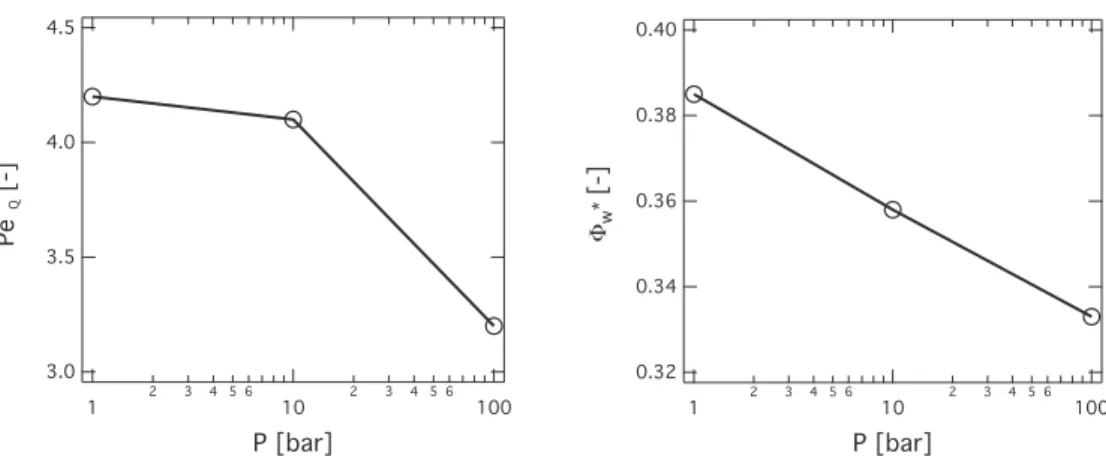
Figure 12 (left) shows the fuel Peclet number obtained at quenchingforthethreecases.Thequenchingdistanceof Pe F Q =4.1
forCase 2a islarger than forCase 1dueto the lower wall
tem-perature. It is slightly larger than the value of ∼ 3 typically
ob-served inpreviousnumericalandexperimentalstudiesfor
hydro-carbonsfuels[4,32,33] ,whichmaybeduetothehighdiffusivityof
H2. When pressureincreases,the quenchingdistance slightly
de-creases, down to Pe F Q =3.2 forCase 2c, still stayingin the range 3− 4.The slightdecrease of Pe F Q withpressure maybe again
at-tributed to the increase of the interface temperature which
al-lows fuel oxidation reactions to occur closer to the wall. As
al-ready mentioned, the non-dimensional maximum wall heat flux,
also reportedin Fig. 12 (right), decreases withpressure. This
be-haviorwasalreadyobservedinotherstudies[5,34] forlower
pres-sureranges(0.5–3.5bar)andisconfirmedhereforhigherpressure
levelsandconjugateheattransfer.Thisalsodemonstratesthat,
al-though thesimpleexpressionEq. (11) stillholdsintermsoforder
ofmagnitude,itisnotabletodescribeacomplexbehaviorsuchas
the simultaneous decreaseofboth
8
∗w,Q and Pe F Q withincreasing
pressure. Thisindeedistheresultofchemical phenomena
occur-ingatthewallandcannotbepredictedfromfreeflameparameters
suchastheflamethickness
δ
l .7.3. Supercritical case
This section presentsthe resultsobtainedforthe supercritical
case (Case 3)where thefreshgas temperaturehasbeen lowered
downto T u =150K.Thecompressibilityfactorinthatcaseis0.887
meaning that real gas effects have to be taken into account. As
shown inTable 5 , theeffusivity ofthe burntgas islarge insuch
thermodynamic conditions,thus requiring the fluid/solidthermal
coupling tosimulatethe transientFWI andpredictthe final wall
temperature. FWIwithanisothermalwallat150Kleads tostrong
watercondensationwhenthecombustionproductsreachthewall,
so that direct comparison of coupled or uncoupled cases is not
possibleinthiscase.
Figure 13 (left)reportsthetemperatureprofilesduringFWI.The
overall process is similar toall previous casesandis comparable
to Case2c,alsoathighpressure.AsinCase2c, theinteractionis
quite fast,with quenching occurring at t ∗ ∼ 8, andheat release
peakonthewallisstillobserved(Fig. 13 (right)).Howeveraswas
observedinthecryogenicfreeflame,theinductionzoneisfrozen
due tothe low temperatureanddoesnot interactwith thewall.
Neither H2O2 orHO2 arepresentoutsidetheflamezoneandthey
start to build on thewall only whenthe flamereaches thewall.
Compared to Case 2c, the increase of heat release atthe wall is
delayedandstartsshortlybefore quenching.Asa result,although
theincreaseiscomparabletoCase2c,its impactonthewallheat
fluxisreduced.
In supercritical conditions, the fluid properties differ largely
fromtheperfectgas,withathermaldiffusivitydividedby4when
compared toCase2c. (Case2c:
λ
u /ρ
u C p u =9.2610−7m2s−1 andCase 3 :
λ
u /ρ
u C u p =2.2310−7m2s−1). This, combined with theFig. 12. Effect of pressure on the quenching fuel Peclet number Pe F
Q ( ◦) (left) and on the dimensionless maximum wall heat flux 8∗w,Q ( ◦) (right) for Cases 2a,b,c, coupled simulations.
Fig. 13. Profiles of temperature at various instants of FWI (left) and time evolution of the maximum heat release at the wall (right). Case 3, coupled.
Fig. 14. Temporal evolution of wall heat flux and wall temperature. Case 3, coupled.
corresponding to Pe F Q =6.0.As a consequence,the wall
tempera-tureincreasesslowly,remaininglowduringthequenchingprocess
and still increasing after the flamehas extinguished (Fig. 14 ). As
theheatreleaseatthewallstayszeroforalongtimeandstartsto
increasejustbeforequenching,itdoesnotcontributemuchtothe
wall temperatureincrease which stays closeto the predictedIFF
temperature(T w IF F =216.2K).Thenon-dimensionalmaximumwall heat fluxreachesavalue of0.36(
8
w,Q =1.97GWm−2), i.e.,staysin therange0.3–0.4, mainlythanks to thelarge temperature
dif-ference T b − Tu .Inthiscase,Eq. (11) doesnotholdanymore. This
againdemonstratesthatthequenchingdistanceandthemaximum
wall heatflux arenot directlylinked butstrongly dependon the
interfacetemperature,requiringtheuseofcoupledsimulations.
8. Conclusions
The interaction between premixed flames and non-adiabatic
wallshasbeeninvestigatedinaconjugateheattransferapproach,
where the fluid and the solid wall are thermally coupled. To
be representative of liquid rocket engines, stoichiometric H2–O2
mixtures in ambient andcryogenic (low temperature, high
pres-sure)conditionshavebeenconsidered.Aunique framework,
cou-pling both fluid and heat transfer solvers, was used in order to
take into account the wall heating transient phenomena. It was
demonstratedthatiftheeffusivityoftheburntgasbecomes
non-negligible comparedto that of the solid, theisothermal
assump-tiondoesnotholdanymore.Itwasfoundthatthissituationmainly
occurs at high pressure, requiring the use of fluid–solid
ther-mal coupling. When pressure increases, the more powerful and
much thinner flame leads to important quenching distance
de-crease and maximum wall heat flux increase by two orders of
magnitude compared to atmospheric conditions. However, when
non-dimensionalized with the flame thickness and flame power,
both quantities become almost insensitive to pressure and take
typicalvaluesalreadyobservedinhydrocarbonflames.Still,the
in-creaseofwalltemperatureduetoconjugateheattransfer,andthe
heatreleaseatthewallduetoradicalrecombination,are
responsi-bleforaslightdecreaseofthequenchingdistanceandmaximum
wall heat flux when pressure increases.Finally, low-temperature,
high-pressurecryogenicconditionswhichleadtosupercriticalfluid
largequenchingdistance.Howeverthenon-dimensionalmaximum
wallheatfluxstays comparabletothepreviouscases.Inthiscase
also,significant impactofthe conjugateheattransfer isobserved
and requires fluid–solid thermal coupling to describe accurately
thewall temperatureandtheflamebehavior. Thesefindingsmay
haveimportantimplicationsforflamestabilizationandthermal
fa-tigue in practical systems such as liquid rocket engine injectors.
The demonstrated feasibility and relevance of thermally coupled
fluid–solidsimulationsallowstoremovetheuncertaintyaboutthe
wallthermalconditionsandimprovethepredictionanddesignof
optimumburnergeometries.
Supplementarymaterial
Supplementary material associated with this article can be
found, in the online version, at 10.1016/j.combustflame.2016.01.
004 .
References
[1] G. Bruneaux , T. Poinsot , J.H. Ferziger , Premixed flame–wall interaction in a tur- bulent channel flow: budget for the flame surface density evolution equation and modelling, J. Fluid Mech. 349 (1997) 191–219 .
[2] T. Poinsot , D. Haworth , G. Bruneaux , Direct simulation and modelling of flame–wall interaction for premixed turbulent combustion, Combust. Flame 95 (1/2) (1993) 118–133 .
[3] O.A. Ezekoye , R. Greif , D. Lee , Increased surface temperatureeffects on wall heat transfer during unsteady flame quenching, Symp. (Int.) Combust. 24 (1) (1992) 1465–1472 .
[4] J.H. Lu , O. Ezekoye , R. Greif , F. Sawyer , Unsteady heat transfer during side wall quenching of a laminar flame, Symp. (Int.) Combust. 23 (1) (1990) 4 41–4 46 .
[5] B. Boust , J. Sotton , S. Labuda , M. Bellenoue , A thermal formulation for sin- gle-wall quenching of transient laminar flames, Combust. Flame 149 (3) (2007) 286–294 .
[6] C.K. Westbrook , A .A . Adamczyk , G.A . Lavoie , A numerical study of laminar flame wall quenching., Combust. Flame 40 (1981) 81–99 .
[7] F. Dabireau , B. Cuenot , O. Vermorel , T. Poinsot , Interaction of H 2 /O 2 flames with
inert walls, Combust. Flame 135 (1–2) (2003) 123–133 .
[8] A. Delataillade , F. Dabireau , B. Cuenot , T. Poinsot , Flame/wall interaction and maximum heat wall fluxes in diffusion burners, Proc. Combust. Inst. 29 (2002) 775–780 .
[9] P. Popp , M. Baum , An analysis of wall heat fluxes, reaction mechanisms and unburnt hydrocarbons during the head-on quenching of a laminar methane flame, Combust. Flame 108 (3) (1997) 327–348 .
[10] R. Owston , V. Magi , J. Abraham , Interactions of hydrogens flames with walls: influence of wall temperature, pressure, equivalence ratio and diluents, Int. J. Hydrogen Energy 32 (2007) 2094–2104 .
[11] T.K. Kim , D.H. Lee , S. Kwon , Effects of thermal and chemical surface–flame in- teraction on flame quenching, Combust. Flame 146 (2006) 19–28 .
[12] A. Gruber , R. Sankaran , E.R. Hawkes , J. Chen , Turbulent flame–wall interaction: a direct numerical simulation study, J. Fluid Mech. 658 (2010) 5–32 .
[13] F. Duchaine , A. Corpron , L. Pons , V. Moureau , F. Nicoud , T. Poinsot , Develop- ment and assessment of a coupled strategy for conjugate heat transfer with large eddy simulation: application to a cooled turbine blade, Int. J. Heat Fluid Flow 30 (6) (2009) 1129–1141 .
[14] L. Quartapelle , V. et Selmin , High-order Taylor-Galerkin methods for nonlinear multidimensional problems, Finite Elements in Fluids 76 (90) (1993) 46 .
[15] O. Colin , M. Rudgyard , Development of high-order Taylor–Galerkin schemes for LES, J. Comput. Phys. 162 (2) (20 0 0) 338–371 .
[16] S. Buis , A. Piacentini , D. Déclat , PALM: a computational framework for as- sembling high performance computing applications, Concurr. Comput. 18 (2) (2005) 231–245 .
[17] F. Duchaine , S. Mendez , F. Nicoud , A. Corpron , V. Moureau , T. Poinsot , Conju- gate heat transfer with large eddy simulation application to gas turbine com- ponents, Comptes Rendus Acad. Sci. Mécanique 337 (6-7) (2009) 550–561 .
[18] T. Poinsot , T. Echekki , M.G. Mungal , A study of the laminar flame tip and im- plications for premixed turbulent combustion, Combust. Sci. Technol. 81 (1-3) (1992) 45–73 .
[19] P. Boivin , C. Jiménez , A. Sanchez , F. Williams , An explicit reduced mechanism for H 2 –air combustion, Proc. Combust. Inst. 33 (1) (2011) 517–523 .
[20] P. Saxena , F. Williams , Testing a small detailed chemical-kinetic mechanism for the combustion of hydrogen and carbon monoxide., Combust. Flame 145 (2006) 316–323 .
[21] A . Sanchez , F.A . Williams , Recent advances in understanding of flammability characteristics of hydrogen, Prog. Energy Combust. Sci. 41 (2013) 1–55 .
[22] D.G. Goodwin , CANTERA: An open-source, object-oriented software suite for combustion, NSF Workshop on Cyber-based Combustion Science, National Sci- ence Foundation, NSF Headquarters, Arlington, VA (2006) .
[23] D.Y. Peng , D.B. Robinson , A new two-constant equation of state, Ind. Eng. Chem. Fundam. 15 (1) (1976) 59–64 .
[24] B.E. Poling , J.M. Prausnitz , J.P. O’Connell , The properties of gases and liquids, 5th ed., McGraw-Hill, 2001 .
[25] T.-H. Chung , L.L. Lee , K.E. Starling , Application of kinetic gas theories and mul- tiparameter correlation for prediction of dilute gas viscosity and thermal con- ductivity, Ind. Eng. Chem. Fundam. 23 (1984) 8–13 .
[26] V. Giovangigli , L. Matuszewski , F. Dupoirieux , Detailed modeling of planar tran- scritical H 2 -O 2 –N 2 flames, Combust. Theory Model. 15 (2) (2011) 141–182 .
[27] A. Ruiz , L. Selle , Simulation of a turbulent supercritical hydrogen/oxygen flow behind a splitter plate: cold flow and flame stabilization, Seventh Mediter- ranean Combustion Symposium (2011) .
[28] T. Schmitt , L. Selle , A. Ruiz , B. Cuenot , Large-eddy simulation of supercritical– pressure round jets, AIAA J. 48 (9) (2010) 2133–2144 .
[29] J. Warnatz , Concentration-, pressure-, and temperature-dependence of the flame velocity in hydrogen-oxygen-nitrogen mixtures, Combust. Sci. Technol. 26 (1981) 203–213 .
[30] E. Lemmon , M. Huber , M. McLinden , NIST standard reference database 23: ref- erence fluid thermodynamic and transport properties-REFPROP, Version 8.0, Technical Report, National Institute of Standards and Technology, Standard Ref- erence Data Program, Gaithersburg, MD, 2007 .
[31] M. Kuznetsov , R. Redlinger , W. Breitung , J. Grune , A. Friedrich , N. Ichikawa , Laminar burning velocities of hydrogen–oxygen-steam mixtures at elevated temperatures and pressures, Proc. Combust. Inst. 33 (2011) 895–903 .
[32] W.M. Huang , S.R. Vosen , R. Greif , Heat transfer during laminar flame quench- ing, effect of fuels, Symp. (Int.) Combust. 21 (1) (1986) 1853–1860 .
[33] S.R. Vosen , R. Greif , C.K. Westbrook , Unsteady heat transfer during laminar flame quenching., Symp. (Int.) Combust. 20 (1) (1984) 76–83 .
[34] J. Sotton , B. Boust , S. Labuda , M. Bellenoue , Head-on quenching of transient laminar flame: heat flux and quenching distance measurements, Combust. Sci. Technol. 177 (7) (2005) 1305–1322 .
![Fig. 2. 1D flame profiles of (a) temperature T , (b) heat release rate Q , (c) HO 2 and (d) H mass fractions for (–) San Diego [20] and (- -) Boivin [19] mechanisms](https://thumb-eu.123doks.com/thumbv2/123doknet/14318998.496686/5.892.154.760.119.589/flame-profiles-temperature-release-fractions-diego-boivin-mechanisms.webp)
![Fig. 3. 1D flame profiles of (a) temperature T , (b) heat release rate Q , (c) HO 2 and (d) H mass fractions for (–) San Diego [20] and (- -) Boivin [19] mechanisms](https://thumb-eu.123doks.com/thumbv2/123doknet/14318998.496686/6.892.139.742.119.587/flame-profiles-temperature-release-fractions-diego-boivin-mechanisms.webp)