HAL Id: hal-01053834
https://hal.archives-ouvertes.fr/hal-01053834v2
Submitted on 13 Aug 2014
HAL is a multi-disciplinary open access
archive for the deposit and dissemination of
sci-entific research documents, whether they are
pub-lished or not. The documents may come from
teaching and research institutions in France or
abroad, or from public or private research centers.
L’archive ouverte pluridisciplinaire HAL, est
destinée au dépôt et à la diffusion de documents
scientifiques de niveau recherche, publiés ou non,
émanant des établissements d’enseignement et de
recherche français ou étrangers, des laboratoires
publics ou privés.
Planning Human-Computer Improvisation
Jérôme Nika, Jose-Manuel Echeveste, Marc Chemillier, Jean-Louis Giavitto
To cite this version:
Jérôme Nika, Jose-Manuel Echeveste, Marc Chemillier, Jean-Louis Giavitto.
Planning
Human-Computer Improvisation. International Human-Computer Music Conference, Sep 2014, Athens, Greece.
�hal-01053834v2�
Planning Human-Computer Improvisation
J´erˆome Nika1,2, Jos´e Echeveste1,2,3, Marc Chemillier4, Jean-Louis Giavitto1,3
1
IRCAM, UMR STMS 9912 CNRS,2
Sorbonne Universit´es UPMC, 3
INRIA Rocquencourt, MuTAnt team,4
Cams, Ecole des Hautes Etudes en Sciences Sociales [email protected], [email protected], [email protected], [email protected]
ABSTRACT
Improvisation intrinsically carries a dialectic between spon-taneity/reactivity and long-term planning/organization. This paper transposes this dialectic to interactive human-computer improvisation where the computer has to interleave various generative processes. They require different levels of prior knowledge, and follow a coarser improvisation plan driven by real-time interactions with the musicians. We propose a time-aware extensible architecture allowing the temporal coordination of different improvisation strategies. It inte-grates various generative strategies capitalizing on the sys-tem Improtek into the high-level structure provided by the language associated to the score follower Antescofo. The resulting framework manages the musical events, the trig-gering of generative processes at different time scales and the declarative specification of improvisation plans driven by the occurrence of complex events.
1. INTRODUCTION
This article proposes a new framework to conciliate the need of spontaneity and reactivity with long-term planning and temporal organization in human-computer improvisa-tion. This framework enables the temporal coordination of different improvisation strategies within an improvisa-tion plandriven by the occurrence of complex musical and logical events.
Most improvisation styles rely on prior knowledge of the temporal evolution of the music to produce. This tempo-ral organization can be an explicit sequence as standard themes in be-bop improvisations or given melodies in some traditional folk music. When it is not, the temporal struc-ture can be specified as a sequential scenario describing a sequence of constraints that must be satisfied successively by the improvisation to be played. A standard example is the harmonic progression used in most current west-ern musical styles such as rock, blues, jazz or pop mu-sic. Otherwise, the temporal organization may not take the form of a sequential structure. In this case it can be best described as responses to complex events implying both musical events and logical conditions, as for instance in soundpainting. These temporal structures exist concur-rently at different time scale, for example: at short-term,
Copyright: c 2014 J´erˆome Nika et al. This is an open-access article distributed
under the terms of theCreative Commons Attribution 3.0 Unported License, which
permits unrestricted use, distribution, and reproduction in any medium, provided the original author and source are credited.
the synchronization of the notes of a generated sequence with current tempo; generation of musical sequences satis-fying global constraints in mid-term; and at a higher level, switching from an improvisation part to another, defined by different sets of prior knowledge, memory, mechanisms and rules (such as switching from lead to follow, from free to idiomatic, etc.). The coordination of these temporal sequences and reactions constitute complex improvisation plans or dynamic scores.
In [1], Rowe outlines that designing interactive musical systems pushes up musical composition “to a meta-level captured in the processes executed by the computer”. The framework proposed in this paper addresses this “meta-level” and is aimed at the definition and the implementa-tion of the temporal structures used to guide or constrain music generation in reaction to an active listening of the live musical input. It couples two literatures, generative model with real-time recognition and reactive systems, usu-ally considered separately but whose integration makes com-plete sense in interactive and improvised musical practices.
This architecture has been deployed with the develop-ment of an experidevelop-mental prototype capitalizing on the Im-protek[2] and the Antescofo [3] systems. The former pro-vides structured and guided musical generation from an ordered and indexed online or offline memory, while the latter provides musical synchronization and the possibility to specify reactions to unordered complex events.
After presenting some background in interactive impro-visation systems and sequencers in section 2, this paper gradually describes how improvisation strategies with dif-ferent degrees of indeterminism can be employed within the same plan. Section 3 focuses on fixed reactions to a planned input. Section 4 presents the generation of musical sequences satisfying long-term constraints and section 5 how reactivity can be injected into these generative pro-cesses through dynamic calls and parametrization with the musical context. Finally, section 6 sketches programing patterns for writing reactions to unordered complex events.
2. RELATED WORK
Interactive improvisation systems can be categorized by their hard-coded inherent strategy to drive the music gener-ation process. A first category let to an operator-musician the guidance of the generation process: OMax [4, 5] is controlled by a user steering the navigation through a rep-resentation extracted in real-time from the playing of a live musician. The user is also at the heart of Mimi4x [6] and is involved in the construction of the performance by
choos-ing the musical corpus and modifychoos-ing the generation pa-rameters. Other systems are driven by an analysis of the live inputs: SoMax [7] translates the musical stream com-ing from an improviser into constraints, for example de-scribed in terms of harmonic background, to filter the pos-sible paths in a corpus whose internal logic can also be followed. VirtualBand [8], emphasizes interaction and re-activity and extracts multimodal observations from the mu-sician’s playing to retrieve the most appropriate musical segment in a memory in accordance to previously learned associations. In the same line, Reflexive Looper [9] uses in addition harmonic annotations in the search criteria. Fi-nally, an upstream structure or description can run the gen-eration process: PyOracle [10] proposes to create behavior rules or scripts for controlling the generation parameters of an improvisation session. The concept of control im-provisation in [11] introduces a control structure to guide the improvisation by a reference sequence and satisfying given specifications. The generation process presented in section 4 also includes an inherent strategy based on long-term constraints. In the context of improvised mixed mu-sic, it needs to be integrated in an environment allowing the specification of temporal developments of musical pro-cesses in reaction to human performance or controls given to an operator-musician.
The system Antescofo is chosen for the high-level or-ganization of the musician-computer interaction because it combines score following capacity with an expressive timed and reactive scripting language. In Max/MSP or PureData [12] which are dataflow graphical languages and where control and signal processing are statically deter-mined, it is easy to construct static behaviors, but much harder to organize and control changing behaviors accord-ing to a complex scenario. Antescofo, compiled as a Max or PureData object, is used in these cases to interact with the external environment. Other dynamic languages en-counter some success in the interactive music community such as SuperCollider [13] or Chuck [14]. These are tex-tual languages facilitating the programming of audio and algorithmic processes. Their real-time properties make them ideal tools for ”Live Coding” practices, often improvised, where the time of composition (in the program) coincides with that of performance. However, the semantics of these languages does not allow the direct specification of the behavior of the external environment. Furthermore, their models of time is not directly linked with that of the per-former.
Compared to traditional sequencers such as LogicPro, Pro-Tools or CuBase, Antescofo is dedicated to more dynamic situations. Ableton Live with Max4Live adds more pos-sibilities of interaction compared to the sequencers cited above, but without providing a flexibility allowing to syn-chronize the electronic processes to the elastic time of the musician.
3. FIXED REACTION TO A PLANNED INPUT An improvised music performance may refer to predefined melodies, scores, audio materials or more broadly sequences of actions with their own temporality. The
synchroniza-tion with a musician’s performance of heterogeneous elec-tronic actions (playing an audio file, triggering of a synthe-sis sound, or the execution of some analysynthe-sis processes, etc) is a common problem of interactive music systems. Many solutions have emerged to deal with this issue depending on musical purpose or available technologies, leading to the score following approach used in the environment de-scribed in this paper.
The most elementary solution is to launch a predefined electronic sequence recorded on a fixed support (magnetic band, classical sequencer). In this case, the musician’s performance is totally constrained by the time of the con-cerned support. Another way to make the time of tronic actions progress is to use a cue-list logic. The elec-tronic is here defined as a list of successive actions and a mechanism as a pedal controller activated by the musician at the right moment triggers corresponding actions to exe-cute. This approach is more flexible than the previous one because the time of the performance is under the supervi-sion of the musician. However it raises the issue of how to partition the electronic part of the score if it is continu-ous in the thought of the composer and during the perfor-mance. Furthermore, giving the control of the electronic time to the musician can hinder the expressivity during the performance.
Score following is defined as the real-time alignment of an audio stream played by one or more musicians into a symbolic musical score. It offers the possibility to auto-matically synchronize an accompaniment, and thus can be used for the association of an electronic part to a predefined instrumental in an improvised music context. Antescofo is a real-time system for interactive music authoring and performing. It focuses on high-level musical interaction between live musicians and a computer, where the tem-poral development of musical processes depends on ac-tive listening and complex synchronization strategies [3]. In [15] a novel architecture has been proposed that relies on the strong coupling of artificial machine listening and a domain-specific real-time programming language for com-positional and performative purposes. The user creates an augmented score whose language integrates both pro-grammed actions and musical events, allowing a unique and flexible temporal organization. The augmented score includes both the instrumental part to recognize and the electronic parts and the instructions for their real-time co-ordination during a performance.
The syntax for writing the instrumental part allows the description (pitches and durations) of events such as notes, chords, trills, glissandi and improvisation boxes. Actions are divided into atomic actions, performing an elementary computation, and compound actions. The atomic actions can be: messages sent to the external environment (for in-stance to drive a synthesis module), a variable assignment, or another specific internal command. The group con-struction describes several actions logically within a same block that share common properties of tempo, synchro-nization and errors handling strategies in order to create polyphonic phrases. Other constructions such as loops for iterated actions or curve for continuous specification
are also available.
During performance, the runtime system evaluates the augmented score and controls processes synchronously with the musical environment, thanks to data received from the machine listening. The reactive system dynamically con-siders the tempo fluctuations and the values of external variables for the interpretation of accompaniment actions. The possibility of dating the events and the actions rela-tively to the tempo, as in a classical score, is one of the pos-sibility offered by Antescofo. Within the augmented score language, the user can thus decide to associate actions to certain events with delays, to group actions together, to define timing behaviors, to structure groups hierarchically and to allow groups act in parallel.
Delays and durations are arbitrary expressions and can be expressed in relative time (in beats) or in physical time (in seconds). Antescofo provides a predefined dynamic tempo variable through the system variable $RT TEMPO. This variable is extracted from the audio stream by the lis-tening machine, relying on a cognitive model of the be-havior of a musician [16]. Programmers may introduce their own frames of reference by specifying a local tempo for a group using a dedicated attribute. All the tempo-ral expressions used in the actions within this group are then computed depending on this frame of reference. As for other attributes, a local tempo is inherited if groups are nested. A local tempo is an arbitrary expression involving any expressions and variables. This expression is evalu-ated continuously in time for computing dynamically the associated delays and durations.
4. IMPROVISATION GUIDED BY A SEQUENTIAL SCENARIO
4.1 Memory and scenario
When the prior knowledge on the structure of the impro-visation is not as explicit as classical score, a melody or a theme, it may consist in a sequence of formalized con-straints for the generation of the improvisation to create. Examples of such formalized structures can be a chord progression in blues, rock, or jazz improvisation; the har-monic progression given by the bass in the baroque basso continuo; or the precise description of the evolution of the improvisation in terms of melody, tempo or register in the indian raga. This section describes an improvisation model
extending that of ImproteK [2]1, relying on such a
se-quence of constraints existing before the performance. This model follows on the work initiated in [17, 18] on the navigation through a cartography of a musician’s live playing, partly capturing his musical logic. The applica-tion of these principles in a real-time improvisaapplica-tion system led to OMax [4, 5], and long-term constraints and a pri-ori knowledge were brought in the generation process with
ImproteK by means of an abstract symbolism conveying
different musical notions depending on the applications, like meter as regards rhythm or chord notation as regards 1Links to video examples of live performances and work sessions can
be found at http://repmus.ircam.fr/nika
harmony [19], joining previous works on the use of chord charts in improvisation [20, 21].
The improvisation process is here modeled as the artic-ulation between a scenario to follow and a structured and indexed memory in which musical fragments are retrieved, transformed and reordered to create new improvisations:
• the scenario is a symbolic sequence guiding the im-provisation and defined over an appropriate alphabet for the musical context,
• the memory is a sequence of contents labeled with a symbolic sequence defined over this same alphabet. In this framework, “improvising” means going through the memory to concatenate some contiguous or discon-nected blocks satisfying the sequence of temporal constraints given by the scenario. These blocks are chained in a way comparable to an improviser who is able to develop an im-provisation by using motifs he eared or played himself in different contexts, described here with different scenarios. The improvisation process searches for the continuity of the musical discourse as well as the ability to grow apart from the original material. It relies on the indexation of some similar patterns in the scenario and the memory, and the self-similarities in both sequences.
4.2 Overview of the model
The scenario and the sequence describing the musical mem-ory are represented as words defined over a same alphabet. This alphabet describes the equivalence classes chosen to compare the musical contents of the online or offline mem-ory. After choosing a temporal unit for the segmentation, the letter at index T of the scenario S of length s is noted S[T ] and corresponds to the required equivalence class for the time T of the improvisation. In the same way, the
let-ter M[P ] gives the equivalent class labeling the musical
fragment corresponding to the date P in the memory M of length m. In what follows, each musical content in the memory will be assimilated to the letter M[P ] indexing it, and by extension the whole memory will be assimilated to the word M . The scenario gives access to a prior knowl-edge of the temporal structure of the improvisation to play. It enables to take into account the required classes for
fu-ture dates T + 1, T + 2,... to generate improvisation at
time T . The current scenario, noted ST, corresponds to
the suffix of the original scenario beginning at the letter at index T : S[T ]...S[s − 1]. At each time T , the improvisa-tion goes on from the last state read in the memory at time
T−1, searching to match the sequence of constraints given
by the current scenario.
The proposed improvisation model undertakes successive
navigation phases2 through the musical memory, which
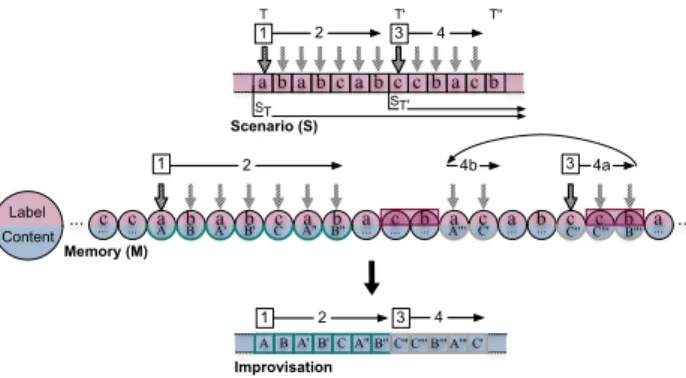
rely on searches of prefixes of the current scenario in the memory. The length of these prefixes is one of the control parameters of the process. Figure 1 illustrates two consec-utive generation phases.
2These navigation phases are successive steps in the algorithmic
pro-cess producing the improvisation, but they do not correspond in general to distinct musical ”phrases”.
a b a b c a b c c b a c b ... c c a b a b c a b a c b a c a b c c b a ... 1 4b 3 4a 1 2 3 4 1 3 4 ... ... A A B Label Content Scenario (S) Memory (M) Improvisation T T' 2 2 ST ST' T'' A' B' C A" B" ... ... ... A"' C' ... ... C" C"' B"' C' B A' B' C A" B" C" C'" B'" A'" ...
Figure 1. Improvising by articulating an indexed memory and a scenario: two navigation phases (1-2 and 3-4).
The first phase (steps1-2) aims to generate the
improvi-sation from the date T by satisfying the current scenario ST=S[T ]...S[s − 1], suffix of S. At the end of this first
phase, the prefix S[T ]...S[T′ − 1] of the suffix S
T of S has been processed. A new research phase over the suffix ST′=S[T′]...S[s − 1] of S has to be launched at step 3 to
complete the improvisation up to T′′− 1 (steps 3-4). Each
of these phases through the memory is constituted by two consecutive steps:
1. Search for a prefix providing a starting point in the memory (steps1 or 3 in figure 1), detailed in 4.3, 2. Follow a linear or non-linear path matching the
sce-nario(steps2 or 4 in figure 1), detailed in 4.4. They respectively take advantage of the prior knowledge on the structure of the scenario and the memory, and ad-dress the concerns of musical continuity and transforma-tion of the original material. Each of these two steps de-scribed in the following part of this section introduces a
parameter whose value influences the musical result: cf
representing the continuity regarding the future of the sce-nario, and cpquantifying the continuity regarding the past of the memory.
4.3 Step 1: searching for a section of the current scenario in the memory
The first step when going through the memory to produce the improvisation is to search for a pattern matching a sec-tion of the current scenario in the memory, that is to say a prefix M[i]...M [i′] of S
T=S[T ]...S[s − 1] in M . The first element of this pattern, M[i], gives a starting point for the navigation phase. The trivial solution is then to copy the whole pattern M[i]...M [i′] (the other options are described
in the following paragraph 4.4). The set SP(T ) of
possi-ble starting points for the generation of the improvisation from a date T is defined by:
SP(T ) = {i ∈ N | ∃cf ≥ 0,
M[i]...M [i + cf] ∈ Prefixes(ST)}
where cf measures the duration of the sequence in the
memory starting at the chosen index i, matching a part of the current scenario ST, and which can be literally cloned.
The choice of an actual starting point among the elements
in SP(T ) is made in accordance with the current state of
the constraints imposed on it. For example, imposing the
maximum value for cf will lead to a maximal length
pre-fix and will provide a homogeneous and continuous mu-sical result throughout its duration. Conversely, a small value will lead to extractions of short segments in poten-tially different zones of the memory. Depending on the musical situations, one can successively prefer a state pro-viding the coherence of the musical discourse in the long term and very close to a section of a learned sequence, or a more fragmented musical result. Constraints on others pa-rameters also influence the choice of an element in SP(T ), among them the location of the pattern in the memory or the preference for a segment offering the best progression regarding the end of the segment produced by the previous phase. The control on these parameters can be given to an operator-musician and/or integrated in a higher level of the improvisation planning (see 6.5).
The prefix indexing algorithm used to obtain the set SP(T ) (detailed in an upcoming paper) uses the “failure func-tion” of the Morris and Pratt algorithm [22] to process self-similarities in ST in a preliminary analysis phase (as it is used in [23] to get the tables of prefixes and borders). This result is then used in the search phase to index the prefixes
of the current scenario ST in the memory M .
4.4 Step 2: following a non-linear path matching the current scenario
For each generation phase, the improvisation process starts from the chosen starting point and runs through the mem-ory collecting a sequence of states whose labels match the scenario, and this mechanism goes on until the research of a new starting point is necessary. After a starting point is chosen in the memory at the indexing step (4.3), the first solution is to literally clone the prefix beginning by this
state (step 2, figure 1). Yet, in particular when ST and
M are very close, the set of possible paths has to offer more than a simple copy to create new material. The nav-igation process exploits therefore an analysis of the self-similarities in the structure of the memory to generate a continuous musical discourse while widening the scope.
The possible progressions matching the scenario from a given state M[k0] is thus defined as the set of the states in
the memory sharing a common past with M[k0], and
satis-fying the next label S[T ] imposed by the scenario. The set
P(T, k0) of indexes k of the states in the memory
match-ing the time T of S and bematch-ing a candidate for the next progression from the previous state M[k0] is defined by: P(T , k0) = {k ∈ N | ∃ cp∈ [1, k],
M[k − cp]...M [k − 1] ∈ Suffixes(M [0]...M [k0]), and
M[k] = S[T ]}
The similar pattern in M and ST can be linearly followed
by choosing in P(T, k0) the consecutive state in the
mem-ory M[k] = M [k0+ 1]. Assuming that jumps between
two segments in the memory sharing a common past pre-serve a certain musical homogeneity, non-linear paths are
also considered, as in the step4 (4a then 4b) in figure 1, to avoid a simple copy of the learnt sequence. Such jumps are authorized when the factors ending at the origin and at the destination of these jumps share a common suffix. The
length of this common suffix cpmeasures the length of the
shared musical past and therefore quantifies the “quality” of these jumps.
The automaton structure chosen to learn the musical mem-ory is the Factor Oracle [24, 25]. The progression process of this second step of the generation extends the mech-anism for improvisation, harmonization and arrangement proposed in [2] based on the navigation [26, 27] in this au-tomaton for musical applications. This auau-tomaton presents links locating repeated patterns within the sequence and providing the existence of a common suffix between the elements that they connect, giving then the successive sets
P(T, k0). The common suffix is seen as a common
mu-sical past in the context of this application. The postulate at the heart of the musical models using the Factor Ora-cle [4, 5, 7, 10, 6, 11] is indeed that such non-linear paths in a musical memory thus mapped enable to create musi-cal phrases proposing new evolutions while preserving the continuity of the musical discourse.
5. INTRODUCING REACTIVITY INTO THE IMPROVISATION MODEL
5.1 From static to dynamic generation
The improvisation model guided by a scenario can be used in live performance to generate autonomous sequences sat-isfying given specifications or in an offline process, for in-stance composition. This section introduces scheduling of dynamic calls to this model in order to bring reactivity and adapt to the generation process to the improvisation envi-ronment. This way, the generation can react to changes of control parameters (given to an operator-musician and/or mapped to the live musical input) or to dynamically modi-fied scenarios while being coherent with the past and keep-ing its long-term horizon.
Musical inputs Controls Synchronised improvisation Scenario (S) Memory (M) Generation Date T → Current position in the scenario
d b c a c ... c a ... Beat Segmenting et labeling Scheduling Learning Q u e ry Pl a y Buffer (B)
Figure 2. The generation process within a real-time archi-tecture.
Listening to a source of beats gives the current date T , and also the associated label S[T ] in the scenario used in different concurrent processes. The three main aspects of the integration of the improvisation model into a real-time environment are presented in figure 2: 1) learning the mu-sical material from the musicians playing with the system, 2) generating and 3) playing the new improvised phrases synchronously with the running improvisation session. For this end, a buffer is added to the two main elements in the model (scenario and memory). It contains the short-term anticipated playing “intentions”, which are refined over time.
5.2 Scheduling the navigation phases: anticipations and rewritings
The implementation of this architecture involves parallel processes listening and reacting to the environment, the el-ements produced by the model, and the instructions given by the operator or a higher scale improvisation plan.
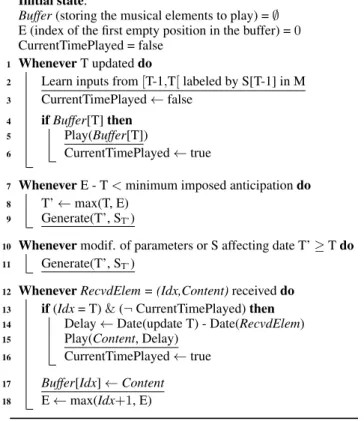
Algorithm 1. Scheduling the reactions to the environment Initial state:
Buffer(storing the musical elements to play) = ∅ E (index of the first empty position in the buffer) =0 CurrentTimePlayed = false
1 Whenever T updated do
2 Learn inputs from[T-1,T[ labeled by S[T-1] in M 3 CurrentTimePlayed ← false
4 if Buffer[T] then 5 Play(Buffer[T])
6 CurrentTimePlayed ← true
7 Whenever E - T < minimum imposed anticipation do 8 T’ ← max(T, E)
9 Generate(T’, ST’)
10 Whenever modif. of parameters or S affecting date T’ ≥ T do 11 Generate(T’, ST’)
12 Whenever RecvdElem = (Idx,Content) received do 13 if (Idx = T)& (¬ CurrentTimePlayed) then 14 Delay ← Date(update T) - Date(RecvdElem)
15 Play(Content, Delay)
16 CurrentTimePlayed ← true
17 Buffer[Idx] ← Content 18 E ← max(Idx+1, E)
These processes correspond to the three blocks building the generic dynamic score given in algorithm 1. It contains the scheduling of the calls to the model described in 4, and the sequence triggering:
1. Listening to update of current date orchestrates la-beling and learning of musical material, and playing
of anticipated events stored in the buffer (lines1-6
in algorithm 1).
2. When a new element generated by the model is re-ceived (lines12-18 in algorithm 1), it is stored in the buffer or immediately played managing potential de-lays.
3. A query to generate a segment of improvisation start-ing at date T′ ≥ T associated to suffix a ST′ of the
scenario can be sent if it is required.
S[T] ... Scenario Buffer B[T] ... ∅ T ... ... S[T'] B[T'] ... ... ... ... ST' Memory T' ≥ T S[T] Output played at time T Labeling musical input [T, T+1[ Learning Rewriting anticipations E New query Trace Update
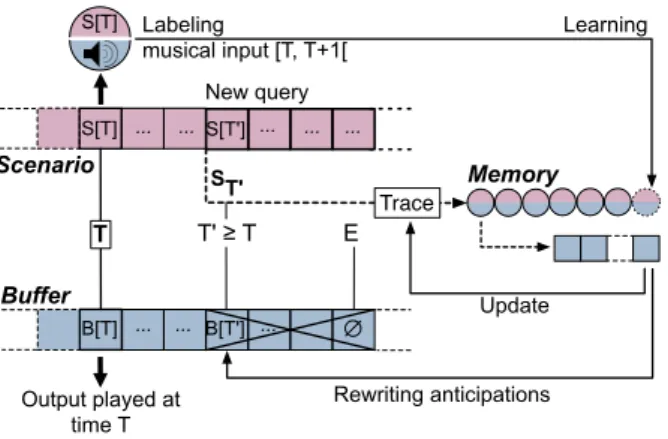
Figure 3. Processes launched at time T of the perfor-mance, reaction to a modification affecting time T′ ≥ T .
The model is called to generate the improvisation phase (see 4.2) after phase, anticipating the performance time. A query launching a new generation phase is thus sent if the minimum anticipation delay between the current time T and the first date with no element previously generated and stored in the buffer E is reached (lines7-9 in algorithm 1). Figure 3 gives an overview of different processes running at a given time T of performance. In reaction to modifi-cation of a parameter or an update of scenario affecting a
date T′ ≥ T , a query launching a new generation phase
is sent (lines 10-11 in algorithm 1). If this query
over-laps with a previous one, the associated anticipated part of the improvisation is rewritten. This scheduling archi-tecture combines anticipation and reactive controls. The short-term intentions stored in the buffer evolve and are refined as the performance goes. A trace records history of paths in the memory and constraints of last navigation phases so that coherence between successive phases asso-ciated to overlapping suffixes of the scenario is maintained. This way for example, constraints can be imposed in real-time, and short-term memory can immediately be injected while keeping up with the scenario. A ”reaction” is not seen here as a spontaneous instant response, but as a revi-sion of the short-term intentions matching the scenario in the light of new events from the environment.
6. CHAINING REACTIONS TO UNORDERED COMPLEX EVENTS
6.1 From scheduling to logical planning
The generative model introduced in section 4 was imple-mented as a Common Lisp library using the OpenMusic environment [28]. The memory and the navigation meth-ods are called in this interaction context through a producer-consumer system which involves parallel processes shar-ing accesses to the memory and the information received from the dynamic score (algorithm 1). This structure con-taining the scheduling of the calls to the model, the buffer,
and the triggering of the playing of the computed sequences is implemented using Antescofo language. The correspond-ing program is generic enough to be independent of impro-visation situations and of types of scenario. The improvisa-tions generated by the model are then played in synchrony with the musical environment, following the fluctuation of the tempo. The synchronization strategies to manage the
delays (lines13-16 algorithm 1) associated to anticipation
are used to maintain musical coherence despite real-time modifications of generation parameters.
Beyond scheduling aspects detailed in the previous para-graph, this section presents Antescofo features allowing specification of high-level temporal structures of this model and also more generally of different kind of processes that can be involved in an improvised interactive music per-formance. Recent developments of the language integrate handling of dynamic duration, complex events specifica-tion and dynamic processes. This generalizes the nospecifica-tion of score following beyond triggering of an action or recog-nition of causal events. The score is no longer subject to linear rigidity of classical scores. It can be seen more as an interactive system where events, actions, durations, tempi and all the temporal structures can change dynami-cally. Such features make it an adequate environment for the temporal coordination of the processes that can be in-volved in Human-Computer Improvisation.
6.2 The whenever statement
The whenever statement launches actions conditionally on the occurrence of a signal.
whenever (predicate) {
actions-list } until (expression)
predicate is an arbitrary expression. Each time the
variables of predicate are updated, the expression is evaluated. The whenever statement is a way to re-duce and simplify the specification of the score particu-larly when actions have to be executed each time an event is detected. It also escapes the sequential nature of tra-ditional scores. Actions of a whenever statement are not statically associated to an event of the performer but to the dynamic satisfaction of some predicate. They can be triggered as a result of a complex calculation, launched by external events, or any combinations of the above. 6.3 Patterns
The whenever structure is relevant when the user wants to define a reaction conditionally to the occurrence of an event. A logical event is specified thanks to a combination of variables. Complex events corresponding to a combina-tion of atomic events with particular temporal constraints are however tedious to specify. Antescofo patterns make the definition of this kind of events concise and easy. A pattern is made of punctual events (EVENT) and of events with some duration (STATE). The example below shows how to define the complex event pattern::P, matching the following configuration: the variable $x is greater than
a threshold equal to 10 during 0.5s. Then the variable is up-dated to 1 before one second is elapsed. This pattern can then be used in the specification of a whenever condition to assign a reaction to this event.
@pattern_def pattern::P {
STATE $x where($x>10) during 0.5s before 1s EVENT $y where($y=1) } whenever(pattern::P) { actions... } 6.4 Processes
Processes are groups of actions dynamically instantiated. Unlike the other actions, the runtime structure associated to a process is not created during the loading of the score but at the time of the call, in accordance with its defini-tion. Then, all the expressions involved in the process (du-rations, command names, attributes, etc.) may depend on parameters of the performance.
@proc_def ::delay($pitch, $d) { $d/3 loop $d/3 { play $pitch }during [2#] } NOTE C4 2. ::delay("C4", 2.) NOTE D3 1 ::delay("D3", 1)
In the previous example, the process ::delay repeats twice the note that triggered it during the duration of this note. Processes are first-class values: for example, a pro-cess can be passed as an argument to a function or an other process. It can be recursively defined and various instances of a same process can be executed in parallel. Processes are quite adapted to the context of improvised music, and can be used for example as a library of parametrized musical phrases that are instantiated following the musical context. 6.5 Writing improvisation plans
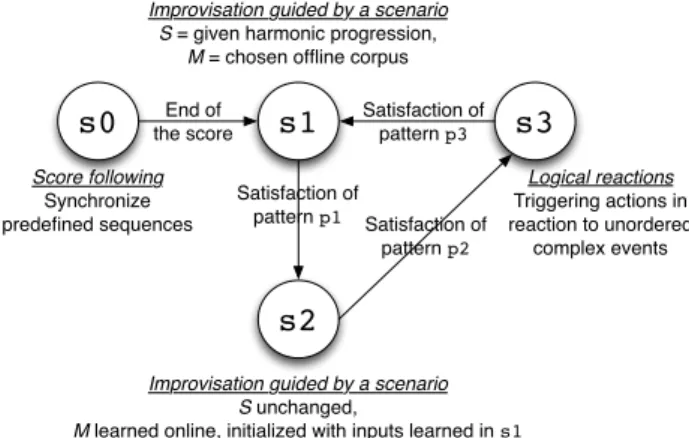
The set of tools presented in this section enables to write improvisation plansdefining different kinds of interactions. The schematic example in figure 4 shows an generic exam-ple of such a plan. In this context, the score of the musi-cian is not completely defined and the inputs of the reac-tive module are not only extracted from Antescofo listening machine but can also be provided by external modules.
Each state corresponds to an interaction mode between the performer and the system. Satisfaction of temporal patterns p1, p2 or p3 allows to switch between the dif-ferent states s0, s1, s2 and s3. These patterns can for example be defined as temporal evolutions of some audio descriptors. s0 is associated to a classical phase of inter-action of a score following system with electronic inter-actions adapting to a sequence of predefined events. Reaching the end of the sequence leads to the beginning of the next part (s1) where the musician improvises with the generation model guided by a scenario chosen as a given harmonic
s0
s1
s3
Score following
Synchronize predefined sequences
Improvisation guided by a scenario S = given harmonic progression,
M = chosen offline corpus
s2
End of the score Satisfaction of pattern p1 Satisfaction of pattern p2 Satisfaction of pattern p3Improvisation guided by a scenario S unchanged,
M learned online, initialized with inputs learned in s1
Logical reactions
Triggering actions in reaction to unordered
complex events
Figure 4. Schematic example of an improvisation plan.
progression, and a musical memory initialized with a cho-sen corpus. The part corresponding to s2 continues with the same scenario using the memory learned from the mu-sician’s performance during s1. Finally, s3 is a combina-tion of predefined interactive mechanisms associating elec-tronic reactions to unordered events.
7. CONCLUSION
This paper sketches an environment allowing the tempo-ral management of human-computer improvisation. In this approach, improvisation plans with different kinds of in-teractions at multiple time-scales were considered ranging from completely determined to unordered events and re-actions. The proposed environment integrates a model of generation for the improvisation in the high-level structure provided by a language for the specification and coordi-nation of electronic actions depending on defined events. This coupling of high-level dynamic language with an im-provisation model (generative processes), which is at the core of the prototype presented in this paper, enhances the coupling between interactive computer music and impro-vised practices. Researches on those lines could address complex problems with simple and elegant solutions useful for both music planning and improvised live performance. Acknowledgments
The authors would like to thank Jean Bresson, Arshia Cont and G´erard Assayag for fruitful discussions. This work is supported in part by ANR projects: IMPROTECH ANR-09-SSOC-068 and INEDIT ANR-2012-CORD-009-03.
8. REFERENCES
[1] R. Rowe, “The aesthetics of interactive music sys-tems,” Contemporary music review, vol. 18, no. 3, pp. 83–87, 1999.
[2] J. Nika and M. Chemillier, “ImproteK, integrating har-monic controls into improvisation in the filiation of OMax,” in Proc. of the International Computer Music Conference, Ljubljana, 2012, pp. 180–187.
[3] A. Cont, “On the creative use of score following and its impact on research,” in Proc. International Conference on Sound and Music Computing, Padova, July 2011. [4] G. Assayag, G. Bloch, M. Chemillier, A. Cont, and
S. Dubnov, “OMax brothers: a dynamic topology of agents for improvization learning,” in Proc. of the 1st ACM workshop on Audio and music computing mul-timedia, ACM, Santa Barbara, California, 2006, pp. 125–132.
[5] B. L´evy, G. Bloch, and G. Assayag, “OMaxist dialec-tics,” in Proc. of the International Conference on New Interfaces for Musical Expression, 2012, pp. 137–140. [6] A. R. Franc¸ois, I. Schankler, and E. Chew, “Mimi4x: an interactive audio–visual installation for high–level structural improvisation,” International Journal of Arts and Technology, vol. 6, no. 2, pp. 138–151, 2013. [7] L. Bonnasse-Gahot, “Online arrangement through
aug-mented musical rendering,” Ircam STMS Lab Internal Report - ANR Sample Orchestrator 2, ANR-10-CORD-0018, 2013.
[8] J. Moreira, P. Roy, and F. Pachet, “Virtualband: Inter-acting with stylistically consistent agents,” in Proc. of International Society for Music Information Retrieval Conference, Curitiba, 2013, pp. 341–346.
[9] F. Pachet, P. Roy, J. Moreira, and M. d’Inverno, “Re-flexive loopers for solo musical improvisation,” in Proc. of the SIGCHI Conference on Human Factors in Computing Systems, ACM, Paris, 2013, pp. 2205– 2208.
[10] G. Surges and S. Dubnov, “Feature selection and com-position using PyOracle,” in Ninth Artificial Intelli-gence and Interactive Digital Entertainment Confer-ence, Boston, Massachusetts, 2013.
[11] A. Donze, S. Libkind, S. A. Seshia, and D. Wes-sel, “Control improvisation with application to music,” EECS Department, University of California, Berkeley, Tech. Rep. UCB/EECS-2013-183, Nov 2013.
[12] M. Puckette, “Combining event and signal process-ing in the max graphical programmprocess-ing environment,” Computer Music Journal, vol. 15, pp. 68–77, 1991. [13] J. McCartney, “Supercollider: a new real-time
synthe-sis language,” in Proc. of the International Computer Music Conference, Hong Kong, 1996.
[14] G. Wang, “The chuck audio programming language.” a strongly-timed and on-the-fly environ/mentality”,” Ph.D. dissertation, Princeton University, 2009. [15] A. Cont, “Antescofo: Anticipatory synchronization
and control of interactive parameters in computer mu-sic,” in Proc. of the International Computer Music Conference, Belfast, 2008.
[16] ——, “A coupled duration-focused architecture for re-altime music to score alignment,” IEEE Transactions on Pattern Analysis and Machine Intelligence, vol. 32, no. 6, pp. 974–987, 2010.
[17] S. Dubnov, G. Assayag, and R. El-Yaniv, “Universal classification applied to musical sequences,” in Proc. of the International Computer Music Conference, Ann Arbor, Michigan, 1998, pp. 332–340.
[18] G. Assayag, S. Dubnov, and O. Delerue, “Guessing the composer’s mind: Applying universal prediction to musical style,” in Proc. of the International Computer Music Conference, Beijing, 1999, pp. 496–499.
[19] M. Chemillier, “L’improvisation musicale et
l’ordinateur,” Terrain, no. 2, pp. 66–83, 2009.
[20] ——, “Improviser des s´equences d’accords de
jazz avec des grammaires formelles,” in Proc. of Journ´ees d’informatique musicale, Bourges, 2001, pp. 121–126, (English summary). [Online].
Avail-able: http://ehess.modelisationsavoirs.fr/marc/publi/
jim2001/jim2001english.pdf
[21] ——, “Toward a formal study of jazz chord sequences generated by Steedman’s grammar,” Soft Computing, vol. 8, no. 9, pp. 617–622, 2004.
[22] J. H. Morris and V. R. Pratt, A linear pattern-matching algorithm, 1970.
[23] M. Crochemore, C. Hancart, and T. Lecroq, Algorithms on strings. Cambridge University Press, 2007. [24] C. Allauzen, M. Crochemore, and M. Raffinot,
“Fac-tor oracle: A new structure for pattern matching,” in SOFSEM 99: Theory and Practice of Informatics. Springer, 1999, pp. 758–758.
[25] A. Lefebvre, T. Lecroq, and J. Alexandre, “Drastic im-provements over repeats found with a factor oracle,” 2002.
[26] G. Assayag and S. Dubnov, “Using factor oracles for machine improvisation,” Soft Computing, vol. 8, no. 9, pp. 604–610, 2004.
[27] G. Assayag and G. Bloch, “Navigating the oracle: A heuristic approach,” in Proc. of the International Com-puter Music Conference, Copenhagen, 2007, pp. 405– 412.
[28] J. Bresson, C. Agon, and G. Assayag, “OpenMusic: vi-sual programming environment for music composition, analysis and research,” in Proc. of the 19th ACM inter-national conference on Multimedia, Scotssdale, 2011, pp. 743–746.