RESEARCH PAPER
Suspect and nontarget screening approaches to identify organic
contaminant records in lake sediments
Aurea C. Chiaia-Hernandez&Emma L. Schymanski&
Praveen Kumar&Heinz P. Singer&Juliane Hollender
Received: 10 June 2014 / Revised: 30 August 2014 / Accepted: 4 September 2014 / Published online: 26 September 2014 # Springer-Verlag Berlin Heidelberg 2014
Abstract Sediment cores provide a valuable record of historical contamination, but so far, new analytical techniques such as high-resolution mass spectrometry (HRMS) have not yet been applied to extend target screening to the detection of unknown contaminants for this complex matrix. Here, a combination of target, sus-pect, and nontarget screening using liquid chromatogra-phy (LC)-HRMS/MS was performed on extracts from sediment cores obtained from Lake Greifensee and Lake Lugano located in the north and south of Switzerland, respectively. A suspect list was compiled from consump-tion data and refined using the expected method coverage and a combination of automated and manual filters on the resulting measured data. Nontarget identification efforts were focused on masses with Cl and Br isotope informa-tion available that exhibited mass defects outside the sample matrix, to reduce the effect of analytical interfer-ences. In silico methods combining the software MOLGEN-MS/MS and MetFrag were used for direct elucidation, with additional consideration of retention
time/partitioning information and the number of refer-ences for a given substance. The combination of all avail-able information resulted in the successful identification of three suspect (chlorophene, flufenamic acid, lufenuron) and two nontarget compounds (hexachlorophene, flucofuron), confirmed with reference standards, as well as the tentative identification of two chlorophene conge-ners (dichlorophene, bromochlorophene) that exhibited similar time trends through the sediment cores. This study demonstrates that complementary application of target, suspect, and nontarget screening can deliver valuable information despite the matrix complexity and provide records of historical contamination in two Swiss lakes with previously unreported compounds.
Keywords High-resolution mass spectrometry . Suspect screening . Nontarget screening . Sediment matrix . Organic contaminants . Mass accuracy . Chlorophenes
Introduction
Sediment cores are useful to reconstruct environmental chang-es over time, providing historic records of natural events, changes in ecosystems, climate, and anthropogenic impact. Thus, sediments can be suitable to reconstruct the environ-mental contamination within a catchment as they provide
records of chemical deposition [1,2]. Additionally, it is now
possible to use sediment cores or specimen banks to study the fate and exposure of many organic contaminants that could not be assessed in the past due to the lack of analytical technology available.
Different methods have been developed for the analysis
of organic contaminants in sediments [2–5], and although
these methods have been shown to be sensitive and se-lective, they aim to quantify and study only a small Electronic supplementary material The online version of this article
(doi:10.1007/s00216-014-8166-0) contains supplementary material, which is available to authorized users.
A. C. Chiaia-Hernandez
:
E. L. Schymanski:
P. Kumar:
H. P. Singer:
J. Hollender (*)Eawag, Swiss Federal Institute of Aquatic Science and Technology, Überlandstrasse 133, 8600 Dübendorf, Switzerland
e-mail: [email protected] A. C. Chiaia-Hernandez
:
J. HollenderInstitute of Biogeochemistry and Pollutant Dynamics, ETH Zurich, Universitätstrasse 16, 8092 Zurich, Switzerland
P. Kumar
Faculty of Chemistry, University of Barcelona, Martí i Franquès, 1-11, 08028 Barcelona, Spain
Anal Bioanal Chem (2014) 406:7323–7335 DOI 10.1007/s00216-014-8166-0
number of compounds. With the increasing number of
synthetic compounds produced annually [6, 7], generic
analytical techniques to measure a broader range of com-pounds in a single study are becoming essential to over-come the challenges in analyzing complex matrices that contain many target and nontarget compounds at different concentrations. The analysis of micropollutants in com-plex matrices, e.g., soils, sludge, and sediments, can be difficult since the presence of natural organic matter such as humic acids and biomolecules can interfere with the extraction and later on with the separation and detection
[8]. High-resolution mass spectrometry (HRMS) using
Orbitrap and time-of-flight (TOF) instruments is very suitable for these applications due to the high resolving power, mass accuracy, and sensitivity in full scan
acqui-sition [8, 9]. Generic analytical methods in combination
with HRMS have been proven to reliably screen molecu-lar ions and their MS/MS fragments against a complex
sediment matrix background [1]. Since not all organic
contaminants can be captured by target analysis alone, new approaches have been developed for the identifica-tion of compounds in surface water and wastewater with-out reference compounds using prior knowledge (i.e., suspect screening) or without any information (i.e.,
non-target screening) [8, 10–15]. Ibáñez et al. [10] applied a
suspect screening approach by comparing experimental data with a homemade spectral library containing 500
compounds. Moschet et al. [16] searched for all registered
pesticides in Switzerland in surface waters using the exact mass followed by automatic filters for blank subtraction, peak area, peak shape, signal-to-noise ratio, and isotopic pattern with an overall success rate of 70 %. These ap-proaches can help tentatively identify possible relevant contaminants without purchasing and measuring hundreds of reference standards in advance.
Structure elucidation can be achieved by applying a series of steps including the prediction of molecular formula from exact mass and isotope pattern match, followed by structure search in databases, matching retention time (RT) and MS/MS
fragmentation [8]. Element information such as the presence
of Cl, Br, or S has been successfully used to restrict possible molecular formulas due to their distinct isotope signal at M+2
[14,17] and characteristic mass defect compared with natural
compounds [8,18].
However, the identification of suspects and nontarget compounds is still an analytical challenge since software and methods to predict fragmentation patterns, ioniza-tion behavior, and retenioniza-tion time are still under devel-opment. Commercial software such as Mass Frontier
[19] and Mass Fragmenter [20] are available to predict
mass spectral fragments using different fragmentation rules, but Mass Frontier, for example, does not contain
many rules for negative ionization. Wolf et al. [21]
combined in silico bond disconnection fragmentation
with compound database searching using KEGG [22],
PubChem [23], and ChemSpider [24] in the openly
accessible MetFrag. Other recent developments include
CFM-ID [25]. Furthermore, the lack of comprehensive
mass spectral libraries for high-accuracy MS/MS and the limited comparability between collision-induced dis-sociation (CID) and higher energy collision disdis-sociation (HCD) spectra make the identification of unknown com-pounds more challenging. Recent contributions to the
open spectral libraries like MassBank [26], mzCloud
[27], and METLIN [28] are a step in the right direction.
Here, it was hypothesized that in silico methods for structure elucidation and further exclusion steps based on physicochemical characteristics and patterns, MS/MS fragmentation, and ultimately confirmation with the pur-chase of reference standards could facilitate the identi-fication of nontarget compounds as has been shown for
GC-MS [29].
In a previous study, a multiresidue method for the target screening of more than 200 compounds with a
broad range of physicochemical properties (log Kow 0–
12) was developed [1] and applied to identify target
compounds and screen for a few important suspects as the first step to identify potential organic contaminants that were not originally in the target list. The objectives of this study were to extend this previous work, namely (i) to explore suspect screening further using an auto-matic filtering for over 800 compounds, (ii) to identify nontarget compounds by performing in silico elucida-tion and candidate selecelucida-tion or exclusion for peaks with distinct negative mass defect, and thus, (iii) to clarify whether the suspect and nontarget screening methods could also be viable for complex sediment matrices and thus provide records of historical contam-ination in two Swiss lakes with previously unreported compounds.
Experimental section
Details on the sources, preparation, and storage of target reference standards and reagents are given in the Electronic
supplementary material (ESM) and elsewhere [1]. The
reference standards chlorophene, mefloquine, oxaprozin, fenazaquin, lumefantrine, mianserin, flunarizine, chlorocresol, lufenuron, flufenamic acid, and
p-chlorophenol (purity≥97 %) were purchased from
Sigma-Aldrich (Buchs, Switzerland), simvastatin (purity≥98 %)
from TRC (Toronto, Canada), and flucofuron and hexa-chlorophene (purity≥97 %) from Dr. Ehrenstorfer (Augs-burg, Germany).
Sample collection and preservation
Sediment cores were taken from Lake Greifensee (47° 20′ 58″
N, 8° 40′ 49″ E) and Lake Lugano (45° 57′ 31.5″ N, 8° 53′ 38.3″ E) located in the north and south of Switzerland, during the summer of 2010 and 2012. Sediment core samples were obtained using a free fall gravity corer and stored vertically in the dark at 4 °C until analysis. Dating of the sediment cores (∼1950–2012) was performed by counting annual laminations
and by using137Cs signals from Chernobyl 1986 and atomic
bomb tests from 1963, as described elsewhere [1].
Liquid chromatography tandem high-resolution mass spectrometric detection
Sediment samples were freeze-dried, extracted by pressurized liquid extraction, and cleaned up by liquid-liquid partitioning
using a combination of acetonitrile, MgSO4, and NH4Cl as
reported elsewhere [1]. Detection of analytes was performed
with a linear ion trap Orbitrap (LTQ-Orbitrap-XL) and a quadrupole Orbitrap (Q-Exactive) mass spectrometer (Ther-mo Fisher Scientific Corp., USA). Electrospray ionization (ESI) was performed using positive and negative ioniza-tion modes in multiple independent injecioniza-tions to acquire meaningful MS/MS spectra. Full scan accurate mass spec-tra were acquired from 115 to 1,000 Da with a resolving power of 60,000 referenced to m/z 400 and a mass accu-racy of ±5 ppm. Data-dependent high-resolution product ion spectra (DD-HR-MS/MS) were recorded at a resolv-ing power of 7,500 for LTQ-Orbitrap-XL. Q-Exactive spectra were acquired at a resolving power of 100,000 referenced to m/z 400 and a mass accuracy of ±5 ppm and a DD-HR-MS/MS of 17,500.
Product ions were generated using HCD at collision energies calculated for each analyte based on its mass. In addition, CID was performed with a normalized collision energy of 35 %, measured at low resolution in the linear ion trap. Calibration standards, quality controls, and quantification criteria used in the analysis are reported in the ESM.
Limits of quantification (LOQ) were defined as the lowest point of the calibration curve with a signal-to-noise (S/N) ratio ≥10 and with sufficient ions for MS/MS fragmentation. The LOQ were then divided by a calculated matrix factor for each compound and subsequently multiplied by the dilution of the matrix sample. The matrix factor and calculated matrix effect
(%) for each analyte are reported elsewhere [1].
Suspect screening of contaminants and transformation products
A suspect list of 838 contaminants was compiled from a theoretical assessment based on consumption data, including
all registered organic synthetic insecticides, fungicides, biocides, and acaricides, including all major metabolites of the most commonly used insecticides and fungicides
in Switzerland [16] as well as important pharmaceuticals
used in Switzerland, Germany, France, and the USA (Singer et al., in preparation) which were not yet in-cluded in the target list. As only more hydrophobic compounds were expected to partition into sediments, the list of suspect compounds was narrowed to
candi-dates with predicted log Kow values higher than 1 using
VCCLAB software [30]. Further, suspect compounds
were eliminated if they were not likely to be ionized by ESI using rules (presence or absence of functional
groups) as in Moschet et al. [16]. The complete list of
suspect compounds that were estimated to fall in the domain of the analytical method is provided in ESM
Table S1.
Suspect screening was performed in sediment core layers
between ∼1950 and 2012 from Lake Greifensee and Lake
Lugano with the aid of ExactFinder 2.0 (Thermo Fisher Sci-entific Corp., USA). The exact mass of the expected ion was extracted from the HR full scan chromatogram using a mass window of ±5 ppm. As ESI generally produces molecular ions
[M+H]+ or [M−H]− [31], suspect screening was performed
using these masses. Other adducts (e.g., NH4+, Na+, HCO2−,
and H3C2O2−) were not included for simplicity. Due to the
difficulty of predicting ionization behavior, all suspected tar-gets were screened in positive and negative ionization modes to avoid losing compounds due to an incorrect prediction in ionization at the beginning of the workflow. Blank subtraction
was performed using a sediment layer from∼100 years ago
for each core, as contamination was not considered likely to be present in these layers. Additional automatic filtering criteria
included peak area cutoff (≥104 in negative and ≥105 in
positive), S/N (≥50), peak score (≥0.45), and isotopic pattern (≥50).
The output list of suspect candidates was then eval-uated manually for correct isotopic pattern, S/N, peak shape, and ionization in the positive and negative modes (based on different functional groups and literature). A RT match factor with a window of ±4 min was also included in the analysis. Predicted RTs were obtained using a linear correlation between the measured
reten-tion times and predicted log Kow values (RT = 1.65 × log
Kow+ 4.36) obtained from the 164 reference standards
used in the target analysis [1].
To obtain more information on suspect candidates, samples were re-injected and measured at different col-lision energies (HCD) of 15, 35, and 55 % for targeted MS/MS fragmentation. MS/MS spectra were compared with predicted MS/MS fragmentation using Mass
Fron-tier 6.0 [19] and MetFrag [21] using ChemSpider and
in silico fragmentation for the molecular formula of the suspect candidate. Unequivocal confirmation was only possible if a reference standard was available; where standards were available, the MS/MS spectra are saved
in MassBank (www.massbank.eu/MassBank/).
Nontarget screening of contaminants
Nontarget screening was performed in the most recent layers (the last 10 years) and the most contaminated layers of each core. The highest period of contamination
around ∼1980s for Lake Greifensee [1] and between
∼1970 and ∼1980s for Lake Lugano is clearly distin-guishable from the other layers. A nontarget mass list for each sediment sample was obtained using enviMass
1.2 [32], with peak picking performed using Formulator
(Thermo Fisher Scientific Corp., USA). Nontarget can-didates were selected using an automated exact mass filter with a window of ±5 ppm, followed by a back-ground subtraction and recalibration of masses using internal standards. A sediment layer (∼100 years ago) within each core was set as a background sample to eliminate matrix peaks. Additionally, background sub-traction was performed using sediment core layers adja-cent to the layers of interest with the aim to match the sediment matrix as close as possible and to identify the most relevant (intense) unknown masses. For example, the layer corresponding to the 1990s (layer 2) was used as a background and subtracted from the first layer of each sediment core (the last 10 years).
Furthermore, the nontarget list was reduced by selecting the top 10 most intense masses from each sediment layer and the top 100 masses containing Cl, Br, and S based on isotopic information obtained from enviMass. Masses higher than m/z 600 were excluded since most contaminants have lower molecular masses (e.g., only 3 % of the target and suspect list was above this mass) and because many of the high masses are considered likely to belong to the sample matrix. The nontarget list was reduced further by keeping candidates
containing mass defect between −200 and 0 mDa to
focus on molecular formulas outside the heavy matrix domain. As for suspect confirmation, the final nontarget candidates were re-injected and measured at different collision energies (HCD) of 15, 35, and 55 % for targeted MS/MS fragmentation; the reference spectra
are also available at www.massbank.eu/MassBank/.
Structure elucidation using the full scan and MS/MS
data was performed using MOLGEN-MS/MS [33] and
MetFrag using ChemSpider and PubChem. MOLGEN-MS/MS was used with a mass accuracy of 5 and 10 ppm in the MS and MS/MS spectra, respectively, checking for the existence of at least one structure for
the given formula (exist filter) and considering odd and even ion species for fragments. Additional parameters were adjusted to the individual cases and included ele-ment restrictions (e.g., C, H, N, O, P, S, including Cl and Br if halogen patterns were detected) and the ion species
(e.g., [M+H]+ or [M−H]−). MetFrag was employed using
the neutral exact mass (with mass error 5 ppm) or molec-ular formula for candidate retrieval with the appropriate ionization mode and charge, while in silico fragmentation was performed using a combined relative mass error of 5 ppm and absolute error of 0.001 Da.
Results and discussion
Target screening of organic contaminants
Comprehensive target analysis is essential before suspect and nontarget screening in order to clearly concentrate on previously unknown compounds as shown by Krauss
et al. [8]. In Lake Lugano located in the south of
Switzerland, 16 of 200 target compounds were detected with the most prominent substance classes correspond-ing to musk fragrances, personal care products (PCP), pesticides, and biocides, similar to the previously de-scribed results for Lake Greifensee located in the north
of Switzerland [1]. In both lakes, the musk fragrance
tonalide, the biocides triclosan and triclocarban, and the quaternary ammonium surfactants, congeners benzyldimethyltetradecylammonium (BAC 14) and didodecyldimethylammonium (DADMAC C12:C12), show similar patterns with increasing concentrations in the late 1970s, followed by a decline in concentrations starting in the 1990s. The biocides irgarol, terbutryn, and prometryn and a transformation product of the musk fragrance galaxolide (galaxolidone) were detected in the nanogram per gram dry weight to the picogram per gram dry weight range with concentrations increas-ing through the early 1990s and with the highest con-centrations in the most recent layers. The biocide propiconazole as well as the pesticides fludioxonil, DEET, and the co-eluting compounds acetochlor plus alachlor (isobaric; total concentrations reported) was
detected in layers of the past ∼10 years. The quantified
concentrations for all positive findings in Lake Lugano
are reported in Table 1. While little information was
available about the historical contamination of Lake Lugano previously, it was known that the lake was
highly contaminated in the 1960s and 1970s [34],
sim-ilar to Lake Greifensee. The concentration range (pg/gdw
to ng/gdw) and contamination pattern in both lakes are
Suspect screening
The detection of organic contaminants was expanded beyond the target list to include 838 suspect candidates. To compare the candidates with that of the complex sediment matrix, a mass list for each lake sediment was compiled using sediment core layers corresponding
to the ∼1950s for both lakes. The mass defect (mDa)
versus nominal masses (m/z) was plotted for the
reten-tion time window 10–15 min as shown in Fig. 1. For
most of the matrix ions (black dots), a slightly positive mass defect is observed, increasing with the nominal mass and consistent with natural compounds containing C, H, N, and O atoms such as fatty acids, peptides, polyphenols, carbohydrates, and humic acids. The sus-pect compounds (red dots) generally fall in the same domain as the sediment matrix, which increases the presence of interferences during identification efforts. Further, the matrix was more predominant in negative compared with positive ionization, which is reasonable as many natural compounds are acids.
The automated data processing with ExactFinder (peak shape and intensity, blank subtraction, retention time) allowed the elimination of an average of 80 % possible suspect candidates, while visual inspection of chromatograms reduced the suspect candidate list further by 3 to 20 %. Suspects for which the intensity ratio of the isotope pattern differed by more than 50 % from the theoretical pattern were eliminated. In the absence
of a distinct isotopic signal, an intensity cutoff of 106
was performed to focus on the most prominent suspect
compounds, analogous to Moschet et al. [16]. As a last
step, candidates outside a predicted RT with a large error window (±4 min) were eliminated despite the limitations inherent in this method since large errors
in the predicted log Kow are involved, especially for
ionic compounds. However, in-house experience with
target analysis using different log Kow predictions
dem-onstrated that the target compounds fell consistently within the RT window of ±4 min, which is also within the boundaries of the 95 % prediction interval of the
linear correlation used [1]. This filter step was not
applied to suspect candidates that were expected to be protonated or deprotonated under the analytical condi-tions used.
In total, 27 of 839 exact mass matches were selected for further analysis. The MS/MS fragmentation of the selected candidates was acquired, and a score based on the number and intensity of matching-predicted frag-ments was obtained using MetFrag. Candidates with a score of 0 (maximum value = 1) and with 0 matching fragments were not considered further. For the remain-ing compounds, reference standards were purchased
Ta b le 1 T ar g et analys is of Lake Lugano showing a temporal pattern o f d if ferent or ganic contaminants in nanogram per g ram d ry weig ht Y ear N, N -d ieth yl-3-meth ylbenzamide T erbutryn/ prometryn Propiconazole Fludioxonil T onalide Ir g arol Acetochlor/alach lor G alax olidon T riclosan T riclocarban B AC 14 DADMAC C16:C16 D ADM AC C18:C18 2012 –2004 0.6 2 0.8 7 0.26 0.35 200 10 <LOQ 60 20 7 8 1 N D 2004 –1994 ND 0.3 2 ND ND 250 7 N D 4 0 3 0 3 0 2 0 142 44 1994 –1984 ND 0.2 7 ND ND 200 2 N D 1 0 2 0 1 10 10 129 31 1984 –1975 ND ND ND ND 20 ND ND ND 4 2 0 6 3 N D 1975 –1965 ND ND ND ND 70 ND ND ND ND 2 N D N D N D 1965 –1954 ND ND ND ND 10 ND ND ND ND ND ND ND ND 1954 –1925 ND ND ND ND ND ND ND ND ND ND ND ND ND 1925 –1915 ND ND ND ND ND ND ND ND ND ND ND ND ND 1915 –1908 ND ND ND ND ND ND ND ND ND ND ND ND ND ND no t d etectable, <LOQ lower than the limit of quantification
where easily available (8 of 13 compounds), as
illus-trated in Table 2.
The biocide chlorophene was detected in both lakes and tentatively identified using MetFrag with four matching fragments in the MS/MS spectrum with a score of 0.987 and finally confirmed with a reference
standard (Table 2 and ESM Fig. S1). The pattern of
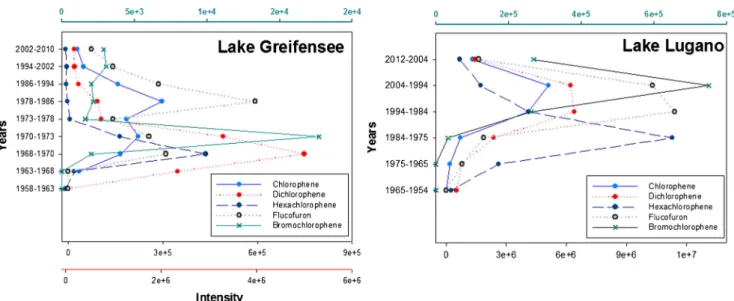
chlorophene in both lakes shows the highest input in the ∼1980s and ∼1990s for Lake Greifensee and Lake
Lu-gano, respectively, as illustrated in Fig. 2. Additionally,
the pharmaceutical flufenamic acid and the pesticide lufenuron were detected and confirmed by reference standards in both lakes.
While the evaluation of experimental MS/MS spectra with predicted MS/MS fragmentation using Mass Fron-tier and MetFrag was certainly helpful for the exclusion of candidates in the sediment matrix, confirmation of the tentative candidates via reference standards was shown to be important. The pesticide fenazaquin had a MetFrag score of 1 (with seven matching fragments), but the MS/MS of the reference standard did not match the measured spectrum, with one main fragment absent. Further, as three of the five unconfirmed suspect com-pounds have a mass defect between 180 and 265 mDa
and thus fall into the matrix domain (Fig. 1), matrix
interferences may have resulted in additional peaks in the MS/MS.
Nontarget screening
enviMass proved a useful first step for the identification of nontarget candidates from samples with an average of 17,000 ± 4,000 picked peaks, as background subtraction and noise removal eliminated up to 60 % of these
picked peaks, shown in Fig. 3. Overall, maximal 2 %
of the picked masses were known (target compounds and internal standards), while up to 52 % of the masses remained unknown. For all sediments, the nontarget candidates contained between 9 and 18 % peaks with an isotopic pattern, 1–5 % with adducts, and around
80 % monoisotopic peaks (Fig. 3). As only a single
mass is available for monoisotopic peaks and these are generally of low intensity, structure elucidation was not attempted for monoisotopic peaks. While the results were generally similar for negative and positive ioniza-tion for both lakes, a higher percentage of unknowns (52 %) were found for the negative mode in Lake Greifensee. This could be explained by the stronger Fig. 1 Mass defects (mDa) of Lake Greifensee and Lake Lugano sediment
matrix (black dots) in positive and negative ionization modes within the retention time window of 10–15 min are plotted in the y-axis against
nominal (m/z) masses at the x-axis. Masses of suspect compounds are plotted as red dots
Ta b le 2 List of 13 su spect cand idates w ith d if ferent cr ite ria u sed in the id enti fi cat ion w or kfl o w Na me Mole cul ar for m ul a Cl ass Ioniza tio n L ake L aye rs e lo g Kow a Δ RT b(m in) Δ m( p p m ) c Ma ss def ec t (m Da ) M et F ra g sc o re M etF ra g fr agm ent s match Standard ava ila ble Ide n tif ic ati o n Chlorophene C13 H11 Cl O B ioc ide / pha rmace uti cal Negative Lug ano/ Gr ei fe nsee 1– 5/1 –64 .0 7 ± 0 .1 1 − 1.7 0 .0 43 0.983 7 Y es Y es Flu fen amic ac id C14 H10 F3 NO 2 Pharmaceutical Negative Lug ano 1– 4 4 .4 8 ± 0.56 − 2.2 0 .8 59 0.989 2 Y es Y es Lufenuron C17 H8 Cl2 F8 N2 O3 Pe stic ide N eg ati v e G re in fen see 1– 3 6 .5 2 ± 0.82 − 0.9 0 .9 − 29 1.000 3 Y es Y es Chlor o cr es ol C7 H7 Cl O B io ci d e/ pha rmace uti cal Negative Greinfen see 3 2.6 8 ± 0 .22 − 0.2 − 2.4 1 1 0 .947 3 Y es No d p -C hlorophenol C6 H5 C lO P ha rmac euti cal Negative Lug ano 2– 5 2 .2 6 ± 0.10 − 1.7 − 3.0 − 4 1 .000 1 Y es No Fenazaquin C20 H22 N2 O P es tic ide P osi tive L ug ano 1 /1 5.3 3 ± 0 .32 − 2.1 1 .3 180 1.000 7 Y es No Flu n ar izin e C26 H26 F2 N2 Pha rmac euti cal Posi tive L ug ano 1– 5 5 .7 1 ± 0.34 − 1.9 2 .5 214 1.000 6 Y es No Simva stat in C25 H38 O5 Pharmaceutical Negative Lug ano 1– 6 4 .8 0 ± 0.28 − 1.9 2 .0 265 0.846 3 Y es No Camphor C10 H16 O P ha rmac euti cal Posi tive L ug ano/ Gr ei fe nsee 1– 5/1 –6 2 .5 4 ± 0.47 2.1 4 .2 127 0.840 8 N o Inconclus ive Dienogest C20 H25 NO 2 Pha rmac euti cal Posi tive L ug ano 1– 2 2 .8 0 ± 0.71 − 4.9 2 .6 196 0.707 6 N o Inconclus ive Er lot inib C22 H23 N3 O4 P h ar ma ce ut ic al N ega tive Greinfen see 1– 6 2 .8 5 ± 0.19 − 4.3 2 .0 162 0.834 3 N o Inconclus ive (E )-oct ade c-2-enal C18 H34 O B ioc ide Posi tive L ug ano 1– 5 7 .2 5 ± 0.78 − 2.9 2 .4 268 0.516 6 N o Inconclus ive Soneclos an C12 H8 Cl2 O2 Biocide N egative L ug ano 2– 4 4 .3 5 ± 0.23 − 1.9 2 .3 − 17 0.994 3 N o Inconclus ive alog Kow values were predic te d u sing V CCLA B [ 30 ] bΔ R T (min) v alues w ere o btained from the d if fer ence between the predicted R T b ased on log Kow values and observed R T c Δ m (ppm) is the ma ss err o r in p ar ts pe r m illi on d R eference standard did not matc h the meas uremen ts e Layers numbered start ing at for mo st re cent
matrix observed in the negative measurements in Lake
Greifensee (Fig.1), compared with the positive measurement.
As an exact match matrix blank subtraction was not possible for this environmental sample, the high number of unknown peaks could correspond to natural organic matter and macro-molecule masses that were not present in the 100 year old
sediment layer. Additionally, more nontarget candidates con-taining isotope signals associated with Cl, Br, or S were observed in negative mode than in positive ionization. For example, in Lake Greifensee, only 30 exact masses containing Cl, Br, or S were found in positive ionization, while 740 were in negative mode.
Fig. 2 Temporal resolution of suspect and nontarget compounds in sediments from Lake Greifensee and Lake Lugano
Fig. 3 Pie chart analysis of the most contaminated sediment layers (∼1970s) from Lake Greifensee and Lake Lugano based on enviMass outputs. Black, red, brown, green, and blue colors (shown at the top) represent the percentage of internal standards, targets, background, noise,
and nontargets, respectively. Further nontarget analysis (shown at the bottom) represents the percentage of monoisotopic, isotopic, and adduct peaks displayed in gray, light blue, and dark blue, respectively
Nontarget candidates with distinct isotope signals and exhibiting mass defects outside the matrix distribution
(Fig.1) were prioritized for further elucidation. The
elucida-tion efforts are demonstrated with two nontarget masses (m/z 402.8427 and 414.9846).
Nontarget compound 1
For the first nontarget compound, two molecular formu-las were generated with MOLGEN-MS/MS restricted using all information available to give a top match with
C13H6Cl6O2(score 0.96). For this formula, 11 structures
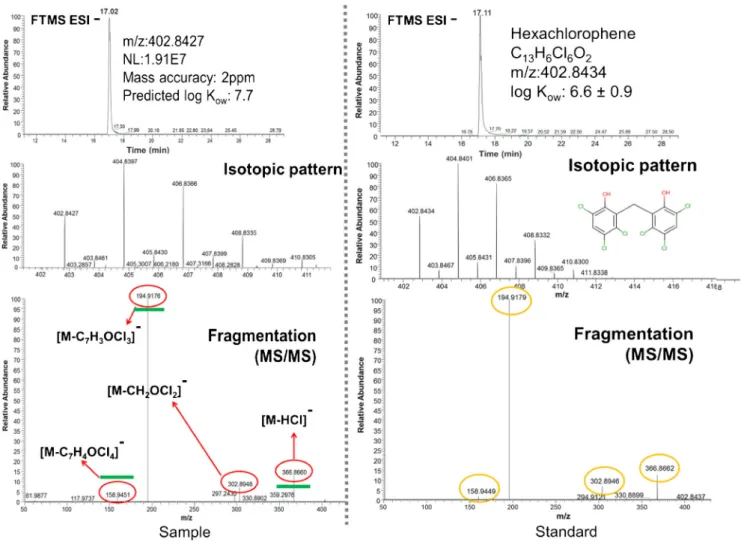
were retrieved by MetFrag, which explained two to three fragments with the proposed structures, with two fragments common to all 11 candidates. MOLGEN-MS/ MS identified subformulas for four of the fragments
(Fig. 4). As all candidates were within the log Kow/RT
range, the nontarget candidates were arranged according to the number of references in ChemSpider and PubMed, shown previously to be very useful for the
identification of “known unknowns” [35], which would
be expected in historical sediments. Hexachlorophene topped this list with 909 references in ChemSpider and 657 in PubMed and was finally confirmed by the
pur-chase of a reference standard as shown in Fig. 4.
Hexa-chlorophene has been detected in estuary sediments in
the USA [36], and although it is still in use as a
surgical hand scrub and a bacteriostatic skin cleanser,
there are only a few limited studies about its fate [37].
Nontarget compound 2
For nontarget compound 2, elucidation efforts using the mea-sured m/z 450.9619 did not yield satisfactory molecular
Fig. 4 Chromatogram, isotopic pattern, and MS/MS fragmentation used for the identification of the disinfectant hexachlorophene. The four frag-ments circled in red were identified successfully by MOLGEN-MS/MS.
The three fragments marked in green were identified by MetFrag. The standard fragments are circled in yellow
formula or structural candidates. Exploring different adduct options with MetFrag revealed many promising candidates
when considering the chlorine adduct [M+Cl]−. Consequently,
the corresponding [M−H]− exact mass, m/z 414.9846, was
searched in the chromatogram, revealing a more intense peak
(106vs 105) with the same retention time and peak shape as
the chloride adduct. Furthermore, the fragmentation patterns
were similar, with the [M+Cl]− MS/MS showing one
addi-tional fragment (Cl loss) to yield the original compound ([M
−H]−), confirming the assumption of the adduct formation.
Although the formation of ion adducts in negative ESI has not been widely reported in literature compared with positive ESI, chloride adducts have been used to enhance ion abundances after addition or contamination with solvents or salts, and chloride adducts are reported to be one of the molecular ion adducts often observed in ESI-negative mass spectra. This is in agreement with our observations and the potential presence
of residual NH4Cl from the QuEChERS sample cleanup
[38–41].
The measured m/z, MS, and MS/MS spectra
corre-sponding to [M−H]−, as well as elemental restrictions
(C, H, O, N, Cl, F), were used in MOLGEN-MS/MS to
yield a top-scoring formula of C15H8Cl2F6N2O (score
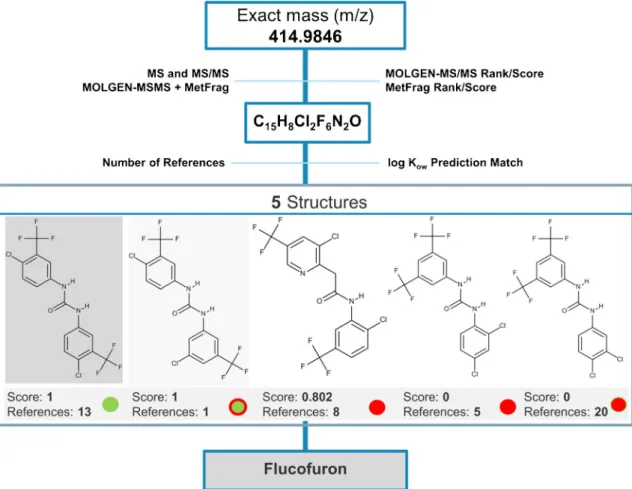
0.96) as one of 140 possible formulas due to the pres-ence of F. This formula was used in MetFrag to retrieve five structures, where two had a score of 1.0, shown in
Fig. 5. The top 2 candidates varied only in the position
of a chloride within one of the benzene rings, with the number of references indicating that the leftmost
candi-date in Fig. 5, flucofuron, was more likely (13
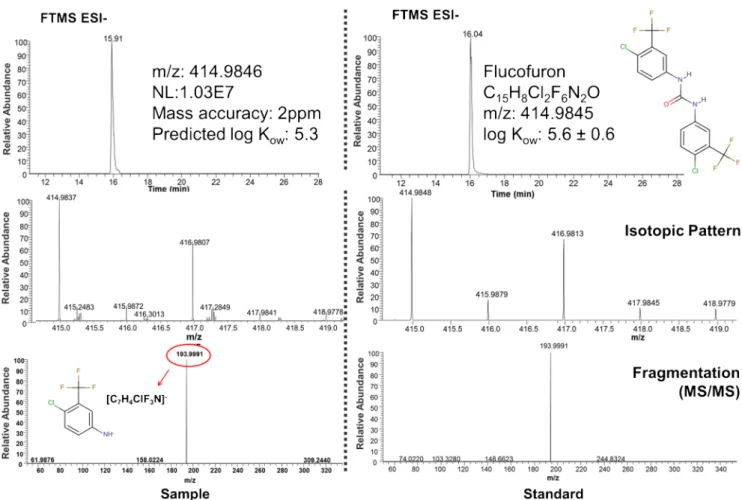
refer-ences in ChemSpider). Confirmation was achieved using
a reference standard as shown in Fig. 6. While
flucofuron is not currently available commercially in
any mothproofing agents [42], it can still be detected
in sediments due to historical use. The temporal resolu-tion of flucofuron and hexachlorophene in the sediment
cores is illustrated in Fig. 2.
The negative mass defects of hexachlorophene and flucofuron, respectively, mean that these compounds fall
out-side of the sediment matrix. As shown in Fig.1, this reduced
the number of interfering peaks in the MS and MS/MS (within the isolation window of 1.5 Da), dramatically improving both the MS1 isotope pattern match and fragmentation prediction and assignment.
Fig. 5 Flowchart for the identification of the mothproofing agent flucofuron. Criteria used for the identification is illustrated at each step, score values are from MetFrag, Reference numbers from ChemSpider
Detection of congeners and related compounds
The suspect and nontarget screening analysis revealed two disinfectants from one substance class: chlorophene and hexachlorophene. Based on these results, further chlorophene and bromophene congeners were screened in Lake Lugano and Lake Greifensee, yielding tentative identifications of the biocides dichlorophene and bromochlorophene. Bromochlorophene is very similar to tetrachlorophene, with one Cl per aromatic ring re-placed with Br in bromochlorophene. The presence of a
characteristic fragment (see ESM Fig. S2) gives
addi-tional evidence to support the presence of an isomer of bromochlorophene, but reference standards are not avail-able for all isomers and the fragmentation pattern did not match completely with the one standard purchased. Both compounds exhibited a similar temporal pattern to hexa-chlorophene and hexa-chlorophene in Lake Greifensee and
Lake Lugano, respectively (Fig. 2). The results here
show that screening for related compounds, as for chlorophene and its halogenated congeners, can also be a successful suspect screening strategy.
Conclusions
The analysis of micropollutants in sediments is generally more challenging than water samples due to the higher occurrence of natural organic matter and biomolecules, which can inter-fere with the analysis of organic contaminants. The strategy to search for compounds with a clear isotopic pattern (Cl, Br) and mass defects outside the prominent matrix mass range facilitated the suspect and nontarget screening and was very successful. The combination of MOLGEN-MS/MS and MetFrag helped direct identification efforts toward “known unknown” compounds and thus provide records of the historical contamination of two Swiss lakes. In total, three suspect candidates, two nontarget compounds, and one congener of a suspect were confirmed with ref-erence standards, while a further congener was tentatively identified. The bias here toward halogenated compounds is reasonable as many anthropogenic and potentially toxic compounds in the environment contain halogens and thus fall outside the sample matrix, but future research should address also the challenges in identifying toxicants with-out halogens in complex matrices.
Acknowledgments The authors are grateful for the assistance provided by Birgit Beck (sediment analysis), Martin Loos (enviMass), Lee Ferguson (input in suspect and nontarget screening), Martin Frey (R), Markus Moest, Piet Spaak, and Flavio Anselmetti (sediment core collec-tion). Funding from the Swiss National Science Foundation (SNF CR32I3_125211), the European Union (Marie Curie Inter-European Postdoctoral Fellowship Grant No. 299734), and the Swiss Federal Office for the Environment is gratefully acknowledged.
References
1. Chiaia-Hernandez AC, Krauss M, Hollender J (2012) Screening of lake sediments for emerging contaminants by liquid chromatography atmospheric pressure photoionization and electrospray ionization coupled to high resolution mass spectrometry. Environ Sci Technol 47:976–986
2. Peck AM, Linebaugh EK, Hornbuckle KC (2006) Synthetic musk fragrances in Lake Erie and Lake Ontario sediment cores. Environ Sci Technol 40:5629–5635
3. Löffler D, Ternes TA (2003) Determination of acidic pharmaceuti-cals, antibiotics and ivermectin in river sediment using liquid chromatography-tandem mass spectrometry. J Chromatogr A 1021: 133–144
4. Ferrer I, Hennion M-C, Barceló D (1997) Immunosorbents coupled on-line with liquid chromatography/atmospheric pressure chemical ionization/mass spectrometry for the part per trillion level determina-tion of pesticides in sediments and natural waters using low preconcentration volumes. Anal Chem 69:4508–4514
5. Reddy CM, Quinn JG, King JW (2000) Free and bound benzotriazoles in marine and freshwater sediments. Environ Sci Technol 34:973–979
6. Schwarzenbach RP, Escher BI, Fenner K, Hofstetter TB, Johnson CA, von Gunten U, Wehrli B (2006) The challenge of micropollutants in aquatic systems. Science 313:1072–1077 7. Giger W (2002) Dealing with risk factors. Eawag News 53e:3–5 8. Krauss M, Singer H, Hollender J (2010) LC-high resolution MS in
environmental analysis: from target screening to the identification of unknowns. Anal Bioanal Chem 397:943–951
9. Hernández F, Sancho JV, Ibáñez M, Abad E, Portolés T, Mattioli L (2012) Current use of high-resolution mass spectrometry in the environmental sciences. Anal Bioanal Chem 403:1251–1264 10. Ibáñez M, Sancho JV, Hernández F, McMillan D, Rao R (2008)
Rapid non-target screening of organic pollutants in water by ultraperformance liquid chromatography coupled to time-of-light mass spectrometry. TrAC Trends Anal Chem 27:481–489
11. Hogenboom AC, van Leerdam JA, de Voogt P (2009) Accurate mass screening and identification of emerging contaminants in environ-mental samples by liquid chromatography–hybrid linear ion trap Orbitrap mass spectrometry. J Chromatogr A 1216:510–519 12. Nurmi J, Pellinen J, Rantalainen A-L (2012) Critical evaluation of
screening techniques for emerging environmental contaminants based on accurate mass measurements with time-of-flight mass spec-trometry. J Mass Spectrom 47:303–312
13. Bueno MJM, Agüera A, Hernando MD, Gómez MJ, Fernández-Alba AR (2009) Evaluation of various liquid chromatography-quadrupole-linear ion trap-mass spectrometry operation modes applied to the analysis of organic pollutants in wastewaters. J Chromatogr A 1216:5995–6002
14. Bobeldijk I, Vissers JPC, Kearney G, Major H, van Leerdam JA (2001) Screening and identification of unknown contaminants in water with liquid chromatography and quadrupole-orthogonal accel-eration-time-of-flight tandem mass spectrometry. J Chromatogr A 929:63–74
15. Schymanski EL, Singer HP, Longrée P, Loos M, Ruff M, Stravs MA, Ripollés Vidal C, Hollender J (2014) Strategies to characterize polar organic contamination in wastewater: exploring the capability of high resolution mass spectrometry. Environ Sci Technol 48:1811–1818 16. Moschet C, Piazzoli A, Singer H, Hollender J (2013) Alleviating the
reference standard dilemma using a systematic exact mass suspect screening approach with liquid chromatography-high resolution mass spectrometry. Anal Chem 85:10312–10320
17. Martínez Bueno MJ, Agüera A, Gómez MJ, Hernando MD, García-Reyes JF, Fernández-Alba AR (2007) Application of liquid chromatography/quadrupole-linear ion trap mass spectrometry and time-of-flight mass spectrometry to the determination of pharmaceu-ticals and related contaminants in wastewater. Anal Chem 79:9372– 9384
18. Thurman EM, Ferrer I, Zweigenbaum JA, García-Reyes JF, Woodman M, Fernández-Alba AR (2005) Discovering metabolites of post-harvest fungicides in citrus with liquid chromatography/time-of-flight mass spectrometry and ion trap tandem mass spectrometry. J Chromatogr A 1082:71–80
19. HighChem (2014) Mass frontier, version 6.0. HighChem Ltd./ Thermo Fisher Scientific, Bratislava
20. ACD (2013) MS fragmenter. Advanced Chemistry Development Inc., Toronto
21. Wolf S, Schmidt S, Müller-Hannemann M, Neumann S (2010) In silico fragmentation for computer assisted identification of metabolite mass spectra. BMC Bioinform 11:148
22. Kanehisa M, Goto S, Sato Y, Kawashima M, Furumichi M, Tanabe M (2014) Data, information, knowledge and principle: back to me-tabolism in KEGG. Nucleic Acids Res 42:199–205
23. NCBI (2014) PubChemhttp://pubchem.ncbi.nlm.nih.gov/, National Center for Biotechnology Information, USA. Accessed 21 Mar 2014 24. RSC (2014) ChemSpider http://www.chemspider.com/, Royal
Society of Chemistry, UK. Accessed 21 Mar 2014
25. Allen F, Greiner R, Wishart D (2014) Competitive fragmentation modeling of ESI-MS/MS spectra for putative metabolite identifica-tion. Metabolomics. doi:10.1007/s11306-014-0676-4
26. Horai H, Arita M, Kanaya S, Nihei Y, Ikeda T, Suwa K, Ojima Y, Tanaka K, Tanaka S, Aoshima K, Oda Y, Kakazu Y, Kusano M, Tohge T, Matsuda F, Sawada Y, Hirai MY, Nakanishi H, Ikeda K, Akimoto N, Maoka T, Takahashi H, Ara T, Sakurai N, Suzuki H, Shibata D, Neumann S, Iida T, Funatsu K, Matsuura F, Soga T, Taguchi R, Saito K, Nishioka T (2010) MassBank: a public reposi-tory for sharing mass spectral data for life sciences. J Mass Spectrom 45:703–714
27. HighChem (2014) mzCloud https://mzcloud.org, HighChem Ltd., Bratislava, Slovakia. Accessed 31 Mar 2014
28. Smith CA, O’Maille G, Want EJ, Qin C, Trauger SA, Brandon TR, Custodio DE, Abagyan R, Siuzdak G (2005) METLIN: a metabolite mass spectral database. Ther Drug Monitor 26(6):747–751 29. Schymanski EL, Meringer M, Brack W (2011) Automated strategies
to identify compounds on the basis of GC/EI-MS and calculated properties. Anal Chem 83:903–912
30. Virtual Computational Chemistry Laboratory (VCCLAB) (2005)
http://www.vcclab.org. Accessed 9 Mar 2014
31. Kern S, Fenner K, Singer HP, Schwarzenbach RP, Hollender J (2009) Identification of transformation products of organic contaminants in natural waters by computer-aided prediction and high-resolution mass spectrometry. Environ Sci Technol 43:7039–7046
32. Loos M, Ruff M, Singer H. enviMass version 1.2 target screening software, http://www.eawag.ch/forschung/uchem/software/
enviMass1_2. Accessed 9 Mar 2014
33. Van Leeuwen SPJ, de Boer J (2007) Extraction and clean-up strate-gies for the analysis of poly- and perfluoroalkyl substances in envi-ronmental and human matrices. J Chromatogr A 1153:172–185 34. Liechti P, Der Zustand der Seen in der Schweiz (1994) Bundesamt für
35. Little J, Cleven C, Brown S (2011) Identification of“known un-knowns” utilizing accurate mass data and chemical abstracts service databases. J Am Soc Mass Spectrom 22:348–359
36. Beller HR, Simoneit BRT (1988) Hexachlorophene distributions in estuarine sediments. Bull Environ Contam Toxicol 41:645–650 37. Antonic J, Heath E (2007) Determination of NSAIDs in river
sedi-ment samples. Anal Bioanal Chem 387:1337–1342
38. Cole RB, Zhu J (1999) Chloride anion attachment in negative ion electrospray ionization mass spectrometry. Rapid Commun Mass Spectrom 13:607–611
39. Mathis JA, McCord BR (2005) The analysis of high explosives by liquid chromatography/electrospray ionization mass spectrometry:
multiplexed detection of negative ion adducts. Rapid Commun Mass Spectrom 19:99–104
40. Zhu J, Hou Y, Feng Y-l, Shoeib M, Harner T (2008) Identification a n d d e t e r m i n a t i o n o f h e x a c h l o r o c y c l o p e n t a d i e n y l -dibromocyclooctane (HCDBCO) in residential indoor air and dust: a previously unreported halogenated flame retardant in the environ-ment. Environ Sci Technol 42:386–391
41. EnviPat Web 1.3 (2013) Isotopic pattern and profile calculator. Eawag, Dübendorfhttp://www.envipat.eawag.ch/index.php 42. Tomlin CDS (1995) The pesticide manual, 10th edn. Royal Society
of Chemistry, Cambridge, and British Crop Protection Council, London