HAL Id: tel-01778152
https://tel.archives-ouvertes.fr/tel-01778152
Submitted on 25 Apr 2018HAL is a multi-disciplinary open access archive for the deposit and dissemination of sci-entific research documents, whether they are
pub-L’archive ouverte pluridisciplinaire HAL, est destinée au dépôt et à la diffusion de documents scientifiques de niveau recherche, publiés ou non,
Abdulhafiz Alkhouli
To cite this version:
Abdulhafiz Alkhouli. Continuous processing of top-k queries in social networks. Social and Information Networks [cs.SI]. Université de Cergy Pontoise, 2017. English. �NNT : 2017CERG0895�. �tel-01778152�
ENSEA, CNRS (UMR 8051)
ETIS, Equipes Traitement de l’Information et Systémes -École doctorale Sciences et Ingénierie
THÈSE DE DOCTORAT
présentée pour obtenir le titre de DOCTEUR en Informatique
Abdulhafiz ALKHOULI
Continuous top-k queries in social networks
Directeur de thèse
Dan VODISLAV, Professeur, laboratoire ETIS Co-encadrant
Boris BORZIC, Ingénieur de recherche, laboratoire ETIS
Date de soutenance : 29 Septembre 2017 COMPOSITION DU JURY
M. Bernd AMANN, Professeur, laboratoire LIP6, Université Pierre et Marie Curie, Paris Rapporteur M. Jean-Marc PETIT, Professeur, laboratoire LIRIS, INSA Lyon Rapporteur Mme. Salima BENBERNOU, Professeure, laboratoire LIPADE, Université Paris Descartes Examinatrice M. Cédric DU MOUZA, MCF HDR, laboratoire CEDRIC, CNAM Paris Examinateur
M. Dimitris KOTZINOS, Professeur, laboratoire ETIS Examinateur
M. Dan VODISLAV, Professeur, laboratoire ETIS Directeur de thèse
Abstract 1 Abstract 3 1 Introduction 5 1.1 Information streams . . . 5 1.2 Processing models . . . 9 1.3 Diversification . . . 10 1.4 Thesis focus . . . 11 1.5 Thesis outline . . . 13
2 State of the art 15 2.1 Continuous top-k queries for information streams . . . 15
2.1.1 Filtering text streams . . . 17
2.1.2 Top-k multicriteria algorithms . . . 18
2.1.3 Filtering social streams . . . 20
2.1.4 Web search with social network-aware personalization . . . 22
2.1.5 Processing top-k queries in a social network context . . . 25
2.1.6 Real-time search . . . 26
2.1.7 Continuous processing of top-k queries over text streams . . . 28
2.2 Diversity-Aware top-k query processing over information streams . . . 35
2.2.1 Query results diversification . . . 37
2.2.2 Diversification for top-k queries over streaming data . . . 39
2.2.3 Diversification in Publish/Subscribe system . . . 40
3 Continuous top-k queries in social networks 43 3.1 Data and processing models . . . 44
3.1.1 Data model . . . 44
3.1.2 Scoring function . . . 45
3.1.3 Problem statement . . . 46
3.1.4 Processing model . . . 47
3.2 The SANTA algorithm . . . 48
3.2.1 Index and other data structures. . . 48
3.2.2 Scoring function . . . 49
3.2.3 The algorithm . . . 49
3.2.5 CF+: an extended version of COL-Filter . . . 56
3.3 Experimental evaluation . . . 56
3.4 Summary . . . 65
4 Diversity-aware continuous top-k queries in social networks 67 4.1 Data and processing models . . . 68
4.1.1 Data model . . . 68
4.1.2 Relevance scoring function . . . 68
4.1.3 Diversity model . . . 68
4.1.4 Processing model . . . 69
4.1.5 Problem statement . . . 69
4.2 The DA-SANTA algorithm . . . 70
4.2.1 DA-SANTA scoring . . . 70
4.2.2 Victim selection heuristics . . . 71
4.2.3 The DA-SANTA index . . . 71
4.2.4 The case of time-dependent scoring . . . 73
4.2.5 The algorithm . . . 73
4.3 Experimental evaluation . . . 75
4.3.1 Experimental setting . . . 75
4.3.2 Effectiveness of DA-SANTA . . . 77
4.3.3 Efficiency of DA-SANTA . . . 79
4.3.4 Comparison with Baseline and Incremental . . . 80
4.4 Summary . . . 81
5 Conclusion and Future Work 83 5.1 Thesis Summary . . . 83
5.2 Future Works . . . 85
Information streams provide today a prevalent way of publishing and consuming con-tent on the Web, especially due to the great success of social networks. In the social networks context, users may subscribe to several information sources of interest and continuously receive new published content. But, this new publishing/consumption mode may lead to huge amounts of received information, overwhelming for human processing. Thus, there is a vital need to develop effective filtering and ranking techniques which allow users to efficiently be updated with the most interesting content.
Continuous top-k queries over the streams of interest allow limiting results to the
most relevant content. To provide a relevant content, the ranking model should consider various context factors including the traditional content-based ones, but also time-based and social network factors. In the social network, maintaining top-k sets may be more difficult because of their dynamic context: users not only publish new messages, but may also interact with existing ones, modify relations, change the profile, etc. For a large social network with millions of users and billions of messages, the continuous processing of the continuous top-k queries is the most effective approach. However, current systems fail in combining continuous top-k processing with rich scoring models including social network criteria. Moreover, such systems do not consider the diversity of published content.
In this thesis, we focus on filtering information streams based on the computation of top-k messages for each user in the social network. We aim at developing a scalable system able to efficiently evaluate the continuous top-k queries with a complex scoring function. We propose the SANTA algorithm, able to handle scoring functions including content similarity, recency, but also social network criteria and events in a continuous processing of top-k queries. We propose a variant (SANTA+) that accelerates the processing of interaction events in social networks. To provide both diverse and relevant messages in top-k sets, we propose the DA-SANTA algorithm which extends the SANTA algorithm to integrate the diversity into the continuous top-k model while maintaining the efficiency of the system. Our experiments are conducted over a real dataset extracted from Twitter, illustrating the properties of our algorithms and demonstrating their efficiency.
En raison du grand succès des réseaux sociaux, la nature et mode de diffusion de l’information sur le Web a changé en faveur de contenus dynamiques diffusés sous forme de flux d’information. Dans le contexte des réseaux sociaux, les utilisateurs peuvent s’abonner à de multiples sources d’information et recevoir continuellement de nouveaux contenus. Or, ce nouveau mode de publication/consommation peut entraîner d’énormes quantités d’information, en surchargeant les utilisateurs. Ainsi, il est essentiel de développer des techniques efficaces de filtrage et de classement qui permettent aux utilisateurs d’être efficacement mis à jour avec le contenu le plus intéressant.
Les requêtes top-k continue sur les flux d’information limitent les résultats au contenu
le plus pertinent. Pour améliorer la pertinence des résultats, le modèle de classement des résultats de requêtes devrait tenir compte de divers facteurs de contexte, y compris les facteurs traditionnels basés sur le contenu, mais aussi sur le temps les facteurs liés aux utilisateurs et à leurs relations (réseau social). Dans le réseau social, le maintien des ensembles de top-k peut être plus difficile à cause de son caractère dynamique: au-delà de la publication de messages, on peut interagir avec des messages existant, modifier les liens avec d’autres utilisateurs, changer son profil, etc. Pour un grand réseau social avec des millions d’utilisateurs et des milliards de messages, le traitement continu des requêtes top-k continue est l’approche la plus efficace. Cependant, les systèmes actuels pour le traitement continu des requêtes top-k ne considèrent pas des modèles de classement riches, incluant des critères de réseau social. En outre, de tels systèmes ne tiennent pas compte de la diversité des contenus publiés.
Dans cette thèse, nous nous concentrons sur le filtrage des flux d’information basé sur le calcul des messages top-k pour chaque utilisateur dans le réseau social. Nous visons à développer un système à large échelle capable d’évaluer efficacement les re-quêtes top-k continues avec une fonction de classement complexe. Nous proposons l’algorithme SANTA, capable d’utiliser des fonctions de classement, incluant la sim-ilarité du contenu, le temps mais aussi les critères et les événements du réseau social avec un traitement continu des requêtes top-k. Nous proposons aussi une variante (SANTA +) qui accélère le traitement des interactions avec les messages dans les réseaux sociaux. Pour fournir des réponses pertinentes et diverses, nous proposons l’algorithme DA-SANTA qui étend l’algorithme SANTA pour intégrer la diversité dans le modèle top-k continu tout en maintenant l’efficacité du système. Nos ex-périmentation sont menées sur des données réelles extraites de Twitter, permettant
1.1 Information streams
Web 2.0 technologies have deeply changed the way information is published and consumed on the Web. Content publishing takes more and more the form of mation streams available through various information channels. As a result, infor-mation consumption becomes per stream where users receive in real-time contents from different information sources. Information streams consist of flows of items, usually short semi-structured text messages, possibly containing links to some Web resources (images, videos, pages, etc.), and continuously published through specific diffusion channels, e.g. RSS feeds from media, blogs, discussion forums, social net-works, etc. Users may subscribe to several information channels of interest and continuously receive new published content. Users may also query this dynamic streams to retrieve relevant information. Every moment, billions of messages being published with a variety of topics and millions of users expect to receive in real-time a stream of the most interesting messages. For example, Twitter1 has 320 million
active users with 340,000 tweets per minute2.
This dynamic content generation and consumption has continuously gained im-portance compared to traditional Web publishing (of Web pages) and exploring (through bookmarks, search engines and hyperlink navigation). Nevertheless, the new publishing/consumption mode may lead to huge amounts of received items, overwhelming for human processing. Thus, there is a vital need to develop effec-tive filtering and ranking techniques which allow users to efficiently be updated with the most interesting items. Effective processing of the enormous amount of messages in information streams has generated considerable recent research interest [CNN+10, CC15, BOPY07, HMA10]. One of the main objectives of these studies is
how to provide an interesting content for a large number of users and ensure effective filtering techniques given this unprecedented amount of messages.
Nowadays, users play a key role in the production and consumption of information streams. Previous passive readers have become both active information collectors and producers. With the great success of the social network, users actively par-ticipate in providing information. In social network services, users can have sev-eral social activities such as publishing a message in Twitter, uploading a video on
1www.twitter.com
Youtube3, tagging a picture in Flickr4 or sharing a message in Facebook5. This user-generated content contributes to the exponential growth of the Web as seen in Figure 1.1 which shows the large amount of data generated by several social services every minute in 2016. In this context, the large number of social network users be-comes a challenge in the ranking techniques. The collection of the generated content in the social network, ranking, and filtering of such large-scale multi-query environ-ment should be made in real-time. In addition, user queries could be implicit based on user profiles that consider long queries, which have a significant impact on the effectiveness of the filtering approach compared to small queries.
A common behavior in almost all social networks is that each user follows other users “friends” in order to be informed of newly published content. Consequently, users receive real-time content published by their friends. An important dimension in this publish-subscribe (pub/sub) framework is the relationship between publishers of information streams and subscribers. This social network dimension varies from no relationship at all in the case of RSS/Atom feeds, to possible interaction with the published messages on blogs (comments) and discussion forums (reply messages), and to explicit relationships between users playing the double role of publishers and subscribers on social networks such as Facebook (symmetric “friendship” relations) or Twitter (asymmetric “following” relations). The social network dimension con-tributes not only with providing information streams of interest to end users, but also comes with criteria to measure this potential interest.
Furthermore, social networks allow users to evaluate content by giving feedback at different levels. Users can produce different types of feedback on the published content, e.g. they can like a message, comment on it or share it. Each of these types plays an important role in assessing the importance of the published content and the visibility of information. Many research works in the web search domain have focused on integrating the social network dimension and social feedback in the filtering techniques in order to personalize the results and to improve their quality [YLL10, GCK+10, KS12]. Unfortunately, these studies fail to process in real-time a
huge amount of information for a large number of users.
One way to cope with the huge amount of information, potentially interesting, available from different information channels is to organize the channels of interest by topic. Mechanisms such as RSS/Atom allow users to subscribe to information sources; once a new information is available in the subscriptions sources, users will immediately be notified. By using RSS reader applications such as Feedly6, users
can group the information sources by topic (e.g Politics, Science, Tech, etc.), to help users to choose information streams of interest. This is impractical since it limits the number of the subscriptions sources made by users, otherwise users would still be overloaded by the published content. Also, in each channel not all the published
3www.youtube.com 4www.flickr.com 5www.facebook.com 6www.feedly.com
Figure 1.1: Content generated by users every minute in 2016
content is equally useful to users. Thus, models for ranking content and filtering are necessary.
Recent research studies propose methods for filtering information streams. Boolean filtering model has been first proposed for text streams, using filters based on boolean keyword predicates. However, it is difficult to manage the number of results because in one context it may retrieve too many results and too few in another context. An alternative way to organize the large amounts of stream messages is to define a ranking model based on the importance of a message relative to a given subscription query. Measuring this importance by a relevance score allows end users to identify and to focus on the most important messages for them. Some approaches [ZC01, YGM99] limit the number of query results through a predefined threshold for the relevance score, only the messages that pass the threshold are presented to users. Nevertheless, choosing a threshold value to be suitable for a given context is a very hard task.
More recent works over information streams [MP11, RCCT14] consider only the k most relevant results in (pub-sub) publish-subscribe framework. This thesis adopts the filtering of the stream messages based on the continuous top-k model. This model
continuously maintains the k most relevant messages of the stream for each subscrip-tion query in the pub-sub system. In this context, the first significant challenge is
to define the ranking model since it plays a key role in determining the complexity and quality of results in the system.
The ranking model may depend on various context factors, among which we em-phasize the following ones:
• Content based factors, measuring the adequacy of the message content with the subscription query. Since textual content is characteristic to information streams, content-based subscription queries are usually based on sets of terms of interest, and the importance of a message is evaluated from an information retrieval perspective, as the relevance of the text message to the query, based on popular models such as tf-idf [SB88] or BM25 [JWR00].
• User based factors, measuring the importance of users and of their relation-ships in the social network, for instance the importance of the message pub-lisher and of the relationship between the subscriber and the pubpub-lisher. In most cases user-based importance is measured on the social network graph, by evaluating e.g. node centrality and distance between nodes.
• Interaction based factors, measuring the importance of messages by the reac-tion they provoked, expressed through acreac-tions of other users on that message. Depending on the social network context, current actions may be likes, com-ments, forwards, tagging as favorite, etc.
• Time based factors, measuring the decrease of importance for a message as time goes by. Two main approaches are used to take into account this dimen-sion: sliding time windows [GÖ03], resulting in dropping messages older than
a given duration, and time decay functions [SGFJ13, VAC12], expressing a continuous decrease of importance.
Other context factors, that we do not consider here, may contribute to evaluate the importance of messages, such as geographic location or other information elements specific to the social network and to the pub/sub environment. In Chapter 3, we will describe in detail our ranking model and how to implement these different factors. We will also see how to manage in particular the last two factors since these factors are dynamic (change over time).
1.2 Processing models
The second main challenge in the continuous top-k model for filtering information streams is the design and implementation of efficient processing models at a very large scale (millions, up to billions of users and information streams). In the case of ranking models based on scoring functions, where subscription results are limited to the most important messages, the main difficulty comes from the need of continu-ously (re-)computing the score of every message relative to every subscription query and of subsequently maintaining the lists of subscription results. The complexity of this task depends not only on the number of messages and queries, but also on the form of the scoring function.
Two main approaches of processing models have been proposed in the literature and in the commercial systems. The static approach runs periodic snapshot queries on all published messages to get the list of the most important messages for each user. The continuous approach handles subscriptions as continuous queries reacting to new messages and to other events, in order to incrementally maintain the important messages. If the continuous approach is more efficient, it also has more difficulties to handle complex scoring functions. To the best of our knowledge, the continuous methods proposed so far only explored simple scoring functions, most of the time based on the textual content, eventually combined with time factors. More com-plex scoring, including social network factors has been proposed, but only handled through a static approach.
Figure 1.2 presents the general architecture of continuous top-k processing of infor-mation streams, behaving as an event-based system. The result of such a process is the set of top-k messages for each user in the social network, continuously main-tained by the system. The event processor handles every input event that may produce changes to the result lists, computes changes and subsequently updates the result lists. Change computation is based on the data structures representing the information streams and the social network, and on the index structures that enable efficient event processing.
• Continuously handled events, with potentially strong impact on top-k update, and that must be processed on the spot. We include in this category, the publication of a new message and the interaction with an existing message. • Secondary events, with a weaker impact on the top-k lists; they may be
accu-mulated and processed from time to time. We include in this category changes in the social network that may produce small changes in the scoring parame-ters.
Evaluating the impact of various categories of events depending on the scoring model is a difficult problem, but continuously reacting to any event that may change some message score component is not realistic in practice, given the complexity of our scoring function. The above classification of events is a necessary trade-off between efficiency and precision.
In Chapter 3, we present our model for continuous top-k processing and we describe the SANTA algorithm, able to handle scoring functions taking into account the above factors. We also present a variant (SANTA+) that improves the processing of interaction events in social networks.
Figure 1.2: General architecture for continuous top-k processing of information
streams
1.3 Diversification
Despite the positive effect of the proposed scoring models to improve the filtering process and increase user satisfaction in the top-k pub/sub system, such models do not guarantee that messages in top-k are diverse. Indeed, ranking based solely on relevance can often produce results that are too homogeneous, which could lead to the over-specialization problem. Moreover, in the social network environment, when an important event occurs, for example “Brexit”, stream messages published on this event tend to be similar due to the nature of the actions in this environment, i.e sharing, retwetting, tagging, liking, etc. Thus, users may receive similar and redundant messages in real time.
The diversification of results is widely studied in traditional IR system and web search to improve the results quality [VRB+11, AK11, GS09]. The aim of
diversi-fication is to ensure that the query results are the most relevant and, at the same time, as diverse as possible. In the literature, several forms of the diversity have been studied. Content-based diversification focuses on increasing dis-similarity be-tween documents in search result. Intent-based diversification interprets explicitly all possible intents (topics) of user’s query using external information such as query logs, and retrieves documents that satisfy all these intents. In this thesis, we focus on the content-based diversification in order to avoid duplicate content in the top-k lists.
In general, a new message can enter a top-k of a given user, if it has a good enough relevance score. In content-based diversification, a new criteria (diversity) is added to the relevance to rank the messages in the top-k list. The relevance expresses the importance of a message for a user query, diversity could express the distance of a message to other messages in top-k. This creates a new filter for stream messages because we want to avoid similar messages in the results, even if the new message has a good relevance score to be ranked high in the top-k, it can be excluded if its diversity is low, i.e it is very similar to existing messages in top-k. In order to combine these two criteria, we adapt bi-criteria objective functions ([GS09]) that mix the relevance and diversity in a linear way.
In information streams context, few researchers have addressed the problem of diver-sity for a large number of queries. To our knowledge, all of top-k pub/sub systems excepting [CC15], do not consider the diversification of results. In the second part of the thesis, we focus on the diversity alongside the relevance in the computation of top-k. We develop an effective solution to scaling up on the number of stream messages and users. In Chapter 4, we present the DA-SANTA (Diversity-aware SANTA) algorithm, which is able to continuously maintain the k messages that are both diverse and relevant for each subscription query in the top-k pub/sub system.
1.4 Thesis focus
In this thesis, we focus on filtering information streams in a social network context based on the computation of top-k messages for a large number of users. We follow the continuous approach to evaluate the top-k queries using a rich scoring function mixing content-based, user-based, interaction-based and time-based components. We also tackle the diversity problem to improve the effectiveness of results and increase the user satisfaction. We model the social network as a pub/sub environ-ment, where users publish messages and subscribe to information streams produced by other users in the network. The subscription queries are implicit, based on the user profile. In this model, when a new message is published by a user, all other users are candidates. We aim to achieve two main objectives. First, to develop a scalable method to maintain the k most relevant messages for each user in the social
network at all time. Second, to introduce diversity into this model in order to ensure that messages in top-k lists are relevant and diverse while preserving the efficiency and the quality of the results.
The main contributions of this thesis are the following ones:
• We propose a general model of information stream social network (ISSN) cov-ering many existing social networks. In an ISSN model, stream messages are generated by social network users and relations between users are non-symmetric. User profiles constitute implicit queries over message streams. In order to filter/rank stream messages, we propose a rich scoring model includ-ing all the factors introduced above: textual content importance, user relative importance, interaction importance and time factor.
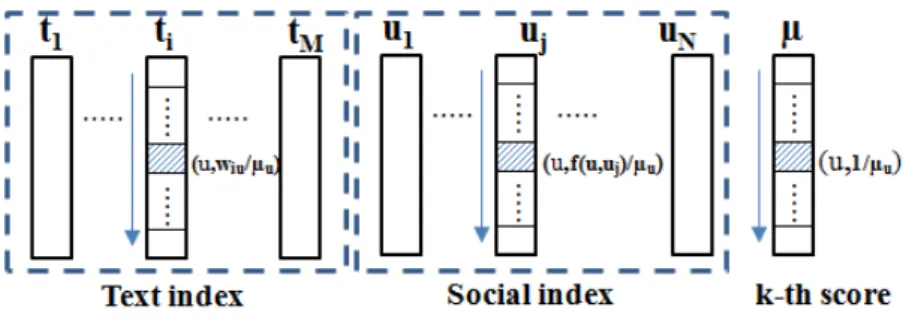
• Based on this model, we propose an algorithm, SANTA (Social and Action Network Threshold Algorithm), for continuous top-k processing of information streams, using a scoring function that includes all the social network factors identified above, and able to handle both publication and action events - to the best of our knowledge, SANTA is the first algorithm of this type. SANTA adopts a simple sorted-lists index that provides flexibility for the extension to new score criteria in a social network context, and for parallel processing. To enable efficient processing for a new event, we use an index structure for queries (user profiles). SANTA using threshold-based techniques evaluates the new event with a limited number of queries in the index. Existing algorithms for continuous top-k processing [VAC12, HMA10, SGFJ13, MP11] can be hardly extended with social network criteria in the scoring function and face the problem of heavy index updates when the top-k scores change. Unlike them, SANTA minimizes index updates by isolating changes into a single dimension. • A variant of SANTA, called SANTA+, that significantly improves the pro-cessing of action events. SANTA+ avoids re-propro-cessing messages by mataining an additional data structure to store the processed messages with in-formation calculated when the message is published.
• The DA-SANTA (Diversity-aware SANTA) algorithm extending the SANTA algorithm for top−k continuous processing, and is able to continuously main-tain the k messages that are both diverse and relevant for each query in the system. The DA-SANTA algorithm adopts the commonly used max-sum
di-versification bi-criteria objective function [GS09] to combine relevance and
diversity into a single scoring function for top−k computation.
• A rich set of experiments over a real dataset extracted from Twitter, illus-trating the properties of our algorithms and demonsillus-trating their efficiency compared to an extension of a state-of-the-art algorithm.
1.5 Thesis outline
Chapter 2 presents a literature survey of the related work. The first part of this chap-ter presents a review in the context of the continuous top-k queries for information streams. We present the filtering and ranking models proposed over text streams. For the top-k queries, we first introduce the general algorithms for processing top-k queries. We also present new filtering approaches used when the streams are pro-duced in social networks. Then, we introduce the ranking models based on social network criteria in the search on the Web. We present the works that addressed the problem of processing top-k queries in the context of the social network. Finally, we present the closest studies to this thesis, the continuous top-k queries over informa-tion streams. The second part presents the problem of query results diversity. We first present a general introduction to the problem. Then, we introduce approaches for computing the diverse top-k result over a static collection of data. Finally, we present the continuous version of the query results diversity.
Chapter 3 describes our first contribution. We present our model of information stream social network (ISSN), the ranking model including social network criteria, and the SANTA/SANTA+ algorithms. Finally, we compare our algorithms with an extension of the closest approach in the state of the art, the COL-Filter algorithm. Chapter 4 describes the second contribution. We present the problem of query results diversity, in particular, the continuous version of the diversification. We in-troduce the adopted diversity model. Then, we describe the DA-SANTA algorithm. Finally, we present the experimental evaluation of our approach.
This work aims at realizing two main objectives. The first one is to propose an efficient solution for filtering content over text streams based on top-k selection with an efficient continuous processing approach. The proposed ranking function in the top-k model considers social network factors combined with text relevance factors. The second objective is to consider the results diversification problem in this continuous top-k model, while preserving the efficiency and effectiveness of our model.
This Chapter is divided into two parts. In the first part, section 2.1 presents an overview of the continuous top-k queries for information streams. In the second part, section 2.2 presents the problem of query results diversity.
2.1 Continuous top-k queries for information streams
Publishing and consuming content through information streams is today at the heart of the new Web. Information streams consist of flows of items, usually short semi-structured text messages, possibly containing links to some Web resources (images, videos, pages, etc.), and continuously published through specific diffusion channels, e.g. RSS feeds from media, blogs, discussion forums, social networks, etc. Users may be both producers and consumers; as consumers, they subscribe to informa-tion channels of interest and continuously receive on it, in real-time, new published content. Nevertheless, this new dynamic publishing/consumption mode may lead to huge amounts of received items, overwhelming for human processing. Thus, there is a vital need to develop effective filtering and ranking techniques which allow users to efficiently be updated with the most interesting items.Our first goal is to propose an efficient solution for filtering content over text streams based on top-k selection with an efficient continuous processing approach. We dis-tinguish in general two types of top-k queries, snapshot top-k queries and continuous
top-k queries.
• Snapshot top-k queries return the k most relevant results from a static col-lection of items at a moment in time. The top-k results do not change in time.
• Continuous top-k queries are applied over a stream of items. These queries maintain the k most relevant results of the stream at all time. That is, continu-ous queries continue to update the top-k results when new items are available.
Many of algorithms are proposed for processing snapshot top-k queries in databases and information retrieval systems. In the case of multicriteria ranking, the most popular algorithms are Threshold Algorithm (TA) and No Random Access (NRA) [Fag02], presented below.
In this thesis, we are interested in the continuous top-k queries over information streams in the social networks. As mentioned above, two main categories of
process-ing models for the continuous top-k queries have been proposed to date, the static approach and continuous approach.
1. The static approach is based on periodic snapshot queries over the set of pub-lished messages to get the top-k list for each query. In this model, the pubpub-lished messages are maintained in some index structure. Then, with a predefined scheduling strategy, a top-k algorithm is applied on the indexed messages for computing the top-k set from scratch for every subscription query. One of the major challenges is that messages arrive in real time and with a very high throughput. Maintaining all messages in an index structure is very costly. Also, the periodic evaluation of a large number of queries from scratch is clearly inefficient. The static approach is used in Twitter’s search service, see subsection 2.1.6 for more details.
2. The continuous approach handles subscriptions as continuous queries reacting to new messages and to other events, in order to incrementally maintain the important messages. Here, only the subscription queries are indexed, and the incoming events are processed on-the-fly. Only the top-k results for the impacted queries are incrementally updated when a new event arrives to the system.
Recent works over information streams [MP11, HMA10, RCCT14, VAC12, SGFJ13] have adopted the continuous processing approach for top-k computation. If the
continuous approach is more efficient, it also has more difficulties to handle complex
scoring functions. The continuous methods proposed so far only explored simple scoring functions, most of the time based on the textual content, possibly combined with time factors. More complex scoring, including social network factors has been proposed, but only handled through the static approach.
We organize this section as follows: Subsection 2.1.1 presents filtering techniques used over text streams, in particular, the boolean filtering model and the filtering based on ranking models (top-k filtering). In Subsection 2.1.2, we present the pop-ular algorithms for processing snapshot top-k queries in databases and information retrieval systems. In Subsection 2.1.3, we present specific filtering techniques and recommender systems when text streams are produced in a social network. Subsec-tion 2.1.4 presents works that focused on the personalizaSubsec-tion of web search results and ranking models based on social network criteria. Subsection 2.1.5 introduces techniques and approaches for processing snapshot top-k query that use ranking models based on social networking criteria. In Subsection 2.1.6, we introduce top-k processing for continuous top-k multi-query environment based on the static
ap-proach. Subsection 2.1.7 presents continuous processing of top-k queries for a large
scale pub/sub environment.
2.1.1 Filtering text streams
Several approaches have been proposed to tackle the problem of reducing the amount of information received from different streams by filtering their contents. We present in this section the most important filtering models proposed over text streams. The Boolean filtering model has been first proposed for text streams, using filters based on Boolean predicates. In this model, the query is expressed by boolean expressions on terms, the terms are equally weighted. All items that match the query predicates, will be retrieved without any relevance ranking. In a pub/sub context such solutions [HKC+12, YGM94b] come with various index structures based on
inverted lists for fast detection of the subscription queries concerned by a stream input message and avoid checking all subscriptions queries, in the context of a large number of subscriptions. The drawback of boolean filtering is that the number of results may be in some cases too big or too small.
Filtering based on ranking models. By using ranking models based on relevance
scores, it is possible to select the best results and to adapt their number to the needs of the end users. Information retrieval (IR) ranking models, such as tf-idf [SB88] or Okapi BM25 [JWR00] provide ranking of results through a relevance score computed for each item in the context of a given text query. Usually, the Vector Space Model is used to represent queries and items and the cosine similarity function is considered to compute the query-item text relevance score [BM96]. Two main approaches have been proposed for filtering stream messages in an IR ranking context. The first one uses a predefined threshold for the relevance score [YGM94a, YGM99, Cal96, SB88] and it only keeps items in the query’s result with a query-item similarity score that exceeds the threshold. However, finding the right threshold in a given context is a difficult task. A low threshold value may make the user be overloaded with an important amount of results, on the other hand, a high threshold value return no results at all. For this reason, [ZC01] proposes a method for adaptive detection of this threshold.
The second approach is a top-k computation that keeps only the k most relevant items in the query’s results. The difficulty in this case, compared to threshold-based ranking, is to continuously maintain a changing list of top-k results.
In this context, our work addresses top-k filtering for information streams in a so-cial network environment, going beyond text-only scoring models. We propose a social relevance score to compute the relevance of a message in the social network environment. Our purpose is to go beyond the state of the art methods for contin-uous processing of top-k queries over information streams, by considering a social
network environment with complex scoring functions that include the ranking fac-tors mentioned above: content-based, social network based criteria and time-based factor.
2.1.2 Top-k multicriteria algorithms
In this section, we introduce the most popular algorithms for processing snapshot
top-k query based on multiple criteria used in databases and information retrieval
systems. The most known algorithm in this context is the Threshold Algorithm (TA) [Fag02]. Our work and many of the top-k algorithms for information streams that will be presented below, are based on the TA algorithm. In the following, we explain the TA algorithm from the perspective of information retrieval.
Given a finite set of documents D, for a document d ∈ D having m terms T d = {t1, ..., tm}, we note wt1d, ...., wtndthe weights of terms in d (each term weight in the
interval [0, 1]). Given a query q with n terms T q =nt01, ..., t0no, with wt0
1q, ..., wt 0
nq the
weights of terms in q. The overall relevance score for a document d relative to q is
f (wt0
1q, ..., wt 0
nq; wt1d, ...., wtnd). Given a fixed number k, the top−k algorithm should
find the best k documents with the highest overall score.
In information retrieval, the TA algorithm supposes the documents are indexed in an inverted index sorted by the term weights. Let ω be the number of all terms appearing in D, the inverted index consists of ω sorted lists l1, ..., lω. Each term t maps to a list l that indexes documents containing t, sorted in the descending order of the term weight where each entry in the list has the form (di, wtdi). The TA
algorithm requires the aggregation function f to be monotonic, which is the case with cosine similarity or with BM25.
At query evaluation, the algorithm identifies the lists corresponding to the query terms. The TA algorithm traverses the lists as follows: it sequentially accesses the first entry of each of the lists, then the second entry of each of the lists, and so on. For each document seen in the index, the overall score is computed and if this score is greater than the k − th score in the current top-k then the document can be added to the top−k list. To avoid evaluating all the documents in the lists, TA examines a stopping condition at each step. Let (di, wtj) be the last entry seen in
each list lj, the threshold value τ is f (wt01q, ..., wtn0q; wt1d, ...., wtmd) and TA stops if
the k − th current score is equal or greater than τ . Note that, the threshold value represents the best possible score for unseen documents because of the monotonicity of the aggregation function and the order in the inverted lists. This means that the stopping condition guarantees that no unseen document can enter the top-k, because its best score would be smaller than the k − th score.
In the TA algorithm, in order to compute the overall score for a document seen in the sequential access on a list, it should randomly access to the other lists to get the weights of the document for the other terms. A variant to the TA algorithm, called
no random access (NRA) could be used when the random access is not available to the lists. An interval of scores is computed for each document instead of the overall score. In this interval, the minimum(maximum) value represents the mini-mum(maximum) score of the document and is updated by traversing the lists. Note that, in this case, the documents in the current top-k are sorted by the minimum score values. Like in the TA the threshold value τ is computed by aggregating the last entries seen in the lists and the NRA stops when the minimum score of the
k − th document is greater than the threshold value τ and exceeds the maximum
values of the candidates’ scores.
Figure 2.1: Execution example for the threshold algorithm TA
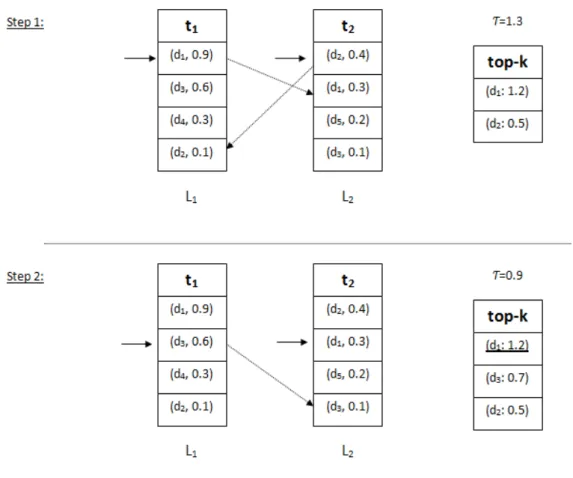
Example 1. Figure 2.1 shows the evaluation of the top−1 results of the query
q(t1, t2) with the TA algorithm. We consider that the aggregation function is the
cosine similarity presented below. For simplicity, the query term weights are equal to
1; wq,t1 = 1, wq,t2 = 1 and we did not use here normalized weights. We consider the two lists (L1, L2) in the inverted index which correspond to the query terms(t1, t2)
sorted in descending order of the documents term weights wd,t1, wd,t2.
In step 1, the documents d1, d2 are retrieved following a sequential access on the
lists L1, L2 respectively. For each document, the algorithm randomly accesses the
be added to the current top−k with their final scores d1 = 1.2, d2 = 0.5 and the
threshold value is computed τ = 1.3. Remember that, the the threshold value is
obtained by applying the aggregation function to the last entry seen in each list. In this step the TA does not stop since the threshold value τ = 1.3 is greater than the k − th document score in the current top−k, d1 = 1.2. Note that here the
k − th document is d1 since k = 1. In step 2, TA retrieves a new candidate d3 and
the threshold value becomes τ = 0.9. In this step, TA confirms that the document
d1 = 1.2 is the top−1 result for the query q and it stops since τ = 0.9 < d1 = 1.2,
which means that the maximum score for any unseen document τ is below of the
k − th current score.
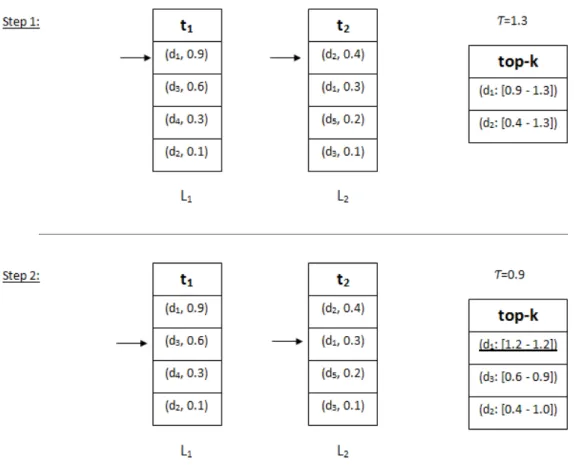
Figure 2.2 shows the evaluation of the query q(t1, t2) using the NRA algorithm. As
mentioned above, NRA only allows the sequential access to the lists and maintains an interval of scores for each candidate. In step 1, as for TA the documents d1, d2
are retrieved following a sequential access to the lists L1, L2. But here, the interval
of scores is computed for each of them instead of an exact score. For example, the document score interval of d1 is [0.9 − 1.3] where its partial score in the list L1
(the minimum score) is 0.9 and its maximum overall score is 1.3. Note that, the maximum overall score of d1 is obtained by applying the aggregation function on
its partial score in L1, (0.9) and the maximum partial score that would have in L2,
(0.4). The documents are maintained in descending order of their minimum scores in the current top-k list. Like in TA, the threshold value τ equal to 1.3. In step 2, the interval scores for each candidate are updated. In this step, the document d1has
its exact score [1.2 − 1.2]. The algorithm NRA stops since the minimum score of the
k − th document in the current top−1 , d1[1.2 − 1.2] is greater than the threshold
value τ = 0.9 and all the maximum scores of the other documents in the current
top-k list.
2.1.3 Filtering social streams
This section presents information filtering over the streams produced by the users of the social network, in this context the proposed filtering techniques benefit from the social dimension. The relationship between users introduces the social network dimension that may provide additional criteria, beyond the traditional content-based ones to measure the potential interest of information messages for users.
The increased number of users on social networks results consequently into an im-portant increase of user-generated content. Social networks services such as Twitter1
and Facebook2 constantly generate millions of messages on a variety of topics every
day. Without filtering these streams, it leads to an overload of information. Unlike simple text streams, social streams have new characteristics that may help in the filtering process. Users in social networks create explicit relationships like symmetric
1www.twitter.com 2www.facebook.com
Figure 2.2: Execution example for the no random access algorithm NRA
“friendship” relations in Facebook or asymmetric “following” relations in Twitter. Thus, users receive in real-time information messages published by their friends. In addition, social networks users can evaluate content by giving feedback on messages such as likes, comments, forwards, tagging as favorite, etc. User feedback can be helpful in assessing the importance of published messages and may change the initial ranking at some point.
Content recommendation systems over social streams have widely studied in the re-search community [CNN+10, CCZ+12, SCZ09, KOSP11, KSJ09, PGC+10, CNC11]
and in the industry. These systems use ranking models based on social network criteria. The role of these systems is to help users to be updated only with an interesting content.
[CNN+10] proposes a URL recommendation to users in Twitter by ranking the
URLs. The ranking is based on text relevance score between user profile keywords and the URL description keywords. It also considers a social voting by recommend-ing the popular URLs mentioned by most of the users.
[DFMGL12] proposes a recommendation system to recommend top-k interesting news articles to users by combining two kind of streams, news streams (from Yahoo! News) and social streams (from Twitter). News streams have a large volume of news
articles and users’ social streams have social signals that can be exploited to address the problem of personalization. The relevance model is based on the profile of user’s friends in the social network, on the content of user’s messages in their own stream, and on the popularity of topics in the news streams and the social network.
In [CCZ+12] authors recommend useful tweets to users based on a collaborative
ranking model. They consider three majors elements in the model: tweet content, user social relationships and other extra information such as publisher authority and quality of the tweet.
[PGC+10] predicts the importance of messages in Facebook feeds using support vector machine (SVM). While above works focused on recommending individual messages, [CNC11] recommends multiple messages (conversation) on Twitter, their algorithms explore three factors to discover the best ranking model: the number of messages in the conversation, the topic relevance and social relationships between users.
Typically, in the recommender systems presented above, the efficiency issue was out of the scope and real-time recommendation for million of users is not consid-ered. These recommender systems are only proposed to provide a better relevance estimation in social network environments.
We propose a real-time recommender system that supports a large number of users in a social networks context, for each of them we recommend in real-time the best k ranked messages published by the users in the network.
In the industry, several filtering techniques and recommendation services have been proposed. Facebook uses its algorithm EdgeRank to determine messages that should appear to users when they log in. An “edge” in Facebook is any event in the network such as publishing a message, liking a message or a comment on it. Three differ-ent compondiffer-ents are considered in EdgeRank: the strength of relationships between the edge’s creator and the consumer, the edge’s weight (for example, publishing a message is more important than a like) and time decay to consider the recency. At the same time, Twitter since its creation, uses a simple display strategy without any filtering technique, simply based on reverse chronological order. More recently, Twitter started to apply some filtering methods based on relevance. Also, many of third-part applications propose techniques to filter social streams such as Flipboard3
and my6sense4.
2.1.4 Web search with social network-aware personalization
This section explores the personalization of web search results and ranking models based on social network criteria.3www.flipboard.com 4www.my6sense.com
Personalizing the search in order to improve the quality of results has been exten-sively studied in information retrieval (IR) and Web search. Search personalization adds various types of the information from the user who initiated the query when evaluating the query. Users have different preferences and interests and may need different results, even when they initiate the same queries. In the non-personalized search (user-neutral), the user who initiates the query is negligible. Thus, two differ-ent users initiate the same query, seeing the same results. While in the personalized search, user is actively involved in the search process and user information has an impact on ranking.
Several studies propose profiling models based on tracking and gathering users’ preferences and interests, they also offer approaches to incorporate them into ranking models to personalize the search. In general, profiling models include users’ searching histories[TSZ06], click-through analysis[JGP+05], personal bookmarks[JW03] and
topics of interest[CNPK05]. Tracking implicit user’s activities to create the user profile pose often the problem of privacy.
Users’ social network provides a relevant public information about their needs and interests. Explicit relationships between users and interactions in the social network provide social data ideal for personalization. Users are generally more interested in content coming from friends than others in the network. On-line social services give users the possibility to express their opinions by publishing content and also by evaluating content through feedback such as likes, comments, forwards, tagging as favorite, etc. User profiles created from the public social data would be appropriate to express user’s interests and do not violate the privacy.
In the following, we present works that focused on personalizing search results and improving the textual search on the Web using social data. Several ranking models to combine social data with textual relevance rankings have been proposed to im-prove the accuracy and quality of query results [KS12, YLL10, GCK+10, CZG+09,
MGD06].
[CZG+09] investigates personalized search over “social” data collected from Web
2.0 applications, such as social networks, blogs, forums, etc., based on the user’s social relationships. They re-rank the search results by considering the relationships between users that belong to the searcher’s social network and the results. Thus, objects that are strongly related to the “close” users in the searcher’s social network, are highly ranked. The relationships strength with the objects in the results depends on its type, which could be authorship, tagging, or commenting. They experiment with different social networks of the user either through explicit connections or implicit connections through social activities (e.g., tagging with the same tag, liking the same object). They show that personalization based on the social network factors significantly outperforms non-personalized social research and other personalization strategies.
[KS12] proposes a scoring model to calculate socio-textual relevance between web documents and users by utilizing social data available in their social network. The
proposed model considers several social parameters including relationships between users, importance of users in the network and actions that users perform on web documents. Then, they linearly combine the social parameters with the textual relevance model (tf-idf).
[YLL10] focuses on efficient top-k search on Web documents and proposes two pro-cessing strategies: textual relevance TR-based search and social influence SI-based search. The scoring model combines two factors, textual relevance (TR) and social influence (SI) to determine the relevance of documents relative to users’ queries. SI relevance is represented by the distance between two users in the social graph and the tf-idf model is used to compute TR relevance. The two strategies operate in a pipeline fashion. TR-based strategy firstly fetches in descending order of TR score all documents with non-zero TR score, then for each retrieved document, it traverses the social network to determine SI score between the querying user and document publisher, finally it computes the total score. SI-based strategy firstly traverses the social network and get users in descending order of SI, then for each document, the total score is computed.
[GCK+10] proposes a social network-aware ranking framework that considers both
text relevance and social relevance. Text relevance is based on popular models like tf-idf or BM25. Social relevance relies on the relationships between document owners and the querying user in the social network. The relationships between two users is modeled by a similarity function which is based on the structural information of the social network. For example, the more common neighbors between two users more those users are similar. They propose an algorithm MAS to compute the similarity functions. They focus on how to efficiently compute these similarity functions over large social networks with millions of users.
The studies in this section focus on discovering different social signals and how to integrate them with traditional content-based ranking models to improve ranking relevance and improve search results. These methods are designed for searching web documents, but their complexity prevents their use for streaming data with continu-ous top-k processing. Our work aims at personalizing the query results on the basis of criteria issued from the user’s social network. We propose a rich score model, including social network components, providing a good compromise between ex-pressiveness and complexity for continuous top-k processing of information streams. We can classify the social criteria used in the scoring model for search personalization on the Web into two components:
1. User based factors, measuring the importance of users and of their relation-ships in the social network. In this category, we can consider two different parametrs, the global importance of the user in the social network and the relative importance between the users. In most cases user-based importance is measured on the social network graph, by evaluating e.g. node centrality and distance between nodes.
2. Interaction based factors, measuring the importance of documents by the re-action they provoked, expressed through re-actions of other users on that docu-ment. Depending on the social network context, current actions may be likes, comments, forwards, tagging as favorite, etc.
2.1.5 Processing top-k queries in a social network context
In this section, we present the works that addressed the problem of processing
snap-shot top-k query in a social network context, particularly in social tagging networks,
with a focus on efficiency issues. In this context, top-k retrieval algorithms consid-ering social criteria have been proposed in [MC13, SCK+08, YLAY09].
Social tagging networks, such as Delicious5 or Flickr6, are a particular case of social
network, where users can publish items and also add some keywords (tags) to items published by other users. Items in social tagging networks could be images, videos or text. Collective human tagging is a significant feature for describing and classifying the content and more importantly make it search-able. Browsing the information by tags is an effective manner to access content. In this social environment, users may also be interested in querying the content and retrieving the most relevant results. “Tags” added manually by users make these social networks rich in both textual and social factors, it is therefore interesting to apply a combined textual-social top-k query in such social networtop-ks where items that are tagged by the querying user’s “friends“ should be ranked higher. Traversing all users and testing their items for ranking is a costly operation. In such context, efficient processing for snapshot top-k queries is a challenging task due to a large number of items in the social network. In the following, we describe the studies that address the problem of processing
snapshot top-k query in social tagging networks.
[YBLS08] proposes network-aware search in collaborative tagging sites and defines the problem of efficiently processing top-k queries. Authors consider only a subset of users that contribute to the social relevance score, those who have a direct rela-tionship with the querying user. The relevance score of an item i for a user u w.r.t a tag tj is defined as a montone function of the number of users in the social network of u who tagged i with tag tj. They develop generalizations of top-k processing algorithms (NRA[FLN01] and TA[Fag02]) to incorporate network-aware search. In [SCK+08], the social relevance is considered under the general interpretation,
users in the whole network could contribute to it. The social scoring of item i for a user u w.r.t a tag t includes the importance of a user v relative to u and the importance of the tag t for the user v w.r.t the item i. All users vj that have a path with u in the social graph are considered in the social relevance. Authors maintain an index composed of three types of lists. Tag-item lists, for each tag t an inverted
5www.del.icio.us/ 6www.flickr.com/
list of items tagged by the tag t. User-tag-item lists, for each user u and each tag t, they maintain an inverted list of items tagged by u with t. User-user lists, for each user u, they maintain a sorted list containing other users vj with their importance relative to u. They propose disk-based algorithm ContextMerge which follow the principle of top-k threshold algorithm TA [Fag02] over sorted lists. At each step, ContextMerge chooses either to test the items retrieved from User-tag-item lists (items tagged by the closest unseen user) or from Tag-item lists.
In [MC13], the social relevance is similar to the one of [SCK+08] and also considers
the users in the whole network but the similarity between users is not pre-computed as in [SCK+08]. They propose a technique to compute the social relevance
on-the-fly for a large family of functions for similarity computation in a social network. This is done based on the generalizations of Dijkstra’s shortest paths algorithm [Dij59]. Then, an exact algorithm for top-k queries using a memory-based index is proposed. In order to improve the execution time, authors explore some approximate techniques in the computation of top-k results. Particularly, they use approximation for the on-the-fly computation of the similarity between users in the social network. we present the works that addressed the problem of processing snapshot top-k query processing in a social network context,
introduces techniques and approaches for processing snapshot top-k query that use ranking models based on social networking criteria
These algorithms propose an efficient snapshot top-k query processing in a social network context using a specific index structure for a large number of items. We address continuous top-k processing in a social network context, with top-k sets recomputed at each publication or feedback event, for all the users in the social network.
2.1.6 Real-time search
The previous section presented the works focused on the efficient processing of a
snapshot top-k query in a large social network. This section presents the studies
focused on processing top-k queries in a multi-query environment. This environment receives a stream of messages and queries. The objective here is to handle the stream of messages by indexing them in real-time and to efficiently evaluate the queries over the messages. To process the continuous top-k queries, the static approach is considered where the query results are updated by running periodic snapshot queries on the messages as in [BGL+12]. Note that, in our solution we adopt the continuous
processing approach that indexes the queries and avoids the indexing of the stream messages. Furthermore, in real-time search, new queries are applied to existing messages and new messages, while in our work new queries are only interested in new messages.
In social networks services and particularly in mircoblogging such as Twitter, users expect real-time search, i.e information should be immediately available in search
results in order of few seconds after the publication. Thus, information should be indexed efficiently and this is difficult given the throughput of message publication. Conventional indexes proposed in the information retrieval community are not de-signed to support very high update rates since in most cases these indexes are based on inverted lists where their entries are sorted by a document’s partial score or by the document identifier so updating with new documents may be expensive. To address this challenge many works have addressed the updates overhead problem [BGL+12, XXWL13, CLOW11].
Twitter’s Search service supports real-time search using the Earlybird index [BGL+12]. It uses the conventional inverted lists to index messages (tweets), and maintains tweets in chronological order. This is highly efficient for tweet insertions, as a new incoming tweet do not affect the order of entries, and is appended at the tail of the lists. Earlybird is organized in two types of indexes: a read-only index only for query evaluation and a write-friendly index that supports both efficient tweet index-ing (write) and query evaluation (read). To manage the consistency in the write-friendly index, they adopt a multi-thread environment where concurrent queries are handled by multiple threads and indexing tweets is done by a single thread. The synchronization between read and write threads is guaranteed by the JVM7. They
use a scoring function that combines different signals: static signals, interaction
based factors and user based factors. Note that the text relevance score is not
con-sidered in their scoring function, Earlybird supports boolean queries and phrase queries. The recency is ensured by traversing lists in chronological order. However, the scoring function and the query evaluation algorithms are not presented at all in this study.
Unlike in [BGL+12], [XXWL13] uses a more complex scoring function that considers
three components: the global importance of a message, the text relevance and the time dimension. The time is modeled by an exponential decay function (more details on decay functions are presented in section 2.1.7.1) and the text relevance score depends on tf-idf model. Unlike in the Earlybird wher new queries are applied to existing messages and new messages, here queries are only applied to existing messages. To enable a real-time search using the different factors of the scoring function, they propose the Log-Structured Inverted Indices (LSII). LSSI consists of a sequences of inverted indexes I0, I1, ...., Im where each of them maintains a disjoint set of documents. The first index I0 is identical to Earlybird, it maintains
a fixed number of newly arrived documents. The other indexes I1, ...., Im maintain older documents where each term t maps to three lists corresponding to scoring function components, the first list sort documents in descending order of the global importance of the document, the second sort them in descending order of the term’s weight and the last list sorted in descending order of timestamp. LSSI can efficiently handle updates as new documents are only inserted into I0 in chronological order,
an efficient merge strategy is applied to flush documents from one index to another. LSSI also evaluates efficiently queries as follows. At query evaluation, LSSI first
checks I0 to identify the k documents with the highest score. Then, it applies the
threshold Algorithm (TA) [Fag02] over the sorted lists corresponding to the query terms in all other indexes I1, ...., Im. The documents in I1, ...., Im indexes have smaller scores compared to those in I0 because the time decay effect, thus TA tends
to terminate early. LSSI manages also the dynamic score of a document following the change of the global importance over time. They also assume the system works in multi-thread environment where there are a reader thread that processes queries, a writer thread that handles documents insertion, and multiple merger threads that deal with index mergers.
We can remark that the above approaches focus on efficiently indexing the incoming documents and make them search-able immediately. In addition, they focus on effi-ciently evaluating queries on this dynamic index of messages. In such solutions, the continuous top-k query is managed by the static approach as in Earlybird[BGL+12].
As mentioned in the beginning of this section, we focus on continuous query pro-cessing reacting to new messages and to other events (interactions), in order to incrementally maintain the lists of top-k messages.
2.1.7 Continuous processing of top-k queries over text streams
Our work focus on the continuous processing of top-k queries over information streams in the social networks. Social networks have millions, up to billions of users and streams messages. The main challenge is how to design and implement an efficient processing at a very large scale in terms of the number of the queries and messages. In this context, we consider a complex scoring model including textual, social and time criteria.In this section, we present the scoring functions considered in the literature and describe the techniques for modeling time dimension. We present the algorithms that deal with continuous top-k queries evaluation in publish-subscribe systems.
2.1.7.1 Scoring functions
In this section, we describe the scoring functions considered in the continuous top-k queries on information streams. As mentioned above, continuous processing employs simpler scoring functions than the static approach.
The scoring function measures the importance of a message w.r.t. a query. The choice of the scoring function has a significant impact on the efficiency and effec-tiveness of continuous top-k systems. A simple scoring function can speed up the query evaluation, but it could have a negative impact on the results quality. On other hand, a rich (complex) scoring function can yield better results quality with complexity in the query evaluation.
Text relevance
Since textual content is characteristic to information streams, content-based queries are usually based on sets of terms of interest, and the importance of a message is evaluated from an information retrieval (IR) perspective, as the relevance of the text message to the query, based on weighting models such as tf-idf [SB88] . Typically, vector space model(VSM) is used to represent both messages and queries as a vector of terms with a tf-idf weight associated to each term. Then, the text relevance score is computed using a similarity function such as the cosine function. Given a message m and a query q and by considering normalized weights, the cosine similarity function between m and q is defined by the following:
cos(q, m) = X
t∈q∩m
w(q, t).w(m, t)
Where w(q, t) and w(m, t) are the term weights of the term t in q and m, respectively. Our work uses the tf-idf model with the cosine function to measure the text relevance score, knowing that other weighting models and similarity functions could be used in our solution as explained in subsection 3.2.2.
Social relevance
The social scoring is lacking in most of the works on continuous top-k queries over text stream. To the best of our knowledge, the only work on continuous top-k pro-cessing for information streams including a social network component in its score model is [VAC12], but this is limited to the simplest component, a global, query independent importance of each message. Recently [Vou15] reported an extension of this work including user feedback in the score model, which can be assimilated to our interaction score components in subsection 3.1.2. However, the user based
fac-tors that measure the importance of relationships between the users in the network
are not taken into consideration. In our ranking model, the social relevance score considers interaction based factors and the user based factors with its two different parametrs: the global importance of the user and the importance of relationships between the users.
It is important to note that including in the scoring function the user based factors, measuring the strength of relationships between the users in the network is a chal-lenge given the size of the network. The on-the-fly computation of this parameter as in the snapshot top-k query [MC13] is impractical in the continuous top-k scenario. In our implementation, we followed [SCK+08] by pre-computing this parameter.
The Interaction based factors add another significant challenge to the continuous top-k scenario because the actions on the messages update (increase) their scores. Thus, it is possible that a message that has not entered into a user’s top-k, will enter in the future because of the actions.