421
Labeling Smokers’ Charts with a “Smoker” Sticker
Results of a Randomized Controlled Trial Among
Private Practitioners
Jean-François Etter, PhD, MPH, Jean-Charles Rielle, MD, Thomas V. Perneger, MD, PhD
We randomly assigned private practitioners (n⫽ 393) to re-ceiving, by mail, a box of “Smoker” stickers and a recommen-dation to label smokers’ charts with these stickers, or to no intervention. Twenty percent of the physicians reported us-ing the stickers and applyus-ing them on 43% of their smokus-ing patients’ charts. The intervention had no impact on physi-cian reports of the proportion of smokers advised to quit smoking, but physicians who reported using the stickers stated that they advised more smokers to quit after the in-tervention (89%) than before (80%, P ⫽ .02). Thus, self-reports by physicians indicated that use of the stickers was associated with an increased proportion of smokers advised to quit. However, overall, the intervention did not modify physicians’ behavior.
KEY WORDS: smoking, prevention and control; delivery of health care; counseling; physicians’ practice patterns; ran-domized controlled trials.
J GEN INTERN MED 2000;15:421–424.
P
hysician counseling against smoking is both effec-tive1–3 and cost-effective in terms of years of life saved.4However, many patients who smoke do not receive advice to stop smoking from their physician.5–9
Labeling the smokers’ charts with a sticker is a sim-ple and inexpensive intervention that can increase the proportion of smokers who receive smoking cessation ad-vice during the medical visit, as well as smoking cessation rates.10,11 Previous studies of this strategy were
imple-mented in teaching hospitals and university-based
clin-ics,10–13 or combined this intervention with physician
training.3,14–16 Thus the acceptability and effectiveness of
mailing “Smoker” stickers to private practitioners, with a recommendation to label their smoking patients’ charts, but without further education, remains untested. We con-ducted a randomized trial to test this intervention.
METHODS
A baseline questionnaire covering the frequency of smoking counseling activities was sent in 1997 to all (n⫽
929) private practitioners in Geneva, Switzerland, exclud-ing pediatricians and psychiatrists. The 542 physicians (58%) who returned the questionnaire were randomly as-signed to receiving the intervention (n⫽ 272) or not (n⫽
270). Intervention materials were mailed in April 1998. The follow-up questionnaire was mailed to baseline partici-pants 1 month later. Further analyses include the 393 par-ticipants who returned the follow-up questionnaire (73% of baseline participants and 42% of the intended sample).
Intervention
Physicians in the intervention group received a box containing 500 “Smoker” stickers (diameter, 22 mm) and a letter presenting arguments in favor of systematically la-beling the smokers’ charts and counseling smokers.2,10,11
The box also contained a form to order smoking prevention materials and to register for a workshop on smoking coun-seling (the workshop took place after the follow-up survey).
RESULTS
Participating physicians were on average 51 years old, 78% were men, 29% were general practitioners and 71% were specialists, 11% were daily smokers, 16% were occasional smokers and 73% were nonsmokers.
Most (82%) of the participants in the intervention group acknowledged receipt of the stickers, and 20% re-ported using the stickers. When they used the stickers, physicians reported applying them on average to 43% of their smoking patients’ charts (median, 29%; SD, 39%).
Reasons for not using the stickers were that physi-cians judged it unacceptable to label the smokers’ charts this way (27% of physicians), that they were not accus-tomed to using stickers (22%), and that the stickers were considered useless (14%). Answers to an open-ended ques-tion (n⫽ 51) indicated that some physicians had already recorded patients’ smoking status on the charts (25 com-ments), and that others were reluctant to label smokers’ charts (10 comments, such as “Anti-smoker racism,” or “It alters the relationship with the patient”).
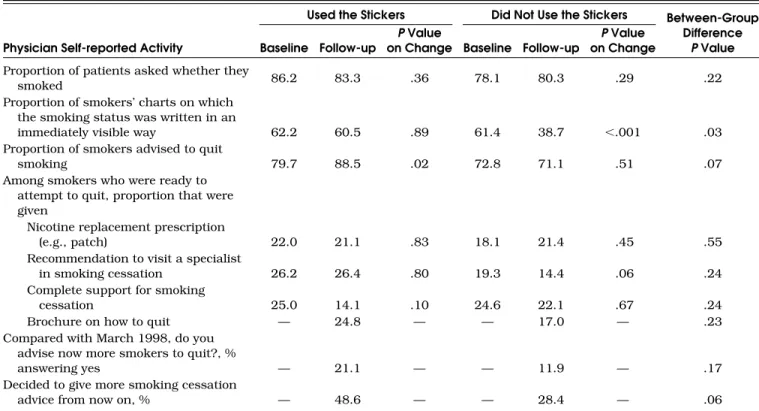
Overall, physicians did not change their reported smoking prevention activities between baseline and follow-up surveys. However, physicians in the intervention grofollow-up who reported using the stickers also stated that they ad-vised more smokers to quit after the intervention (89%) than before the intervention (80%, P⫽ .02) (Table 1).
In the intervention group, the reported proportion of smokers’ charts on which the smoking status was written in an “immediately visible way” decreased by 14%, but
re-Received from the Institute of Social and Preventive Medicine, University of Geneva, Switzerland (JFE, TVP); CIPRET (Center for Information on Smoking Prevention), Geneva, Switzerland (JCR); and Quality of Care Unit, Geneva University Hospitals, Geneva, Switzerland (TVP).
Address correspondence and reprint requests to Dr. Etter: In-stitute of Social and Preventive Medicine, University of Geneva, CMU, Case Postale, CH-1211 Geneva 4, Switzerland (e-mail: [email protected]).
422 Etter et al., “Smoker” Stickers on Charts JGIM
mained unchanged in the control group (between-group difference, P⫽ .001). This decrease occurred only among physicians in the intervention group who said that they did not use the stickers (Table 1).
In a retrospective assessment made in the follow-up survey, the proportion of physicians who reported advis-ing more of their smokadvis-ing patients to quit smokadvis-ing than at baseline was similar in the 2 study groups (Table 2).
Self-reported use of the stickers was not associated with specialist/generalist status, or with age or gender. Physicians who smoked reported using the stickers less often than nonsmokers, but the difference was not statis-tically significant (15% vs 30%, P⫽ .14).
DISCUSSION
Only a minority of private practitioners who received by mail an unsolicited box containing “Smoker” stickers reported using these stickers. Overall, the intervention had no impact on smoking prevention activities as re-ported by physicians. However, physicians who rere-ported using the stickers also reported a 9% increase in the pro-portion of smokers whom they advised to quit smoking, between baseline and follow-up. This result is congruent with published data on the effectiveness of sticking a la-bel on smokers’ charts,10,11 but the observational nature
of this result does not enable us to conclude that it was caused by the intervention.
Reasons for not using the stickers were that the smoking status was already written in the chart and that
this way of labeling the charts was judged unacceptable or useless. More discreet ways of indicating smoking sta-tus on the chart may be more acceptable.
Several explanations can be given for the absence of impact of this intervention. First, only a minority of physi-cians reported using the stickers, and we could not expect any change among physicians who did not. In previous studies of the effectiveness of flagging the smokers’ charts, research assistants systematically affixed stickers, and physicians received training on smoking cessation.10,11
The intervention tested in this study was less intensive but closer to a real-life situation. Recruiting large num-bers of private practitioners in workshops is not realistic, as only 4 (1.5%) of 272 physicians in our study partici-pated in the workshop. Similarly, few Australian physi-cians (4.5%) accepted an invitation to a smoking-counsel-ing workshop.17
Second, any impact of the intervention would have been difficult to detect because the self-reported fre-quency of smoking counseling was probably overesti-mated at baseline. Direct observation shows that only 32% to 54% of smokers are identified by physicians,5,6
much less than the self-reported figures in our study. Further studies of prevention activities performed by phy-sicians should probably rely more on direct observation than on self-reports.
Selection bias may also explain the high frequency of smoking prevention activities reported in this study, if re-spondents to the survey were more involved in smoking prevention than nonrespondents.
Table 1. Change in Smoking Prevention Activities Self-Reported by Physicians Who Received “Smoker” Stickers and Used Them to Label Their Patients’ Charts, and in Physicians Who Received the Stickers but Did Not Use Them
Used the Stickers Did Not Use the Stickers Between-Group Difference
P Value Physician Self-reported Activity Baseline Follow-up
P Value
on Change Baseline Follow-up
P Value on Change
Proportion of patients asked whether they
smoked 86.2 83.3 .36 78.1 80.3 .29 .22
Proportion of smokers’ charts on which the smoking status was written in an
immediately visible way 62.2 60.5 .89 61.4 38.7 ⬍.001 .03 Proportion of smokers advised to quit
smoking 79.7 88.5 .02 72.8 71.1 .51 .07
Among smokers who were ready to attempt to quit, proportion that were given
Nicotine replacement prescription
(e.g., patch) 22.0 21.1 .83 18.1 21.4 .45 .55
Recommendation to visit a specialist
in smoking cessation 26.2 26.4 .80 19.3 14.4 .06 .24
Complete support for smoking
cessation 25.0 14.1 .10 24.6 22.1 .67 .24
Brochure on how to quit — 24.8 — — 17.0 — .23
Compared with March 1998, do you advise now more smokers to quit?, %
answering yes — 21.1 — — 11.9 — .17
Decided to give more smoking cessation
JGIM Volume 15, June 2000 423
Our response rate was near the average of 54% ob-served in mail surveys of physicians,18 but we have no
reason to believe that the intervention would be more ef-fective among nonrespondents. Further telephone inter-views could have improved participation.
Physicians in the intervention group who did not use the stickers reported a decrease in the labeling of their smoking patients’ charts. The most convincing explana-tion for this result is that at follow-up, these physicians understood that the question concerned their use of the stickers, whereas at baseline, they understood that it con-cerned any labeling of the charts.
Even though our disappointing results may not apply to other countries, we believe that simply making stickers available will not improve smoking cessation counseling in doctors’ offices. Further research should strive for a better compromise between feasibility and intensity of in-terventions aimed at changing physician behavior.19
This work was supported by the Health Authority of the Canton of Geneva.
REFERENCES
1. Kottke TE, Battista RN, DeFriese GH, Brekke ML. Attributes of successful cessation interventions in medical practice: a meta-analysis of 39 controlled trials. JAMA. 1988;259:2882–9. 2. Agency for Health Care Policy and Research. The Agency for
Health Care Policy and Research smoking cessation clinical prac-tice guideline. JAMA. 1996;275:1270–80.
3. Strecher VJ, O’Malley MS, Villagra VG, et al. Can residents be trained to counsel patients about quitting smoking? Results from a randomized trial. J Gen Intern Med. 1991;6:9–17.
4. Cummings SR, Rubin SM, Oster G. The cost-effectiveness of coun-seling smokers to quit. JAMA. 1989;261:75–9.
5. Humair JP, Ward J. Smoking-cessation strategies observed in videotaped general practice consultations. Am J Prev Med. 1998; 14:1–8.
6. Dickinson JA, Wiggers J, Leeder SR, Sanson-Fisher RW. General practitioners’ detection of patients’ smoking status. Med J Aust. 1989;150:420–6.
7. Goldstein MG, Niaura R, Willey-Lessne C, et al. Physicians coun-seling smokers: a population-based survey of patients’ percep-tions of health care provider-delivered smoking cessation inter-ventions. Arch Intern Med. 1997;157:1313–9.
8. Anda RF, Remington PL, Sienko DG, et al. Are physicians advising smokers to quit? The patient’s perspective. JAMA. 1987;257:1916–9. 9. Thorndike AN, Rigotti NA, Stafford RS, Singer DE. National pat-terns in the treatment of smokers by physicians. JAMA. 1998; 279:604–8.
10. Cohen SJ, Stookey GK, Katz BP, Drook CA, Smith DM. Encourag-ing primary care physicians to help smokers quit. Ann Intern Med. 1989;110:648–52.
11. Cohen SJ, Christen AG, Katz BP, et al. Counseling medical and dental patients about cigarette smoking: the impact of nicotine gum and chart reminders. Am J Public Health. 1987;77:313–6. 12. Fiore MC, Jorenby DE, Schensky AE, Smith S, Baker TB.
Smok-ing status as the new vital sign: effect on assessment and inter-vention in patients who smoke. Mayo Clin Proc. 1995;70:209–13. 13. Robinson MD, Laurent SL, Little JM. Including smoking status as
a new vital sign: it works! J Fam Pract. 1995;40:556–61. 14. McIlvain H, Susman JL, Manners MA, Davis CM, Gilberts CS.
Im-Table 2. Impact of Mailing a Box of “Smoker” Stickers to Physicians on the Self-reported Smoking Prevention Activities Performed by Private Practice Practitioners
Intervention Group Control Group Between-Group
Difference P Value Physician Self-reported Activity Baseline Follow-up
P Value
on Change Baseline Follow-up
P Value on Change
Proportion of patients asked whether they
smoked 79.6 80.9 .44 76.8 74.5 .15 .12
Proportion of smokers’ charts on which the smoking status was written in an
immediately visible way 58.4 44.4 ⬍.001 61.4 65.6 .45 .001 Proportion of smokers advised to quit
smoking 73.6 72.6 .49 72.7 72.8 .80 .76
Among smokers who were ready to attempt to quit, proportion that were given
Nicotine replacement prescription
(e.g., patch) 22.1 24.0 .64 19.6 24.9 .052 .30
Recommendation to visit a specialist
in smoking cessation 18.7 16.7 .21 18.2 17.9 .61 .57
Complete support for smoking
cessation 26.5 19.6 .051 24.8 24.3 .40 .42
Brochure on how to quit — 21.3 — — 15.8 — .12
Compared with March 1998, do you advise now more smokers to quit?, %
answering yes — 12.9 — — 13.0 — .92
Decided to give more smoking cessation
424 Etter et al., “Smoker” Stickers on Charts JGIM
proving smoking cessation counseling by family practice resi-dents. J Fam Pract. 1992;34:745–9.
15. Cummings SR, Coates TJ, Richard RJ, et al. Training physicians in counseling about smoking cessation: a randomized trial of the “Quit for Life” program. Ann Intern Med. 1989;110:640–7. 16. Cummings SR, Richard RJ, Duncan CL, Hansen B. Training
phy-sicians about smoking cessation: a controlled trial in private prac-tices. J Gen Intern Med. 1989;4:482–9.
17. Richmond R, Mendelsohn C, Kehoe L. Family physicians’
utiliza-tion of a brief smoking cessautiliza-tion program following reinforce-ment contact after training: a randomized trial. Prev Med. 1998; 27:77–83.
18. Asch DA, Jedrziewski MK, Christakis NA. Response rates to mail surveys published in medical journals. J Clin Epidemiol. 1997;50: 1129–36.
19. Cockburn J, Ruth D, Silagy C, et al. Randomised trial of three ap-proaches for marketing smoking cessation programs to Australian general practitioners. BMJ. 1992;304:691–4.