Publisher’s version / Version de l'éditeur:
Vous avez des questions? Nous pouvons vous aider. Pour communiquer directement avec un auteur, consultez la première page de la revue dans laquelle son article a été publié afin de trouver ses coordonnées. Si vous n’arrivez pas à les repérer, communiquez avec nous à [email protected].
Questions? Contact the NRC Publications Archive team at
[email protected]. If you wish to email the authors directly, please see the first page of the publication for their contact information.
https://publications-cnrc.canada.ca/fra/droits
L’accès à ce site Web et l’utilisation de son contenu sont assujettis aux conditions présentées dans le site LISEZ CES CONDITIONS ATTENTIVEMENT AVANT D’UTILISER CE SITE WEB.
Algorithms and Computation: 21st International Symposium, ISAAC 2010, Jeju,
Korea, December 15-17, 2010, Proceedings, Part II, Lecture Notes in Computer
Science; no. 6507, pp. 446-457, 2010-12-15
READ THESE TERMS AND CONDITIONS CAREFULLY BEFORE USING THIS WEBSITE.
https://nrc-publications.canada.ca/eng/copyright
NRC Publications Archive Record / Notice des Archives des publications du CNRC :
https://nrc-publications.canada.ca/eng/view/object/?id=b5712542-720e-4226-8919-42c3d65ea51e
https://publications-cnrc.canada.ca/fra/voir/objet/?id=b5712542-720e-4226-8919-42c3d65ea51e
NRC Publications Archive
Archives des publications du CNRC
For the publisher’s version, please access the DOI link below./ Pour consulter la version de l’éditeur, utilisez le lien DOI ci-dessous.
https://doi.org/10.1007/978-3-642-17514-5
Access and use of this website and the material on it are subject to the Terms and Conditions set forth at
π/2-Angle Yao graphs are spanners
Bose, Prosenjit; Damian, Mirela; Douïeb, Karim; O'Rourke, Joseph;
Seamone, Ben; Smid, Michiel; Wuhrer, Stefanie
π/2-Angle Yao Graphs are Spanners
Prosenjit Bose⋆1, Mirela Damian⋆⋆2, Karim Dou¨ıeb⋆3, Joseph O’Rourke4, Ben Seamone5
, Michiel Smid⋆6, and Stefanie Wuhrer7
1
School of Computer Science, Carleton University, Ottawa, Canada. [email protected].
2
Department of Computer Science, Villanova University, Villanova, USA. [email protected].
3
School of Computer Science, Carleton University, Ottawa, Canada. [email protected].
4
Department of Computer Science, Smith College, Northampton, USA. [email protected].
5
School of Mathematics and Statistics, Carleton University, Ottawa, Canada. [email protected].
6
School of Computer Science, Carleton University, Ottawa, Canada. [email protected].
7
Institute for Information Technology, National Research Council, Ottawa, Canada. [email protected].
Abstract. We show that the Yao graph Y4in the L2metric is a spanner
with stretch factor 8√2(29 + 23√2).
1
Introduction
Let V be a finite set of points in the plane and let G = (V, E) be the complete Euclidean graph on V . We will refer to the points in V as nodes, to distinguish them from other points in the plane. The Yao graph [7] with an integer parameter k > 0, denoted Yk, is defined as follows. Any k equally-separated rays starting
at the origin define k cones. Pick a set of arbitrary, but fixed cones. We can now translate the cones to each node u ∈ V . In each cone, pick a shortest edge uv, if there is one, and add to Yk the directed edge −uv. Ties are broken arbitrarily.→
Note that the Yao graph differs from the Θ-graph in how the shortest edge is chosen. While the Yao graph chooses the shortest edge in terms of the Euclidean distance, the Θ-graph chooses the shortest edge as the one that has the shortest distance to u after being projected to the bisector of the cone. Most of the time we ignore the direction of an edge uv; we refer to the directed version −uv of→ uv only when its origin (u) is important and unclear from the context. We will distinguish between Yk, the Yao graph in the Euclidean L2metric, and Yk∞, the
Yao graph in the L∞ metric. Unlike Yk however, in constructing Yk∞ ties are
broken by always selecting the most counterclockwise edge; the reason for this choice will become clear in Section 2.
⋆
Supported by NSERC.
⋆⋆
For a given subgraph H ⊆ G and a fixed t ≥ 1, H is called a t-spanner for G if, for any two nodes u, v ∈ V , the shortest path in H from u to v is no longer than t times the length of uv. The value t is called the dilation or the
stretch factor of H. If t is constant, then H is called a length spanner, or simply
a spanner.
The class of graphs Yk has been much studied. Bose et al. [2] showed that,
for k ≥ 9, Yk is a spanner with stretch factor 1 cos2π
k−sin2πk
. In [1] we improve the stretch factor and show that, in fact, Yk is a spanner for any k ≥ 7. Recently,
Molla [5] showed that Y2 and Y3 are not spanners, and that Y4 is a spanner
with stretch factor 4(2 +√2), for the special case when the nodes in V are in convex position (see also [3]). The authors conjectured that Y4is a spanner for
arbitrary point sets. In this paper, we settle their conjecture and prove that Y4
is a spanner with stretch factor 8√2(29 + 23√2).
The paper is organized as follows. In Section 2, we prove that the graph Y∞ 4
is a spanner with stretch factor 8. In Section 3 we establish several properties for the graph Y4. Finally, in Section 4, we use the properties of Section 3 to prove
that, for every edge ab in Y∞
4 , there exists a path between a and b in Y4 not
much longer than the Euclidean distance between a and b. By combining this with the result of Section 2, it follows that Y4is a spanner.
2
Y
∞4
in the
L
∞Metric
In this section we focus on Y∞
4 , which has a nicer structure compared to Y4.
First we prove that Y∞
4 is a plane graph. Then we use this property to show
that Y∞
4 is an 8-spanner. To be more precise, we prove that for any two nodes
a and b, the graph Y∞
4 contains a path between a and b whose length (in the
L∞-metric) is at most 8|ab|∞.
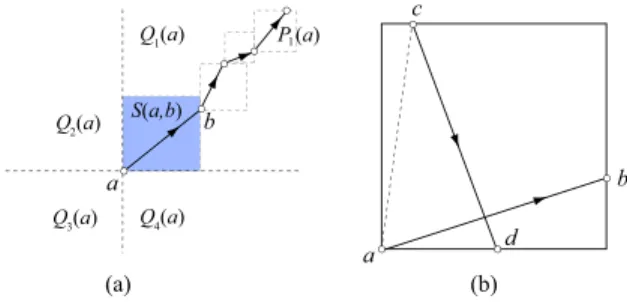
We need a few definitions. We say that two edges ab and cd properly cross (or cross, for short) if they share a point other than an endpoint (a, b, c or d); we say that ab and cd intersect if they share a point (either an interior point or an endpoint). Let Q1(a), Q2(a), Q3(a) and Q4(a) be the four quadrants at a, as in
a b c (b) a (a) Q (a)1 Q (a)2 Q (a)3 Q (a)4 P (a)1 d S(a,b) b
Figure 1a. Let Pi(a) be the path that starts at point a and follows the directed
Yao edges in quadrant Qi. Let Pi(a, b) be the subpath of Pi(a) that starts at a
and ends at b. Let |ab|∞be the L∞distance between a and b. Let sp(a, b) denote
a shortest path in Y∞
4 between a and b. Let S(a, b) denote the open square with
corner a whose boundary contains b, and let ∂S(a, b) denote the boundary of S(a, b). These definitions are illustrated in Figure 1a. For a node a ∈ V , let x(a) denote the x-coordinate of a and y(a) denote the y-coordinate of a.
Lemma 1. Y∞
4 is a plane graph.
Proof. The proof is by contradiction. Assume the opposite. Then there are two
edges−→ab,−→cd ∈ Y∞
4 that cross each other. Since
− → ab ∈ Y∞
4 , S(a, b) must be empty
of nodes in V , and similarly for S(c, d). Let j be the intersection point between ab and cd. Then j ∈ S(a, b) ∩ S(c, d), meaning that S(a, b) and S(c, d) must overlap. However, neither square may contain a, b, c or d. It follows that S(a, b) and S(c, d) coincide, meaning that c and d lie on ∂S(a, b) (see Figure 1b). Since cd intersects ab, c and d must lie on opposite sides of ab. Thus either ac or ad lies counterclockwise from ab. Assume without loss of generality that ac lies counterclockwise from ab; the other case is identical. Because S(a, c) coincides with S(a, b), we have that |ac|∞= |ab|∞. In this case however, Y4∞ would break
the tie between ac and ab by selecting the most counterclockwise edge, which is −
→
ac. This contradicts that −→ab ∈ Y∞
4 . ⊓⊔
Theorem 1. Y∞
4 is an 8-spanner in the L∞ metric space.
Proof. We show that, for any pair of points a, b ∈ V , |sp(a, b)|∞< 8|ab|∞. The
proof is by induction on the pairwise distance between the points in V . Assume without loss of generality that b ∈ Q1(a), and |ab|∞= |x(b)−x(a)|. Consider the
case in which ab is a closest pair of points in V (the base case for our induction). If ab ∈ Y∞
4 , then |sp(a, b)|∞= |ab|∞. Otherwise, there must be ac ∈ Y4∞, with
|ac|∞= |ab|∞. But then |bc|∞< |ab|∞ (see Figure 2a), a contradiction.
a b c a’ b’ a b c S d i a b c a’ b’ r a b c a’ b’ r i i d j j e A A A (a) (b) (c) (d) a b c a’ b’ r i d j e A (e)
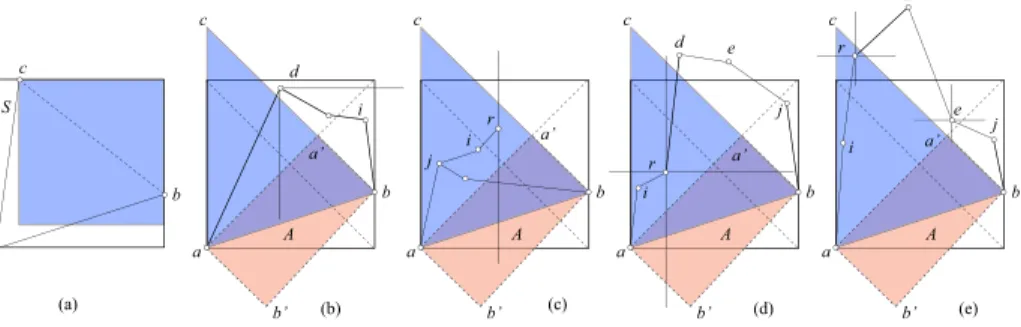
Fig. 2.(a) Base case. (b)△abc empty (c) △abc non-empty, Par∩P2(b) ={j} (d) △abc
Assume now that the inductive hypothesis holds for all pairs of points closer than |ab|∞. If ab ∈ Y4∞, then |sp(a, b)|∞ = |ab|∞ and the proof is finished. If
ab /∈ Y∞
4 , then the square S(a, b) must be nonempty.
Let A be the rectangle ab′ba′ as in Figure 2b, where ba′ and bb′ are parallel
to the diagonals of S. If A is nonempty, then we can use induction to prove that |sp(a, b)|∞ <= 8|ab|∞ as follows. Pick c ∈ A arbitrary. Then |ac|∞+
|cb|∞ = |x(c) − x(a)| + |x(b) − x(c)| = |ab|∞, and by the inductive hypothesis
sp(a, c) ⊕ sp(c, b) is a path in Y∞
4 no longer than 8|ac|∞+ 8|cb|∞= 8|ab|∞; here
⊕ represents the concatenation operator. Assume now that A is empty. Let c be at the intersection between the line supporting ba′and the vertical line through
a (see Figure 2b). We discuss two cases, depending on whether △abc is empty of points or not.
Case 1: △abc is empty of points. Let ad ∈ P1(a). We show that P4(d) cannot
contain an edge crossing ab. Assume the opposite, and let st ∈ P4(d) cross
ab. Since △abc is empty, s must lie above bc and t below ab, therefore |st|∞≥
|y(s)−y(t)| > |y(s)−y(b)| = |sb|∞, contradicting the fact that st ∈ Y4∞. It follows
that P4(d) and P2(b) must meet in a point i ∈ P4(d) ∩ P2(b) (see Figure 2b).
Now note that |P4(d, i) ⊕P2(b, i)|∞≤ |x(d)−x(b)|+|y(d)−y(b)| < 2|ab|∞. Thus
we have that |sp(a, b)|∞≤ |ad ⊕ P4(d, i) ⊕ P2(b, i)|∞< |ab|∞+ 2|ab|∞= 3|ab|∞.
Case 2: △abc is nonempty. In this case, we seek a short path from a to b that does not cross to the underside of ab, to avoid oscillating paths that cross ab arbitrarily many times. Let r be the rightmost point that lies inside △abc. Arguments similar to the ones used in Case 1 show that P3(r) cannot cross ab
and therefore it must meet P1(a) in a point i. Then Par = P1(a, i) ⊕ P3(r, i) is
a path in Y∞
4 of length
|Par|∞< |x(a) − x(r)| + |y(a) − y(r)| < |ab|∞+ 2|ab|∞= 3|ab|∞. (1)
The term 2|ab|∞in the inequality above represents the fact that |y(a) − y(r)| ≤
|y(a) − y(c)| ≤ 2|ab|∞. Consider first the simpler situation in which P2(b) meets
Parin a point j ∈ P2(b)∩Par(see Figure 2c). Let Par(a, j) be the subpath of Par
extending between a and j. Then Par(a, j)⊕P2(b, j) is a path in Y4∞from a to b,
therefore |sp(a, b)|∞≤ |Par(a, j) ⊕ P2(b, j)|∞< 2|y(j) − y(a)| + |ab|∞≤ 5|ab|∞.
Consider now the case when P2(b) does not intersect Par. We argue that, in
this case, Q1(r) may not be empty. Assume the opposite. Then no edge st ∈ P2(b)
may cross Q1(r). This is because, for any such edge, |sr|∞< |st|∞, contradicting
st ∈ Y∞
4 . This implies that P2(b) intersects Par, again a contradiction to our
assumption. This establishes that Q1(r) is nonempty. Let rd ∈ P1(r). The fact
that P2(b) does not intersect Parimplies that d lies to the left of b. The fact that
r is the rightmost point in △abc implies that d lies outside △abc (see Figure 2d). It also implies that P4(d) shares no points with △abc. This along with arguments
similar to the ones used in case 1 show that P4(d) and P2(b) meet in a point
j ∈ P4(d) ∩ P2(b). Thus we have found a path
extending from a to b in Y∞
4 . If |rd|∞= |x(d)−x(r)|, then |rd|∞< |x(b)−x(a)| =
|ab|∞, and the path Pabhas length
|Pab|∞≤ 2|y(d) − y(a)| + |ab|∞< 7|ab|∞. (3)
In the above, we used the fact that |y(d) − y(a)| = |y(d) − y(r)| + |y(r) − y(a)| < |ab|∞+ 2|ab|∞. Suppose now that
|rd|∞= |y(d) − y(r)|. (4)
In this case, it is unclear whether the path Pab defined by (2) is short, since
rd can be arbitrarily long compared to ab. Let e be the clockwise neighbor of d along the path Pab (e and b may coincide). Then e lies below d, and either
de ∈ P4(d), or ed ∈ P2(e) (or both). If e lies above r, or at the same level as r
(i.e., e ∈ Q1(r), as in Figure 2d), then
|y(e) − y(r)| < |y(d) − y(r)| (5) Since rd ∈ P1(r) and e is in the same quadrant of r as d, we have |rd|∞≤ |re|∞.
This along with inequalities (4) and (5) implies |re|∞ > |y(e) − y(r)|, which
in turn implies |re|∞ = |x(e) − x(r)| ≤ |ab|∞, and so |rd|∞ ≤ |ab|∞. Then
inequality (3) applies here as well, showing that |Pab|∞< 7|ab|∞.
If e lies below r (as in Figure 2e), then
|ed|∞≥ |y(d) − y(e)| ≥ |y(d) − y(r)| = |rd|∞. (6)
Assume first that ed ∈ P2(e), or |ed|∞= |x(e) − x(d)|. In either case, |ed|∞≤
|er|∞ < 2|ab|∞. This along with inequality (6) shows that |rd|∞ < 2|ab|∞.
Substituting this upper bound in (2), we get |Pab|∞≤ 2|y(d) − y(a)| + 2|ab|∞<
8|ab|∞. Assume now that ed 6∈ P2(e), and |ed|∞= |y(e)−y(d)|. Then ee′∈ P2(e)
cannot go above d (otherwise |ed|∞ < |ee′|∞, contradicting ee′ ∈ P2(e)). This
along with the fact de ∈ P4(d) implies that P2(e) intersects Par in a point k.
Redefine Pab = Par(a, k) ⊕ P2(e, k) ⊕ P4(e, j) ⊕ P2(b, j). Then Pab is a path in
Y∞
4 from a to b of length |Pab| ≤ 2|y(r) − y(a)| + |ab|∞≤ 5|ab|∞. ⊓⊔
This theorem will be employed in Section 4.
3
Y
4in the
L
2Metric
In this section we establish basic properties of Y4. Due to space restrictions, some
of these properties are stated without proofs. The proofs can be found in [1]. The ultimate goal of this section is to show that, if two edges in Y4 cross, there is a
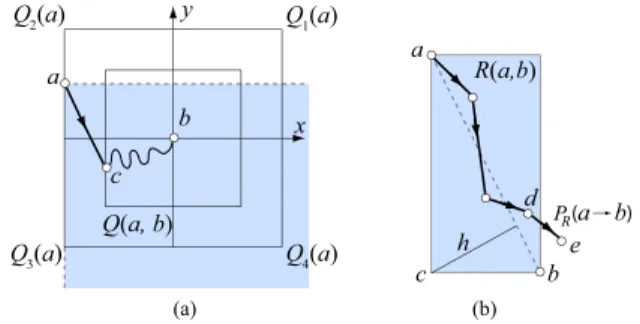
short path between their endpoints (Lemma 8). We begin with a few definitions. Let Q(a, b) denote the infinite quadrant with origin at a that contains b. For a pair of nodes a, b ∈ V , define recursively a directed path P(a → b) from a to b in Y4 as follows. If a = b, then P(a → b) = null. If a 6= b, there must exist
− →
ac ∈ Y4 that lies in Q(a, b). In this case, define
Recall that ⊕ represents the concatenation operator. This definition is illustrated in Figure 3a. Fischer et al. [4] show that P(a → b) is well defined and lies entirely inside the square centered at b whose boundary contains a.
a b y x Q(a, b) Q (a)1 Q (a)2 Q (a)3 Q (a)4 a b e R(a,b) (a) (b) P (a b) c R d h c
Fig. 3.Definitions. (a) Q(a, b) andP(a → b). (b) PR(a→ b).
For any node a ∈ V , let D(a, r) denote the open disk centered at a of radius r, and let ∂D(a, r) denote the boundary of D(a, r). Let D[a, r] = D(a, r)∪∂D(a, r). For any path P and any pair of nodes a, b ∈ P , let P [a, b] be the subpath of P from a to b. Let R(a, b) be the closed rectangle with diagonal ab.
For a fixed pair of nodes a, b ∈ V , define a path PR(a → b) as follows. Let
e ∈ V be the first node along P(a → b) that is not strictly interior to R(a, b). Then PR(a → b) is the subpath of P(a → b) that extends between a and e. In
other words, PR(a → b) is the path that follows the Y4 edges pointing towards
b, truncated as soon as it reaches b or leaves R(a, b). Formally, PR(a → b) =
P(a → b)[a, e]. This definition is illustrated in Figure 3b. Our proofs will make use of the following two propositions.
Proposition 1. The sum of the lengths of crossing diagonals of a non-degenerate (necessarily convex) quadrilateral abcd is strictly greater than the sum of the lengths of either pair of opposite sides:
|ac| + |bd| > |ab| + |cd| |ac| + |bd| > |bc| + |da|
Proposition 2. For any triangle △abc, the following inequalities hold:
|ac|2 < |ab|2 + |bc|2 , if ∠abc < π/2 = |ab|2 + |bc|2 , if ∠abc = π/2 > |ab|2 + |bc|2 , if ∠abc > π/2
Lemma 2. For each pair of nodes a, b ∈ V , |PR(a → b)| ≤ |ab|
√
2 (7)
Proof. Let c be one of the two corners of R(a, b), other than a and b. Let−→de ∈ PR(a → b) be the last edge on PR(a → b), which necessarily intersects ∂R(a, b)
(note that it is possible that e = b). Refer to Figure 3b. Then |de| ≤ |db|, otherwise −→de could not be in Y4. Since db lies in the rectangle with diagonal
ab, we have that |db| ≤ |ab|, and similarly for each edge on PR(a → b). This
establishes the latter claim of the lemma. For the first claim of the lemma, let p = PR(a → b)[a, d] ⊕ db. Since |de| ≤ |db|, we have that |PR(a → b)| ≤ |p|.
Since p lies entirely inside R(a, b) and consists of edges pointing towards b, we have that p is an xy-monotone path. It follows that |p| ≤ |ac| + |cb|, which is
bounded above by |ab|√2. ⊓⊔
Lemma 3. Let a, b, c, d ∈ V be four disjoint nodes such that −→ab,−→cd ∈ Y4, b ∈
Qi(a) and d ∈ Qi(c), for some i ∈ {1, 2, 3, 4}. Then ab and cd cannot cross.
The next four lemmas (4–8) each concern a pair of crossing Y4edges, culminating
(in Lemma 8) in the conclusion that there is a short path in Y4 between a pair
of endpoints of those edges.
Lemma 4. Let a, b, c and d be four disjoint nodes in V such that −→ab,−→cd ∈ Y4,
and ab crosses cd. Then (i) the ratio between the shortest side and the longer diagonal of the quadrilateral acbd is no greater than 1/√2, and (ii) the shortest
side of the quadrilateral acbd is strictly shorter than either diagonal.
Lemma 5. Let a, b, c, d be four distinct nodes in V , with c ∈ Q1(a), such that
(i) −→ab ∈ Q1(a) and −→cd ∈ Q2(c) are in Y4 and cross each other, and (ii) ad is
a shortest side of quadrilateral acbd. Then PR(a → d) and PR(d → a) have a
nonempty intersection.
Lemma 6. Let a, b, c, d be four distinct nodes in V , with c ∈ Q1(a), such that
(i) −→ab ∈ Q1(a) and−→cd ∈ Q3(c) are in Y4 and cross each other, and (ii) ad is a
shortest side of quadrilateral acbd. Then PR(d → a) does not cross ab.
The next lemma relies on all of Lemmas 2–6.
Lemma 7. Let a, b, c, d ∈ V be four distinct nodes such that −→ab ∈ Y4 crosses
− →
cd ∈ Y4, and let xy be a shortest side of the quadrilateral abcd. Then there exist
two paths Px and Py in Y4, where Px has x as an endpoint and Py has y as an
endpoint, with the following properties: (i) Px and Py have a nonempty intersection.
(ii) |Px| + |Py| ≤ 3
√ 2|xy|.
(iii) Each edge on Px∪ Py is no longer than |xy|.
Proof. Assume without loss of generality that b ∈ Q1(a). We discuss the
follow-ing exhaustive cases:
1. c ∈ Q1(a), and d ∈ Q1(c). In this case, ab and cd cannot cross each other
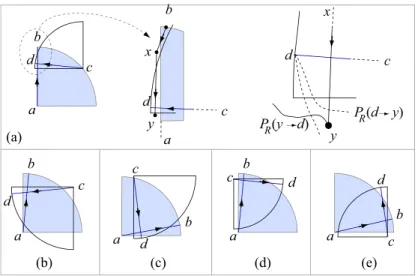
a b c d a b c d a b c d (a) (b) (d) (e) a b c d a b c d y d y c x P (y d)R P (d y)R x a b c d (c)
Fig. 4.Lemma 7: (a, b) c∈ Q1(a) (c) c∈ Q2(a) (d) c∈ Q4(a).
2. c ∈ Q1(a), and d ∈ Q2(c), as in Figure 4a. Since ab crosses cd, b ∈ Q2(c).
Since −→ab ∈ Y4, |ab| ≤ |ac|. Since −→cd ∈ Y4, |cd| ≤ |cb|. These along with
Lemma 4 imply that ad and db are the only candidates for a shortest edge of acbd. Assume first that ad is a shortest edge of acbd. By Lemma 3, Pa=
PR(a → d) does not cross cd. It follows from Lemma 5 that Pa and Pd =
PR(d → a) have a nonempty intersection. Furthermore, by Lemma 2, |Pa| ≤
|ad|√2 and |Pd| ≤ |ad|
√
2, and no edge on these paths is longer than |ad|, proving the lemma true for this case. Consider now the case when db is a shortest edge of acbd (see Figure 4a). Note that d is below b (otherwise, d ∈ Q2(c) and |cd| > |cb|) and, therefore, b ∈ Q1(d)). By Lemma 3, Pd =
PR(d → b) does not cross ab. If Pb = PR(b → d) does not cross cd, then
Pb and Pd have a nonempty intersection, proving the lemma true for this
case. Otherwise, there exists −xy ∈ P→ R(b → d) that crosses cd (see Figure 4a).
Define
Pb= PR(b → d) ⊕ PR(y → d)
Pd= PR(d → y)
By Lemma 3, PR(y → d) does not cross cd. Then Pb and Pd must have a
nonempty intersection. We now show that Pb and Pd satisfy conditions (i)
and (iii) of the lemma. Proposition 1 applied on the quadrilateral xdyc tells us that |xc| + |yd| < |xy| + |cd|. We also have that |cx| ≥ |cd|, since−→cd ∈ Y4
and x is in the same quadrant of c as d. This along with the inequality above implies |yd| < |xy|. Because xy ∈ PR(b → d), by Lemma 2 we have that
|xy| ≤ |bd|, which along with the previous inequality shows that |yd| < |bd|. This along with Lemma 2 shows that condition (iii) of the lemma is satisfied.
Furthermore, |PR(y → d)| ≤ |yd|
√
2 and |PR(d → y)| ≤ |yd|
√
2. It follows that |Pb| + |Pd| ≤ 3
√ 2|bd|.
3. c ∈ Q1(a), and d ∈ Q3(c), as in Figure 4b. Then |ac| ≥ max{ab, cd}, and by
Lemma 4 ac is not a shortest edge of acbd. The case when bd is a shortest edge of acbd is settled by Lemmas 3 and 2: Lemma 3 tells us that Pd= PR(d → b)
does not cross ab, and Pb= PR(b → d) does not cross cd. It follows that Pd
and Pb have a nonempty intersection. Furthermore, Lemma 2 guarantees
that Pd and Pb satisfy conditions (ii) and (iii) of the lemma. Consider now
the case when ad is a shortest edge of acbd; the case when bc is shortest is symmetric. By Lemma 6, PR(d → a) does not cross ab. If PR(a → d) does
not cross cd, then this case is settled: Pd= PR(d → a) and Pa= PR(a → d)
satisfy the three conditions of the lemma. Otherwise, let −xy ∈ P→ R(a → d)
be the edge crossing cd. Arguments similar to the ones used in case 1 above show that Pa= PR(a → d)⊕PR(y → d) and Pd= PR(d → y) are two paths
that satisfy the conditions of the lemma.
4. c ∈ Q1(a), and d ∈ Q4(c), as in Figure 4c. Note that a horizontal reflection
of Figure 4c, followed by a rotation of π/2, depicts a case identical to case 1, which has already been settled.
5. c ∈ Q2(a), as in Figure 4d. Note that Figure 4d rotated by π/2 depicts a
case identical to case 1, which has already been settled.
6. c ∈ Q3(a). Then it must be that d ∈ Q1(c), otherwise cd cannot cross ab. By
Lemma 3 however, ab and cd may not cross, unless one of them is not in Y4.
7. c ∈ Q4(a), as in Figure 4e. Note that a vertical reflection of Figure 4e depicts
a case identical to case 1, so this case is settled as well. ⊓⊔ We are now ready to establish the main lemma of this section, showing that there is a short path between the endpoints of two intersecting edges in Y4.
Lemma 8. Let a, b, c, d ∈ V be four distinct nodes such that −→ab ∈ Y4 crosses
− →
cd ∈ Y4, and let xy be a shortest side of the quadrilateral abcd. Then Y4contains
a path p(x, y) connecting x and y, of length |p(x, y)| ≤ 6 √
2−1· |xy|. Furthermore,
no edge on p(x, y) is longer than |xy|.
Proof. Let Px and Py be the two paths whose existence in Y4 is guaranteed by
Lemma 7. By condition (iii) of Lemma 7, no edge on Px and Py is longer than
|xy|. By condition (i) of Lemma 7, Px and Py have a nonempty intersection. If
Pxand Py share a node u ∈ V , then the path p(x, y) = Px[x, u] ⊕ Py[y, u] is a
path from x to y in Y4no longer than 3
√
2|xy|; the length restriction follows from guarantee (ii) of Lemma 7. Otherwise, let−→a′b′ ∈ Px and−→c′d′∈ Py be two edges
crossing each other. Let x′y′ be a shortest side of the quadrilateral a′c′b′d′, with
x′∈ Pxand y′ ∈ Py. Lemma 7 tells us that |a′b′| ≤ |xy| and |c′d′| ≤ |xy|. These
along with Lemma 4 imply that |x′y′| ≤ |xy|/√2. This enables us to derive a
recursive formula for computing a path p(x, y) ∈ Y4as follows:
p(x, y) = (
x, if x = y
Px[x, x′] ⊕ Py[y, y′] ⊕ p(x′, y′), if x 6= y
4
Y
∞4
and
Y
4We prove that every individual edge of Y∞
4 is spanned by a short path in Y4.
This, along with the result of Theorem 1, establishes that Y4 is a spanner. Fix
an edge −xy ∈ Y→ 4∞. Define an edge or a path as t-short (with respect to |xy|) if
its length is within a constant factor t of |xy|. In our proof that ab is spanned by a t-short path with respect to |ab| in Y4, we will make use of the following
three statements.
S1 If ab is t-short, then PR(a → b), and therefore its reverse, PR−1(a → b), are
t√2-short by Lemma 2.
S2 If ab ∈ Y4is t1-short and cd ∈ Y4is t2-short, and if ab intersects cd, Lemmas 4
and 8 show that there is a t3-short path between any two of the endpoints
of these edges with t3= t1+ t2+ 3(2 +
√
2) max(t1, t2).
S3 If p(a, b) is a t1-short path and p(c, d) is a t2-short path and the two paths
intersect, then there is a t3-short path P between any two of the endpoints
of these paths with t3= t1+ t2+ 3(2 +
√
2) max(t1, t2), by S2.
Lemma 9. For any edge ab ∈ Y∞
4 , there is a path p(a, b) ∈ Y4between a and b,
of length |p(a, b)| ≤ t|ab|, for t = 29 + 23√2.
Proof. For the sake of clarity, we only prove here that there is a short path p(a, b)
between a and b, and skip the calculations of the actual stretch factor t (which are detailed in the appendix of [1]). We refer to an edge or a path as short if its length is within a constant factor of |ab|. Assume without loss of generality that − → ab ∈ Y∞ 4 , and − →
ab ∈ Q1(a). If−→ab ∈ Y4, then p(a, b) = ab and the proof is finished.
So assume the opposite, and let −→ac ∈ Q1(a) be the edge in Y4; since Q1(a) is
nonempty, −→ac exists. Because −→ac ∈ Y4 and b is in the same quadrant of a as c,
we have that
|ac| ≤ |ab| (i)
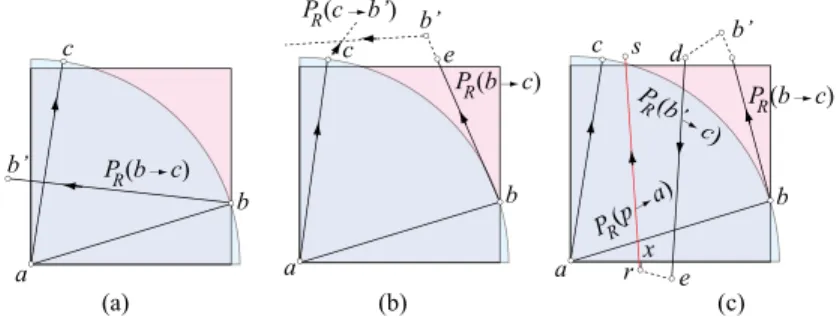
|bc| ≤ |ac|√2 (ii) (8) Thus both ac and bc are short. And this in turn implies that PR(b → c) is short
by S1. We next focus on PR(b → c). Let b′ ∈ R(b, c) be the other endpoint of/
PR(b → c). We distinguish three cases.
Case 1: PR(b → c) and ac intersect. Then by S3 there is a short path p(a, b)
between a and b.
Case 2: PR(b → c) and ac do not intersect, and PR(b′ → a) and ab do not
intersect (see Figure 5b). Note that because b′ is the endpoint of the short
path PR(b → c), the triangle inequality on △abb′ implies that ab′ is short, and
therefore PR(b′ → a) is short. We consider two cases:
(i) PR(b′→ a) intersects ac. Then by S3 there is a short path p(a, b′). So
p(a, b) = p(a, b′) ⊕ P−1 R (b → c)
a (a) P (b c)R b c b’ a b c b’ P (b c)R P (c b’)R a b c b’ r s ) c ( ) b ( e P (p a ) R P (b c)R P (b’ c ) R e d x
Fig. 5. Lemma 9: (a) Case 1:PR(b → c) and ac have a nonempty intersection. (b)
Case 2:PR(b′→ a) and ab have an empty intersection. (c) Case 3: PR(b′→ a) and ab
have a non-empty intersection.
(ii) PR(b′ → a) does not intersect ac. Then PR(c → b′) must intersect PR(b →
c) ⊕ PR(b′ → a). Next we establish that b′c is short. Let
−→
eb′ be the last edge
of PR(b → c), and so incident to b′ (note that e and b may coincide). Because
PR(b → c) does not intersect ac, b′ and c are in the same quadrant for e. It
follows that |eb′| ≤ |ec| and ∠b′ec < π/2. These along with Proposition 2 for
△b′ec imply that |b′c|2
< |b′e|2
+|ec|2
≤ 2|ec|2
< 2|bc|2
(this latter inequality uses the fact that ∠bec > π/2, which implies that |ec| < |bc|). It follows that |b′c| ≤ |bc|√2 ≤ 2|ac| (by (8)ii) (9)
Thus b′c is short, and by S1 we have that P
R(c → b′) is short. Since PR(c →
b′) intersects the short path P
R(b → c) ⊕ PR(b′→ a), there is by S3 a short
path p(c, b), and so
p(a, b) = ac ⊕ p(c, b) is short.
Case 3: PR(b → c) and ac do not intersect, and PR(b′ → a) intersects ab (see
Figure 5c). If PR(b′→ a) intersects ab at a, then p(a, b) = PR(b → c) ⊕ PR(b′→
a) is short. So assume otherwise, in which case there is an edge−→de ∈ PR(b′→ a)
that crosses ab. Then d ∈ Q1(a), e ∈ Q3(a) ∪ Q4(a), and e and a are in the
same quadrant for d. Note however that e cannot lie in Q3(a), since in that case
∠dae > π/2, which would imply|de| > |da|, which in turn would imply−→de /∈ Y4.
So it must be that e ∈ Q4(a).
Next we show that PR(e → a) does not cross ab. Assume the opposite, and
let −→rs ∈ PR(e → a) cross ab. Then r ∈ Q4(a), s ∈ Q1(a) ∪ Q2(a), and s and a
are in the same quadrant for r. Arguments similar to the ones above show that s /∈ Q2(a), so s must lie in Q1(a). Let d be the L∞ distance from a to b. Let x
be the projection of r on the horizontal line through a. Then
Because a and s are in the same quadrant for r, the inequality above contradicts −
→rs ∈ Y4.
We have established that PR(e → a) does not cross ab. Then PR(a → e)
must intersect PR(e → a) ⊕ de. Note that de is short because it is in the short
path PR(b′ → a). Thus ae is short, and so PR(a → e) and PR(e → a) are short.
Thus we have two intersecting short paths, and so by S3 there is a short path p(a, e). Then
p(a, b) = p(a, e) ⊕ P−1
R (b′→ a) ⊕ PR−1(b → c)
is short. Straightforward calculations show that, in each of these cases, the stretch factor for p(a, b) does not exceed 29 + 23√2. ⊓⊔ Our main result follows immediately from Theorem 1 and Lemma 9:
Theorem 2. Y4 is a t-spanner, for t ≥ 8
√
2(29 + 23√2).
5
Conclusion
Our results settle a long-standing open problem, asking whether Y4 is a spanner
or not. We answer this question positively, and establish a loose stretch factor of 8√2(29 + 23√2). Experimental results, however, indicate a stretch factor of the order 1 +√2, a factor of 200 smaller. Finding tighter stretch factors for both Y∞
4 and Y4 remain interesting open problems. Establishing whether Y5 and Y6
are spanners or not is also open.
References
1. P. Bose, M. Damian, K. Dou¨ıeb, J. O’Rourke, B. Seamone, M. Smid, and S. Wuhrer. π/2-Angle Yao Graphs are Spanners. Technical Report, arXiv:1001.2913v1, 2010. 2. P. Bose, A. Maheshwari, G. Narasimhan, M. Smid, and N. Zeh. Approximating
geometric bottleneck shortest paths. Computational Geometry: Theory and
Appli-cations, 29:233–249, 2004.
3. M. Damian, N. Molla, and V. Pinciu. Spanner properties of π/2-angle Yao graphs. In Proc. of the 25th European Workshop on Computational Geometry, pages 21–24, March 2009.
4. M. Fischer, T. Lukovszki, and M. Ziegler. Geometric searching in walkthrough animations with weak spanners in real time. In ESA ’98: Proc. of the 6th Annual
European Symposium on Algorithms, pages 163–174, 1998.
5. N. Molla. Yao spanners for wireless ad hoc networks. M.S. Thesis, Department of Computer Science, Villanova University, December 2009.
6. J.W. Green. A note on the chords of a convex curve. Portugaliae Mathematica, 10(3):121–123, 1951.
7. A.C.-C. Yao. On constructing minimum spanning trees in k-dimensional spaces and related problems. SIAM Journal on Computing, 11(4):721–736, 1982.