Publisher’s version / Version de l'éditeur:
Vous avez des questions? Nous pouvons vous aider. Pour communiquer directement avec un auteur, consultez la
première page de la revue dans laquelle son article a été publié afin de trouver ses coordonnées. Si vous n’arrivez pas à les repérer, communiquez avec nous à [email protected].
Questions? Contact the NRC Publications Archive team at
[email protected]. If you wish to email the authors directly, please see the first page of the publication for their contact information.
https://publications-cnrc.canada.ca/fra/droits
L’accès à ce site Web et l’utilisation de son contenu sont assujettis aux conditions présentées dans le site LISEZ CES CONDITIONS ATTENTIVEMENT AVANT D’UTILISER CE SITE WEB.
>CSB 2010, 16th Biennial Conference of the Canadian Society for Biomechanics
[Proceedings], 2010-06-09
READ THESE TERMS AND CONDITIONS CAREFULLY BEFORE USING THIS WEBSITE.
https://nrc-publications.canada.ca/eng/copyright
NRC Publications Archive Record / Notice des Archives des publications du CNRC :
https://nrc-publications.canada.ca/eng/view/object/?id=048d86c6-886a-4e62-b252-07ca90271b85
https://publications-cnrc.canada.ca/fra/voir/objet/?id=048d86c6-886a-4e62-b252-07ca90271b85
NRC Publications Archive
Archives des publications du CNRC
This publication could be one of several versions: author’s original, accepted manuscript or the publisher’s version. / La version de cette publication peut être l’une des suivantes : la version prépublication de l’auteur, la version acceptée du manuscrit ou la version de l’éditeur.
Access and use of this website and the material on it are subject to the Terms and Conditions set forth at
A new biomimetic composite material stem in surface replacement of
the hip
Caouette, Christiane; Bureau, Martin N.; Vendittoli, Pascal-André; Lavigne,
Martin; Nuño, Natalia
A NEW BIOMIMETIC COMPOSITE MATERIAL STEM IN SURFACE REPLACEMENT OF THE HIP
Christiane Caouette1, Martin N. Bureau2, Pascal-André Vendittoli3, Martin Lavigne3, Natalia Nuño1 1Génie de la production automatisée, École de technologie supérieure, Montréal, canada, [email protected]
2Industrial Materials Institute, National Research Council, Boucherville, Canada 3Maisonneuve-Rosemont Hospital, Montréal, Canada
INTRODUCTION
The short metaphyseal stem of current surface replacement arthroplasty (SRA) of the hip are designed for alignment purposes and was not bonded to adjacent bone. To prevent early femoral head loosening some surgeons suggested to cement the metaphyseal stem to allow a more distal fixation[1]. The adverse effects of this fixation method may be increased stress shielding in the femoral head[2] (bone is less stressed and resorbs as a result) and possibly compromised long term results.
A possible solution to reduce potential stress shielding of bonded metallic stems in SRA implants would be the use of a composite material with bone-matching mechanical properties to fabricate the metaphyseal stem. Such a stem could be osseointegrated and provide the same kind of stable fixation as a cemented metallic stem without increasing stress shielding in the femoral head. The objective of this study is to verify the validity of this claim using a finite element model.
METHODS
A finite element model (FEM) was constructed; the femur was obtained from CT-scans of a patient and modeled with heterogenic mechanical properties. All material properties were modeled as isotropic and linearly elastic; trabecular bone heterogeneity was also modeled. Three models of a commercially available implant were constructed: an unfixed metallic stem, a cemented metallic stem (cement mantle is 1 mm thick) and an osseointegrated stem made of composite material. All bone-cement and osseointegrated interfaces were modeled as perfectly bonded; implant-cement and bone-metal interfaces were modeled as frictional interfaces. A static load case representing healthy gait was applied to evaluate stress shielding in the trabecular bone of the femoral head.
RESULTS
Trabecular bone underneath the spherical part of the implant was divided into four zones; the same was done with the trabecular bone in the femoral neck. Maximal compressive stress (σ3) in these zones for the cemented and biomimetic
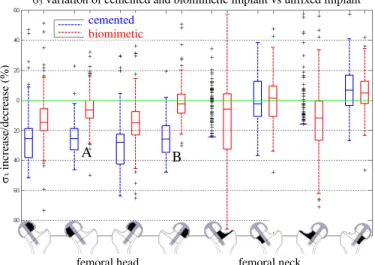
stems was compared with that of the unfixed stem. The decrease in stress varied from 1.8% to 21.5% in the femoral head of the cemented stem; the posterior and inferoanterior zones were the most severely stress shielded with -16.4% and -21.5% of stress respectively (see A and B on figure 1). The same two zones in the biomimetic stem saw decreases of 5.5% and 0.2% respectively. The femoral neck regions did not show a clear trend.
Figure 1: Increase/decrease of maximum compressive stress
when comparing cemented metallic stem and biomimetic stem with unfixed stem.
DISCUSSION AND CONCLUSIONS
The FEM model has showed increased stress shielding in the femoral head and neck when the metallic stem of the implant was cemented; it has also shown that this stress shielding can be reduced if a composite material with bone-matching properties is used to fabricate the stem. The main limitation of this study is that it has been done with only one patient-specific femur, which may not represent clinical situations. Also, the interfaces were modeled with bonded contacts, which cannot simulate aseptic loosening (bonded contacts will always remain attached regardless of load, micromotions or bone resorption).
Further studies will be necessary to confirm these findings; bone remodelling simulations will have to be done in order to assess the severity of long term bone resorption resulting from stress shielding.
An osseointegrated metaphyseal stem made of biomimetic material seems to reduce the stress shielding effect observed in the femoral head in comparison with a bonded chromium-cobalt metallic stem. Such a biomimetic stem could become an interesting alternative when fixation extension is desired.
REFERENCES
[1] Amstutz, H.C., et al. (2007). The Effects of Technique Changes on Aseptic Loosening of the Femoral Component in Hip Resurfacing. J Arthroplasty Vol 22(4): p. 481-489. [2] Ong, K.L., et al. (2006). Biomechanics of the Birmingham hip resurfacing arthroplasty. JBJS Br Vol 88B(8): p. 1110-5.
cemented
biomimetic
femoral head femoral neck
A B
σ3 variation of cemented and biomimetic implant vs unfixed implant
σ3 in cr ea se /d ec re ase ( %)