HAL Id: insu-03112000
https://hal-insu.archives-ouvertes.fr/insu-03112000
Submitted on 16 Jan 2021
HAL is a multi-disciplinary open access
archive for the deposit and dissemination of
sci-entific research documents, whether they are
pub-lished or not. The documents may come from
teaching and research institutions in France or
abroad, or from public or private research centers.
L’archive ouverte pluridisciplinaire HAL, est
destinée au dépôt et à la diffusion de documents
scientifiques de niveau recherche, publiés ou non,
émanant des établissements d’enseignement et de
recherche français ou étrangers, des laboratoires
publics ou privés.
Lidar measurements of atmospheric lithium
Jean-Pierre Jegou, Marie-Lise Chanin, Gérard Mégie, Jacques-Emile Blamont
To cite this version:
Jean-Pierre Jegou, Marie-Lise Chanin, Gérard Mégie, Jacques-Emile Blamont. Lidar measurements
of atmospheric lithium. Geophysical Research Letters, American Geophysical Union, 1980, 7 (11),
pp.995-998. �10.1029/GL007i011p00995�. �insu-03112000�
LIDAR MEASUREMENTS OF ATMOSPHERIC LITHIUM
Jean-Pierre Jegou, Marie-Lise Chanin, G•rard M•gie, Jacques E. Blamont Service d'A•ronomie du CNRS, 9]370 Verri•res-le-Buisson, France. Abstract. The Haute-Provence Observatory (44 ø
N, 6øE) lidar facility has been extended to stu- dy the atmospheric lithium and its isotopic ra-
tio Li7/Li 6 in the upper atmosphere.
The experi-
mental features have been improved in order to lower the detection limit to 3.]05 cm -2 for the
total abundance with a resolution of ].2 km in
the altitude profile. The night-time measure-
ments have been carried out from November ]977 to December 1979 and show some characteristic
trends.
The seasonal variation of the total abundance is similar to the one observed for sodium. The al-
titude profile is variable during the night. Total abundance fluctuations and peaks with smaR
scale heights (].5 km) are observed on numerous
occasions. The layer is sensitive to high-alti- tude artificial releases, like CAMEO in November 1978, and to impinging meteor showers. It is con- cluded that study of the behavior of atmospheric
lithium and sodium should further our understan-
ding of the alkali-metals chemistry.
Introduction
The preliminary photometric measurements of lithium total abundance were successfully per- formed in 1957 by Delannoy and Weill (1958) and the results confirmed by Sullivan and Hunten (1962), Gault and Rundle (]969). Lithium has
been shown to be layered around 90 km as the
other alkali metals sodium and potassium. The width of this layer has been estimated to be
about 20 km. The vertical total abundance usual-
ly observed
was of the order of 106 cm
-2, whereas
abundances
of 4.]06 cm
-2 were reached
mainly in
fall and winter and, values larger than ]07 cm
-2
measured sporadically. About fifty percent of
these exceptional values were correlated with
lithium releases from rocket experiments or ther- monuclear explosions (Silverman 1962, Sullivan
1970, Sullivan 1976). Explanations provided up to now for the other fifty percent including meteor showers occurrence have not been quite satisfac- tory (Gault and Rundle, 1969).
We report in this paper the first lidar mea- surements of the atmospheric lithium in the at- mosphere. As compared to photometric measurements
the lidar technique possesses unique experimen-
tal features :
- altitude resolution leading to an altitude profile of the number density
1
Supplement (Table 1) is available with entire article on microfiche. Order from American
Geophysical Union, 2000 Florida Ave., N.W., Washington, D.C. 20009. Document L80-005;
$1.00. Payment
must accompany
order.
Copyright 1980 by the American Geophysical Union.
- nocturnal total abundance average free from
twilight conditions
- time resolution leading to the variation of the
total abundance during the night
It is also a powerful tool to describe the struc- ture and the intensity of a temporary source like a meteor shower (M•gie et al., 1978) and the noc- turnal variation of sodium number density with high-resolution altitude profiles (Rowlett et al.
1978, Clemesha et al. ]978).
The total abundance of the lithium 7 isotope is three orders of magnitude lower than the so-
dium and the total abundance of the lithium 6
isotope is still an order of magnitude lower. For this reason, during the two years of observation, the isotopic ratio has only been measured twice, after exceptional enhancements due to artificial releases. Once the experimental improvement was achieved, one of the scientific aims of the li- thium experiment was to measure the isotopic ra-
tio in meteor showers in order to obtain the cos-
mological isotopic ratio. The lithium 7 lidar re- sults presented in this paper should contribute to our knowledge of chemical and dynamic interac- tions of alkali metals with the atmosphere.
Experimental set up
The ground-based lidar facility set up at the Haute-Provence Observatory (44øN, France) and
used for the study of alkali metals is described
'in .M•gie et al. (]977). The laser emitter and the
photodetector are adapted to the lithium experi ment and their characteristics, together with the spectroscopic data of the lithium atom, are pre- sented in Table ]. An important addition to the earlier system is a servo-wavelength control en- suring the spectral stability of the laser and• the ability to automatically tune from one iso- tope resonance line to the other. Its description will be presented in detail in a future publica- tion (Cahen et al., ]980). The backscattered si- gnal is received on a 80 cm Cassegrain telescope,
•etected by a photomultiplier and, after amplifi -ø
cation and discrimination, fed into a 220 channel- photon counting system.
The number S o of the received photons back-
scattered between the altitude z and z + Az is
for a single shot :
Eo
A --
.
(•)
S
o = T . z-
2 . n . Az Oe ß
where- T is the global efficiency of the lidar system (optics and atmospheric transmission, quantum ef- ficiency of the photomultiplier .... )
- A is the telescope area
- • is the mean number density between z and z +
Az
- hv is the individual photon energy at the fre-
quency v.
- øe is the integrated effective cross-section Paper number 80L0640.
0094-8276/80/0080L-0640501.00
996 Jegou et al.' Lidar Measurements of Atmospheric Lithium
defined as the product of the laser line profile by the resonance line profile.
- E o is the laser energy per pulse (see Table 1). The signal to noise ratio for X shots is given, assuming Poisson statistics for the received si-
gnals, by :
S o •
•S• + B
o
where B• is the photo-electronic background
due
to the brightness of the sky and the PMT dark noise in the range bin Az.
Thus,
if S
o >> B
o, R is proportional
to X•C•.Eo
whereas if S o << Bo, for a faint signal, R isproportional toV•-.Eo.
In the case of lithium measurements, the re-
by Rayleigh scattering at lower altitudes, and to
the efficiency of the resonant excitation (Oe).
The uncertainty on the effective cross-section
• is reduced by using the servo-wavelength con-
t•ol ensuring
the wavelength
stability and mea-
suring the lines shape and the energy fluctua- tions for each shot. The spectral stability of
the laser is certain to be better than a tenth
of the laser linewidth which implies the know- .ledge of •e within 3%.
The calibration of the atmospheric density re- quires the choice of a reliable density model in the 40 km range taking into account the short-
term and seasonal variations. Checks are made to
ensure that the signal variation over the range
30-50 km is consistent with the value deduced from
ceived signal is small due to the low total abun- the appropriate model atmosphere (US Standard
dance
of scatterers (• 106 atm.cm
-2) ; and thus,
1976). Taking into account
these different sour-
the signal to noise ratio has to be enhanced by ces of uncertainties and for the typical experi- maximizing E o and reducing B o. mental conditions described in Table 1, and as- A larger value of E o is obtained by using a suming a one-hour integration time (7200 shots), flash-lamp pumped dye laser with high energy per an altitude resolution of 1.2 km and a lithium
pulse (800 mJ) and low repetition rate (2 Hz) ra-
total abundance
of 1.5.106 cm
-2 for a 20 km ex-
ther than a high repetition rate and low energy per pulse as obtained with a laser-pumped dye
laser.
Two processes have been used to reduce the
noise B o :
- a thermo-electric cooling system for the pho- tomultiplier to reduce the value of the dark cur-
rent to 10 counts per sec.
~ • small receiving field of view (45.10 -4 rd)
compatible with the laser divergence to reduce
tent of the layer, the relative error on the al-
titude profile is of the order of + 20 % and the
absolute error on the total abundance is ñ 20 %. Results and discussion
The night-time lidar measurements of atmosphe-
ric lithium reported here have been carried out from November 1977 to December 1979. The detec-
tion limit has appeared low enough to study the
the nocturnal sky backgrouud to 30 counts per se=
seasonal variation of th• lithium 7 isotope to-
Taking into account these experimental featu-
tal abundance, but the lithium 6 isotope detec-
res the detection limit of total abundance
is
tion, and then the measurement
of the isotopic
3.105
cm
•2.
ratio, have
only been
possible
in the case
of ex-
ceptional events such as (see fig.'l) :
The uncertainties in the lithium measurements - the CAMEO lithium release from Nimbus 7 (Novem-
are of two different kinds : ber 6,7 and 8, 1978)
- a relative error on the altitude profile stric-
- a sporadic enhancement
between April 21 and 25,
tly relevant to the Poisson statistics
law for
1979 following two artificial
releases from Poker
the signal and thus dependent upon the integra-
Flat (Alaska) on April 15 and 18, 1979.
•ion time and the altitude resolution.
The isotopic ratio was for those two cases
- an absolute error on the number density or to- 11.2 on November 7 and on April 22, with an ac-
tal abundance
value mainly due to the calibration
curacy of 20% due to the fast switching between
using the atmospheric
density profile as measured the 2 resonance
lines (2mn
-1) avoiding the need
•.. o o ø
. 10 • .0 . : 10 •
.... , ,I ø% '"
J F H A H J J A S 0 N O los
HONTH
Fi•. 1 ß Data averaged from the measurements during the night for different years
( o 1977, •
1978, ß 1979) and data obtained close to sunrise (•)
and sunset ( •
)
are identified on the chart. A vertical arrow is an indication of the nocturnal variation.
0 I 1 o 1 -- ß
ß '\
ß o • -. , ./, ,
(r)••'x
'k.k
• ,
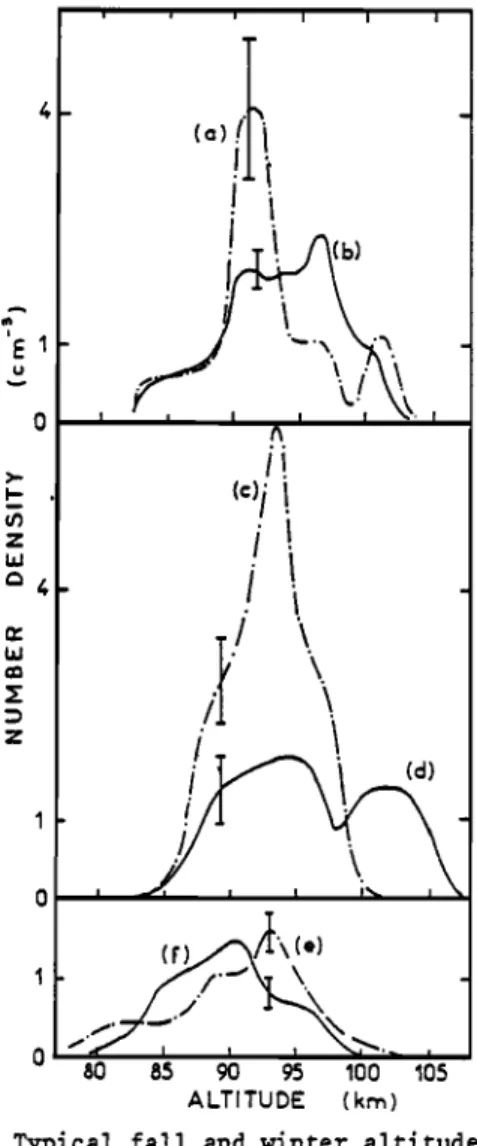
80 85 90 95 100 105 ALTITUDE (kin)Fig. 2 : Typical fall and winter altitude profiles
for 3 nights :
- September ], ]979 : (a) average between 21 : 30
and 22 : 30 UT
(b) average over the night. -October 21, 1978 : (c) average between 21 : O0
and 23 : O0 UT
(d) average betwwen O0 : O0
and 02 : O0 UT
-November 15, 1979 : hourly average
(e) for 22 : O0 UT (f) for 02 : O0 UT
for Rayleigh calibration. Recent improvements in the experimental performances allow measurements of the isotopic ratio with the same accuracy whe-
never the lithium 7 total abundance is around
2.106 cm
-2 as usually is the case in winter
During thesefirst two years of observation, we were mainly concerned with the study of the li- thium 7 seasonal variation. The two exceptional
events mentioned above should not be considered
in that study ; the time constant of disappea- rance of the lithium produced d•ring those spora- dic events appears to be of the order of a few days, and it seems reasonable to consider that such inputs should not affect the seasonal varia-
tion observed.
As shown in fig. 1, the fall and winter ave-
raged total abundance appears to be larger than
the summer one by a factor of 5, indicating that the lithium seasonal behavior is very close to
the sodium one.
Typical altitude profiles are displayed in fig. 2 and 3. They show a large variability in
the shape of the layer but some general trends can be deduced from the data.
The fall (or winter) profiles of lithium are most of the time coarsely located around 92 km, higher than sodiu• by about 4 km. As a general feature, when the total abundance is large during
fall (1.5 to 3.106 cm
-2) the altitude profile
peaks with small scale heights on both sides and varies in altitude. A typical sharp profile ave- raged over one hour and the profile averaged over the same whole night are presented in fig. 2a and gb. The thin layer, shifting during the night, is responsible for the small scale heights and the appearance of a plateau-type shape in fig. 2b. This points out the importance of temporal reso- lution in the measurements of such layered struc-
ture.
In fig. 2c and 2d, we notice a rather sharp layer at the beginning of the night and a decreasing total abundance during the night. On September 1, ]979, (fig. 2a and 2b), the total abundance re- mains constant within 20%. On the other hand, a decrease by a factor of 4 of the central part of
•he layer is observed
on October 21, ]978 (fig.
2c and 2d) even though this period is situated in
the middle
of the Orionids
shower
(October
18 •?
26), with meteorites of fast velocity (66 km s ), which may be responsible for the localized input
around ]00 km. A changing structure with a total abundance stable within 10% has been observed on
November ]5, 1979. Two samples of the hourly ave- rage profiles are shown in fig. 2e and 2f and, from the total set of data during that night, we
j i i i i i i
>..2.-
)
-
z 1 I.t.I I I I n"0 (c) 80 85 90 95 100 105 ALTITUDE (kin)Fi•. 3 : Typical summer altitude profiles averaged over several nights
(a) on August I I and 12, 1979
(b) on August 2l and 22, 1979. (c) from July 2] to July 23, 1979.
998 Jegou et al.' Lidar Measurements of Atmospheric Lithium
can observe a descending layer with a maximum Acknowledgements
around 93 km at 23 h U.T. and around 89 km at 4 h
U.T. emphasizing the importance of the dynamics We wish to thank Charles Fehrenbach, the as already observed with sodium. A plateau-type Director of the Haute-Provence Observatory, for structure is obtained for the profils averaged his hospitality. We are grateful to J.P. Schnei- over the whole night. This shape is obtained most • der and F. Syda who helped to collect the data. of the time for the winter profiles averaged over This program was supported by the CNRS and INAG.
the night.
In summer, due to the smaller total abundance
and shorter night duration the measurements
have
References
to be averaged over more than one night. But even with this long integration time, a great variabi-
lity of the altitude profiles is clearly observed Cahen, C., P. Gildwarg, J.P. Jegou, J. Porteneuve
as shown
in fig. 3. Fig. 3a shows
the impinging
Servo-wavelength
control device for lidar experi-
Perseids meteor shower
on August 11/12, 1979 ta-
ment, to be submitted to J. Appl. Physics, 1980.
king place at the same altitude as the Orionids
Clemesha,
B.R., V.W.J.H. Kirchhoff, D.M. Simo-
input. The profile in fig. 3b, on August 21/22,
nich and H. Takahashi, Evidence for an extra-ter-
has lost all memory
of the altitude of the impact
restrial source for the mesospheric sodium layer,
and tends to an autumnal profile. In fig. 3c is
presented a typical profile for the smallest to-
tal abundances encountered but, because of this low value and the lack of experiments from May till June, this structure should be confirmed be-
fore being considered as characteristic of the
summer profile.
Conclusion
The first lidar measurements of atmospheric
lithium are consistent with former photometric
measurements of the total abundance but show a
much more detailed altitude profile.
The total abundance is very sensitive to spu-
Geophys. Res. Letters, •, 873-876, 1978.
Delannoy, J., G. Weill, Observation d'une nouvel-
le raie d'•mission cr•pusculaire atmosph•rique, C.R. Acad. Sci. Paris 24___7, 806-807, 1958.
Gadsden, M., Metallic atoms and ions in the upper atmosphere, Ann. Geophys. 26, 141-150, 1970. Gault, W.A., H.N. Rundle, Twilight observations of upper atmospheric sodium, potassium an lithium
Can. J. Phys. 47, 85, 1969.
M•gie, G., F. Bos, J.E. Blamont, M.L. Chanin,
Simultaneous nighttime lidar measurements of at-
mospheric sodium and potassium, Planet. Space ScL
26, 27-35, 1978.
rious enhancements
due to rocket releases and the
M•gie, G., J.E. Blamont, Laser sounding of atmos-
long term reaction (several years) of such inputs
pheric sodium : interpretation in terms of global
is not well defined (Gadsden 1970). Ignoring
atmospheric parameters, Planet. Space Sci • 25,
these exceptional values, the general behavior of 1093-1109, 1977.
lithium total abundance shows a seasonal varia- tion similar to the one observed for sodium (M•- gie and Blamont, 1977). A dynamic nocturnal al- titude profile, with or without a total abundance
variation, appears to be a common characteristic
of all the lithium measurements. The altitude range of the layer is more stable in fall and
Rowlett, J.R., C.S. Gardner , E.S. Richter, C.F. Sechrist Jr., Lidar observation of wave-like structure in the atmospheric sodium layer, Geo- phys. Res. Letters, 5, 683-686, 1978.
Silverman, S.M., Comments on lithium in the upper
atmosphere, Planet. Space Sci. 9, 89-92 (1962).
winter than in summer.
Like the other alkali me-
Sullivan, H.M., D.M. Hunten, Lithium twilight at
tals, the lithium altitude profile and totalabun-
Saskatoon,
1960-61, Nature 193, 1064-1065,1962.
8ance are sensitive to impinging meteor showers
Sullivan, H.M., Some unusual red twilight emis-
(M•gie et al.,
1978), but the consequent enhan-
sions, Ann. Geophys. 26, 161-166, 1970.
cement and altitude profile evolution are not much --
larger than typical nocturnal variation. In this
Sullivan, H.M., Vertical distribution of atomic
respect, a strong and reversible sink and/or
lithium in the upper atmosphere
following a ro-
source process, involving cluster ions, could be
cket release, Ann. Geophys. 32, 13-21, 1976.
envisaged.
We have pointed out the control of the
Sullivan,H.M., Enhancement
of twilight lithium
lithium layer by meteor
showers,
chemistry
and/or emission
following a rocket release, Ann. Geophvs.
dynamics.
32, 407-409, 1976.
Experiments on lithium will now be performed simultaneously with sodium measurements in order to provide data for a more accurate analysis of
alkali metals chemistry and dynamics on a time- (Received March 14, 1980;