HAL Id: hal-01540297
https://hal.sorbonne-universite.fr/hal-01540297
Submitted on 16 Jun 2017
HAL is a multi-disciplinary open access
archive for the deposit and dissemination of
sci-entific research documents, whether they are
pub-lished or not. The documents may come from
teaching and research institutions in France or
abroad, or from public or private research centers.
L’archive ouverte pluridisciplinaire HAL, est
destinée au dépôt et à la diffusion de documents
scientifiques de niveau recherche, publiés ou non,
émanant des établissements d’enseignement et de
recherche français ou étrangers, des laboratoires
publics ou privés.
Stereoselective access to trisubstituted fluorinated
alkenyl thioethers
Indira Fabre, Thomas Poisson, Xavier Pannecoucke, Isabelle Gillaizeau, Ilaria
Ciofini, Laurence Grimaud
To cite this version:
Indira Fabre, Thomas Poisson, Xavier Pannecoucke, Isabelle Gillaizeau, Ilaria Ciofini, et al..
Stereos-elective access to trisubstituted fluorinated alkenyl thioethers. Catalysis Science & Technology, Royal
Society of Chemistry, 2017, 7 (9), pp.1921-1927. �10.1039/C7CY00076F�. �hal-01540297�
Journal Name
ARTICLE
J. Name., 2013, 00, 1-3 | 1www.rsc.org/
Stereoselective Access to Trisubstituted Fluorinated Alkenyl
Thioethers
Indira Fabre,a b Thomas Poisson,c Xavier Pannecoucke,c Isabelle Gillaizeau,d Ilaria Ciofini,*b
Laurence Grimaud*a
We report the first copper-catalyzed olefinic ethoxy carbonyl difluoromethylation of alkenyl thioethers via direct C-H bond functionalization using BrCF2COOEt. The developed methodology allows the preparation of trisubstituted olefins with a
controlled stereochemistry. A mechanistic study is reported and reveals a radical mechanism.
1. INTRODUCTION
Since the last decade, organofluorine chemistry has known a very fast expansion since fluorinated molecules became popular in the quest for drugs and agrochemicals. This is reflected in the continuing increase of the number of fluorinated drugs already approved or drug candidates entering clinical trials.1–3 Indeed, the presence of a fluorine atom or a
fluorinated group strongly affects the physical and chemical properties of a molecule. These features result from the particular properties of the fluorine atom, like its electronegativity, its small size and the strength of the carbon fluorine bond, for instance.4 In that context the development of
new methodologies to access these strategic molecules is of high demand toward the discovery of new bioactive molecules. For this purpose, the direct C-H bond functionalization was recently recognized as an outstanding and efficient method for a straightforward access to the desired fluorine-containing molecules.5
Besides, sulfur-containing molecules are prevalent in a broad range of pharmaceuticals and natural products, and often display interesting various biological activities.6
As part of these sulfur-containing molecules, alkenyl thioethers7
are a versatile chemical platform and represent an interesting
motif to access complex sulfur-containing molecules. It is noteworthy, that Julia and coworkers developed the introduction of alkyl, allyl or silyl groups on 1-tert-butylthio-3-methoxy-1-alkenes using metallating agents (Scheme 1a).8
However, most efforts to functionalize this motif focused on the development of palladium-catalyzed arylation of alkenyl thioethers (Scheme 1b).9–11 Concerning the synthesis of
fluorinated alkenyl mercaptans, Marquet and coworkers described an approach based on the anodic functionalization of alkenyl thioethers allowing the introduction of a fluorine atom at the α or β position (Scheme 1c).12,13 More recently,
β-trifluoromethyl-α-functionalized-vinyl sulfides were
synthesized under anionic conditions by Hanamoto and coworkers.14,15 As a complementary approach, Zard and
coworkers reported the synthesis of tri- and tetra-substituted functionalized alkenyl thioethers by radical allylation, including examples bearing a CF3 motif.16 The fluorination of thiophenes
and benzothiophenes, which have an aromatic scaffold, have been reported with different metal catalysts (Ag,17 Pd,18 Fe19
and Ir20 or Ru21,22 with light irradiation) and under
photochemical conditions23 (Scheme 1d). These reactions are
selective for the C2 position. To the best of our knowledge, no
example of alkenyl thioether fluorination has been reported so far using functionalized fluorinated building blocks as the CF2CO2R group. Stimulated by our previous works dealing with
the copper-catalyzed ethoxy carbonyl difluoromethylation of various scaffolds through a direct C-H functionalization,24–27 we
report herein a successful application to the functionalization of alkenyl thioethers (Scheme 1e). In addition, significant insights regarding the mechanism of this reaction were also disclosed, demonstrating the existence of a radical pathway.
a. Ecole Normale Supérieure, PSL Research University, UPMC Univ Paris
06, CNRS, Département de Chimie, PASTEUR, Sorbonne Universités, UPMC Univ Paris 06, ENS, CNRS, PASTEUR, 24, rue Lhomond, 75005 Paris, France. E-mail : [email protected]
b. PSL Research University, Institut de Recherche de Chimie Paris, CNRS
Chimie ParisTech, 11 rue P. et M. Curie, 75005 Paris, France. E-mail: [email protected]
c. Normandie Univ, INSA Rouen UNIROUEN, CNRS, COBRA (UMR 6014),
76000 Rouen (France).
d. Institut de Chimie Organique et Analytique, UMR 7311 CNRS, Université
d’Orléans, rue de Chartres, 45067 Orléans cedex 2, France
Electronic Supplementary Information (ESI) available: [details of any supplementary information available should be included here]. See DOI: 10.1039/x0xx00000x
ARTICLE Journal Name
2 | J. Name., 2012, 00, 1-3
Scheme 1 Schematic illustration of previous and present works
2. RESULTS AND DISCUSSION
2.1 Optimization of the Reaction
The reaction conditions were optimized using n-hexyl(styryl)sulfane 1a as a model substrate. Standard screening of solvent, catalysts, bases, ligands, temperature and reagent stoichiometry confirmed that the best yield is obtained using the conditions previously settled for the ethoxy carbonyl difluoromethylation of enamides,26 with
longer reaction time. A brief overview of the optimization of the reaction is displayed in Table 1 (for a more complete study, see Supporting Information). The desired product 2a was isolated in 82% yield (Table 1, entry 1) when using Cu2O (10 mol%),
1,10-phenanthroline (12 mol%) as a ligand in the presence of K2CO3 (2
equiv) and BrCF2CO2Et (2 equiv), in acetonitrile at 80 °C for 24 h.
Several copper sources were also found to be efficient (Table 1, entries 2-4); however, the use of different ligands (Table 1, entries 5-8) or bases (Table 1, entries 9-13) gave very low to no conversion. Unfortunately, the catalyst loading could not be reduced since the yield significantly dropped when using 2 mol% of copper salt (Table 1, entry 14). Similarly, we could perform the reaction with 2 equiv of BrCF2CO2Et but lowering its amount (1.3 equiv) greatly impacted the
reaction yield (Table 1, entry 15). The reaction was carried out under an air atmosphere, but with a lower yield (65%). Control experiments showed no reactivity in the absence of ligand, catalyst or base, and that no conversion occurred at room temperature. Under this optimized set of experimental conditions, the reaction turned out to be highly regio- and stereoselective. Indeed, the trisubstituted alkene 2a was isolated as the major compound with a 5:95 Z/E ratioi
starting from alkenyl thioether 1a as a Z/E (10:90). A NOE between the alkenyl proton and the alkyl chain on the sulfur atom allowed us to unambiguously confirm the regioselectivity of the reaction as shown in Table 2.
Table 1 Optimization of the reaction conditions
Entry Deviation from the standard conditions Yield
1 None 82 % a 2 Catalyst: Cu(OTf)2 60 %a 3 Catalyst: CuI 59 %a 4 Catalyst: Cu(CH3CN)4PF6 70 %a 5 Ligand: Neocuproine 0 % 6 Ligand: TMEDA 0 % 7 Ligand: TMHD 0 % 8 Ligand: 2,2’-bipyridine 35 % a 9 Base: Cs2CO3 28 %b 10 Base: Na2CO3 12 %b 11 Base: Et3N < 5 %b 12 Base: 2,6-lutidine 0 %
13 Base: nBu4NOAc 0 %
14 Catalyst: Cu2O 2 mol% 24 %b
15 BrCF2CO2Et: 1.3 equiv 30 %b
Default catalyst, ligand and base are Cu2O, 1,10-phenanthroline and
K2CO3. a Isolated yield. b19F NMR yield, α,α,α-trifluorotoluene was used as
an internal standard.
2.2 Scope of the Reaction
Having established the optimal reaction conditions, the scope of the reaction was further examined with a wide array of alkenyl thioether derivatives (see Table 2). Different styryl thioethers were successfully functionalized under these conditions. The reaction turned out to be of similar efficiency when performed with secondary (2b) or S-tertiary (2c) alkyl substituents as well as with a benzyl group (2d). Aryl styryl thioethers gave slightly lower yields of isolated adducts (2e to 2h) whatever the nature of the substituent on the aromatic ring. When replacing the styryl moiety with an alkyl-substituted olefin, the reaction behaved similarly affording excellent yields of the trisubstituted alkenes 2i-2k. However, the electron-deficient sulfanyl acrylate 1l was poorly reactive giving 2l in a modest yield (20%). When the gem-disubstituted alkenyl thioether 1m was used, traces of the expected product were obtained (yield about 8%) along with the product 2m (55% yield) resulting from a subsequent isomerization.
The reaction turned out to be highly regio- and stereoselective. Indeed, when starting with a nearly equimolar Z/E mixture of alkenyl thioether (eg. 1b or 1c), the trisubstituted alkenes 2b and 2c were isolated in a diastereomeric ratio > 90:10 in favor of the E isomer. Except for 2l, no isomerization was observed when starting with pure
E substrates as observed for 1i and 1k. NMR experiments were
performed to determine the configuration of the trifunctionalized thioethers. Heteronuclear NOESY experiments clearly demonstrated a correlation between fluorine and the olefinic proton on 2j and 2k, enabling us to establish the E selectivity of the reaction.ii
Journal Name ARTICLE
J. Name., 2013, 00, 1-3 | 3
Table 2 Scope of the copper-catalyzed ethoxy carbonyl difluoromethylation of various alkenyl thioethers 1
The major isomer is represented. NOE stands for Nuclear Overhauser Effect (between 1H and 1H) HOE stands for Heteronuclear Overhauser
Effect (between 19F and 1H).
The regioselectivity of the reaction was further confirmed using the β-disubstituted styryl thioether 1n. In this case, the compound 2’n was isolated in a modest 30% yield along with diphenyldisulfide. The latter could result from an α-addition-desulfination sequence due to the steric hindrance at the β-position (see Scheme 2). It is worth noting that this byproduct has been observed in 0 to 15 % yield also with 1a to 1l.
Scheme 2 Copper-catalyzed difluoroacetylation of 1n
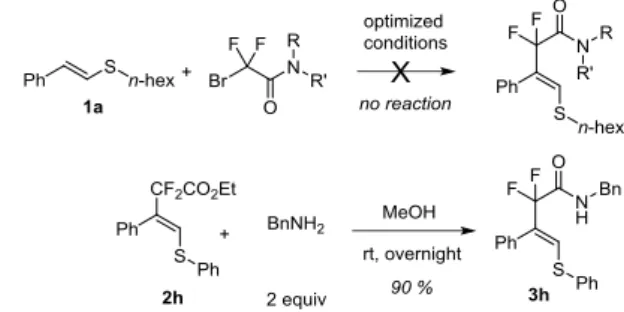
Surprisingly, the replacement of BrCF2CO2Et with the
bromodifluoroacetamide or bromodifluorophosphonate failed to give the corresponding fluorinated alkenyl thioethers. However, the post-functionalization of product 2h turned out to be very efficient as shown in Scheme 3. The ester residue can be readily converted into the corresponding amide by treating compound 2e with an
excess of benzylamine (Scheme 3). This transformation enlarges even more the molecular diversity accessible with this protocol.
Scheme 3 Transformation of fluorinated alkenyl thioether 2h
2.3 Mechanistic Studies
To get more insights into the mechanism, selected reactions were performed in the presence of radical scavengers.
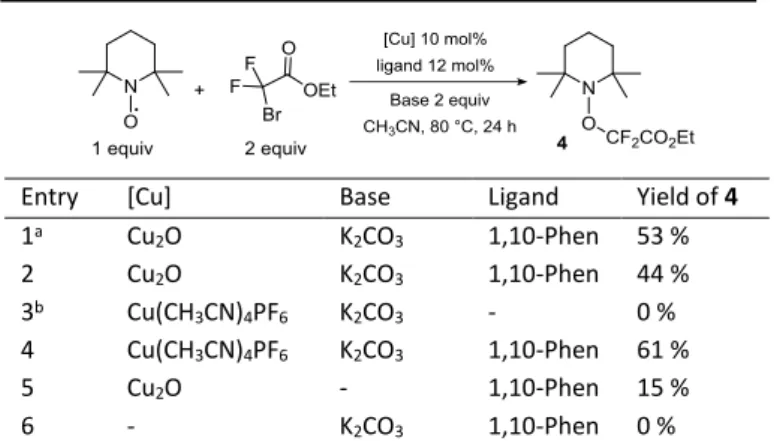
When 1a was reacted under standard reaction conditions in the presence of Galvinoxyl (1 equiv), no product was formed, while in the presence of TEMPO (1 equiv, Table 3, entry 1), traces of product were obtained along with 53 % of the TEMPO-adduct 4, characterized both by 19F NMR and Mass Spectroscopy. These observations along with
the formation of diphenyldisulfide previously reported suggest that a radical mechanism is involved in the process. These conclusions are consistent with the recent studies of fluorination of hydrazones with analogous copper systems28,29 and with similar radical reactions
mediated by copper.30-32 To identify the key players in the radical
formation, the trapping by TEMPO was further examined under various conditions (Table 3). The yield of 4 is only slightly lower (44 %, Table 1, entry 2) when the reaction is performed in the absence of the alkenyl thioether 1a, suggesting that 1a is not essential for the formation of the difluoroacetate radical. Note that in the absence of copper, no radical was generated (Table 3, entry 6). As already
observed during the optimization process,
tetrakis(acetonitrile)copper(I) hexafluorophosphate behaved similarly (Table 3, entry 4). This copper source allowed us to test the effect of the ligand toward the formation of 4, indeed the use of Cu2O
without ligand was not conclusive due to solubility issues. In the absence of phenanthroline, no traces of 4 were detected (Table 3, entry 3), revealing its crucial role for the generation of the radical species, and explaining the failure of the reaction in the absence of ligand. Without a base the formation of 4 dropped significantly (Table 3, entry 5), unveiling its contribution in the generation of the reactive species. These experimental observations suggested that the combination of copper, 1,10-phenanthroline and K2CO3 might be
responsible for the formation of a radical species in our reaction conditions.
ARTICLE Journal Name
4 | J. Name., 2012, 00, 1-3
Table 3 Mechanistic experiments performed in the presence of TEMPO
Entry [Cu] Base Ligand Yield of 4
1a Cu2O K2CO3 1,10-Phen 53 % 2 Cu2O K2CO3 1,10-Phen 44 % 3b Cu(CH3CN)4PF6 K2CO3 - 0 % 4 Cu(CH3CN)4PF6 K2CO3 1,10-Phen 61 % 5 Cu2O - 1,10-Phen 15 % 6 - K2CO3 1,10-Phen 0 %
Yields were evaluated by 19F NMR using α,α,α-trifluorotoluene as an internal
standard a In the presence of 1 equiv of 1a. 2 % of 2a was formed. b The
copper source was changed for solubility issues in the absence of ligand.
For a better understanding of the elementary steps involved in this transformation, further investigations on the copper(I) complex involved in the reduction of BrCF2CO2Et were performed at the
theoretical level using density functional theory (DFT). Bulk solvent effects were included by means of a polarizable continuum model (PCM) (see the Supporting Information for details). Two different mechanisms of activation of BrCF2CO2Et were compared: a single
electron transfer (SET) and a halogen atom transfer (HAT).iii Though
the approach used here cannot provide a good description of the entropic effects that can play a role in the present case, the energetic –ie enthalpies- associated to these reaction can be trustfully estimated and it is here discussed. An estimate of the associated reaction free energies is reported in SI.
As starting complexes models, A to E were considered, where solvent molecules, alkenyl thioether 1b, 1,10-phenanthroline and hydroxide anion (the base formed in the reaction medium) were included as possible ligands (see Scheme 4 and Table 4, details in the Supporting Information).iv
Scheme 4 Relative stability of possible starting complexes computed (in kcal.mol-1)
Table 4 Reaction energies for the different complexes (Enthalpy in kcal.mol-1) A B C D E SET ΔE SET 55.2 39.9 11.7 39.1 16.7 HAT ΔE HAT - 28.4 4.7 25.8 4.1
Both SET and HAT were computed to be endothermic processes (ΔH > 0). In the absence of the ligand (A), the energy required for the SET is very high (ΔH = 55.2 kcal.mol-1). This energy is lowered by
complexation with 1,10-phenanthroline (B: ΔH = 39.9 kcal.mol-1 and
D: ΔH = 39.1 kcal.mol-1), and even more favorable when copper is
bound to a hydroxide anion (C: ΔH = 11.7 kcal.mol-1 and E: ΔH = 16.7
kcal.mol-1). The presence of alkenyl thioether 1b has only a tiny
effect, as one can see by comparing the energies computed for B to the ones for D and the energies computed for C to the ones for E. In all cases, the reaction energies for HAT reactions were lower than those calculated for SET. A similar behavior was observed whatever the presence of the alkenyl thioether; in the absence of phenanthroline, no radical was formed; and the absence of base significantly impacted the radical formation. These findings are consistent with experimental data from Table 3.
Overall, complexes C and E are the most likely to initiate the formation of the difluoroacetate radical by HAT (C: ΔH = 4.7 kcal.mol -1 and E: ΔH = 4.1 kcal.mol-1). In addition, the complexation of one
molecule of 1a to the copper/phenanthroline complex in the absence of base (complex D) was evidenced by 1H NMR, but not in
its presence (complex E, see the Supporting Information). After HAT, both C and E formed a copper (II) complex, bearing a phenanthroline
Journal Name ARTICLE
J. Name., 2013, 00, 1-3 | 5
ligand, a hydroxide and a bromide. Surprisingly, the alkenyl thioether has low affinity for the copper complex and is expelled from the coordination sphere of copper at this step for E.
Scheme 5 Computed reaction pathways (in kcal.mol-1). Solid line: initiation with C. Dashed line: initiation with E. The last part of the
reaction path after regeneration of E by SET is omitted for clarity. This part is the same as for C. Grey: path for the formation of the main byproduct. Blue: path for the formation of the minor stereoisomer.
The formed °CF2CO2Et radical can then add to the alkenyl thioether
1b. The addition at the α position with regards to the S atom (ΔHa =
7.6 kcal.mol-1, TS-1’) had a higher activation barrier than at the β
position (ΔHa = 5.1 kcal.mol-1, TS-1), but appeared achievable under
the reaction conditions (Scheme 5). This small difference allowed us to explain the observed regioselectivity in some cases with the formation of the disulfide as byproduct. The addition of the °CF2CO2Et radical on the alkenyl thioether 1b on the copper (I)
complex D has a higher energy barrier (ΔHa = 8.2 kcal.mol-1, see the
Supporting Information), and is thus less favorable. The so formed radical I-1 can reduce the copper (II) complex to regenerate copper (I) (ΔH = 12.9 kcal.mol-1 to regenerate C, ΔH = 13.5 kcal.mol-1 to
regenerate E). The resulting carbocation I-2 can then be deprotonated by the base to form the final product 2b. The different conformations of the carbocation I-2 are very close in energy (ΔH = 0.8 kcal.mol-1) and are in equilibrium. These conformers are similar
whatever the configuration of the starting alkenyl thioether (Z or E). Both can undergo a deprotonation step: after interaction with the base (OH-) leading to two stable and closely lying intermediates
(E)-I-3 and (Z)-(E)-I-3 (ΔH = 1.4 kcal.mol-1), the E and Z products can be
formed. In agreement with the experiments, the transition state corresponding to the deprotonation step for the E form (that is
(E)-TS-3) and leading to the most stable (E)-2b product is computed to be lower in energy than the one of the corresponding Z form. Similar conclusions can be drawn by considering the values for the Gibbs free energies. The interaction with the base leads to the two stable intermediates (E)-I-3 and (Z)-I-3 (ΔG = 2.7 kcal.mol-1). The transition
state for the deprotonation leading to the major product E is the lowest in energy (ΔG = 1.7 kcal.mol-1) and this major product is the
most stable one (ΔG = 0.9 kcal.mol-1). The complete Gibbs free
energy profile can be found in Supporting Information.
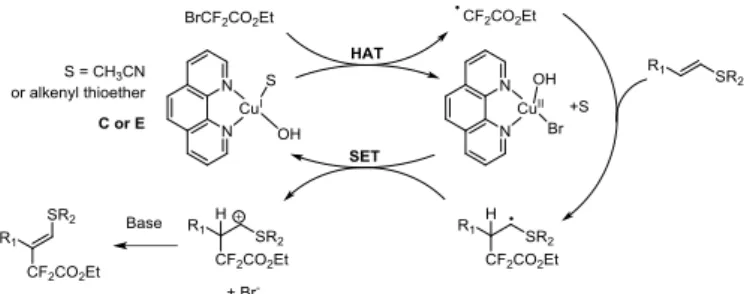
Based on these findings, we suggested the mechanism depicted in Scheme 6. In the presence of 1,10-phenanthroline and a base, the copper(I) hydroxo complex reduced BrCF2CO2Et to form a copper (II)
complex and a ethoxy carbonyl difluoromethyl radical. Then, the addition of this radical on the alkenyl thioether 1 proceeded according to an outsphere process and the observed stereoselectivity is related to the relative stability of the two possible isomers after the deprotonation step.
ARTICLE Journal Name
6 | J. Name., 2012, 00, 1-3
Scheme 6 Proposed reaction mechanism
These findings can be generalized. Indeed, for the initiation step, we could rationalize the absence of reactivity of BrCF2CONR2,
BrCF2PO(OEt)2 and BrCH2CO2Et with the higher barrier energies
computed for the HAT as well as with their higher reduction potential measured by cyclic voltammetry (see the Supporting Information). Moreover, the fact that the radical initiation did not depend on the presence of the alkenyl thioether showed that this method is broadly applicable to the generation of °CF2CO2Et radicals using copper
catalyst. This hypothesis was confirmed by performing a radical trapping experiment with TEMPO in the presence of enamide (Table 5, entry 1) and benzofuranes (Table 5, entry 2 and 3) in previously reported conditions.25,26 For example the adduct 4 was isolated in
30% yields in the case of ene-carbamates without traces of the desired addition product, revealing a similar mechanism for these substrates. In a previous report,26 a non-radical mechanism was
proposed based on stoichiometric reactions performed in the absence of the base. After ruling out the direct oxidative addition of the bromo compound with the cationic copper(I) complex (by both NMR and electrochemistry performed at RT)26, a pre-complexation
of the latter with enamide was established via cyclic voltammetry as evidenced here by 1H NMR in the case of the alkenyl thioether (in the
absence of the base). This emphasized the important role of the base that transformed the cationic copper(I) complex to neutral copper(I) hydroxo complex. Finally, the radical mechanism established herein turned out to be quite general for these systems.
Table 5 Experiments in the presence of TEMPO for enamide and benzofuranes
Entry Substrate Solvent, time Yield of 4 a
1 CH3CN, 6 h 30 %
2 DMF, 20 h 10 %
3 DMF, 20 h 10 %
a19F NMR yield, α,α,α-trifluorotoluene was used as an internal standard.
3. CONCLUSIONS
We report herein a general regio- and stereoselective method for the ethoxy carbonyl difluoromethylation of alkenyl thioethers. The developed methodology was applied to a broad range of substrates with good yields and an excellent selectivity in favor of the E isomer. Mechanistic studies supported by experimental observations and theoretical calculations gave evidences for a radical mechanism. The generation of a difluoroacetate radical promoted by a well-defined copper complex was established by these studies. Compared to other strategies to introduce a fluorine atom or a fluorinated group,19–21,23,33–39 this method allowed the generation of a radical
under mild conditions, without requirement of light irradiation, expensive metal or radical initiator, which constitutes a real asset. It allows an easy access to fluorinated chemical platform of interest, since post-functionalizations of these substrates are possible thanks to the versatility of the ester function.
Acknowledgements
I. F. thanks the Ministère de l'Education Nationale de l'Enseignement Supérieur et de la Recherche (MNESR) for a fellowship. We acknowledge the Centre National de la Recherche Scientifique (CNRS), Chimie ParisTech, the Ecole Normale Supérieure (ENS), as well as the Agence Nationale de la Recherche (ANR) [program CD2I (CuFeCCBond)] for financial support. I. G., T. P. and X. P. thank the LABEX SynOrg (ANR-11-LABX-0029).
Notes and references
i The complete elucidation of the structure of the major isomer
was established further by HOESY experiments.
ii All other configurations were assigned by analogy (see the
Supporting Information)
iii For comparison purposes, a mechanistic path involving an
oxidative addition (OA), which does not involve the generation of radicals, was also calculated and is reported in the Supporting Information.
iv We chose Cu(CH3CN)4PF6 as a simpler starting complex whose
observed reactivity was similar to Cu2O (see the Supporting
Information and Table 3).
1 S. Purser, P. R. Moore, S. Swallow and V. Gouverneur, Chem
Soc Rev, 2008, 37, 320–330.
2 J. Wang, M. Sánchez-Roselló, J. L. Aceña, C. del Pozo, A. E. Sorochinsky, S. Fustero, V. A. Soloshonok and H. Liu, Chem.
Rev., 2014, 114, 2432–2506.
3 E. P. Gillis, K. J. Eastman, M. D. Hill, D. J. Donnelly and N. A. Meanwell, J. Med. Chem., 2015, 58, 8315–8359.
4 D. O’Hagan, Chem Soc Rev, 2008, 37, 308–319.
5 M.-C. Belhomme, T. Besset, T. Poisson and X. Pannecoucke,
Chem. - Eur. J., 2015, 21, 12836–12865.
6 E. A. Ilardi, E. Vitaku and J. T. Njardarson, J. Med. Chem., 2014, 57, 2832–2842.
7 P. Johannesson, G. Lindeberg, A. Johansson, G. V. Nikiforovich, A. Gogoll, B. Synnergren, M. Le Grèves, F. Nyberg, A. Karlén and A. Hallberg, J. Med. Chem., 2002, 45, 1767–1777.
8 C. Bibang Bi Ekogha, O. Ruel and S. A. Julia, Tetrahedron Lett., 1983, 24, 4825–4828.
Journal Name ARTICLE
J. Name., 2013, 00, 1-3 | 7
9 B. M. Trost and Y. Tanigawa, J. Am. Chem. Soc., 1979, 101, 4743–4745.
10 K. Itami, M. Mineno, N. Muraoka and J. Yoshida, J. Am. Chem.
Soc., 2004, 126, 11778–11779.
11 D. G. Bachmann, C. C. Wittwer and D. G. Gillingham, Adv.
Synth. Catal., 2013, 355, 3703–3707.
12 B. S. Marquet, E. G. Laurent, D. F. Andres, A. Bensadat and H. Benotmane, Tetrahedron, 1995, 51, 2605–2618.
13 B. S. Marquet, E. G. Laurent and D. F. Andres, Tetrahedron
Lett., 1997, 38, 1049–1052.
14 T. Hanamoto, R. Anno, K. Yamada and K. Ryu, Tetrahedron
Lett., 2007, 48, 3727–3730.
15 T. Hanamoto, R. Anno, K. Yamada, K. Ryu, R. Maeda, K. Aoi and H. Furuno, Tetrahedron, 2009, 65, 2757–2765.
16 L. Debien, M.-G. Braun, B. Quiclet-Sire and S. Z. Zard, Org.
Lett., 2013, 15, 6250–6253.
17 J. Li, W. Wan, G. Ma, Y. Chen, Q. Hu, K. Kang, H. Jiang and J. Hao, Eur. J. Org. Chem., 2016, 2016, 4916–4921.
18 C. Shao, G. Shi, Y. Zhang, S. Pan and X. Guan, Org. Lett., 2015, 17, 2652–2655.
19 Y. Ohtsuka and T. Yamakawa, Tetrahedron, 2011, 67, 2323– 2331.
20 J. Jung, E. Kim, Y. You and E. J. Cho, Adv. Synth. Catal., 2014, 356, 2741–2748.
21 Q. Lin, L. Chu and F.-L. Qing, Chin. J. Chem., 2013, 31, 885–891. 22 Y.-M. Su, Y. Hou, F. Yin, Y.-M. Xu, Y. Li, X. Zheng and X.-S.
Wang, Org. Lett., 2014, 16, 2958–2961.
23 S. Murakami, H. Ishii, T. Tajima and T. Fuchigami, Tetrahedron, 2006, 62, 3761–3769.
24 M.-C. Belhomme, T. Poisson and X. Pannecoucke, Org. Lett., 2013, 15, 3428–3431.
25 M.-C. Belhomme, T. Poisson and X. Pannecoucke, J. Org.
Chem., 2014, 79, 7205–7211.
26 G. Caillot, J. Dufour, M.-C. Belhomme, T. Poisson, L. Grimaud, X. Pannecoucke and I. Gillaizeau, Chem. Commun., 2014, 50, 5887–5890.
27 M.-C. Belhomme, A. Bayle, T. Poisson and X. Pannecoucke,
Eur. J. Org. Chem., 2015, 2015, 1719–1726.
28 A. Prieto, R. Melot, D. Bouyssi and N. Monteiro, ACS Catal., 2016, 6, 1093–1096.
29 M. Ke and Q. Song, J. Org. Chem., 2016, 81, 3654–3664. 30 A. J. Clark, Chem. Soc. Rev., 2002, 31, 1–11.
31 L. Forti, F. Ghelfi, M. L. Lancellotti, U. M. Pagnoni, Synth.
Commun., 1996, 26, 1699-1710
32 N. Zhang, S. R. Samanta, B. M. Rosen, V. Percec, Chem. Rev., 2014, 114, 5848-5958.
33 I. S. Kondratov, M. Y. Bugera, N. A. Tolmachova, G. G. Posternak, C. G. Daniliuc and G. Haufe, J. Org. Chem., 2015, 80, 12258–12264.
34 C. Yu, N. Iqbal, S. Park and E. J. Cho, Chem Commun, 2014, 50, 12884–12887.
35 Z. Gu, H. Zhang, P. Xu, Y. Cheng and C. Zhu, Adv. Synth. Catal., 2015, 357, 3057–3063.
36 X. Sun and S. Yu, Org. Lett., 2014, 16, 2938–2941.
37 Y. Li, J. Liu, L. Zhang, L. Zhu and J. Hu, J. Org. Chem., 2007, 72, 5824–5827.
38 H. Jiang, C. Huang, J. Guo, C. Zeng, Y. Zhang and S. Yu, Chem.
– Eur. J., 2012, 18, 15158–15166.
39 J. Xie, T. Zhang, F. Chen, N. Mehrkens, F. Rominger, M. Rudolph and A. S. K. Hashmi, Angew. Chem. Int. Ed., 2016, 55, 2934–2938.