HAL Id: hal-00838642
https://hal.inria.fr/hal-00838642
Submitted on 26 Jun 2013
HAL is a multi-disciplinary open access
archive for the deposit and dissemination of
sci-entific research documents, whether they are
pub-lished or not. The documents may come from
teaching and research institutions in France or
abroad, or from public or private research centers.
L’archive ouverte pluridisciplinaire HAL, est
destinée au dépôt et à la diffusion de documents
scientifiques de niveau recherche, publiés ou non,
émanant des établissements d’enseignement et de
recherche français ou étrangers, des laboratoires
publics ou privés.
SPLEMMA: A Generic Framework for
Controlled-Evolution of Software Product Lines
Daniel Romero, Simon Urli, Clément Quinton, Mireille Blay-Fornarino,
Philippe Collet, Laurence Duchien, Sébastien Mosser
To cite this version:
Daniel Romero, Simon Urli, Clément Quinton, Mireille Blay-Fornarino, Philippe Collet, et
al..
SPLEMMA: A Generic Framework for Controlled-Evolution of Software Product Lines.
MAPLE/SCALE 2013, Aug 2013, Tokyo, Japan. pp.59-66. �hal-00838642�
SPLEMMA: A Generic Framework for Controlled-Evolution
of Software Product Lines
Daniel Romero
*, Simon Urli
†, Clément Quinton
*,
Mireille Blay-Fornarino
†, Philippe Collet
†, Laurence Duchien
*, Sébastien Mosser
†*ADAM Project-team, Université Lille 1, LIFL (UMR CNRS 8022), INRIA Lille-Nord Europe, France
{first.last}@inria.fr
†MODALIS team,Université Nice Sophia Antipolis, I3S (UMR CNRS 7271), France
{urli,blay,collet,mosser}@i3s.unice.fr
ABSTRACT
Managing in a generic way the evolution process of feature-oriented Software Product Lines (spls) is complex due to the number of elements that are impacted and the hetero-geneity of the spls regarding artifacts used to define them. Existing work presents specific approaches to manage the evolution of spls in terms of such artifacts, i.e., assets, fea-ture models and relation definitions. Moreover stakeholders do not necessarily master all the knowledge of the spl mak-ing its evolution difficult and error-prone without a proper tool support. In order to deal with these issues, we introduce SPLEmma, a generic framework that follows a Model Driven Engineering approach to capture the evolution of a spl in-dependently of the kind of assets, technologies or feature models used for the product derivation. Authorized changes are described by the spl maintainer and captured in a model used to generate tools that guide the evolution process and preserve the consistency of the whole spl. We report on the application of our approach on two spls: YourCast for digital signage systems, and SALOON, which enables generation of configurations for cloud providers.
1.
INTRODUCTION
In recent years, the evolution process of feature–oriented Software Product Lines (spl)1 has gained the attention of
several research works due to the need of improving the de-rived software to meet the changing business requirements, to use new or evolving technologies or to integrate new func-tionalities. This evolution process, as the evolution of soft-ware systems, requires the consideration of several issues. The verification of Feature Models (fm)2, assets and
map-pings (i.e., links between features and assets) consistency and their co–evolution, as well as the control of evolution
1
A feature–oriented spl is composed by a set of feature mod-ules (or code units implementing requirements) along with a feature model [1].
2
Our work focuses on variability descriptions based on fea-ture models [10].
impact on the set of products, and the heterogeneity man-agement of spl solutions are some of these issues [3, 6]. These issues make evolution complex and difficult to carry out in a controlled and automated way.
In the literature, several works analyse and tackle some of these issues. For example, Borba et al. [5] and Th¨um et al. [19] consider the impact on the variability of the spl by reasoning on feature models. Other approaches study the co–evolution of different elements of the spl such as feature models, assets and mappings [11, 17] and even the derived products themselves [8]. Some work also focuses on version-ing the assets, feature models and architecture of the spl in order to deal with maintenance of derived products [12, 18]. Nevertheless, all these approaches are not generic enough to be easily used in the evolution of any spl.
As a matter of fact, feature-oriented spls are heterogeneous regarding their assets, mappings and fms. Even if all spls are based on common principles and building blocks, how each spl is concretely made depends on the requirements on derived products. Moreover, evolution operations depend on the spl domains and the kind of stakeholders. The evolution can be made by hand when few actors hold all the domain knowledge of a small spl. However, this activity is much more difficult when the scale of the spl increases, involving many different contributors as well as a large amount of operations with different granularities and impact depending on their knowledge level. Even if some tools [17, 19] propose a partial help with some aspects of evolution, the lack of genericity and support for evolution operations increases the burden of evolving feature–oriented spl.
In this paper we introduce SPLEmma3, a framework for dealing with the evolution in feature–oriented spls. SPL-Emma enables the validation of controlled spl evolution by following a Model Driven Engineering (MDE) approach. By controlled, we mean that a spl maintainer defines the au-thorized operations of evolution. Such definition is made through an evolution model enabling the generation of evo-lution tools. These tools automate the evoevo-lution process, i.e. the usage of generic services for validation, as well as the or-chestration of the spl specific services to execute the actual evolution operations. spl contributors, who do not master the whole spl, will use such tools to improve the spl. Fur-thermore, SPLEmma is generic and domain-independent,
3
SPLE for Software Product Line Evolution and mma for Emma Darwin, Charles Darwin’s wife.
i.e., the framework is independent of the spl implementa-tion and therefore of Feature Metamodels (fmm), assets and mappings but still can be specialized regarding the require-ments of the spl in terms of evolution.
The rest of this paper is structured as follows. Section 2 pro-vides background concepts and motivates our work through two case studies. In Section 3 we introduce the requirements related to spl evolution. We continue in Section 4 with the presentation of SPLEmma, our approach for evolution. Sec-tion 5 describes our experience of applying SPLEmma in the case studies while Section 6 provides an overview of exist-ing approaches dealexist-ing with spl evolution. In Section 7 we discuss the advantages of SPLEmma before concluding and presenting the perspectives of our work in Section 8.
2.
BACKGROUND AND CASE STUDIES
In this section we introduce our context of work and present two case studies to motivate our needs in spl evolution.
2.1
On SPL Evolution
In order to define our context of work, we identify who par-ticipates in spl evolution and we adapt to spls the taxonomy defined by Buckley et al. [6] related to the where, what and how of software evolution.
Regarding actors (who), we identify three of them: (i) spl maintainer that manages spls, which includes the control of the evolution process to avoid inconsistency; (ii) spl con-tributor performing the actual evolution operations; (iii) spl user that configures products by using the tool support of the spl.
Concerning the system properties (what ), we assume that the spl tools will be unavailable during an evolution. This means that products will not be derived when executing the changes. Moreover, all evolutions will be driven externally, responding to a user request, and the safety of the evolution must be ensured statically to avoid inconsistency. However the openness (i.e., the planned capacity to evolve) of a spl is not defined in a generic way. spl maintainers should antic-ipate possible evolutions. In the same way, spl maintainers also define the objects of change (where):
• Artifacts are evolvable elements. In feature-oriented spls such elements include fms, assets and mappings. • Granularity refers to the scale of evolution elements to be changed. The granularity can be coarse, medium or fine. In feature models, a coarse granularity refers to a general modification of the whole fm. A medium granularity is expressed in terms of change on specific features and a fine granularity enables modifications on attributes of features.
• Impact is related to the range of elements, which will be impacted by an evolution. An impact can be local (e.g., one asset of the spl is replaced) or global (e.g., the structure of a feature model is modified affecting mappings and assets).
Finally, change support (how ) refers to different mechanisms making the execution of the evolution easier. The framework defined in Section 4 gives such support.
2.2
YourCast
YourCast [22] is a system designed to support the defini-tion of customized digital signage system [7]. To do that, the spl captures the variability of such systems, and provides a user-friendly way of configuration. The project is funded as an industrial transfer and involves 2 SMEs interested in the automatic generation of digital signage systems applied to large associations meetings (e.g.,Choralies, an event involv-ing 4,000 choir sinvolv-ingers durinvolv-ing 11 days), conferences, or sport events (e.g., Tour de France).
There is a lot of variability to be managed to create a coher-ent digital signage system adapted to users’ needs. Your-Cast targets non-specialist users (e.g., association member) that have to select information sources implemented through common Internet services (e.g., RSS feeds, Twitter), screens look and feel, and information rendering mechanisms. Besides, YourCast aims to create an open community of users and developers. Currently, new Internet services are constantly created due to the expansion of Web 2.0. People want to use these services in digital signage systems through adapted rendering mechanisms they define. Then, we need to give the opportunity for everyone to contribute to the spl by adding new assets, updating the feature model and changing mappings between assets and configurations. That is why contributors and maintainers are distinct in Your-Cast. Contributors are allowed to update and add prod-ucts, enriching the family of products. Maintainers can delete some products to keep a consistent line regarding the available sources. Thus, a framework to support evolution in the YourCast spl, exposing specific operations, is really a need since the community will drive the changes without having all the knowledge of the spl.
2.3
SALOON
SALOON [14] is a spl to manage and derive cloud Platform-as-a-Service (PaaS) configurations. The automated deploy-ment of applications on PaaS has become very trendy. This deployment discharges application owners from dealing with virtual machine configuration, by providing application sup-port and hiding the cloud infrastructure. However, the selec-tion of a suitable PaaS to host an applicaselec-tion remains com-plicated. Indeed, the wide range of available PaaS providers combined with the lack of visibility among them make their selection a real challenge.
In order to address this challenge, SALOON relies on ontol-ogy and feature modeling to handle cloud platforms hetero-geneity and variability. The ontology captures the domain knowledge, in this case the PaaS provider offers, while the fms are used to reason about configurations in the frame-work. Each fm represents a cloud PaaS provider and the set of configurations related to this PaaS. A semantic mapping is defined between ontology concepts and fm features. This mapping allows users to choose their application technical requirements only once in the configuration process, thus avoiding a tedious and error-prone selection of such require-ments for each PaaS provider.
Because of constant changes of technologies and to stay alive in the market, offers from PaaS providers evolve and new ones appear. Contributors of SALOON, i.e., cloud experts,
need to update information and include new offers in order to enable SALOON’s users to benefit of them. However, the ontology should not be modified because of restrictions on the spl definition. Thus, a framework that enables a controlled spl evolution is required.
3.
REQUIREMENTS
Evolution in spls has been a challenge for many years [13]. Though several works exist on feature models evolution [3, 9], we identify three challenges to provide a generic evolution framework able to guarantee some properties: 1) how to ensure SPL consistency during evolution, 2) how to control the impact on the family of products and 3) how to deal with SPL heterogeneity.
3.1
Ensuring SPL consistency
In order to ensure the consistency of a spl, the correctness and co-evolution of impacted elements have to be checked:
1. Assets’ consistency. When assets are added or up-dated, they should behave properly. In general, the definition of a correct behaviour depends on each spl. Therefore, according to its domain, a spl will define suitable tests to verify the behavior of its assets. As YourCast evolution is driven by a community, each new asset has to be automatically tested before a complete integration in the spl. Currently, as soon as we let anyone contributing, we have to ensure the correctness of the code through continuous integration services. In SALOON, tests on assets are lighter since contributors are the cloud experts and each PaaS de-fines its own set of fixed instructions (which are the assets in SALOON) for its configuration.
2. FM consistency. In the literature, several opera-tions are defined to anomaly detection such as void fm, dead features, false optional features, wrong cardi-nalities and redundancies [3]. Besides these anomalies, we can find problems related to the concrete domain of spls. For example, in YourCast, the addition of a new configuration can introduce features that are semantically equivalent. The addition of a new ser-vice for weather predictions by using a forecast feature instead of a weather feature will cause the creation of two different features with the same semantics. In SALOON, the inclusion of a new cloud provider can lead to repetition of an existing one if a different name or identifier is specified for the provider being added. Thus, verifications using existing research can be sys-tematically used on each spl but specialized verifica-tions will be also required according to the domain. 3. Mapping consistency. Modifications on mappings also require checks. If spls define a metamodel for mappings, it is used to make structural verifications. In the contrary case, mappings have to include at least two elements of different type. Depending on the spl, it is also required to verify that mappings do not exist. In YourCast each asset is related to a given con-figuration of the fm. Mappings are defined through a mapping model. Because we have a lot of possible con-figurations, the mapping definition is an error-prone task without a proper tool. Each time that a mapping is added or updated, it is necessary to check if the con-figuration is not already related to another mapping.
The semantic mapping in SALOON requires the def-inition of relations between features and concepts in the ontology. Mappings are also based on a mapping metamodel, but their definition is difficult as the on-tology has several concepts.
4. Co–Evolution Several studies [11, 19] confirm that changes on evolvable elements are not isolated. Then, changes on elements from the Problem Space (PS), containing feature models, can also need modifications on the Configuration Knowledge (CK) or mappings and the Solution Space (SS) that has the assets [10]. An evolution can then be Intraspatial (only elements of the same space are modified), Interspatial First De-gree (the mapping and one of the spaces are modified) or Interspatial Second Degree (the mapping and both spaces are modified) [17]. Therefore, the co–evolution for different element of spls is required.
In YourCast and SALOON, co–evolution has to be guaranteed when a new product is added: a user has to provide both the new assets and the new configura-tion. Then, several validations have to be done (e.g., checking assets consistency, checking updated feature model consistency, checking mappings) in a transac-tional way to keep the consistency of the spl. If one of the validation fails, all the evolution should be can-celled and problems notified to contributors.
3.2
Controlling the impact on the SPL
In order to control the impact, we need first to identify it. According to the literature, an evolution can produce four kinds of impact on the family of products [19]: generaliza-tion, specializageneraliza-tion, refactoring and other. In generaliza-tions, we can still derive the set of original products but we add new ones. On the contrary, in specializations we can only derive a subset of the original products. Refac-torings improve the cohesion between spl elements with-out changing the product family. Other impacts should be avoided. and should be avoided. The control of impact refers to the automatic detection of evolution kind, prevent-ing regressions durprevent-ing the evolution.
In YourCast, contributors are only authorized to make generalizations. This means that we only allow contribu-tors to define new configurations opening the possibility of deriving new digital signage systems but we are still able to derive the original ones. In contrast, spl maintainers are able to specialize and refactor the spl family of products. Specializations are required when, for example, a source is no longer accessible. Maintainers also need to execute refac-torings when the architecture of the spl has to evolve or for simple maintenance reasons (e.g., to add a missing feature in the feature model).
In a similar way, SALOON allows for generalizations and specializations of the spl. Generalizations are needed when new PaaS are included in the spl. Specializations are due to changes on cloud provider offers. Thus, spl maintainers should control the impact on the variability.
3.3
Dealing with SPL heterogeneity
The previous issues illustrate the complexity of the evolution process in spls. An approach automating and making this
process easier is required. However spls are heterogeneous regarding the elements used to build them.
In a spl, the nature of assets depends on its domain. Your-Cast has Web application ARchives (WAR) files, javascript files and images while we find script fragments in SALOON. In a similar way, each spl can have its own mechanisms to express relationships between assets and decisions made on feature models. Indeed, our both case studies use different mapping metamodels.
Finally, there is no standard Feature Metamodel (fmm). SA-LOON employs a fmm with attributes and cardinalities while YourCast uses one without them. Thus, the spls are developed in different ways, which make the definition of an approach controlling the evolution process difficult.
Towards a generic approach.
The analysis of the evolu-tion in heterogeneous spls leads us to find commonalities to propose a generic approach. In particular, types of evolution operation in any spl can be additions, removals or updates. Such operations produce a generalization, specialization or refactoring of the spl (cf. Section 3.2) and consequently cer-tain elements are expected to execute them. Furthermore, structural validations can be easily made by using fmms and mapping metamodels. In a similar way, fm consistency can be ensured through existing algorithms (cf. Section 3). In the next section we use this commonality to introduce our approach to deal with heterogeneity, impact and spl consis-tency related to the evolution process.4.
THE SPLEMMA FRAMEWORK
In this section we introduce SPLEmma, a generic approach for the evolution of spls. The main objective of SPLEmma is the definition and execution of the evolution by keeping the consistency of the whole spl. To do that, the approach supports basic validations on fms, mappings and assets as well as the evolution itself. The evolution process is autom-atized and controlled through a tool, generated from models specifying the authorized changes on the spl.
4.1
SPLEMMA Overview
SPLEmma is a framework that follows MDE principles for the generation of tools to guide a controlled evolution of spls. By controlled we mean that spl maintainers decide about changes to be done by spl contributors. Figure 1 depicts an overview of the process to generate evolution tools. The evolution of the spl is defined by spl maintain-ers through an Evolution Model (cf. Section 4.2). SPLEmma validates explicit and implicit constraints of such models (cf. step 1 in Figure 1) before continuing with the generation process (cf. Section 4.3). The spl maintainer then selects the generic Validation Services (cf. Section 4.4) used by the Evolution Manager, which enable the verification of precon-ditions and postconprecon-ditions on evolution. Maintainers also indicate specific services of the spl to define specialized pre-conditions and postpre-conditions. Generic validation services are hold by the SPLEmma Store, which allows the extension of the framework through the addition of new services. The Model Checker and Evolution Manager (cf. Section 4.4) are tools generated (step 3 and 4) and compiled (step 5) by
SPLEmma to support a controlled evolution. The former checks the validity of feature and mapping models by using the FMM and MappingMM. The latter enables spl contrib-utors to define a concrete evolution as well as its orchestra-tion and execuorchestra-tion through the use of Maintenance Services provided by the spl maintainer.
SPL Maintainer FMM MappingMM Maintenance Services addadd add deletedelete
delete updateupdateupdate getget utility SPLEmma Store A B C D w a rn n in g s, p ro b le ms SPL Evolvable Elements asse ts Mapping SPLEmma Evolution Model SPL Maintainer Evolution Metamodel Model Checker Evolution Manager Model Checker Evolution Manager validationvalidation validation SPL Maintainer SPL Contributors Defines Conforms to Input Use(s) Legend: Output Evolution Model Validation 1 Validation Services Selection 2 Model Checker Generation 3 Evolution Manager Generation 4 Compilation and Packaging 5
Figure 1: SPLEMMA generation process overview
4.2
Evolution Metamodel
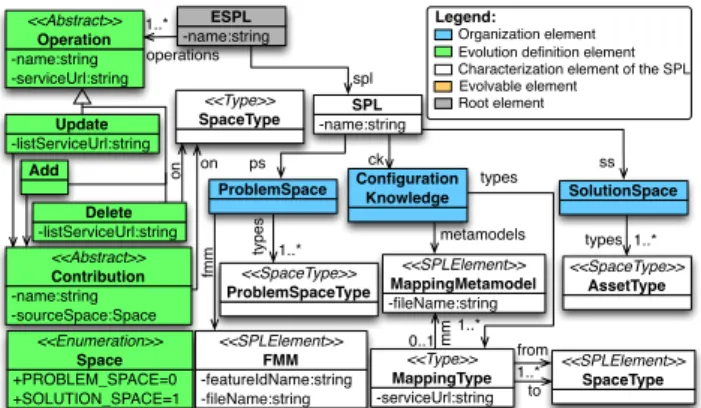
The keystone of our framework is the model reifying the evo-lution of the spl. Figures 2, 3 and 4 depict the metamodel used to define such model. This metamodel includes the dif-ferent elements required to characterize a feature-oriented spl as well as its evolution. Such metamodel is indepen-dent of domains and technologies related to spls in order to deal with their heterogeneity (cf. section 3.3). In particu-lar, the SPLEmma metamodel captures the how and where of spl evolution (cf. Section 2.1). The how includes oper-ations, which are atomic and independent from each other. We define the evolution in this way to simplify its execution and control. The where are concrete elements that repre-sent evolvable elements. These elements have a type and can be modified through an evolution. Therefore, an evolu-tion model is composed by a set of operaevolu-tions and different elements of the spl reifying evolvable elements.
-name:string ESPL -name:string -serviceUrl:string <<Abstract>> Operation -featureIdName:string -fileName:string <<SPLElement>> FMM fmm 1..* 1..* +PROBLEM_SPACE=0 +SOLUTION_SPACE=1 <<Enumeration>> Space <<SpaceType>> AssetType types types <<SpaceType>> ProblemSpaceType typ e s 1..* <<Type>> SpaceType <<SPLElement>> SpaceType from to 1..* 0..1 metamodels operations -listServiceUrl:string Update ps ck ProblemSpace -fileName:string <<SPLElement>> MappingMetamodel Configuration Knowledge SolutionSpace ss mm 1..* Organization element Evolution definition element Characterization element of the SPL Root element Legend: on -name:string -sourceSpace:Space <<Abstract>> Contribution on Evolvable element Add -serviceUrl:string <<Type>> MappingType -listServiceUrl:string Delete spl -name:string SPL
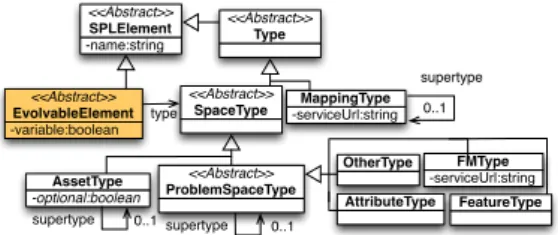
Figure 2: Evolution Metamodel in SPLEMMA Each operation is applied on a SpaceType such as Asset-Type or ProblemSpaceAsset-Type (i.e., a FeatureModelAsset-Type,
Fea-tureType or AttributeType in Figure 3). These types en-able the expression of different granularity levels in evolu-tion (cf. Secevolu-tion 2.1). The operaevolu-tions that can be defined are delete, update and add. The last two require a Contri-bution element, which defines the type of elements expected according to the evolution kind (cf. Section 3.1): IntraSpa-tial, InterSpatialFD (InterSpatial First Degree), and Inter-SpatialSD (InterSpatial Second Degree). The definition of Contributions in this way allows us to provide a basic valida-tion of evoluvalida-tion by controlling its impact. Figure 4 depicts Contributions in SPLEmma. -name:string <<Abstract>> SPLElement -optional:boolean AssetType -serviceUrl:string FMType supertype 0..1 OtherType type <<Abstract>>
SpaceType -serviceUrl:stringMappingType
supertype 0..1 <<Abstract>> ProblemSpaceType supertype 0..1 AttributeType -variable:boolean <<Abstract>> EvolvableElement <<Abstract>> Type FeatureType
Figure 3: Types in SPLEMMA Metamodel In our metamodel, EvolvableElement s are concrete elements of the spl that can be impacted by Update and Delete op-erations. These elements have a SpaceType (cf. Figure 3) according to the category to which they belong: PS, CK and SS (cf. section 3.1). The PS has FeatureModel s, their Features and Attributes. In the PS also is the FeatureMeta-model used by the spl. The Other element is an evolvable element for the definition of other elements that are part of the PS such as the ontology in SALOON.
The CK contains the MappingTypes and Mapping Metamod-els (if they exist) defined by the spl. These types describe the types of elements involved in the mapping and the meta-model that they should respect, which are used in our frame-work to validate InterSpatial Contributions. Each Mapping-Type has a serviceUrl attribute that defines the relation to-wards an utility service (cf. Section 4.4), for checking the existence of a mapping when Add or Update operations are executed. Finally, in the SS we find assets and their types. In an evolution model, all the spl elements that are not evolvable elements (e.g., types or metamodels) can not be changed by an evolution. The spl maintainer decides about their modifications when required, and changes the evolution model accordingly. Furthermore, an evolution model does not include all the elements belonging to the spl. Only evolvable elements that can not be modified freely have to be specified.
IntraSpatial <<Abstract>>InterSpatial
1..*
<<SPLElement>>
SpaceType
InterSpatialFD MappingType<<Type>>
1..* -name:string -sourceSpace:Space <<Abstract>> Contribution on mappings targetSpaceTypes InterSpatialSD
Figure 4: Contributions in SPLEMMA Metamodel
4.3
Validations on Evolution Models
As already said, SPLEmma uses evolution models in order to provide tools for evolution automatization. However, in order to generate such tools, SPLEmma validates the ex-plicit and imex-plicit constraints on the model. Exex-plicit con-straints are defined by the relationships in the metamodel
and validated by verifying the “conforms to” relation. On the other hand, implicit constraints depend on Contribu-tions and Types of evolvable elements in the model:
• Contribution checking: the SpaceType of the contri-bution (cf. on relationship between Contricontri-bution and SpaceType in Figure 4) belongs to the sourceSpace. • Interspatial contribution checking: mappings in
Inter-spatial contributions include the type defined by on as source or target types. In the same way, the from (resp. to) types in a mapping belong to the same space. • InterspatialSD contribution checking: the targetSpace-Types should belong to the opposite space of sourceS-pace. Additionally, at least one mapping has to involve types from both spaces.
4.4
Generated Tools
The Evolution Manager tool (cf. Figure 1) enables spl con-tributors to execute a controlled evolution. In particular, the Evolution Manager performs the following tasks: 1) contri-bution creation, 2) contricontri-bution validation, 3) validation of preconditions for the evolution, 4) operation execution, and 5) validation of postconditions for the operation.
The contributions are created by respecting the restrictions of the evolution model. Contribution validations supported by the Evolution Manager include the satisfaction of the “conforms to” relation by feature models and mapping mod-els through the Model Checker, and the containment of the suitable mappings and elements by contributions. This last validation provides a basic control on the structural impact. The validation of preconditions depends on the selected Val-idation Services and specific services of the spl when the tools were generated (cf. Section 4.1). If at least one pre-condition is not respected, the operation is not executed. Once the Evolution Manager validates the preconditions, it proceeds to the operation execution through the Mainte-nance Services. Then, the postconditions are validated and results presented to the contributor. The non-selection of Validation services means that there are no preconditions and/or postconditions. This can happen because the main-tainer considers that they are not required or because there are no compatible Validation Services with the spl.
Maintenance Services.
These services, developed by the spl maintainer, define the semantics of operations (or evolu-tions) on the spl. Each operation in the evolution model is related to an evolution service (i.e., a Delete, Update or Add service in Figure 1). Maintenance Services also include util-ity services, which provide information related to evolvable elements for the definition of update and delete operations as well as mapping and product existence verification.SPLEmma Store.
The Store allows spl maintainers to en-rich SPLEmma through the incorporation of new Validation Services and it fosters the reuse of well-know verification mechanism in literature. Such verifications mainly focus on basic semantic checks on fms including the presence of dead features, false optional features, wrong cardinalities and re-dundancies [3] but also the relationships between two fms (i.e., generalization, specialization or refactoring) to identify the impact on spl variability. These verifications deal withthe consistency of the spl (cf. section 3). The usability of different Validation Services on evolution for a specific spl is checked by SPLEmma when such services are chosen by the maintainer. Such checking process consists in determin-ing if the fmm used by Validation Services are the same as the one used by the spl. The Validation Services are used to define the preconditions and postconditions of evolution.
4.5
Evolution Process Summary
The automation of spl evolution through SPLEmma is sum-marized as follows:
1. Definition of the evolution model by SPL main-tainer . This model reifies the openness degree of the spl and therefore the control maintainers keep on evo-lution operations.
2. Generation of tools by SPLEmma . The SPLEmma framework uses the Evolution Model to generate an Evolution Manager and Model Checker enabling the automatization of the evolution (cf. Figure 1). 3. Definition of a concrete evolution by SPL
con-tributors. Through the Evolution Manager, contribu-tors define an operation and its contribution according to changes on the business domain. A concrete evolu-tion is an operaevolu-tion allowed by the evoluevolu-tion model. 4. Validation of contribution and preconditions by Evolution Manager . The contribution is analysed and checked by regarding the constraints from the Evo-lution Model. If there are preconditions, they are eval-uated through the Validation Services.
5. Execution of the evolution by Evolution Man-ager . The Evolution ManMan-ager uses the Maintenance Services of the spl to perform the concrete evolution. 6. Validation of postconditions by Evolution Man-ager . If there are postcondifitions, they are evaluated by calling the related Validation Services.
5.
IMPLEMENTATION AND APPLICATION
TO CASE STUDIES
In this section, we present the details of the tool support for our approach as well as its use in both case studies.
Tool support.
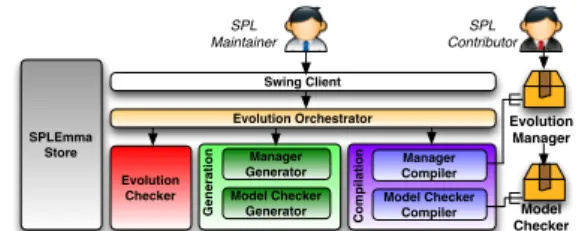
SPLEmma provides a standalone tool basedon Java and Eclipse EMF4. The tool, called SPLEmma Gen-erator, allows spl maintainers to generate evolution tools for their spls. Figure 5 depicts the architecture of the SPL-Emma Generator. The architecture modularizes the differ-ent tasks in SPLEmma, i.e., checking, generation, compi-lation and service management (cf. Figure 1). Such modu-larization fosters reuse and makes modification on different tasks easier.
The Evolution Orchestrator guides the generation process depicted by Figure 1. The Evolution Checker verifies the implicit constraints of the evolution model as well as the usability of Validation Services by regarding the metamod-els of the spl. The Manager Generator and Model Checker Generator enable the Evolution Manager and Model Checker generation, respectively. The Manager Compiler and Model Checker Compiler support the compilation and packaging of generated tools. The SPLEmma Store provides functional-ity to manage Validation Services.
4
Eclipse EMF: http://www.eclipse.org/modeling/emf/
SPLEmma Store Evolution Checker Manager Generator Model Checker Generator Swing Client G e n e ra ti o n C o m p il a ti o n Model Checker Compiler Manager Compiler Evolution Orchestrator Model Checker Evolution Manager SPL Maintainer SPL Contributor
Figure 5: SPLEMMA implementation overview
Application to YourCast.
In YourCast two different evo-lution models are needed: a first to express the authorized evolution for contributors and a second one for spl main-tainers. This stresses the fact that evolving the SPL is an error-prone and tedious activity, even for maintainers. In the YourCast community, recurrent needs are the use of new information sources and information rendering mech-anisms (called renderers). An information source is related to a WAR file and an image. On the other hand, a renderer is a javascript function for a kind of information.Based on this information, the YourCast evolution model for contributors contains add operations for sources and ren-derers. The add source operation requires an InterSpatialSD Contribution. For each source addition expected elements are the fm representing the configuration, a war file, an im-age and a mapping between the configuration and assets. The add renderer operation needs an InterSpatialSD Con-tribution. Expected elements are the fm representing the configuration, a javascript file containing the renderer func-tion and a mapping between the configurafunc-tion and asset. The evolution model for spl maintainer provides the previ-ous operations and also operations to update the variability description of sources and delete sources. The former re-quires an InterSpatialFD Contribution and is used, for ex-ample, to rename a feature. In this case, the asset remains the same but the feature model and all mappings involved (possibly a large amount) need to be updated. The latter operation can be used if an external source has been shut down. The corresponding assets are removed as well as the related mappings and features (in the FM).
Validations provided by SPLEmma include structural veri-fications on fms and mappings (YourCast defines a meta-model for the definition of relationships) as well as correct construction of Contributions. As the previous evolutions in-volve fm changes, we use generic preconditions related to fm consistency (e.g., detection of dead features and void fm). Moreover, we define specialized preconditions for the addi-tion of sources and renderers. Such precondiaddi-tions execute tests to check the reliability of the assets being added. For the add evolution, a postcondition is specified, which verifies that they always produce a generalization of the spl.
Application to SALOON.
In SALOON required evolu-tions are addievolu-tions and updates of PaaS providers. Each provider is reified by a fm and a set of parametrisable in-structions enabling its configuration. Mapping between on-tology concepts and features is done through a dedicated mapping metamodel. Thus, the specified operations in SA-LOON evolution model for cloud experts or contributors are the addition and update of providers. For eachaddi-tion expected elements are a fm, a set of instrucaddi-tions, and a mapping between features and ontology concepts. The mapping between instructions and fm is defined with an at-tribute in features. Each update includes a fm, and new instructions and/or ontology concept mappings for features being modified or added.
Structural validations and generic preconditions are the same used by the YourCast evolution. However, we also include an additional generic precondition related to fm with cardi-nalities such as the wrong cardinality detection. For both, add and update operations, we define a specific precondition to verify that mappings towards the ontology use existing concepts. In SALOON case, no postcondition is specified.
6.
RELATED WORK
In this section we present existing works by grouping them according to three requirements introduced by section 3.
SPL consistency.
In the literature, some works face spl consistency in evolution by focusing on fms consistency (cf. [2, 4, 15, 20]). Batory [2] proposes an approach to integrate fms, grammars and propositional formulas in order to de-bug fms through satisfiability solvers. Benavides et al. [4] analysis the usage of constraint programming to provide a base for an automated reasoning on extended fms. Tools as FeatureIDE [20] and VMWare [15] provide automated reasoning on fms. All these works provide valuable mech-anisms to detect the already mentioned fm anomalies. In SPLEmma, we benefit from them to provide basic valida-tions on evolution through the definition of precondivalida-tions. Other approaches deal or analyze the co–evolution of evolv-able elements (cf. [5, 17]). Borba et al. introduce templates to guide the co-evolution [5]. The approach presented by Seid et al. considers the co-evolution of PS and SS and de-fine remapping operators [17]. With our approach we do not redefine or improve these approaches but rather we focus on ensuring the presence of required elements according to the kind of evolution (i.e., intraspatial or interspatial). By do-ing this, SPLEmma provides a first validation mechanism for the consistency of the co-evolution.Impact in the SPL family of products.
Existing works propose algorithms to determine impact of the evolution on spl product family [5, 19]. In particular, Borba et al. [5] pro-pose a theory of spl refinement independent of the language used to implement assets, where a refinement expresses a refactoring or generalization of the spl. In order to define algorithms for determining the relationship (i.e., generaliza-tion, specializageneraliza-tion, refactoring or arbitrary) between two feature models, Th¨um et al. model operations on fms using propositional formula [19]. FeatureIDE [20] provides sup-port for determining such relations. SPLEmma uses such algorithms. Furthermore, SPLEmma allows maintainers to define operations or evolutions accepted by spls to provide some control on the impact of spls variability.SPL heterogeneity.
To the best of our knowledge, there are not works focusing on evolution of heterogeneous spls. However, we found some tool support for analysis of hetero-geneous fms such as FAMA [21] and BeTTy [16]. FAMA is an extensible framework for an automated analysis of fms.The framework deals with spl heterogeneity by support-ing different variability models, reasoners and analysis ques-tions. BeTTy, which is built on the top of FAMA, is a framework for benchmarking and testing on the analysis of feature models. The framework can be easily extended to support different formats of variability models. Although FAMA and BeTTy do not focus on the evolution and only care about fms, in SPLEmma we exploit their idea of using automated analysis on fm based on existing research.
7.
DISCUSSION
The use of SPLEmma on evolution of YourCast and SA-LOON allows us to confirm the following advantages:
• SPLEmma supports the validation of evolution by fos-tering reuse of well validated algorithms as made by the Fama framework [21] and FeatureIDE [20]. For example, in YourCast and SALOON we use the al-gorithm proposed by Th¨um et al. [19] to determine the impact of evolution on the spl.
• Evolution is less error-prone. By reifying evolution in a model, we force the definition of restrictions about elements that can be modified and how. This provides a degree of control on evolution to maintainers. Thus, in YourCast, the spl maintainer decides that only sources and renderers can be added. In SALOON, the ontology remains untouched by evolution.
• Evolution tools generated by SPLEmma are easily mod-ifiable. The incorporation of new operations or evolv-able elements only requires the modification of the evo-lution model and the regeneration of tools.
• The framework is spl independent. The successful tool generation and execution of the evolution in both cases show that we can deal with heterogeneous spl. The framework provides a suitable abstract level to avoid conflicts with the kind of assets, mappings of feature models employed by spl, enabling us to deal with spl heterogeneity. Existing tools such as FeatureEdit [19] and FeatureMapper [17] assume the all spl uses their formalism to express variability.
• The consistency of the whole spl is considered. As FeatureMapper and the theory proposed by Borba et al. [5], SPLEmma deals with the co-evolution of map-pings, fms and assets according to the kind of evo-lution. In YourCast and SALOON, the definition of Interspatial Contributions makes tools generated by SPLEmma check the presence of the required elements as well as their correct structure and basic semantics according to preconditions and postconditions. Other approaches (cf. [19]) only focus on the impact of fms. The main drawback of the approach is related to the for-malism to deal with models. In SPLEmma implementation, we assume that the feature-oriented spl uses EMF for the model definition. This assumption impacts the genericity of the framework by limiting the kind of spl that can be evolved through SPLEmma. However, the EMF dependency is at the implementation level and not conceptual. There-fore, SPLEmma tools can be improved to support different model formalisms as made by Fama [21].
8.
CONCLUSION
In this paper we introduced SPLEmma, a framework for the validation of feature-oriented spl evolution. The validation
is reached through the generation of tools from evolution models describing the granularity level of changes as well as evolvable elements. In order to keep consistency of the spls, SPLEmma enables the definition of preconditions and post-conditions on the evolution by reusing existing algorithms for fmm analysis as well as basic validations regarding the kind of evolution. Each evolution is reified as one opera-tion that defines the kind of elements to modify in order to control the structural impact on spl. Furthermore, the framework is independent from business domains and tech-nologies used for the development of spls, to deal with spl heterogeneity. The framework is validated with two use cases from different domains. Experiences of the evolution with them confirm the soundness of the approach.
In terms of perspectives, we intend to consolidate the results obtained so far, following three directions. First, we will ex-plore the introduction of the when dimension from software evolution by means of version management. This would make the approach more flexible by enabling spl maintain-ers to retrieve previous vmaintain-ersions of the spl which can be useful when the evolution produces specializations of spls. Secondly, we plan to introduce an ontology for improving the definition of relationships between operations and validation services. This ontology will enable a partial automatization of service selection according to the evolution operations. Finally, we plan to extend the SPLEmma metamodel and tools to enable privilege management on the evolution. Until now, if different operations are required regarding the kind of role (i.e., maintainer or contributor ) different evolution models and the related tools need to be generated. The idea is to have an evolution tool by spl with authentications that grant access only to operations according to user role.
Acknowledgments.
This work is supported by Ministry of Higher Education and Research, Nord–Pas de Calais Re-gional Council, the FEDER through the Contrat de Plan Etat Region Campus Intelligence Ambiante (CPER CIA) 2007-2013 and the ANR YourCast project under contract ANR-2011-EMMA-013-01.9.
REFERENCES
[1] S. Apel, C. K¨astner, A. Gr¨oßlinger, and C. Lengauer. Type safety for feature-oriented product lines. Automated Software Engg., 17(3):251–300, Sept. 2010.
[2] D. Batory. Feature models, grammars, and propositional formulas. In Proceedings of the 9th international conference on Software Product Lines, SPLC’05, pages 7–20, Berlin, Heidelberg, 2005. Springer-Verlag.
[3] D. Benavides, S. Segura, and A. Ruiz-Cort´es. Automated analysis of feature models 20 years later: A literature review. Inf. Syst., 35(6):615–636, Sept. 2010.
[4] D. Benavides, P. Trinidad, and A. Ruiz-Cort´es. Automated reasoning on feature models. In Proceedings of the 17th international conference on Advanced Information Systems Engineering, CAiSE’05, pages 491–503, Berlin, Heidelberg, 2005. Springer-Verlag.
[5] P. Borba, L. Teixeira, and R. Gheyi. A theory of software product line refinement. In Proceedings of the 7th
International colloquium conference on Theoretical aspects of computing, ICTAC’10, pages 15–43, Berlin, Heidelberg, 2010. Springer-Verlag.
[6] J. Buckley, T. Mens, M. Zenger, A. Rashid, and G. Kniesel. Towards a taxonomy of software change: Research articles. J. Softw. Maint. Evol., 17(5):309–332, Sept. 2005. [7] F. Dupin and M. Adolph. Digital signage: the right
information in all the right places. Technical report,
International Telecommunication Union (ITU), Nov. 2011. [8] N. Gamez and L. Fuentes. Software product line evolution with cardinality-based feature models. In Proceedings of the 12th international conference on Top productivity through software reuse, ICSR’11, pages 102–118, Berlin, Heidelberg, 2011. Springer-Verlag.
[9] J. Guo, Y. Wang, P. Trinidad, and D. Benavides. Consistency maintenance for evolving feature models. Expert Systems with Applications, 2011.
[10] K. Kang, S. Cohen, J. Hess, W. Nowak, and S. Peterson. Feature-Oriented Domain Analysis (FODA) Feasibility Study. Software Engineering Institute, Carnegie Mellon University Pittsburgh, PA., 1990.
[11] R. Lotufo, S. She, T. Berger, K. Czarnecki, and A. Wasowski. Evolution of the linux kernel variability, model. In Proceedings of the 14th international conference on Software product lines: going beyond, SPLC’10, pages 136–150, Berlin, Heidelberg, 2010. Springer-Verlag. [12] R. Mitschke and M. Eichberg. Supporting the evolution of
software product lines. In Oldevik, J., Olsen, G.K., Neple, T., Paige, R. (eds.) ECMDA Traceability Workshop (ECMDA-TW) 2008 Proceedings, pages 87–96, 2008. [13] K. Pohl, G. B¨ockle, and F. van der Linden. Software
Product Line Engineering: Foundations, Principles and Techniques. Springer, 2005.
[14] C. Quinton, N. Haderer, R. Rouvoy, and L. Duchien. Towards Multi-Cloud Configurations Using Feature Models and Ontologies. In Proceedings of the 1st International Workshop on Multi-Cloud Applications and Federated Cloud, Multi-Cloud’13, 2013. To appear.
[15] C. Salinesi, C. Rolland, and R. Mazo. VMWare: Tool Support for Automatic Verification of Structural and Semantic Correctness in Product Line Models. In International Workshop on Variability Modelling of Software-intensive Systems, page 173, Sevilla, Espagne, Jan. 2009.
[16] S. Segura, J. A. Galindo, D. Benavides, J. A. Parejo, and A. Ruiz-Cort´es. Betty: benchmarking and testing on the automated analysis of feature models. In Proceedings of the Sixth International Workshop on Variability Modeling of Software-Intensive Systems, VaMoS ’12, pages 63–71, New York, NY, USA, 2012. ACM.
[17] C. Seidl, F. Heidenreich, and U. Assmann. Co-evolution of models and feature mapping in software product lines. In Proceedings of the 16th International Software Product Line Conference - Volume 1, SPLC ’12, pages 76–85, New York, NY, USA, 2012. ACM.
[18] C. Thao. Managing evolution of software product line. In Proceedings of the 2012 International Conference on Software Engineering, ICSE 2012, pages 1619–1621, Piscataway, NJ, USA, 2012. IEEE Press.
[19] T. Th¨um, D. Batory, and C. K¨astner. Reasoning about edits to feature models. In Proceedings of the 31st International Conference on Software Engineering, ICSE ’09, pages 254–264, Washington, DC, USA, 2009. IEEE Computer Society.
[20] T. Th¨um, C. K¨astner, F. Benduhn, J. Meinicke, G. Saake, and T. Leich. Featureide: An extensible framework for feature-oriented software development. Science of Computer Programming, 2012. to appear; accepted 7 Jun 2012.
[21] P. Trinidad, D. Benavides, A. Ruiz-Cort´es, S. Segura, and A. Jimenez. Fama framework. In Proceedings of the 2008 12th International Software Product Line Conference, SPLC ’08, pages 359–, Washington, DC, USA, 2008. IEEE Computer Society.
[22] S. Urli, M. Blay-Fornarino, P. Collet, and S. Mosser. Using Composite Feature Models to Support Agile Software Product Line Evolution. In Models and Evolution 2012 (ME’12), workshop. ACM DL, Sept. 2012.