Development and Evaluation of a Thermal Model for Haptic Interfaces
byHsin-Ni Ho
B.S. Mechanical Engineering, 2000 National Taiwan University
M.S. Mechanical Engineering, 2002 National Taiwan University
Submitted to the Department of Mechanical Engineering in Partial Fulfillment of the Requirements for the Degree of
Doctor of Philosophy in Mechanical Engineering
at the
M1SSAcHUSE~T
*
S INSTi
OF TECHNOLOGY
APR 9 2007
LIBRARIES
Massachusetts Institute of Technology February 2007
C 2007 Massachusetts Institute of Technology
All rights reserved
ARCHIVES
Signature of Author... ... •l....
Department tof Mech Lical Engineering September 20, 2006
Certified by. ... . . ... ...
Lynette A. Jones Principal Research Scientist in Mechanical EngineeringA
Thesis SupervisorAccepted by... ... ...
Lallit Anand Chairman, Department Committee on Graduate Students
Development and Evaluation of a Thermal Model for Haptic Interfaces
by
Hsin-Ni Ho
Submitted to the Department of Mechanical Engineering on September 22, 2006 in partial fulfillment of the requirements for the degree of Doctor of Philosophy in
Mechanical Engineering
ABSTRACT
The thermal interaction between the skin and an object is influenced by the thermal properties and initial temperatures of the skin and object, and by the contact force and surface roughness of the contact surfaces. This thermal interaction is modeled in this research which characterizes the transient thermal responses during contact. The thermal model was evaluated in psychophysical and physiological experiments by determining whether simulated thermal feedback generated based on the model was capable of conveying information to users that was similar to that provided by real materials, and by comparing the temperature responses of the skin predicted by the model and elicited by real materials. In order to obtain precise skin temperature measurements, an infrared thermal measurement system was designed to overcome the limitations imposed by thermal sensors and to determine the influence of contact pressure on the skin temperature responses during contact. The results from the psychophysical and physiological experiments validated the thermal model proposed in this research within the typical contact force range of manual exploration. A thermal display based on this model is able to convey thermal cues that can be used to perceive and identify objects as effectively as those provided by real materials.
Thesis Supervisor: Lynette A. Jones
ACKNOWLEDGMENTS
I would like to express my sincere gratitude to my advisor, Dr. Lynette A. Jones for
her guidance throughout my PhD years. Her wisdom and kindness helped me adapt to the foreign environment and shaped me into a researcher. This thesis would not be possible without her expertise and advice, and the countless hours that she spent on reviewing and editing the manuscript.
I also would like to thank my committee members, Prof. John H. Lienhard and Prof.
Ioannis Yannas, for their valuable suggestions and support for this work. Prof. Lienhard's teaching stimulated my great interest in heat transfer, and the suggestions from Prof. Yannas always showed me the importance of considering the problems in other perspectives. Their expertise enabled me to build the foundation of this work.
My special thanks also go to Prof. Ian Hunter for providing the wonderful research
environment and resources. I am also grateful to Prof. Bora Mikic for his enthusiasm when discussing the thermal modeling with me.
I want to thank all the members in Bio-instrumentation lab for their help and
support. My MIT experience would not be so joyful without having Erin Piateski as an officemate and a best friend. Her company and encouragement made our office feel like home. Robert David is always very kind and helpful to me. His insights in heat transfer are inspiring and his attitude of conducting research sets a good example to me. Andrew Taberner and James Tangora have always been the great sources of expertise when I faced the challenges of my research. Not to mention Dawn Wendell, Brian Hemond, Craig Forest, Mike Garcia-Webb, Angela Chen, and Kate Melvin for making the lab a friendly place.
For all my friends, without you standing by my side, the summer in Boston would not be so joyous and the winter would be longer and darker. The laughs that we shared
are the most precious memory of my life in USA.
Lastly and most importantly, I would like to thank my parents, Ting-Keng Ho and Ho-Tze Lin, for their bottomless support and always having faith in me. This thesis is dedicated to them.
This research was supported in part through the Advanced Decision Architectures Collaborative Technology Alliance sponsored by the U.S. Army Research Laboratory under Cooperative Agreement DAAD 19-01-2-0009.
TABLE OF CONTENTS
INTRODUCTION ... 8
1.1 H APTIC INTERFACES ... 8
1.2 UTILITY AND DEVELOPMENT OF THERMAL DISPLAYS... 9
1.3 THERMAL MODELS FOR HAND-OBJECT INTERACTIONS... ... 13
1.4 PROPOSAL AND OVERVIEW ... 17
THERMAL SENSATION ...
19
2.1 SKIN ANATOMY AND PROPERTIES ... 19
2.2 THERMORECEPTORS ... 20
2.3 THRESHOLDS ... 21
2.4 SPATIAL SUMMATION AND LOCALIZATION ... 22
CONTRIBUTION OF THERMAL CUES TO MATERIAL DISCRIMINATION AND LOCALIZATION ... 24
3.1 MODELING THE THERMAL PROCESS... 26
3.2 MATERIAL DISCRIMINATION ... 29
3.3 MATERIAL LOCALIZATION ... 39
3.4 C ONCLUSION ... 48
THERMAL DISPLAY DEVELOPMENT AND EVALUATION ... 50
4.1 THERMAL DISPLAY DESIGN ... 51
4.2. REAL AND SIMULATED MATERIAL IDENTIFICATION... ... 53
4.3 REAL AND SIMULATED MATERIAL DISCRIMINATION ... 63
4.4 CHANGES IN SKIN TEMPERATURE DURING CONTACT ... 72
4.5 C ON CLUSION ... 81
THERMAL MEASUREMENTS FOR HAND-OBJECT INTERACTIONS ... 83
5.1 LIMITATIONS OF CONTACT THERMAL SENSORS ... ... 83
5.2 INFRARED THERMAL MEASUREMENT SYSTEM ... 85
5.3 CONCLUSION ... 103
THERMAL MODEL REVISION AND VALIDATION...
105
6.1 THERMAL MODEL WITH CONSIDERATION OF THERMAL CONTACT RESISTANCE... 106
6.2 SKIN SURFACE ROUGHNESS MEASUREMENT... ... 110
6.3 M ODEL SIM ULATION ... ... 115
6.4 MODEL VALIDATION ... 123
6.5 C ONCLUSION ... ... 137
CONCLUSIONS ...
139
7.1 SUMMARY AND CONTRIBUTIONS... 139
7.2 FUTURE W ORK ... ... 142
APPENDIX A: DEFINITIONS OF SURFACE ROUGHNESS PARAMETERS ... 145
CHAPTER
1
INTRODUCTION
1.1 Haptic Interfaces
1.2 Utility and Development of Thermal Displays 1.3 Thermal Models for Hand-Object Interactions 1.4 Proposal and Overview
1.1
HAPTIC INTERFACES
The haptic sensory system involves the tactile and proprioceptive senses and is the only sensory system that can both sense and act on stimuli. The tactile sense refers to the 'sense of touch' which is involved in perceiving the surface features, mechanical properties and thermal characteristics of objects in contact with the skin. The proprioceptive sense encodes the position and movement of our limbs. In our daily lives, we rely on both senses to observe and explore the environment. Tactile and proprioceptive inputs therefore play an important role in assessing the properties of objects that we used to interact with the environment. Without the haptic sense, this interaction would be extremely limited and most manual activities would be performed very inefficiently.
In order to assist in the physical interaction with a virtual environment or teleoperated robotic system, it is important to provide haptic feedback to the human operator. A haptic interface is defined as a device which is able to communicate with the user's sensory system through tactile and force feedback. Depending on the application, the haptic interface can either be a display which provides tactile or force feedback or it can use the operator's response as an input and display the appropriate feedback based on the user's response.
Current tactile displays are able to convey the shape, texture or contour of an object by deforming the skin or changing the distribution of contact forces (for a review see Burdea & Coiffet, 2003). Tactile displays are able to convey detailed localized contact information, whereas force displays provide feedback of the forces produced during interaction. Force displays are usually configured as hand controllers or exoskeletal devices that are mounted on the back of the hand and arm. The grounding of force displays is necessary to prevent slippage and potential accidents during force transmission. With the integration of sensors and actuators, these force displays are capable of sensing force and measuring limb position and therefore form a closed loop for force feedback control (for a review see Burdea & Coiffet, 2003).
With the objective of providing a complete image of a virtual environment, multimodal haptic displays have been developed to generate tactile, kinesthetic and thermal feedback simultaneously to convey the characteristics of an object during hand-object interactions (Benali-Khoudja & Hafez, 2004; Caldwell & Gosney, 1993; Citerin et al., 2006; Kron & Schmidt, 2003; Yang et al., 2006a). These multimodal displays are configured in various forms ranging from a haptic glove to a computer mouse. The tactile feedback is typically generated with a miniature motor, pin array, micro coils or piezoelectric bimorphs, whereas the thermal feedback is provided by a Peltier device with temperature control. With such an interface, the degree of immersion in a virtual environment can be enhanced.
1.2
UTILITY AND DEVELOPMENT OF THERMAL DISPLAYS
For applications involving virtual environments and teleoperated robotic systems, the object that interacts with the hand is either a virtual object or an object that is actually at a remote site. Users can therefore only interact physically with the object through a haptic interface. In order to provide a holistic image of a virtual object, the integration of thermal feedback into haptic interfaces has received increasing attention. With such a
display, the thermal characteristics of an object and thermal sensations associated with contact can be reproduced to assist users in identifying the object.
Typical thermal displays consist of thermal stimulators, thermal sensors, and a temperature control system that is used to monitor and control the surface temperature of the displays (Benali-Khoudja & Hafez, 2004; Caldwell & Gosney, 1993; Citerin et al., 2006; Deml et al., 2006; Ho & Jones, 2004; Ino et al., 1993; Kron & Schmidt, 2003; MacLean & Roderick, 1999; Ottensmeyer & Salisbury, 1997; Yamamoto et al., 2004; Yang et al., 2006a). In some studies, infrared lamps or fans have also used to provide thermal information about the environment through thermal convection or radiation (Dionisio et al., 1997; Lecuyer et al., 2003).
The Data Glove Input System designed by Caldwell and Gosney (1993) is a haptic interface that provides force, tactile, and thermal feedback. The thermal feedback unit is a Peltier device which makes contact with the dorsal surface of the index finger. Using this device, Caldwell and Gosney (1993) recorded the thermal changes on a teleoperated robotic hand as it made contact with a variety of objects (a cube of ice, a soldering iron, insulating foam, and a block of aluminum), and then presented these thermal transients to subjects who were required to identify the virtual material based on the simulated thermal cues. Subjects achieved an 80% success rate in identifying the various materials based only on these thermal cues.
Ino et al. (1993) also developed a thermal display which provided thermal cues associated with contact. They measured the decreases in finger temperature upon contact as subjects tried to identify various materials (aluminum, glass, rubber, polyacrylate, and wood), and the measured decreases in finger temperature were then used to simulate the thermal transients associated with contact. Subjects were required to identify the materials using only the simulated thermal cues. Ino et al. (1993) found that the recognition rates for the various materials presented with the thermal display were equivalent to those measured using real materials (61% correct with the real materials and 56% correct with the display), and that there was no significant difference in the
information transmission rates associated with the real object and the Peltier-based thermal display.
Besides empirically measuring temperature changes and re-creating them in a display, model-based thermal displays have also been developed to simulate different materials. Using an electrical analogy (Benali-Khoudja et al., 2003) as the basis of their thermal model, Benali-Khoudja and Hafez (2004) built a vibrotactile and thermal interface, VITAL. The simulation of the virtual material was achieved by integrating four Peltier devices with the vibrotactile interface so that the interface could generate thermal and tactile stimulation simultaneously. They demonstrated that the model predictions of the skin temperature responses when making contact with glass, copper and aluminum were similar to those measured when making contact with the corresponding real materials.
Another thermal display that was built to assist in material identification was designed and fabricated by Yamamoto et al. (2004) who used a thermal model to predict changes in skin temperature. The display was based on a Peltier device with thermal sensors, and a PID (proportional-integral-derivative) controller. The performance of the display was evaluated with four simulated materials (EPS, wood, ceramic, and brass) that subjects were required to identify. Subjects achieved an 80% success rate in identifying EPS and brass with the thermal cues generated by the thermal display, but were less accurate with the other two materials.
In order to enhance the ability of subjects to identify materials, multi-finger thermal displays have also been developed to present thermal information about an object to all of the fingers in one hand (Deml et al., 2006; Kron & Schmidt, 2003; Yang et al., 2006a, 2006b). These thermal displays are all model-based and utilize Peltier devices as the thermal stimulator. Deml et al. (2006) found that the simulated skin temperature responses during contact based on their thermal model were only slightly different from those recorded with real materials. In addition, subjects achieved similar performance in material identification tasks with real materials and those simulated with the thermal display. Kron and Schmidt (2003) evaluated their display using a pairwise material
discrimination task with four real (aluminum, ceramic, PVC, and wood) and simulated materials. Subjects' performance in material discrimination was comparable when the materials were presented physically or with the thermal display. Yang et al. (2006a, 2006b) further suggested that subjects' performance in material identification improves as the number of the fingers simulated increases, but that most of the improvement occurs when three rather than a single finger is used.
Other displays have been fabricated using Peltier devices to simulate changes in temperature in virtual environments. A thermal display, the Thermostylus, has also been built that can be incorporated into the PHANTOM interface (SensAble Technologies), a commercially available force reflecting device (Ottensmeyer & Salisbury, 1997). It utilizes a Peltier device to provide thermal feedback together with the force feedback of PHAMTON interface. The heating and cooling rates of this unit are 11 oC/s and 4.5 oC/s, respectively.
As a new medium of communication, a haptic doorknob was designed by MacLean and Roderick (1999) to convey information about the space beyond the door using thermal, tactile, and auditory feedback. The thermal feedback unit in this haptic display consisted of a Peltier device controlled by a PID temperature controller. This unit was able to output approximately 10 oC above and below the ambient temperature within 30 s.
Thermal feedback can also be presented without physical contact between the device and the user. In 1997, Dionisio et al. introduced the Thermopad which consists of a Peltier device, a fan and an IR lamp. The purpose of the Peltier device is to induce changes in skin temperature based on the virtual scenario. The IR lamp serves to warm the environment, and the fan is used to cool it. With this configuration, the Thermopad is able to generate thermal feedback in the form of conduction, convection and radiation, and is able to simulate different thermal scenarios in virtual reality environments, such as the perception of a fire blazing in a fire place.
Another type of non-contact thermal display called the HOMERE system was designed to assist visually-impaired people in virtual reality environments. (Lecuyer et al., 2003). The thermal feedback in this system is generated by twelve IR lamps located around a circular structure. They provide the warm feeling of the 'virtual sun' with 30 degree resolution for the direction of sunlight.
1.3
THERMAL MODELS FOR HAND-OBJECT
INTERACTIONS
One of the most crucial processes in developing a thermal display is the characterization of the thermal responses that occur on the hand as it makes contact with a material. In the early stages of thermal display development, the simulation of a virtual material in contact with the fingertip was based on empirical data of the changes in skin temperature when the hand made contact with the corresponding real material (Caldwell
& Gosney, 1993; Ino et al., 1993). In other words, numerous measurements needed to be
completed in order to simulate every material and condition that could appear in the virtual scenario. The time and labor needed for these measurements was considerable and there was not a consistent measurement protocol which introduced variability in the results obtained.
These limitations were overcome as thermal modeling has become the major methodology used for predicting the thermal interaction between the skin and an object (Bergamasco et al., 1997; Citerin et al., 2006; Deml et al., 2006; Ho & Jones, 2004,
2006b; Kron & Schmidt, 2003; Shitzer et al., 1996; Yamamoto et al., 2004; Yang et al.,
2006a). A thermal model is able to incorporate various material properties and contact conditions for different hand-object interaction scenarios. It can predict the thermal responses of the skin and an object during contact and the algorithms used for the thermal display should elicit the correct skin temperature response that simulates the intended thermal sensation. By working with a thermal model, a thermal display is able to simulate any object and environmental condition.
Most of the existing analytical thermal models are developed based on the bio-heat equation (Pennes, 1948), which is able to account for the effects of metabolic heat generation and blood perfusion with thermal diffusion to describe the energy balance within the tissue:
dT
pc = V(kVT) + (PC)bcb(Ta - T) + qm (1-1)
where pc is the heat capacity of the tissue, T is the tissue temperature, t is time, k is the conductivity of the tissue, (pc)b is the heat capacity of the blood, (ob is the perfusion rate of blood, Ta is the temperature of arterial blood before entering the capillaries, and qm is the metabolic heat generation.
This bio-heat equation describes a transient, conduction-dominated heat transfer process within tissue with the assumptions that metabolic heat generation, q,, is homogeneously distributed throughout the tissue of interest, that the blood perfusion effect (pc)bob(Ta - T) is homogeneous and isotropic, and that thermal equilibration occurs in the microcirculatory capillary bed. An important advantage of Pennes' bio-heat equation is that the blood perfusion term is linear with temperature, which means that the equation can be solved by methods commonly used to solve the heat-conduction equation. Numerous alternative models have been proposed for bio-heat transfer over the past 50 years (for a review see Charny, 1992), but the simplicity of Pennes' bio-heat equation and its agreement with experimental data have made it the quantitative foundation for the field of bio-heat transfer (Charny, 1992).
Using the bio-heat equation, existing thermal models predict the skin temperature responses during hand-object interactions with different assumptions and boundary conditions. In these thermal models, the initial temperatures and thermal properties of the skin and materials, and the effects of blood perfusion have generally been considered.
Shitzer et al. (1996) proposed a lumped heat transfer model for bio-heat transfer of a gloved semi-spherical fingertip with the cold environment based on the assumptions that the fingertip is supplied and drained by a single artery and a single vein, that the thermal properties of the tissue are homogeneous, and that the conduction of heat along the finger is neglected. The heat balance at the fingertip is given by:
dT
pcV dT = hA(To - T) + (pc) b Cob( Tb - T) (1-2)
dt
where pc is the heat capacity of the fingertip, V is fingertip volume, T is fingertip temperature, t is time, h is the heat transfer coefficient between the fingertip and the environment, A is fingertip surface area, and wo is blood perfusion rate. Subscripts o and b are for the properties of the environment and blood, respectively. In this model, the
dT effects of heat storage and blood perfusion within the tissue are described by pcVd T and
dt
(pc)b C(Tb- b T) respectively. In spite of the assumptions made to simplify the
complicated heat transfer process, Shitzer et al. (1996) found a good conformity between the analytic and measured results.
The thermal model proposed by Yamamoto et al. (2004) attempted to simulate the early time sensation (ETS) when the hand is brought into contact with an object. The skin and object were therefore regarded as two homogenous materials with uniform initial temperatures and the effect of thermal contact resistance was neglected. According to the model, the contact temperature within the ETS is constant with time and can be calculated based on the material properties and initial temperatures of the skin and object. In order to reproduce the thermal sensations with a thermal display, Yamamoto et al. (2004) determined a static temperature based on the contact temperature and the thermal properties of the display. This temperature was presented with the display before contact was made. After the finger made contact with the display, the surface temperature of the display changed to the contact temperature. The contact temperature was then maintained for the rest of the contact period. Based on the same assumptions and governing
equations as Yamamoto et al. (2004), Yang et al. (2006a) calculated the time dependent temperature profile during contact at 1.24 mm from the skin surface. This technique attempted to provide the same thermal stimuli to the thermoreceptors with the thermal display as if the hand was making contact with a real object.
In 1997, Bergamasco et al. proposed two thermal models, a partial differential equation (PDE) and an ordinary differential equation (ODE) thermal model of the finger, to describe thermal contact phenomena for virtual reality applications. The goal of these models was to calculate the transient skin temperature gradient in the direction perpendicular to finger pad surface when the finger rested in air and when it made contact with an object. The PDE model for the finger in air was based on the one-dimensional bio-heat equation with the assumption that the thermal properties of the tissue are
spatially uniform. For modeling contact with an object, the PDE model treated it as a one-dimensional conduction problem with the assumptions that the object is a semi-infinite body and no heat exchange occurs at the tissue boundary which is some distance from the interface. Instead of regarding skin as a tissue with uniform thermal properties, the ODE model divided the skin into 10 layers with different material properties. In this model, the heat storage within each layer, the continuum of the one-dimensional heat conduction at the interfaces, blood perfusion, and metabolic heat generation were all considered for both non-contact and contact situations.
The ODE model proposed by Bergamasco et al. has been adapted by others to include the three layers of skin based on its anatomical structure, namely epidermis, dermis and endodermis (Deml et al., 2006; Kron & Schmidt, 2003). The model proposed by Kron and Schmidt (2003) is able to determine the temperature distribution inside the fingertip when the fingertip moves in air or makes contact with an object. The effects of metabolic heat generation and blood perfusion are considered within the dermal and hypodermal layers. However, these effects were only taken into account for the hypodermal layer in a similar model developed by Deml et al. (2006).
In order to capture the temperature response within the fingertip more precisely, Citerin et al. (2006) utilized the superposition property of the thermal system and solved the skin temperature responses during the different stages of contact using an analytical and finite element method. At the early stage of contact, the temperature distribution was solved analytically by assuming that both the skin and object were semi-infinite materials. For the remainder of the contact period, the effects of metabolic heat generation and blood perfusion were considered and the temperature distribution was solved using finite-element methods.
1.4
PROPOSAL AND OVERVIEW
The objectives of the research conducted for this thesis were to understand what happens thermally during hand-object interactions and to develop a thermal model that was able to describe this contact process. Based on the thermal model, a thermal display was constructed to generate realistic thermal feedback when interacting with a virtual object. With this thermal feedback, the essential thermal information about an object could be conveyed and a complete image of the virtual object could be created.
The thesis is organized in the following manner. In Chapter 2, the characteristics of human thermal perception are described; the role of thermal cues in material discrimination is further examined in Chapter 3. In this chapter a thermal model is presented and two psychophysical experiments are described which were designed to evaluate how people perceive thermal sensations during hand-object interactions.
In Chapter 4, a thermal display was constructed based on the proposed thermal model and was evaluated with both psychophysical and physiological experimentation. The results indicated that there was an inconsistency between the model predictions and the measured skin temperature responses during contact. This discrepancy may have resulted from inaccuracies in skin temperature measurement and/or from inadequacies in the proposed thermal model. An infrared thermal measurement system was therefore
designed to improve the accuracy of temperature measurement. A detailed description of the system is provided in Chapter 5.
Chapter 6 describes the revision and validation of the thermal model. The thermal model now takes into account the influence of thermal contact resistance on the skin temperature response during contact. This model was evaluated using the physiological measurements recorded with the infrared thermal measurement system. The results indicated that the revised thermal model is accurate within the typical contact force range used for manual exploration.
Finally, Chapter 7 provides a summary of the conclusions of the research, and possible future research.
CHAPTER
2
THERMAL SENSATION
2.1 Skin Anatomy and Properties 2.2 Thermoreceptors
2.3 Thresholds
2.4 Spatial Summation and Localization
When making contact with an object, the skin is the surface that interacts with the object and receives thermal information during the interaction. Knowledge of the anatomy and properties of the skin is an important starting point in understanding what happens thermally in the skin during contact. The thermal stimuli generated during contact are sensed by thermoreceptors located in the skin, of which there are two sub-modalities that respond to different ranges of thermal stimuli. Humans can only perceive a thermal stimulus when it exceeds some specific threshold and this threshold depends on the stimulated site and if the stimulus is warm or cold. Human thermal perception has been shown to have good spatial summation and poor localization for thermal stimuli at low intensities. These characteristics influence how people perceive temperature.
2.1
SKIN ANATOMY AND PROPERTIES
Skin, the largest organ of the human body, defines the boundary between the body and the outer world. For an average adult human, the skin has a surface area of approximately 1.8 m2 with a thickness typically between 2-3 mm and a mass of about 4.5 to 5 kg (Tortora & Grabowski, 1993). With both low thermal conductivity (0.37 W/mK) and thermal diffusivity (10-7 m2/s), skin is a good thermal insulator that helps maintain core body temperature and minimize environmentally-induced surface temperature
fluctuations. The skin contains sweat glands, blood vessels, and numerous nerve endings. With these characteristics, it is able to guard against bacterial invasion, protect underlying muscles and organs, regulate temperature (Moore & Agur, 1995), and is also the sensing surface that permits us to explore our environment tactually.
Skin is composed of two principal layers: the epidermis and dermis. The epidermis is the outermost layer and its thickness ranges between 65-115 gim. It provides a barrier to the outside world and houses free nerve endings. With no blood vessels in the epidermis, its cells are nourished by the capillaries extending from the upper layers of the dermis. The second major layer of the skin is the dermis. The thickness of the dermis ranges between 0.3 - 3 mm. Within the dermis, there are sensory nerve endings which respond to touch and pressure, temperature changes and painful stimuli. The papillary folds that interconnect the epidermis and dermis form the fingerprints and footprints that are the basis of unique identify. Lying below the dermis is the hypodermis which is the subcutaneous tissue that attaches the skin to underlying bone and muscle and supplies it with blood vessels and nerves. The subcutaneous fat within the hypodermis serves as a protective padding and insulation for the body.
2.2
THERMORECEPTORS
Changes in skin temperature are encoded by two classes of thermoreceptors located in the dermis of the skin, cold and warm receptors. Warm receptors are located 0.3-0.6 mm below the skin surface, whereas cold receptors are 0.15-0.17 mm in depth, which is immediately beneath the epidermis. The receptive field of thermoreceptors is typically less than 1 mm in diameter (Hensel, 1981). The density of thermoreceptors varies from one body region to another, but cold receptors are always more numerous than warm receptors (Darian-Smith, 1984).
Although there is little morphological evidence regarding the structure of thermoreceptors, it appears that areas sensitive to cold or warmth in humans are not
associated with any encapsulated or corpuscular nerve endings (Hensel, 1981). Nerve conduction studies on afferent fibers excited by cutaneous thermal stimulation indicate that the afferent fibers from cold and warm receptors are small myelinated A8 and unmyelinated C fibers, respectively. Because myelinated axons have larger diameters than unmyelinated axons, the conduction velocity of cold receptors is much faster (5-30 m/s) than that of warm receptors (0.5-2 m/s) (Brown, 1989).
In the neutral thermal zone between 30 and 36 oC, both thermoreceptors discharge spontaneously at low rates and no thermal sensation is noted. When the skin temperature drifts away from this neutral thermal zone, the relative discharge rate of the warm and cold receptors changes. In general, increases in skin temperature induce warm receptors to fire, and decreases in temperature result in cold receptors discharging. The warm receptors respond to a temperature range between 30-50 oC with peak intensities between 38-43 oC. Cold receptors fire in bursts at temperatures below 300C with peak intensities
between 23-28 oC. They are silent between 37-44°C and then fire paradoxically at 450 C
(Darian-Smith, 1984; Spray, 1986). When the skin temperature rise above 45 oC or falls below 130C, nocioceptors respond to the extreme thermal stimuli which results in the perception of pain.
2.3
THRESHOLDS
The ability to perceive thermal changes depends on many factors including the site stimulated, the amplitude and rate of temperature change, and the baseline temperature of the skin (for reviews see Darian-Smith, 1984; Stevens, 1991). Thermal sensitivity varies
by approximately 100-fold at different body sites. The face, especially the mouth, is the
most sensitive region and the extremities are the least sensitive. All body regions are more sensitive to cold than to warmth which might result from the fact that cold receptors
The threshold for discriminating the difference in the amplitudes of two temperature pulses delivered to the thenar eminence of the hand is 0.02-0.07 oC for cooling pulses, and 0.03-0.09 oC for warming pulses (Johnson et al., 1973; Johnson et al., 1979). This is considerably lower than the threshold for discriminating a change in skin temperature. When the skin temperature of the thenar eminence is maintained at 33 oC, the differential threshold for warming is 0.11 oC and for cooling, 0.07 oC (Stevens & Choo, 1998). If skin temperature changes very slowly, for example at a rate of less than 0.5 oC/minute, then an observer can be unaware of a change of up to 4-5 oC, provided that the temperature remains within the neutral thermal zone of 30-36 oC (Kenshalo, 1976).
2.4
SPATIAL SUMMATION AND LOCALIZATION
Human thermal sensibility has been shown to have good spatial summation for thermal stimuli at low intensities (Hardy & Oppel, 1937; Marks et al., 1976; Taus et al., 1975). Spatial summation refers to the effect of the size of the simulated area on the perceived amplitude of the stimulus. The intensity and areal extent of a thermal stimulus can be traded to preserve the same thermal sensation. The rules governing spatial summation for warmth and cold differ in that the degree of spatial summation for warmth declines with increasing stimulus intensity, whereas the summation for cold tends to remain about the same with decreases in temperature ranging from 1.5 to 12 oC (Stevens & Marks, 1979). For both warm and cold sensation, spatial summation decreases as the thermal stimulus approaches the thermal pain threshold. (Stevens, 1991).
The localization of thermal stimuli has been shown to be extremely poor compared to that of tactile stimuli (Taus et al., 1975). With a pure thermal stimulus, such as a radiation source, it is possible for a subject to misjudge whether the stimulus is on the front or back of the torso (Cain, 1973). The localization of a thermal stimulus can be facilitated by the tactile input associated with contact. However, the interaction of thermal and tactile inputs can also lead to mislocalization of thermal sensations when adjacent parts of the skin are differentially stimulated. Green (1977) described a thermal
illusion involving the hand in which the thermal sensation experienced by the middle finger changed as a function of the sensations experienced at the two adjacent fingers. When the index and ring fingers were placed on cold (or warm) thermal stimulators and the middle finger was placed on a thermally neutral stimulator, cold (or warmth) was felt on all three fingers. The perceived magnitude of these thermal sensations was the same as that experienced in the control condition in which the temperature of the thermal stimulator under the middle finger was varied and the outer two stimulators remained thermally neutral. This referral of thermal sensations required equivalent tactile experiences on the three fingers, in that it did not occur when the middle finger was held above the stimulator (Green, 1977).
With poor spatial localization but good spatial summation for both warm (Hardy & Oppel, 1937; Marks & Stevens, 1973; Marks et al., 1976) and cold (Hardy & Oppel,
1938; Stevens & Marks, 1979) stimuli, it is difficult for the thermal perceptual system to identify precisely where a specific thermal change occurs. As a result, thermal illusion can occur under some conditions as described by Green (1977) and this will affect the ability to identify the nature of the thermal stimulus.
CHAPTER
3
CONTRIBUTION OF THERMAL CUES TO
MATERIAL DISCRIMINATION AND
LOCALIZATION
3.1 Modeling the Thermal Process 3.2 Material Discrimination 3.3 Material Localization 3.4 Conclusion
The ability to discriminate between objects by touch is based on the perception of a number of properties including shape, surface texture, compliance, and thermal characteristics. These cues become particularly important when objects must be identified in the absence of vision. The human hand is capable of resolving remarkably fine variations in texture, as shown by its capacity to detect periodically ordered elements that are only 0.06 pm high when there is a relative motion between the texture and the finger pad (LaMotte & Srinivasan, 1991). The ability to discriminate between the compliance of objects depends on whether the objects have deformable or rigid surfaces. With deformable surfaces, cutaneous cues from skin deformation are sufficient to discriminate compliance, whereas for rigid objects both cutaneous and proprioceptive cues are necessary for discrimination (Srinivasan & LaMotte, 1995). The thermal cues that are used to assist in identifying an object arise from changes in skin temperature that occur when the object is held in the hand. Warm and cold thermoreceptors in the skin discharge in response to these local thermal transients. The resting temperature of the skin is generally higher than the temperature of objects in contact with the skin, and so it is the cold thermoreceptors that signal the decrease in skin temperature upon contact.
Several studies have suggested that subjects can identify objects varying in thermal properties using only thermal cues. Jones and Berris (2003) evaluated the performance of subjects in a material discrimination task in which thermal cues were the main source of information about the materials. Of the materials presented to the hands (copper, brass, nickel, stainless steel and nylon), nylon was the only material that could be reliably discriminated from the other materials. Caldwell and Gosney (1993) presented the simulated thermal transients associated with various materials (ice cube, a heated soldering iron, an aluminum block, and a piece of insulation foam) to the hands of subjects with their thermal display and found that subjects achieved an 80% success rate in identifying the various materials based only on these thermal cues. In a further study of thermal cues and object identification, Ino et al. (1993) found that of the five materials presented to the fingertip, subjects could reliably identify aluminum and wood with success rates higher than 80%, but confused glass, rubber and polyacrylate. In these studies (Caldwell & Gosney, 1993; Ino et al., 1993; Jones & Berris, 2003), subjects were required to identify the material based on the pattern of thermal cues presented to the hand, and subjects knew in advance the types of material being presented. These results suggest that subjects can use thermal cues effectively to identify objects when the thermal transients associated with contact are perceptually distinct.
A thermal model was developed and the two psychophysical experiments were conducted to determine what thermal cues are used to discriminate between objects. The thermal model can predict the changes in temperature during contact and from these predictions and psychophysical results, it is possible to determine the magnitude of the thermal changes required for subjects to discriminate between materials. In the material discrimination experiment, subjects were required to discriminate between two materials presented to the left and right index fingers by selecting the material that felt colder. The second experiment focused on identifying which of three fingers was in contact with a material that differed from the other two. In this study, the ability to localize thermal changes was evaluated.
3.1
MODELING THE THERMAL PROCESS
The resting temperature of the skin on the hand ranges from 25 to 36 'C (Verrillo et al., 1998), and is typically higher than the ambient temperature of materials encountered in the environment. The thermal cues used to identify a material by touch are influenced
by the interface temperature and the heat flux conducted out of the skin upon contact.
These are in turn a function of thermal properties such as conductivity and heat capacity, and the initial temperatures of the skin and material.
The thermal interaction between the skin and a material in contact with the skin is a transient process that is dominated by heat conduction. The interface temperature during contact is the only temperature load imposed on the skin, and the heat transfer within the skin depends mainly on this temperature. To model this process, a simple but representative model was sought that was able to characterize the interface temperature.
The 'two semi-infinite bodies in contact' model was a reasonable initial choice to model the contact between the finger and an object (Ho & Jones, 2004; 2006a). The assumptions of this model were that the contact time was short enough for the fingerpad and material to behave as semi-infinite bodies (Lienhard & Lienhard, 2003), that the heat flux due to blood perfusion and metabolic heat generation was insignificant, that the thermal contact resistance was negligible, and that the temperature variation was only significant in the direction perpendicular to the contact interface. The validity of the last assumption was confirmed by a two-dimensional finite element simulation of the temperature responses of the finger and object during contact conducted by Sarda et al. (2004). Their results indicated that the isotherms within the temperature gradient are almost parallel to the contact surface and this suggested that thermal interaction between the skin and object is essentially one-dimensional in the direction perpendicular to the contact surface (Sarda et al., 2004).
Material Ts
Tmtri~l i
I Tskin,i
Skin
Figure 3-1. Heat transfer process between the fingerpad skin and a material during contact based on the semi-infinite body model
With the 'two semi-infinite bodies in contact' model, the temperature profiles of the skin and a material during contact can be described as shown in Figure 3-1. At the moment of contact (t = 0), the surface temperatures of the skin and material change instantaneously to the interface temperature, Ts, and remain constant throughout the whole contact process. The interface temperature, Ts, is determined by the thermal properties and initial temperatures of the skin and object. Based on this model, the interface temperature, Ts, can be calculated as:
T = Tmateria,,i( kpC) teriai + Tskin, i,( kpc)2 (3-1)
TS = T
(kpc)jfre; + (kpc)'
P material sk+ (3sin(3-)
where Ts is the interface temperature, k is the thermal conductivity, p is density, c is specific heat, Tmaterial,i is the initial temperature of the material, Tskin,i is the initial temperature of the skin, and (kpc)1/2 is the contact coefficient. The thermal property that influences this process is the contact coefficient (kpc)1/2 which acts as a weighting factor
that determines whether Ts will more closely approach Tskin,i or Tmaterial,i (Incropera &
DeWitt, 1996). In this thermal model, the contact coefficient is used to characterize the thermal properties of objects during hand-object interactions. Although the interface temperature remains constant during contact, the temperature profiles within the skin (for x > 0) change with time and can be calculated based on the following equation:
TIkf(x,t)- T = erfr x (3-2)
Tskin,i - Ts 2 t
where askin is the thermal diffusivity of the skin. The heat fluxes, which are created by the difference between the interface temperature and the initial temperatures of the skin and material, penetrate into the skin and material and change the temperatures of both the skin and material with time. The heat flux conducted out of the skin during contact is time dependent in this process and can be calculated from Equation (3-3):
of kskin ( Ts - Tskin,i)
qskin - /raskint) 2 (3-3)
where q"skin is the heat flux conducted out of the skin during contact, k skin is the thermal conductivity of the skin, and t is time. Because the heat flux conducted out of the skin depends on the interface temperature, Ts, the decrease in skin temperature during contact,
AT (Tskin,i - Ts), can be used as an index of how cold subjects would feel a material is when making contact. When a person makes contact with an object, the contact coefficients of the skin and material determine the interface temperature and the heat flux conducted out of the skin. The change in temperature within the skin is encoded by thermoreceptors in the dermis (x - 0.16 mm for cold receptors, Hensel, 1981) and is transmitted to the central nervous system to assist in object identification.
The Fourier number of the material can be used to determine whether the time is short enough for the semi-infinite body model to be valid. The definition of the Fourier number, Fo, is:
at
Fo=-t (3-4)
where a is the thermal diffusivity of the material, L. is the characteristic length, which is defined as the material volume divided by the contact area, and t is time. Generally speaking, the semi-infinite body model is valid under the condition that the Fourier number of the material in the process is less than 0.05 (Mills, 1999). For materials whose Fourier numbers are larger than 0.05, the semi-infinite body model can still serve as a reasonable description of the transient thermal process.
3.2
MATERIAL DISCRIMINATION
Jones and Berris (2003) found that subjects were able to discriminate between materials presented to the right and left index fingers using only thermal cues when the thermal properties of the materials were considerably different. The goal of this experiment was to further quantify the difference in thermal properties that is required for subjects to discriminate reliably between materials.
3.2.1 Method
Subjects. Ten normal healthy adults (five women and five men) aged between 20 and 35 years, participated in this experiment. They included undergraduate and graduate students and research staff in the Department of Mechanical Engineering at MIT. They had no known abnormalities of the tactile or thermal sensory systems and no history of peripheral vascular disease. They all reported that they were right-handed. This research was approved by the local ethics committee.
Apparatus. Six materials that covered a broad range of thermal properties were selected.
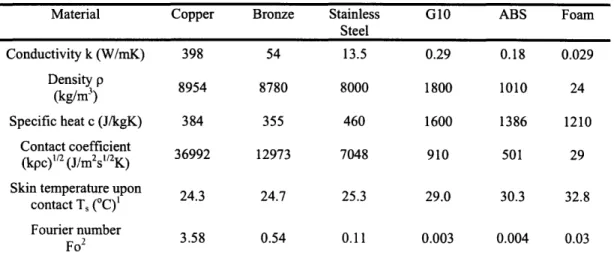
They were: copper, bronze, stainless steel, glass reinforced epoxy (G10), plastic (ABS), and foam. Their thermal properties are listed in Table 3-1. Based on the semi-infinite body model, the corresponding skin temperature upon contact with the materials is shown in Table 3-1 and Figure 3-2 (A), and the corresponding heat flux conducted out of the skin with contact is shown in Figure 3-2 (B)
Table 3-1. Thermal properties of the materials.
Material Copper Bronze Stainless G10 ABS Foam
Steel
Conductivity k (W/mK) 398 54 13.5 0.29 0.18 0.029
Density p 8954 8780 8000 1800 1010 24
(kg/m')
Specific heat c (J/kgK) 384 355 460 1600 1386 1210 Contact coefficient(kpContact coefficient 36992 12973 7048 910 501 29
(kpc)"2 (J/m2s"2K)
Skin temperature upon 24.3 24.7 25.3 29.0 30.3 32.8 contact T, (OC)I
Fourier numberFourier number 3.58 0.54 0.11 0.003 0.004 0.03 Fo2
Based on semi-infinite body model with initial skin temperature at 33 'C and initial material temperature at 24 OC
2. Based on 5 s contact time and sample dimensions
The materials were stored at room temperature which was maintained at 24 oC. Each sample was 12.4 mm in diameter and 100 mm long, and had a flat upper surface which was 12 mm by 60 mm. They were turned from 12.7 mm (/2 inch) rod stock, milled and then sanded to provide a flat, smooth contact surface. Their surface roughness was measured with a Mitutoyo Surface Roughness Tester (Model SV-3000S4). The surface roughness was measured to ensure that textural differences among the material samples were minimized. These values and the Young's modulus (the tensile elastic modulus) of the materials are listed in Table 3-2.
Two pieces of delrin were used to make a material presentation fixture as shown in Figure 3-3. The combined size of these pieces when screwed together was 103 x 63 x 46 mm3. Two 22 x 20 mmn2 rectangular holes were machined into the upper piece to allow
insertion of the fingers. In the lower piece of delrin, two 12.5 mm diameter compartments were machined 43 mm apart directly under the holes. The material samples slid into these slots and were flush with the surrounding surface. An extended roof was added on top of the fixture to prevent subjects from seeing the material samples.
(I, M cc *6, CL 0 0 C 0 a 0
E
U) 4-C cl) 34 33 32 31 30 29 28 27 26 25 24 23 1 0 2 at 1 of 6;'.(1( 1 0 loop 0 1 1)(1· 1 ) 1 )1 10. 11(11 -I'll' T ) 11111 1 1 11· L ..i - U .,6I. 1 11 Am.I t 4 Ill I
I I 111
Fom L~LI~r-~r~r~Graniteh
.LUL--SS r' r r ... v - 741-vo
Bronze1
111(
10 102 103 104Contact Coefficient (J/m
2sl/
2K)
4Time (s)
Figure 3-2. Skin thermal responses based on model predictions. (A) Skin temperatures and (B) corresponding heat fluxes conducted out of the skin during contact with the identified materials. Granite was used in the material localization
experiment.
(A)
(B)
x Ei Cu a) I | " . . .. . .. . . . .. .. . . . 0Conner-Table 3-2. Surface roughness and Young's modulus of the material samples
Material' Mean Rq2 Young's Modulus
(Aim) (GPa) Copper 0.40 110.0 Bronze 0.32 93.0 SS 0.43 193.0 ABS 0.20 2.3 G10 1.50 17.0 Granite 1.47 53 Foam 15.22 1.50E-03
.Copper, bronze, stainless steel (SS), G10, ABS, and foam were used in the first experiment. Copper, stainless steel, ABS, granite, and foam were used in the second experiment.
2. Rq: Root-mean-square surface roughness.
A thermistor (457 Atm in diameter and 3.18 mm in length; Model 56A1002-C8, Alpha Technics) measured the skin temperature of the index finger. The thermistors were connected to a Data Acquisition Unit (Model 34970A, Agilent Technologies) which was controlled using a Visual Basic program. Temperature data were sampled at 20 Hz. To ensure that the skin temperature of the hand was maintained constant, a fixture was made using a recirculating chiller (Model 1167P, VWR International). The chiller was connected to a spiral folded tube (ID 4.8mm, OD 7.9 mm) that was placed in a delrin fixture. A 2 mm thick copper plate was placed on the tube to improve the temperature uniformity of the surface. A 3.2 mm thick rubber pad was then added on top of the copper plate to increase comfort for subjects when they placed their hands on the fixture to maintain skin temperature.
Figure 3-3. Material discrimination fixture. The thermistors are glued to the index fingers.
Procedure. Subjects washed their hands with soap prior to participating in the
experiment. A thermistor was glued to the fingerpads of each index finger using biocompatible cyanoacrylate (Liquid BandageTM, Johnson & Johnson). The thermistor was 457 pm in diameter and 3.18 mm in length, and was chosen on the basis of its small dimensions and thermal mass. To ensure that skin temperature measurements were not influenced by contact force directly, baking soda was used to mark the contact area of the skin with the material and the thermistor was glued on the edge of the contact area as shown in Figure 3-4. Subjects' initial skin temperatures ranged from 30 to 35.5 oC and the average value was 33 OC. The ambient temperature in the room was maintained at 240C, as measured with a k-type thermocouple (Omega) in free air.
Figure 3-4. Thermistor position on the fingerpad.
Each of the six materials was paired with all other materials including itself, which gave a total of 21 different combinations. These 21 combinations were repeated four times for a total of 84 trials. Within each block of 21 trials the order of presentation of the materials was randomized. There was at least a 1-minute break between each block of trials, during which the subjects placed their hands on the recirculating chiller.
Prior to each trial, subjects were instructed to place both of their hands on the recirculating chiller to maintain their skin temperature at 33 OC. For the first part of the experiment, two material samples were inserted into the two separate compartments as shown in Figure 3-3. Subjects inserted their left and right index fingers into the compartments after hearing a sound cue. The data acquisition system recorded temperature from the thermistors attached to the subjects' fingerpads after the sound cue.
At the end of each trial, subjects withdrew their hands from the fixture and placed them on the recirculating chiller pad. A maximum of 10 s was allowed for each trial.
A two-alternative forced choice (2AFC) method was used in which subjects were instructed to choose the colder of the two materials presented by reporting which hand made contact with the colder material. Subjects were not told which materials were used and no feedback was given regarding the correctness of their judgments. They were encouraged to lift and replace their fingers on the material samples during each trial, but were discouraged from lateral scanning of the sample surface.
Subjects lifted and replaced their fingers on the material repeatedly during each trial, which meant that the temperature responses fluctuated and so it was difficult to record meaningful temperature data. The measurement of the decrease in skin temperature on contact was therefore undertaken separately. The procedure in this second part of the experiment was similar to that in the first, except that subjects were instructed to leave their index fingers on the sample surface for 5 seconds after inserting their left and right index fingers into the compartments. The goal of this part of the experiment was to measure the change in skin temperature upon contact.
3.2.2 Results
In this experiment, the responses for the trials involving different materials were analyzed in terms of the number of correct responses, that is, correctly identifying the "colder" of the two materials as defined in terms of the predicted thermal responses at the skin surface-material interface. The chance level in this experiment was 50%, and a threshold level of 72% correct was chosen as indicating that subjects could reliably discriminate between a pair of materials. An initial analysis of the results from trials in which the same material was presented to both hands indicated that there was a bias towards reporting that the material on the right index finger was colder (t=2.08, p=0.04). This did not reflect any temperature difference between the hands as they were both maintained at 33 1C.
Table 3-3. Percentages of correct discriminations for different pairs of materials. SS is stainless steel, G10 is glass-reinforced epoxy and ABS is a plastic.
Copper Bronze SS G10 ABS Foam
Copper 70 75 95 98 100 Bronze 68 98 98 100 SS 98 100 95 G10 78 90 ABS 85 Foam
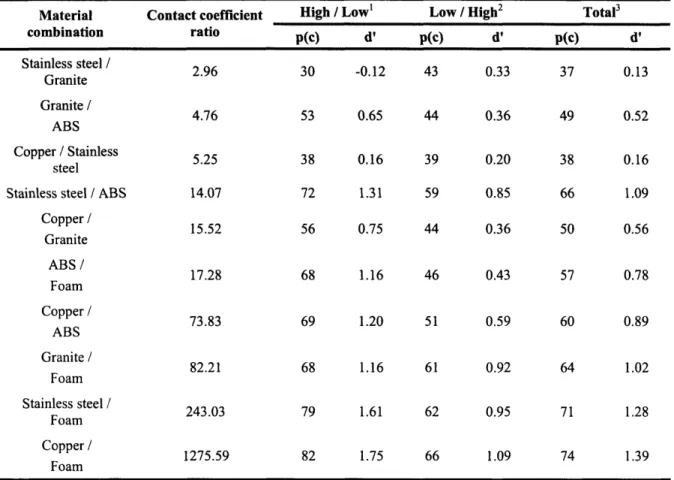
The percentage of correct discriminations for the various combinations of materials is shown in Table 3-3. For all combinations except copper-bronze and bronze-stainless steel the percentages were above 72%. This means that subjects were able to discriminate reliably between two materials when the ratio of the contact coefficients of the materials exceeded three. For combinations involving foam, the percentage of correct discriminations ranged from 85-100%. This high performance presumably reflects the distinct thermal and textural properties of foam, in particular its much greater surface roughness when compared to the other materials, as shown in Table 3-2. Analyses of covariance (ANCOVA) were conducted to determine whether the surface roughness and elasticity of the materials (the latter defined in terms of Young's modulus which is the ratio of the stress to strain) influenced subjects' performance. The covariates were the ratio of the surface roughness of the two materials being compared or the ratio of their Young's moduli. The analyses indicated that there was no significant effect of the ratio of the materials' surface roughness (p=0.53) or Young's modulus (p=0.20) on the percentage of correct responses.
In the second part of the experiment, the change in temperature upon contact was recorded for each of the materials presented. These data are shown in Figure 3-5 where it can be seen that the decrease in skin temperature was small, ranging from a mean of 0.25 for foam to 1.44 oC for bronze. A one-way ANOVA indicated that there was no significant difference in the decrease in skin temperature across the six materials
presented (F(5, 48)=1.927; p=0.11). With the exception of foam, the decreases in skin temperature as the finger made contact with the six materials were considerably smaller than the theoretical values listed in Table 3-1, which were calculated using an initial skin temperature of 33 oC and an initial material temperature of 24 oC.
1* 1.5-II E 0.5-<'
W
I
N
INXIN NXN NXN INNIN NNN NXN NXN NZ NCopper Bronze SS G10 ABS Foam Material
Figure 3-5. Group mean decrease in skin temperature after 5 s of contact with the six materials. SS, stainless steel; G10, glass reinforced epoxy; ABS, a plastic.
3.2.3 Discussion
In this material discrimination task, subjects perceived thermal cues by lifting and replacing their fingers on the surfaces, and the local thermal transients associated with contact were presumably used to discriminate between the materials. The results from this experiment indicate that when textural cues are minimized, thermal cues can be used to discriminate between materials when the differences in the contact coefficients are relatively large. The only two combinations that could not be reliably discriminated were copper and bronze, and bronze and stainless steel. The thermal cues used to discriminate between these materials, such as the heat fluxes conducted out of skin, were so similar that they did not facilitate discrimination. These results are consistent with the semi-infinite body model illustrated in Figures 3-2 (A) and 2 (B), which show the similarity in the predicted heat fluxes for copper and bronze, and bronze and stainless steel.
I
Although the thermal cues associated with contact were presumably used to discriminate between the materials, differences in surface texture and elasticity could have influenced subjects' performance. However, the analyses indicated that the percentage of correct responses was not significantly affected by the ratio of the surface roughness or the Young's moduli of the materials being compared. The ease with which foam was discriminated when presented with any of the other materials is probably due to its distinctive thermal characteristics, surface roughness and elasticity. Of all the materials presented, foam changed the skin temperature the least. The average decrease in skin temperature when making contact with foam was 0.25 oC, which is above the threshold of 0.14 oC for discriminating decreases in skin temperature on the fingertip (Stevens & Choo, 1998). Although the surface roughness and compliance of foam may have provided additional cues to assist in material discrimination, the percentages of correct discriminations for the combinations including foam decreased progressively from copper to ABS. This suggests that even with the extra tactile cues, the ability to discriminate foam from the other materials was influenced by their thermal properties.
The elastic moduli (i.e., Young's modulus) of the materials varied considerably, with foam being the most elastic. The typical contact force during this type of thermal discrimination experiment would have been between 1.5-2 N (Jones & Berris, 2003) and the average contact area was 135 mm2. Based on these force and contact area estimates and the Young's modulus for each material, the strain of the materials (i.e., the change in length of the material normalized by the initial length) was calculated. The estimated strain for foam is 0.01 and for the other materials it ranged between 10-6 -10-7. From these values, it would seem reasonable to assume that, with the exception of foam, no deformation occurred during contact with these materials.
The present findings are consistent with those of Dyck et al. (1974) who designed a set of thermal stimulators known as the "Minnesota Thermal Disks." These disks are made from copper, stainless steel, glass and polyvinyl chloride (PVC), and were developed as a clinical tool to measure thermal sensation. Dyck et al. (1974) found that the pairs of disks that normal healthy subjects reliably distinguished on the palm of the