HAL Id: in2p3-00183781
http://hal.in2p3.fr/in2p3-00183781
Submitted on 30 Oct 2007
HAL is a multi-disciplinary open access
archive for the deposit and dissemination of
sci-entific research documents, whether they are
pub-lished or not. The documents may come from
teaching and research institutions in France or
abroad, or from public or private research centers.
L’archive ouverte pluridisciplinaire HAL, est
destinée au dépôt et à la diffusion de documents
scientifiques de niveau recherche, publiés ou non,
émanant des établissements d’enseignement et de
recherche français ou étrangers, des laboratoires
publics ou privés.
Chromatic correlations at injection and related ejection
problems in separated sector cyclotrons
A. Chabert, J. Fermé, G. Gendreau, P. Lapostolle, P. Yvon
To cite this version:
A. Chabert, J. Fermé, G. Gendreau, P. Lapostolle, P. Yvon. Chromatic correlations at injection and
related ejection problems in separated sector cyclotrons. 8th Particle Accelerator Conference, Oct
1979, San Francisco, United States. pp.3612-3614. �in2p3-00183781�
IEEE Transactions
on Nuclear Science,
Vol. NS-26,
NO.3, June 1979
CHROMATIC CORRELATIONS AT
INJECTION
AND RELATED EJECTION PROBLEMSIN
SEPARATED SECTOR CYCLOTRONSby A. CHABERT, J. FERME, G. GENDREAU, P. LAPOSTOLLE and P. YVON.
GANIL (Grand Accelerateur National d'Ions Lourds) CAEN, France AbstractInjection into a cyclotron, in order to prevent emittance and phase spread dilution, requires proper couplings in the matching. One must first introduce a
AP/r'
associated with anr/AW
coupling (through sim- plectic conditions) ; according to the angle of the accelerating dees and the choice of harmonic number the(r,r') acceptance may also have to be tilted. All these effects are investigated in the case of the GANIL SSC's. At extraction corresponding correlations exist. For a resonant system, extraction may be diffi- cult when the energy spread is large because of the large coupling induced by resonance. A precessional extraction which has been studied might in this case be more efficient. Other ways for making extraction easier are also considered. Moreover a new method of phase compression at injection into the SSC is present- ly under study at GANIL.1. Introduction
GANIL is a complex cyclotron system made of two SSC's in cascade following a small compact injector cy- clotron, Its purpose is to accelerate all ions from an energy of 10 MeV/A for very heavy ions up to 100 MeV/A for light ones. Emphasis is put on beam quality to
be
delivered from that installation and to the intensity produced.
Maximizing intensity leads to accept as much emit- tance and phase spread as possible; furthermore because flat-topping will not be available, at least at the beginning of operation, extreme care must be taken not to let these emittance and phase spread increase above the intrinsic limits. In order to do so, matching pro- blems have been devoted a particular attention at in- jection into the SSC's but extraction also deserves consideration.
2. Matching into a cyclotron [A$[A2] In a SSC, there is in general no problem for the axial motion but there exists an intrinsic correlation between radial coordinate r and energy deviation
AW/W
inside a bunch. It then seems good to introduce such a correlation at injection rather than injecting achroma- tically. Our first order approximate analysis will show that, if this is true, it is rather through the phase versus angle correlation associated from simplectic conditions.al4
=Ro ; az4 =o wherefrom comes the associated correlation :r =
Ro.AW/&'o
(7)
Then, for injecting into a cyclotron, besides matching in (r,r') and possibly in (1,
AW/Wo)
spaces, one must introduce coupling (3) or (7), the other one following automatically in practice, due to simplectic conditions.2.1 Let us consider first the case of a classical cyclotron with a uniform magnetic field, and no accele- ration. We use polar coordinates R, 0 and define parti- cles with respect to the center of a bunch by r and 1 0rQ:
1 = - Ro.q/h (1) Ro being the orbit radius, h the harmonic number andq the R.F. phase with respect to the center.
To first order, the motion in a bunch of particles of a given energy is obtained from equations :
dr = (1 - lo).de ; dl = - rde (2) In the space (1, r, dr/de) a particle describes an ellipse in an oblique plane (fig.
1).
Should a beam be injected in an ellipsoid with principal axis along 1, r, dr/de coordinates it would start oscillating around r axis and get a larger average phase length.2.2 In a separated sector cyclotron, the same pro- perties exist. Looking in the center of a valley for instance, one now has :
1 = Rvalley . r'&= - hr'.(Rvalley/R) (8) and, provided vr is close enough to
1,
between two successive turns (putting lo = 0) :Ar = l.(BIR)valley.AB
Al = - r.(R/B)valley.A0
; A0 = 'Zn(vr -
1) (9)The previous slight scaling in
Curves
1
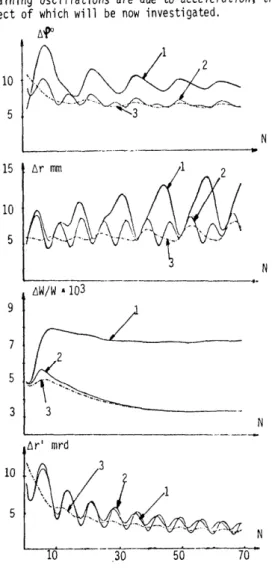
and 2 on figure 2 illustrate the influ- ence of correlations (3) and (7) in the case of the separated four sectors cyclotron“CSSl”
of GANIL. We can see the great influence of the (r',$) correlation on phase width pattern and associated energy spread ; in this case of large h, the influence of the(AW/W,r)
correlation on betatron oscillations, is much smaller.3612
0018-9499/79/0600-3612$00.75 0 1979 IEEE
A correct matching requires a distribution oosses- sing the dr/d8 = 1 plane of symmetry, that means', from equations
(l), (2)
and with r' = dr/ds, the (r',$) correlation :1 = Ro.r' M 9 = - hr' (3) $i dr/de
‘J
Fig. 1.This correlation must
be
produced through the transfer system from an external achromatic section to some point inside the cyclotron. The general form of the transfer is givenby :
r all a12 0 al4 r
F
I a2 1= asI
az2 0 a2$
a321 b+'
F I
(4)
Ap/p
2
0
0
0
1
APIP I Correlation (3) is obviously satisfied ifa31 = Ro.azl . 9
and,from simplect be the single one
this solution ic conditions and entails : a32 = Ro.aZ2
(5)
appearsto
(6) di r, scussion r' andstill holds apart from a '1
© 1979 IEEE. Personal use of this material is permitted. However, permission to reprint/republish this material for advertising or promotional purposes or for creating new collective works for resale or redistribution to servers
Note that the oscillations of Ar and
A9 have double
frequency when the correlations are introduced. Re- maining oscillations are due to acceleration, the ef- fect of which will be now investigated.N ,Ar' mrd 10 .'i,. 3 '. %4d#Pd&& '. 1 5 ' 'i _ '\ ., . -.. -. L.S, _. -4x$ N
L---$----~--3--.ll-jij^
Fig. 2 Bunch widths Af’,Ar, AW/W, Ar’ sampled at azimuth of injection (middle
of
a free valley) aredefid
as
two times the standard deviationof
the related distri- bution. Acceleration is simulated in the GANIL CSSl on harmonic 14.Curves 1: beam injected without any correlation(Af= So, M/w = 5 1~3, cr = 45 T.m.mrd = IS mm x 9 mrd).nl. Curves 2 : same beam injected with (r = Rinj.AW/W) and related (2 = Rin *.r’) correlations.
Curves 3 : same t: eam injected with an additional (r,r’l correlation (see par 3).
3. Effects of acceleration
For multi-dee accelerating systems it has been already mentioned that a bad choice of the dee angle may lead to difficulties [l], [2] . When crossing a dee of angle 2.6 a particle radially displaced by r gets an extra relative energy gain (a).
ww, = 2 A-r/R (10) \ &glh Rvalley d (11) I' I -ff 1 DWo being the energy gain of the non-displaced particle.
Let us consider a 4 SSC with two dees in opposite valleys and look at the orbits in a dee free valley.
Various matrix or geometric treatments can be used to compute the evolution of a particle along one turn.Let us just give an approximate description assuming vr=l. Along one turn, an initial displacement 1 in the dee free valley is transformed in r in the first dee ; according to (10) it only gives a displacement r(1 - A) after the first dee and -r(l - A)2 after the second one with respect to the equilibrium orbit moving itself by rA and rA2 respectively after one and two dees.
Similarly an initial displacement r gives - 1 at the first dee which, refering to (1) and adding the proper phase displacement and effect of radial kick ibl gives r(ltA) after one half turn and r(ltA)2 after one turn. Neglecting A2 terms, one now has instead of (9) :
1 . (BIR)valIey
. A0 + 2.Ar
:Y z - r .(R/@)valley
lA@
- 2.A1(12) Geometric relation (8) still holds and as said, there is during the turn only the very small extra energy
gain 2
GW/WO = 2 A .l / Rvalley (13) To our degree of approximation (12) can be replaced by :
dp/de = A + kp
dh/de = - p - kh ; k =
2A/AO =
2A/h(vr-1) (14) with P = r l V(R/B)valleh=l*V& (15) In the (p,A) plane-and correspondingly in the (r, ) or (r,r') planes-the motion is no longer along a circle, but along the curve
p2t2kXptA2 = const (16) and is obviously stable only if lk( < 1. From (ll), we see that A, that means k, decreases during acceleration and the ellipse comes closer and closer to the circle of figure 1. But, the difference may be quite important at injection where relative energy gain may be quite large and, in order to match the beam, besides correla- tions (3) and (7), the radial emittance should be elon- gated and tilted in the (r,r') plane. Then , bunch breathing is reduced to a minimum in all coordinates.
We have considered here the beam in the middle of a free valley and of course different injection condi- tions would apply to other azimuths in the SSC.
I
r.mm \ IO rlmrd ,+---.--- /' r(4);25=30' r(9);26=32' r(9);26=34" r(f);26=26' r(Q);25=O"r’ (‘0
Fig. 3(r.5@) and (r!Y? patterns sampled at injection azi- muth of a particle in the GANIL CSSl on harmonic h = 14
showing
theeffect
onacceleration
of
the dee angle (GANIL cavity angle is 2 x 17 O corresponding to kxo. 7. )Curves of figure 3 illustrate the effects of acce- leration in the GANIL "CSSl" when we change the dee ia) Note that the parameter A m introduce here
corres-
ponds to one dee and not to one turn.
tbl The total phase displacement effect over one turn is zero when r’ = 0 in the dees as seen in [I] but
onZy
in this case.angle that means the value of k. Curves 3 of figure 2 show the beam behaviour with all correlations esta- blished as well as possible ; hopefully, beam behaviour remains good in a rather large range around the ideal values and correlations do not need to be established with a great accuracy.
4. Extraction
The internal beam presents before extraction the correlations described before ; then extraction and subsequent transport systems should take them into account in order to deliver achromatic beams.
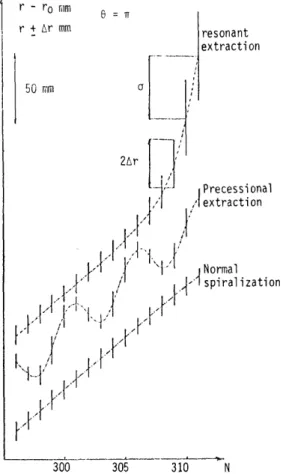
When resonant extraction is used, it should be noticed that the coefficient of the (AW/W,r) and (r',q) correlations have been multiplied by the same factor the turn separation has been. This is one of the diffi- culties of this type of extraction where the contribu- tion of energy spread to the beam width is increased in proportion of turn separation and only pure betatron contribution is not affected.
r - r0 mm 6=n
r t
Ar
mm resonant extractiony--L.-..---.---.-
300
305
310
NFig. 4 Spiralization
u and radial
width Ar near ejec- tion in the GANIL f’CSS2 ” Ih = 2 W * eJEnergy dispersion
of
extracted icam- 100 MeV/A). c -
R, s been choosen rather large
(AW/W
=
2.1~3) in order to show clearlythe associated radial width increase in the case
of
re- sonant extraction. Precessional extraction-initiated in this case by a AV/V =t 30 % on cavities-
is
much less sensitive to this ZGge energy spread.A precessional extraction making use of an oscil- lation established at injection can instead be consi- dered. Schulte [3] has even shown that in this case energy spread contribution to beam width can be compen- sated for by a proper choice of vr at ejection, One may consider the following scheme for this type of extrac- tion : orbit center position near ejection is function of turn n through a relation of type :
RN = A t UN t a.cos
(N.ACI
t eo)
(17)
u being the nominal turn separation, a and 00 the am- plitude and phase of the precession, A0 = il.n(vr - 1). The initial amplitude a of oscillation in the case of the precessional extraction is induced by an orbit perturbation either magnetic (very small bump near in- jection), electric (for instance unequal voltage on the dees), or by a change in the injection conditions (r,r' or W). Optimization possibly includes a shift of vr at ejection, but this last effect is often contri- dactory to the one necessary to reduce beam chromatic width according to Schulte 131 .
The beam behaviour is illustrated on figure 4 in the case of the GANIL "CSSZ".
5. Conclusion
Proper matching at injection into an SSC including various coupling effects avoids phase space dilution, permits large acceptance and reduces energy spread to a strict minimum. These effects strongly depend on the harmonic number and on the relative energy gain, the larger h and DWo/Wo, the larger the effects.
In the absence of flat-topping, the energy spread may still be quite large when bunches are not short enough and we have shown how to extract the beam in this case. However, small energy spread may be necessary for other reasons and anyway ease the extraction problems. If one does not accept to reduce intensity by cutting the bunches (for instance by probes inside the SSC 141 there are possibilities to compress the phase by a voltage ramp 151 at beginning of acceleration. Moreover, we have recently found at GANIL that a slight departure from the isochronism law by means of a small field gra- dient on the first few turns may produce a very signifi- cant reduction of phase spread. The possibility of using this encouraging result is presently under study in conjunction with all its implications on injection matching and ejection problems.
Bibliography
1. W.M. Schulte, H.L. Hagedorn, Accelerated particles in an A.V.F. cyclotron with a one or two dee system. Proc. of the 8th Inter. Conf. on Cyclotrons and their applications, BLOOMINGTON, 1978, to be published in I.E.E.E. N.S.
2. A. Chabert, G. Gendreau, P. Lapostolle. Limited energy spread in an SSC. Proc. of the 8th Inter. Conf. on Cyclotrons and their applications,
BLOOMINGTON,
1978,
to be published in I.E.E.E. N.S. 3. W.M. Schulte. A method to obtain single turn ex-traction for large phase width in cyclotrons. Proc. of the 8th Inter. Conf. on Cyclotrons and their applications, BLOOMINGTON,
1978,
to be published in I.E.E.E. N.S.4. P. Lapostolle,
J.
Sauret. Reduction de la largeur en phase des faisceaux dans les CSS a l'aide de fentes, GANIL Report 78R/104/TP/05.5. R.W. Muller, R. Mahrt, Phase compression and phase dilatation in isochronous cyclotrons. Nucl. Instr, and Moth. 86
(1970)
pp. 241. 244.Al.&
Hinderer. Remarks on beam matching before injec- tion into a split pole cyclotron, 13 ECPM, Milan,1976.
A2.W.M. Schulte. The theory of accelerated particles in AVF Cyclotrons. Thesis