Publisher’s version / Version de l'éditeur:
Journal of the Acoustical Society of America, 47, 3(Part 1), pp. 667-675,
1970-07-01
READ THESE TERMS AND CONDITIONS CAREFULLY BEFORE USING THIS WEBSITE. https://nrc-publications.canada.ca/eng/copyright
Vous avez des questions? Nous pouvons vous aider. Pour communiquer directement avec un auteur, consultez la
première page de la revue dans laquelle son article a été publié afin de trouver ses coordonnées. Si vous n’arrivez pas à les repérer, communiquez avec nous à [email protected].
Questions? Contact the NRC Publications Archive team at
[email protected]. If you wish to email the authors directly, please see the first page of the publication for their contact information.
NRC Publications Archive
Archives des publications du CNRC
This publication could be one of several versions: author’s original, accepted manuscript or the publisher’s version. / La version de cette publication peut être l’une des suivantes : la version prépublication de l’auteur, la version acceptée du manuscrit ou la version de l’éditeur.
Access and use of this website and the material on it are subject to the Terms and Conditions set forth at
Influence of diffusivity on the transmission loss of a single-leaf wall
De Bruijn, A.
https://publications-cnrc.canada.ca/fra/droits
L’accès à ce site Web et l’utilisation de son contenu sont assujettis aux conditions présentées dans le site
LISEZ CES CONDITIONS ATTENTIVEMENT AVANT D’UTILISER CE SITE WEB.
NRC Publications Record / Notice d'Archives des publications de CNRC:
https://nrc-publications.canada.ca/eng/view/object/?id=cce5e6f9-05a1-464e-9b71-b9c2be02a93c https://publications-cnrc.canada.ca/fra/voir/objet/?id=cce5e6f9-05a1-464e-9b71-b9c2be02a93c
A h j ~ k y ~ ~ ~ ~
Rcprirltetl from TIIR JJOURNAI. OF T I I E ACOUS~ICAL SOCIE.~I- OF AJIIZKICA, Vol. 47, Ko. 3, (Part I ) , 667-675, Srarch 1970
Copyright, 1970, by thc r 2 r o u s t i ~ ~ ~ l Socictp of i i m e ~ i c a . Printed in U. S. A.
Influence of Diffusivity on the Transmission Loss of a
Single-Leaf Wall
A. DE BKUIJN
D i v i s i o ~ ~ of B r ~ i l d i r ~ g I;ese~~rclr, Natiorial Researclr Cor~r~cil, Oltau~a, Orllnrin, Carrada
Crerner's theory of sountl Lransmission for a single-leaf wall is transformed into a more general formulation in which the exciting pressure is e~pressed in terms of the spatial cross-correlation. T h e correlation coefficient was nlcasured in a reverberation room just in front of the nrall untler test. T h e souncl-transmission loss of a single gypsum-board wall was calculated employing these diffusivity n1e;lsurements and compared wit11 crperimental data. Agreement b e h e e n theory ant1 experiment is good, especially in the frequency range below the coincidence frequency. I ' i n a l l y , ~ few fictitious quasidiffuse sound fields are investigated in further study of the influence of the degrec of diffusivily upon transmission loss.
INTRODUCTION
Sound-transmission loss through a single panel is not yet coinplete1~- understood. Cremer's theory' regarding the influence of the various parameters on transmission loss has been the most informative to date. I t assumes that a panel estends to infinity and that sound waves induce silnplc fleuural w:~vcs in the panel. 'I'he lirst essential step in thv anal! sis is the dvtennination of the transmission loss for a wall escited by a plane wave incident under a certain angle 0. I t may be seen that the transmission-loss factor is a rather complicated function of the angle of incidence. T h e transmission loss for a diffusively incident sound field is obtained by averaging transmission loss with respect to the angle of incidence with the appropriate weighting function.
T h e resulting expression is a complicated function and an exact integration has not been performed. Northwood%used a numerical integration method and obtained figures for a number of examples. T h e numer- ical data agreed reasonably well with experimental data if some correction was included.
Assun~ption of internal friction in the material is quite natural froin a physical point of view. Assumption of a coinples Young's modulus provides the easiest method of including the damping of the material, the imaginary part representing the damping factor. The influence of darnping is very iinportant above the coinci- dence frequency range. I t is essential in this range to make a proper choice of values in order to match theo- retical with experimental data. I n practice, however, the panel is finite, and it might be expected that the
treatment of the edges would have sonle bearing up011 transn~ission loss. T h e model might therefore be too simple to predict the finer points.
Another important feature for better agreement between e~periment and practice below coincidence is the introduction of additional suppositions concerning the incident sound field. As has been explained, the most appropriate inoclel for a diffuse sound field is the super- position of plane waves travelling in all directions. I n the middle of the reverberation chamber this mathe- matical model is correct, but near the walls one could expect divergences from the ideal case. One way out of this difficulty is the supposition of a lack of grazing incident waves, i.e., plane waves with angles of incidence more than, say, 85'. I n other words, an integration with respect to the angle of incidence from 0=O0 to 0 = 8 j 0 in Cremer's formulation yields much better results in matching theory and practice. Again, there is a weak- ness in Cremer's analysis: the lack of a good representa- tion of the sound field exciting the panel.
Gershmann3 and Cook4 have indicated that the cor- relation function in space n i g h t be a powerful quantity for characterizing the measure of diffusivity. Cook obtained a simple formula for the cross-correlation coefficient by averaging the cross-correlation coefficient for a plane wave over all angles of incidence. I n the middle of a reverberation room, the experimental data fit the theoretical curve4r5 reasonably well. In field measurements, there may be deviations from ideal diffusivity. T h e correlation coefficient might be the most useful parameter to describe the sound field. Hence,
Cook's formula will be replaced by one that takes such I. RANDOM VIBRATION THEORY O F
deviations into account. TRANSMISSION LOSS
It is essential to change to randoin vibration inethods
-
A. Basic Theory of Random Vibrations to acquire a better comprehension of the importantfeatures governing transnlission loss. If energy froin the incident sound field has been accepted b ~ - the plate, part of it will be radiated into the media around the plate and the remainder will be dissipated into the plate. Internal friction of the inaterial and damping a t the edges of the panel are responsible for the energy dissipation in the panel. T h e treatinent of the edges (supported or clamped) and the connection of studs and joists are uncertain factors in the analysis. The influence of damping is in general small, but for prediction of the finer details of transmission loss it is the inost difficult problem to handle. Radiation eificiencj- is rather a\vb- ward to predict, but it is iinportant for successful application of the rand oil^ vibration method. From a
reciprocity argument, the radiation eflicicncy is asso- ciated with the response of the structure to the incident sound field. Hence, the transn~ission of noise through a plate is a problem combining response to a sound field and radiation of sound.
An important phenomenon, "coincidence," provides inajor complications foi a better understanding of trans- inission loss. The wavenumber of the flexural vibration in the plate is about eclual to the wavenumber of the fluid medium of the environment. I11 this frequency legion, the difference between data obtained froin C~einer's theory and e~perimental data is still quite large. T h e difficulty ensues froin the improper definition of the radiation efficiency in this region, because the boundary condition a t the edges seems to be important. Cremer's theor)., which ignores the elTect of edges and the size of the panel, yields inaccurate results in this case.
T h e purposeof this paper is twofold. T h e first part will be devoted to a randoin vibration approach to Cremer's problem, and an attempt will be inade to prove that the randoin vibri~tion method, applied to a finite plate, gives approximately the salne iesults as Cremer's anal) sis. This indicates that even a finite plate can in sonle circunistances act like an infinite plate; this is confirnled by experiment. T h e secoild part presents an analysis of the influence oi the degree of dilf~isivity upon transnlission loss. Cremer's ior~n~ilation will be transformed into a inore general formulation which employs the cross-correlatioil coefficient in the representation of the exciting pressure. T h e correlation coefficient was measured in a reverberation room close to the wall under test in a number of positions in order to obtain an average coefficient. T h e average coefficient was then employed to calculate the transmission loss of a gypsum-board wall. Finally, to extend the analysis to a greater range of room conditions, quasidiffuse sound fields were investigated with respect to their influence upon transnlission loss.
Assuine a rectangular elastic plate with dimensions a and b, area A , and thickness 11. Sound is incident from one side and trailsinitted through the plate to the other side. T h e differential equation governing the vibration of the panel is given by
where w(x,y) represents deflection, B the bending stiffness, p, the mass per unit area of the plate, and
P
the coefficient of damping, representing acoustic radin- tion load and a structural damping part, and p(x,y,t) is the incident sound pressure or external force a t time t and position r(x,y).
The norinal inode appro:~ch of generalized harinonic analysis will be used to determine the response of the plate to the randomly varying loading. Small d a n ~ p i n g is assumed, so that cross-coupling of the modes froin this effect can be ignored.
Consider an entirely ranclonl pressure held acting on a panel with a general mode shape +,,,,,(r). T h e general- ized force is
the integration being talien over the entire surface A
of the panel. T h e Fourier spectrum of 1,,,,(1) becomes
T h e power density spectrum ol the total displacelncnt a t a point r, including all modes, becomesG
a,,
being the damping factor in the -m, n t h mode and wmn the circular frequency of the m,.t~th mode. Substitut- ing from Eq. 3, we can write Eq. 4 in the formI N F L U E N C E 01; L ) I I ~ I ; U S I V I r ~ Y O N ' T R A N S M I S S I O N L O S S
where, if we let 1-t'= T, ination over all nornlal modes. I t is inlplied that the cross-terms involving different nlodes do not contribute to the radiated sound power because of the orthogonality
P I r r =[ I J I r r (6) property of the normal modes.
T h e radiated sound power is forlllally given: is the cross-power density spectrum ancl
is the cross-correlation function of the pressure a t rl and r2. The integrals, with respect to the surface '4 in Eq. 3, represent the cross-spectral density of the generalized forces in the modes IIZ, n and 7, s and will be abbreviated to I,,,,,,,(w). Equation 5 is essentially Powell's central result.' but Powell wrote the forenanled integrals in a difierent way, nornlalizing thein to non- di~llensional factors. The function I,,,,,,,,,,(w) gives the effectiveness of a randoill forcing field in exciting the rtz, 12th mode, and the function I,,,,,,,(o) represents tlie contribution froill the coiipling effect between the two different inodes ?I$. t~ and 7. s.
Equation 5 can be split into two series if the response spectral densit). is averaged over the surface of the plate. I t is assumed that the cross-tei-ins ?IZ#T, i z f s contribute nothing to this average because of the orthogonality condition, but that the second series with ternls involving each inode represents esactly the average spectral density over the surface. I n order to obtain the average mean-square velocity, the series inay bc multiplied by Aw.w? 'Thus, if all the results are talcell together,
I t is possible to rewrite Eq. 8 as
where (.i,,,,,2(w)) reprcsei~ts the average mean-square velocity of the panel vibrating in them, 12th mode. Thus,
B. Transmission Loss of the Plate
Ecli~ation 8 provides a general fornlula for the average mean-square velocity of the plate when escited by a randoin incident sound field characterized by a correla- tion function pp1,(rl,r2;w). I n order to predict the transmission loss, it is essential to determine the sound power reradiated from the panel into the medi~inl beyond. Every normal lnode produces its own radiated sound power, and the total radiation is given by a sum-
when S,,,(k,) represents the Fourier transfornl of the 112, 12th lllode $
,,,,,,
which has a velocity amplitude v,,,,,.
The definition of the radiation resistance is now given by2R,,,,,=l',,,,,(w)/(v,,,,?). (10) The transmission loss can be considered to be the quotient of the illcident power, given by
[p,,o(w) is the spectral density of the forcing field at
a reference point 0 1 and the power radiated from the panel, viz.,
1 "
2 w - I m n (w)Rrnn (w)
TL=
C
(11)771s 7L
I
z,,, (w)I
3t11 ppO(W)/Pa~a'where, for convenience, I
,,,,,,,,,,
(w) is abbreviated to I",
7, (w ).
Ecluation 11 seeins to be relatively simple, but the quantities I,,,,,(w) and R,,,,,(w) are intricate formulae. One siiuplification can be made by observing that I,,,,,(w) and R,,,,,(w) have similar fonns, apart froin some constants, if I,,,,,(w) is the quantity found for a coin- pletely diffuse sound Coinplete diffusion is characterized bj- the correlation function,
I , 1 , ( r , , r 2 ; w ) = s i ( I a r - r ) I - P O (12) With the aid of the Fourier transforin of pp,(rl,rz;w) :
+l,l,(k,;w) and of the norillal illode $ ,,,,, (r) : S
,,,,
(k,), the espression for I,,,,,(w) is converted into its wave- nunlber representation9 :The pe~-formance of the Fourier transfornl of ppP(rI,r2;w) turns out to be elementary; p,, is cj71in- drically symmetric-i.e., the function depends only upon the distance of two points under consideration. I n this case, the Fourier transform reduces to a HanBel
transf orinlo :
CO
@pI,(k.;u)
=~TL
ppp(r;w)Jd1
krl 7)7(i7= 2apPo(w)ka-' Re(ka2-
/
k,l"-?. (14)A . D E B K U I J N
The final rcsult for I,,,,,(w) is: The freqileilcy influence function ZnLn(w) needs more attention because it contains a convenient property P P O ( ~ )
I
S,n,,(kr ;w)I
'dkr for simplifying results. The damping factor 6,,, con- Is,,, (w) = k--- (I5) tains the radiation load and might contain the internal 12 a (ha2-I
krI')*
damping of the plate. T h e latter cluantity will be removed to a complex Young's modulus, which implics Coinparison of Eqs. 9, 10, and 15 exhibits the closea natural frequency w,,,,, with an imaginary part. I t relation between R,,,(o) and I,,,,(o). From a reciprocity develops that 6,,,,, and R,,,, are related by thc following principle, one may expect such results. T h e quantity
equation :
I,,,,,(o) indicates how well the incident sound field
coiiples to a particular normal mode. T h e reciprocity 6,,,,= R,,,,,/w,,,,,p,il.
principle requires that sound radiation must be governed (19)
in the same way by the variables iilvolved in I,,,,,(w).ll This illakes
I
Z,,,,,(w)/
2 = ( A p p ) ' ( w ~ - ~ , , , n 2 ) 2 + 4 R , , , , ? w ' . (20)C. Transmission Loss (TL) of a Large Panel 1i:rom physical considerations, one can expect that transmission loss for a very large panel will approach the T L of an infinite panel. This expectation is now prolyed.
Assume a rectangular panel, supported a t thc edges. The normal inodes are represented by'"
?'he scluarc 1:ouricr transforill is given bj-
1
s,,,,,
(lz*,lzu)1
'
(2snta)?(2xtzb)%in2(k,a - 111~/2) sin2(lr,b - t ~ s / 2 )
On substituting this in Eq. 15, an integration \vith respect to k, and k,, is carried out. I t may be observed that, for large numbers of ms/a and tis/b,
/
S,,,,,
(k,,k,,)1
peaks sharply around k,=nzs/a and k,=tzs/b. If this is the case, then an application of the delta-function approximation is valid because only contributions around the critical points are significant. I n this way,For a very large plate, i.e., when n and b arc large, oilc may presume that the normal modes are so close to each other that an integration instead of a sunlnlation with respect to the inode numbers is permitted. T h e fact that both /Z,,,,(w)
i 2
and R,,,,, contain the wave- nilmbcr of the plate in quadratic form, viz.,w,,,
,,=
(B/pP) i[m?s2/a2+ t ~ ? s ? / L ~ ] ,immediately suggests an application of polar coordi- nates. T h e following step is the determination of the number of inodes having resonance frequencies lying in the sillall frequency band between w , , and w,,,,,+Aw. T h e result is
AN= ( A Aw/4x) (pP/B)$, (21)
which is independent of frequency.13
The double suin~nation reduces itself to an integration with respect to a coordinate lz,, which is defined by
\\'ith the aid of this coordinatc transformation, wc find R
,,,,,
=p,,ca,4 Re(l-K,2jk;"-~, (23a)~ , , , ~ , ~ = B k , 4 / p ~ , (23b)
I:or the sake of convenience, R,,, (a) = Ap,cak, Re
(I22
- m2.rr2/a2- n2s2/t2)-4. (18b)kn4= ppo2/U.
Equation 18b is exactly the representation for the (24) radiation resistance of an infinite panel in which a T h e quantity Ize represents the wavcnuinbcr of a free- flexural wave is travelling with wavenumber [ ( ? n s / a ) V r a v e l i n g wave in an infinite plate a t frequency w.I4
+
( n ~ / b ) ~ ] ? . ~ T h e wavenumber [ ( m ~ / a ) ~ + (tzs/b)?]: Combining these results, one obtains an intcgral = k a marks the coincidence phenomenon. formulation,I N F L U E N C E O F D I F F U S I V I T Y O N T R A N S M I S S I O N 1 , O S S
Removing all conunon factors in the numerator and T h e relation between R,,, and I,,,(w) is broken up, but denominator and rearranging the equation, one obtains this is not serious, because it destroys only Cremer's simple representation of the TL. I n the field, ideal
l
k;?lz,dk,T L = 2 diffusivity is rarely met. I n the middle of the reverbera-
B (kk-kB4)' (26) tion room, the ideal situation is usually approximated,
(L)
7 2 x [ 1 - f 3 1 + 1 but diffusivity. in the vicinity I n field of measurements, the walls one evpects deviations a lack from of which is the same equation as has been found by ideal diffusivitj- are alillost certain and must be taken crenler1s for free waves in an infinite panel. hi^ indi- into account. One of the possibilities is to convert Eq. 12 cates that Cremer7s is not very of an to a more general function that includes parameters for oversimplification, since the random vibration Illelhod obtaining a wide variety of correlation functions. T h e is well based on physical principles. Below-coincidencesound transnlission is completely governed by the non-
resonant modes. This proves that airborne sound insula- I I I
-
'Lion according to the "mass-law" is in fact nonresonant transmission.
Powelll6 has shown that, with certain restrictions, the -
results on infinite-structure and normal-mode methods
must be equivalent. H e pointed out the inlportance of -
damping: even a mediunl-sized panel can act as an infinite panel if the damping factor is large enough. A
difficulty with finite panels arises from the definition of
-
radiation resistance. T h e delta-function approximation,which was used to obtain the simple form for R,,,,, holds only for a very large plate. Finite plates show radiation resistances that have a slightly different form from those represented in Eq. 23. For values of frequency where lz,<k,, or below coincidence, radiation can be sinall
and often negligible, as has been assumed so far. Useful - 0 . 2
-
investigations concerning the sound radiation belowcoincidence have been carried out by various authors,
- 0 . 4 I
I
1 , including Gijsele,17 Maidanik,* and Nikiforov.lB o 3 6 9Sound radiation in the vicinity of k,-k, provides k a r
illajor diflici~lties. Further investigatioil concerning the (a)
iillpact of the finiteness of the panel upon transmission
loss woi~ld be interesting. T h e approach employing 70 statistical nlethods and nonnal-mode techniques is
extremely useful because it begins with a finite panel. rn 6 0
a
Cremer's method does not fit into this context; it
:
5 0 assumes an infinite panel. I n the present study, the 2influence of the condition a t the edges is negligible. Z
0 40 Although it was assumed initially that the edges were VI
VI
-
supported, the present analysis holds also for clamped s cn 3 0
Z edges, since the delta-function approsilllation for the a =
C
Fourier transfornl of the nornlal mode is valid in this = 20
Z case. = 0 1 0 I l ~ l l j l l ~ l l ~ l l ~ l l ~ l l - 5 1 8 - I N . G Y P S U M B O A R D
-
-
-
--
.
.
.
.
. ..
- --
-
l l l l l l l l l l l l l l l l l l l l 11. INFLUENCE O F DIFFUSIVITY ON TRANSMISSION LOSS o 125 250 5 0 0 1 0 0 0 2000 4000 T h e foregoing analysis can be generalized by con- M I D B A N D F R E Q U E N C Y I N H Z sidering different field representations for the incident (I>)sound pressure. I n the previous sections, ideal dif- FIG. 1. (a) Correlation coefficient for semidiffuse sound fields fusivity represented by the correlation fllnction (Eq. 12) in which the grazing incident waves have been neglected; ~ e r f e c t l y
cliffuseBo=90°: --; Bo=8j0: - - - e 0 = 7 j 0 :
. . . .
. ;(b) sound Uras presumed. This equation can be r e ~ l a c e d by a transmission loss for a ;-in+ gypsum-boar~ la)-er for c l i ~ e r e n t different formula afiecting only the quantity I,,,,,(w). incident sound fields of (a).proposed formula is given by Eq. 27 is given by s~n(Dk,Irl-r.~I) @,lp(kr,u) =-
3.
pp,,(rl,r~;w) = P , . o ( ~ ) cos (RK,I
rl- rz/
) 2DK, Dlz,I
rl- rzI
xp,,o(w)(Im{I
k,l2+1z,TCFi- j(D+ B)"l)-t ~e~p(-CFlz,l rl - r ? / ).
(27) XIm{I
k,l ?+ka2[P+j(D-e)?])-!). (28) Equation 27 reduces to Eq. 1 2 if D = 1 alld E= P = 0. F~~ a very large again using delta-fLlllctionA further advantage of this proposal is its sinlple approsilllations, one obtains an allalogy of E ~ . 18:
Hankel transform, which is essential in malcing u p a
simple equation for I,,,,(w). T h e Hankel transfornl of Inrrc(w)= $ T A @ ~ ~ ( ~ Z ~ O ; ~ ) , (29)
tions have been carried out in various laboratories and
I N F L U E N C E O F D I F F U S I V I T Y O N T R A N S M I S S I O N L O S S
plasterboard constructions represent a common com- ponent of nlodern buildings.
where 70
lzTo= [ ( m ~ / a ) ~ + ( n ~ / b ) ~ ] f .
60
n
Employing the method used previously to switch froin
,
a sumnlation to an integration, one obtains an equation 2 50
0 analogous to Eq. 26 -I z 0 40 -
"
k~~[@,,(kT;w)/cpPo(w)](l -k,?/ka2)~kTrlk, m mI
-- - T L = 2-
30(B/w)?[(Be4
-
k,4)'/ (2PY~,)?] (1 - k://~(la)+
1Zz u w
(30) C 20
Z
111. DISCUSSION OF RESULTS a o
'c I 0
In order to study the effect of degree of diffusivity on
transnlission loss, a wall material clearly defined in its o
Physical properties such as elasticity and internal damping were measured with the aid of small strips set up to vibrate in flexure as cantilever bars. The resonance
I I I I I I I I I I I ~ I I I I I ~ I I
-
518-IN. G Y P S U M B O A R D-
-
-
-
#.I!...-
d
I
a *-
-
-
-
I I I I I I I I I I I I I I I I I ~ I Ifrequency provided the elasticity, and the vibrational amplitude a t resonance provided the damping factor. The easiest way to include damping in Eq. 30 is to join the elasticity and the damping factors together to form a complex Young's nlodulus B 1 = B ( l + jq). A value for
I3 of 3.109 N/m2 was found, and for the damping factor q a value of 0.012 of critical damping was used for all frequencies.
A
wall 10 by S ft, placed between two reverberation rooms, was enlployed to determine trans- mission loss. Use of a reasonably large wall for expel-i-physical properties was considered. Plasterboard meets 125 250 500 1000 2000 4000 this requirement. I n addition, experimental investiga- M I D B A N D F R E Q U E N C Y I N H Z
merit guaranteed that the nonresonance transmission of sound was predominant. T h e diffusivity of the sound field in the source rooin was investigated a t a number of locations close to the wall to discover how diffusivity
1 2 5 250 500 1000 2000 4000 M I D B A N D F R E Q U E N C Y I N H z m 6 0 CI 2 5 0 - 0 -I Z 0 40 m m -
5
3 0 - Z u c=,r
2 0 - Z z, 0 ", 10 0FIG. 4. Transmission loss of a ;-in. gypsum-boarcl layer; calculatecl with the aid of the measurecl correlation coefficients:
...
, transnlission loss for a perfectly diffuse souncl field :-.
Points indicate measurecl values.
-
- ~/~-IN.GYPsUM B O A R D
-
-
-
-l I I l l l J l l l l l ~ l l l l l l l
varies with location and eventually to obtain an average value of the cross-correlation coefficient.
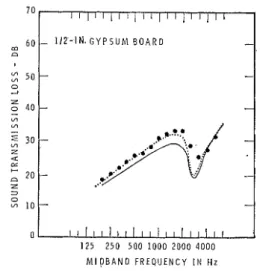
T h e source room was excited by an octave of pink noise, and the sound field was picked up by two $-in. nlicrophones and filtered by two i-oct filters; the two signals fro111 the filters were correlated by a PAR correlator. From these experimental data the param- eters D, E, and F in Eq. 27 were determined and used in Eq. 30 to carry out numerical integration. Fiumerical evaluation of Eq. 30 was carried out by an adaptive integration method employing Simpson's rule. The transmission loss was averaged with respect to 10 frequencies in the 3-oct frequency band under consideration.
It has been recognized that prediction of transnlission loss with Cremer's original formula, averaged with respect to all angles of incidence from 0" t o 90°, yields quite disappointing results in con~parison with those of experiment. T h e device usually adopted to fit theory and experiment takes an average with respect to angles of incidence from O0 to, say, SjO, thus neglecting grazing incident waves. T o illustrate this, three transmission- loss curves are shown in Fig. 1 (b), in which the limiting upper angle of incidence is chosen to be 90°, 8j0, and 7j0, respectively. The shift of the curve to higher T L data for frequencies below coincidence is much more than would be expected from the three corresponding correlation coeflicients [Fig. 1 (a)]. These coefficients have been obtained by averaging the correlation coeffi- cient for aplane wave with respect to angles of incidence from O0 t o 90°, 0' to 8.5' and O0 to 7j0, respectively. The evaluation of the integral
FIG. 3. Transmission loss of a ;-in. gypsum-board layer; J o J o
calculated with the aid of the measured correlation coefficient:
,...
,
transn~ission loss for a perfectly diffuse sound field:-.
Points indicate measured values.674 Volume 47 Number 3 (Port 1) 1970
A. D E B R U I J N
I I in front of the wall and three different bands of noise, - with lllidbancl frequencies of 500, 1000, and 2000 Hz, respectively. T h c deviations from complete diffusivity are small but obvious, as one might expect, in the -
vicinity of the walls of a rcverbcration room. The shifts of the intercepts around k,r=?r and k,r=27r are - especially striking. The minimum around k,r= 1 . 5 ~ is deeper, and the lnasimum around k,r= 2 . 5 ~ is somewhat lower than it should be. This gcncral trend holds for all
-
curves.
I t is possiblc to match these curves with the trial function of Ecl. 27 if D=0.475, E=0.51, and F=0.01 =
= arc chosen. The solid line in Fig. 2(d) depicts this
I I I - 0 . 2 - 0 . 4 \ / \ / \ / /
-
-
'.--'
1 11
_
--
0 3 6 9 k a r-
('1) 7 0 6 0 n 2 5 0 - 0 2 Z 2 4 0 - rn rn -5
3 0 - Z 4 C1 b- , 20 Z 3 0 1 0 0 l l l l l ~ l l ~ l ~ ~ l i ~ l l ~ l l - 518-IN. G Y P S U ' I B O A R D --
-
-
.\-
--
--
l l l l l / l l l l l l l l l l l l l I 1 2 5 250 5 0 0 1 0 0 0 2000 4 0 0 0 h1I D B A N D T R E Q U E k C Y I N H z (b) D , 6 0EIG. 5 (a) Correlation cocflicients for t\vo fict~iious sound ficlds 5 0 I)=O.S; 11=03; F=0.1:-. L)=O35; E=0.45; Ic=0.1: - - - o
(b) Sound transmission loss of a :-in gypsum-hoard layer, corre- 2
spontling to the t n o sound fields, depicted in (a). Perfectly diffuse ,' - S O souncl field :
-
. D=0.35, k'=0.45; I;=O.l: D=O.S; v, v,/j=0.3. F=0,1: . . .
.
.. -30
Z 4 is thcn rccluiled, Bo being 90°, S j O , and 7j0, respectively. = +
, 20 The thrce curves exhibit few departures from each Z
3
other; in particular, differences bctwecn Bo=900 a rn 10 and 00=85' are hardly disccrniblc. This confilms
Diimmig's o b s c r v a t i o n ' ~ 1 ~ a t for high diff~isivity sit~la- o
-
-
112-IN. G Y P S U h l B O A R D - - --
- - -A'
,/ \ /-
--
--
I I ~ I I ~ I I ~ I I ~ I I ~ I I ~ I I - 0 . 2lions thc sensitivity of thc correlation nlethod in finding 125 zso 5 0 0 1 0 0 0 2000 4000 dcficicncics in cliflusivity is restricted. Only thc inter- M I D B A N D F R E Q U E N C Y I N H Z ccpts along the h,r axis provide a fairly good indication (b)
ill this 'rl1is indicates that tllc c,pcrimcntal PIG 6 (a) Correlatio~l coellicients for three fictitious sound fields I)= 1 0; IT=0.0; F=O.O (perfectly diffuse) :
. . ..
I)= 1.0; investigation must bc carricd out vcry carefully bccausc 1 ~0, ~I( = 0 1: 0 - - -. ., ~ = 1 . 0 ; E=O.O; ~ = 0 . 2 :-.
(b)of the sinall dcpal lures onc can cxpcct. Sound transmission loss of a :-in. gypsum-board layer corresponcl- i \ i ~ correlatioll cocficients are dcpictcd ill ~ ~ ~ ~ ~ ~ d sound field: ing to the three sourld fields, depicted in (a).
---.
D = 1.0; E=0.0; F=0.1:. .
..
Perfectly D= 1.0; E=O.O; diffuse Figs. 2(a)-2(c),\vhich show the resultsfor three locations F = O 2: - - -- -.
'. ..
-
'.... .."-
1 - 0 . 4 0 3 6 9 kar (4 7 0 1 1 ~ 1 I ~ I I ~ l l ~ l l ~ l l j l /I N F L U E N C E O F D I F F U S I V I T Y O N T R A N S h / I I S S I O N L O S S
function. T h e calculated transmission-loss curves Canada, and is publishecl wit11 thc approval of the cinploying this correlation function confirm very well Director of the Division.
the experimental data. This may be seen in Figs. 3 and 4 for plasterboard walls in. and f in. thick. Below
coincidence, the results agrce exactly. T h e slight spread 1 I,. Crenler, "Thcoric (1er S c l i a l l d i i t ~ ~ n g dunncr \\ ancle bei
of the esperilnelltal data aroLllld the tllcoretical line is Schr.~gen Einfall," i \ l < ~ s t . Zeit., 7, 81-87 (1942).
T. D. Nortli~~~ootl, "Transmission Loss of Plasterboald Walls," believed to be due to factors such as material impurities. J , hcoust, Sot. Anler. 40, 1246(-.l) (1966),
T h e correlation nlethod thus onens a new wav of 3 S. G. Gershmann. "The Correlation Coefficient as a Criterion
dealing with the influence of non-ideal soillld fields
-
occurring in field measurements upon the transmission loss of actual walls in buildings. 1;or this reason, a few fictitious sound fields. which illustrate deviation that might occur in practice, were iilvcstigated (Figs. 5 and 6). Diffusivity is quite important below coincidence, and shifts of about 5 dB can be expected in the curve. T h e d e ~ t h of the coincidence remains about 10 dB. and its location in the frequency scale is :~pprosimately the same for the range of ditfusivities consiclcrcd. Above coincidence, the situation appears to be more compli- cated as damping is also important. Semidiffuse sound fields [Figs. j(a) and 6(a)] have sonle cfiect upon the trans~nission loss [Figs. 5(b) and ~ ( I I ) ] ; it is difficult, however, to indicate any trend in this case. If dif- fusivity is fairly high, the transmission-loss data are very much the same as those found for ideal diffusivity. I n conclusion. for ~ r e d o n ~ i n a l l t nonresonant trans- mission, diffusivitg is an important factor to be con- sidered, as is the case with large plates below coinci- dence. For resonant transmission, difiusivity is not critical.A C K N O W L E D G M E N T
This paper is a contribution from the Division of Building I<esearch, Xational IZesearch Council of
of Acoustic Quality i;l X Closed Room," J . 'l'cch. I'hjs. (USSII)
21, 1492-1496, (1951).
K. K. Cool; R. V. \Vaterhousc, R. D Uerendt, Seymour Edelnian, ancl M. C. 'l'liompson, Jr., ">Ieasurcment of Correla- tion Coenicient in I<cvcrbcrant Sound I'ieltls," J . ilcoust. Soc. Amer. 27, 1072-1077 (1955).
H. Kuttruff, 'Lliaun~akustiscl~c Korrelationsmess~~ngc~~ mit Einfachcn Mitteln," hcustica 13, 120-122 (1963).
C. A. Mercer, "IIesponse of a IIulti-Supportetl Beam to :l Rantlom I'rcssurc I'icltl," J..Sountl Vibration 2, 293-304 (1965). I'o\\cll, "On thc Fatiguc I~ailure of Structures clue to Vibrations E\cited by Rantlom I'ressure I~ieltls," J ilcoust. Soc. rlmcr. 30, 1130-1135 (1958).
8 G hllaidanik, "Rcsponsc oi I<il)l~ccl I'anels to Rcvcrbe~ant
Acoustic I'iclds," J. Acoust Soc . h e r . 31, 809-826 (1962).
T. K. Lin, P ~ o b a b i l i ~ l t c 7 i i e o ~ y o/ Sfi i[ c f i ~ ~ ( z l I ) Y ~ I ( I I I L ~ C J
(lIcGra\\-Hill Boo1 Cornpan), SF\\ Yorl,, 1967), p. 206.
l o K. Urace\\ell, Tiie I f o i ~ i i e ~ I icirr~Jori~t c111d I t s ,l~plicutrorr
(McGrs\~-Ilill Uooh Cornpan)., Ye\\ York, 1965), p. 206. l1 K. f l I,j.on ant1 G. Maidanik, "St:ltisticnl ~ I c t l ~ o t l s in Vibra- tion ilnalvsis." .lI.\r\ 1 2. 1013-1024 (1964).
'2 L. ~;e&er ;mtl $1. keckl, ~ijrf;ersciihll
Berlin, 1967), p. 2S1.
I3 Ref. 12, p. 201.
l4 Ref. 12, p. 254. l5 Ref. 12, p. 477.
l G A. Powell. "On thc A~nrosimation to the
(Springer-Vcrlag,
'Infinite' Solution by the ~ c t 1 l ; d of ~ o r m i l ' k 1 o d e s for Rantlom Vibrations," J. Acoust. Soc. Amer. 30, 11361139 (1958).
l7 K. Gosele, "Scl~allal~strahlung voll Platten, tlic zu hiegesch-
\vingunb.cn angcrcgt sincl," ilcuslica 3, 243-248 (1953).
l 8 A. S. xikifor~v, "Radiatioll fro111 a I'latc of Finite Dimensions
\\it11 Arbitrary Boundary Contlitions," Sov. Ph).s.-ilcoust. 10,
178-182 (1964).
l 9 P. Dammix, "Zur lnessung tlcr 1)iilusitat von Sch:~llfelclcrn
durch Korrelation," Acustica 7, 38;-399 (1957).