N A N O E X P R E S S
Open Access
Study on the CO Oxidation over
Ceria-Based Nanocatalysts
Marco Piumetti , Tahrizi Andana, Samir Bensaid
*, Nunzio Russo, Debora Fino and Raffaele Pirone
Abstract
A series of ceria nanocatalysts have been prepared to study the structure dependency of the CO oxidation reaction. The ceria samples with well-defined nanostructures (nanocubes/Ce-NC and nanorods/Ce-NR) have been prepared using the hydrothermal method. Mesoporous ceria (Ce-MES) and ceria synthesized with solution combustion technique (Ce-SCS) have also been prepared for comparison. The lowest CO oxidation temperature has been reached by using ceria nanocubes (Ce-NC). This high activity draws immense contributions from the highly reactive (100) and (110) surfaces of the truncated nanocubes. The Ce-MES and Ce-SCS samples, despite their high surface areas, are unable to outdo the activity of Ce-NC and Ce-NR due to the abundant presence of (111) crystalline planes. This finding confirms the structure sensitivity of CO oxidation reaction catalyzed with ceria.
Keywords: CO oxidation, Properties of cerium-based oxides, Nanostructured ceria, Ceria-based catalysts, Structure sensitivity
Background
During the last few decades, ceria-based materials have been widely used for many catalytic applications, including diesel soot combustion, CO oxidation, and VOC abatement [1–4]. These oxidation processes take advantage of the unique redox properties and high oxygen storage capacity (OCS) of ceria. In particular, CO oxidation, a primary func-tion of three-way catalytic converters (TWCs), diesel oxida-tion catalysts (DOC), and diesel particulate filters (DPF), can be a prototypical reaction for probing the oxidation ac-tivity of ceria-based materials [5–8]. As a result, many stud-ies have been carried out to evaluate the catalytic oxidation of CO by ceria and related materials. According to the lit-erature [1, 5, 8, 9], CO oxidation over ceria-based catalysts takes place via a Mars-van Krevelen (MvK)-type mechan-ism, whereby the reaction involves alternating reduction-oxidation steps on the solid surface with the formation of oxygen vacancies and their successive replenishment by gas-phase oxygen. However, a general consensus has been reached on the fact that CO interaction with ceria is struc-ture sensitive [5, 8]. In addition, it has been revealed that ceria nanoparticles (i.e., nanowires and nanorods), exhibit-ing an abundance of (110) and (100) crystalline planes, are
catalytically more active toward several reactions than
CeO2 particles with preferred exposure of stable (111)
facets [8, 10–15].
Exposure of specific crystallographic facets, together with the increased number of edges, corners, and facets, is pivotal in controlling the surface reactivity. In fact, nanocatalysts with multifaceted morphologies are highly desirable in catalysis. For fcc metal nanoparticles, the surface energy density (γ) for the three lowest index planes can be ordered as γ(111)<γ(100)<γ(110) [16, 27]. Experimental studies have confirmed that this trend may also hold for ceria-based materials [16, 17]. Theoretical
work on the interaction among CO and CeO2 planes
have shown the structure sensitivity for CO adsorption, thus suggesting weak CO adsorption for the most stable (111) surface and stronger chemisorption with (100) and (110) facets [18–23]. In this scenario, the metastable ceria (110) surface seems to be the most promising can-didate for CO oxidation, since the formation of oxygen vacancies on the (110) planes needs the least amount of energy [24]. Several theoretical studies have shown that the oxygen vacancy formation energy depends on the nature of CeO2 surface [25, 26]. It has also been well-established that the specific surface area of solid catalysts is a key factor in determining their overall catalytic activ-ity in a wide number of catalytic reactions [3, 4, 27]. * Correspondence:[email protected]
Department of Applied Science and Technology, Politecnico di Torino, Corso Duca degli Abruzzi 24, 10129 Torino, Italy
© 2016 Piumetti et al. Open Access This article is distributed under the terms of the Creative Commons Attribution 4.0 International License (http://creativecommons.org/licenses/by/4.0/), which permits unrestricted use, distribution, and reproduction in any medium, provided you give appropriate credit to the original author(s) and the source, provide a link to the Creative Commons license, and indicate if changes were made.
Therefore, it is necessary to maximize the dispersion of the nanoparticles using high-surface-area supports, such as micro- and mesoporous materials [1, 28, 29].
In the present work, a set of CeO2samples with differ-ent topological and textural properties (CeO2nanocubes,
CeO2 nanorods, mesoporous CeO2, and CeO2 prepared
by solution combustion synthesis) has been prepared to investigate the shape-dependency activity of ceria toward CO oxidation, a probe reaction for more complex oxida-tion processes. Then, the physico-chemical features of the prepared materials have been investigated using comple-mentary techniques.
Methods
Synthesis of Samples
CeO2nanoparticles, denoted further asNC” and “Ce-NR” for nanocubes and nanorods, respectively, were prepared via hydrothermal procedure, using sodium hy-droxide as the precipitating agent, as we described
else-where [30]. Mesoporous CeO2, denoted as“Ce-MES,” was
synthesized via nanocasting procedure using the SBA-15 silica template [30]. Lastly, a comparative CeO2 sample was prepared via solution combustion synthesis (SCS) and further referred to as “Ce-SCS.” A typical synthesis in-volved dissolving 3.8 g of Ce(NO3)3·6H2O and 1.8 g of urea in 60 ml of deionized water at room temperature. The homogeneous solution was put into a ceramic cru-cible and then placed in a furnace at 650 °C for 20 min.
Catalyst Characterization
Powder X-ray diffraction (XRD) patterns were acquired on an X’Pert Philips PW3040 diffractometer using Cu Kα radiation. The XRD spectra were recorded in the 2θ range of 20°–70° with 0.02° step size and a time per step of 0.2 s. The diffraction peaks were identified using powder diffraction files by the International Centre of Diffraction Data (ICDD). The average crystallite size was determined using Scherrer’s equation, D = 0.9λ/bcosθ,
where λ is the wavelength of the Cu Kα radiation, b is
the full width at half maximum (FWHM) in radians, 0.9 is the shape factor for spherical particles, and θ is the angle of diffraction peaks.
BET-specific surface areas (SBET) and total pore
vol-umes (Vp) were measured through N2 physisorption at
−196 °C on a Micrometrics ASAP 2020 instrument. The samples were previously outgassed at 200 °C for 2 h to remove water and other atmospheric contaminants. The specific surface area of the samples was calculated using the BET method.
Sample morphology was investigated through a field emission scanning electron microscope (FESEM; Zeiss MERLIN, Gemini-II column) and transmission electron microscopy (TEM; Jeol JEM 3010 operating at 200 kV).
Redox properties of the catalysts were investigated by means of X-ray photoelectron spectroscopy (XPS). The measurements were carried out on XPS PHI 5000 Versa probe apparatus using a band-pass energy of 187.85 eV, a 45° takeoff angle, and a 100.0-μm-diameter X-ray spot size. Curve fits were performed by means of Multipack 9.0 software.
Reducibility of the catalysts was determined by H2-TPR measurements. Before the analyses, 50 mg of catalyst was pre-treated under air flow (40 cm3 min−1) at 150 °C for 1 h, to remove water and other atmospheric contami-nants, and then cooled to 25 °C with Ar. The analysis was conducted by heating the sample up to 950 °C at a con-stant rate of 5 °C min−1under an Ar flow (4.95 % molar H2in Ar). H2consumption was recorded using a thermal conductivity detector (TCD).
Catalytic Activity Tests
Catalytic tests for CO oxidation were carried out via a classical temperature-programmed combustion (TPC). The tests were conducted in a fixed-bed quartz reactor (4-mm inner diameter, U-tube) heated by a vertical tubular furnace. The reactor bed comprised of 0.1 g of powder catalyst. A K-type thermocouple was placed at the inlet of the reactor, in such a way that the tip was as close as possible to the catalytic bed. During the
reac-tion, a 50 cm3 min−1 gas containing 1000 ppm of CO
and 50 %-vol of air in N2was continuously fed into the reactor, while the temperature of the furnace increased
at a rate of 5 °C min−1 until complete CO conversion
was reached. The CO and CO2 concentrations at the
outlet of the reactor were measured by NDIR analyzers (ABB Uras 14). Temperatures at which 10, 50, and 90 % of CO was converted were taken as indices of the cata-lytic activity. The tests were conducted for 2 cycles to evaluate the stability of the catalysts.
Results and Discussion
Textural and Redox Properties of the Catalysts
Some main textural properties of the catalysts, obtained
from N2physisorption at −196 °C and X-ray diffraction
analyses, are summarized in Table 1. Figure 1 shows the XRD diffractograms of the prepared catalysts. All sam-ples exhibit similar patterns referring to cubic fluorite structure, marked by the existence of (111), (200), (220), (311), (222), and (400) planes [31]. The relative amount of the (110), (100), and (111) planes have been estimated by means of the XRD peak intensity ratios. As shown in Table 1, the highest (200)/(111) and (220)/(111) values appear for the Ce-NC sample thus showing the richest population of highly reactive (100) and (110) exposed planes. On the other hand, both the Ce-MES and Ce-SCS samples exhibit the highest amount of (111) surfaces.
However, it is worth noting that peak intensities of Ce-MES are rather broad and low. This is most likely due to nanocrystalline ceria frameworks in the sample that constitute mesoporous walls [32].
Although it is rather difficult to evaluate the average particle size through Scherrer’s formula for morphologies that differ from spherical geometry, an evaluation was conducted to corroborate the TEM results. Scherrer’s equation was employed to estimate the crystallite sizes of the catalysts: Ce-NC, Ce-NR, and Ce-SCS samples possess similar dimensions; the sizes fall in the range of 30–50 nm, whereas the mesostructured sample (Ce-MES) has the smallest particle dimension (5 nm).
The BET surface areas, obtained from N2
physisorp-tion measurement at −196 °C, are very low for both the
Ce-NC and Ce-NR samples (4 m2g−1), thus suggesting a small amount of interparticle voids. In contrast, Ce-MES and Ce-SCS have much higher surface areas than their
nanostructured counterparts (75 and 69 m2 g−1,
re-spectively). Indeed, particles in the latter samples are arranged in a network that allows a creation of pores. Ce-MES has higher pore volume than Ce-SCS (0.15
and 0.04 cm3 g−1 for Ce-MES and Ce-SCS,
respect-ively). This supports the fact that pores in Ce-MES are present in mesoscale and that those in Ce-SCS most likely exist in nanoscale.
Electron microscopy techniques were applied to find out the morphological properties of the catalysts. FESEM images of Ce-NC and Ce-NR are shown in Fig. 2a, b. The images show the morphology of
nano-structured CeO2 (namely cubes and rods, respectively).
Nanocubes are present in the size range of 50 to 200 nm, whereas nanorods can be observed, with lengths of about 300–350 nm. In contrast, Ce-MES sam-ple (Fig. 2c) comprises of self-assembled agglomerates of small particles (average size about 50 nm) with interpar-ticle voids. The morphology of Ce-SCS, as reported else-where [30, 33, 34], exhibits typically foamy structures formed by agglomerates of small particles. The represen-tative TEM image of Ce-NC, as seen in Fig. 3a, shows the morphology of truncated nanocubes with abundant (100) surfaces and additional (110) surfaces at their trun-cated corners. The truntrun-cated shape is a result of the reduced surface energy; sufficient energy would give rise to a well-defined cubic structure [35]. Figure 3b shows the TEM image of Ce-NR, displaying nanorods with a width of approximately 70 nm and a length of about 350 nm. A more profound analysis with TEM, not re-ported here for the sake of brevity, shows many (111) planes on Ce-NR. Such a surface has higher stability and possesses lower oxidation activity than the (100) and (110) surfaces [36, 37]. The Ce-MES sample exhibits uniform particles whose sizes range from 4 to 10 nm. These particles are interconnected with each other creat-ing a three-dimensional mesoporous network. Deeper observation with TEM discovered the exposure of many (111) lattice planes [30]. TEM analysis of Ce-SCS, as
Table 1 Textural properties of the catalysts, as obtained from N2physisorption at−196 °C and X-ray diffraction analysis [30]
Catalyst SBET Vp Particle size Intensity ratio
a Intensity ratioa (m2g−1) (cm3g−1) (nm) (200)/(111) (220)/(111) Ce-NC 4 0.01 54 0.33 0.75 Ce-NR 4 0.01 43 0.32 0.71 Ce-MES 75 0.15 5 0.28 0.46 Ce-SCS 69 0.04 35 0.27 0.49 a
XRD peak intensity ratios
reported in our previous work [30], showed non-uniform polycrystalline ceria nanoparticles whose di-mension ranges from 20 to 40 nm.
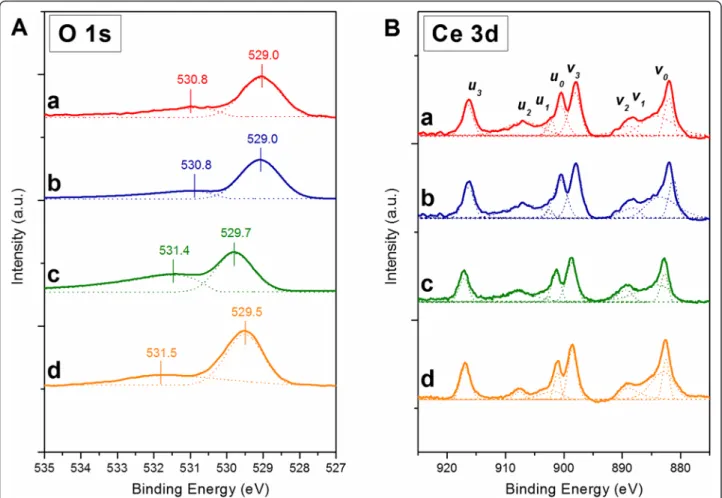
Redox properties of the catalysts were investigated by means of X-ray photoelectron spectroscopy. Figure 4a reports the XPS spectra of all samples in the O 1s core level. Two peaks are generally observed in the spectra: the first peak in the higher binding energy range (529.0– 529.7 eV) refers to weakly adsorbed oxygen at the
surface of the catalyst (Oαspecies) and the second peak in the lower binding energy range (530.8–531.5 eV) sig-nifies the presence of oxygen in the crystal lattice of the catalyst [29, 32, 38, 39]. In general, the NC and Ce-NR samples possess a significantly low population of
chemisorbed oxygen species due to their low Oα-to-Oβ
ratios (Table 2). Richer lattice oxygen species translate as easier oxidation reaction via a Mars-van Krevelen mech-anism, which is known to govern the reaction of CO
Fig. 2 FESEM images of the a Ce-NC, b Ce-NR, and c Ce-MES samples
oxidation [1, 5, 8, 9]. Figure 4b reports the XPS spectra of all samples in the Ce 3d core level. The doublets (v0,u0), (v2,u2), and (v3,u3) were attributed to the Ce4+state while the doublet (v1,u1) was attributed to the Ce3+state [40]. Relative abundances of Ce3+and Ce4+(in atomic percent-age, %) estimated from deconvoluted peaks of the Ce 3d spectra are summarized in Table 2. Among all the sam-ples, Ce-SCS possesses the highest concentration of Ce3+, most likely owing to the highly exotermic reaction during the synthesis (≥600 °C). Ce-SCS sample is also the most reducible catalyst among the series, mainly due to rich chemisorbed oxygen content on the catalyst surface.
Reducibility of Catalysts
Analyses with H2-TPR were carried out to understand
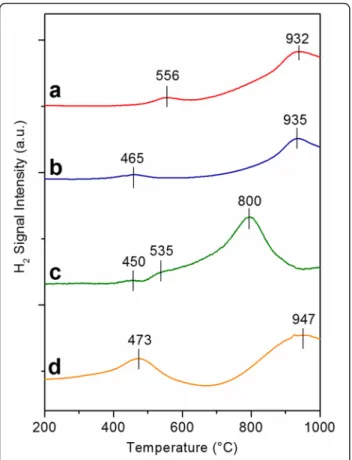
the reduction behavior of the catalysts. Figure 5 shows the H2-TPR results of all samples. A typical reduction curve for cerium dioxide comprises of two peaks: (1) low-temperature reduction peak in the range of 400–500 °C that characterizes the presence of chemisorbed oxygen and (2) high-temperature reduction peak in the range of 700–1000 °C that marks the slow release of lattice oxygen (“bulk reduction”). The low-temperature reduction peak for Ce-NC (curve a) is the highest among all catalysts (556 °C), confirming the low reducibility of the catalyst owing to the scarcity of surface-capping oxygen. A similar trend is also observed for Ce-NR (curve b), although the first peak appears at a lower temperature (465 °C). The analysis with Ce-MES sample (curve c) shows two reduc-tion peaks centered at 450 and 535 °C, due to the surface reduction of small CeO2crystals, whereas the bulk reduc-tion only occurs at 800 °C. Ce-SCS sample conforms the similar reduction trend; however, the second peak appears at the highest temperature (950 °C). This is most probably because of the low Oα-to-Oβratio.
Fig. 4 XPS spectra of the a Ce-NC, b Ce-NR, c Ce-MES, and d Ce-SCS samples in the O (1s) (a) and Ce (3d) core level regions (b). Adapted from ref. [30]
Table 2 Results of XPS spectra curve fittings on the O 1s and Ce 3d core level [30] Sample Oα/Oβ Ce3+(u1+ v1) (%-atom) Ce-NC 0.04 27.6 Ce-NR 0.04 25.5 Ce-MES 1.03 25.5 Ce-SCS 0.62 36.1
Catalytic Activity Tests
A series of tests with a classical TPC approach were car-ried out to investigate the role of structural and elec-tronic properties on the activity of catalysts during CO oxidation reaction. A typical test was conducted accord-ing to this sequence: (1) reactor heat-up from ambient to 150 °C with air to remove any possible impurities; (2) introduction of the mixed gas (1000 ppm of CO and 50 %-vol of air in N2) to the reactor; and (3) second re-actor heat-up from 150 °C to the temperature at which 100 % CO conversion is reached, (TOS = 2 h at 100 % conversion).
Figure 6a shows CO conversions as a function of re-actor bed temperature over the fresh catalysts. In gen-eral, a complete CO oxidation is attainable between 150 and 400 °C. Table 3 summarizes the temperatures at which 10, 50, and 90 % of CO are converted. It appears that the performance of the catalysts follow this order: Ce-NC > Ce-NR > Ce-MES > Ce-SCS; the lowest oxida-tion temperature was obtained for Ce-NC (T50%= 214 °C) due to the larger number of reactive (100) and (110) sur-faces. This suggests the beneficial effect of well-defined nanostructures by which some active surfaces are possibly generated. The nanocubic structures in the Ce-NC sample allow highly reactive (100) and (110) low-index surfaces to
be exploited, due to their low coordination numbers on the surface and better redox properties [30, 41], as re-vealed by XPS and H2-TPR analysis. However, the Ce-SCS and Ce-MES samples, despite their higher surface areas, exhibit lower oxidation reactivity due to the abundance of stable (111) surfaces that constitute the catalysts’ struc-tures. This may be inferred that CO oxidation reaction can be structure sensitive over ceria materials. These findings are in agreement with previous work [29, 30, 42–44], according to which ceria-based catalysts, exhibiting highly
Fig. 5 H2-TPR profiles of the a Ce-NC, b Ce-NR, c Ce-MES, and d Ce-SCS
samples. Adapted from ref. [30]
Fig. 6 CO to CO2conversion versus temperature over the“fresh”
and“used” catalysts (a and b, respectively)
Table 3 CO oxidation activity results over ceria-based catalysts
Sample 1st cycle 2nd cycle
T10% T50% T90% T10% T50% T90%
Ce-NC 203 214 219 177 185 190
Ce-NR 220 239 268 203 216 237
Ce-MES 232 260 270 214 230 255
reactive planes, show promising catalytic activities for diesel soot combustion despite their low textural properties.
In order to evaluate the stability of the catalysts, as well as the reliability of the data, re-tests have been car-ried out with previously used catalysts. Figure 6b shows CO conversions as a function of temperature over the “used” catalysts. The activity order of the catalysts ap-pears to be preserved, with Ce-NC still being the most active catalyst. Interestingly, it was found that the re-tests with used catalysts resulted in better CO oxidation
activity compared to those with “fresh” catalysts. The
temperature indicators showed values 10–20 °C lower than those in the tests with fresh catalysts. The exposure of CO during the first cycle might give some carbonate species (e.g., CO32−) on the solid surface that would help improve CO oxidation. It is known that oxygen spillover at catalyst surface contributes to the CO oxidation [45], and so, an abundant presence of surface polycarbonates, stable at high temperature, would have a beneficial effect on the reactivity of ceria nanocatalysts, as already ob-served by FT-IR analysis over ceria-zirconia catalysts [46].
Conclusions
As a whole, it has been observed that the catalytic
per-formance for CO oxidation over CeO2 nanocatalysts
mainly depends on the presence of highly reactive (100) and (110) surfaces, thus confirming the structure sensitiv-ity for this prototypical reaction. The best results, in terms of CO oxidation, were achieved for the Ce-NC catalyst, due to the abundance of coordinative unsaturated atomic sites in the (100) and (110) exposed surfaces of the CeO2 -truncated nanocubes. Moreover, this nanostructured cata-lyst has shown the lowest reducibility (vide H2-TPR data), thus validating the structure dependency for the CO oxi-dation reaction. On the other hand, worse CO conversion values were obtained for the high-surface-area catalysts
(CeO2-MES and CeO2-SCS), thus showing the key role
played by the structural properties of ceria. The least ac-tive catalyst was the CeO2-SCS, exhibiting the highest amount of stable (111) planes.
Competing interests
The authors declare that they have no competing interests.
Authors’ contributions
TA synthesized and characterized the reported materials. MP and SB contributed to the interpretation of the results and coordinated the scientific work. NR, DF and RP supervised the work and approved the final version of the manuscript.
Acknowledgements
The Ministero dell’Università e della Ricerca (MIUR) (grant number: RBFR12LS6M 001) is acknowledgedfor sponsoring this research activity (FIRB - Futuro in Ricerca 2012). This work was also co-funded througha SINCHEM Grant. SINCHEM is a Joint Doctorate programme selected under the Erasmus Mundus Action 1 Programme (FPA 2013-0037).
Received: 8 February 2016 Accepted: 15 March 2016
References
1. Trovarelli A, Fornasiero P (2013) Catalysis by ceria and related materials, 2nd edn. Imperial College Press, London
2. Heck RM, Farrauto RJ, Gulati ST (2006) Catalytic air pollution control: commercial technology, 3rd edn. Wiley-VCH, Hoboken, New Jersey 3. Ertl G, Knözinger H, Schüth F, Weitkamp J (2008) Handbook of
heterogeneous catalysis, 2nd edn. Weinheim, Wiley-VCH
4. Duprez D, Cavani F (2014) Handbook of advanced methods and processes in oxidation catalysis. Imperial College Press, London
5. Wu Z, Li M, Overbury SH (2012) On the structure dependence of CO oxidation over CeO2nanocrystals with well-defined surface planes. J Catal
285:61–73
6. Russo N, Fino D, Saracco G, Specchia V (2006) Supported gold catalysts for CO oxidation. Catal Today 117:214–219
7. Freund HJ, Meijer G, Scheffler M, Schlögl R, Wolf M (2011) CO oxidation as a prototypical reaction for heterogeneous processes. Angew Chem Int Ed 50: 10064–10094
8. Royer S, Duprez D (2011) Catalytic oxidation of carbon monoxide over transition metal oxides. ChemCatChem 3:24–65
9. Aneggi E, Llorca J, Boaro M, Trovarelli A (2005) Surface-structure sensitivity of CO oxidation over polycrystalline ceria powders. J Catal 234:88–95 10. Tana, Zhang M, Li J, Li H, Li Y, Shen W (2009) Morphology-dependent redox
and catalytic properties of CeO2nanostructures: nanowires, nanorods and
nanoparticles. Catal Today 148:179–183
11. Liu X, Zhou K, Wang L, Wang B, Li Y (2009) Oxygen vacancy clusters promoting reducibility and activity of ceria nanorods. J Am Chem Soc 131:3140–3141 12. Yan L, Yu R, Chen J, Xing X (2008) Template-free hydrothermal synthesis of
CeO2nano-octahedrons and nanorods: investigation of the morphology
evolution. Cryst Growth Des 8:1474–1477
13. Guan Y, Hensen EJM, Liu Y, Zhang H, Feng Z, Li C (2010) Template-free synthesis of sphere, rod and prism morphologies of CeO2oxidation
catalysts. Catal Lett 137:28–34
14. Lin KS, Chowdhury S (2010) Synthesis, characterization, and application of 1-D cerium oxide nanomaterials: a review. Int J Mol Sci 11:3226–3251 15. Han WQ, Wen W, Hanson JC, Teng XW, Marinkovic N, Rodriguez JA (2009)
One-dimensional ceria as catalyst for the low-temperature water-gas shift reaction. J Phys Chem C 113:21949–21955
16. Sau TK, Rogach AL (2012) Complex-shaped metal nanoparticles: bottom-up syntheses and applications. Wiley-VCH, Weinheim
17. Wang ZL, Feng X (2003) Polyhedral shapes of CeO2nanoparticles. J Phys
Chem B 107:13563–13566
18. Teng B, Jiang S, Guo X, Yuan J, Luo M (2009) A density functional theory study of CO oxidation on CeO2(110) surface. Acta Chim Sinica 67:2765–2772
19. Nolan M (2009) Molecular adsorption on the doped (110) ceria surface. J Phys Chem C 113:2425–2432
20. Muller C, Paulus B, Hermansson K (2009) Ab initio calculations of CO physisorption on ceria (111). Surf Sci 603:2619–2623
21. Huang M, Fabris S (2008) CO adsorption and oxidation on ceria surfaces from DFT + U calculations. J Phys Chem C 112:8643–8648
22. Scanlon DO, Galea NM, Morgan BJ, Watson GW (2009) Reactivity on the (110) surface of ceria: a GGA + U study of surface reduction and the adsorption of CO and NO2. J Phys Chem C 113:11095–11103
23. Alam MK, Ahmed F, Nakamura K, Suzuki A, Sahnoun R, Tsuboi H, Koyama M, Hatakeyama N, Endou A, Takaba H, Del Carpio CA, Kubo M, Miyamoto A (2009) Study of carbon monoxide oxidation on CeO2(111) using ultra accelerated
quantum chemical molecular dynamics. J Phys Chem C 113:7723–7727 24. Cheng Z, Sherman BJ, Lo CS (2013) Carbon dioxide activation and
dissociation on ceria (110): a density functional theory study. J Chem Phys 138:014702
25. Nolan M, Fearon JE, Watson GW (2006) Oxygen vacancy formation and migration in ceria. Solid State Ionics 177:3069–3074
26. Nolan M, Parker SC, Watson GW (2005) The electronic structure of oxygen vacancy defects at the low index surfaces of ceria. Surf Sci 595:223–232 27. Liu Y, Wen C, Guo Y, Lu G, Wang Y (2010) Effects of surface area and
oxygen vacancies on ceria in CO oxidation: differences and relationships. J Mol Catal A 316:59–64
28. Cejka J, Corma A, Zones S (2010) Zeolites and catalysis: synthesis, reactions and applications. Wiley-VCH, Weinheim
29. Piumetti M, Bensaid S, Russo N, Fino D (2016) Investigations into nanostructured ceria–zirconia catalysts for soot combustion. Appl Catal B 180:271–282 30. Piumetti M, Bensaid S, Russo N, Fino D (2015) Nanostructured ceria-based
catalysts for soot combustion: investigations on the surface sensitivity. Appl Catal B 165:742–751
31. Laha SC, Ryoo R (2003) Synthesis of thermally stable mesoporous cerium oxide with nanocrystalline frameworks using mesoporous silica templates. Chem Commun 17:2138-2139
32. Ji P, Zhang J, Chen F, Anpo M (2008) Ordered mesoporous CeO2synthesized
by nanocasting from cubic Ia3d mesoporous MCM-48 silica: formation, characterization and photocatalytic activity. J Phys Chem C 112:17809–17813 33. Kumar PA, Tanwar MD, Bensaid S, Russo N, Fino D (2012) Soot combustion
improvement in diesel particulate filters catalyzed with ceria nanofibers. Chem Eng J 207–208:258–266
34. Miceli P, Bensaid S, Russo N, Fino D (2015) Effect of the morphological and surface properties of CeO2-based catalysts on the soot oxidation activity. Chem Eng J 278:190–198
35. Agarwal S, Lefferts L, Mojet BL (2013) Ceria nanocatalysts: shape dependent reactivity and formation of OH. ChemCatChem 5:479–489
36. Yang Z, Woo TK, Baudin M, Hermansson K (2004) Atomic and electronic structure of unreduced and reduced CeO2 surfaces: a first-principles study. J Chem Phys 120:7741–7749
37. Agarwal S, Lefferts L, Mojet BL, Ligthart DAJM, Hensen EJM, Mitchell DRG, Erasmus WJ, Anderson BG, Olivier EJ, Neethling JH, Datye AK (2013) Exposed surfaces on shape‐controlled ceria nanoparticles revealed through AC‐TEM and water–gas shift reactivity. ChemSusChem 6:1898–1906
38. Zhang G, Shen Z, Liu M, Guo C, Sun P, Yuan Z, Li B, Ding D, Chen T (2006) Synthesis and characterization of mesoporous ceria with hierarchical nanoarchitecture controlled by amino acids. J Phys Chem B 110:25782–25790 39. Sinha AK, Suzuki K (2005) Preparation and characterization of novel
mesoporous ceria-titania. J Phys Chem B 109:1708–1714
40. Brezesinski T, Erpen C, Iimura K, Smarsly B (2005) Mesostructured crystalline ceria with a bimodal pore system using block copolymers and ionic liquids as rational templates. Chem Mater 17:1683–1690
41. Paier J, Penschke C, Sauer J (2013) Oxygen defects and surface chemistry of ceria: quantum chemical studies compared to experiment. Chem Rev 113:3949–3985
42. Fino D, Bensaid S, Piumetti M, Russo N (2016) A review on the catalytic combustion of soot in diesel particulate filters for automotive applications: from powder catalysts to structured reactors. Appl Catal A 509:75–96 43. Miceli P, Bensaid S, Russo N, Fino D (2014) CeO2-based catalysts with
engineered morphologies for soot oxidation to enhance soot-catalyst contact. Nanoscale Res Lett 9:254
44. Bensaid S, Russo N, Fino D (2013) CeO2catalysts with fibrous morphology
for soot oxidation: the importance of the soot-catalyst contact conditions. Catal Today 216:57–63
45. Thomas JM, Thomas WJ (2015) Principles and practice of heterogeneous catalysis (2n Edition). Wiley-VCH Verlag, Weinheim, Germany 113-126 46. Piumetti M, Bensaid S, Fino D, Russo N (2016) Ceria-zirconia nanocatalysts
for CO oxidation: study on surface properties and reactivity. Appl Catal B http://dx.doi.org/10.1016/j.apcatb.2016.02.023
Submit your manuscript to a
journal and benefi t from:
7 Convenient online submission 7 Rigorous peer review
7 Immediate publication on acceptance 7 Open access: articles freely available online 7 High visibility within the fi eld
7 Retaining the copyright to your article
![Fig. 1 XRD patterns of the catalysts. Adapted from ref. [30]](https://thumb-eu.123doks.com/thumbv2/123doknet/13909076.448739/3.892.84.807.149.274/fig-xrd-patterns-catalysts-adapted-ref.webp)
![Fig. 3 HRTEM images of the a Ce-NC, b Ce-NR, and c Ce-MES samples. Adapted from ref. [30]](https://thumb-eu.123doks.com/thumbv2/123doknet/13909076.448739/4.892.85.810.573.1072/fig-hrtem-images-ce-nc-mes-samples-adapted.webp)