Publisher’s version / Version de l'éditeur:
Materiaux et constructions. Materials and Structures, 11, 63, pp. 175-83, 1978-05
READ THESE TERMS AND CONDITIONS CAREFULLY BEFORE USING THIS WEBSITE.
https://nrc-publications.canada.ca/eng/copyright
Vous avez des questions? Nous pouvons vous aider. Pour communiquer directement avec un auteur, consultez la
première page de la revue dans laquelle son article a été publié afin de trouver ses coordonnées. Si vous n’arrivez pas à les repérer, communiquez avec nous à [email protected].
Questions? Contact the NRC Publications Archive team at
[email protected]. If you wish to email the authors directly, please see the first page of the publication for their contact information.
NRC Publications Archive
Archives des publications du CNRC
This publication could be one of several versions: author’s original, accepted manuscript or the publisher’s version. / La version de cette publication peut être l’une des suivantes : la version prépublication de l’auteur, la version acceptée du manuscrit ou la version de l’éditeur.
Access and use of this website and the material on it are subject to the Terms and Conditions set forth at
Effect of surface finish on the durability of GRP sheets
Blaga, A.; Yamasaki, R. S.
https://publications-cnrc.canada.ca/fra/droits
L’accès à ce site Web et l’utilisation de son contenu sont assujettis aux conditions présentées dans le site LISEZ CES CONDITIONS ATTENTIVEMENT AVANT D’UTILISER CE SITE WEB.
NRC Publications Record / Notice d'Archives des publications de CNRC:
https://nrc-publications.canada.ca/eng/view/object/?id=413b6a3f-c76a-420d-af37-baade5a1c25a https://publications-cnrc.canada.ca/fra/voir/objet/?id=413b6a3f-c76a-420d-af37-baade5a1c25aNational Research
Conseil national
1
*
Council Canada
de recherches Canada
EFFECT OF SURFACE FINISH O N THE
DURABILITY OF GRP SHEETS
P N IILYZED
by
A. Blaga andR.S.
YamasakiI Reprinted from
Mat6riaux et Constructions Vol. 11, No 63, mai - juin 1978
p. 175 -183
DBR Paper No. 808
Effect of surface finish on the durability of
GRP
sheets
A. BLAGA (I), R. S. YAMASAKI (I)
ArtiJicial and natural weathering in conjunction with scanning electron microscopy ( S E M ) was used to study the effect of surfaceJinish on the resistance to deterioration of GRP sheets. When exposed in a xenon arc weathering machine or to outdoor weathering, GRP sheets protected with either a gel-coat or an acrylic lacquer have considerably better resistance to deterioration than sheets with smooth, unprotected surfaces (conventionaljinish)
.
Temperature- humidity cycling in conjunction with thermal gradients cause no deterioration in gel-coated sheets, but induce cratering in those coated with an acrylic lacquer. Sheets with conventional 'surface jinish undergo usual deterioration in artlJicia1 or natural weathering after relativelyshohperiods of exposure.
1. INTRODUCTION
When used in the outdoor environment, conventional glass-fiber reinforced polyester (GRP) sheets undergo undesirable changes in appearance, as a result of surface deterioration. Results reported previously ([I]-[4]) have established that there are two main types of surface degradation, namely, breakdown in the glass-resin interface, which results in fiber prominence (fiber pop out), and matrix microcracking; both affect the appearance of the surface. If deterioration is severe, mechanical and other physical properties are adversely affected.
Fiber prominence occurs first, because the glass- resin interface situated in the surface layer of a GRP
composite is more susceptible to environmental attack than the similarly located, more homogeneous matrix resin. It develops under the influence of environmen- tally induced (thermally and/or by moisture) stress- fatigue [2] which causes fracture of the resin at the interface. Fiber prominence takes place after variable periods of ageing, depending on the GRP material and the service environment.
( I ) Research Officers, Building Materials Section,. Division
of Building Research, National Research Council of Canada, Ottawa, Canada.
Surface microcracking, the other type of breakdown, generally occurs on the side of the sheet exposed to radiation, after fiber prominence has become relatively extensive. It takes place under the combined action of physically-induced stress fatigue and radiation-induced tensile stresses in the surface layers of the resin as a result of shrinkage caused by post-crosslinking during weathering ([3], [4]).
By using protective coatings or other means to modify the surface finish texture and by keeping the fibers away from the surface, the physically-induced stresses at the interface should be considerably reduced and the rate of surface breakdown decreased. In addition to reducing stresses in the interface region of the surface layer, some appropriately stabilized, protective coatings can also improve the resistance of the sheet to the destructive action of ultraviolet light.
Studies of the durability of GRP sheets protected with a gel-coat or other type of durable surface finish are few and usually for short periods of exposure to laboratory ageing or outdoor weathering ([5], [6]). Most of these studies are associated with development work by the material suppliers, for the purpose of evaluating and screening gel-coat and other coating formulations for improved resistance of GRP sheets to surface deterioration. Generally, the sheets with the surface protection are subjected to accelerated ageing
VOL. 11
-
NO 63-
M A T ~ R I A U X ET CONSTRUCTIONSTABLE I
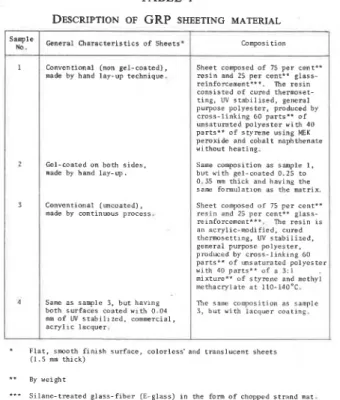
DESCRIPTION OF GRP SHEETING MATERIAL
Saz-le
General C h a r a c t e r i s t i c s of S h e e t s * Co~nposltion 1 Conventional (no" g e l - c o a r e d ) , S h e e t covnposed o f 75 p e r cent'"
made by hand l a y - u p t e c h n i q ~ .
1
r e s i n and 21 per cent-. glass. reinforcement*+*. me r e s i n consisted of cured thermoset- t i n g , UY s t a b l l l s e d , general pulpose p o l y e s t e r , produced by c r o s s - l i n k i n g 60 p a r t s " o f u n s a t u r a t e d p o l y e s t e r w i t h 40 parts.* o f s t y r e n e u s i n g M€K peroxide and c o b a l t naphthenate without h e a t i n g .2 Gel-coated on both s i d e s , Same cornposltion a s sample 1 , made by hand l a y - q . b u t with g e l - c o a t e d 0.25 t o
0.35 m m t h i c k and having t h e same f o m u l a t ~ o n as t h e m a t r i x . 3 Conventional ( u n c o a t e d ) , S h e e t composed of 75 p e r cent"
made by continuous process. r e s i n and 25 p e r cent'* g l a s s - r e l n f o r c e n e n t * * * . The r e s i n i s an acrylic-modified, cured i h e r m s e t t ~ n g , U V s t a b i l i z e d . g e n e r a l purpose p o l y e s t e r , produced by c r o s s - l i n k ~ n g 60 p a r t s * " of u n s a t u r a t e d p o l y e s t e r with 40 p a r t s " o f a 3:1 ,
mixture'* o f s t y r e n e and methyl m e t h a c r y l a t e a t 110-140°C. 4 Same as sample 3, b u t having The same composition as sample
both surfaces coated wlth 0.04 3, b u t with l a c q u e r c o a t i n g . mm of W s r a b l l l r e d , commercial,
acrylic l a c q u e r .
F l a t , s n o o t h f l n l s h rurface, c o l o r l e s s ' a n d t r a n s l u c e n t s h e e t s ( 1 . 5 rnm t h i c k )
^ * By welght
*'* S l l a n e - t r e a t e d g l a s s - f l b e r ( E - g l a s s ) ~n t h e form o f chopped s t r a n d mat
tests, one of the most frequently used being immersion in boiling water ([5], [7], [8]). Changes in surface properties are assessed by measuring gloss and yellow-
ness ; visual examination is also used to assess formation
of cracks and fiber prominence.
The purpose of the present paper is to report a study of the relative resistance to surface deterioration of GRP sheets protected with either a gel-coat or an acrylic lacquer, as determined by the scanning electron microscope. The deterioration process of some of these materials is described.
2. EXPERIMENTAL
2.1. Materials and methods of ageing
Samples used for the various exposures were pre- pared from 1.5-mm thick commercial GRP sheets produced by the hand lay-up and continuous processes. Table I gives a detailed description of these materials.
TABLE I1
METHODS OF AGEING OF GRP SHEETS
Method G e n e r a l D e s c r i p t i o n N0.6 o f Agelng C o n d i t i o n s D e t a i l s . 1 C y c l i c v a r i a t i o n o f h u m j d l t y . 4 h w a t e r s p r a y (100% R.H. t e m p e r a t u r e a n d r a d i a t i o n a n d 12'C) a n d 4 h r a d l a t i o n ( A t l a s Xenon A r c W e a t h e r - (50% R . H . a n d 55"C)**; 3 , O m e t e r ) c y c l e s p e r d a y . 2 O u t d o o r w e a t h e r i n g a t S a m p l e s e x p o s e d h o r i z o n t a l l y O t t a w a ( t e m p e r a t e n o r t h e r n w ~ t h no b a c k l n g , I n accor- c l i m a t e ) d a n c e w i t h ASTM D1435. 3 C y c l i c v a r i a t i o n o f h u m i d i t y 7 h a t 1 0 0 % R.H. a n d 56°C" a n d t e m p e r a t u r e (Aminco a n d 5 h a t 25 t o 1 0 0 % R.H. C l i m t e Lab) a n d 11 t o 56'C*(; 2 c y c l e s p e r d a y . * A d d i t i o n a l d e t a l l s a r e g i v e n i n Reference 5 , F i g u r e s 1 a n d 2, * * T e m p e r a t u r e s m e a s u r e d a t p a n e l surface.
To study the relative resistance to surface breakdown of the GRP sheets, samples were subjected to artificial ageing in either an accelerated weathering machine
(Weather-Ometer (R)) or a variable humidity-tempe-
rature cabinet, and to outdoor weathering at Ottawa. Details of the methods of exposure are given in table 11.
2.2. Examination of surface deterioration by scanning electron microscopy
The occurrence of surface breakdown of the GRP sheets at different times of exposure was followed by
a Stereoscan (R' scanning electron microscope (SEM)
using a tilt angle of 45". The instrument was generally operated at 20 kV; however, a voltage of only 5 kV was used for the examination of sheets protected with poly(methy1 methacrylate)-based lacquer to prevent overheating of the surface (higher voltages induce thermal decomposition of the coating).
3. DISCUSSION OF RESULTS
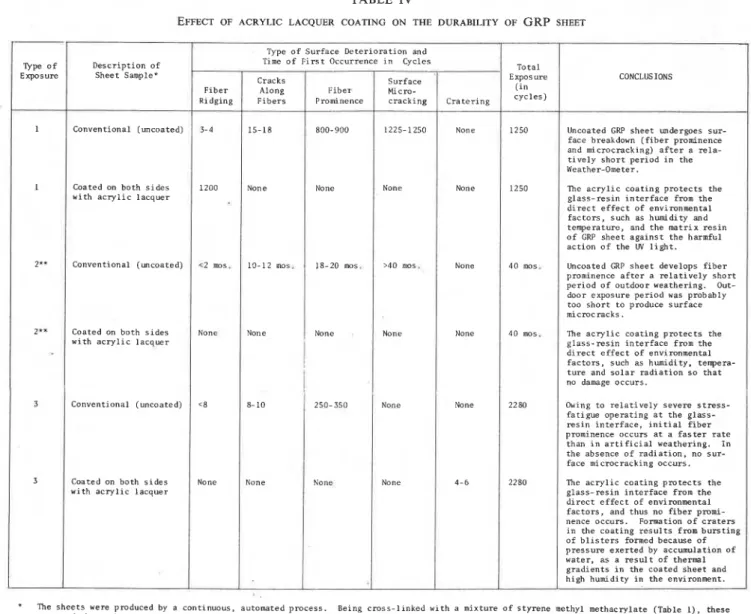
The SEM micrographs in figures 1 to 16 are pre- sented to illustrate the relative resistance to, and the eventual mode of, surface deterioration of conven- tional, gel-coated and lacquer-protected GRP sheets subjected to artificial and outdoor weathering. The results and conclusions are summarized in tables I11 and IV.
3.1. Effect of gel-coat on the resistance to surface deterioration at the glass-resin interface
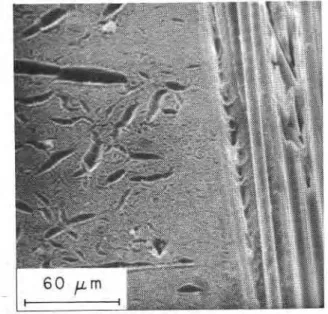
Results presented here indicate that the gel-coated GRP sheets have good resistance to surface deterio- ration in the glass-resin interface. In the conventional non gel-coated sheet, all the damage features usually occurring in the glass-resin interface were detected after relatively short periods of exposure in the Weather- Ometer, whereas none of these features were found in the gel-coated sheet (table 111, method 1). The surface of the non gel-coated control sheet (hand lay-up) and the exposed side of the sheet weathered for different periods are shown in figures 1 to 3. It can be seen in figure 2 that fiber prominence is relatively advanced after 600 cycles of exposure in the non gel-coated sheet. By contrast there is no indication of deterioration in the glass-resin interface of gel-coated sheets even after 1,250 cycles of artificial weathering.
In outdoor weathering, incipient fiber prominence was detected in the non gel-coated sheet after 30 to 32 months of exposure (table 111, method 2). At the end of the exposure program (40 months), fiber pro- minence was relatively advanced ( j i g . 4), but not widespread. The gel-coated GRP sheet did not show any surface damage associated with the glass-resin interface when subjected to outdoor weathering.
As reported elsewhere [9], surface breakdown pro-
ceeds at a faster initial rate (during the first 300 to 350 cycles) at the glass-resin interface in sheets exposed
in the Climate Lab (R' to humidity-temperature
cycling (table 111, method 3) than on the front side of sheets subjected to Weather-Ometer or outdoor
A. BLAGA - R. S. YAMASAKI exposure; subsequently, however, the rate of break-
down is considerably slower. The surface breakdown features at the glass-resin interface are similar to those produced in artificial or outdoor weathering. A site of relatively advanced deterioration in the glass-resin interface after only 300 cycles of exposure to humidity- temperature cycling is shown in figure 5.
When a gel-coat is applied to a GRP sheet, the reinforcing glass-fibers are no longer in the surface layer. The resulting resin-rich surface thus consists of a more homogeneous component. As a result the envi- ronmentally induced stresses normally operating in the surface region and, more particularly, in the glass- resin interface [2] are reduced, thus preventing for- mation of fiber prominence.
3.2. Effect of gel-coat on the resistance to surface microcracking
The resistance of the matrix to weathering depends on the chemical nature of the polyester resin and its
formulation. As both the conventional and the gel- coated GRP samples contained the same resin, it was logical to expect that the sheets would have similar resistances to surface microcracking under the combined influence of radiation and environmentally induced stress fatigue. In fact, the exposed surface of both types of sheets developed microcracks or micro- fractures after approximately the same period of exposure to artificial weathering (950 to 1,000 cycles) (table 111, method 1).
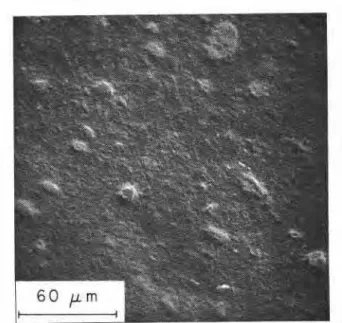
The pattern of microcracks induced in the conven- tional sbeet (,figs. 3 and 6) is different from the surface deterioration produced in the gel-coated sheets shown at different magnifications in figures 7 and 8. In conven- tional sheets, the cracks are produced under the predo- minant influence of stresses induced by the differential response of the resin and the underlying glass-fibers to the fluctuating environmental factors (such as humi- dity and temperature) in addition to the surface gradient-dominated stresses caused by shrinkage of the resin as a result of post-crosslinking. In gel-coated
TABLE I11
EFFECT OF GEL-COAT ON THE DURABlLITY OF GRP SHEET Type o f S u r f a c e D e t e r i o r a t i o n and
m e of D e s c r i p t i o n o f Time o f F i r s t Occurrence i n Cycles
I
T o t a l/
Exposure S h e e t Sample* F i b e r Cracks F i b e r S u r f a c e Exposure ( i n CONCLUSIONS Ridging Along Prominence Micro- c y c l e s )
F i b e r s Cracking
1 Conventional 4-6 42-60 500-550 950- 1000 1250 The non g e l - c o a t e d GRP s h e e t undergoes (non g e l - c o a t e d ) s u r f a c e breakdown ( f i b e r prominence
and s u r f a c e m i c r o c r a c k i n g ) a f t e r a r e l a t i v e l y s h o r t p e r i o d i n t h e Weather-Ometer.
1 G e l - c o a t e d None None None 950-1000 1250 7he r e s i n - r i c h s u r f a c e l a y e r p r o t e c t s t h e g l a s s - r e s i n i n t e r f a c e a g a i n s t t h e e f f e c t o f m o i s t u r e a n d / o r t e m p e r a t u r e induced s t r e s s - f a t i g u e (2.3) and t h u s no f i b e r prominence o c c u r s . ' h e s u r - f a c e m i c r o f r a c t u r e s a r e randomly o r i e n t e d and a r e caused by t h e combined e f f e c t o f r a d i a t i o n and s t r e s s e s r e s u l t i n g from m o i s t u r e - a n d / o r tem- p e r a t u r e g r a d i e n t s and i n h o m o g e n e i t i e s
( f l a w s and d e f e c t s ) .
2*' Conventional < 2 mos. 12 mos. 30-32 mos. 34-36 mos. 40 mas. ' h e non g e l - c o a t e d GRP s h e e t undergoes (non g e l - c o a t e d ) s u r f a c e breakdown ( f i b e r prominence and
microcracking) a f t e r a r e l a t i v e l y s h o r t p e r i o d o f o u t d o o r w e a t h e r i n g .
2 * * Gel-coated None None None None 40 m s . The r e s i n - r i c h s u r f a c e l a y e r p r o t e c t s
t h e g l a s s - r e s i n i n t e r f a c e a g a i n s t t h e
'
e f f e c t o f m o i s t u r e a n d / o r t e m p e r a t u r e induced s t r e s s - f a t i g u e . S u r f a c e micro- c r a c k i n g d i d n o t o c c u r , p r o b a b l y owing t o t h e r e l a t i v e l y s h o r t p e r i o d o f e x p o s u r e . 3 Conventional <4-6 36- 50 200- 250 None 2280 R e l a t i v e l y s e v e r e s t r e s s - f a t i g u e * " ' (non g e l - c o a t e d ) o p e r a t i n g a t t h e g l a s s - r e s i n i n t e r - f a c e produces i n i t i a l breakdown a t a f a s t e r r a t e i n s h e e t s exposed t o h u m i d i t y - t e m p e r a t u r e c y c l i n g t h a n i n a r t i f i c i a l w e a t h e r i n g (method 1 ) ; s u r f a c e microcracking does n o t o c c u r i n t h e absence o f r a d i a t i o n (1.3).3 G e l - c o a t e d None None None None 2280 The r e s i n - r i c h s u r f a c e l a y e r p r o t e c t s t h e g l a s s - r e s i n i n t e r f a c e a g a i n s t t h e e f f e c t o f m o i s t u r e a n d / o r t e m p e r a t u r e induced s t r e s s - f a t i g u e , and t h u s f i b e r prominence c a n n o t o c c u r . S u r f a c e m i c r o c r a c k i n g does n o t o c c u r i n t h e absence o f r a d i a t i o n ( 1 . 3 ) .
* m e s h e e t s were produced by t h e hand l a y - u p t e c h n i q u e .
*' Outdoor w e a t h e r i n g time c o u l d n o t b e c o n v e r t e d i n t o c y c l e s , and i s t h u s g i v e n i n nwnths ( m s l .
**' As a r e s u l t o f c y c l i c v a r i a t i o n o f h u m i d i t y a n d / o r t e m p e r a t u r e , t h e s u r f a c e r e g i o n i s normally s u b j e c t e d t o a l t e r n a t i n g s t r e s s e s (induced by d i f f e r e n t i a l dimensional changes due t o g r a d i e n t s , and d i s s i m i l a r i t y i n p r o p e r t i e s between g l a s s and r e s i n ) . These s t r e s s e s e x e r t a s t r e s s - f a t i g u e on t h e s u r f a c e m a t e r i a l ( 2 . 3 ) .
Fig. 1. - Surface of non gel-coated (made by hand lay-up) G R p Fig. 4. - Surface of non gel-coated G R P sheet weathered outdoors Control. for 40 months.
Fig. 2. - Surface of non gel-coated G R P sheet aged for 600 cycles Fig. 5. - Surface of non gel-coated G R P sheet subjected to in the Weather-Ometer. humidity-temperature cycling for 300 cycles.
Fig. 3. -Surface of non gel-coated G R P sheet aged for 1,200 cycles Fig. 6. -Surface of non gel-coated G R P sheet aged in the Weather- in the Weather-Ometer. Ometer for 1,200 cycles.
Fig 7. - Surface of gel-coated G R P sheet (made by hand lay-up) Fig. 10. - Gel-coated G R P sheet weathered outdoors for 40 months. aged for 1,200 cycles in the Weather-Ometer (the control is
similar in appearance to figure 1).
Fig. 8. - Surface of gel-coated G R P sheet aged in the Weather- Fig. 11. - Uncoated G R P sheet (made by continuous process) Ometer for 1,200 cycles. aged for 1,200 cycles in the Weather-Ometer (the control is
similar in appearance to figure 1).
Fig. 9. - Surface of non gel-coated G R P sheet weathered outdoors Fig. 12. - Surface of acrylic lacquer-coated G R P sheet (made for 40 months. by continuous process) aged for 1,200 cycles in the Weather-
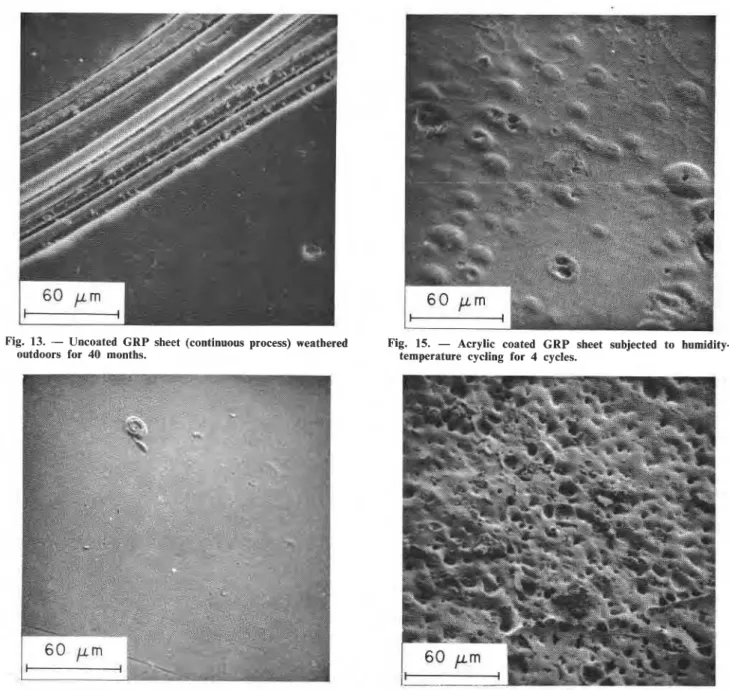
Fig. 13. - Uncoated GRP sheet (continuous process) weathered outdoors for 40 months.
Fig. 15. - Acrylic coated GRP sheet subjected to humidity- temperature cycling for 4 cycles.
Fig. 14. - Acrylic lacquer-coated GRP sheet (continuous process) weathered outdoors for 40 months.
sheet, owing to the absence of glass-fibers in the surface layer, the stress-fatigue resulting from the differential interaction of the glass and resin is considerably reduced or no longer operative. The environmentally induced stress-fatigue, in this instance, is the result of random inhomogeneities in the resin, and thermal and moisture gradients. These gradients may be in planes parallel to the surface, owing to inhomogeneities, and from the surface inward. The presence of inhomogeneities accounts for the random orientation of the surface microfractures in the gel-coated sheets.
The exposed surface of non gel-coated GRP sheet developed very h e surface cracks after approximately 34 to 36 months of outdoor weathering. Figure 9 illustrates its appearance when weathered outdoors for 40 months. The areas confined by the intersecting cracks are still relatively large, possibly because surface microcracking is still in the early stage. No micro- cracking was detected on the exposed side of gel-coated sheets (table 111, method 2 and jig. 10).
Fig. 16. -Acrylic lacquer-coated GRP sheet subjected to humidity- temperature cycling for 2,280 cycles.
3.3. Resistance to surface breakdown of GRP sheets coated with acrylic lacquer
Acrylic resins are known to have very good resistance to weathering [lo]. Consequently, they are sometimes used by the industry as a surface finish to improve the resistance of GRP to surface breakdown in outdoor applications.
Whereas the conventional uncoated sheet develops all the features of surface damage in the glass-fiber interface after relatively short periods of ageing in the Weather-Ometer and ultimately undergoes surface microcracking, only incipient fiber ridging was detected in the sheet coated with acrylic lacquer after approxi- mately 1,200 cycles (table IV, method 1). The surfaces of uncoated and coated sheet after 1,200 cycles in the Weather-Ometer are shown in figures 11 and 12.
Weathering outdoors induced formation of the usual features of surface deterioration at the glass-resin interface in the uncoated GRP (table IV and jig. 13).
A. BLAGA
-
R . S. YAMASAKITABLE IV
EFFECT OF ACRYLIC LACQUER COATING ON THE DURABILITY OF GRP SHEET
Type o f Surface D e t e r i o r a t i o n and
Type o f Description of Time o f F i r s t Occurrence i n Cycles - - Total
Exposure Sheet Sample*
Cracks Surface Exposure CONCLUSIONS
Fiber Along Fiber Micro- ( i n
Ridging Fibers Prominence cracking C r a t e r i n g
1 Conventional (uncoated) 3 - 4 15-18 800-900 1225-1250 None 1250 Uncoated GRP s h e e t undergoes s u r -
face breakdown ( f i b e r prominence and microcracking) a f t e r a r e l a - t i v e l y s h o r t period i n the Weather-Ometer.
1 Coated on both s i d e s 1200 None None None None 1250 The a c r y l i c c o a t i n g p r o t e c t s the
with a c r y l i c lacquer g l a s s - r e s i n i n t e r f a c e from t h e
d i r e c t e f f e c t of e n v i m n n e n t a l f a c t o r s , such as humidity and temperature, and t h e matrix r e s i n o f GRP s h e e t a g a i n s t t h e harmful a c t i o n o f t h e W l i g h t .
2" Conventional (uncoated) 42 mos. 19-12 mos. 18-20 mos. >40 mos. None 40 mos. Uncoated GRP s h e e t develops f i b e r
prominence a f t e r a r e l a t i v e l y s h o r t
period o f outdoor weathering. Out-
door exposure p e r i o d was probably too s h o r t t o produce s u r f a c e microcracks.
2'- Coated on both s i d e s None None None None None 40 mos. The a c r y l i c coating p r o t e c t s the
with a c r y l i c lacquer g l a s s - r e s i n i n t e r f a c e from t h e
1
d i r e c t e f f e c t of envimnmentalf a c t o r s , such as humidity. tempera- t u r e and s o l a r r a d i a t i o n s o t h a t no damage occurs.
3 Conventional (uncoated) <8 8- 10 250-350 None None 2280 Owing t o r e l a t i v e l y severe s t r e s s -
f a t i g u e o p e r a t i n g a t t h e g l a s s - r e s i n i n f e r f a c e , i n i t i a l f i b e r prominence occurs a t a f a s t e r r a t e than i n a r t i f i c i a l weathering. I n t h e absence o f r a d i a t i o n , no s u r - face microcracking occurs.
3 Coated on both s i d e s None None None None 4-6 2280 Ihe a c r y l i c c o a t i n g p m t e c t s t h e
with a c r y l i c lacquer g l a s s - r e s i n i n t e r f a c e from the
d i r e c t e f f e c t of envimnmental f a c t o r s , and thus no f i b e r promi- nence occurs. Formation o f c r a t e r s i n t h e c o a t i n g r e s u l t s fmm b u r s t i n g of b l i s t e r s formed because of p r e s s u r e e x e r t e d by accumulation of water, a s a r e s u l t of thermal g r a d i e n t s i n the coated s h e e t and high humidity i n the environment.
* The s h e e t s were produced by a continuous, automated process. Being c r o s s - l l n k e d with a mixture o f s t y r e n e methyl methacrylate (Table l ) , these
uncoated s h e e t s have b e t t e r r e s i s t a n c e t o s u r f a c e d e t e r i o r a t i o n than those c r o s s - l i o k e d with s t y r e n e alone (Table I and 111). l h i s i s well known (153.
.'
Outdoor weathering time could not be converted i n t o c y c l e s and i s thus given i n months (mos.)No surface damage of any kind was detected in the acrylic lacquer-coated GRP sheet, even at the end of 40 months of exposure (table IV and jig. 14).
As expected, exposure of the coated sheet to humi- dity-temperature cycling did not induce any surface
breakdown in the glass-resin interface region ; however
it resulted in relatively severe damage to the acrylic surface coating after a very short period of exposure. The surface of lacquer-coated sheet is shown in figures 15. and 16, after 4 and 2,280 cycles of exposure, respectively. The microscopic texture of the surface layer was drastically changed even after a relatively short exposure (15 to 20 cycles), as evidenced by the presence of extensive craters. The shapes of the craters suggest that this type of surface deterioration results from the bursting of blisters formed probably at the interface between the coating material and the , G W substrate and/or within the coating.
Examination of coated GRP samples by optical microscopy indicated that the craters were formed during the humidity-temperature cycling and thus could not result from subjection to vacuum during specimen
preparation for SEM observation. Indeed, when sheets exposed for short periods (3 to 5 cycles) were observed, the surface contained blisters almost exclusively, whereas surfaces of the same sheets aged for somewhat longer periods (about 20 to 25 cycles) contained a very large proportion of craters.
Unlike the other two exposures, the humidity- temperature cycling (table 11, method 3) involves exposure of the coated GRP sheet to high humidity
(approx. 100% R.H.) in addition to the relatively high
temperature (56°C). Furthermore, over a certain period of the cycle, while the relative humidity is about loo%,
the temperature increases from approximately 1 1
to 56OC ([2], [3]). Given the low thermal conductivity of plastic material, the temperature during this period is continuously higher in the surface coating layer than in the underlying layers or at the interface. Thus, under the influence of high humidity and temperature gradients, the moisture diffuses into the sheet and accumulates into the colder region of the coating and/or at the interface, more particularly at sites of micro-flaws (including voids, low density regions, and
VOL. 11 - No 63 - MATERIAUX ET CONSTRUCTIONS
occluded extraneous particles). It is generally assumed that the blisters form because of pressure exerted by this accumulation of water ([Ill-[14]). Osmosis does not play a role in the formation of blisters in the acrylic coated GRP sheets because there are no significant water soluble materials within the coating, or at the interface to give rise to an osmotic pressure.
The coating resin forming the outer portion of the blister wall undergoes distension by viscoelastic flow; thus, with each cycle, as more and more water is accumulated, the blister wall becomes thinner. In the early stages, the resin of the blister wall is probably plasticized by the residual solvent originally used in the lacquer. In addition to the stresses by the water pressure, the blister resin wall is subjected to physically induced stress-fatigue (thermally and/or by moisture). the ability of the resin in the wall of the blister to the stress-fatigue is produced by differential dimen- sional changes between the coating material and the GRP substrate ([2], [4]), mainly as a result of differences in thermal expansion coefficients (8.3 x 10⁻⁵C-' versus 2 . 2 ~ 10-5C-') and equilibrium water of absorption (2.2% versus 1
.
1% ; McBain quartz balance, 100% R.H.,23°C; data from the DBR laboratory).
With exposure, the resin in the blister wall becomes more rigid as a result of loss of residual solvent and exudation of the lower molecular weight polymer. Thus the ability of the resin in the wall of the blister to undergo plastic deformation is gradually reduced, and it ruptures under the combined effect of the stress caused by pressure of the accumulated water and the physically induced stress-fatigue.
Although the humidity in the Weather-Ometer is high (100% R.H.) for half (4 hours) of the cycle, conditions are not favourable for blister formation. The thermal gradients at the panel are of very short duration because of rapid temperature changes [3] taking place when the arc comes on and goes out (table 11). Similarly, the R.H. is also changing rapidly especially at the sample surface; thus there are no significantly long periods in which high humidity and temperature gradients are simultaneously prevailing. It can be shown that the relation between high relative humidity and temperature gradients prevailing outdoors is similar to that existing in the Weather-Ometer.
I
4. CONCLUSIONSGel-coated GRP sheets do not undergo breakdown in the glass-resin interface when subjected to natural or artificial weathering. The resin-rich surface of the sheets consists of. a more homogeneous component, and thus protects the glass-resin interface by reducing the environmentally induced stresses normally occur- ring in the surface region. The gel-coated sheet develops surface microfractures on the exposed side when subjected to accelerated weathering in the Weather- Ometer for the same number of cycles as the non gel-coated sheet. In outdoor weathering, the gel- coated sheet has better resistance to surface breakdown of the matrix. To produce a GRP sheet with consi- derably improved resistance to surface microcracking, a gel-coat with good ultraviolet light stability should be used. In particular, such gel-coats should be used to
improve the outdoor performance of GRP sheets known to have poor weathering resistance e. g., the fire retardant type [9].
When subjected to ageing in the Weather-Ometer or weathered outdoors, GRP sheets protected with acrylic coating did not develop surface breakdown. Similarly, exposure to humidity-temperature cycling did not produce fiber prominence or surface micro- cracking, but resulted in cratering of the acrylic coating. It is believed that craters are produced by bursting of blisters which are formed by pressure exerted by the accumulation of water as a result of thermal gradients in the coated sheet during periods of high humidity.
Thus acrylic lacquer-coated GRP sheets should not be used where thermal gradients and high humidity prevail in the service environment (e. g., shower rooms).
ACKNOWLEDGEMENTS
The authors wish to thank E. G. Quinn for coating
the plastic sheet specimens for SEM examination
and R. L. Dubois for operating the Weather-Ometer and the Climate Lab. This paper is a contribution from the Division of Building Research, National Research Council of Canada and is published with the approval of the Director of the Division.
REFERENCES
[I] BLAGA A. - Weathering study of glass-fiber reinforced polyester sheets by scanning electron microscopy. Poly- mer Eng. Science, Vol. 12, (I), 1972, p. 53.
[2] BLAGA A,, YAMASAKI R. S. - Mechanism of breakdown in the interface region of glass reinforced polyester by artEficia1 weathering. J . Materials Science, Vol. 8,
1973, p. 654.
[3] BLAGA A., YAMASAKI R. S. - Mechanism of surface microcracking of matrix in glass-reinforced polyester by artijicial weathering. J . Materials Science, Vol. 8,
1973, p. 1331.
[4] BLAGA A. - Durability of G R P composites. B2timent International/Building Research and Practice, Vol. 3, (I), 1975, p. 10.
[5] DAVIS J. H., HILLMAN S. L. - Synthesis and evaluation
of gel-coat resins for interior and exterior applications.
Proceedings, 26th Ann. Techn. Conf., Reinf. Plast./Composite Division, Soc. Plast. Ind., Washing- ton, 1971, paper 12 C.
[6] BUCK D. A., MURRAY E. J: - Light-stablefire retardant
polyester for building panels and gel-coats. Idem, Paper 5 D.
[7] EUCHNER E. B., THRONE C. O., ROBRECHT R. F. -
A study of factors that a f e c t water resistance of gel- coats. Proceedings, 20th Annual Conf., Reinf. Plastics, Soc. Plast. Ind., Chicago, 1965, Paper 13 B. [8] PATTERSON W. A. - Extensible gel-coat based on
isophthalic polyester resins. Proceedings, 18th Ann. Techn. Management Conf., Reinf. Plast. Div., Soc. Plast. Ind., Chicago, 1963, Paper 10 E.
[9] BLAGA A., YAMASAKI R. S. - Durability offire retardant G R P sheet. RILEM, Materials and Structures, Vol. 10, (59), 1977, p. 289.
A. BLAGA
-
R. S. YAMASAKI [lo] BRYDSON J. A. - Plastic materials. Butterworth [13] BABBITT J. D. - Osmotic pressure, semipermeableand Co. (Publishers) Ltd., London, 1975,
v.
335. membranes, and the blisterinn o f paint. - Can. J . Techn., Vol. 32, 1954, p. 49.1111 PAYNE H. F. - Organic coating technology Val. 11,
1141 H~~~~~~ C, y , ,
smRT
B C . - ~ ~study ~ ~ i ~ ~ ~ ~ ~ lJohn Wiley and Sons, Inc., New York, 1961, p. 1302. of blistering of paints on wood. Chem. in Canada, [12] KUZMAK J. M., SEREDA P. J. - The blistering of paint Vol. 5, 1953, p.-35.
in the presence of water. Can. J. Techn., Vol. 33, [15] PARKIN B. - Glass reinforced plastics. Illife Books,
1955, p. 67. London, 1970, p. 223.
Influence de la finition des surfaces sur la durabilitk des feuilles de plastique renforckes de fibres de verre (GRP).
-
On a dtudid I'inJEuence de la jinition des surfaces sur la rbistance des failles de GRP sur des e'chantillons soumis a diflirentes actions de vieillissement : arc de Xdnon, cycles hwniditdltempdrature (en conjonc- tion avec I'efet de gradient thermique) et exposition naturelle. Les mod@cations de structure des surfaces ont dte' contr8ldes au microscope e'lectronique d balrtyage. On s'est servi de quatre types de feuilles cle GRP : des feuilles priparkes manuellement a partir d'une rbine polyester thermodurcissable re'ticulde par du styrdne, a revdtement degel ou ajiqition conventionnelle ( a surface lisse, non revdtue) ; des feuilles obtenues par un prockdk automatique en continu, avec une rbine re'ticule'e avec un mdlange de styrdne et de mdtacrylate de mdthyl, ajinition conventionnelle ou revdtues d'un vernis acrylique. Les feuilles a revitement de gel n'ont pas ddveloppe' de saillies jibreuses a p r b des pdriodes relativement longues d'exposition dans les trois ambiances; les feuilles correspondantes a jinition conventionnelle ont montrd des saillies jibreuses assez pronondes apr2s une courte durde des mdmes expositions. Les feuilles a revdtement de gel sownises a l'arc de xdnon prdsentent une micro-jissuration superficielle de la matrice du c8td exposd aprds le mime nombre de cycles que les feuilles sans revd- tement de gel, ce qui est probablement dzi au fait que les deux types de feuille ont dte' confectionnb a partir de la mime rbine. Ajin d'amdliorer la re'sistance a la microjissuration de surface des feuilles de GRP, il faudrait utiliser un revdtement de gel ayant une bonne stabilitd au rayonnement ultraviolet. En exposition naturelle, les feuilles a revitement de gel montrent une meillare rbistance a la ddtdrioration superjicielle de la matrice.
Les feuilles de GRP revitues de vernis acrylique sownises a I'arc de xe'non ou a I'exposition naturelle n'ont pas montre' de dkte'rioration. De mime, sous I'efSet des cycles humidite'ltempdrature, elles n'ont pas rdvdle' de saillies jibreuses ou de microjissures en surface mais la formation de cratdres dans le revdtement acrylique. Les cratdres rdsultent de I'dclatement de cloques formdes sous I'inJEuence des gradients thermiques durant des pe'riodes de forte humiditk. Les,feuilles corres- pondantes 13 jinition conventionnelle ont subi en gdndral des de'te'riorations habituelles dans les trois types d 'exposition.