Publisher’s version / Version de l'éditeur:
Specifying Engineer, 43, 5, pp. 93-96, 1980-05
READ THESE TERMS AND CONDITIONS CAREFULLY BEFORE USING THIS WEBSITE. https://nrc-publications.canada.ca/eng/copyright
Vous avez des questions? Nous pouvons vous aider. Pour communiquer directement avec un auteur, consultez la première page de la revue dans laquelle son article a été publié afin de trouver ses coordonnées. Si vous n’arrivez pas à les repérer, communiquez avec nous à [email protected].
Questions? Contact the NRC Publications Archive team at
[email protected]. If you wish to email the authors directly, please see the first page of the publication for their contact information.
NRC Publications Archive
Archives des publications du CNRC
This publication could be one of several versions: author’s original, accepted manuscript or the publisher’s version. / La version de cette publication peut être l’une des suivantes : la version prépublication de l’auteur, la version acceptée du manuscrit ou la version de l’éditeur.
Access and use of this website and the material on it are subject to the Terms and Conditions set forth at
Sorting out fire exit vs. building security needs
Johnson, B. M.
https://publications-cnrc.canada.ca/fra/droits
L’accès à ce site Web et l’utilisation de son contenu sont assujettis aux conditions présentées dans le site LISEZ CES CONDITIONS ATTENTIVEMENT AVANT D’UTILISER CE SITE WEB.
NRC Publications Record / Notice d'Archives des publications de CNRC:
https://nrc-publications.canada.ca/eng/view/object/?id=a67683d5-9273-4413-8d6e-d338f32606f2
https://publications-cnrc.canada.ca/fra/voir/objet/?id=a67683d5-9273-4413-8d6e-d338f32606f2
National Research Council of Canada
.
Conseil national de recherches du Canada
Ser
TEl
N21dno.
975
c .2
BLDG
SORTING OUT FIRE
EXIT VS BUILDING
SECURITY NEEDS
ANALYZED
By Byron M. Johnson
Reprinted from Specifying EngineerVol.
43, No. 5, May, 1980p. 93-96
DBR Paper No. 975
Division of Building Research
SOMMAIRE
L
'auteur pre'sente les techniques de se'curite' contre les intrusions
e t les techniques de sgcurit; contre 1 'incendie dans les bztiments
en insistant sur les cas d 'objectifs contradictoires.
I1
indique
une m6thode d 'analyse des relations gestion-occupation e t de la
conception du bztiment propre
&
re'duire les contradictions
dans la plupart des cas.
Sorting
out
fire
exit
vs
building security
needs
The author unravels the conflicts which
occur when making tradeoffs between
building security and fire safety
By BYRON M. JOHNSON Division of Building Research, National Research Council of Canada Ottawa
Individuals concerned with fire safety want as many exits as are economically possible; those concerned with security want as few as possible. Both groups have compromised, especially security person- nel, despite increasing life and property losses resulting from crime i r - recent years.
At present, fire and crime result in property losses and personal injuries of equal magnitude. Specialists in security, building design, building management and sociology have discussed the impor- tance of building design in relation to this problem at the Division of Building Re- search, National Research Council of Canada. They concluded that relatively simple modifications to building design and the specification of better hardware and construction would greatly reduce crime, without jeopardizing fire safety.
To provide measures that are sufficient to deter a potential intruder without being too elaborate or too expensive, involves an assessment of the risk to the building, its contents and the occupants. Among the factors that determine the risk of criminal attack are location of the building, value of contents, and type of building. These are described in "Pat- terns of Burglary," H.A. Scarr, U.S. Government Printing Office, Washing-
About the author
Byron M. Johnson, B.Sc. in Mathemat- ics (University of Victoria), B.Sc. in Archi- tecture (University of Edinburgh), joined the Division of Building Research, Nation- al Research Council of Canada, in 1975. His main interests at DBR have been the requirements of building occupancies, in particular the movement of people within buildings and the design of buildings for easy use by the handicapped. A recent outgrowth of these interests is the study of crime prevention through building design.
ton, D.C., 1973. Consideration must be given not only to the costs of building repairs or replacing valuables but also to those resulting from personal injury, legal proceedings and the wider social costs of support for convicted criminals and their Eunilies. Compared with these, the addi- tional cost of providing adequate protec- tion to most buildings is negligible (John- son, B.M., Crime Prevention Through Building Design, Specification Associate, Vol. 20, No. 1, January1Februar-y 1978).
Non-residential buildings
In non-residential occupancies, the res- olution of the conflicts between building security and fire safety requires under- standing of the needs of the occupants and method of operation of the building.
Over the past five years DBWNRC has investigated- the movement of spectators in theatres, arenas, and grandstands. - These studies were concerned with evac- uation time and safety and identifying
security procedures that affected evacua- tion. Such procedures were most appar- ent at the Olympic Games in Montreal where all exits were constantly surveyed and complex arrangements made for the protection of dignitaries.
Places of assembly are usually con- cerned with preventing unpaid entry, either by guarding the exits or locking them during performances. Guards, how- ever, are expensive because of the num- ber required. Even where exits are close together at least one guard may be re- quired at each door. In one Canadian arena two guards are needed for hockey games and rock concerts to prevent groups of spectators inside from assaulting solitary guards and letting friends in.
Where regulations permit, exit doors can be locked either by manual latches or solenoid holders. The solenoids have the obvious advantage of allowing rapid re- lease from a central control, overcoming many of the problems associated with manual latches; but they need to meet strict (in many cases impossible) regula- tions to prevent electric shock or failure to function. In addition, a manual lock must be installed to ensure that doors remain locked during power failures.
Several factors have contributed to the rising rate of theft from office buildings. Increased area and open working arrange- ments make it possible for strangers to walk unchallenged through work areas, steal an article and escape by way of exit stairs. Calculators, electric typewriters, and specialty equipment are prime tar- gets. Very often security systems have been designed to prevent illegal entry for the purpose of industrial espionage or similar crime, but petty theft is a greater problem, possibly of the order of $75,000 for every ten stories of office space (10,000
Losses of $75,000 a year
for every 10,000 sq ft of
office space makes petty
theft more than just
petty
sq meters) every year. In Canada, as elsewhere, government agencies require provisions for security in the design of all
new buildings, (Building Security, Public Works Canada, August 1975, Briefing Document D-9).
The main problem with offices results from the ease of movement between floors via stairs or elevators, particularly after hours. The importance of control at elevator lobbies has long been recognized and specific recommendations have been made. Entry to the offices can be con- trolled by a simple installation of a contact switch that sounds a buzzer when a person opens the door from the lobby. It is suggested that passage via elevators should be made more ditficult by enclos- ing and locking each elevator lobby when no one is working on the floor. An exit stair off the elevator lobby would be required, and it could be designed for smoke pressurization to provide tempo- rary refuge in the event of fire for anyone having difficulty using the stairs.
Most building regulations require at least one exit stair directly to the outside and this makes it difficult to prevent "grab-and-run" techniques. This direct exit is required for its assumed usefulness in evacuations, but research has revealed that during evacuations 40 percent more
TABLE 1-REQUIREMENTS FOR EXIT-DOOR DESIGN
TYPe of Type of occupant
exit Hostile Responsible Security conscious
Open Easily opened in confirmed Door needs surveillance but Usually needs to be
exits emergency but otherwise entrytexit is uncontrolled controlled
controlled
May be required for Method of detecting Hardware should give good evacuation of crowds "unwanted" visitors may be
security when building required
unoccupied Hardware should give good
"silent-hour" security May require 24-hour "guarding" or alarm Enclosed Surveillance required when Surveyed or set with alarms Alarm on exit is needed
exits building occupied that allow adequate response
Possible surveillance by
Easily inspected from No exterior hardware cameras
outside, should be very
secure In some locations may be
locked unless confirmed emergency
Special Isolated from main building Should be controlled when To be avoided unless doors exits unless controlled building occupied and locked are locked by remote control
or isolated when unoccupied Secure hardware, possible
alarms
Building securitylfire safety
people, on average, use the stair that ment in the event of fire. Although this of the schools ("Stopping School Property terminates in the main lobby than the problem is not related to security, it Damage," American Association of School
stair that does not. emphasizes the importance of under- Administrators, 1976). In correctional in-
There are several possible explanations standing and planning for the desired stitutions the conflict between security for this, but the main one is familiarity. tr&c patterns in buildings. This means and evacuation needs is obvious. This conclusion is reinforced by other that integration of fire emergency systems Standards have been developed in the studies, such as "Pilot Study on Personnel and security systems is essential, as advo- U.S.A. to deter the use of windows as a Movement in Office Buildings, Health cated by Fitzpatrick and Ruchelman: point of entry in all types of buildings. Impacts of the Use, Evaluation and De- "Rather than operating as separate activi- Windows are frequently broken by van- sign of Stairways in Office Buildings," ties, the two functions must be seen as dals and can be lifted out of their mount- Johnson, B. M. and Pauls, J. L., Health comprising a total security package for ings either by prying or unscrewing. They and Welfare Canada, April 1977. Pauls high-rise buildings" ("Integrated Fire can be secured by stronger frames, non- recommends that the lobby stair be de- and Crime Systems in High-Rise Office retractable screws on the outside, or by signed to encourage normal use as well as Buildings," Skyscraper Management, July pins through the frame and mullion. efficiency during evacuations. In build- 1974). A school is an example of a building These pins should be designed to be ings with central service-cores, exit stairs type where the complexity of the activity easily removed for windows that might be often pass through the basement if they patterns creates ~roblems. Night-time used as emergency exits. Basement win-
do not terminate at the lobby. As fires dows are the most difficult to force open;
frequently start in the service area be- sash and pivot hung windows are easier to
neath the lobby level, it is worth re-
One of the considerations
force* open, sliding windows generally examining requirements that result inis whether the occupants
provide little security. Sliding patio doorsexits through basements.
Will aid or prevent a crime
can be secured by placing screws in theOne solution for such stairs would be to top track to prevent the window or door
construct an emergency door in the stair- being raised. Laying a rectangular wood
well at lobby level that, if opened, would use presents significant problems of van- board in the lower track will stop forcible activate an alarm to give security person- dalism even where schools are used only sliding; round sections can be rolled out of nel sufficient time to apprehend the thief. by adults in the evening. This raises the place.
Such a door and wall could also reduce issue of master keying and a mechanism The use of plastic glazing can serve to smoke movement. Alternatively, if all for key control. As with office buildings, stop vandalism to inaccessible windows, stairs and elevators from upper stories there is value in analyzing activities and but in high risk buildings such as schools, terminate in the main lobby, then every- zoning the building so that everyone does such material is easily marred. Windows one would pass security personnel either not have free access after hours when few should be protected by meshing in such to exit directly outside or indirectly supervisory staff are present. Zeisel has locations. Expanded metal of similar size through parking or service areas. made recommendations on design and as ornamental leaden windows can be Non-emergency use of exit-ways results hardware selection that allow designers to used to make illegal entry difticult. In in the common problem of exit-doors produce good buildings with proper con- general, bars or meshings should be being held open, allowing smoke move- sideration given to the occupancy patterns positioned on the inside of the windows.
*
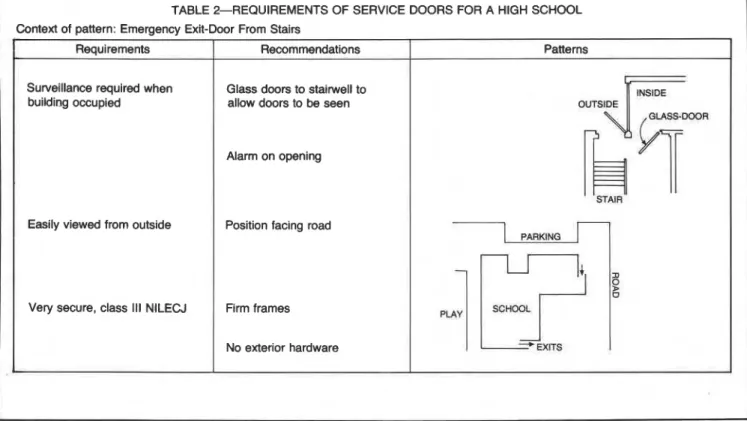
TABLE 2-REQUIREMENTS OF SERVICE DOORS FOR A HIGH SCHOOL Context of pattern: Emergency Exit-Door From Stairs
Requirements Recommendations Patterns
Surveillance required when Glass doors to stairwell to !WIDE
building occupied allow doors to be seen OUTSIDE
~ ~ - m o R
Alarm on opening
Easily viewed from outside Position facing road
D
w
Very secure, class Ill NILECJ Firm frames No exterior hardware
Security hardware
There are two basic types of security hardware: passive and active. The first attempts to delay or discourage an intrud- er by presenting obstacles. Active hard- ware announces an intrusion or retaliates. This type is often advocated, however, without adequate recognition of the in- herent daculties. Many types of active hardware, such as electric fences, can be dangerous and may make a building owner liable to an extent greater than his potential loss would just*.
Alarm systems depend on having some- one to react quickly. They are frequently installed on exit doors to deter thieves from grab-and-run techniques. Although no definitive studies have been done, it seems probable that in most cases these installations are ineffective. Security per- sonnel can seldom react fast enough to reach an exit in time to apprehend the culprit. The same seems true of prevent- ing illegal entry. By the time security personnel can reach the door there will probably be no sign of the intruder, and it is uncertain whether the alarm was acti- vated as a result of malfunction or hard hocking. Video cameras can be useful for observing an entrance when an alarm sounds, but are very expensive and would be warranted where the risk is very great.
Passive hardware may also present di£Ficulties. For exit doors the required panic bar is most unsuitable for security. Tests have shown that it is easily cheated unless special door frames are installed
and, if used frequently, it breaks down because people often exert force on the door before the bolt can retract.
Type of occupants
Hostile Occupants: Despite the emo- tive strength of this term, there are many occupancies where the occupants would not try to prevent a crime. The inmates of correctional institutions are, in general, hostile to management or administration. Less obviously hostile are those who use public assembly buildings, yet seldom will a visitor or spectator try to prevent a-
Main entrances are often
the least vulnerable when
compared to other exits
criminal action. Other occupancies such as schools and universities are subject to circumstance. As a general rule, the determining factor is whether occupants would be expected to prevent or aid a crime. In most instances hostile occupan- cies require some security staff to protect either the building or its occupants from other occupants. If either illegal entry or exit is the main security problem, then large numbers of security staff may be needed.
Responsible Occupants: Occupants of this type would in the majority of cases be held responsible if they did not sound the alarm or question doubtfi~l behavior.
Most office buildings fall marginally into this category. Generally, the number of security personnel is few and the occu- pants are implicitly expected to perform this hnction, although they have not been given clear directives or training.
Security Conscious Occupants: Few buildings have occupants trained to take definite action toward someone commit- ting a crime. Military establishments and similar occupancies are of this type, but they face little risk of the type of crime that can be prevented by environmental design. Other occupancies where people perceive intervention to be in their inter- est might include airports, owing to the common fear or terrorist action, or banks where fear of financial loss might prevail.
Types of exits
The categories first described help to define how occupants use entrances and exits of buildings and their attitude tow- ard them. Frequent use of an exit door and failure to ensure that it is properly closed can allow an intruder to enter illegally. This often happens in office or apartment buildings where considerable caution is, at the same time, being taken to ensure that garage or main entrance doors are kept locked. The problem of exit doors requires a classification scheme for the topology of exit doors.
Open Exits: These are generally the main or front entrances of buildings. They are locked or unlocked according to the amount of supervision available and the
Building securitylfire safety
general level of security. They can often be observed from a desk or from the road (i. e., from patrol cars). Ironically, these doors have received the greatest attention for security, yet they are probably the least vulnerable. One problem concerns the requirement for determining who should be allowed to enter, one of the unresolved problems in crime preven- tion. In many instances front entrances may need to be only class I or class 11, according to- the classification system of the National Institute of Law Enforce- ment and Criminal Justice (NILECJ).
Enclosed Exits: Most buildings contain several exit stairs that are completely enclosed and exit directly to the outside. They can only be surveyed by cameras, prohibited for normal use, or given spe- cial security treatment. There are many problems with such exits: easy escape for thieves, occupants using the stair to travel to prohibited floors or to avoid being questioned by receptionists, occupants using the exit on a day-to-day basis (there- by wearing out hardware that later allows entrance to unauthorized persons), and persons who cheat the exit door from the outside. This last problem of unautho- rized entry concerns both door manufac- turers (i.e., to produce hardware that
cannot be defeated easily) and designers of security systems in trying to design a system that reacts quickly to illegal intru- sion. These exits should be at least class I11 of the NILECJ classification system, but if there is no external hardware they can easily be built to class IV.
Special Exits: Special exits are those at which users can expect to be challenged, for example, exits from workrooms, base- ments, or perhaps such facilities as freight doors. Use of such exits would require good knowledge of the building. General- ly they share the problems of enclosed exits, but have the advantage of being isolated when the building is unoccupied and perhaps even when it is occupied. Exits in this category can easily be deter- mined by considering the level of risk and the occupant/management relation.
Exit door requirements
If an analysis is undertaken of occup- ancylmanagement relations and the topol- ogy of exit doors, the requirements given in Table 1 can be used to develop specific design recommendations for individual buildings. A series of patterns can be drawn and taken by the designer to produce hardline drawings. This tech- nique of pattern drawing was strongly
advocated by Alexander in "Notes on the Synthesis of Form," Harvard University Press, Cambridge, Mass., 1967, as a method of expressing requirements.
The use of patterns of requirements is shown in Table 2 for a hypothetical high school. Several topologies and functions of exits are analyzed. The occupancy/ management relation is considered hos- tile, primarily because of the number of students with this attitude. The main concern, however, is illegal entry plus theft or vandalism rather than illegal entry alone (e.g., at dances) or uncontrolled escape during school hours. It is h r t h e r assumed that the school is used in the evening despite the management prob- lems this creates.
In the development of these patterns the NILECJ classification system was used for describing the level of resistance of the doors. It has the advantage of ready use in producing a specific statement of what should become established tests on doors. To some extent, however, it must be admitted that the classification system did not relate well to the problems of the types of door in the example chosen, primarily because of its apparent orienta- tion to domestic situations.