Analyzing Autonomic Activity in Neonatal Seizures
by
Priya Ramaswamy
S.B. in Electrical Engineering and Computer Science, Massachusetts Institute of
Technology (2010)
Submitted to the Department of Electrical Engineering and Computer Science
in partial fulfillment of the requirements for the degree of
Master of Engineering in Electrical Engineering and Computer Science
MASSACHUSETTS INSTITUTE
at the OF TECHNOLOGY
MASSACHUSETTS INSTITUTE OF TECHNOLOGY
JUN 2 1 2011
June 2011'
LIBRARIES
@
Massachusetts Institute of Technology 2011. All rights reserved.
ARCHIVES
A
u ho
. .. .
. .
...
... ...
.
..
.. ... ... ...
Author...
-Departm t of Electrical Engineering and Computer Science
May 20, 2011
Certified by...
George C. Verghese
a At
Professor of Electrical Engineering
Thesis Supervisor
C ertified by ...
...
Thomas Heldt
Research Scientist
Thesis Supervisor
A ccepted by ...
...
.
... ..
.. . .. . .
C
iaDr.
Christopher J. Terman
Analyzing Autonomic Activity in Neonatal Seizures
by
Priya Ramaswamy
Submitted to the Department of Electrical Engineering and Computer Science on May 20, 2011, in partial fulfillment of the
requirements for the degree of
Master of Engineering in Electrical Engineering and Computer Science
Abstract
Recent studies suggest that seizures in the newborn occur more often than previously appre-ciated. The effect of neonatal seizures remain unclear, however. Do seizures in the newborn cause brain injury, are they a consequence of brain injury, or are they benign? Seizures in the newborn tend to occur without overt clinical correlates, such as convulsions, so their diagnosis requires electroencephalography (EEG). In this thesis, we investigate whether seizure activity is associated with changes in the discharge pattern of the autonomic ner-vous system, which could be picked up in heart rate (HR) or heart-rate variability (HRV) analysis. More fundamentally, we seek to investigate whether seizures in the neonate are confined to the cerebral cortex or whether they might originate from or propagate to deeper brain structures. Prior studies have provided some evidence that neonatal seizures can re-sult in HR and HRV changes. From these past studies, there seems to be a heart-brain connection, however, this connection is currently poorly understood. Our long term goal is to understand the connection between electro-cortical activity, electro-cardiac activity, and brain injury in newborns with seizures.
In this study, we analyzed the EEG and the electrocardiogram (ECG) signals in fourteen newborns with neonatal stroke and three newborns with hypoxemic-ischemic encephalopa-thy. Furthermore, we used information from magnetic resonance imaging and magnetic resonance spectroscopy reports to identify injury location in these full-term newborns. Our results indicate that some babies show strong changes in HR and HRV during seizure episodes while others tend to respond very weakly. Due to the small sample size of our patient population, no consistent picture emerged whether the location of injury might be responsible for this response pattern.
We also explored a spectrogram-based method to determine the occurrence of seizure (on a lead-by-lead basis) and to determine seizure propagation from one region of the cortex to another.
Thesis Supervisor: George C. Verghese Title: Professor of Electrical Engineering
Thesis Supervisor: Thomas Heldt Title: Research Scientist
Acknowledgments
I am thankful for the opportunity to work with Dr. Carmen Fons, who sat for hours with me
annotating datasets, teaching me about neonatal neurology, and enthusiastically discussing
research with me. I thank fellow members of the CPCI group for their advice, support, and friendship. I also thank Dr. Adr6 du Plessis and members of the Fetal and
Neona-tal Neurology Research Group at Childrens HospiNeona-tal Boston, for giving me the amazing
opportunity to work on this project. My sincere thanks goes to my amazing advisors Dr. Thomas Heldt and Professor George Verghese, who patiently helped me through my thesis
and were always available for guidance and support. I especially thank Thomas for making sure I leave this institution with an appreciation for soccer. I would like to thank Maria for
keeping me company while working in lab during late nights. Lastly, I thank my family for the encouragement, love, and support they have always given me.
Contents
1 Introduction
1.1 Contributions . . . . 1.2 Thesis Outline . . . . 2 Electroencephalography during Neonatal Seizures
2.1 The Scalp Electroencephalogram in the Newborn . . . 2.1.1 EEG during Neonatal Seizure . . . .
2.2 The Surface Electrocardiogram in a Newborn . . . . . 2.2.1 ECG During Neonatal Seizure . . . .
3 Neonatal Seizure Database
3.1 Description of the Database . . . . 3.2 Initial Seizure Database . . . . 3.3 Stroke Population . . . .
3.3.1 Significant Data Periods . . . .
3.4 HIE Population . . . .
4 Association of Autonomic Activity Changes during Seizure
4.1 Quantifying Autonomic Activity . . . .
4.1.1 Autonomic Influence on HR and HRV . . . . 4.1.2 Measures of HR and HRV . . . . 4.1.3 Comparing HR and HRV Between Major Time Segments . . . . . 4.2 Results in Stroke Patients . . . . 4.2.1 HR and HRV results . . . . 4.2.2 Mapping Strong and Weak Responders to Stroke Injury Location .
10 . . . . 11 . . . . 13 14 . . . . 14 . . . . 16 . . . . 17 . . . . 18 19 . . . . 19 . . . . 19 . . . . 20 . . . . 20 . . . . 26
4.3 Results in HIE Patients . . . . 40
4.3.1 HR and HRV Results . . . . 40 4.4 D iscussion . . . . 44
5 Tracking Cortical Seizure 47
5.1 Power Spectral Density Methods for Seizure Tracking . . . . 47
5.2 Interesting Case Study of HIE . . . . 48
6 Conclusion and Future Work 54
6.1 Topics for Future Work . . . . 55
6.1.1 Clinical Investigation . . . . 55
List of Figures
1-1 Hypothesized connections between brain injury, EEG and ECG activity. 2-1 EEG Montage and Example of Seizure. . . . . 2-2 Example of an ECG signal . . . .
Breakdown of neonatal stroke database. Pre-ictal-post selection . . . . Summary of stroke data records... Close up of stroke data summary. Cortical and thalamic stroke locations in Summary of HIE data records... Close up of HIE data summary. . . . . .
. . . . 2 0 . . . . 2 2 . . . . 2 3 . . . . 2 4 14 neonates . . . . 26 . . . . 2 8 . . . . 2 9 Stroke HR results . . . . Stroke HRV results . . . . Reproduction of Figure 2-1 . . . . Brain injury grading scheme . . . . Injury location in stroke database. . . HIE HR results .. . . . . HIE HRV results. . . . .
Strong and weak HIE responders. . . .
Baseline selection shows HR variation.
. . . . 3 6 . . . . 3 7 . . . . 3 8 . . . . 4 0 . . . . 4 1 . . . . 4 2 . . . . 4 3 . . . . 4 4 . . . . 4 5
5-1 HR increase during HIE seizure in Patient 289.
5-2 Spectrogram of EEG in Patient 289. . . . . 5-3 PSD thresholding general location of seizure.
3-1 3-2 3-3 3-4 3-5 3-6 3-7 4-1 4-2 4-3 4-4 4-5 4-6 4-7 4-8 4-9 . . . . 5 3
6-1 Hypothesized connections between brain injury, EEG and ECG activity. . 54
List of Tables
3.1 Gender, gestational age, post-natal age of stroke subjects . . . . 25
3.2 Gender, gestational age, post-natal age of HIE subjects . . . . 30
4.1 Subject ID mapped to seizure number. . . . . 35
4.2 Brain injury template key. . . . . 39
Chapter 1
Introduction
Modern technologies in neonatal intensive care units (NICU) allow even very premature babies to survive despite having underdeveloped organ systems. With intense technological
support, the current viability (50% survival) for premature infants resides at 24 weeks [1].
While mortality in these fragile infants has decreased over the past decades, morbidity has not. Infants born at younger gestational ages have an increasing likelihood of significant
health issues and death. One central health problem is injury to the brain, which can cause issues like learning difficulties to more debilitating conditions like severe mental retardation
and motor dysfunction (cerebral palsy).
In both pre-term and full-term neonates, one potential source of brain injury is from
seizures. Seizures are excessive, synchronous electrical depolarizations of neurons within the central nervous system [2]. They take energy to maintain and might therefore consume
a lot of the developing brain's metabolic substrate. Repeated seizures in the newborn, accompanied by serious hypoventilation and apnea, might therefore cause or worsen existing
brain injury [2]. There is a great need to detect and treat seizure activity in neonates to
prevent long-term brain damage. In the United States, the risk for neonatal seizures is
roughly 1.8 to 3.5 per 1000 live births [3, 4, 5].
Most often, neonatal seizures are a result of two classes of brain injury: stroke or hypoxic-ischemic encephalopathy (HIE). Neonatal stroke is a focal insult due to an ischemic, thrombotic, and/or hemorrhagic event occurring between labor and delivery or early in
post-natal life [6]. HIE is a generalized brain injury due to oxygen deprivation via decreased oxygen concentration in the blood supply (hypoxemia) or decreased blood perfusion of the
brain (ischemia) [2]. Stroke accounts for 12 to 20% of neonatal seizure activity while HIE
accounts for 60 to 65% of neonatal seizure activity [7, 8, 9].
Since a neonate's brain has only begun to develop outside the mothers womb, neonatal seizures tend to manifest differently than in adults. Neonatal seizures are distinct in prema-ture infants or even older infants. They are behaviorally subtle; the electroencephalogram
(EEG) patterns tend to indicate a multi-focal process rather than coordinated seizure
ac-tivity [3]. Electro-graphically, seizure detection in neonatal EEG is generally challenging
[10]. Furthermore, neonatal seizures quite often manifest without clinical correlates like
muscle tensing (tonic movements) or convulsions (clonic movements), making their routine diagnosis difficult.
Several independent predictors of neonatal seizures include male gender, younger ges-tational age, respiratory distress syndrome, pulmonary air leak, intra-ventricular hemor-rhage, periventricular leukomalacia, patent ductus arteriosus, and necrotizing entercolitis
[11]. Additionally, prior studies have associated heart rate (HR) changes with seizure
ac-tivity [12, 13], and recently, heart rate variability (HRV) has been used for newborn seizure detection [14]. From these past studies, there seems to be a heart-brain connection. From a physiologic perspective, it is both interesting and important to understand why and to
what extent seizures are coupled with changes in HR. Such knowledge can lead us to better
understand the developing brain and may help us diagnose, treat, and ultimately prevent neonatal brain injury.
1.1
Contributions
Brain Injury
Electro-cortical
Electro-cardiac
Activity
ANS
Activity
Figure 1-1: Hypothesized connections between brain injury, EEG and ECG activity. ANS: autonomic nervous system.
electro-cardiac activity, and brain injury, as Figure 1-1 depicts. Currently, there exists
no mechanistic model that explains these possible connections. Our research provides the
methods and explores seizure data to better understand how cortical seizure location and injury type (stroke or HIE) or injury location can influence cardiac activity. In this
the-sis, we hope to take steps to better understand these connections by linking EEG and electrocardiographic (ECG) activity during neonatal seizure (ictal) episodes.
Based on a retrospective analysis of ECG, EEG, and brain imaging data collected from
stroke and HIE newborns, the contributions of this thesis are to address the following questions:
1. Do HR or HRV metrics change with seizure onset?
2. Are there HR or HRV differences between stroke and HIE populations during seizure,
baseline, pre-ictal, and post-ictal periods?
3. Do HR or HRV changes during seizures correlate with a particular anatomical brain
injury location.
4. Do HR or HRV changes during seizures correlate with a particular seizure location,
as determined by activation of EEG leads?
5. Does inter-hemispheric seizure dispersion or propagation influence HR or HRV?
To address these questions, we describe the framework for examining aggregate ECG
data around the ictal times. We also implemented several computational tools to analyze
EEG activity. A spectrogram-based method was used to determine the occurrence of seizure
on a lead-by-lead basis.
Preliminary results suggest that the subjects can be classified into strong and weak HR
responders of seizure activity. Furthermore, our case studies lead us to hypothesize that
regions in the brain stem, which control autonomic activity, may be triggered when a seizure
propagates or disperses from one hemisphere to another.
1.2
Thesis Outline
Chapter 2 gives a clinical background on EEG and neonatal seizures. Chapter 3 describes
Chapter 4 describes the various methods developed to understand the database, and it describes key findings from the stroke and HIE subjects. Chapter 5 describes a spectrogram based method to track seizure activity across the brain and it presents the application of this method to study an interesting HIE case. Finally, Chapter 6 briefly summarizes the main results of this thesis and outlines future clinical and algorithmic methods that can be applied to better understand seizure and autonomic activity in stroke and HIE newborns.
Chapter 2
Electroencephalography during
Neonatal Seizures
This chapter introduces the electroencephalogram (EEG) and the electrocardiogram (ECG)
and provides an example of these signals during a neonatal seizure episode. This chapter
also provides brief review of the heart-brain connection found in previous neonatal seizure studies.
2.1
The Scalp Electroencephalogram in the Newborn
The scalp EEG is a monitoring modality that, with multiple leads, records spatio-temporal voltage activity of neurons in the brain. Specifically, it measures the local aggregate
depo-larization of neurons close to the cortical surface on the scalp. The choice and placement of
the electrodes follows the 10-20 International System of Electrode Placement, where each electrode is 10-20% of the left-to-right skull distance (or the front-to-back skull distance)
away from its neighboring electrodes [15]. Generally, EEG devices have built-in capabilities to amplify and filter the acquired voltage signals.
Left
Shoke (D 1601)ECG-FTM C4-P4 F4-C4 Fp2-F4-F3-C3 FP1-01 7-P7 $1 FTM Fp1-F7go!0 iv0 'j1 4 O Ow 10 20 30 40 50 60 70 80 90 100 150-* / . e. E~ CL 10 20 30 40 50 Time(s) 60 70 30 90 100
Figure 2-1: Example of stroke neonate with seizure following increase in HR. We show the EEG bipolar montage and the ECG (top) signals depicting strong seizure activity in the central brain (Cz-Pz, Fz-Cz) starting around t = 70 sec. Prior to seizure, there is a rise in mean HR and a pronounced loss in beat-to-beat HRV.
Figure 2-1 depicts a typical 21-lead EEG placement on a neonate. Due to the small
size of the head, neonates generally have fewer electrodes placed than adults. Each lead's identifier includes a letter and a number. The letter corresponds to the frontal (F), central
(C), parietal (P), and occipital (0) regions of the brain. Even and odd numbered electrodes
correspond to the right and left hemispheres of the brain, respectively, with larger numbers
further away from the center (z). Al and A2 correspond to the reference leads, usually placed at the left and right ears, respectively.
In EEG recordings, one registers potential differences of activity picked up by electrodes. Montages are the different ways to connect electrodes. They come in two forms: referential
and bipolar [15]. Referential recordings takes each active lead, L, and references them to
the average of the reference leads: Li = Li - A1+A2. Bipolar recordings take the difference between two active and usually neighboring electrodes: Bij = Li - Lj = Li - Lj.
The developing brain of healthy newborns presents EEG signals with background noise consisting of alpha (8-13 Hz), beta (13-30 Hz), theta (4-8 Hz), and delta (< 4 Hz) frequencies
[2, 15]. Additionally, newborns spend ~50% of their time sleeping. Their EEG contains the trace alternant pattern of quiet sleep. Traci alternant describes periods of 3 to 15 seconds
of voltage attenuation followed by higher amplitude, synchronous activity [2].
2.1.1 EEG during Neonatal Seizure
As discussed in Chapter 1, neonatal seizures are sustained synchronous electrical discharges,
and they are different from seizures in adults. Neonatal seizure episodes are typically brief
(generally < 2 min) and commonly localize in the temporal and central regions. Often, neonatal seizures are characterized by electroclinical dissociation - seizures detectable by
electroencephalogram only [2], i.e. without clinical correlates such as tonic or clonic
move-ments. According to Scher, a neonatal seizure pattern consists of repetitive waves in the
EEG which may vary in frequency, amplitude, electrical field, or morphology [16]. Such
repetitive activity must last 10 seconds to be considered a seizure in a newborn [2]. Most
frequency-based neonatal seizure detection algorithms base their work off Gotman et. al
and look for consecutive bursts in the 0.1-10 Hz frequency range [17]. Sometimes, how-ever, neonatal seizures can present only with clinical signs with normal EEG signals;
in-dicating sub-cortical seizures. Some common clinical symptoms include repetitive limb or
recognition, signal collection of ECG, EOG (electro-oculogram), EMG (electromyogram), and video-electroencephalographic monitoring have become increasingly popular in helping
neurologists make a diagnosis [18, 16].
Figure 2-1 shows the start of seizure activity (red) in a newborn with stroke. The
seizure is focused to the central brain, and it is predominantly sensed by leads Cz-Pz and Fz-Cz.
2.2
The Surface Electrocardiogram in a Newborn
Similar to the EEG, the ECG acquires the electrical activity at the surface of the body.
The ECG, however, acquires the electrical activity of the heart.
ECG Signal eoo- 500- 40-E 200- 10 0-
-100-PI
3RSI
2.5 2 2.5 2929(5 30 flue (s)Figure 2-2: Example of an ECG signal from a stroke patient. The ECG is a periodic signal. Each cycle consists of a P-wave, a QRS complex, and a T-wave.
Compared to an EEG, the ECG signal is much more periodic and of much larger
ampli-tude, as depicted in Figure 2-2. The signal shows the beat-to-beat tracing of the cardiac cycle; each cycle consists of a P-wave, a QRS complex, and a T-wave. Compared to older
children and adults, newborns have much higher heart rates, averaging 130 beats per minute
or more, due to the parasympathetic system still under development [19], which tends to lower heart rate.
...
...
.
...
2.2.1
ECG During Neonatal Seizure
During seizure activity, previous studies have found contradicting evidence of heart rate changes. Vaughn et al. found mean HR to decrease while Greene et al. found mean HR
to increase during seizures in the newborn [12, 20]. In the seizure example we present in
Figure 2-1, mean HR increases while HRV significantly decreases before the onset of seizure. Malarvili et al., who developed a HRV-based-seizure detection algorithm, recommended
more studies to understand the exact nature of the coupling between seizure activity and
Chapter 3
Neonatal Seizure Database
3.1
Description of the Database
In this section, we will describe the neonatal seizure database used in this thesis. In Section
3.1, we will present a brief description of the initial stroke and HIE database. In Section 3.2,
we will describe the stroke database in more detail. Lastly in Section 3.3, we will describe the three HIE subjects used for the initial HIE study in more detail.
3.2
Initial Seizure Database
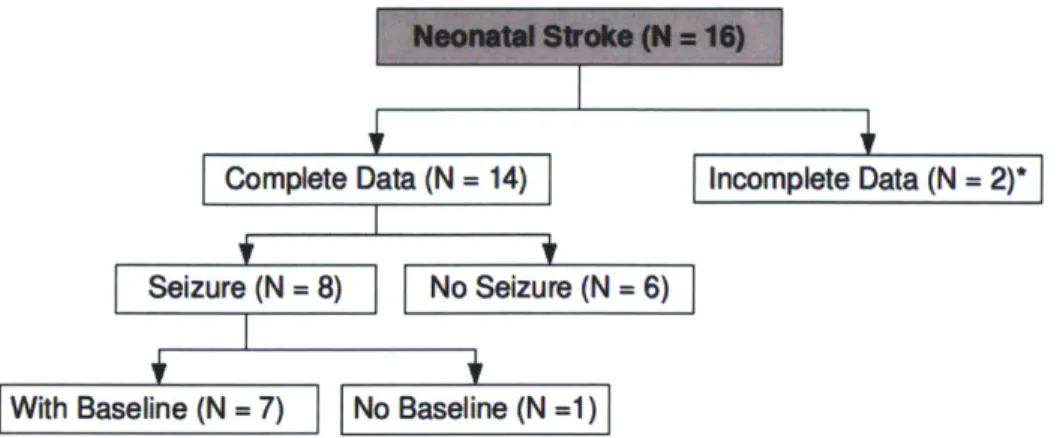
The initial seizure database was developed by members of the Fetal and Neonatal Neurology Research Group at Children's Hospital Boston (CHB). The stroke and HIE subjects in this database came from newborns who were admitted to the the neonatal intensive care unit (NICU) between 1999 and 2007, after presenting with clinical signs of brain injury or seizure activity post delivery. Institutional Review Board (IRB) permission was obtained at MIT to use the data records within this database. There were a total of 67 subjects in this database, 16 stroke subjects and 51 HIE subjects. Each subject had been given a 3-digit study ID by the CHB personnel, so only de-identified information was obtained at MIT.
3.3
Stroke Population
The neonatal stroke database contains data collected from 16 term babies at CHB. The diagnosis of stroke was confirmed using radiology reports by a pediatric neurologist. At the
Seizure (N =
8)
No Seizure (N =6)
With Baseline (N =7)
No Baseline (N =1)
Figure 3-1: Breakdown of neonatal stroke database. A total of 16 neonatal stroke subjects resulted in only seven neonates with seizures and usable baseline(s). The remaining subjects either had no seizure, lacked a usable baseline, or lacked properly formatted signal data (*no text file).
NICU, multi-signal EEG of varying duration (along with time-locked ECG) recordings were taken and saved in the form of raw proprietary binary files for each patient. Some of these
recordings also included respiration signals and EOG, and very few included time-locked
video. All signals were sampled at a 256 Hz sampling frequency. To achieve discernible
signals, the NICU nursing staff notch-filtered the signals at the point of data collection. The
raw binary data is viewable by proprietary software (Bio-Logic CEEGraph). A majority of these binary signals (EEG and ECG only) were converted to compatible text files by a
research technician using proprietary software at CHB. The availability of the EEG text
files allowed for the inclusion of the subject into this study. Out of a total of 16 original records, only 14 could be processed, as shown in Figure 3-1.
3.3.1
Significant Data Periods
In the process of viewing the raw binary data, a pediatric neurologist marked the onset and offset of cortical seizure. Sometimes, notable electro-cortical observations and sleep
patterns, such as traci alternant, were also noted on each record. The time-locked ECG
and EEG signals, where available, were stored as MATLAB files, while the ictal onset and offset times, electro-cortical observations, observable sleep patterns, medication, and
notable electro-cortical observations were stored as easily readable MATLAB text files.
The segments directly associated with the seizure are defined as the pre-ictal, ictal, and post-ictal periods. Below, we describe the major periods, including the seizure (ictal)
period, in more detail.
. .... ... ....
1. Ictal: duration during which seizure activity occurs. A pediatric neurologist
deter-mined the ictal period by visually inspecting the EEG traces using proprietary EEG visualization software. A given record could have multiple ictal periods. If periodic discharges lasted greater than 10 seconds, they were marked as a seizure. The start time, end time, and record number for seizure activity were recorded along with basic information about the EEG rhythm and background activity. This information was later stored in a MATLAB-compatible file.
2. Pre-ictal: period immediately preceding ictal activity. We defined the pre-ictal pe-riod as the pepe-riod in the record that immediately precedes the onset of the seizure. The seizure onset annotation was used as the fiducial marker. For this study we exam-ined 15- and 45-second pre-ictal periods. Longer pre-ictal durations were not possible for a majority of the records because often seizures occurred in close succession, with little break time in-between. Not all records had a pre-ictal time because seizures were already under way at the beginning of the record.
3. Post-ictal: period immediately following ictal activity. Similar to pre-ictal times, we
looked at 15- and 45-second post-ictal periods. For the same reason accounting for the occasional lack of extended pre-ictal activity, longer post-ictal times were not possible for all ictal episodes. Some seizures had no post-ictal periods because the recording ended before seizure activity stopped.
4. Baseline: duration of time with quiet and normal EEG and ECG activity. When available, each subject record had one baseline within a 24-hour period of seizure activity. Many records did not have adequate baseline activity. We considered baseline activity our control period against which the activity during the pre-ictal, ictal, and post-ictal periods were compared. If multiple baselines were available, like in record
159, the first baseline was used for all comparisons within the record.
During the development of this thesis, a significant effort was devoted to ensuring that the seizure annotations, along with the baseline locations, were performed carefully and consistently.
A representation of pre-ictal, ictal, post-ictal, and baseline is shown in Figure 3-2. To
Baseline Pre Ictal Post Baseline
Figure 3-2: Selection of pre-ictal, and ictal periods around seizure. Pre-ictal and post-ictal periods were either 15 or 45 seconds. Baseline, if available, could either fall before or after the ictal period. If multiple baselines were available, only the first baseline was used for comparisons.
our 15- or 45-second pre-ictal or post-ictal periods would not overlap with each other. This
guaranteed separation between our pre-ictal and post-ictal periods for consecutive seizures. Based on the results, the stroke babies were classified into subjects with seizures (N =
8) and subjects without seizures (N = 6), as shown in Figure 3-1. A total of 47 seizures
existed in the resultant eight stroke patients. Seven subjects with seizures contained baseline
activity. For seizing subjects, we defined the baseline as five minutes of normal or quiet
Stroke Data Summary
Stroke Data Seizure 28 --- Baseline-l
I Il
II
I II
|
I
I
I
I
1161I
105
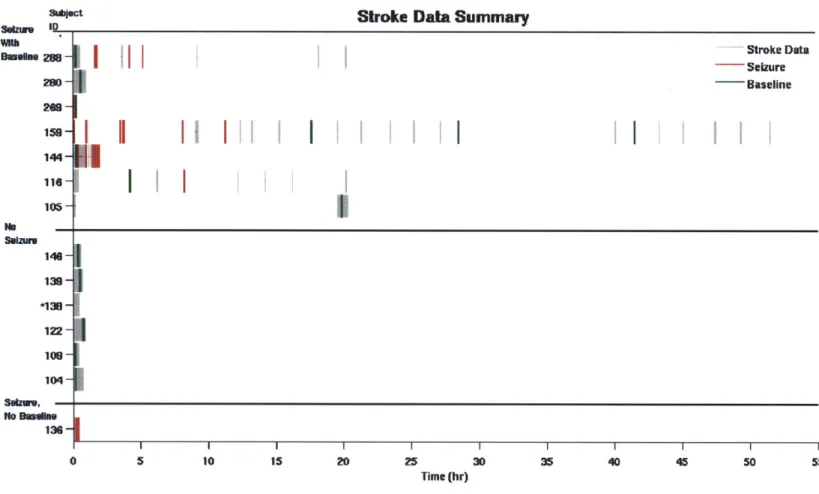
I I I 10 15 20 I I I I I 1 1 25 30 35 40 45 50 55 Time (hr)Figure 3-3: Stroke data overview shows disparity of record lengths and location of baseline across subjects. Time zero corresponds to the earliest time of available data recording for each subject. The lengths of the gray bars indicate durations of usable signal recordings; green and red annotations represent five minutes of baseline and seizure presence, respectively. (* Subject 138 did not have a usable baseline). 3*j"ct ID 3dzure
agng
Busies He N11z 146 139 *138 122 108 104 No Banukm 136 I a - - ''1',"-" 11 ----- ----sa ura' Bm 2 21 21 1' 1' Setire
Stroke
Data Summary - Close UpD
SStroke
Data ______________________________-Seizure
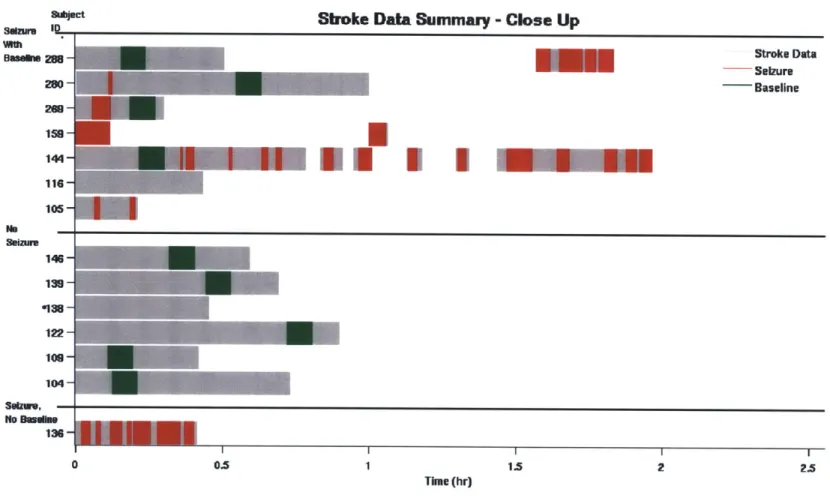
0- Baseline 59 44 16s 05f -e 122 104 3dZre, No Basells 136 Time (hr)Figure 3-4: Close up of stroke database reveals variability in seizure duration. Seizure frequency and inter-ictal times vary greatly across subjects. Ictal periods were defined as a minimum of 10 seconds of seizure activity to be included. There were 40 seizures with a baseline reference and 7 seizures without a baseline reference. The mean ictal duration was 131 t 94 seconds (min/max = 11/416)
An overview of the stroke data is shown in Figure 3-3. Time zero marks the earliest time of data recording for a given subject. Gray bar lengths indicate durations of usable signal recordings; green and red annotations indicate seizure presence and five minutes of baseline, respectively. Figure 3-4 displays a close up of the first 2.5 hours of data recording for each stroke patient. Seizure frequency, seizure duration, and inter-ictal times vary greatly across subjects. Ictal periods were defined as a minimum of 10 seconds of seizure activity to be included. The mean ictal duration for all subjects (no. of seizures = 47) was 131 ± 94 seconds (min/max = 11/416 seconds).
Table 3.1: Gender, GA, PNA of stroke subjects. There were a total of eight males and six females. Full Term (FT) indicates 37-40 weeks of GA, with specific values in parentheses when available. SB indicates seizure with baseline, S indicates seizure only, and N indicates no seizure.
Subject ID Gender GA (Weeks) PNA(Days-Hours) Available Data
105 M FT 4-4 SB 116 F FT 1-22 SB 144 M FT 1-17 SB 159 M FT(40) 2-10 SB 269 M FT 1-16 SB 280 F FT(40) 1-17 SB 288 F 41 0-14 SB 136 F 43 2-3 S 104 M FT 1-20 N 109 F FT 3-6 N 122 F FT(39) 3-23 N 138 M 41 5* N 139 M FT(39) 3* N 146 M 41 2-20 N
* Hours of PNA not available.
The gender, gestational age (GA), post-natal age (PNA), and other available data are listed in Table 3.1. All records were from fullterm babies (37-40 weeks of GA); however two of the records with seizure and two records without seizure exceeded a GA of 40 weeks (ID
288, 166, 138, 146). The physiological signal recording in the NICU started within a PNA
of 5 days.
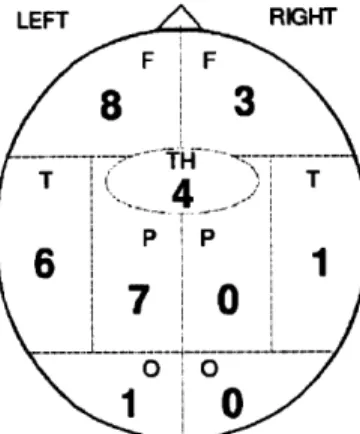
To diagnose stroke, magnetic resonance imaging (MRI) and magnetic resonance spec-troscopy (MRS) studies were evaluated by a pediatric neurologist, whose reports were read, interpreted, and coded in a standardized manner by a member of our study team. Two separate heuristics for assigning the injury location were used. Figure 3-5 shows the first
Figure 3-5: Cortical and thalamic stroke locations in 14 neonates. Values indicate the number of complete data subjects with infarct in either frontal (F), temporal (T), parietal (P), or occipital (0) lobes, and the thalamus (TH). Infarcts predominantly occur in the left hemisphere, notably due to blockage of the posterior cerebral artery.
portrait of assigning infarct location in the stroke subjects. Values in each brain region
indicate the number of complete data records with infarct in either frontal (F), temporal
(T), parietal (P), or occipital (0) lobes, and the thalamus (TH). Infarct locations were based on the imaging reports. They heavily occur in the left hemisphere, notably due to
blockage of the left posterior cerebral artery. This location is a common cause of stroke in newborns. The second type of classification method is described in the Chapter 4.
3.4
HIE Population
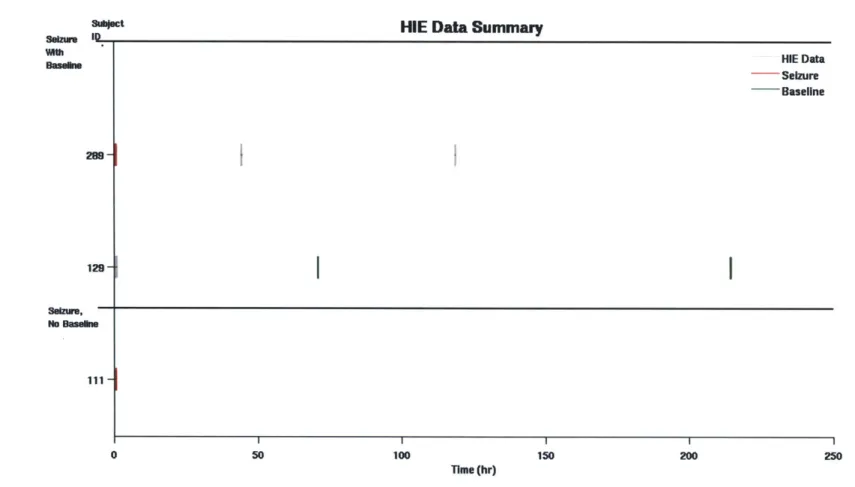
Similar to the presentation of the stroke data, an overview of the HIE data is shown in
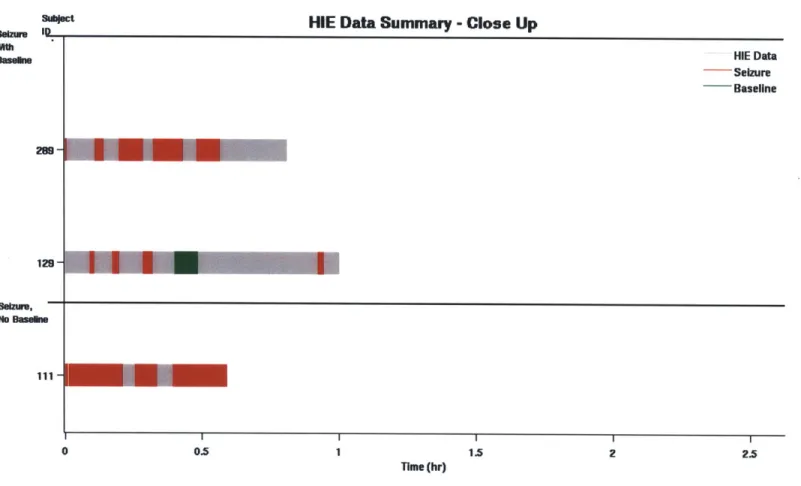
Figure 3-6. Figure 3-7 displays a close up of the first 2.5 hours of data recording for each HIE patient. As before, seizure frequency, seizure duration, and inter-ictal times vary greatly across subjects. Additionally, the time span between recordings is much greater in
the HIE patient population. For each subject, Table 3.2 lists the gender, GA, and other
available data. The mean ictal duration for our three HIE subjects (no. of seizures = 14) was 231 i 226 seconds (min/max = 11/699 seconds). Compared to the stroke population,
there was more variance in ictal durations from the HIE subjects. Chapter 4 presents the
SWUM
YMb
HIE Data Summary
s"*"* HIE Data Seizure Baseline 289]I
129 I
ill
-I
Time (hr)Figure 3-6: HIE data overview shows disparity of record lengths and location of baseline across subjects. All three HIE patients had seizures. Time zero corresponds to the earliest time of available data recording for each subject. The lengths of the gray bars indicate durations of usable signal recordings; green and red annotations represent five minutes of baseline and seizure presence, respectively.
ID
No Baseku
. I
yarn HIE Data - Seizure - Baseline
-1291
I7 No Basbwn 111 Time (hr)Figure 3-7: Close up of HIE database reveals variability in seizure duration. Subject 111 had 4 seizures with no baseline. The mean seizure duration for our three subjects with 14 seizures was 231 i 226 seconds (min/max = 11/699 seconds).
-- 7
3111480
Table 3.2: Gender, GA, PNA of HIE subjects. There were a 2 males and 1 female used in this thesis from the HIE population. Full Term (FT) indicates 37-40 weeks of GA, with specific values in parentheses when available. SB indicates seizure with baseline, S indicates seizure only. We did not examine any HIE subjects without seizure.
Subject ID Gender GA (Weeks) PNA(Days-Hours) Available Data
111 M FT(40) 0-20 SB
129 F 41 1-13 SB
Chapter 4
Association of Autonomic Activity
Changes during Seizure
This chapter presents methods to analyze the ECG and EEG data for the stroke and HIE
patients. The aim behind this work is to elucidate to what extent a coupling exists between seizure activity and autonomic activity. The latter is assessed indirectly by heart rate and
heart rate variability. A further aim of this chapter is to document the extent to which the location of the stroke injury correlates with the presence and strength of a
seizure-autonomic coupling. In Section 4.1, we briefly cover how the seizure-autonomic system modulates
HR and HRV, and then discuss the methods we chose for studying the heart rate changes during seizure activity. In Section 4.2, we present the HR and HRV results of the stroke
patients, and in Section 4.3, we present the HR and HRV results of our three HIE patients.
We conclude this chapter with a discussion of our methods in Section 4.4.
4.1
Quantifying Autonomic Activity
The autonomic nervous system (ANS) modulates, among other body functions, heart rate (HR). The dynamic balance between the sympathetic branch and the parasympathetic
branch of the ANS not only influences mean heart rate, but also influences the fluctuations
around the mean, and thus account for heart rate variability (HRV). In this section, we will briefly cover methods for extracting and quantifying HRV from the ECG. We will
then present the methods we used for studying heart rate changes during neonatal seizure activity.
4.1.1
Autonomic Influence on HR and HRV
The heart and the brain are connected via the autonomic system. The vagus nerve (a parasympathetic branch) and sympathetic nerves innervate the heart and modulate heart rate dynamically. An increase in sympathetic outflow increases HR, whereas an increase in parasympathetic outflow slows HR down. the dynamic interplay of the two branches of the ANS thus lead to variations in HR from one beat to the next. The sympathetic branch changes heart rate slowly, over the course of 10 to 20 seconds, while the parasympathetic branch can act very quickly (within a heart beat), but its effect is also highly ephemeral. Both branches converge on the brain stem where the center of autonomic control resides.
The question of whether seizure activity affects autonomic function therefore aims to address whether electro-cortical discharges, measured at the cerebral cortex, travel deep into the brain to affect neuronal events at the level of the brain stem. To study whether heart activity could be coupled with seizure activity, we aim to infer changes in autonomic activity from changes in HR and HRV.
Heart rate and HRV are measures that can be derived from an ECG tracing. Mean HR is readily obtained by averaging the instantaneous HR signal over appropriately sized windows. Many methods exist to quantify HRV They are either based on analyzing the HR time series (time-domain methods) or are based on spectral methods (frequency-domain methods). Examples of time-domain methods include the standard deviation of HR or the PNNX value, which measures the fraction of beats whose RR intervals differ by more than X milliseconds from the previous RR interval. Of the frequency-domain methods, calculation of the high frequency (HF) and low frequency (LF) components of HRV are well established [21]. In the adult, the HF component encompasses frequencies in the range of 0.15 to 0.4 Hz, and the LF component ranges from 0.04 to 0.15 Hz. Recordings of at least five minutes in duration are usually required to resolve these frequency components adequately. The established frequency ranges, somewhat arbitrary in nature, generalize autonomic system behavior for all patients. No meaningful HF and LF ranges have been established for a neonate, whose autonomic system is still under development. Newborns have a parasympathetic system (vagal system) that matures more slowly than the sympathetic system. This lack of maturity accounts for an infant's increased HR immediately after birth and general lack of pronounced HRV.
As mentioned in Section 2.2.1, HR and HRV have been associated with seizure activity, suggesting that there may be autonomic dysregulation associated with seizure activity. However, the clinical and scientific understanding of the link between autonomic control
and seizure activity is poorly understood.
4.1.2
Measures of HR and HRV
To measure HRV changes between ictal, pre-ictal, post-ictal, and baseline periods, we com-puted differences in mean HR and PNN1O. PNN1O, a measure of short-acting autonomic
response, gives the percentage of differences > 10 ms between adjacent RR intervals. Mean
HR changes represent overall sympathetic/parasympathetic balance while PNN10 measures
parasympathetic activity. We chose not to use spectral analysis on RR intervals as a mea-sure of HRV because our seizure durations were not long enough to obtain meaningful or
sensible results. Furthermore, it would be unclear what frequency ranges would be best to analyze the spectrum.
4.1.3
Comparing HR and HRV Between Major Time Segments
For each record, a peak-detection algorithm was applied to the ECG signal to determine
the location of each individual QRS complex. The algorithm we used is based on the curve length of the ECG and has previously been validated against standard ECG databases [22].
From the location of the QRS complexes, we computed the instantaneous HR and RR time
series. This information formed the basis for the HR and HRV analysis described below. To assess whether HR significantly changes during neonatal seizure, we compared the mean HR, HR, and PNN10 in the four major segments, when available, associated with a
given seizure (these segments were previously described in Section 3.3.1). Specifically, the
following combinations of HR differences were computed:
A HRi,b = HRi - HRb (4.1)
AHRi,pre = HRi - HRpre (4.2)
AHRi,pst = H Ri - H Rst (4.3)
AHRb,pst = HRb - HRpst (4.5)
A HRpre,pst = HRpre - HRpst (4.6)
where i signifies ictal, b stands for baseline, and pre and pst relate to the pre-ictal and post-ictal periods, respectively. The same methodology was used to determine differences in PNN10. In general, the averaging intervals were not equal. While the pre-ictal and post-ictal periods only allowed for averaging across 15 and 45 seconds of data (depending on what window size had been selected), averaging over the baseline period extended over the entire 5-minute period. Finally, averaging extended over the entire seizure period for the ictal segment.
4.2
Results in Stroke Patients
Based on the methods described in Section 4.1.3, we first studied the HR and HRV changes in the stroke population. Based on these results, we mapped strong and weak HR and HRV responders to their location of injury, as described in Figure 4.2.2.
4.2.1
HR and HRV results
We now present the result of the HR and PNN1O comparisons for the major data segments in the 47 seizure episodes from our stroke population. Table 4.1 shows the seizure index number corresponding to our eight stroke subjects. As is evident from the table, some subjects had more seizures than other subjects.
Table 4.1: Subject ID mapped to seizure number. The seizure numbers denote the seizure index for comparing HR and HRV changes in Figures 4-2 and 4-3.
Subject ID 105 116 136 144 159 269 280 288
Pro - BaseNne SpstpmtUM:15sN-32 0 pe&pst me:45SN-19 -25 5 1 15 25 25 3 M e 45 ask" Ictal- Baseline. N -3 3 --10 5 10 15 2 25 3 35 40 45 Post - Baseline pre &pat tm:15 s N-34 - ' -- p& pst im: 45 s -23 40--2 S i 1 2 2 Is E3. U 45 45 5 10 15 20 25 30 35 4 45 MM * Ietal - Post 5 10 15 20 25 30 35 45 45 PMine s Pre -Post 5 18 15 28 25 3 35 4 45 salms *
Figure 4-1: A total of 47 seizures from 8 stroke subjects were available to study. Out of those, only 40 seizures Clusters of similar trends are generally from similar subjects.
had baseline (N = 7).
U-j
45-=I
letal - PrePro -BaseNne
29
-2--ue - -+Iue pst#ne:1ss N-34
- P & pat m :a 8 N-23 5 19 15 29 25 33 35 45 45 etat- Base1e, N - 39
1l1tl1ll1ll
5 10 15 20 29 ske Post - Bumeline 30 35 a a a. 40 5; lctal -Pre 5 10 1 20 25 30 35 4 45 Ictal -Post - pst bW:145 s N-S 4pst ine: 45:1N-29I
...
I
a- 11il -- t"1 5 10 1 20 25 30 as 4 4 Pre - Post 4 -pre&pStaiM:15SN-3421 -
--
+
pMe
&
pst
One:
a
S
N-2
4
-5 10 1S 21 25
.... e,
i~
33 33 4 45
Figure 4-2: Changes in PNN10 show same subject trends. Clusters of similar trends are generally from the same patient.
40-i 1s 15 29 29 33 35 a 4
The results of our HR and HRV comparisons are shown in Figure 4-1 and Figure 4-2, respectively. In comparing mean heart rate changes across all seizure episodes, we observe that HRi,b increases. We observe a similar trend for HRpre,b and HRpst,b, indicating that
the HR during the baseline period tends to be different from the HR before, during, and
following a seizure episode. The response of HRi,pre and HRi,pst are variable across seizures. However, it seems that the length of the pre-ictal and post-ictal periods have little effect
on the qualitative behavior of the results, as the green (15 sec) and red (45 sec) stems seem
to move in the same direction in those seizure episodes in which both analyses could be
done. This result might mean that autonomic changes may manifest themselves well before, and might persist well beyond, the duration of a seizure, as judged by visual inspection of electro-cortical potentials. Stroke (D 136.001) ECG TB-P8 F8-T8 C4-P4 F4-C4 Fg2-F4 Fz-Cz P3-01 C5-P3 iill'111O 40 F3-C3ajo' F 1_ cs-P7 F7-IWIf 0 Fp1-F7 10 20 30 40 50 60 70 80 90 100 150-** e r 4% ON 100 I I I I 10 20 30 40 50 60 70 80 90 100 Tim. (0)
Figure 4-3: Example of stroke neonate with seizure following increase in HR. We show the
EEG bipolar montage and the ECG (top) signals depicting strong seizure activity in the
central brain (Cz-Pz, Fz-Cz) starting around t = 70 see. Prior to seizure, there is a rise in
mean HR and a pronounced loss in beat-to-beat HRV.
As an impressive example of early autonomic changes, Figure 4-3 reproduces Figure 2-1 which shows significant changes in mean heart rate and HRV, starting about 30 seconds
prior to the onset of electro-cortical seizure activity. The aggregate changes in mean heart
rate mask strong individual responses, as is evident from Figure 4-2. For example, seizure episodes 13-26 (Patient 144), 27-35 (Patient 159) and 38-47 (Patient 288) dominate the
---overall HRi,b response in the positive (Patients 159 and 288) and the negative (Patient 144)
direction.
For changes in PNN10 value, we see either a minimal change or a great change in PNN10 changes from ictal to baseline, indicating that some subjects have a decrease in HRV during
the ictal period. When we look more closely, we see that clusters of seizures have similar trends. This suggests that within patients, we see similar HR and HRV responses. To make
an aggregate conclusion, however, a larger sample size of patients and seizures is needed.
4.2.2
Mapping Strong and Weak Responders to Stroke Injury Location
We were interested in seeing whether location of brain injury is associated with particular
seizure or HR dynamics. To do so, we extracted the location of brain injury from the MRI and MR spectroscopy reports. To visualize infarct locations, we mapped injury location
to a standard image of the brain, shown in Figure 4-4. Table 4.2 lists what each of the
numbers represent in our brain image.
Figure 4-4: Injury location grading scheme for stroke and HIE subjects. Available MRI, spectroscopy, and USG (ultrasonography) results were used to determine infarct locations.
We classified our stroke subjects into strong and weak responders based on whether their heart rate changes were strong and similar-trended around ictal episodes. These are indicated by the red stars near each subject's respective brain injury map. We did not
Table
observe any significant trend. More subjects are needed to study a potential connection between injury location and HR-seizure dynamics.
Seizure No Seizure
105 116 * 136 104 109 122
144 1591* 1
Figure 4-5: Injury location in stroke database. Red star indicates strong responders.
4.3
Results in HIE Patients
We performed the same HR and HRV comparisons on the HIE patients as we did for the stroke patients. We had three HIE subjects to study. In addition to performing the HR
and HRV analysis, we also mapped their injury locations.
4.3.1
HR and HRV Results
We now present the result of the HR and PNN10 comparisons for the major data segments in the 14 seizure episodes from our HIE population. Table 4.3 shows the seizure index number corresponding to our eight stroke subjects. As is evident from the table, each of our three HIE patients had at least 4 seizures.
Table 4.3: HIE subject ID mapped to seizure number. The seizure numbers denote the seizure index for comparing HR and HRV changes in Figures 4-5 and 4-6.
Subject ID 111 129 289
Pre -Baseine pr & pst #w: 15 s N-3 prm & pst n: 45 s N-S 15 15 -2 4 0 10 12 14 Bsein.re N letul- Baselne. N- 10 feti -Pr pl-ow:15 s N-1I pr im: 45s N-11
e
8.1T
r
2 4 6 U 1 12 14 Suing. P Ietal -Post a 10 12 14 Post - Baseline :pm&psttbus:45sN-1S1111
2 4 6 S bin.. # pstlbu.:15sN.12 Opstusn: 45 sN-12;
t 0 2 4 6 S 1S 12 14 Sein,. 4 Pr - Post 18-pre&pt:1SSN-19
5 - M & th"ne 45 8 N-111I
I
10 12 14i
*
6±
t ~
-15 , II- -2 4 6 a 1 12 14 UdaIfue #Figure 4-6: HIE HR results
40-Is
a-I
is-Pro -Baseline
pre &pstimm:15sN- U
-- pro & pst time: 45 11
2 4
11 I III
6 S 1 12 14 sbee lctal- Basemln. N - 10 n-I f. 2 4 6 S 10 Post - Baseline pre&psttns:1 ssN-S - pm & pst S: 45 a N-111111I1I
U-E E-16- -15-12 14I
1
6 U 1 12 14 Ictl -Post Spst Wmu:l15sNO-12 -~t~rj::~!1! 2 4 6 a 10 12 14 Pre - Post 10 p & Pat m:15s N-10 -- e pm&pstn:15s N-J10 2 4 6 a asmbr 10 12 14Figure 4-7: HIE PNN10 results.
a--3. - -16-I-ze -S-38 - -16-E -30 -EU -0 2 4 6 3 10 12 14 asime i . . letal - Pro
. I
We show the results for the 14 seizure episodes from 3 HIE patients in Figure 4-6 and
Figure 4-7. In these three patients, we also observe strong patient-specific HR and HRV
trends. Patients 129 and 289 both have baseline periods with lower HR and higher HRV
(PNN10) suggested by the upward and downward trends, respectively. There seem to be
strong directional changes in HRi,pre, HRi,pst, HRpre,pst, especially in Patient 289.
Particu-larly, the results for Patient 289 suggest that HR increases between the onset and offset of
ictal periods. With respect to PNN10, Patient 129 has conflicting but strong results when
comparing HRi,pre and HRpre,pst, suggesting that the seizure's effect on parasympathetic activity could continue past the seizures end.
Seizure
129* 289
Figure 4-8: Strong and weak HIE responders.
As we presented for the stroke subjects, Figure 4-8 shows the location of injury in our
HIE subjects. As expected by the different nature of injury, the HIE patients have more
global damage than the stroke subjects.
4.4
Discussion
Overall, we did observe trends in HR and HRV on a patient-by-patient basis, particularly in the strong responders. Our HR comparisons against baseline showed the strongest trends.
Amongst the stroke patients, all records, except that of Patient 136, had one baseline
available. However, the record of stroke Patient 159 had many continuous recordings with
no seizure activity. We went back to the record to acquire additional quiet periods without seizure to make a total of five baselines. We were interested to see whether the choice of
baseline could skew our HR and HRV results. Accordingly, we compared the five baselines
of Patient 136.
Figure 4-9 shows our results for our five baseline comparisons. Immediately, we observe that there are some significant HR fluctuations in two of our baseline choice. Upon
examin-ing the ECG traces durexamin-ing those periods, we found some noise in the signal that accounted
Record 150 BaselIne Variation: N -S. Mean -123 ± 5 401 1-2W0 200 - I-10U so IN IN " Z31 a 8818 183 288 28038 11e (a)
Record 158 Baselne Variation: N -3. Mean - 135 4
2e
-1e
-0 50 1N 1SO 2W 250 3N
11e (a)
Figure 4-9: Baseline selection shows HR variation. Subject 159 was used to study baseline variations. The HR trends of five baselines (top) show significant heart rate fluctuations (128 ± 5 bpm). Two baselines with intermittent noise in the EKG resulted in high fluctuation HR. These baselines were removed (below), and resulted in a mean HR of 135 ± 4 bpm. Significant differences exist suggesting limitations in baseline selection.
for mis-detections. Since our definition is based on clean EEG and ECG activity, these
baselines would have been ruled out as baseline candidates. However, even after taking these baselines out, there was still variability in our traces, with a mean HR of 135 ± 4
bpm (N = 3). Many of the baseline HR comparisons against pre-ictal, ictal, or post-ictal
periods were less than 5 beats. As such, the variability in baselines does suggest that there exists a limitation in our HR and HRV comparisons against baseline periods.
Another limitation of this study was the number of stroke and HIE patients available;
without a greater sample size, we cannot make definite conclusions. Based on our initial database acquired by CHB, we used all the stroke subjects available for this study. However, we do have the potential to add more HIE patients to this study in the future.
Lastly, these aggregate comparisons in HR and HRV may not be the optimal method to
study whether seizure activity influences HR or HRV. Our observation of strong responders suggests that it may be more interesting to study patients on a case-by-case basis to observe
whether we can relate specific EEG phenomenon to HR and HRV phenomenon.
stimulator. It has only been recently discovered that the vagal nerve has an afferent pathway towards the brain. This gives us encouragement that there could be vagal or sympathetic
control mechanisms in seizure activity and possibly brain injury. It is possible that this control mechanism is hindered in neonates with seizures.
Chapter 5
Tracking Cortical Seizure
In order to study whether seizure power, location, or dispersion can modulate HR, we developed a simple method to track seizure activity across the brain. In Section 5.1, we will discuss a spectrographic method for tracking seizure movement across the cortex. In section 5.2, we will demonstrate this method by presenting an interesting case study of HIE Patient 289.
5.1
Power Spectral Density Methods for Seizure Tracking
Simple frequency domain methods were used to track seizure activity in neonatal EEG. We first used a power spectral density (PSD) spectrogram on a lead-by-lead basis to determine which bipolar leads showed seizure activity and which did not. To make this determination, we applied a power threshold. This method was used to explore whether signal power, frequency shifts, or seizure movement across the cortex could relate to HR activity.
On a lead-by-lead basis, a PSD spectrogram was computed to visualize periods of high-power seizure frequency. Recall that our signals were sampled at a 256 Hz. For a given EEG bipolar lead signal, a 10-second PSD (N = 1024 samples) moving window, with an FFT window of 1024 samples and 50 % overlap, was implemented. The window was moved at 1-second intervals, and the MATLAB pwelch command was used to compute the PSD. To detect seizure frequency, we were interested in a general frequency range between 0.25 and 12 Hz for the bipolar configuration. This frequency range falls within the general frequency range for neonates.
combi-nations, out of possible 18 , were showing seizure activity and which were not. The threshold was variable for each seizure record. A variable power-threshold was needed due to various
noise levels on all EEG data recordings. Within each continuous record, the same threshold
was used for all leads across the seizure frequency range, which we defined to be 0.25-12 Hz.
Using this approach, we were able to keep track of how many leads showed seizure activity at any given time.
The bipolar lead configurations were mapped to either the left, central, or right side
of the brain. We were able to track whether the left, central, or right side of the brain
was seizing, and we were able to compare this to the seizure annotations documented by
a neurologist. This method provided us with a simple way to see whether general seizure propagation (dispersion) was associated with HR changes.
5.2
Interesting Case Study of HIE
As a demonstration of our methods presented in Section 5.1, we will examine an inter-esting case study of a seizure found in Patient 289. Figure 5-1 demonstrates a gradual
and significant increase in HR during the course of the seizure, which is indicated by the
red portions of the EEG. Electrographically, we can make several interesting observations. Firstly, we notice there are frequency and power changes that occur throughout the course
of the seizure. Specifically, the increase in HR occurs around time 470 seconds, when there
is a global increase in burst frequency and power. Towards the waning of the seizure, the burst frequency reduces.
EEG ID 289-002
Fz-Cz-
2 I t - A%- .. - - ---P4-02
-WI#W4--RC4
F p F - - -- --- - --- - -v-Cz-Pz
---P3-Oh-C3P3 - "rn'M*4 00lmu~m~ft~~w~-2wt~mbf~fftttArbn? 4r 1i'~A is Li, U'*
F--y
-F7-T7-JUj A -I4
Fp1-F7
470 480 490 500 510 520 530 540 550 56C
*oso noe i eno *
... * noeooo**nf---- 000**on E 130 -** * . 00a00 * 125 * * amW o*e * Z aem **,oo*e~~** **
120-
*
,
470 480 490 510Time (s)
520 530 540 550 560Figure 5-1: HR increase during HIE seizure (red) in Patient 289. There is a significant and gradual increase thre the duration of the seizure. Electrographically, we also observe frequency changes throughout the seizure. The strongest focus of the seizure is in left hemisphere: T7-P7.