arXiv:nucl-ex/0406005v3 4 Oct 2004
M. Amarian24 , L. Auerbach20 , T. Averett6,23, J. Berthot4 , P. Bertin4 , W. Bertozzi11 , T. Black11 , E. Brash16 , D. Brown10 , E. Burtin18 , J. Calarco13 , G. Cates15,22, Z. Chai11 , J. -P. Chen6 , Seonho Choi20 , E. Chudakov6 , E. Cisbani5 , C. W. de Jager6 , A. Deur4,6,22, R. DiSalvo4 , S. Dieterich17 , P. Djawotho23 , J. M. Finn23 , K. Fissum11 , H. Fonvieille4 , S. Frullani5 , H. Gao11 , J. Gao1 , F. Garibaldi5 , A. Gasparian3 , S. Gilad11 , R. Gilman6,17, A. Glamazdin9 , C. Glashausser17 , E. Goldberg1 , J. Gomez6 , V. Gorbenko9 , J. -O. Hansen6 , B. Hersman13 , R. Holmes19 , G. M. Huber16 , E. Hughes1 , B. Humensky15 , S. Incerti20 , M. Iodice5 , S. Jensen1 , X. Jiang17 , C. Jones1 , G. Jones8 , M. Jones23 , C. Jutier4,14, A. Ketikyan24 , I. Kominis15 , W. Korsch8 , K. Kramer23 , K. Kumar12,15, G. Kumbartzki17 , M. Kuss6 , E. Lakuriqi20 , G. Laveissiere4 , J. Lerose6 , M. Liang6 , N. Liyanage6,11, G. Lolos16 , S. Malov17 , J. Marroncle18 , K. McCormick14 , R. Mckeown1 , Z. -E. Meziani20 , R. Michaels6 , J. Mitchell6 , Z. Papandreou16 , T. Pavlin1 , G. G. Petratos7 , D. Pripstein1 , D. Prout7 , R. Ransome17 , Y. Roblin4 , D. Rowntree11 , M. Rvachev11 , F. Sabatie14 , A. Saha6 , K. Slifer20 , P. Souder19 , T. Saito21 , S. Strauch17 , R. Suleiman7 , K. Takahashi21 , S. Teijiro21 , L. Todor14 , H. Tsubota21 , H. Ueno21 , G. Urciuoli5, R. Van der Meer6,16, P. Vernin18 , H. Voskanian24 , B. Wojtsekhowski6 , F. Xiong11 , W. Xu11 , J. -C. Yang2 , B. Zhang11 , P. A. ˙Zo lnierczuk8 (Jefferson Lab E94010 Collaboration)
1
California Institute of Technology, Pasadena, California 91125
2
Chungnam National University, Taejon 305-764, Korea
3
Hampton University, Hampton, Virginia 23668
4
LPC IN2P3/CNRS, Universit´e Blaise Pascal, F–63170 Aubi`ere Cedex, France
5
Istituto Nazionale di Fiscica Nucleare, Sezione Sanit`a, 00161 Roma, Italy
6
Thomas Jefferson National Accelerator Facility, Newport News, Virginia 23606
7
Kent State University, Kent, Ohio 44242
8
University of Kentucky, Lexington, Kentucky 40506
9
Kharkov Institute of Physics and Technology, Kharkov 310108, Ukraine
10
University of Maryland, College Park, Maryland 20742
11
Massachusetts Institute of Technology, Cambridge, Massachusetts 02139
12
University of Massachusetts-Amherst, Amherst, Massachusetts 01003
13
University of New Hampshire, Durham, New Hampshire 03824
14
Old Dominion University, Norfolk, Virginia 23529
15
Princeton University, Princeton, New Jersey 08544
16
University of Regina, Regina, SK S4S 0A2, Canada
17
Rutgers, The State University of New Jersey, Piscataway, New Jersey 08855
18
CEA Saclay, DAPNIA/SPHN, F–91191 Gif/Yvette, France
19
Syracuse University, Syracuse, New York 13244
20
Temple University, Philadelphia, Pennsylvania 19122
21
Tohoku University, Sendai 980, Japan
22
University of Virginia, Charlottesville, Virginia 22904
23
The College of William and Mary, Williamsburg, Virginia 23187
24
Yerevan Physics Institute, Yerevan 375036, Armenia (Dated: June 15, 2018)
The generalized forward spin polarizabilities γ0 and δLT of the neutron have been extracted for
the first time in a Q2
range from 0.1 to 0.9 GeV2
. Since γ0 is sensitive to nucleon resonances and
δLT is insensitive to the ∆ resonance, it is expected that the pair of forward spin polarizabilities
should provide benchmark tests of the current understanding of the chiral dynamics of QCD. The
new results on δLT show significant disagreement with Chiral Perturbation Theory calculations,
while the data for γ0at low Q
2
are in good agreement with a next-to-lead order Relativistic Baryon Chiral Perturbation theory calculation. The data show good agreement with the phenomenological MAID model.
PACS numbers: 25.30.-c,11.55.Hx,11.55.Fv,12.38.Qk
The study of nucleon structure is one of the most im-portant subjects of modern physics. The dominant in-teraction responsible for nucleon structure is the strong interaction. High energy experiments have established Quantum Chromodynamics (QCD) as the gauge theory
describing the strong interaction between quarks and glu-ons, which are the elementary constituents of the nu-cleon. At high energies, observables in QCD can be calcu-lated perturbatively since the running coupling constant is small. However, at low energies, the coupling
con-stant becomes increasingly large and quarks and gluons are confined to color singlet objects known as hadrons. There, nucleon structure is usually described in terms of hadronic degrees of freedom, namely baryons and mesons. Chiral Perturbation Theory (χPT) is applica-ble in this region. The intermediate energy region is de-scribed by phenomenological models and will eventually be described by Lattice QCD calculations.
The polarizabilities of the nucleon are fundamental observables that characterize nucleon structure. They are related to integrals of the nucleon excitation spec-trum. The electric and magnetic polarizabilities mea-sure the nucleon’s response to an external electromag-netic field. Because the polarizabilities can be linked to the forward Compton scattering amplitudes, real pho-ton Comppho-ton scattering experiments [1] were performed to measure these polarizabilities. Another polarizabil-ity, associated with a spin-flip, is the forward spin po-larizability γ0. It has been measured in an experiment at MAMI (Mainz) [2] with a circularly polarized photon beam on a longitudinally polarized proton target. The extension of these quantities to the case of virtual photon Compton scattering with finite four-momentum-squared, Q2
, leads to the concept of the generalized polarizabili-ties [3]. Generalized polarizabilipolarizabili-ties are related to the for-ward virtual Compton scattering (VCS) amplitudes and the forward doubly-virtual Compton scattering (VVCS) amplitudes [4]. With this additional dependence on Q2
, the generalized polarizabilities provide a powerful tool to probe the nucleon structure covering the whole range from the partonic to the hadronic region. In particular, the generalized polarizabilities provide one of the most extensive tests of χPT calculations in the low Q2
re-gion [4, 5]. However, up to now, other than the real photon measurement of γ0 for the proton from MAMI, there are no experimental data available for the gener-alized spin polarizabilities for either the proton or the neutron.
In this paper, we present the first results for the neu-tron generalized forward spin polarizabilities γ0(Q2
) and δLT(Q2
) over the Q2
range from 0.1 to 0.9 (GeV)2 . These results were extracted from a measurement of σT T and σLT, the doubly polarized transverse-transverse and longitudinal-transverse interference cross sections, or equivalently g1 and g2, the two inclusive spin structure functions, in the resonance region. Jefferson Lab’s high intensity polarized electron beam and a high density po-larized 3
He target were used for the measurement. The polarized3
He target provided an effective polarized neu-tron target because the ground state of3
He is dominated by the s state, in which the spins of the two protons anti-align and cancel. Therefore the spin of the 3
He nucleus comes largely from the neutron. Doubly polarized inclu-sive cross sections were measured at six incident beam energies from 0.86 to 5.1 GeV, all at a fixed scattering angle of 15.5◦
. Data were collected for both longitudinal
and transverse target polarization orientations, enabling the extractions of both σT T and σLT. The integrals of σT T and σLT of the neutron were extracted from those of the 3
He following the prescription suggested by Ciofi degli Atti and Scopetta in Ref. [6] to take into account the nuclear corrections. Details of the experiment can be found in Refs. [7, 8].
Following Ref. [4], an unsubtracted dispersion relation for the spin-flip VVCS amplitude gT T with an appropri-ate convergence behavior at high-energy leads to
Re ˜gT T(ν, Q2) = ( ν 2π2)P Z ∞ ν0 K(ν′ , Q2 )σT T(ν′ , Q2 ) ν′2−ν2 dν ′ , (1) where ˜gT T ≡gT T−gpoleT T , g pole
T T is the nucleon pole contri-bution, ν is the energy of the virtual photon and K is the virtual photon flux factor. The lower limit of the inte-gration ν0 is the π production threshold on the neutron. A low energy expansion gives:
Re ˜gT T(ν, Q2) = (2α M2)IA(Q 2 )ν +γ0(Q 2 )ν3+O(ν5), (2) with α the electromagnetic fine-structure constant and M the neutron mass. IA(Q2
) is the coefficient of the O(ν) term of the Compton amplitude. Equation (2) de-fines the generalized forward spin polarizability γ0(Q2). Combining Eqs. (1) and (2), the O(ν) term yields a sum rule for the generalized Gerasimov-Drell-Hearn (GDH) integral [9, 10, 11]: the integration of σT T, with 1/ν weighting, is proportional to IA, the coefficient of the O(ν) term of the VVCS amplitude. From the O(ν3
) term, one obtains a sum rule for the generalized forward spin polarizability [4]: γ0(Q2 ) = ( 1 2π2) Z ∞ ν0 K(ν, Q2 ) ν σT T(ν, Q2 ) ν3 dν (3) = 16αM 2 Q6 Z x0 0 x2h g1(x, Q 2 ) −4M 2 Q2 x 2 g2(x, Q 2 )idx, where x = Q2
/(2M ν) is the Bjorken scaling variable. Considering the longitudinal-transverse interference amplitude gLT, with the same assumptions, one obtains:
Re ˜gLT(ν, Q2 ) = (2α M2)QI3(Q 2 ) + QδLT(Q2 )ν2 + O(ν4 ) (4) where the O(1) term leads to a sum rule for I3(Q2
), which relates it to the σLT integral over the excita-tion spectrum. The O(ν2
) term leads to the generalized longitudinal-transverse polarizability [4]: δLT(Q2 ) = ( 1 2π2) Z ∞ ν0 K(ν, Q2 ) ν σLT(ν, Q2 ) Qν2 dν (5) = 16αM 2 Q6 Z x0 0 x2hg1(x, Q 2 ) + g2(x, Q 2 )idx.
The basic assumptions leading to the dispersion rela-tions between the forward Compton amplitudes and the generalized spin polarizabilities are the same as those leading to the generalized GDH sum rule. However, since the generalized polarizabilities have an extra 1/ν2 weighting compared to the GDH sum or I3, these inte-grals converge much faster, which minimizes the issue of extrapolation to the unmeasured region at large ν. For the kinematics of this experiment, the contributions to the generalized polarizabilities from the unmeasured re-gion are negligible.
At low Q2
, the generalized polarizabilities have been evaluated with χPT calculations [12, 13]. One issue in the χPT calculations is how to properly include the nucleon resonance contributions, especially the ∆ reso-nance, which is usually dominating. As was pointed out in Ref. [12, 13], while γ0is sensitive to resonances, δLT is insensitive to the ∆ resonance. Measurements of the gen-eralized spin polarizabilities will be an important step in understanding the dynamics of QCD in the Chiral Per-turbation region.
We will first focus on the low Q2
region where the com-parison with χPT calculations is meaningful, and then show the complete data set from Q2
of 0.1 GeV2 to 0.9 GeV2
.
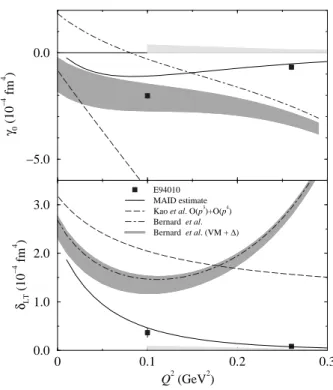
The results of γ0(Q2
) for the neutron are shown in the top panel of Fig. 1 as a function of Q2
for the two lowest Q2
values of 0.10 GeV2
and 0.26 GeV2 . The statistical uncertainties are generally smaller than the size of the symbols. The systematic uncertainties are dominated by the uncertainties in the radiative correc-tions, the spectrometer acceptance and the beam and target polarization measurements. The data are com-pared with a next-to-leading order, O(p4
), Heavy Baryon χPT (HBχPT) calculation [12], a next-to-leading-order Relativistic Baryon χPT (RBχPT) calculation [13], and the same calculation explicitly including both the ∆ reso-nance and vector meson contributions. Predictions from the MAID model [14] are also shown. At the lowest Q2 point of 0.1 GeV2
the RBχPT calculation including the resonance contributions is in good agreement with the ex-perimental result. For the HBχPT calculation without explicit resonance contributions, discrepancies are large even at Q2
= 0.1 GeV2
. This might indicate the signif-icance of the resonance contributions or a problem with the heavy baryon approximation at this Q2
. The higher Q2
data point is in good agreement with the MAID pre-diction, but the lowest data point at Q2
= 0.1 GeV2 is significantly lower, consistent with what was observed for the generalized GDH integral results [7] and the under-estimation from MAID for the neutron GDH sum rule at the real photon point [14].
Since the longitudinal-transverse spin polarizability δLT is insensitive to the dominating ∆ resonance con-tribution, it was believed that δLT should be more suit-able than γ0 to serve as a testing ground for the chiral
0 0.1 0.2 0.3 Q2 (GeV2) 0.0 1.0 2.0 3.0 δLT (10 −4 fm 4 ) E94010 MAID estimate Kao et al. O(p3
)+O(p4 ) Bernard et al. Bernard et al. (VM + ∆) −5.0 0.0 γ0 (10 −4 fm 4 )
FIG. 1: Forward spin polarizabilities γ0 (top panel) and δLT
(bottom panel). Solid squares are the results with statistical uncertainties. The light bands are the systematic uncertain-ties. The dashed curves are the Heavy Baryon χPT calcula-tion from Ref. [12]. The dot-dashed curves and the dark bands are the Relativistic Baryon χPT calculation from Ref. [13], without and with the ∆ and vector meson contributions, re-sepctively. Solid curves are from the MAID model [14].
dynamics of QCD [12, 13]. The bottom panel of Fig. 1 shows δLT for the neutron compared to χPT calculations and the MAID predictions. It is surprising to see that the data are in significant disagreement with the χPT calculations even at the lowest Q2
, 0.1 GeV2
. This dis-agreement presents a significant challenge to the present theoretical understanding. The MAID predictions are in good agreement with our results.
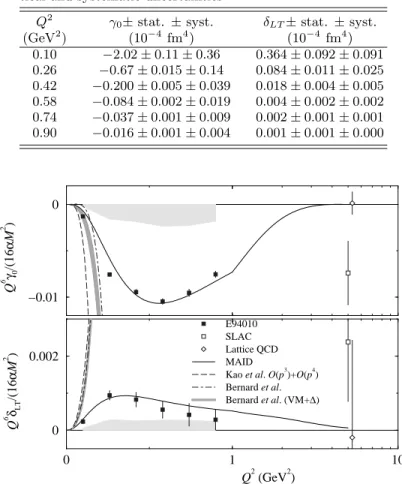
Table 1 lists the experimental results for all Q2 values. Figure 2 shows the results of both γ0 and δLT multiplied by Q6
along with the MAID and χPT calculations. Also shown are the world data [15] and a quenched Lattice QCD calculation [16], both at Q2
= 5 GeV2 . It is expected that at large Q2
, the Q6
-weighted spin polarizabilities become independent of Q2
(scaling) [4], and the deep-inelastic-scattering (DIS) Wandzura-Wilczek relation [17] leads to a relation between γ0 and δLT: δLT(Q2 ) → 1 3γ0(Q 2 ) as Q2 → ∞. (6)
mo-TABLE I: Results for γ0(Q 2
) and δLT(Q
2
), along with statis-tical and systematic uncertainties
Q2
γ0±stat. ± syst. δLT±stat. ± syst.
(GeV2 ) (10−4 fm4) (10−4 fm4) 0.10 −2.02 ± 0.11 ± 0.36 0.364 ± 0.092 ± 0.091 0.26 −0.67 ± 0.015 ± 0.14 0.084 ± 0.011 ± 0.025 0.42 −0.200 ± 0.005 ± 0.039 0.018 ± 0.004 ± 0.005 0.58 −0.084 ± 0.002 ± 0.019 0.004 ± 0.002 ± 0.002 0.74 −0.037 ± 0.001 ± 0.009 0.002 ± 0.001 ± 0.001 0.90 −0.016 ± 0.001 ± 0.004 0.001 ± 0.001 ± 0.000 0 Q2 (GeV2) 0 0.002 Q 6 δ LT /(16 α M 2 ) E94010 MAID
Kao et al. O(p3)+O(p4) Bernard et al. Bernard et al. (VM+∆) SLAC Lattice QCD −0.01 0 Q 6 γ 0 /(16 α M 2 ) 1 10
FIG. 2: Forward spin polarizability γ0 (top panel) and δLT
(bottom panel) with Q6
weighting. The solid squares are the results with statistical uncertainties. The light bands are the systematic uncertainties. The open squares are the SLAC data [15] and the open diamonds are the Lattice QCD calcu-lations [16]. The curves are the same as in Fig. 1.
ments the scaling behavior is observed to start around Q2
of 1 GeV2
, where the higher twist effects become in-significant. For the higher moments the scaling behavior is expected to start at a higher Q2
than that for the first moments. Our results show that scaling behavior is not observed at Q2
< 1 GeV2
. Again, both results are in good agreement with the MAID model.
In conclusion, we have made the first measurement of the forward spin polarizabilities γ0(Q
2
) and δLT(Q2 ) for the neutron in the Q2
range from 0.1 GeV2
to 0.9 GeV2 . The low Q2
results were compared to next-to-leading or-der χPT calculations of two groups. The datum for γ0 at the lowest Q2
is in good agreement with the RBχPT calculations including explicit resonance contributions. Although it was expected that χPT calculations should converge faster for δLT than for γ0as a result of smaller resonance contributions, we find significant disagreement
between data and both χPT calculations for δLT. The discrepancy presents a significant challenge to our theo-retical understanding at its present level of approxima-tions and might indicate that higher order calculaapproxima-tions are needed for Q2
≥0.1 GeV2
and above. Our results, combining with future measurements at even lower Q2 [18], will provide benchmark tests for our understanding of QCD chiral dynamics. Except at the lowest Q2
point for γ0, the rest of the new data agree well with the MAID model. It shows that the current level of phenomeno-logical understanding of the resonance spin structure in these observables is reasonable. In the Q2
range of this experiment, the expected high-Q2
scaling behavior has not been observed yet.
We would like to acknowledge the outstanding sup-port of the Jefferson Lab staff. We thank V. Bernard, D. Drechsel, T. Hemmert, B. Holstein, C. W. Kao, Ulf-G. Meissner, L. Tiator, M. Vanderhaeghen and their collab-orators for theoretical support and helpful discussions. This work was supported by the U.S. Department of En-ergy (DOE), the U.S. National Science Foundation, the European INTAS Foundation, the Italian INFN and the French CEA, CNRS, and Conseil R´egional d’Auvergne. The Southeastern Universities Research Association op-erates the Thomas Jefferson National Accelerator Facility for the DOE under contract DE-AC05-84ER40150.
[1] V. Olmos de Leon et al., Eur. Phys. J. A 10, 207 (2001); J. Tonnison et al., Phys. Rev. Lett. 80, 4382 (1998). [2] J. Ahrens et al., Phys. Rev. Lett. 87, 022003 (2001). [3] P. A. M. Guichon, G. Q. Liu and A. W. Thomas, Nucl.
Phys. A 591, 606 (1995).
[4] D. Drechsel, B. Pasquini and M. Vanderhaeghen, Phys. Rep. 378, 99 (2003).
[5] J. Roche et al., Phys. Rev. Lett. 85, 708 (2000). [6] C. Ciofi degli Atti and S. Scopetta, Phys. Lett. B 404,
223 (1997).
[7] M. Amarian et al., Phys. Rev. Lett. 89, 242301 (2002). [8] M. Amarian et al., Phys. Rev. Lett. 92, 022301 (2004) [9] S. B. Gerasimov, Sov. J. Nucl. Phys. 2, 598 (1965); S. D.
Drell and A. C. Hearn, Phys. Rev. Lett. 16, 908 (1966). [10] D. Drechsel, S. S. Kamalov and L. Tiator, Phys. Rev. D
63, 114010 (2001).
[11] X. Ji and J. Osborne, J. of Phys. G 27, 127 (2001). [12] C. W. Kao, T. Spitzenberg and M. Vanderhaeghen, Phys.
Rev. D 67, 016001 (2003).
[13] V. Bernard, T. R. Hemmert and Ulf-G. Meissner, Phys. Rev. D 67, 076008 (2003).
[14] D. Drechsel, S. S. Kamalov and L. Tiator, Phys. Rev. D
63, 114010 (2001).
[15] P. L. Anthony, et al., Phys. Lett. B 493, 19 (2000); ibid.
553, 18 (2003).
[16] M. Gockeler, et al., Phys. Rev. D 63, 074506, (2001). [17] S. Wandzura and F. Wilczek, Phys. Lett. B 72, 195
(1977).
A. Deur and F. Garibaldi, spokespersons; http://hallaweb.jlab.org/experiment/E97-110/.